Monthly Archives: September 2011

As I Lay with My Head in Your Lap Camerado

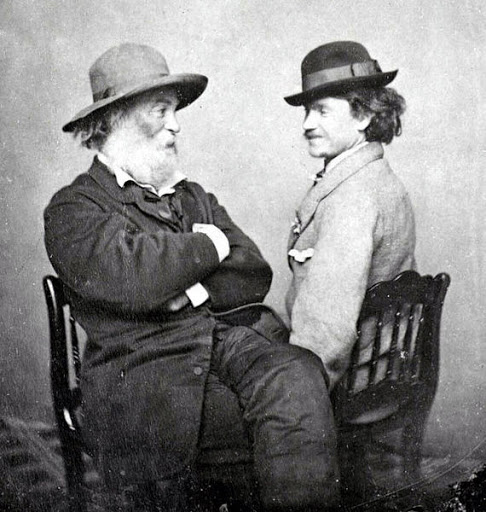
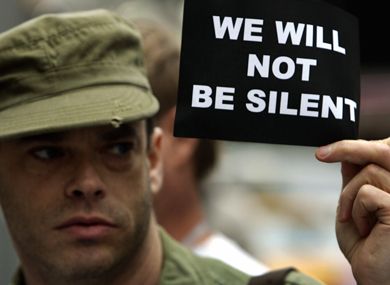
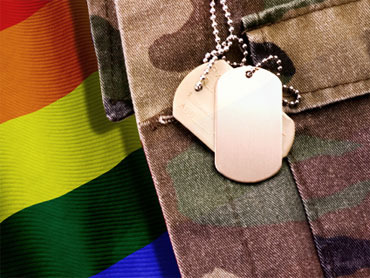
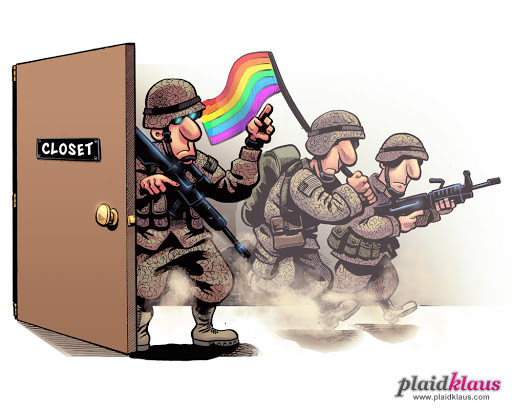
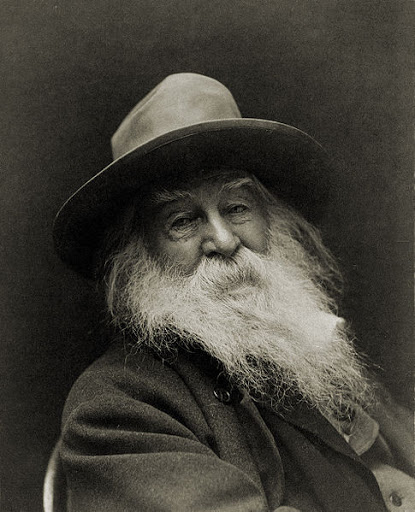
In honor of the official repeal of DADT today, I wanted to post a poem about homosexual love in the military. Long before DADT was an official policy, Walt Whitman was serving as a nurse for the US Army during the Civil War. Drum Taps (1865), Walt Whitman’s sequence of poems on the Civil War that reflects his experience as a hospital volunteer, includes several poems that appreciate soldiers in more or less homoerotic terms (for example, “First O Songs for a Prelude” and “O Tan-Faced Prairie-Boy”).

But it is elegies such as “Vigil Strange I Kept on the Field One Night,” “Reconciliation,” and “As I Lay with My Head in Your Lap Camerado” that allow Whitman to express himself unrestrainedly.

In “Reconciliation,” the speaker’s tenderness for the fallen soldier overpowers the enmity between armies, in terms that anticipate Wilfred Owen’s “Strange Meeting”: “my enemy is dead, a man divine as myself is dead, / I look where he lies white-faced and still in the coffin–I draw near, / Bend down and touch lightly with my lips the white face in the coffin.”

As I Lay with My Head in Your Lap Camerado

As I lay with my head in your lap camerado,
The confession I made I resume, what I said to you and the open air
I resume,
I know I am restless and make others so,
I know my words are weapons full of danger, full of death,
For I confront peace, security, and all the settled laws, to
unsettle them,
I am more resolute because all have denied me than I could ever have
been had all accepted me,
I heed not and have never heeded either experience, cautions,
majorities, nor ridicule,
And the threat of what is call’d hell is little or nothing to me,
And the lure of what is call’d heaven is little or nothing to me;
Dear camerado! I confess I have urged you onward with me, and still
urge you, without the least idea what is our destination,
Or whether we shall be victorious, or utterly quell’d and defeated.

Walt Whitman

In this particular poem, Whitman writes a brief, but beautiful confession and declaration of his own sexuality. It is a brief, but significant love poem, and the manner of Whitman’s “confession” can be explored in a number of ways, but it ultimately points to a homosexual relationship. The first obvious hint that this poem is linked to Whitman’s homosexuality is his adjustment of the word “camerado.” The original Spanish word is actually “camarada” with a feminine ending, and it means “friend” or comrade.” By changing this specific word to have a male ending, we know that Whitman is aiming and professing this poem to a male friend. The significance of this male friend becomes more apparent as Whitman continues with his poem.  His use of the actually word “confession” within the second line – “The confession I made I resume, what I said to you and the open air I resume” is another example of Whitman confessing openly his sexuality. As Whitman continues to describe this poem, he draws attention to the fact that it will make others “restless” and his words are “weapons full of danger, full of death.”

The intensity of the poem, although subtle but existent, is what ultimately points that nature of the poem has to do with love or at least intimacy. Whitman seems very determined in this poem, especially as he says “Dear camerado! I have urged you onward with me, and still urge you, without the least idea what is our destination or whether we shall be victorious, or utterly quell’d and defeated.” Whitman seems to be dismissing everything else, and urging this other person to do the same. He is rejecting any significance of heaven or hell, and embracing the fact that whatever road he is going down may bring hard times. Indeed, to announce homosexuality during Whitman’s era would have brought on a lot of criticism and grief.

Sources:


The End of DADT

‘Don’t ask, don’t tell’ repeal will be big relief for civilian partners of gay servicemembers
Article by: DAVID CRARY , Associated Press Updated: September 18, 2011 – 6:47 PM

NEW YORK – After 19 years hiding her relationship with an active-duty Army captain, Cathy Cooper is getting ready to exhale. On Tuesday, the policy known as “don’t ask, don’t tell” will expire. And Cooper will dare speak her love’s name in public.

“This is life-changing,” said Cooper, choking up. “I just want to be able to breathe — knowing I can call my partner at work and have a conversation without it having to be in code.”

Much has been reported about the burdens that “don’t ask” placed on gay and lesbian service members who risked discharge under the 1993 policy if their sexual orientation became known in the ranks. There’s been less attention focused on their civilian partners, who faced distinctive, often relentless stresses of their own.

In interviews with The Associated Press, five partners recalled past challenges trying to conceal their love affairs, spoke of the joy and relief accompanying repeal, and wondered about the extent that they would be welcomed into the broader military family in the future.

Even with repeal imminent, the partners — long accustomed to secrecy — did not want to reveal the full identity of their active-duty loved ones before Tuesday.

Cooper, who works for a large private company, moved from the Midwest to northern Virginia to be near her partner’s current Army post, yet couldn’t fully explain to friends and colleagues why she moved. “It’s been really difficult — it’s really isolated us,” she said. “I became much more introverted, more evasive.”

Cooper said her partner’s Army career is thriving, though she’s had to hide a major component of her personal life.

“I don’t know any of her co-workers,” Cooper said. “She says, `You’re the best part of me and I have to pretend you don’t exist.'”

Looking ahead, Cooper is unsure how same-sex partners will be welcomed by the military establishment.

“Will it be, `Hey, come join all the family support programs’?” she wondered. “I’m not going to be so naive as to think that … I’m just hoping the door is open.”
___

During the long, arduous campaign to repeal “don’t ask, don’t tell,” activists and advocacy groups tended to downplay issues related to post-repeal benefits for civilian partners. “It’s not something we’ve been pushing very hard for yet, but it’s obviously going to be the next front in the ongoing battle for equality,” said Alex Nicholson, executive director of Servicemembers United.

Nicholson’s organization, which advocates on behalf of gay and lesbian military personnel, conducted a survey of same-sex partners last year to gauge their concerns. One widespread hope, he said, was the military might issue ID cards to same-sex civilian partners so they could gain access to bases, commissaries and support services on their own.

In general, same-sex partners will not get the same benefits that the Pentagon grants to heterosexual married couples to ease the costs of medical care, travel, housing and other living expenses. The Pentagon says the 1996 federal Defense of Marriage Act — which defines marriage as a legal union between a man and woman — precludes extending those benefits to gay couples, even if they are married legally in certain states.

Same-sex partners can be listed as the person to be notified in case a service member is killed or injured, but current regulations prevent anyone other than immediate family — not same-sex spouses — from learning the details of the death.

Some activists predict that gay couples will remain second-class citizens in the military’s eyes as long as the Defense of Marriage Act is in force. It is currently under challenge in several court cases, and the Obama administration has said it will not defend DOMA in court.

In the meantime, some activists suggest the military could allow all its personnel — gay or straight — to be eligible for subsidized off-base housing, emergency leaves and other benefits by virtue of a relationship with an unmarried partner.

Heather Lamb, an IBM software engineer in northern Virginia, looks ahead to the post-repeal era and hopes that eventually, same-sex couples receive the same support as other military families.

How will the military handle the changes? “I think it will be like any neighborhood or city in America,” she said. “There will be people in the military who are very open and accepting, and there will be people who will not be.”

The advent of repeal emboldened Lamb to propose earlier this month to her partner of six years, an Air Force officer named Adrianna.

No wedding date is set, but Lamb, 35, is excited in part because marriage — impossible under “don’t ask, don’t tell” — offers a more secure future for their son, Jacob, who she gave birth to in April.

Adrianna took leave from her post near Washington, D.C., to be present for Jacob’s birth, Lamb said, but “don’t ask, don’t tell” nonetheless took its toll.

“Most people at work share the news of a birth,” Lamb said. “When Adrianna went back, she couldn’t get congratulations. It was one of the sad things — she had to keep quiet about it.”

___

For Ariana Bostian-Kentes, repeal comes at an already emotional time. Her partner of nearly five years, an Army medical supply officer named Nicole, has just started a 12-month deployment in Afghanistan with the 1st Armored Division from Fort Bliss, Texas.

Before repeal became certain, Nicole was leaning toward leaving the military after the deployment, Bostian-Kentes said. Now, there’s more of a chance she’ll stay in the service, and the two are discussing the possibility of marrying after Nicole returns to the U.S.

“She might go back in, since she won’t have to hide her private life,” Bostian-Kentes said. “Before, it was let’s get out as soon as we can, and not have to lie to our family and friends.”

The two women, both 28, met in 2006 while on a rugby team at the University of Michigan in Ann Arbor, where Bostian-Kentes now works at the university’s center serving gay, lesbian and transgender students. At that stage, Nicole was in the ROTC program, and Bostian-Kentes had to learn the intricacies of dating someone governed by “don’t ask, don’t tell.”

“I’d never had to be in the closet, but I happened to fall in love with someone in the military and had to create a closet that didn’t exist before,” she said. “We couldn’t hold hands walking down the street, couldn’t write this or that on my Facebook site — it was a huge learning curve for me.”

There was a brief scare last October, when a fellow reveler at a Halloween party posted a photo on Facebook of Ariana and Nicole embracing.

“I freaked out and called the guy who posted it and said, `Take it down. This could ruin her career,'” Bostian-Kentes recalled. “The guy did take it down — but it was a terrifying two hours of my life.”

Bostian-Kentes, who co-founded an advocacy group called the Military Partners and Families Coalition, is hopeful that repeal will enable her to be an active part of the military community and its various support systems.

“It’s so much more difficult to shoulder the burden of deployment without support,” she said. “It’s exhausting, it’s scary — the continuous web of lies that’s being weaved. I can’t wait to come out of that, to come out as a military spouse.”

___

The repeal process has been watched closely by Catherine Crisp, a professor of social work at the University of Arkansas, Little Rock, who endured “don’t ask, don’t tell” for 15 years as partner of a career Army officer, Kaye McKinzie.

McKinzie, 47, a West Point graduate, retired two years ago after being promoted to colonel, and now teaches in the University of Central Arkansas College of Business.

“I felt like I spent 15 years holding my breath,” Crisp said. “I did not realize until Kaye retired what a toll it had taken on both of us, that we lived in constant fear that became a part of who we were.”

Crisp, 46, said both she and McKinzie were dedicated to their careers, lived apart for long stretches, and often took exhausting steps to conceal their relationship.

“In hindsight it seems ludicrous that we had to spend time and energy on stuff like that,” Crisp said. “We lived in fear not of `the enemy’ but of our government and the fear of disclosure and discovery under this horrible policy.”

There were delicate moments along the way, said Crisp, who noted that much of her academic research has focused on topics related to gays and lesbians. She taught about “don’t ask, don’t tell” in some of her classes, and challenged her students to think about the plight of civilian same-sex partners.

But her own experience went unmentioned.

___

Stephen Peters, 31, knows the strains of “don’t ask, don’t tell” from two perspectives. He’s a former Marine discharged under the policy in 2007 after telling his commander he was fed up with having to lie constantly about himself.

As Peters was leaving the military, he met an active-duty Marine who’s been his partner ever since. Peters recently followed him from Hawaii to a posting in the San Diego area.

“I had to go to work and lie to people, and say I was single,” Peters said. “I made up excuses about why I had to move — made it seem I was crazy.”

Throughout their relationship, Peters said, there were recurring fears of being seen together by his partner’s Marine colleagues.

“We’d see people he worked with and he’d make up some story about who I was, constantly creating a profile that wasn’t real,” Peters said.

Peters said his partner, who is 38, hopes to stay in the Marines. Peters is unsure how easy it would be for them to live together if the partner is deployed overseas, given that he would not be officially recognized as family.

On a less weighty matter, Peters wonders how he’ll respond if the opportunity arises to attend a Marine Corps ball with his partner.

“Personally, I don’t feel a desire to go,” he said. “But maybe it’s important for my partner, given everything he’s sacrificed, for his family to be part of that community.”

___

Online:

Servicemembers United: http://www.servicemembers.org/

Servicemembers Legal Defense Network: http://www.sldn.org/

The Campaign for Military Partners: http://militarypartners.org/

___

David Crary can be reached at http://twitter.com/CraryAP
http://www.startribune.com/nation/130067228.html?page=all&prepage=1&c=y#continue

Lynn Lavner and Homosexuality

“There are 6 admonishments in the Bible concerning homosexual activity and our enemies are always throwing them up to us usually in a vicious way and very much out of context. What they don’t want us to remember is that there are 362 admonishments in the Bible concerning heterosexual activity. I don’t mean to imply by this that God doesn’t love straight people, only that they seem to require a great deal more supervision.” from Butch Fatale–Lynn Lavner

Lynn Lavner is an American comedian and musician from Brooklyn, New York. Much of her material is based around the facts that she is Jewish and a lesbian. She is frequently billed as “America’s Most Politically Incorrect Entertainer.”

Lavner began her career in 1981 when she wrote the music to the lesbian themed play Ladies! Don’t Spit and Holler!. After a showing of the play a fan came up to her and asked if the soundtrack was available on album. When Lavner told her it wasn’t, the fan, who had recently inherited a large amount of money, offered to put up the money so the soundtrack could be adapted into an album.

Lavner’s musical style harkens back to Tin Pan Alley pop. Lavner lists some of her major influences as George Gershwin, Irving Berlin, and Cole Porter. Lavner initially was inspired to begin playing piano by her father, who played to entertain company.


Moment of Zen

Though I think not
To think about it,
I do think about it
And shed tears
Thinking about it.

Ryōkan Taigu (良寛大愚)

Ryōkan Taigu (良寛大愚) (1758–1831) was a quiet and eccentric Sōtō Zen Buddhist monk who lived much of his life as a hermit. Ryōkan is remembered for his poetry and calligraphy, which present the essence of Zen life.


Taking a Break Today

I’ll be back to the regularly scheduled program tomorrow.

St. Sebastian in Art

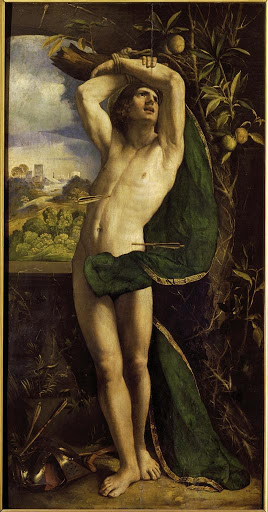
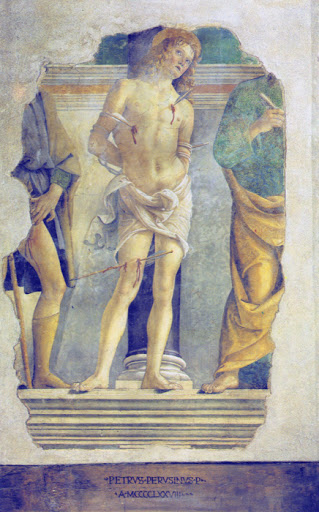
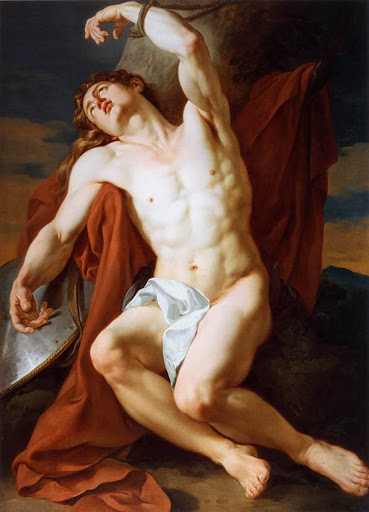
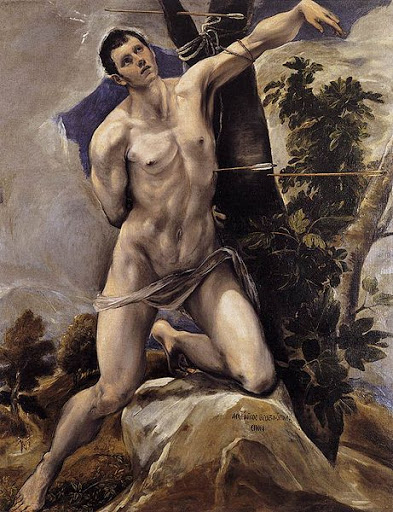
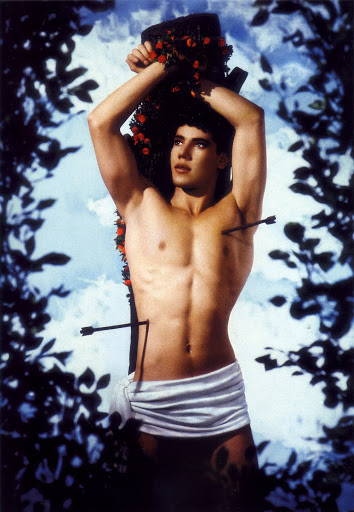
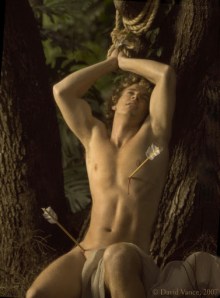
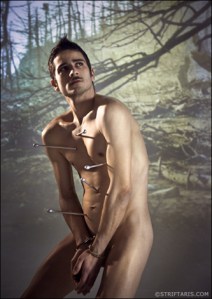
To continue our look at St. Sebastian, I wanted to look at his depiction in art. Can a Christian saint be a gay icon? Apparently he can. Sebastian was a Christian martyr who died during the persecutions of the Roman Emperor Diocletian in 288. According to legend, he was born in Gaul (present-day France) and went to Rome to serve in the army. When officials learned that he was a Christian seeking converts, they ordered his execution by archers. Left for dead, he was nursed back to health by a Christian widow. He presented himself before the emperor, who condemned him to death by beating. His body was thrown into a sewer but was afterward found and buried. In Renaissance art he was often depicted as a handsome youth pierced by arrows.
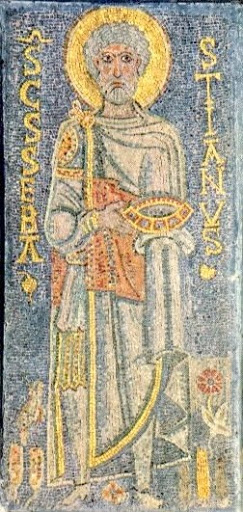
The earliest representation of Sebastian is a mosaic in the Basilica of Sant’Apollinare Nuovo (Ravenna, Italy) dated between 527 and 565. The right lateral wall of the basilica contains large mosaics representing a procession of 26 martyrs, led by Saint Martin and including Sebastian. The martyrs are represented in Byzantine style, lacking any individuality, and have all identical expressions.

Another early representation is in a mosaic in the Church of San Pietro in Vincoli (Rome, Italy), probably made in the year 682. It shows a grown, bearded man in court dress but contains no trace of an arrow. The archers and arrows begin to appear by 1000, and ever since have been far more commonly shown than the actual moment of his death by clubbing, so that there is a popular misperception that this is how he died.

As protector of potential plague victims (a connection popularized by the Golden Legend) and soldiers, Sebastian naturally occupied a very important place in the popular medieval mind, and hence was among the most frequently depicted of all saints by Late Gothic and Renaissance artists, in the period after the Black Death. The opportunity to show a semi-nude male, often in a contorted pose, also made Sebastian a favourite subject. His shooting with arrows was the subject of the largest engraving by the Master of the Playing Cards in the 1430s, when there were few other current subjects with male nudes other than Christ. Sebastian appears in many other prints and paintings, although this was also due to his popularity with the faithful. Among many others, Botticelli, Perugino, Titian, Pollaiuolo, Giovanni Bellini, Guido Reni (who painted the subject seven times), Mantegna (three times), Hans Memling, Gerrit van Honthorst, Luca Signorelli, El Greco, Honoré Daumier, John Singer Sargent and Louise Bourgeois all painted Saint Sebastians.

The saint is ordinarily depicted as a handsome youth pierced by arrows. There were predella scenes, when required, often of his arrest, confrontation with the Emperor, and final beheading. The illustration in the infobox is the Saint Sebastian of Il Sodoma, at the Pitti Palace, Florence.

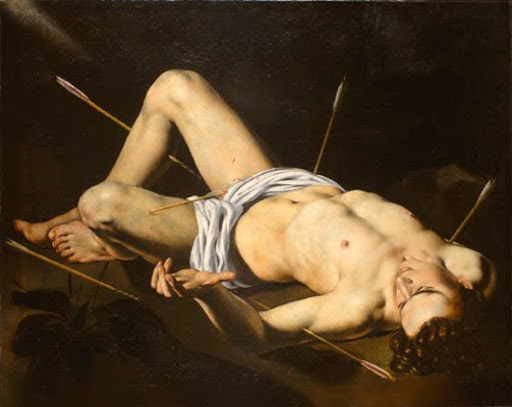
A mainly 17th-century subject, though found in predella scenes as early as the 15th century, was St Sebastian tended by St Irene, painted by Georges de La Tour, Trophime Bigot (four times), Jusepe de Ribera, Hendrick ter Brugghen and others. This may have been a deliberate attempt by the Church to get away from the single nude subject, which is already recorded in Vasari as sometimes arousing inappropriate thoughts among female churchgoers. The Baroque artists usually treated it as a nocturnal chiaroscuro scene, illuminated by a single candle, torch or lantern, in the style fashionable in the first half of the 17th century.

There exist several cycles depicting the life of Saint Sebastian. Among them, the frescos in the “Basilica di San Sebastiano” of Acireale (Italy) with paintings by Pietro Paolo Vasta.

Egon Schiele, an Austrian Expressionist artist, painted a self-portrait as Saint Sebastian in 1915. During Salvador Dalí’s “Lorca (Federico García Lorca) Period”, he painted Sebastian several times, most notably in his “Neo-Cubist Academy”. For reasons unknown, the left vein of Sebastian is always exposed.

In 1911, the Italian playwright Gabriele d’Annunzio in conjunction with Claude Debussy produced a mystery play on the subject. The American composer Gian Carlo Menotti composed a ballet score for a Ballets Russes production which was first given in 1944.

In his novella Death in Venice, Thomas Mann hails the “Sebastian-Figure” as the supreme emblem of Apollonian beauty, that is, the artistry of differentiated forms, beauty as measured by discipline, proportion, and luminous distinctions. This allusion to Saint Sebastian’s suffering, associated with the writerly professionalism of the novella’s protagonist, Gustav Aschenbach, provides a model for the “heroism born of weakness”, which characterizes poise amidst agonizing torment and plain acceptance of one’s fate as, beyond mere patience and passivity, a stylized achievement and artistic triumph.

In 1976, the British director Derek Jarman made a film, Sebastiane, which caused controversy in its treatment of the martyr as a homosexual icon. However, as several critics have noted, this has been a subtext of the imagery since the Renaissance.

Renaissance artists had access to history that we currently do not. There was obviously some reason why they chose to depict him as a beautiful young man. Since Sebastian was a Gaul, it could have been influenced by the beauty of The Dying Gaul, one of my all time favorite statues. The warrior is depicted as a beautiful man, but there is obviously love and lust for his beauty that the sculptor saw. It is also likely that Renaissance artists may have known some historical gossip about Sebastian, or the loving relationships that existed between the early brothers and sisters in Christ. Who knows why they depicted him as a beautiful young man, but they have left behind a question for history and the beauty of man.  Since many of the Renaissance artists were homosexuals, St. Sebastian allowed them to depict a beautiful naked (or nearly naked) young man, very similar to those young models they often used.

dyinggaul


The Missing Text of the Gospel of St. Mark

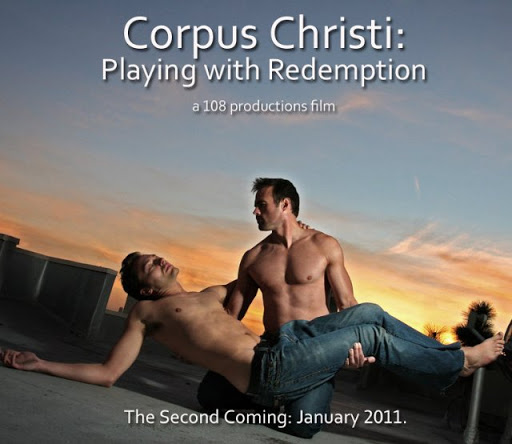
More recently, but in a somewhat similar vein to Kirkup’s poem, the American playwright, Terrence McNally had the 1998 scheduled run of his new play, Corpus Christi, cancelled by the prestigious Manhattan Theatre Club in New York, following threats to kill the staff, burn down the theatre, and “exterminate” McNally. The reason for these threats was that McNally’s play told the story of a young gay man called Joshua and his sexual adventures with his 12 disciples. The Catholic League for Religious and Civil Rights in New York vowed to “wage a war” against any attempt to stage the play. While top playwrights, such as Tony Kushner, Edward Albee and Athol Fugard, urged the theatre to reverse its cancellation, accusing them of “capitulation to right-wing extremists and religious zealots”.

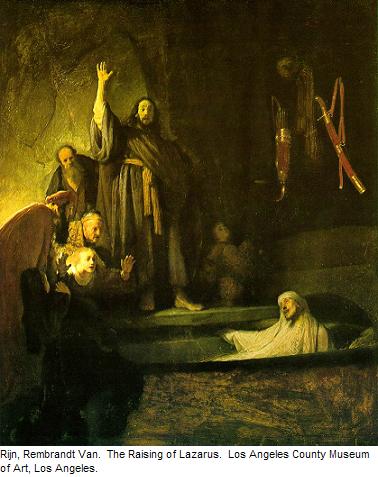
The homosexual associations being made with Jesus are not simply the work of gay artists seeking to appropriate conventional religious themes for the sake of blasphemy or controversy, but may actually be based in fact. In 1958, Professor Morton Smith of Columbia University uncovered a letter at the Mar Saba monastery, which mentioned a suppressed extract from the gospel of Mark. The letter was between Bishop Clement of Alexandria (one of the founding fathers of the early church), and a correspondent called Theodore, who wrote complaining about the Carpocratians, a Gnostic sect. The Carpocratians were using a passage from Mark’s gospel to justify their beliefs and practices, which were not shared by Clement and Theodore. In his reply to Theodore, Clement congratulated him on his opposition to the Carpocratians, and then wrote a dissertation on the passage in question, quoting the passage in its entirety. What is remarkable is that this passage does not appear in the canonical New Testament today, but was obviously current at the time. It is from Mark chapter 10 (between verses 34 and 35), and tells the story of the raising of Lazarus:

And the youth, looking upon him (Jesus), loved him and beseeched that he might remain with him. And going out of the tomb, they went into the house of the youth, for he was rich. And after six days, Jesus instructed him and, at evening, the youth came to him wearing a linen cloth over his naked body. And he remained with him that night, for Jesus taught him the mystery of the Kingdom of God.

The expurgated text seems to suggest that the raising of Lazarus, rather than being a literal raising from the dead, was the kind of mystery school initiation that was common throughout the ancient world; something that the biblical scholar Barbara Thiering has emphasised in her recent work. What is also clear, and may have been obvious to the Carpocratians also, is that there seems to have been a homosexual element to the ritual, with the half-naked youth who loved Jesus being shown the mystery of the Kingdom of God during the final night of his instruction. If these inferences can be so readily made from the passage in Mark, it is somewhat understandable that the founding fathers of the Church would feel no guilt over removing it from the canon in order to preserve the image of Jesus that was in concordance with their particular ideas.

Source: Torture By Roses, “Sebastian~Salome” (pdf).


The Love That Dares To Speak Its Name

“The Love that Dares to Speak its Name” is a controversial poem by James Kirkup.  In fact, some might find the poem to be quite offensive, but after reading it and researching about it, I found it fascinating, even if it is blasphemous.  Maybe intellectual curiosity sometimes kills the cat, but I decided to write about it anyway.  It is written from the viewpoint of a Roman centurion who is graphically described having sex with Jesus after his crucifixion, and also claims that Jesus had had sex with numerous disciples, guards, and even Pontius Pilate.  If the poem was not about Jesus Christ and the centurion, Longinus, I would truly consider the poem beautiful and erotic in an odd necrophilia sort of way that is also quite disturbing.  Maybe it is either way, or maybe I have been reading too much Edgar Allen Poe in the high school English class that I am currently teaching.

The poem was at the centre of the Whitehouse v. Lemon trial for blasphemous libel, where the editor of Gay News—which first published in the poem in 1976—was convicted and given a suspended prison sentence.  In later years, Britain’s Royal Crown Prosecution Service attempted to charge the Lesbian and Gay Christian Movement with a similar charge of blasphemous libel after a complaint by religious conservatives over a hypertext link on their web site to text of “The Love that Dares to Speak its Name” by James Kirkup.

The Love That Dares To Speak Its Name
By James Kirkup

As they took him from the cross
I, the centurion, took him in my arms-
the tough lean body
of a man no longer young,
beardless, breathless,
but well hung.


He was still warm.
While they prepared the tomb
I kept guard over him.
His mother and the Magdalen
had gone to fetch clean linen
to shroud his nakedness.


I was alone with him.
For the last time
I kissed his mouth. My tongue
found his, bitter with death.
I licked his wound-
the blood was harsh
For the last time
I laid my lips around the tip
of that great cock, the instrument
of our salvation, our eternal joy.
The shaft, still throbbed, anointed
with death’s final ejaculation


I knew he’d had it off with other men-
with Herod’s guards, with Pontius Pilate,
With John the Baptist, with Paul of Tarsus
with foxy Judas, a great kisser, with
the rest of the Twelve, together and apart.
He loved all men, body, soul and spirit. – even me.


So now I took off my uniform, and, naked,
lay together with him in his desolation,
caressing every shadow of his cooling flesh,
hugging him and trying to warm him back to life.
Slowly the fire in his thighs went out,
while I grew hotter with unearthly love.


It was the only way I knew to speak our love’s proud name,
to tell him of my long devotion, my desire, my dread-
something we had never talked about. My spear, wet with blood,
his dear, broken body all open wounds,
and in each wound his side, his back,
his mouth – I came and came and came


as if each coming was my last.
And then the miracle possessed us.
I felt him enter into me, and fiercely spend
his spirit’s finbal seed within my hole, my soul,
pulse upon pulse, unto the ends of the earth-
he crucified me with him into kingdom come.


-This is the passionate and blissful crucifixion
same-sex lovers suffer, patiently and gladly.
They inflict these loving injuries of joy and grace
one upon the other, till they dies of lust and pain
within the horny paradise of one another’s limbs,
with one voice cry to heaven in a last divine release.


Then lie long together, peacefully entwined, with hope
of resurrection, as we did, on that green hill far away.
But before we rose again, they came and took him from me.
They knew not what we had done, but felt
no shame or anger. Rather they were glad for us,
and blessed us, as would he, who loved all men.


And after three long, lonely days, like years,
in which I roamed the gardens of my grief
seeking for him, my one friend who had gone from me,
he rose from sleep, at dawn, and showed himself to me before
all others. And took me to him with
the love that now forever dares to speak its name.

Further Reading:


St. Sebastian: The Patron Saint of Homosexuals

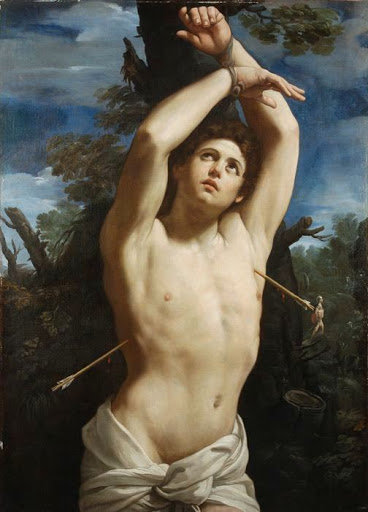
Saint Sebastian by Guido Reni (c. 1616)

There is hardly anything unusual or particularly compelling about a gay icon who is young, beautiful, white, shirtless, and baby-faced. But what if this same boyish icon had emerged from a key historical antagonist of same-sex desire: the teachings of Christianity?

The case of Saint Sebastian, who was martyred in 287, animates several complex questions about the evolution of a gay idol, not the least of which is his so-called appropriation from the hallowed pages of Church history and martyrology to the visual, literary, and filmic works of numerous gay artists.

Although he has had various embodiments throughout history–plague saint in the Middle Ages, shimmering youth of Apollonian beauty throughout the Renaissance, “decadent” androgyne in the late nineteenth century–Sebastian has long been known as the homosexual’s saint.

Precisely when and how this role evolved may be related to details of St. Sebastian’s life, the earliest reference to which can be found in the Martyrology of 354 A.D., which refers to him as a young nobleman from either Milan or Narbonne, whose official capacity was commander of a company of archers of the imperial bodyguard.

According to the Church’s official Acta Sanctorum, Sebastian, serving under the emperors Diocletian and Maximian, came to the rescue of Christian soldiers, Marcellinus and Mark, and thereby confessed his own Christianity. Diocletian insisted that Sebastian be shot to death by his fellow archers; these orders were followed, and Sebastian was left for dead.

What is often neglected in later accounts is that Sebastian survived this initial attack after having been nursed by a “pious woman,” St Irene of Rome. Diocletian was required to order a second execution, and this time Sebastian was beaten to death by soldiers in the Hippodrome.

School of Nicolas Regnier, Saint Sebastian, 17th century

These details–based on accounts written centuries after Sebastian’s death and therefore largely apocryphal–may have helped form Sebastian’s subsequent reputation as a homosexual martyr since his story constitutes a kind of “coming out” tale followed by his survival of an execution that may be read symbolically as a penetration.

Renaissance representations of Saint Sebastian–mostly paintings of a tender, loin-clothed youth writhing in the ecstasy of the arrows that pierce him–are perhaps ground zero for his appointment as the patron saint of gay sensuality.

And for seemingly obvious reasons. Sebastian’s supple, near-naked body; the wink-wink symbolism of the penetrating arrows; his thrown-back head expressing a mixture of pleasure and pain; and his inviting gaze all readily contribute to his homoerotic appeal. But Sebastian’s entry into gay cultures in the first place most certainly involves his origins as an emblem of Christian godliness and martyrdom.

Same-sex desire is often, on many levels, about the crossing of lines, the overturning of sacred norms, the pleasure of the forbidden. Both the story of Sebastian and his subsequent role in modern gay cultures epitomize this subversive impulse: Sebastian revels in the pleasure of his own martyrdom as gay men revel in gazing upon an off-limits emblem of Christian holiness. By all accounts, Sebastian is a very good “bad object choice.”

Possibly his role as a plague saint may have generated associations between Sebastian and what, in a nineteenth-century medical context, was represented as a disease, homosexuality.

The question of whether Sebastian himself was gay is largely moot. While some historical records suggest a notable affection between the saint and his male superiors, after almost two thousand years Sebastian’s sexuality is not only greatly speculative, but also rather inconsequential.

However, while it is doubtful that a buried homosexual existence could justify his current camp popularity, it seems equally doubtful that his homoerotic associations can be explained away as the superficial afterthoughts, revisions, or cross-readings of a willful contemporary gay purview.

Saint Sebastian is not just represented in the visual arts during the Renaissance, but also in the written arts as well. In Shakespeare’s Twelfth Night (1600), for example, the character of Sebastian, saved from a shipwreck by Antonio, is the intense focus of Antonio’s love: “And to his image, which methought did promise / Most venerable worth, did I devotion.”

Mosaic of St. Sebastian, ca. 682 in San Pietro in Vincoli

Sebastian has been reinvented numerous times in history, from the middle-aged man in the mosaic at the Church of San Pietro in Vincoli, not far from San Sebastiano Fuori le Mura, where the martyr’s punctured remains have lain since the year 287 AD. Here, in a niche to the left, is the seventh-century mosaic of a middle-aged man, bearded and in Byzantine court dress. Perhaps Sebastian’s oddest reinvention came in Thomas Mann’s Nobel Prize acceptance speech. “Grace in suffering – that is the heroism symbolised by St Sebastian,” said Mann; then, warming to his theme, he added: “The image may be bold, but I am tempted to claim this heroism for the German mind and German art.” The date was 1929. A decade later, German gays such as Mann were being rounded up and tortured in the Nazi concentration camps.

All of which is to say that the secret of Sebastian’s success may lie in his ability to be all things to all men. Along with the famous arrows, the symbol of his martyrdom is the rope that binds his hands; yet the shape-shifting Sebastian just won’t be tied down. The novelist and political activist Susan Sontag pointed out that his face never registers the agonies of his body, that his beauty and his pain are eternally divorced from each other. This made him proof against plague in 1348, and, in these ungodly times, it still does.

Sources:


Lest We Forget

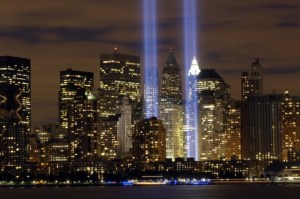
On the morning of September 11, 2001, nineteen terrorists from the Islamist extremist group, al Qaeda, hijacked four commercial airplanes, deliberately crashing two of the planes into the upper floors of the North and South Towers of the World Trade Center complex and a third plane into the Pentagon in Arlington, VA. The Twin Towers ultimately collapsed because of the damage sustained from the impacts and the resulting fires. After learning about the other attacks, passengers on the fourth hijacked plane, Flight 93, fought back, and the plane was crashed into an empty field in western Pennsylvania about 20 minutes by air from Washington, DC.
The attacks killed nearly 3,000 people from 93 nations. 2,753 people were killed in New York,  184 people were killed at the Pentagon, and 40 people were killed on Flight 93.


Ode of Remembrance
With proud thanksgiving, a mother for her children,
England mourns for her dead across the sea.
Flesh of her flesh they were, spirit of her spirit,
Fallen in the cause of the free.
Solemn the drums thrill: Death august and royal,
Sings sorrow up into immortal spheres.
There is music in the midst of desolation,
And a glory that shines upon her tears.
They went with songs to the battle, they were young.
Straight of limb, true of eyes, steady and aglow.
They were staunch to the end against odds uncounted,
They fell with their faces to the foe.
They shall not grow old, as we that are left grow old:
Age shall not weary them, nor the years condemn.
At the going down of the sun and in the morning,
We will remember them.
Lest We Forget

They mingle not with their laughing comrades again;
They sit no more at familiar tables at home;
They have no lot in our labour of the daytime;
They sleep beyond England’s foam.
But where our desires are and our hopes profound,
Felt as a well-spring that is hidden from sight,
To the innermost heart of their own land they are known,
As the stars are known to the night.

As the stars will be bright when we are dust,
Moving in marches upon the heavenly plain;
As the stars that are starry in the time of our darkness,
To the end, to the end, they remain.
Lest We Forget

English poet Laurence Binyon, overwhelmed by the carnage and loss of life by British and Allied forces in World War 1, penned one of the most moving tributes the world has known to those who died in war.

Originally titled For the Fallen, the ode first appeared in The Times of London on September 21, 1914. It has now become known in Australia and Canada as the Ode of Remembrance.  I think that on the 10th anniversary of 9/11 it is a fitting memorial.  After the verse in bold is recited in memory of those who died, it is followed by the response, “Lest we forget” as I have added it above.