I’m so glad it’s Friday. This has been a very busy week at work, and I need some time away from the office. I’m not sure what, if anything, I’ll do this weekend besides get some much-needed rest. The only two things I know for sure are that I’ll watch some college football tomorrow and try out a few new recipes over the weekend.
Today was one of those rare mornings when I actually wanted to get out of bed. Well, not the first time I woke up, when Isabella decided she needed to be fed, but the second time. I had been having a wonderful dream.
The dream unfolded as a series of brief scenes showing the progression of a new relationship. He was handsome and about my age, and it began with a hookup arranged through one of the apps. Later, we saw each other online again and decided to meet up a second time. Eventually, we exchanged numbers and became regular fuck buddies. There was no longer any need to search the apps; all it took was a horny text.
Each time we got together, though, we talked a little more and began genuinely getting to know one another. One evening, I was cooking when he texted. After we finished with the usual reason for his visit, I invited him to stay for dinner. Then he invited me to his place for dinner. That led to a few “Netflix and chill” evenings that involved more Netflix—and more conversation—than our earlier encounters had.
Eventually, I had an event to attend and was allowed to bring a plus-one, so I asked whether he wanted to come with me. After that, we began seeing each other outside our apartments. We went on actual dates. We even took a trip together.
The dream was made up of all these small moments in the building of a relationship. It was almost as though I were watching everything from above. Each scene lasted only briefly, yet somehow I understood the larger story connecting them.
After watching us go on a few dates, I woke up before the dream could progress any further. Sadly, it was only a dream.
Of course, there are couples who met on Grindr and eventually built lasting relationships. Still, if you’ve ever used Grindr, you know that it tends to be more of a “come and go” situation—although “come” might be spelled a little differently. That was fine when I was younger, but these days, it would be nice to find something more: someone to talk to, cook with, travel with, and share all those little moments that gradually turn a hookup into a relationship.
Earworms are strange things. Sometimes, something you hear sets one off. Other times, you wake up with a song already playing in your head, and it simply refuses to go away. Sometimes, though, it takes me a little while to recognize the song.
That happened this morning. Almost as soon as Isabella woke me, the words “Wake me up when…” began running through my mind. At first, I couldn’t remember what came next. When exactly did the singer want to be awakened?
Then it finally hit me: “Wake me up when September ends.”
I paused and wondered, Are those really the lyrics? A quick Google search confirmed that they are not only the lyrics but also the title of Green Day’s 2005 song “Wake Me Up When September Ends.” The song begins:
Summer has come and passed The innocent can never last Wake me up when September ends
The song itself is quite sad, but its appearance in my head this morning struck me as funny. I think my earworm was simply trying to tell me that I wasn’t ready to get out of bed. Unfortunately, Isabella is not a patient critter, and she had no intention of letting me sleep until the end of September.
So, I got up and fed her. She woke me long before September ended—we aren’t even halfway through the month.
Note: An earworm is a song or tune that becomes stuck in your head and repeats itself involuntarily.
Today is one of those days when I wish I could stay in bed all day. I went to bed early last night because I had a migraine that was steadily getting worse. I still have a dull headache this morning, along with the foggy-headed feeling neurologists call the postdrome phase—sometimes referred to as a “migraine hangover.”
If Isabella hadn’t demanded breakfast and nature hadn’t called, I would probably still be in bed instead of writing this. Unless the headache and fogginess get worse, though, I’ll go to work today. It usually improves once I’ve been awake and moving for a while. I still have plenty to do at work, so staying busy should help push the headache to the back of my mind—and hopefully make the day pass a little faster.
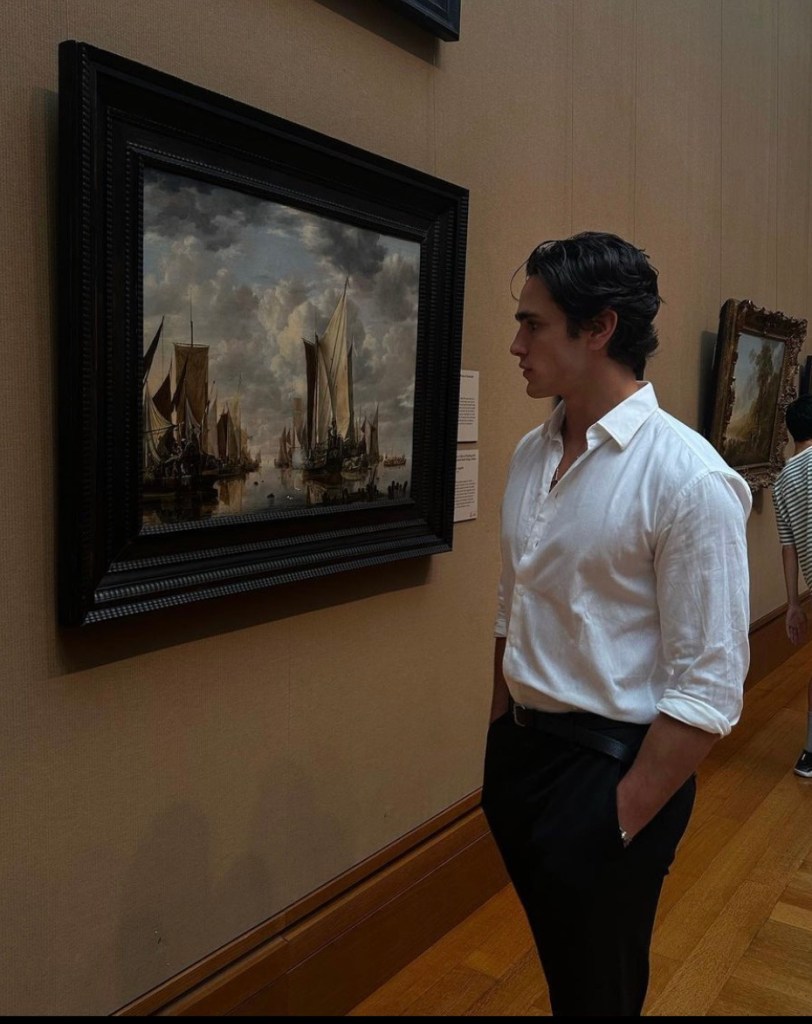
Giorgio Ramondetta views Jan van de Cappelle’s Shipping in a Calm at Flushing with a States General Yacht Firing a Salute (1649) at the J. Paul Getty Museum in Los Angeles.
It’s Wednesday, and the week is almost half over. I’ve spent only one day in the office so far, but it was a very busy one. Today will likely be no different. In fact, I doubt there will be a single day this week when I find myself wondering what to do. Emails, meetings, training sessions, and preparations for upcoming classes are more than enough to fill my days.
Don’t think I’m complaining. I love being busy with these kinds of tasks. They make the day pass much faster. I often become so absorbed in what I’m doing that when I finally look at the clock, I’m surprised by how much time has passed. If my days were filled with activities I dreaded, it would be altogether different. Instead, much of what I’m doing this week—and, I hope, throughout the semester—is the part of my job I enjoy most.
Things are not perfect at work, but I genuinely love the work I do.
Part of my job involves welcoming our guests. Sometimes it is a special dignitary visiting campus who wants a tour of the museum. Other times it is a scholar who has come to speak as part of our lecture series, and I have the opportunity to entertain them, show them some of Vermont, and take them out to dinner. It is a role for which I am particularly well suited. Being from the South and growing up in an environment where good manners and hospitality were expected prepared me well for this aspect of my job. I have a reputation within the university for being able to welcome and entertain dignitaries, while our museum has earned a wider reputation among some prestigious cultural institutions for the hospitality we provide our guests. I take a great deal of pride in that.
Then there is the academic side of my job. I get to teach history through artifacts. In some classes, I teach students how to analyze and interpret objects. Sometimes, I tell the history of particular artifacts, while other sessions involve tours of the museum or its collections. Each class is different, and each gives me another opportunity to help students understand that objects are more than simply things displayed behind glass. They can reveal stories about the people who made, owned, used, exchanged, or preserved them.
I enjoy working with our students because, for the most part, they are well behaved, polite, and willing to engage. Best of all, I get to teach and prepare lessons without having to grade papers and exams, which was always the bane of my existence when I taught in a more traditional setting. I receive the parts of teaching that I love without being burdened by the part I dreaded most.
Of course, there are difficult personalities to contend with from time to time. I’m not paid enough, and there are certainly mornings when I would rather remain at home with Isabella. No job—and no workplace—is perfect. Still, when I consider the work itself, I know how fortunate I am.
After all, how many people can genuinely say, “I love the work I do”?
It’s Labor Day, which means a holiday from work—and you really shouldn’t have to work on a holiday that celebrates workers.
Isabella got me up at an ungodly hour to feed her, but afterward, I went back to bed. I could sleep in today, so that’s exactly what I did. As I write this, I’m obviously awake, but I still haven’t gotten out of bed. I haven’t decided whether to take care of the hard dilemma at hand, go back to sleep, or get up and make coffee. Whatever I choose, it’s nice knowing the choice is entirely mine.
TGIF! Four o’clock this afternoon cannot come fast enough.
I have a few things to work on today, but thankfully, nothing is a major priority. It should be a pretty low-key day—just a matter of getting through the next several hours until the long weekend officially begins.
After work, I have a grocery order to pick up, and then I can come home and settle in for a three-day weekend with Isabella. She and I need some quality time together, and I desperately need some time to relax. Isabella probably doesn’t need any additional rest, considering she already sleeps about eighteen hours a day, but I’m sure she’ll be happy to supervise mine—and let me know when she thinks I’ve slept long enough.
Of course, college football starts this weekend, so my major Saturday activity will be watching my favorite teams play their first games of the season. Other than that, I’m looking forward to some quiet time, perhaps with a good book, a little cooking, or both. Nothing too exciting—just a peaceful weekend at home with my favorite little black cat. Honestly, that sounds pretty wonderful to me.
I hope everyone has a great weekend, whether you’re in the United States enjoying the three-day Labor Day weekend or spending an ordinary weekend somewhere else. Whatever your plans may be, I hope you find some time to relax and enjoy yourself.
It’s Thursday, and honestly, I don’t have much to say this morning. It’s been a pretty low-key week, even with classes starting back and the campus coming to life again. Nothing particularly exciting has happened, which I suppose isn’t necessarily a bad thing.
I am definitely ready for the upcoming three-day weekend, though I have absolutely nothing exciting planned. For that matter, I’m not even sure I’ll manage anything moderately entertaining. I’ll probably spend most of it at home with Isabella, reading, relaxing, and enjoying not having to go anywhere. There are certainly worse ways to spend a long weekend.
For now, though, I just have to get through Thursday and Friday. My coffee is helping with Thursday. We’ll worry about Friday when it gets here.
Have a great Thursday, everyone. The long weekend is almost here!
It’s Wednesday. Hump Day. The week is almost half over, and so far, this week has been pretty boring. Not that I’m complaining too much. Sometimes boring is better than the alternative.
The students are back, though, and that means one thing that makes the beginning of the fall semester a little more enjoyable: eye candy.
I still appreciate the fact that the new gym is now on the edge of campus closest to the museum. That means there is a fairly steady stream of guys passing by on their way to and from working out. Earlier this week, however, I saw something that I have probably only seen four or five times since I moved to Vermont nearly eleven years ago: shirtless guys on campus.
That probably sounds strange to anyone who has spent much time around a university in the South. On a warm, sunny day, shirtless college guys are practically part of the scenery. Walk across almost any Southern university quad and you’re likely to see guys tossing a Frisbee, playing an impromptu shirts-and-skins game of football, lounging around in the sun, or going for a run without a shirt. When I lived in the South, I never thought twice about it because it was such a common sight.
It happens at universities up here, too, although certainly not with the same frequency. There’s a decent chance that if you drive by the University of Vermont campus in Burlington on a warm afternoon, you’ll spot a couple of frat guys jogging along without shirts. On my campus, however, a shirtless guy is practically an anomaly.
I’m not even sure cadets are allowed to run around campus shirtless. There are rules governing so many aspects of their appearance that it wouldn’t surprise me if there were one about that as well. You would think the civilian students would make up for it, but apparently they didn’t get the memo.
So, when it does happen, it’s still a welcome sight.
Of course, on a campus like mine, where physical fitness is basically a requirement for the majority of the student body, the guys have plenty of other ways to show off what all those hours in the gym have accomplished. Tight T-shirts do a pretty good job of displaying shoulders, chests, and arms, while thin athletic shorts and sweatpants have been known to highlight certain other assets. I may be getting older, but I’m certainly not blind.
Summer would seem like the obvious season for more shirtless scenery, but unfortunately, we don’t have a large summer student population. Only a handful of programs hold classes during the summer, so there simply aren’t that many students around when Vermont finally gets warm enough for shirts to become optional.
And this is Vermont, after all. During the regular academic year—from late August through May—the window for genuinely warm weather is rather small. We might get a few weeks at the beginning of the fall semester and another few toward the end of spring before everyone disappears for summer. Before long, those athletic shorts will give way to sweatpants, then jackets, then heavy coats as winter settles in for what always seems like six months.
So, I suppose I should appreciate these warm September days while they last.
Besides, there’s still plenty of eye candy around campus, with or without shirts.
Last night was a strange night. I’d had a migraine for most of the afternoon and evening, and it was bad enough that I took a late-afternoon nap. The nap didn’t help the migraine, but eventually it eased enough that I could read. I got really into my book and finally had to make myself put it down around 10:30 and turn out the lights. Unfortunately, turning out the lights did not mean falling asleep. So, I resorted to a time-honored tradition that many guys have used to help themselves fall asleep. It worked, and sometime after 11, I finally drifted off to sleep.
Isabella had been trying to get me to go to bed since around 9 pm. Apparently, she knew perfectly well that regardless of how late I stayed up, she wasn’t changing her schedule. Sure enough, at 4 am, she woke me up to feed her.
She also woke me from a rather odd dream. I didn’t appear to be in the dream at all, and all I’ll say about the subject matter is that it had the plot of some fairly kinky porn. I seemed to be watching everything from above, almost as if I were watching a movie rather than participating in the dream. After Isabella roused me and I fed her, I went back to bed.
That’s when something even more unusual happened: I went back to dreaming, and the new dream seemed to continue the previous one. Somewhere along the way, though, the kinky porn plot began turning into a love story that appeared to be heading toward a throuple. Eventually, that dream ended and another began. This time I was actually in the dream, but it was much more romantic than erotic.
I’ve mentioned before that remembering dreams has never happened very often for me. You might remember Saturday’s “Moment of Zen: Sweet Dreams,” and I’m guessing some of you figured out that it was inspired by waking from an erotic dream. Strangely enough, I wasn’t in that dream either. Again, it was more like watching a movie. Judging by the state of certain parts of my anatomy when I woke up, however, apparently I’d found the movie pretty sexy.
I didn’t remember that dream nearly as clearly as I remember this morning’s dreams. Then, another morning last week, I woke remembering a dream that wasn’t erotic at all but much more mundane. So, for whatever reason, I seem to be going through a period of unusually vivid and memorable dreams. I’m not sure why. If I’d started a new medication, I might blame that, but nothing has really changed.
Sadly, all those dreams did nothing for my migraine. I still have it this morning, but I’m going to work. If I called out sick today, it would mean I’d missed three of the last four Mondays because of a migraine. They’ve all been legitimate migraines, but I also know how people can gossip when someone seems to miss work on a regular schedule. I don’t want it to start looking like I’ve developed a convenient case of the Mondays.
If the migraine gets worse—or simply doesn’t get any better as the day goes on—I may come back home. For now, though, I’m going to give Monday a try.
Needless to say, between too little sleep, bizarre dreams, and a lingering migraine, I’m looking forward to this Monday even less than usual.










 Joe
Joe




 The Closet Professor