|
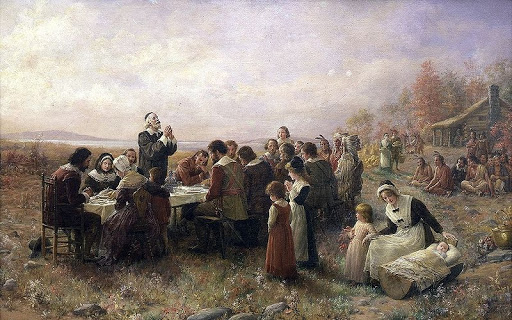
One day is there of the series
Termed “Thanksgiving Day”
Celebrated part at table
Part in memory –
Neither Ancestor nor Urchin
I review the Play –
Seems it to my Hooded thinking
Reflex Holiday
Had There been no sharp subtraction
From the early Sum –
Not an acre or a Caption
Where was once a Room
Not a mention whose small Pebble
Wrinkled any Sea,
Unto such, were such Assembly,
‘Twere “Thanksgiving day” –
|
Monthly Archives: November 2012
One day is there of the series
Gay Pilgrims
PLYMOUTH – In the summer of 1637, two working men at the English colony at Plymouth faced the possibility of execution, convicted of what the law books said was a grave moral crime.
John Alexander and Thomas Roberts had been caught in a homosexual relationship.
Court records from their case, and from a handful of others, are the only keyhole through which researchers at the Plimoth Plantation museum can peek backward through time to imagine the lives of the colony’s gays and lesbians.
On this date in 1637, John Alexander and Thomas Roberts were changed with and convicted of “lude behavior and unclean carriage one with another, by often spending their seed one upon another, which was proved both by witness and their own confession; the said Alexander found to have been formerly notoriously guilty that way, and seeking to allure others thereunto.”
John Alexander was sentenced to a severe whipping, then to be burned in the shoulder with a hot iron, and then to be permanently banished from the Colony.
Roberts was sentenced to a severe whipping, but was not banished. He was prohibited from ever owning any land within the Plymouth Colony “except he manifest better desert.” He was returned to his master and forbidden to hold any lands in the future.
Sodomy, usually homosexuality, was considered a capital offence but rarely punished as such. These punishments, while harsh, still lacked the full force of the law.
At the Out at Plimoth Plantation event, the living museum of Colonial and Native American history presents special programs on gay history of the 17th and 18th centuries in early American culture.
“Plimoth Plantation as a museum has always been a place that has tried to recover every life,’’ said Richard Pickering, the museum’s deputy director. Pickering quoted the poet and author Paul Monette, who wrote that most of gay history “lies in shallow bachelors’ graves.’’
“We’re telling the audience that we’re going to talk about all those uncles and all those aunts who have fallen off the family tree,’’ said Pickering. “Their stories may be lost, so let’s contemplate those lost lives.’’ Though the historical record is sparse, “we can get a sense of what the options of the past were,’’ and provide some sense of history to a modern gay community “that really doesn’t have a strong sense of its past much before 1960.’’
Back in the 1600s, homosexuality was thought to be a behavior that could be learned due to a lack of “proper’’ examples of traditional relationships, said Pickering. Being gay or lesbian at the time was not a sexual identity as we think of it today. Gays and lesbians “did not have the opportunity to pursue the kind of lives and identities that modern social structures allow,’’ he said.
Yet the prosecution of Alexander and Roberts for homosexual conduct reveals layers of complexities in Colonial life, despite the scant court records. Though the maximum penalty was death, neither man was executed.
Alexander, who was perceived as the seducer and therefore was considered more responsible, was branded with a hot iron and banished from the colony, said Pickering.
Roberts was allowed to stay, though the court forbade him from owning land or participating in the political process, Pickering said.
“At first glance you would think that 17th-century New Englanders would be very harsh,’’ said Pickering. But both men were spared execution, and in time Roberts was allowed to own land and to vote. “Even though there are statutes, in the enactment of the law they are much more gentle.’’ It may have been that the colony needed every pair of hands and couldn’t afford to lose both workers, or that in a tiny community of a few hundred, the judges would have known the defendants personally and were reluctant to send neighbors to their deaths.
Plimoth Plantation began researching the gay history of the colony about 10 years ago, in preparation for bringing its replica of the Pilgrim ship Mayflower to gay-friendly Provincetown.
The role players at Plimoth Plantation wear period costumes and never come out of character while they’re on the job. In a recent interview, for example, Pickering had to leave the “village’’ for a private room to speak as a modern man. In that spirit of authenticity, the museum researched gay Colonial history to educate its staff in case one of the role players got a question about same-sex relationships while in Provincetown.
The museum last year presented that research to visitors at its first Out at Plimoth Plantation, a conscious effort to reach out to the gay community. “For a while the museum just assumed it was known that everyone was welcome here,’’ said spokeswoman Jennifer Monac. “History is everybody’s story. We realize we need to make it relevant for everybody.
“We wanted to create a day where same-sex couples could attend like any other family and not have to worry if they hold hands or show affection,’’ she said.
The museum’s website is www.plimoth.org.

God’s Good Purposes
When Joseph’s brothers saw that their father was dead, they said, “It may be that Joseph will hate us and pay us back for all the evil that we did to him.”So they sent a message to Joseph, saying, “Your father gave this command before he died, ‘Say to Joseph, Please forgive the transgression of your brothers and their sin, because they did evil to you.’ And now, please forgive the transgression of the servants of the God of your father.”Joseph wept when they spoke to him.His brothers also came and fell down before him and said, “Behold, we are your servants.”But Joseph said to them, “Do not fear, for am I in the place of God? As for you, you meant evil against me, but God meant it for good, to bring it about that many people should be kept alive, as they are today. So do not fear; I will provide for you and your little ones.” Thus he comforted them and spoke kindly to them.Genesis 50:15-21
In the Old Testament, the son of the patriarch Jacob and his wife, Rachel. He was favored by his father, and his brothers became bitterly jealous when he was given a resplendent coat of many colors (literally, coat with flowing sleeves). They sold him into slavery in Egypt, telling Jacob he had been killed by a wild beast. In Egypt Joseph gained favor with the pharaoh and rose to high office, owing to his ability to interpret dreams, and his acquisition of grain supplies enabled Egypt to withstand a famine. When famine forced Jacob to send his sons to Egypt to buy grain, the family was reconciled with Joseph and settled there.
Portrait Of A Drag Queen
Is it time to dump the term openly gay?
I do believe that we are not quite there where we will stop saying “openly gay,” and that is because we do still need some openly gay role models. People need to see that we are essentially no different from them. We just happen to have an attraction to someone of the same sex. To which I say, “So what?”
Sick
I was sick yesterday and still not feeling well today. I think it is a stomach virus. Anyway, I went home yesterday and went to bed. I have not had time nor have I felt like doing a post today. Sorry.
Reasons to Survive November
November like a train wreck—
as if a locomotive made of cold
had hurtled out of Canada
and crashed into a million trees,
flaming the leaves, setting the woods on fire.
The sky is a thick, cold gauze—
but there’s a soup special at the Waffle House downtown,
and the Jack Parsons show is up at the museum,
full of luminous red barns.
—Or maybe I’ll visit beautiful Donna,
the kickboxing queen from Santa Fe,
and roll around in her foldout bed.
I know there are some people out there
who think I am supposed to end up
in a room by myself
with a gun and a bottle full of hate,
a locked door and my slack mouth open
like a disconnected phone.
But I hate those people back
from the core of my donkey soul
and the hatred makes me strong
and my survival is their failure,
and my happiness would kill them
so I shove joy like a knife
into my own heart over and over
and I force myself toward pleasure,
and I love this November life
where I run like a train
deeper and deeper
into the land of my enemies.
Southern Tall-Tales
Southerners love tall tales, the taller and crazier the better. If you hear somebody say, “Now, this is a true story …,” you might as well go ahead and sit down and get comfortable. Whether it’s exaggeration or downright lies, it’s fun to listen to storytellers. Southerners are the best, mostly due to the insane real life events all around here that are better than fiction. You can’t make this stuff up. There was a historian once who said that one of the reasons that southerners were so crazy was the heat and humidity. He believed it drove us all insane. There might be some validity to this argument. Whatever the reason, we love to tell stories, and we often exaggerate a little in our stories. If you ever hear a southerner tell the same story more than once, the exaggerations will always get bigger, especially if it is a funny story, because it just makes the punchline even better.
Two of the best storytellers I have ever heard were Kathryn Tucker Windham and Lewis Grizzard, both of whom have now passed away. Each could tell a tale and have you rolling in the floor, especially Grizzard. Windham just loved to collect tall-tales and ghost stories. My granddaddy was another who loved to tell tall-tales. I will tell two of the stories he used to love to tell.
The first one, the shortest one, involved a rattlesnake that once bit him. He swore that the rattlesnake bit him and then rolled over and died. My granddaddy claimed he was just that mean, and some would agree with him on that, but he was always very kind to me. The truth of that story is that the bite nearly killed my grandfather, but whatever happened to the snake, we will never know.
The other story was about a swamp that was about a mile from his house. He always told the story of the him and his brother going hunting in the swamp. All of a sudden they heard this loud noise and thought it must be a helicopter, but then trees began to fall. He said before they new it, whatever it was got closer. When it got close enough for them to see, they realized that it was the biggest mosquito they had ever seen. His point was always that the mosquitoes around that swamp were huge, but it was always fun hearing him tell his stories.
I think most southerners tend to exaggerate a bit, some more than others, when we tell stories, I know I do. You know what, it makes life more interesting that way.
What’s the biggest tall-tale you have ever heard? Do other parts of the country tend to exaggerate as much as southerners do?
Proverbs And Words, Part II
Proverbs 12:15The way of a fool seems right to him, but a wise man listens to advice.
Proverbs 18:2
A fool finds no pleasure in understanding but delights in airing his own opinions.
Proverbs 25:15Through patience a ruler can be persuaded, and a gentle tongue can break a bone.
Proverbs 16:32
Better a patient man than a warrior, a man who controls his temper than one who takes a city.
Proverbs 14:29
A patient man has great understanding, but a quick-tempered man displays folly.
Proverbs 15:18
A hot-tempered man stirs up dissension, but a patient man calms a quarrel.
Proverbs 17:19
He who loves a quarrel loves sin; he who builds a high gate invites destruction.
Proverbs 17:14
Starting a quarrel is like breaching a dam; so drop the matter before a dispute breaks out.Proverbs 20:3
It is to a man’s honor to avoid strife, but every fool is quick to quarrel.
Proverbs 24:29
Do not say, “I’ll do to him as he has done to me; I’ll pay that man back for what he did.”Proverbs 29:11
A fool gives full vent to his anger, but a wise man keeps himself under control.Proverbs 26:4
Do not answer a fool according to his folly, or you will be like him yourself.Proverbs 12:16A fool shows his annoyance at once, but a prudent man overlooks an insult.