Monthly Archives: April 2020

Laughter in an Age of Pandemics

This is an article by Michael A. Genovese, a Director for the Institute for Leadership Studies in the Loyola Marymount University (Los Angeles, CA) that I wanted to share with you.

In the 1941 movie classic Sullivan’s Travels, successful movie director John L. Sullivan, played by Joel McCrea, laments the fact that in the midst of the misery caused by the Depression and War, he is making frivolous films such as Ants In Your Pants, 1939. Sullivan rebels. He decides to pose as an average citizen and go out among the people to see what they are like, what they want, and how he can be of service to humanity. After a series of troubles along the way, Sullivan happens upon the sound of laughter. He searches for the source and finds a group of down and out men hysterically laughing at a silly cartoon. Eureka! Sullivan realizes the error of his ways. The people don’t want serious, ponderous social criticism, they want to laugh, escape, lose themselves for just a few moments, forget about the troubles they face and have a good time. The movie’s point is driven home by Sullivan in the final lines of the film: “There’s a lot to be said for making people laugh. Did you know that’s all some people have? It isn’t much, but it’s better than nothing in this cockeyed caravan.”

During World War II, the commissioner of baseball, Judge Kenesaw Mountain Landis, sent President Franklin D. Roosevelt a letter offering to cancel the baseball season if the President so wished. Roosevelt, in a January 15, 1942 letter, told the commissioner that baseball must go on. The people needed it in the midst of the troubles of the war. Baseball brought joy to millions of anxious Americans. The game had to go on.

When things go from bad to worse, we have essentially two choices: let it defeat us or rage against the madness and laugh. Laughter is good medicine for virtually anything that ails us. And in this age of pandemics, where social distancing removes the tactile from our daily lives, and forces us to hibernate in isolation, we social animals hunger for the embrace of others. Stripped of the direct contact with others, we search to fill the void. Laughter helps. True, things aren’t very funny just now, but life remains ironic, silly, discombobulated, and downright hysterical – if you wish to see things that way. And if you do, it will help see you through this insanity. In a world where the Trump Covfefe Panic Index has exploded off the charts, we all need distractions from the misery that surrounds us. And speaking of distractions, I find myself suffering from Kardashian Withdrawal Syndrome. My social grounding has been torn out from under me.

As our politicians inadvertently spread fear and anxiety, we search for security and hope. There was a time when FDR could remind us that the only thing, we had to fear was fear itself. But today, watching Donald Trump bumble and fumble his way through a press briefing on the coronavirus, we are left dumbfounded and with a feeling of “Oh Dear Lord, all is lost if this guy is in charge.” Yes, we get the occasional chuckle, as when Dr. Fauci stands behind as the daily press briefing while the President is speaking, shakes his head, looks down at this feet and invites us to imagine the thought bubble over his head that reads “What the [bleep] is wrong with this moron?” But that is little consolation. Trump, who is wrapped tighter than an airport sandwich, actually inspires fear and anxiety every time he opens his mouth. His credibility has disappeared faster than cupcakes at a pot party, and as each member of Team Trump – crammed together in a very non-socially distanced way – goes up to the microphone, bows and makes the ritual “You are doing a wonderful job, Dear Leader” before delivering the bad news about a pandemic out of control, we cringe and think, “Life under Trump is like running through hell wearing a gasoline bathing suit.” Trump’s disappointing response to the coronavirus has been as welcome as an ingrown toenail. Our president who used to say “I alone can fix it” has been revealed as a fraud. He does however have the Midas Touch… everything he touches turns to mufflers.

This president may be a joke, but it is no laughing matter. In this, Marx was right. Of course, I refer to Groucho Marx, who said that the problem with political jokes is that they keep getting elected. Can President Trump lead us out of this crisis? That’s about as likely as Mike Pence marrying Cardi B. And while the President says that he is doing a tremendous job (and that is why I do not let my students grade their own exams), and that he would give himself an “A” grade for his handling of the crisis, in reality the case for Trump handling this crisis well has fallen apart faster than a third-grade science project.

If President Trump cannot provide decisive leadership in this crisis, at least we can laugh, and at this time, laughing at and not with President Trump is a tiny bit comforting. Our hope is that governors and mayors can lead us through the crisis. President Trump is AWOL on this, and perhaps we are all the better for that (OK, we aren’t better off for that, but if he can’t lead the least he can do is get out of the way).

We are all struggling, and we all need the distractions that only absurdity can provide. If we take President Trump seriously, we are lost. And so our only option is to turn away from our president and turn to each other for comfort, solace, and hope. Social distancing makes that a bit harder, but we are a strong, resilient people. We have been through worse than this. So, laugh now and then; see the silly, the absurd and the comic in life. And remember, always remember, we are all in this together and we can get through this together. Reach out to your friends, your neighbors (at a safe distance, of course) and spread hope. It is better than despair.



Pic of the Day


Students of history, your professors have prepared you for such a time as this!

This was written by John Fea, a professor of history and chair of the history department at Messiah College in Mechanicsburg, Pennsylvania, and a scholar of early American history and American religious history, he is the author of several books. This article is a bit long, but I think it’s worth reading.

Students of history, your professors have prepared you for such a time as this!

The study of history offers an approach to the world necessary for the creation of good citizens in a democratic society. In school, most of us probably recall taking some sort of “civics” courses that taught us things about the United States government. We learned about the importance of voting, the system of checks and balances, and some basic information about our constitutional rights.

This kind of knowledge is essential and useful. But taking a course, or memorizing some facts about the system of government, does not make us citizens with an understanding of our roles, power and obligations in those systems. And citizenship is what we need at this moment.

Good students and teachers of history understand full well that history is more than just “the facts.” Yet even they may fail to grasp the role of history within civic education. Too often young people are taught to engage public life for the purpose of defending their rights or, to put it in a negative way, their self-interests. This approach to citizenship education, as historian Robert Ketcham writes in his 1987 book Individualism and Public Life, “would be intricate knowledge of how the system really works and shrewd understanding of how and where to exert pressure to achieve particular objectives.”

Such a rights-based approach, an operating manual for the civic machine, is a vital part of citizenship, but it does not help us in a time when sacrifice is essential. The coronavirus pandemic demands a citizenship that places a commitment to the public good over self-interest. Yes, we have a right to spend Spring Break partying in Florida, eat meals in restaurants, and buy as much toilet paper as we may afford, but citizenship also requires obligation, duty, and responsibility. Sometimes the practice of these virtues means that we must temporarily curb our exercise of certain rights. We must think of others and their needs.

Historians think critically about their world, and about how they can reliably know it. They will evaluate the information they receive about the coronavirus and develop insight into which sources they can trust and which they can’t. In a time when news and information about this virus is changing and developing at a rapid rate, context becomes very important. News that came across our feeds two days ago may no longer be relevant today. Historians’ work revolves around building a context for knowledge out of disparate documents and sources and demands revising and reframing knowledge in light of new discovery. Odd as it may seem, the skill of building knowledge from an archive of old documents is the same skill of sorting the flood of electronic information.

Historians are also able to put this pandemic in a larger context. Type the words “1918 Influenza” into your web browser and you will find opinion essays, interviews and news articles written by or featuring dozens of historians trying to help us make sense of the present by understanding the past. They can, at times, alert us to potential present-day behavior by reminding us of what happened in an earlier era.

The study of history also cultivates the virtues necessary for a thriving democracy. In his book Historical Thinking and Other Unnatural Acts, Stanford historian Sam Wineburg argues convincingly that it is the strangeness of the past that has the best potential to change our lives in positive ways. Those who are willing to acknowledge that the past is a foreign country–a place where they do things differently than we do in the present–set off on a journey that has the potential to transform themselves and their society.

An encounter with the past in all of its fullness teaches us empathy, humility, and selflessness. We learn to remove ourselves from our present context in order to encounter the culture and beliefs of others who live in this “foreign country.”

Sometimes the people we meet in the past may appear strange when compared with our present sensibilities. Yet the discipline of history requires that we understand them on their own terms, not ours.

History demands we set aside our moral condemnation about a person, ideal or event from the past in order to understand it. It thus, ironically, becomes the necessary building block of informed cultural criticism and political commentary. It sharpens our moral focus and places our ethical engagement with society in a larger context.

One cannot underestimate how the virtues learned through historical inquiry also apply to our civic life. The same skills of empathy and understanding that a student or reader of history learns from studying the seemingly bizarre practices of the Aztec Empire might also prove to be useful at work when we don’t know what to make of the beliefs or behavior of the person in the cubicle next to us.

The study of the past has the potential to cure us of our narcissism. The narcissist views the world with himself at the center. While this a fairly normal way to see the world for an infant or a toddler, it is actually a very immature way of viewing the world as an adult.

History, to quote Yale historian John Lewis Gaddis, “dethrones” us “from our original position at the center of the universe.” It requires us to see ourselves as part of a much larger human story. When we view the world this way, we come face-to-face with our own smallness, our own insignificance.”

As we begin to see our lives as part of a human community made up of both the living and the dead, we may start to see our neighbors (and our enemies) in a different light. We may want to listen to their ideas, empathize with them, and try to understand why they see the world the way they do. We may want to have a conversation (or two) with them. We may learn that even amid our religious or political differences we still have a lot in common. We also may gain a better understanding into why their ideas must be refuted.

This is a time for engaged citizenship and regard for our fellows along with ourselves. The study of history reminds us that we are all in this together.


Pic of the Day


Pic of the Day


Do not go gentle into that good night

Do not go gentle into that good night
By Dylan Thomas – 1914-1953

Do not go gentle into that good night,
Old age should burn and rave at close of day;
Rage, rage against the dying of the light.

Though wise men at their end know dark is right,
Because their words had forked no lightning they
Do not go gentle into that good night.

Good men, the last wave by, crying how bright
Their frail deeds might have danced in a green bay,
Rage, rage against the dying of the light.

Wild men who caught and sang the sun in flight,
And learn, too late, they grieved it on its way,
Do not go gentle into that good night.

Grave men, near death, who see with blinding sight
Blind eyes could blaze like meteors and be gay,
Rage, rage against the dying of the light.

And you, my father, there on the sad height,
Curse, bless, me now with your fierce tears, I pray.
Do not go gentle into that good night.
Rage, rage against the dying of the light.

About This Poem:
“Do not go gentle into that good night” is a poem in the form of a villanelle(one of my favorite forms of poetry), and the most famous work of Welsh poet Dylan Thomas (1914–1953). Though first published in the journal Botteghe Oscure in 1951, it was written in 1947 when Thomas was in Florence with his family. It was published, along with other stories previously written, as part of Thomas’ In Country Sleep, And Other Poems of 1952. The poem was also included in Collected Poems, 1934–1952, first published by Dent in 1952.

It has been suggested that the poem was written for Thomas’ dying father, although he did not die until just before Christmas 1952. It has no title other than its first line, “Do not go gentle into that good night”, a line that appears as a refrain throughout the poem along with its other refrain, “Rage, rage against the dying of the light”.


Pic of the Day


World on Fire

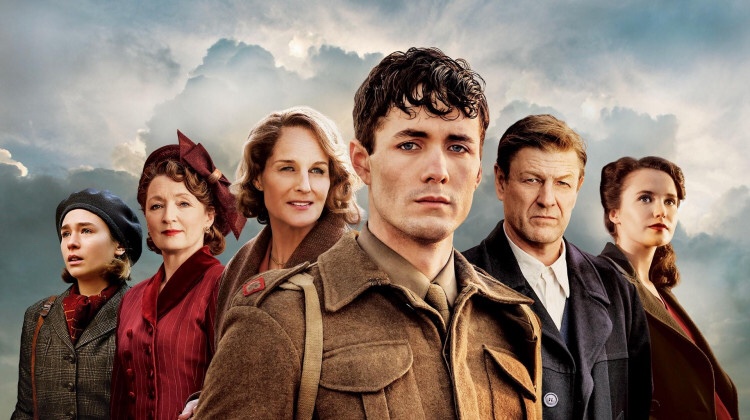
Last night, I watched the beginning of a new series on PBS’s Masterpiece called World on Fire. The series follows the hidden lives of ordinary people from Britain, Poland, France, Germany and the USA during World War II. The drama switches its scenes between various locations in France, Britain, Germany and Poland. It features repeated visits to Paris, Warsaw, Manchester, Berlin and Dunkirk.

I really enjoyed the first episode and can’t wait to see more. One of the stars is a favorite actor of mine, the out gay actor Brian J. Smith who plays Dr. Webster O’Connor, a gay American doctor living in Paris.

Did any of you watch it last night? If you did not, I highly recommend you do.


Pic of the Day


Patience

Strengthened with all might, according to his glorious power, unto all patience and longsuffering with joyfulness; (KJV) ( Colossians 1:11 )

When was the last time your patience was tested? Right now with so many people in isolation, We probably have all had our patience tested in some way or another. Maybe someone wasn’t social distancing like we’re supposed to, or it’s all the extra work we are doing from home these days. We all have different problems right now that try our patience.

How have you dealt with it? It’s such a tough battle when you are running on empty and your patience is wearing thin. This emotion is a great reminder that it’s time to supplement your day with prayer, meditation, and time in the Bible. You will be filled with all the patience you need.

Also, remember to reach out to those you love. They are experiencing a trying time as well. I know for some of us, our families may be a source of our impatience, but we all need each other right now.