

Monthly Archives: October 2020

Five Years Ago…

Five years ago today, I was stranded in Knoxville, Tennessee. I had headed out the day before for my new life in Vermont. I had everything planned. I was going to drive that first day to Blacksburg, Virginia, to see a friend of mine who was a Ph.D. student at Virginia Tech. Then I would drive the next day to Albany, New York. I had reservations at a historic hotel in downtown Albany. Then I would spend the third day of my trip driving the rest of the way to Vermont. Life has a way of throwing a wrench in your plans because none of those plans happened.
I set out that Wednesday morning on October 7, 2015, and things looked like they were going so well. Then while driving down I-40 just outside of Knoxville, I hit some large piece of metal (well about the size of my head) in the road. It punctured my gas tank. I had no choice as semi-trucks flanked me on both sides. Luckily, no sparks were present, and I could pull off to the side of the road and call 911. The local fire department arrived and neutralized the gas, and my car was towed to a local garage. The tow truck was kind enough to take me to a hotel. So, I was stuck in Lenoir City, Tennessee, in a hotel. My insurance company provided me with a rental car while mine was being fixed, but it would not arrive until the next afternoon. Luckily, there was a Mexican restaurant next door to my hotel, so I could at least get something to eat, but emotionally, I was as wrecked as my car. I had called my new boss and told her what had happened, but she insisted that I had to be there by a specific date, and I could not be delayed. Luckily, I did make it to Vermont in time.
As I was finishing packing my car before beginning my journey to Vermont, a good friend of mine wrote to me to give me this advice:
I’m so excited for you starting off this new adventure and, more importantly, putting the past behind you. A friend once told me to not just look ahead but to metaphorically turn a corner because then if you should ever glance back, you won’t be able to see what’s behind you because it’ll be out of your sights. Good advice to go and never look back. This poem reminded me of a song on the radio. Every time I hear it, I smile and think of you. Play it as you hit the gas and drive like hell out of the south.
He then sent me the Andy Grammar song “Good To Be Alive (Hallelujah).” These days, I have a really hard time listening to this song because I had no idea that by the end of the next month, my friend would die in a car accident, but today, I don’t want to dwell on that. Today, I want to say: Hallelujah, it is good to be alive. I can’t help but wish my friend was also still alive. He would be so happy with the way things have gone in my life since. Yes, there have been ups and downs, but overall, I do have a new life and a life that I love.

Our Rights Hang in the Balance

The Supreme Court had overruled more than 300 of its cases. With a Senate confirmation of Amy Coney Barrett, there should be a real concern that many landmark cases could be overturned. In recent years, the Supreme Court has been split four liberal, four conservative, and one swing vote. Chief Justice John Roberts now seems to be the swing vote replacing Justice Anthony Kennedy to bring balance to the Court. If Amy Coney Barret is confirmed, the balance will shift to three liberal, five conservative, and one swing vote. That puts Roe v. Wade in jeopardy, it puts the Affordable Care Act in jeopardy, and it puts Obergefell v. Hodges in jeopardy. Barrett has already indicated that she would like to see Roe v. Wadeoverturned. She has been critical of the Affordable Care Act. She has also voiced her disagreement with the 2015 Obergefell v. Hodges decision, which declared that same-sex couples have a constitutional right to marry under the 14th Amendment guarantee to equal protection of the law.
Her stance on Obergefell v. Hodges should be the most concerning for many in the LGBTQ+ community, especially after the news that Justices Clarence Thomas and Samuel Alito issued a strongly worded and scathing attack against the Court’s 2015 same-sex marriage decision on Monday. The justices issued the broadside when the Court declined to hear a case brought by a former Kentucky county clerk who refused to issue a marriage license for same-sex couples. The two justices agreed with the decision not to hear the case but used the occasion to make a strong statement about their disagreement with Obergefell v. Hodges. Writing for himself and Alito, Thomas said that the Court’s decision “enables courts and governments to brand religious adherents who believe that marriage is between one man and one woman as bigots, making their religious liberty concerns that much easier to dismiss.”
His words came in a case brought by Kim Davis, a former county clerk in Kentucky, who refused to issue marriage licenses to same-sex couples and was sued in the aftermath of the same-sex marriage decision. “Davis may have been one of the first victims of this court’s cavalier treatment of religion in its Obergefell decision,” Thomas and Alito wrote. But they agreed that the Court properly decided not to take up Davis’ case because, they said, it does not “cleanly” present the issues in the Court’s 5-4 decision five years ago. Nevertheless, they said, the case “provides a stark reminder” of the consequences of the same-sex marriage decision. By choosing to endorse “a novel constitutional right over the religious liberty interests explicitly protected in the First Amendment, and by doing so undemocratically, the court has created a problem that only it can fix,” they said. “Until then, Obergefell will continue to have ruinous consequences for religious liberty.”
The fact that Thomas and Alito chose this moment to issue their blast provoked dismay in the LGBTQ+ community and elsewhere. At a time when the Supreme Court judicial balance is precarious, it is particularly alarming that there are justices who want to overrule Obergefell. Obergefell is a precedent the Court has reaffirmed and has allowed hundreds of thousands of couples to get married and legally affirm their commitment to each other. We have to ask ourselves, what would happen if Obergefell is overturned? It would lead to the end of same-sex marriage, but would it also invalidate the marriages that have already occurred? This would be a disastrous setback for LGBTQ+ rights. The Court is usually hesitant to overturn its own decisions, but it has famously been done several times and quietly many more times.
Chief Justice Roberts, who dissented in the 2015 decision along with Thomas, Alito, and the late Justice Antonin Scalia, did not sign on to the Thomas-Alito statement in the case, which could be a positive sign for a changed opinion from him. Trump appointees Neil Gorsuch and Brett Kavanaugh also did not sign the statement. But Barrett has indicated her disagreement with the 2015 decision, and Roberts, Gorsuch, Kavanaugh, and Barrett have all been staunch supporters of robust religious rights, de-emphasizing the concept of separation between church and state and emphasizing the importance of the free exercise of religion.
A conservative Court, especially one who disregards the separation of church and state, is a frightening proposition, making it all the more imperative to get out and vote. We have to win the Senate and the White House while retaining the House of Representatives. The Republican Party is barreling ahead with its effort to install Barrett mere weeks before Election Day. The reckless rush to vote indicates the desperate and corrosive power grab at play, one that places the future of the Court at risk. If Republicans succeed, and Democrats win the Senate and the White House in November, Democrats will have no choice but to add seats for additional justices—not as a means of political one-upmanship, but, paradoxically, to save the Court.
For the past few years, court-packing has mostly been a fringe idea, and the Democratic establishment has been resistant to the notion because Republicans would someday surely try to respond in kind. The current battle over the Supreme Court changes everything; if Barrett is confirmed and Trump loses the election, adhering to norms and accepting the status quo on January 20 poses a greater harm than expanding the Court would. Because of the damage Barrett’s confirmation could do to the nation, adding justices may be the only way to restore the institutional legitimacy of the Court.
Consider the nature of McConnell’s gamble in pushing forward Barrett’s nomination. If Trump wins, there is little upside to the current rush to fill the late Justice Ginsburg’s seat; the Senate would easily be able to confirm Barrett just a few weeks later, and with far broader public confidence. However, if Trump loses, Republicans might not have enough votes during the lame-duck session to confirm Barrett because a handful of Republican senators—particularly senators from states that seem poised to break for Biden—could hesitate to disregard the will of voters so brazenly. The fact that Trump advisers and allies are pushing so hard to vote on Barrett’s confirmation before the election is a sign of how many of them believe he’s likely to lose. They are desperate. Their desperation seems even truer now that McConnell is determined to push through with his original confirmation schedule despite the spread of the coronavirus among Senate Republicans. By forcing a vote before Election Day, McConnell is ensuring that electoral loss—which is to say, the public’s will—won’t prevent conservatives from filling the seat.
So let me say this loud and clear if you are LGBTQ+ or an Ally, which I assume you are since you’re reading this blog, it is imperative that you vote for Joe Biden for president and vote for Democrats down the ballot. We must preserve our rights. At this point, a vote for a Republican is a vote against LGBTQ+ rights. The following is from the 2020 Republican Party Platform:
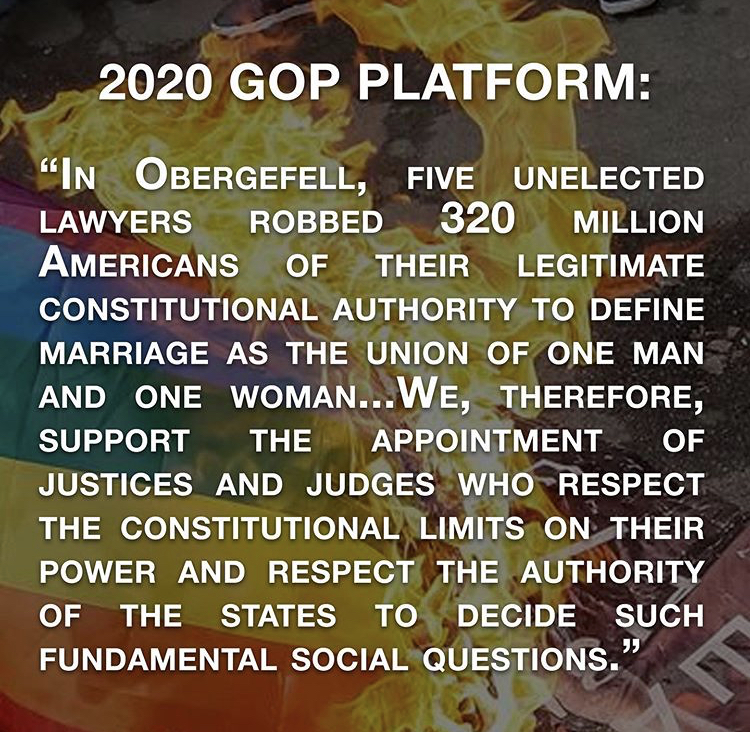
There are many other reasons that I have mentioned numerous times for voting for Democrats in this election, but if you care about our right to marry, our right to have jobs without the fear of losing them over our sexuality, or maybe you want to adopt a child, all of this hangs in the balance in this election. While I doubt I will ever get married (I’m older and not in the best of shape, and I live in Vermont where there are slim pickings), I still want the ability to get married if I ever meet the right person. I want equality for all members of the LGBTQ+ community, and that is in jeopardy with the current administration. If you were considering not voting, think again. You cannot afford not to vote. Our lives depend on voting blue in this election. Every vote is needed to defeat the current president and the disastrous policies of the Republican Party. We are literally in a fight for our lives, and we must let our voices be heard loud and clear.
Alone

Alone
By Edgar Allan Poe
From childhood’s hour I have not been
As others were-I have not seen
As others saw-I could not bring
My passions from a common spring-
From the same source I have not taken
My sorrow-I could not awaken
My heart to joy at the same tone-
And all I lov’d-I lov’d alone-
Then-in my childhood-in the dawn
Of a most stormy life-was drawn
From ev’ry depth of good and ill
The mystery which binds me still-
From the torrent, or the fountain-
From the red cliff of the mountain-
From the sun that ’round me roll’d
In its autumn tint of gold-
From the lightning in the sky
As it pass’d me flying by-
From the thunder, and the storm-
And the cloud that took the form
(When the rest of Heaven was blue)
Of a demon in my view-
Born during the early 19th century, Edgar Allen Poe’s characteristic mood swings were probably symptoms of Poe suffering from bipolar depression which may have led to his alcoholism and other self-destructive behaviors. Poe exhibited many of the symptoms of a man who suffered from mental illness. Trauma can cause mood disorders, and Poe was orphaned at a young age. He was also believed to be an alcoholic, likely the cause of his untimely death at the age of 40. When his beloved foster mother died in 1829, he wrote perhaps one of his most famous poems about depression, “Alone.” The poem illustrates loneliness associated with depression that leaves many feeling disconnected from others.
Each year, millions of Americans face the reality of living with a mental health condition. However, mental illness affects everyone directly or indirectly through family, friends or coworkers. Despite mental illnesses’ reach and prevalence, stigma and misunderstanding are also, unfortunately, widespread. That is why each year, the first week of October (October 4-10 in 2020) has been set aside for raising awareness of mental illness. Each year, mental health professionals focus on educating the public, fighting stigma, and providing support. While mental health conditions are important to discuss year-round, highlighting them during Mental Illness Awareness Week provides a dedicated time for mental health advocates across the country to come together as one unified voice. Since 1990, when Congress officially established the first full week of October as Mental Illness Awareness Week, advocates have worked together to sponsor activities, large or small, to educate the public about mental illness.
Below are only a few of the reasons why it’s important to take part in promoting awareness for Mental Illness Awareness Week. Please use these facts and others to encourage discussions about mental health.
- 1 in 5 U.S. adults experience mental illness each year
- 1 in 25 U.S. adults experience serious mental illness each year
- 1 in 6 U.S. youth aged 6-17 experience a mental health disorder each year
- Mental illness affects:
- 37% of LGBTQ+ adults
- 27% Mixed/Multiracial adults
- 22% of American Indian or Alaska Native
- 20% of White adults
- 17% of Latinx adults
- 16% of Black adults
- 15% of Asian adults
- Annual prevalence among U.S. adults, by condition:
- Anxiety Disorders: 19.1% (estimated 48 million people)
- Major Depressive Episode: 7.2% (17.7 million people)
- Posttraumatic Stress Disorder: 3.6% (estimated 9 million people)
- Bipolar Disorder: 2.8% (estimated 7 million people)
- Borderline Personality Disorder: 1.4% (estimated 3.5 million people)
- Obsessive Compulsive Disorder: 1.2% (estimated 3 million people)
- Schizophrenia: <1% (estimated 1.5 million people)
Remember, people with mental illness need your support, not your pity. Talking to friends and family about mental health problems can be an opportunity to provide information, support, and guidance. People with mental health problems deserve respect, compassion, and empathy.

Sleep

I always find it ironic that when I don’t have to get up at a specific time, I am wide awake sometime between 5:30 am and 6:00 am. Yet, when I have to get up at a particular time like somewhere between 5:30 am and 6:00 am, I have the hardest time waking up. All I want to do is stay in bed. Sometimes, that 6 am wake-up is because Isabella has decided that I need to get up. Sometimes, she is very persistent in not just waking me up, but getting me to get out of bed. When she does this, I always check her food and water and make sure that she has enough of everything, but most of the time, she has plenty of food and water. Most of the time, I have found that when I do get up, she walks around for a few minutes, and then she curls up in my bed, where I was just lying and goes to sleep. She doesn’t let that spot cool down before she’s there and asleep. It’s very aggravating because I get up and check to see what she wants, then I go to the bathroom only to find her fast asleep in the exact spot I just vacated. I guess she’s a little spoiled.
This morning was one of those mornings when I had to get up very early. I had to be at my physical therapy (PT) appointment at 7:30 am (actually a few minutes early to go through the COVID protocols). It takes about 30 minutes to drive to the PT clinic. There are closer places I could go for PT, but I was sent here the first time I needed PT a few years ago for a neck issue. I have an excellent relationship with my physical therapist, and she has never failed to help me tremendously. While I could probably go somewhere closer, I don’t want another physical therapist. I am the same way about my primary care physician, who I will be seeing next Monday.



Authors
Recent Comments
furbirdsqueerly on Pic of the Day Joe on Pic of the Day noisilycool3bc985058… on Pic of the Day vandycolt on Moment of Zen: Reading noisilycool3bc985058… on Pic of the Day Top Posts & Pages




Amazon Associate

As an Amazon Associate I earn from qualifying purchases. So, if you click on a link that takes you to Amazon.com, I may earn a commission.
Trust me, it isn’t much, but every little bit helps.

 Joe
Joe


 The Closet Professor