Monthly Archives: June 2021

LGBTQ+ Poetry Classics

Love the Light-Giver
By Michelangelo Buonarroti (1475-1564)

To Tommaso De’ Cavalieri

Veggio co’ bei vostri occhi.

With your fair eyes a charming light I see,
 For which my own blind eyes would peer in vain;
 Stayed by your feet, the burden I sustain
 Which my lame feet find all too strong for me;
Wingless upon your pinions forth I fly;
 Heavenward your spirit stirreth me to strain;
 E’en as you will, I blush and blanch again,
 Freeze in the sun, burn ‘neath a frosty sky.
Your will includes and is the lord of mine;
 Life to my thoughts within your heart is given;
 My words begin to breathe upon your breath:
Like to the moon am I, that cannot shine
 Alone; for lo! our eyes see nought in heaven
 Save what the living sun illumineth.


Love Returned
By Bayard Taylor (1825-1878)

He was a boy when first we met;
 His eyes were mixed of dew and fire,
And on his candid brow was set
 The sweetness of a chaste desire:
But in his veins the pulses beat
 Of passion, waiting for its wing,
As ardent veins of summer heat
 Throb through the innocence of spring.

As manhood came, his stature grew,
 And fiercer burned his restless eyes,
Until I trembled, as he drew
 From wedded hearts their young disguise.
Like wind-fed flame his ardor rose,
 And brought, like flame, a stormy rain:
In tumult, sweeter than repose,
 He tossed the souls of joy and pain.

So many years of absence change!
 I knew him not when he returned:
His step was slow, his brow was strange,
 His quiet eye no longer burned.
When at my heart I heard his knock,
 No voice within his right confessed:
I could not venture to unlock
 Its chambers to an alien guest.

Then, at the threshold, spent and worn
 With fruitless travel, down he lay:
And I beheld the gleams of morn
 On his reviving beauty play.
I knelt, and kissed his holy lips,
 I washed his feet with pious care;
And from my life the long eclipse
 Drew off; and left his sunshine there.

He burns no more with youthful fire;
 He melts no more in foolish tears;
Serene and sweet, his eyes inspire
 The steady faith of balanced years.
His folded wings no longer thrill,
 But in some peaceful flight of prayer:
He nestles in my heart so still,
 I scarcely feel his presence there.

O Love, that stern probation o’er,
 Thy calmer blessing is secure!
Thy beauteous feet shall stray no more,
 Thy peace and patience shall endure!
The lightest wind deflowers the rose,
 The rainbow with the sun departs,
But thou art centred in repose,
 And rooted in my heart of hearts!


A Shropshire Lad, XXXVI
By A. E. Housman (1859-1936)

White in the moon the long road lies,
 The moon stands blank above;
White in the moon the long road lies
 That leads me from my love.

Still hangs the hedge without a gust,
 Still, still the shadows stay:
My feet upon the moonlit dust
 Pursue the ceaseless way.

The world is round, so travellers tell,
 And straight though reach the track,
Trudge on, trudge on, ’twill all be well,
 The way will guide one back.

But ere the circle homeward hies
 Far, far must it remove:
White in the moon the long road lies
 That leads me from my love.


Undressing You
By Witter Bynner (1881-1968)

Fiercely I remove from you
All the little vestiges—
Garments that confine you,
Things that touch the flesh,
The wool and the silk
And the linen that entwine you,
Tear them all away from you,
Bare you from the mesh.
And now I have you as you are,
Nothing to encumber you—
But now I see, caressing you,
Colder hands than mine.
They take away your flesh and bone,
And, utterly undressing you,
They tear you from your beauty
And they leave no sign.


The More Loving One
By W. H. Auden (1907-1973)

Looking up at the stars, I know quite well
That, for all they care, I can go to hell,
But on earth indifference is the least
We have to dread from man or beast.

How should we like it were stars to burn
With a passion for us we could not return?
If equal affection cannot be,
Let the more loving one be me.

Admirer as I think I am
Of stars that do not give a damn,
I cannot, now I see them, say
I missed one terribly all day.

Were all stars to disappear or die,
I should learn to look at an empty sky
And feel its total dark sublime,
Though this might take me a little time.


And for the “L” in LGBTQ+:

[In my eyes he matches the gods]
By Sappho (c. 630-c. 570 BCE)

In my eyes he matches the gods, that man who
sits there facing you–any man whatever–
listening from closeby to the sweetness of your
  voice as you talk, the

sweetness of your laughter: yes, that–I swear it–
sets the heart to shaking inside my breast, since
once I look at you for a moment, I can’t
  speak any longer,

but my tongue breaks down, and then all at once a
subtle fire races inside my skin, my
eyes can’t see a thing and a whirring whistle
  thrums at my hearing,

cold sweat covers me and a trembling takes
ahold of me all over: I’m greener than the
grass is and appear to myself to be little
  short of dying.

But all must be endured, since even a poor


About the Poets

Michelangelo di Lodovico Buonarroti Simoni, known simply as Michelangelo, was an Italian sculptor, painter, architect and poet of the High Renaissance born in the Republic of Florence.

Bayard Taylor was an American poet, literary critic, translator, travel author, and diplomat. Though he wanted to be known most as a poet, Taylor was mostly recognized as a travel writer during his lifetime. Modern critics have generally accepted him as technically skilled in verse, but lacking imagination and, ultimately, consider his work as a conventional example of 19th-century sentimentalism.

Alfred Edward Housman, usually known as A. E. Housman, was an English classical scholar and poet. His cycle of poems, A Shropshire Lad, wistfully evoke the dooms and disappointments of youth in the English countryside.

Harold Witter Bynner, also known by the pen name Emanuel Morgan, was an American poet and translator. He was known for his long residence in Santa Fe, New Mexico, and association with other literary figures there.

Wystan Hugh Auden, usually known as W.H. Auden, was an Anglo-American poet. Auden’s poetry was noted for its stylistic and technical achievement, its engagement with politics, morals, love, and religion, and its variety in tone, form, and content. 

Sappho was an Ancient Greek poet from the island of Lesbos. Sappho is known for her lyric poetry, written to be sung while accompanied by a lyre. In ancient times, Sappho was widely regarded as one of the greatest lyric poets and was given names such as the “Tenth Muse” and “The Poetess”. Most of Sappho’s poetry is now lost, and what is extant has mostly survived in fragmentary form.

🏳️‍🌈 LGBT POETS FOR PRIDE MONTH 🏳️‍🌈


Pic of the Day

In the United States, Flag Day is celebrated on June 14. It commemorates the adoption of the flag of the United States on June 14, 1777, by resolution of the Second Continental Congress. 


I “Dare” You to Watch This

In the early 2000s when I first came out, I read every gay book and watched every gay movie I could get my hands on. I think I watched every gay movie that Netflix (back when they sent you a DVD instead of streaming) had in its library. I will admit, most of the movies were independent movies and were decidedly bad. The production value was low, and the acting wasn’t great, or even good in some cases. The books I read fared better than the movies, but there were a few duds there too. However, gay literature has always been a step above the gay movie genre.

I did have a few favorite movies. For comedy, my favorite is probably the 2003 movie Mambo Italiano, a movie about the son of Italian immigrants to Canada who struggles to find the best way to reveal to his parents that he’s gay. While this is probably going to get me some comments from my Canadian readers, one of the lines that always makes me laugh comes from Paul Sorvino’s character, Gino Barberini, the family patriarch. At one point, he describes how his family came to live in Montreal, “Nobody told us there was two Americas: the real one, United States, and the fake one, Canada. Then, to make matters even worse, there’s two Canadas: the real one, Ontario, and the fake one, Quebec.” It’s a cute movie, but not great cinema. Few of these movies were.

In drama, my hands down favorite is Latter Days, a 2003 movie about a gay relationship between a closeted Mormon missionary and his openly gay neighbor. While many might point to Brokeback Mountain as a pivotal moment in gay cinema, I will always believe that Latter Days was a much better movie. While not great cinema in any regard, my other favorite is the 1997 movie Defying Gravity. In the movie, two fraternity brothers have a secret affair. One wants to maintain just a superficial relationship with his all-gay boyfriend, but his feelings begin to change when his boyfriend gets seriously wounded in a gay bashing. It is a heart wrenching movie, but there is one scene where one of the characters says, “Oh, man.” That little line gets me every time.

Because gay movies have never gotten the budget of more mainstream movies, there were also a lot of gay short films made. In 2005, I came across a short film that was getting a lot of attention in gay media called Dare. In the 16-minute-long movie, a high school senior, Ben, secretly lusts after bad boy classmate Johnny. After Ben gives Johnny a ride home one night, the boys end up in Johnny’s swimming pool and have an encounter that is filled with a lustful teen crush and forbidden gay love in high school. Dare played at over 50 film fests and was released as the lead film on gay short DVD compilations and eventually became a Sundance feature. I either watched it on my computer screen or I got one of those DVD compilations from Netflix. The short film has always kept a special place in my heart. You can watch it here:

Saturday night as I was winding down and getting ready for bed, I was watching some TikToks, which is how I often wind down at the end of the day. I came across a clip from this short film, and I looked it up intending to watch it again. What came as a surprise is that writer and producer David Brind and director Adam Salky have done something unprecedented. They’ve brought back the very same cast and creative team from the original short film 15 years later for The Dare Project, a continuation of Ben and Johnny’s story. Yes, I am behind the times on this, since The Dare Projectwas released in 2018. I’m not sure how I missed this news. Once I saw that there was a sequel, I knew I had to watch it, and I did. Usually, sequels come far short of the original, this is not the case. It was just as good as the original.

Writer and producer David Brind describes best why this movie made such an impression on most people who saw it. “When I first wrote the Dare short in film school in 2003, I had no fucking clue what I was doing,” said Brind. “My professor told me to write from the heart and the gut. So, I wrote about ‘Johnny.’ Everyone in the world has their own ‘Johnny,’ the elusive one that seemed untouchable, that made you feel so intensely you thought you would die. ‘Johnny’ existed for me.” There is more to that quote, but it gives too much away of the original short film, and I think would ruin it if you haven’t seen Dare yet. Like Brind, I had my “Johnny,” but we never had an experience anything like in the film.

Brind said that after understanding the fan base that the original Dare had developed over the years, he decided to try and continue the story he had begun. “Fifteen years later, I decided to revisit this world with The Dare Project,” Brind added. “Our legions of fans—13.5M views on YouTube while being suppressed from search by them, but that’s another story—demanded a sequel. They wrote Instagram messages. Like Jack from a small village in Ireland. Jack is 17. He’s gay. He’s suicidal. He wrote to tell me that he watches Dare over and over when he’s feeling like he doesn’t want to live. Because it brings him hope. And that’s more worthwhile than any Netflix or HBO deal could ever bring me.”

After fifteen years, Brind made the decision to try and put together a sequel. In The Dare Project, Ben and Johnny, now in their early 30s fortuitously run into each other at a party in Los Angeles after not seeing each other since high school.  Of the sequel, Brind added, “Ben isn’t 17 anymore. And he’s a lot more like me now. He’s good at what he does. He’s successful in his way. He’s more confident. He’s out. But he’s still been unable to find intimacy in a real way. A real and constant struggle for LGBTQ people, especially in the age of Grindr (which is in the new film) and Instagram ‘influencers’ aka hot guys in underwear.”

“Johnny isn’t 17 either,” Brind continued. “And he’s no longer the arrogant bad boy of high school hallways. Life has gotten more complex. And when Ben and Johnny meet for the first time since high school, they talk about it all. And of course, they get back in the pool…”

There also seems to be an expanded full length 2009 version of the original short film. The feature-length version, which premiered at the Sundance Film Festival, stars Emmy Rossum in a story about how “three very different teenagers discover that, even in the safe world of a suburban prep school, no one is who she or he appears to be.” The film has been described as a cross between Pretty in Pink and Cruel Intentions. While I have always liked Cruel Intentions, possibly only for the pool scene with Ryan Phillippe, I watched the trailer for the feature length version of Dare, and I have no interest in seeing it. However, to add a little to The Dare Project’s ending, there was a “video call” between Ben and Johnny at the beginning of the pandemic, that is, in its own way, just as sweet as the previous versions:

To watch The Dare Project, it is available on Vimeo on Demand. There is the option to rent The Dare Project at a cost of $2.99 for 48-hour streaming period or buy it for $5.99 to stream and download to watch anytime. The $2.99 was worth every penny. I think Dare will always hold a special place in my wide variety of gay cinematic experiences. It is thirty-four minutes I will never forget, and I hope you will enjoy it as well.


Pic of the Day


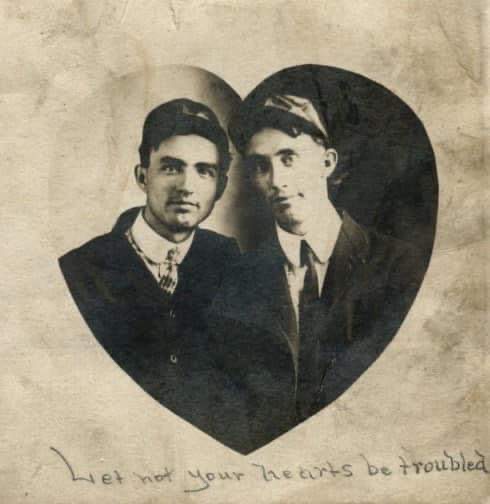
Let Not Your Hearts Be Troubled

Let not your hearts be troubled. Trust in God; trust also in me.

—John 14:1

Few words in the Bible are better known or more often quoted than these, but for all their timelessness, they were addressed to a very specific situation, the death of Jesus on the cross, and with that, the resurrection of Jesus is implied.

The “Last Supper” is described in John 13:1–17:26. John 14:1 is part of the sermon Jesus gave to his disciple at his last meal with them. Jesus had filled his disciples with foreboding though his demeanor and language during this sermon. He was going to leave them, and that itself was devastating to the disciples. But the disciples would also have to cope with the manner of his departure. They would see him betrayed by one of their own, arrested, and condemned to a death that would not only take him away from them, but would discredit his name and message burying all their hopes with him.

John 14:1 is Jesus’s way of helping his disciples cope with what is to come. It is the trouble in their minds that troubles him, and he addresses it not only with soothing words, but with powerful arguments — arguments they must remember when they see him hanging on the cross, and which we, too, must remember when God leads us where we cannot cope and cannot understand.

The disciples are told they have to trust God even when they cannot see His reasons; and we can be sure that the arguments Jesus presented to the disciples were the very arguments he presented to himself. He, too, “the man, Christ Jesus,” had to trust God, laying down his life (to all human appearance an unfinished life), risking all on the “sure and certain hope of the resurrection.” I think that at times we all present arguments to others to convince ourselves of what we are saying.

Jesus told the grieving Martha in John 11:25–26, “I am the resurrection and the life. Whoever believes in me, though he die, yet shall he live, and everyone who lives and believes in me shall never die. Do you believe this?” Surely, if that were true of those who believed in him, it must first of all be true of himself? Death could not hold the life of the world as He says in John 14:19, “Yet a little while and the world will see me no more, but you will see me. Because I live, you also will live.”

With the message Jesus gives his disciples, we can also take this to heart. The photograph above is from BosGuy’s Thursday “Vintage Gay” post. It is doubtful we will ever know why one of the men wrote on the heart-shaped photograph, “Let not your hearts be troubled,” but I think we can all probably guess. My suspicion is that they were being separated, similar to how Jesus was going to be separated from his disciples after the Last Supper. What is left unspoken is the rest of that verse: trust also in me. Whoever wrote the note seems to be saying, “We will get through this. We may be separated but trust me that we will survive this separation.” We don’t know what the two men were going through, but we can know that Jesus has told us, “Let not your hearts be troubled. Trust in God; trust also in me.


Pic of the Day


Moment of Zen: Redheads

Sometimes, you just got to love a sexy redhead. The redhead pictured is model Alex Espenshade. He has modeled for Andrew Christian and magazines such as Wire Magazine, DNA, ADON, & Fashionably Male.

Instagram: @alexespenshade

Twitter: @alexespenshade


Pic of the Day


The Equality Act, et al.

Sen. Jon Ossoff (D-GA)

Democracy is in peril. Though it has yet to fully register as the national story it deserves to be, America is currently in the throes of what may well be the most concerted effort at voter suppression and discrimination in living memory. Since the beginning of the year, Republican state legislators have introduced a deluge of new laws intended to restrict voting, suppress traditionally non-Republican constituencies, and overturn election results. These laws represent the greatest assault on voting rights since the end of Reconstruction. If you look at the number of bills introduced, the number of bills passed, and the intensity of the effort behind it, I don’t think we’ve seen anything like this since the Voting Rights Act was passed in 1965. Many of these efforts were blocked under the Voting Rights Act — and since the Supreme Court gutted it in 2013, voter suppression has gotten worse. But this seems to be the worst it’s been in the past decade.

It’s not like this is the first time there have been efforts to suppress the vote, but we are seeing a greater number of efforts at suppression, more restrictive bills than before, and more intensity within the Republican party to pass them. On a national level, Republicans in Congress refuse to support the For the People Act (also known as H.R. 1), which would expand voting rights, change campaign finance laws to reduce the influence of money in politics, limit partisan gerrymandering, and create new ethics rules for federal officeholders. Republican know that they cannot win the majority of elections if free, fair, and accessible elections are allowed to occur. The GOP knows that they are a minority party led by extremists who fear true democracy. It is not election fraud that Republicans fear; they fear easier access to the polls. The 2020 election proved their worst fears: if people are given greater voting access, Republicans will remain in the minority. So, they are doing everything possible to make it more difficult to vote.

In addition, thirty-three states have introduced more than 100 bills that aim to curb the rights of transgender people across the country, with advocacy groups calling 2021 a record-breaking year for such legislation. LGBTQ+ people in America continue to face discrimination in their daily lives. While more states every year work to pass laws to protect LGBTQ+ people, we continue to see state legislatures advancing bills that target transgender people, limit local protections, and allow the use of religion to discriminate. With an unprecedented number of anti-LGBTQ measures sweeping through state legislatures across the country, 2021 is on the cusp of surpassing 2015 as the worst year for anti-LGBTQ legislation in recent history, according to new tracking and analysis by the Human Rights Campaign.

Senate Majority Leader Chuck Schumer announced last month that the Senate could take up the Equality Act, which would enshrine legal protections for LGBTQ+ Americans, in June. Still, it’s not yet clear whether the Senate will consider the House-passed bill during Pride month. The Equality Act, if passed, would amend the Civil Rights Act of 1964 to prohibit discrimination based on sex, sexual orientation, and gender identity in employment, housing, public accommodations, education, federally funded programs, credit, and jury service. The Supreme Court’s June 2020 ruling in Bostock v. Clayton County, Georgia, protects gay and transgender people in matters of employment, but not in other respects. The bill would also expand existing civil rights protections for people of color by prohibiting discrimination in more public accommodations, such as exhibitions, goods and services, and transportation.

Twenty-nine states do not have laws that explicitly shield LGBTQ Americans from discrimination, resulting in a patchwork of protections that vary from state to state. The Equality Act would extend protections to cover federally funded programs, employment, housing, loan applications, education, and public accommodations. In addition, the Equality Act would prevent discrimination under federally funded programs based on sex or sexual orientation, including barring discrimination by faith-based organizations that receive federal funding, such as Catholic Charities, which has refused its adoption services to same-sex couples in the past. Senator Joe Manchin, the problem child of Democrats in the Senate, is the lone Democrat who is not a co-sponsor of the bill. Manchin said in 2019 that he would not support the bill without changes, explaining at the time that he was “not convinced that the Equality Act as written provides sufficient guidance to the local officials who will be responsible for implementing it, particularly with respect to students transitioning between genders in public schools.” I personally believe that any tax-exempt faith-based organization that involves itself in politics, then it should lose its tax-exempt status. Politics and discrimination have no place in religion, and it is time for religious institutions to realize this. Furthermore, I don’t believe any political and partisan organization should be tax-exempt. If you’re non-partisan and don’t discriminate, then you can have tax-exempt status.

The protections offered by the Equality Act are broadly popular among most Americans. A recent poll by the Public Religion Research Institute found that 76% of Americans support protections for LGBTQ+ Americans from discrimination in jobs, housing, and public accommodation. Although support is stronger among Democrats and independents, the poll found that most Republicans, 62%, also support anti-discrimination laws. Advocates argue that given the popularity of anti-discrimination measures even among Republicans, senators from GOP-dominant states should vote with their constituents on the issue. However, we have found out from the Republican Party that they do not care about the majority of their constituents. They want to restrict access to the ability to vote, especially for people who disagree with them. They also do not care what even those who largely agree with them want. For example, Congress passed the American Rescue Plan Act of 2021 without a single vote from a Republican, even though most Republican voters supported the stimulus bill. Even though they all voted against it, Republicans across the country have promoted elements of the legislation they fought to defeat.

The opposition to the For The People Act and the Equality Act are not the only threats to democracy. The Washington, D.C. Admission Act (and the possibility of the admission of Puerto Rico as a state) and the George Floyd Justice in Policing Act of 2021 would also expand democracy and safety for minorities in the United States. Republicans know that if Puerto Rico became a state, it would likely add five members with full voting rights to the House of Representatives and two members to the Senate, which would likely result in an almost guaranteed seven electoral votes in a presidential election. Since the House of Representatives is limited to 435 members under the Reapportionment Act of 1929, Minnesota, California, Texas, Washington and Florida would each lose one electoral vote. Washington, D.C. would likely get one Representative, giving it three electoral votes, which are also almost guaranteed to be cast for the Democratic nominee in a presidential election.

The George Floyd Justice in Policing Act of 2021would hold law enforcement accountable for misconduct in court, improve transparency through data collection, and reform police training and policies. To me, the most essential provision of this bill is that it will establish a federal registry of police misconduct complaints and disciplinary actions. Currently, there is no such registry. As a result, if a law enforcement officer does something that warrants misconduct and disciplinary action and is dismissed from one department and applies for another, there is no way to know why they left their former employment. Furthermore, nothing requires their former employer to report misconduct to a new employer. In fact, current laws discourage a former employer from making any statements that might be seen as derogatory about their former employee.

To get any of this done, the Senate must reform or get rid of the filibuster. The filibuster is an archaic rule that the House of Representatives did away with in 1888. By the way, it was Republicans who ended the filibuster in the House. Democrats tried to bring it back in 1891 when they regained control, but Republicans used the reinstated filibuster to such frustrating effect that Democrats had no choice but to re-abolish it two years later. Opponents of abolishing the filibuster in the Senate often claim that the filibuster was part of the original design of the Senate. It was not. In fact, the traitor Aaron Burr introduced the idea of the filibuster in the Senate in 1805, and the Senate enacted it in 1806. But no Senator used it until 1837, when it was used for the first time. 

The Senate has been a problem to democracy from its beginning. The so-called “Great Compromise” (aka the Connecticut Compromise) was never popular with our Founding Fathers. It passed at the Constitutional Convention by one vote, 5–4–1. If we are talking about majority will, this was not a good example. Those five state delegations voting in favor did not represent most state delegations because 12 states sent delegates to the convention. Although there were thirteen states, Rhode Island did not send any delegates. The Senate has always been an elitist institution. State legislatures initially chose senators, but that ended in 1913 with the Seventeenth Amendment, which established the direct election of United States senators in each state.

The Senate’s operations result in partisan paralysis due to its preponderance of arcane and undemocratic rules. The Constitution specifies a simple majority threshold to pass legislation, and the filibuster is mentioned nowhere in the document. Representation in the Senate is not proportional to the population and is “anti-democratic” and creates “minority rule.” The Senate, like the rest of the U.S. government, does not represent minorities well. The approximately four million Americans that have no representation in the Senate (in the District of Columbia and U.S. territories) are heavily African and Hispanic American. D.C. and the territories at least have nonvoting delegates in the House. While we cannot get rid of the Senate, it is the most undemocratic institution in the American government, followed closely by the Electoral College. Reforms are desperately needed, and the laws mentioned above need to be enacted at all costs. We are guaranteed just under two years to have a majority in both houses of Congress. Someone needs to get Democratic Senators like Joe Manchin of West Virginia and Kyrsten Sinema of Arizona, both of whom have frustrated Democrats with their defense of the filibuster. The Senate has to be made more democratic, and while the Seventeenth Amendment was a start, more needs to be done to promote equality in America.


Pic of the Day