
Monthly Archives: July 2021










Rough Day

Yesterday, I woke with a bad headache. My trigeminal nerve is still healing and some days the pain can still be pretty bad. Yesterday was one of those days. It was compounded by a bad stomachache and some hypoglycemic episodes. Occasionally, my blood sugar does drop to between 55 and 70. Around lunchtime yesterday, my blood sugar dropped to 70. I know when it’s happening because I get very unsteady on my feet and confused. I often also feel very hungry, but that was not the case yesterday because I wasn’t hungry at all. I have glucose tabs to get my blood sugar back to where it should be, and I was able to get it back up. However, a few hours later, it dropped back down to 72. The second time it dropped, it was a little more difficult to get it back up, but it did eventually get back to normal.
Today is likely to be a very emotional day for me. Nine years ago today, my beloved Grandmama passed away. I will always miss her. Growing up, I spent as much time with her, if not more, than with my parents. She also took up for me when my sister got me into trouble or when Daddy was being particularly mean to me. I had a truly special bond with her. I never came out to her, but if she was alive today, I probably would. When I could not reason with other people in my family, I could with her. She would listen to me, and she always took my side and saw my side of things. Hell, I even convinced her to vote for Democrats. Grandmama never lived a perfect life, but she was perfect to me. I loved her so much.

Recalculating

Sometimes you’ve got to let everything go—purge yourself. If you are unhappy with anything… whatever is bringing you down, get rid of it. Because you’ll find that when you’re free, your true creativity, your true self comes out.
—Tina Turner
For most of my life, I tried to be the person other people wanted me to be. I tried to live up to other’s expectations, especially my parents. I tried to be more myself when I lived in Mississippi when I was in graduate school, but I was never fully able to be me. The main reason I struggled was because I did not love myself. I knew I was gay, but even back then, I didn’t fully accept it. I knew I’d never marry a woman because it would not be fair for me or her, and it would only make other people happy. It would never make me truly happy, and I’d have continued to hate myself. As Lucille Ball said, “Love yourself first and everything else falls into line.” It took moving to Vermont before I could really begin to love myself. For the past eighteen months, I have not seen my family. I have spoken to them over the phone, and even over the phone they can make my blood boil, but being away from them for the past year and half has helped me heal in ways I never thought was possible.
Carol Burnett once said, “Only I can change my life. No one can do it for me.” Her words are so very true. Others can try to mold me and make me into what they want me to be, but only I can change to my life. While I haven’t gotten rid of my family (I will still go home this Christmas), I have done my best to get rid of their negativity. I haven’t completely purged myself of caring what they think, but I’m on my way there. The unhappiness in my life was bringing me down, but as I have lived a freer and fuller life 1,200 miles from Alabama, I have begun to let my “true self come out.” It’s still a journey, a journey that I’m not sure will ever end in this life, but it is a journey we all take to find our true self. We just have to keep trudging along on that path and listen to that internal GPS that guides us to our destination.
Yes, sometimes we will miss a turn (such as an opportunity) or we make a wrong turn (a bad decision), but that internal GPS can recalculate our route. We all can hear that familiar voice in our head saying “recalculating route” when we didn’t follow the directions correctly. Sometimes, we can only carry on and let our internal GPS continue recalculating until we finally reach our destination. Many times we are traveling through life with people telling us what to do. If we are unfamiliar with the a situation, we allow others, much like a GPS, to guide us. But does the GPS always provide us the best route? Maybe, maybe not. Do people always provide us the best advice? Maybe, maybe not. I think that no matter what, one must listen to their own GPS and allow others to offer suggestions but ultimately, we must decide our own path and journey.

Erasing History in Schools

This past Pride month, as revelers hit the streets to celebrate LGBTQ+ history, Republican state legislatures were hard at work trying to erase it. And it’s not just momentous events like the Stonewall riots or towering figures like Harvey Milk that could be wiped from classroom instruction. In public schools in Tennessee, Arkansas, and Montana, it may soon become illegal even to mention Bayard Rustin, the openly gay co-organizer of the 1963 March on Washington, or educate kids about the AIDS crisis. Republicans don’t want our nation’s children to know that a gay black man organized one of the most pivotal events in the Civil Rights Movement, and they still insist that AIDS is the result of/punishment for immoral behavior.
In May, Tennessee became the first state to pass what queer-rights advocates have branded as “Don’t Say Gay” laws, which either forbid the teaching of LGBTQ+ history in K-12 schools outright or allow parents to choose whether their children participate in lessons that include it. Within days, Montana followed suit. Yet another bill in Arkansas awaits the signature of the state’s Republican governor. Similar bills have been considered in West Virginia, Iowa, and Missouri. Red-state legislatures are introducing more proposals to hinder education.
Akin to bans on the teaching of critical race theory (If you are not familiar with what critical race theory means [check out the link above and see note below*]. It’s been around for forty years and is merely teaching history as it should be taught.), these laws seek to preserve the myth that the story of America is one of destined progress and unblemished virtue. These laws claim that we stand exceptional among nations as the gleaming embodiment of democracy and, in turn, imply that a significant number of us do not matter. In particular, legislation forbidding the teaching of LGBTQ+ history aims to solidify what remains of society’s moral disapproval of LGBTQ+ people and endangers LGBTQ+ youth who are most susceptible to suicide.
The Republican efforts are a false representation of the past. They want to pretend that LGBTQ+ people have never even existed. They do not want students to question their Pollyanna view of American history. They do not want to open up questions about the failures of the past to allow students to question whether the United States is living up to the goals of the republic—”We the People of the United States, in Order to form a more perfect Union, establish Justice, insure domestic Tranquility, provide for the common defence, promote the general Welfare, and secure the Blessings of Liberty to ourselves and our Posterity.” This whitewashing of history is less about the past than about not wanting to change the present, to hold in place the status quo, and not allow for genuine moments of debate and change. I have always believed that education is more about teaching students how to think critically than it is about memorization.
The Organization of American Historians and the American Historical Association released a joint statement in May condemning the recent spate of “Don’t Say Gay” bills, which the organizations say perpetuate homophobia, distort the historical record, and deprive students—LGBTQ+ and not—of a complete education. Among the many dangers of these laws is that they will create a two-tiered system that will harm students by keeping them from learning about the complexity of our larger society and their place in it, depriving them of a fully rounded education. Maybe if I and those of my generation had been taught just a little LGBTQ+ history, we would not have spent so much of our lives questioning our sexuality or hating ourselves for the way we were born. Teaching tolerance raises self-esteem, and if our sexualities were not constantly demonized, then maybe, just maybe, there would be fewer suicides by LGBTQ+ youths.
Politically, the bills reflect the resurgence of culture-war politics at the state level now that Republicans are out of power in Congress and the White House and the religious right’s expanding moral panic over the advancement of LGBTQ+ rights. As with the bill in Arkansas, the laws in Tennessee and Montana are in one sense narrow—designed, it seems, to invite legal challenges when an overwhelmingly conservative Supreme Court is inclined to grant religious exemptions. In Tennessee, parents must now be given thirty days’ notice to examine any curriculum materials related to sexual orientation or gender identity. They can request their children be pulled from such instruction. Montana gives parents forty-eight hours to “withdraw the child from a course of instruction, a class period, an assembly, an organized school function regarding human sexuality.” A similar notification law in Arkansas requires school districts to tell parents in writing about “instruction of any kind” about “sex education, sexual orientation, and gender identity.”
The emphasis on telling teachers what they can and cannot teach is totalitarianism at its worse. What will happen when a student asks a teacher about Bayard Rustin, Harvey Milk, the Stonewall Riots, AIDS, etc.? Will that teacher have to say, “The law does not allow us to discuss this in class without your parents’ prior permission”? Critical thinking, along with intellectualism, is the enemy of conservatives and the religious right. Just think of Christianity before the Reformation and the Catholic Church’s fear of translations of the Bible in the vernacular, especially as literacy become more common between 1500 and 1800. Conservatives have often feared education throughout history. The elite could be educated, but everyone else was discouraged from education. Conservatives realized that expanded educational opportunities led to greater knowledge and could lead to the questioning of authority. Now conservatives often fear that knowledge could lead to equality and greater power in the hands of the masses. Republicans in the United States know that if more people have access to voting, they stand a lesser chance of winning elections.
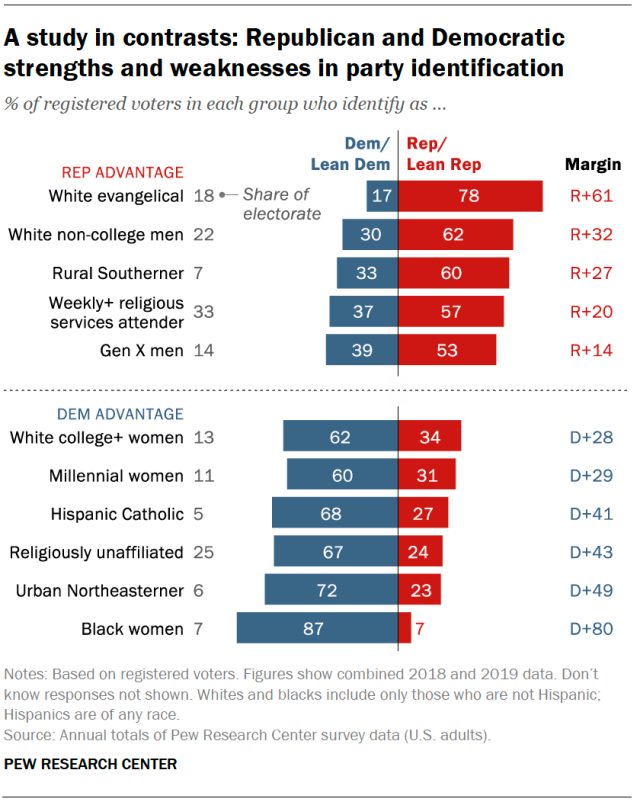
According to the Pew Research Center, Democrats hold advantages in party identification among blacks, Asians, Hispanics, well-educated adults, and Millennials. Republicans have leads among whites – particularly white men, those with less education, and evangelical Protestants – as well as members of the Silent Generation. Just 36 percent of registered voters have a four-year college degree or more education; a sizable majority (64 percent) have not completed college. Democrats increasingly dominate in party identification among white college graduates – and maintain wide and long-standing advantages among black, Hispanic, and Asian American voters. Republicans increasingly dominate party affiliation among white non-college voters, who continue to make up a majority (57 percent) of all GOP voters.
*Here is one example of critical race theory: the Servicemen’s Readjustment Act of 1944, a.k.a. the G.I. Bill. African American veterans benefited less than others from the G.I. Bill, and it was designed that way. The G.I. Bill aimed to help American World War II veterans adjust to civilian life by providing them with benefits including low-cost mortgages, low-interest loans, and financial support. African Americans did not benefit nearly as much as White Americans. The law was deliberately designed to accommodate Jim Crow laws. Banks and mortgage agencies refused loans to blacks, making the G.I. Bill even less effective for non-whites. Once they returned from the war, blacks faced discrimination and poverty, which represented a barrier to harnessing the mortgage and educational benefits of the G.I. Bill, because labor and income were immediately needed at home. Most southern universities refused to admit blacks until the Civil Rights revolution. Colleges accepting blacks in the South (numbering about 100) were of lower quality, with 28 classified as sub-baccalaureate. Only seven states offered post-baccalaureate training, while no accredited engineering or doctoral programs were available for blacks. By 1946, only one-fifth of the 100,000 blacks who had applied for educational benefits had been registered in college. Furthermore, historically black colleges and universities (HBCUs) came under increased pressure as rising enrollments and strained resources forced them to turn away an estimated 20,000 veterans. Though blacks encountered many obstacles in their pursuit of G.I. benefits, the bill greatly expanded the population of African Americans attending college and graduate school. In 1940, enrollment at Black colleges was 1.08 percent of total U.S. college enrollment. By 1950 it had increased to 3.6 percent. However, these gains were limited almost exclusively to Northern states, and the educational and economic gap between white and black nationally widened under the effects of the G.I. Bill. With 79 percent of the black population living in southern states, educational gains were limited to a small part of black America.
Did any of you learn this in school? Is there harm in teaching failures in history? If we do not know about the failure to live up to the ideals of the Declaration of Independence or the Constitution, then how can we begin to correct these mistakes and move forward? And this fear, my friends, is what the Republicans (and conservatives throughout history) fear the most: progress and equality.

Shall I compare thee to a summer’s day?

Shall I compare thee to a summer’s day? (Sonnet 18)
By William Shakespeare – 1564-1616
Shall I compare thee to a summer’s day?
Thou art more lovely and more temperate.
Rough winds do shake the darling buds of May,
And summer’s lease hath all too short a date.
Sometime too hot the eye of heaven shines,
And often is his gold complexion dimmed;
And every fair from fair sometime declines,
By chance, or nature’s changing course, untrimmed;
But thy eternal summer shall not fade,
Nor lose possession of that fair thou ow’st,
Nor shall death brag thou wand’rest in his shade,
When in eternal lines to Time thou grow’st.
So long as men can breathe, or eyes can see,
So long lives this, and this gives life to thee.
This sonnet is certainly the most famous in the sequence of Shakespeare’s sonnets; it may be the most famous lyric poem in English. It’s also one of my favorite Shakespearean sonnet. Among Shakespeare’s works, only lines such as “To be or not to be” and “Romeo, Romeo, wherefore art thou Romeo?” are better-known. This is not to say that it is at all the best or most interesting or most beautiful of the sonnets; but the simplicity and loveliness of its praise of the beloved has guaranteed its place.
On the surface, the poem is simply a statement of praise about the beauty of the beloved; summer tends to unpleasant extremes of windiness and heat, but the beloved is always mild and temperate. Summer is incidentally personified as the “eye of heaven” with its “gold complexion”; the imagery throughout is simple and unaffected, with the “darling buds of May” giving way to the “eternal summer”, which the speaker promises the beloved. The beloved’s “eternal summer” shall not fade precisely because it is embodied in the sonnet: “So long as men can breathe or eyes can see,” the speaker writes in the couplet, “So long lives this, and this gives life to thee.” The language, too, is comparatively unadorned for the sonnets; it is not heavy with alliteration or assonance, and nearly every line is its own self-contained clause—almost every line ends with some punctuation, which effects a pause.



Authors
Recent Comments
noisilycool3bc985058… on Pic of the Day Joe on Pic of the Day noisilycool3bc985058… on Pic of the Day Mark Douglas Budka on Gates noisilycool3bc985058… on Pic of the Day Top Posts & Pages




Amazon Associate

As an Amazon Associate I earn from qualifying purchases. So, if you click on a link that takes you to Amazon.com, I may earn a commission.
Trust me, it isn’t much, but every little bit helps.

 Joe
Joe


 The Closet Professor