

Monthly Archives: August 2023
Liberty v. Power

The love of liberty is the love of others; the love of power is the love of ourselves.
—William Hazlitt
William Hazlitt (10 April 1778 – 18 September 1830) was an English essayist, drama and literary critic, painter, social commentator, and philosopher. In the above quote, Hazlitt makes a point that is relevant today as it was over 200 years ago when he was alive. As we see more and more right wing politicians striving for greater power by taking away the liberty of those they deem unworthy or a threat to their power. They attack those who are most vulnerable: transgender youth (and all other LGBTQ+ people), immigrants, minorities, and the list grows on and on. It’s not just Donald Trump, Ron DeSantis, and their followers, but this trend towards a 21st century fascism is on the rise around the world.
Thomas Paine began his pamphlet The Crisis with these famous words, “These are the times that try men’s souls; the summer soldier and the sunshine patriot will, in this crisis, shrink from the service of his country; but he that stands it now, deserves the love and thanks of man and woman. Tyranny, like hell, is not easily conquered; yet we have this consolation with us, that the harder the conflict, the more glorious the triumph.”
The right wing politicians are definitely “summer soldier and the sunshine patriot.” They wrap their undemocratic laws and policies in the name of protecting democracy, yet they are really trying to destroy democracy. The greatest threat is that if they come to power, their tyranny will “not easily conquered.” The more laws they pass and the more the courts side with these policies, the harder it will be to undo the damage.

So It Begins…
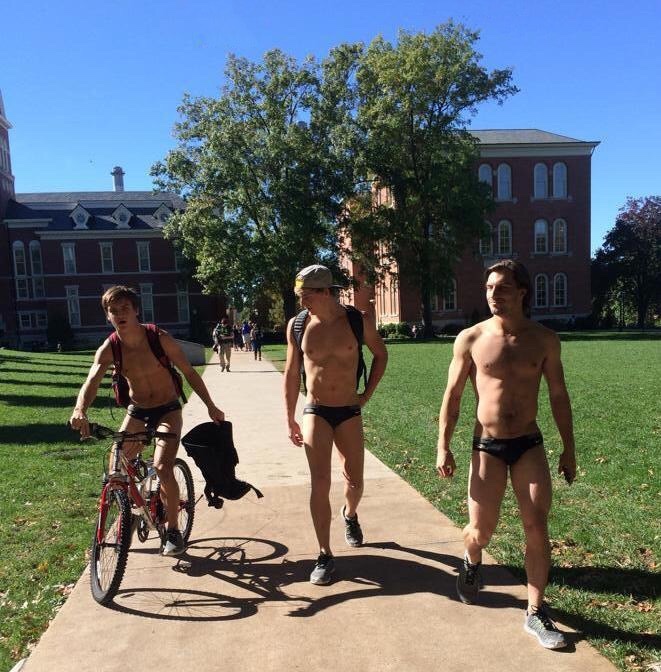
First, you’ll never see students on my campus dressed this way. Maybe if they are on the swim or dive team, but they they wouldn’t be out on campus like this. Rarely do I ever see guys without their shirts. It’s probably the only thing I miss about campuses in the South.
Anyway, my first class seemed to go well yesterday, and I think I have a good group of students. It’s a small class, but once I get them all more comfortable in the class, I think we’ll get some good discussions going. I have my second class tomorrow, and then I’ll be teaching various classes nearly all day every day for the next two weeks. As I said the other day, it will slow down some after September, but it’s a marathon over the next month. After that, it will be a series of sprints for the rest of the semester. At least I get a three day weekend to rest before the “marathon” begins.

The Imaginal Stage

The Imaginal Stage
By D. A. Powell
turns out
there are more planets than stars
more places to land
than to be burned
I have always been in love with
last chances especially
now that they really do
seem like last chances
the trill of it all upending
what’s left of my head
after we explode
are you ready to ascend
in the morning I will take you
on the wing
About This Poem
“An imago is, for many winged insects, the final form of its metamorphosis. The plural of imago is imagines, and this time in the insect’s life is called the imaginal stage. The insect at this point has reached sexual maturity and has also earned its wings.” —D. A. Powell
About The Poet
D. A. Powell was born in Albany, Georgia, on May 16, 1963. He attended Sonoma State University, where he received his bachelor’s degree in 1991 and his master’s in 1993. He received his MFA degree from the Iowa Writers’ Workshop in 1996.
Powell is the author of the trilogy of books Cocktails (Graywolf Press, 2004), which was nominated for the National Book Critics Circle Award, Lunch (Wesleyan University Press, 2000), and Tea (Wesleyan University Press, 1998). His poetry collection Chronic(Graywolf Press, 2009) received the Kingsley Tufts Award and was nominated for a National Book Critics Circle Award. His most recent books are Repast: Tea, Lunch, Cocktails (Graywolf Press, 2014) and Useless Landscape, or a Guide for Boys: Poems(Graywolf Press, 2012).
Powell’s subjects range from movies, art, and other trappings of contemporary culture to the AIDS pandemic. Powell’s work often returns to AIDS; his first three collections have been called a trilogy about the disease. As Carl Phillips wrote in his judge’s note for Boston Review’s Annual Poetry Award for Powell’s work, “No fear, here, of heritage nor of music nor, refreshingly, of authority. Mr. Powell recognizes in the contemporary the latest manifestations of a much older tradition: namely, what it is to be human.”
Powell has received a Paul Engle Fellowship from the James Michener Center, a grant from the National Endowment for the Arts, and the Lyric Poetry Award from the Poetry Society of America, among other awards.
Powell has taught at Columbia University, the University of Iowa, Sonoma State University, and San Francisco State University and served as the Briggs-Copeland Lecturer in Poetry at Harvard University. He currently teaches at the University of San Francisco.

Busy Weeks Ahead

Classes start back this week, and for the first time in over ten years, I’ll be back in a college classroom teaching a full semester long course using the museum’s collection. I’ve been teaching a class here and there for various professors who want to use objects from the museum, but that’s just one or two days in those classes. My first class will be tomorrow, and unless there was a rush of students signing up for it over the weekend, it should be a nice small group of students.
In addition to my class, we have a new exhibit we are preparing to open on Friday. Also, during the two weeks after this one, I’ll be teaching more than 30 classes for other professors hoping to use objects from the museum. Nearly every day during September, I have at least one class a day, sometimes, there will be seven or eight in a day.
It’s tiring and a lot of work, but there is always a rush at the beginning of the semester. It should slow down in October. If you’ve ever taught, you know how tiring teaching can be. You have to be “on” and at your best for your students. It’s a good tiring though, especially if your students are enjoying their learning experience.
The Great Physician

When Jesus heard it, He said to them, “Those who are well have no need of a physician, but those who are sick. I did not come to call the righteous, but sinners, to repentance.”
—Mark 2:17
I’m not feeling great this morning, and I was thinking of how Jesus is known as “The Great Physician.” He is called this for several reasons, not least of all because of the many miracles of healing He performed during His earthly ministry. The Bible tells us in John 6:2, “Then a great multitude followed Him, because they saw His signs which He performed on those who were sick.” He healed many sick people in the cities he traveled to. But Jesus wanted more than to heal their physical bodies. He wanted them to believe in Him.
When we read the four gospels in the Bible, we see many accounts of miraculous healings that Jesus performed. He healed people from leprosy (Luke 17:11-19), paralysis (Matthew 9:1-8), blindness (Matthew 9:27-31), deafness (Mark 7:31-37), and other illnesses. He cured many people (Luke 4:40). He even brought three dead people back to life: the son of a widow (Luke 7:11-17), the daughter of Jairus (Mark 5:21-24, 35-43), and Lazarus (John 11:1-44). In John 4:48, He once said, “Unless you people see signs and wonders, you will by no means believe.” All the signs and wonders Jesus performed had the purpose of proving that He was the Son of God, the promised Messiah. John 20:30-31 proclaims, “And truly Jesus did many other signs in the presence of His disciples, which are not written in this book; but these are written that you may believe that Jesus is the Christ, the Son of God, and that believing you may have life in His name.”
A clear example of the purpose behind the miracles is His healing of a man born blind (John 9:1-41), a miracle that no one had ever heard of before (John 9:32). John 9:33 tells us that the Jews knew that “If this Man were not from God, He could do nothing.” That’s why the Pharisees did everything they could to dismiss this miracle, up to the point of excommunicating the main witness (John 9:34). They knew, if they admitted that Jesus had done it, they would have to admit that He was the Messiah. So, they kept on refusing to believe the evidence because they didn’t want to believe in Jesus (John 9:39-41).
During His ministry, Jesus didn’t heal only people’s physical bodies. He cared for the other aspects of their ailments as well. He knew what they needed besides getting rid of their sicknesses. For example, when Jesus healed a man with leprosy in Matthew 8:1-4, He first touched him. We don’t know for how long that man had been sick. Due to the strict laws regarding skin diseases, we can assume that, for the duration of his illness, no one had ever touched him, until Jesus did. Leprosy is spread through touch, and Jesus’s touch was the first physical contact he had had in a long time. Jesus also told him to show himself to the priest and follow what the Law of Moses determined that he should do in that case. The procedure would allow him to be socially and religiously active again. After the priest confirmed his healing, he would be able to go to the Temple, to move back inside the city, and to touch and be touched. He would have his normal life back. It was not only about physical healing. Jesus took care of this man’s emotional, social, and psychological needs as well.
The Bible mentions other aspects of the mind and the heart that Jesus takes care of. For example, He takes care of our anxiety. First Peter 5:7 says, “casting all your care upon Him, for He cares for you.” He gives us peace (John 14:27), rest (Matthew 11:28), and joy (John 15:11). He gives purpose to our lives (Philippians 1:21) and makes us part of His family (John 1:12). Every good thing that we have and everything we need comes from the Father through Him (James 1:17). Jesus also gives us the respect we deserve in this life. No one can take away our faith because they say LGBTQ+ people are unworthy. He gives us the love so many of us need in this life. He wants us to be part of his family, and it is through Christ’s teachings that we can make the world a better place.
Jesus never promised to heal every sickness we have in this life. We will inevitably experience suffering (John 16:33), but Jesus wants us to be healed and saved. That’s why He died and was resurrected. The Bible tells us that, one day, we will meet with Him (1 Thessalonians 4:17). He will give us an immortal body (1 Corinthians 15:54). There will be no more sickness, no more pain. We will be free from all suffering (Revelation 21:4). And we will enjoy eternity in His glorious presence.



Authors
Recent Comments
noisilycool3bc985058… on Pic of the Day iameverywhere1 on Not Quite as Planned iameverywhere1 on Pic of the Day noisilycool3bc985058… on Not Quite as Planned Joe on Pic of the Day Top Posts & Pages



Amazon Associate

As an Amazon Associate I earn from qualifying purchases. So, if you click on a link that takes you to Amazon.com, I may earn a commission.
Trust me, it isn’t much, but every little bit helps.

 Joe
Joe


 The Closet Professor