

Monthly Archives: December 2024
The Old Year

The Old Year
By John Clare
The Old Year’s gone away
To nothingness and night:
We cannot find him all the day
Nor hear him in the night:
He left no footstep, mark or place
In either shade or sun:
The last year he’d a neighbour’s face,
In this he’s known by none.
All nothing everywhere:
Mists we on mornings see
Have more of substance when they’re here
And more of form than he.
He was a friend by every fire,
In every cot and hall—
A guest to every heart’s desire,
And now he’s nought at all.
Old papers thrown away,
Old garments cast aside,
The talk of yesterday,
Are things identified;
But time once torn away
No voices can recall:
The eve of New Year’s Day
Left the Old Year lost to all.
About the Poem
John Clare’s poem “The Old Year” reflects on the passage of time, focusing on the transition from one year to the next. The poem is deeply rooted in Clare’s characteristic sensitivity to nature, change, and human experience. The poem treats the “old year” as a living entity, personifying it as something that has completed its journey and now fades into the past. Clare mourns the passing of the old year, imbuing it with a sense of nostalgia and melancholy. The tone suggests a recognition of time’s relentless progression, an idea that resonates universally.
Clare often uses imagery from the natural world to express emotions, and this poem is no exception. The changing of the year is depicted through seasonal transitions, emphasizing the cycles of nature as a parallel to human life and time. For example, the closing of the year might evoke images of winter or decay, symbolizing an end but also hinting at renewal.
The poem captures the duality of endings and beginnings. While the old year is mourned, there is an implicit acknowledgment that a new year is dawning, bringing fresh opportunities and challenges. Clare’s reflection on the passing year invites readers to consider their own experiences, losses, and hopes for the future. The poem is wistful and contemplative, blending sadness for what is gone with a quiet acceptance of change. This emotional depth makes the poem relatable, as it mirrors the universal human tendency to reflect on time, achievements, and missed opportunities.
Clare’s “The Old Year” serves as a meditation on impermanence, inviting readers to pause and consider the flow of life and the inevitable passage of time. It is both personal and universal, making it a poignant reflection on the human condition.
About the Poet
John Clare (1793–1864) was an English poet known for his vivid depictions of rural life and nature, as well as his poignant explorations of human emotion and identity. Sometimes called the “peasant poet,” Clare’s work is remarkable for its deep empathy for the natural world and its ability to capture the details of everyday life with precision and beauty. Despite his humble background and later struggles with mental health, Clare’s poetry continues to be celebrated for its authenticity, lyricism, and insight.
Clare was born in Helpston, Northamptonshire, to a poor agricultural family. He had minimal formal education and worked as a farm laborer from a young age, which deeply influenced his poetry. His love of nature began in childhood, where he spent time exploring the countryside around his home. Clare’s first collection of poetry, Poems Descriptive of Rural Life and Scenery (1820), brought him initial fame and recognition. His ability to capture the details of rural life resonated with readers and critics, earning him the nickname “Northamptonshire Peasant Poet.” Subsequent collections, such as The Village Minstrel (1821), continued to showcase his deep connection to nature and his gift for descriptive writing.
Clare wrote extensively about the English countryside, celebrating its beauty while lamenting its destruction due to industrialization and enclosure laws. He depicted the daily lives of villagers and farmers with both realism and affection. Later in life, Clare’s poetry often explored themes of alienation, identity, and loss, reflecting his personal struggles.
Clare experienced mental health challenges later in life, exacerbated by financial difficulties and a sense of disconnection from the changing world around him. He spent his final years in an asylum, where he continued to write poetry, including some of his most haunting and introspective work. Poems like “I Am” reflect his feelings of isolation and yearning for peace.
Clare was largely forgotten after his death in 1864 but was rediscovered in the 20th century as a major Romantic poet. Today, he is celebrated for his unique voice, keen observational skills, and the authenticity of his work. His poems remain a vital part of English literature, offering a timeless appreciation for the natural world and the complexities of the human spirit. John Clare’s life and work stand as a testament to the enduring power of poetry to capture the beauty of the world and the struggles of the human heart.

Backache

I don’t remember what it was I did yesterday, but I think it was picking up something heavy. Anyway, I remember when I did it, I thought, Oh! That doesn’t feel right. And sure enough, I woke up this morning with a stabbing pain in my lower back. It’s not so bad that it’s inhibiting too much movement, but it does make bending over uncomfortable. Some time on a heating pad, pain medicine, and a muscle relaxer should take care of the issue. I just need to take it easy today. Thankfully, I don’t have to return to work until Thursday. The only thing I really need to do today is do some work on my class that starts next week.

The End and the Beginning

Forget the former things; do not dwell on the past. See, I am doing a new thing! Now it springs up; do you not perceive it? I am making a way in the wilderness and streams in the wasteland.
— Isaiah 43:18-19
Therefore, if anyone is in Christ, the new creation has come: The old has gone, the new is here!
—2 Corinthians 5:17
As the final days of the year slip away and we prepare to welcome a new year, we stand at a crossroads of endings and beginnings. The old year, with its triumphs and struggles, is behind us. The new year, full of hope and uncertainty, stretches before us like a blank canvas. This year, for many of us, the coming year and the four to follow are probably fraught with more uncertainty than hope with the inauguration of the new administration in three weeks. However, we will not dwell on that today. Instead, I want to look at the transformation from endings to beginnings. This transition offers us a sacred opportunity to reflect, release, and renew. It is a chance to let go of what no longer serves us and embrace the new things God is doing in our lives. Let us consider how God works through endings and beginnings, transforming both into opportunities for growth, grace, and hope.
The closing of a year naturally invites reflection. We look back at the milestones, the unexpected turns, and the lessons learned. Reflection is a holy act—it allows us to recognize God’s faithfulness in the joys and in the challenges. But God also calls us to release the past. In Isaiah 43:18, God says, “Forget the former things; do not dwell on the past.” This doesn’t mean ignoring what has happened, but rather choosing not to let past mistakes, failures, or even successes define us. What do you need to leave behind as the old as 2024 comes to a close? Perhaps it’s a lingering hurt, an old habit, or a missed opportunity. Just as God’s mercies are new every morning, He offers us the freedom to begin again.
Forgiving others and ourselves is key to moving forward. Just as Christ forgave us, we are called to release the burden of grudges and regrets. In doing so, we open our hearts to the newness God has in store. Over and over again, God calls us to forgive others. In the Sermon on the Mount, Jesus says in Matthew 6:14-15, “For if you forgive other people when they sin against you, your heavenly Father will also forgive you. But if you do not forgive others their sins, your Father will not forgive your sins.” Forgiveness is not optional in the Christian life. It reflects the forgiveness we have received from God. Paul tells us in Colossians 3:13, “Bear with each other and forgive one another if any of you has a grievance against someone. Forgive as the Lord forgave you.” Just as God forgives us freely, we are called to extend that same grace to others. When Jesus was challenged by the chief priests in Mark 11:25, He says, “And when you stand praying, if you hold anything against anyone, forgive them, so that your Father in heaven may forgive you your sins. Forgiveness clears the way for reconciliation with God and others.
The new year is a reminder that God is always at work, creating and renewing. In Isaiah 43:19, God declares, “See, I am doing a new thing!” God is a God of new beginnings, offering us fresh starts not just once a year but every single day. What “new thing” is God calling you to? Perhaps it’s a new season in your relationships, a deeper commitment to your faith, or a step into the unknown. God makes a way in the wilderness and streams in the wasteland—He specializes in creating possibilities where none seemed to exist. In 2 Corinthians 5:17, Paul reminds us that “Therefore, if anyone is in Christ, the new creation has come: The old has gone, the new is here!” This means our past doesn’t define us. Our mistakes don’t have the final say. God’s grace transforms us from the inside out, enabling us to live with purpose and joy.
The transition between the old and the new is not always smooth. There may be uncertainty, hesitation, or fear. But as people of faith, we trust that God is with us in the in-between spaces. Paul says in 1 Corinthians 13:11, “When I was a child, I talked like a child, I thought like a child, I reasoned like a child. When I became a man, I put aways childish things.” The new year is like a blank page, and we often worry about what will be written on it. But as believers, we can face the future with hope. Romans 15:13 says, “May the God of hope fill you with all joy and peace as you trust in him, so that you may overflow with hope by the power of the Holy Spirit.”
As we step into this new beginning, here are some ways we can align our hearts with God’s plans. Dedicate the year to God. Ask for His guidance, wisdom, strength, and forgiveness. Instead of just making resolutions, focus on deepening your faith. Commit to prayer, Scripture, and acts of service. The new year may not bring immediate change, but trust that God’s work is unfolding in His perfect time. Allow God to shape you, even if it means stepping out of your comfort zone. Growth often comes from challenges. As we say goodbye to the old and welcome the new, let us remember that God is the Alpha and the Omega—the beginning and the end. He has been with us through the past year and will walk with us into the next.










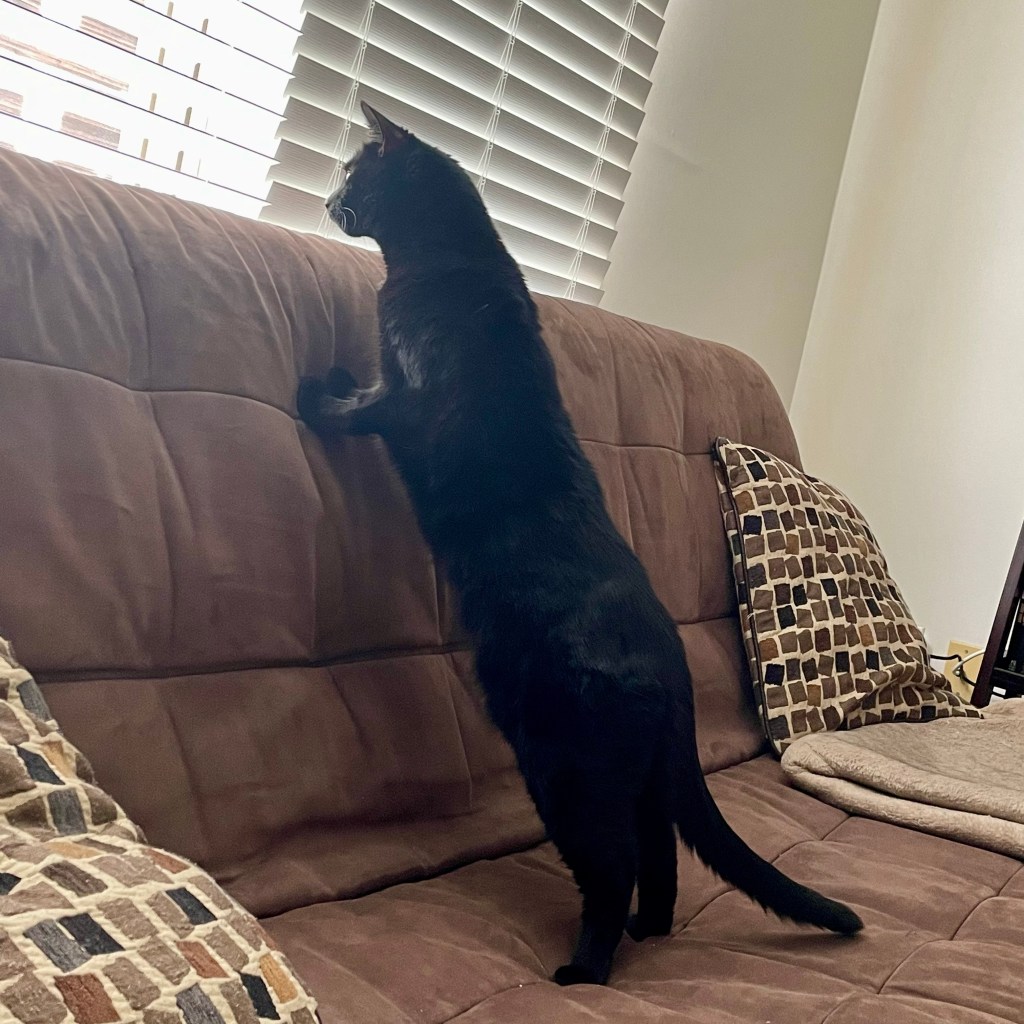

Going Home Tomorrow

I’m thankful I got to spend time with family, if only because I can tell how bad my mother’s dementia is getting. I want to be able to see her while she’s still doing relatively good, even though I can see the decline. We watched as her father slipped into dementia and that was hard enough, but this is my mama. She may have her faults, but no matter what, she’s still the woman who gave birth to me.
My father has actually been on good behavior. I still have another day to go here, so hopefully I’m not jinxing it, but he hasn’t started an argument with me over some perceived slight, which is usually what he does. If I can make it one more day, then I’ll be on my way home.
I’ll fly back to Vermont tomorrow afternoon. I’m ready to be back home with Isabella and sleeping in my own bed. I have a two hour layover in Atlanta and should arrive back in Vermont just before midnight, as long as there are no unforeseen delays. As it is, the trip back will put me getting home at about 1am Sunday morning. Tomorrow will be a long day, but I least I should be home at the end of it.


Authors
Recent Comments
furbirdsqueerly on Pic of the Day Joe on Pic of the Day noisilycool3bc985058… on Pic of the Day vandycolt on Moment of Zen: Reading noisilycool3bc985058… on Pic of the Day Top Posts & Pages




Amazon Associate

As an Amazon Associate I earn from qualifying purchases. So, if you click on a link that takes you to Amazon.com, I may earn a commission.
Trust me, it isn’t much, but every little bit helps.

 Joe
Joe


 The Closet Professor