

Monthly Archives: February 2025
TGIWFHF

Thank goodness, it’s a work from home Friday. I can relax and not be bothered. I have to do some online training today, and I’ll probably grade some midterms. Other than that, it should be an easy day. This week has either been incredibly busy or incredibly boring. There hasn’t been much in between. I have a four day weekend at home since we are off Monday for Spring Break.
If you are in the USA, you might have heard about the organization People’s Union USA calling for a nationwide boycott. They want today to be an economic blackout. This movement follows the rollback of diversity, equity and inclusion initiatives at several major companies, including Target, PepsiCo and others. (Coca-Cola and Apple have both refused to rollback DEI initiatives.) The boycott coincides with protests against President Dumbass’s plans to reduce the government workforce and mass firings at federal agencies. The boycott began at midnight last night and will last for 24 hours. During this time, the organization encourages Americans not to buy anything — this includes gas, fast food, or shopping in-store or online at major retailers. If participants need to buy anything, they are encouraged to shop at local and small businesses. Essential items such as medicine, food and emergency supplies can still be bought.
I hope you’ll join in. The thing about boycotts is that if enough people don’t participate, then it won’t be successful. There had to enough of an economic impact to make a difference and to make the point your trying to make. So, please consider following this boycott and only buy locally today.

Inspirational Quote
“We deserve to experience love fully, equally, without shame and without compromise.” — Elliot Page
Love is one of the most fundamental human experiences, yet for too long, LGBTQ+ individuals have been told that their love is something to be hidden, altered, or diminished. Elliot Page’s words remind us that love should be free from fear and compromise. No one should have to justify their identity or fight for the right to love openly and authentically.
This quote speaks to the importance of equality—not just in legal rights, but in the way love is valued and respected in society. It’s a call to reject shame and embrace pride, to push back against narratives that suggest LGBTQ+ love is anything less than beautiful and valid. Whether in relationships, friendships, or self-love, everyone deserves to experience love without barriers. Today, let this quote serve as a reminder to support, uplift, and celebrate each other in our journeys toward full acceptance and joy.
Since it’s Thursday, here’s your Isabella Pic of the Week:

This is about as close as I get to her cuddling. She’s not a cuddly cat, and she also seems to not like her picture being taken.

The Aesthetics of the Male Nude in Ancient Art

The male nude was a central subject in the art of many ancient civilizations, particularly in Greece and Rome, but also in Egypt and Mesopotamia. These representations were not just artistic choices but carried deep cultural, religious, and philosophical meanings. The aesthetic of the male nude in the ancient world often emphasized idealized forms, physical perfection, and heroic attributes, reflecting societal values and beliefs about masculinity, virtue, and even divine favor.
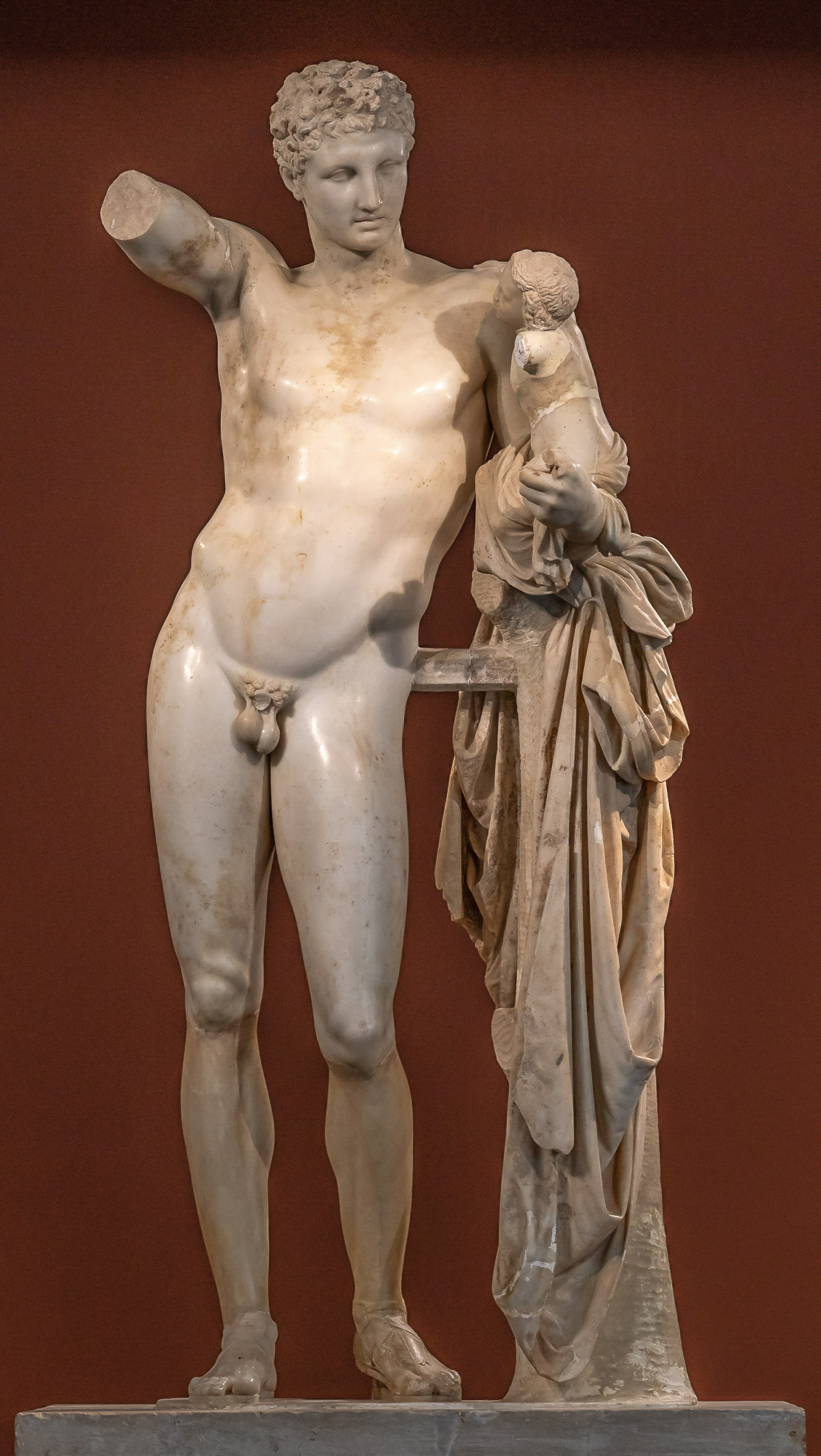
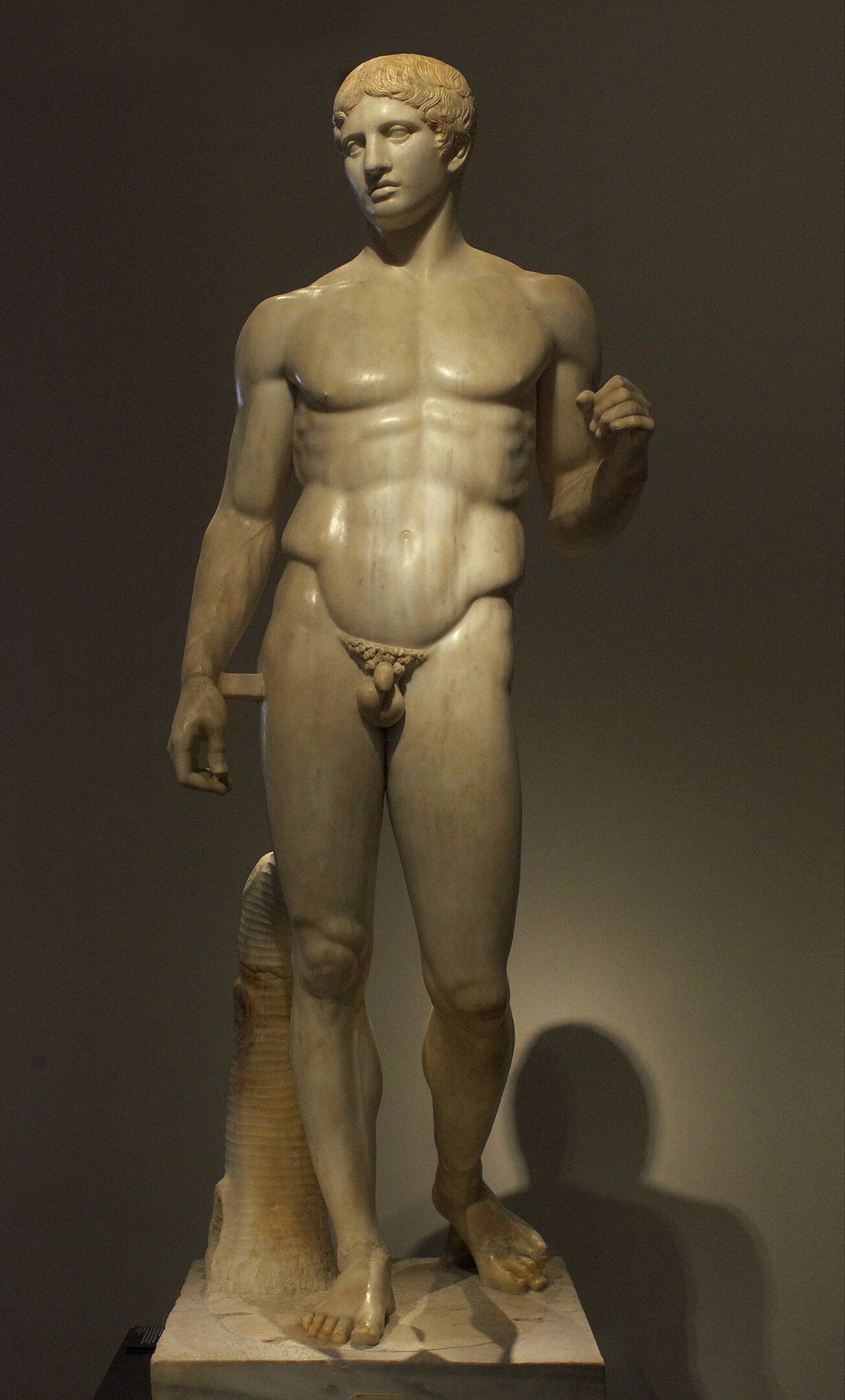
In ancient Greek art, the male nude was idealized in sculpture, particularly in works such as Polykleitos’ Doryphoros and Praxiteles’ Hermes and the Infant Dionysus. The Greek kouros statues (early archaic depictions of young men) emphasized youthful beauty, symmetry, and a balance between realism and idealization. Nudity in Greek art was associated with athleticism, heroism, and even moral virtue, reflecting the Greek belief that the male form was the pinnacle of divine beauty. Greek vase paintings often depicted nude male athletes, warriors, and gods, reinforcing the connection between physical excellence and noble character. The gymnasium (a place where young men trained nude) was both an athletic and intellectual center, reinforcing the idea that physical and intellectual excellence were intertwined.
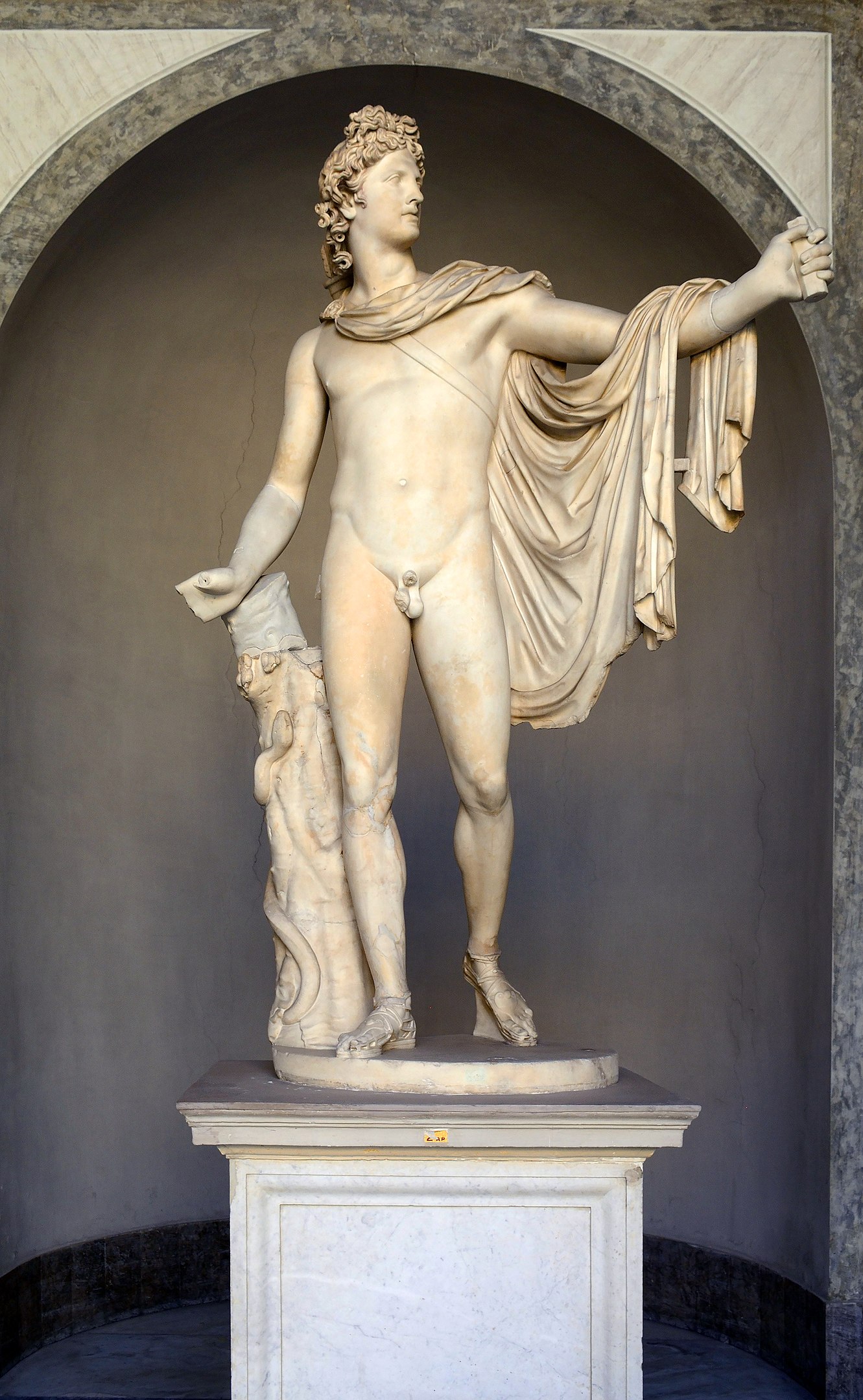
The second century Roman copy of the Apollo Belvedere is one of, if not the, most celebrated marble sculpture of a nude male from classical antiquity. From the mid-18th century, it was considered the greatest ancient sculpture by ardent neoclassicists, and for centuries it epitomized the ideals of aesthetic perfection for Europeans and westernized parts of the world. The Apollo became one of the world’s most celebrated art works when in 1755 it was championed by the German art historian and archaeologist Johann Joachim Winckelmann as the best example of the perfection of the Greek aesthetic ideal. Its “noble simplicity and quiet grandeur,” as he described it, became one of the leading lights of neoclassicism and an icon of the Enlightenment. Goethe, Schiller, and Byron, all endorsed it. The Apollo was one of the artworks brought to Paris by Napoleon after his 1796 Italian Campaign. From 1798 it formed part of the collection of the Louvre during the First Empire, but after 1815 was returned to the Vatican where it has remained ever since.
The frequent depiction of the male nude in ancient art reveal how cultures conceptualized beauty, masculinity, and relationships between men. In ancient Greece, for example, the admiration of the male form was closely tied to pederasty, a socially accepted relationship between an older man (erastes) and a younger man (eromenos). This relationship was often educational and mentorship-based but could also have an erotic component. Greek vase paintings sometimes depicted these relationships explicitly, showing affection between men, including courtship rituals like gift-giving or intimate gestures. In Rome, male-male relationships existed, but Roman masculinity was defined differently than in Greece. A freeborn Roman man (citizen) could engage in relationships with other men, but societal norms dictated that he should take the dominant role; being the passive partner was seen as unmanly. Roman frescoes and sculptures sometimes depicted homoerotic themes, especially in private or mythological contexts, such as scenes involving the god Ganymede, who was abducted by Zeus.
While not often, Greek and Roman art would feature homoerotic relationships. One of the most compelling pieces of ancient Roman art that directly addresses same-sex desire is the Warren Cup, a silver drinking vessel from the 1st century CE. The Warren Cup, named after its modern owner Edward Perry Warren, is a luxurious Roman silver cup featuring explicit homoerotic scenes. The two sides of the cup depict male-male sexual encounters between older and younger men, rendered in a detailed and naturalistic style. The craftsmanship suggests that it was an elite object, likely used in private banquets (symposia) where discussions of philosophy, poetry, and sexuality took place. The scenes on the cup align with what we know of Roman and Greek attitudes toward male-male relationships. The figures are shown engaging in acts that emphasize the older man as the active partner and the younger as the passive partner, reflecting Roman norms around masculinity and dominance in sexual relationships. The setting, with draped beds and carefully arranged compositions, suggests that such relationships were not only known but also accepted in elite social circles. The cup’s artistic style is distinctly Greco-Roman, with a focus on idealized musculature and classical composition. The use of silver, a valuable material, indicates that it belonged to a wealthy individual who may have collected art reflecting personal tastes or cultural ideals around eroticism.
Continue reading
The Journey

The Journey
by Mary Oliver
One day you finally knew
what you had to do, and began,
though the voices around you
kept shouting
their bad advice—
though the whole house
began to tremble
and you felt the old tug
at your ankles.
“Mend my life!”
each voice cried.
But you didn’t stop.
You knew what you had to do,
though the wind pried
with its stiff fingers
at the very foundations,
though their melancholy
was terrible.
It was already late
enough, and a wild night,
and the road full of fallen
branches and stones.
But little by little,
as you left their voices behind,
the stars began to burn
through the sheets of clouds,
and there was a new voice
which you slowly
recognized as your own,
that kept you company
as you strode deeper and deeper
into the world,
determined to do
the only thing you could do—
determined to save
the only life you could save.
About the Poem
Mary Oliver’s poem “The Journey” is a deeply inspirational and metaphorical piece about personal transformation, self-discovery, and resilience. It describes the speaker’s realization that they must leave behind external voices and influences in order to forge their own path in life. The poem is often interpreted as an encouragement to break free from unhealthy situations, relationships, or societal expectations to embrace one’s own truth.
The poem begins with a sense of urgency—”One day you finally knew what you had to do, and began.” This opening line sets the stage for the journey as a necessary and inevitable step toward self-liberation. The speaker acknowledges that, although others may demand their attention and try to hold them back, they must move forward. Oliver vividly describes the external voices calling after the speaker, emphasizing how difficult it is to break away. These voices represent societal pressures, relationships, or even self-doubt that try to prevent change. The imagery of a storm and darkness conveys the challenges and emotional turmoil of making such a difficult decision.
Despite the hardships, the speaker persists, pushing forward into the unknown. The journey becomes symbolic of self-reliance and personal growth. The physical struggle in the poem mirrors an internal struggle to stay true to oneself despite fear and uncertainty. By the end of the poem, the speaker finds that the world begins to open up—”the stars began to burn through the sheets of clouds.” This suggests enlightenment, hope, and a sense of peace. The journey was painful, but it was necessary to achieve personal freedom and fulfillment.
“The Journey” is a poem about finding the strength to follow one’s own path despite external pressures. Mary Oliver’s simple yet profound language makes it a universal and uplifting piece that resonates with anyone undergoing a period of change or self-discovery. The poem ultimately affirms that, though the journey may be difficult, it is essential for living an authentic and fulfilled life.
About the Poet
Mary Oliver (1935–2019) was an American poet known for her deep connection to nature, spirituality, and the themes of self-discovery, love, and mindfulness. She was one of the most beloved contemporary poets, celebrated for her accessible yet profound writing style that resonated with readers across generations. Born in Maple Heights, Ohio, Oliver had a difficult childhood and found solace in nature and poetry. She was heavily influenced by poets such as Walt Whitman and Rainer Maria Rilke, whose themes of transcendence and deep observation of the world around them echoed in her own work. In her teenage years, she spent time at the home of poet Edna St. Vincent Millay, helping to organize Millay’s papers, which further shaped her literary career.
Oliver lived much of her life in Provincetown, Massachusetts, where she found inspiration in the coastal landscapes. She was in a long-term relationship with photographer Molly Malone Cook, who was also her literary agent. Their partnership greatly influenced Oliver’s poetry, often bringing themes of love and companionship into her work.
Mary Oliver’s poetry remains widely read and quoted, particularly in spiritual and self-help communities. Her work continues to inspire readers to embrace nature, self-reflection, and the beauty of everyday life. She was often compared to poets like Emily Dickinson and Robert Frost for her ability to capture deep truths in simple, evocative language. Her most famous lines, such as “Tell me, what is it you plan to do with your one wild and precious life?” from “The Summer Day,” encapsulate the essence of her poetic vision—one of wonder, appreciation, and a call to live fully.
Thank you, Susan, for sending me this wonderful and thought provoking poem.

Grading

Although I’ll be dressed and in my office, I will probably have the same look as this guy all day today. I need to catch up on grading. I love teaching, but I have always loathed grading. For one thing, it takes up a lot of time, and I don’t like giving bad grades, though I think any good teacher would hate giving bad grades I know there are some who get joy out of it, but if students are making bad grades, a lot of that reflects back on how well a teacher is doing their job.
Also, modern technology like texting, tweeting, etc. has caused many people to write in a modern and often perplexing shorthand, and people get out of the habit of writing complete sentences. An emphasis on teaching writing is not what students are used to anymore. That being said, this is usually an issue with freshman. None of my students are freshmen, and thus are further along in their studies.
It’s also hard to get students into discussions in class or to ask questions. I get that. I was a very shy and not a confident student. I was a good and attentive student, but I was always afraid I’d say something dumb. So, I mostly kept quiet. To make up for this, I have my students write journal entries each week, that I “grade at random,” which translates to, I’ll grade them when I have to. Well, I need to catch up on grading their journals. Usually, it’s mostly pretty interesting because I get to see what my students are thinking about and learning in class.
I should have been grading all weekend, but I’ve had a migraine and kept putting it off. So, I need to get caught up today and turn in midterm grades. Luckily, I will be the only one in the office today and can concentrate on grading.


Authors
Recent Comments
noisilycool3bc985058… on Pic of the Day iameverywhere1 on Not Quite as Planned iameverywhere1 on Pic of the Day noisilycool3bc985058… on Not Quite as Planned Joe on Pic of the Day Top Posts & Pages



Amazon Associate

As an Amazon Associate I earn from qualifying purchases. So, if you click on a link that takes you to Amazon.com, I may earn a commission.
Trust me, it isn’t much, but every little bit helps.

 Joe
Joe


 The Closet Professor