Monthly Archives: October 2025

The Divine Cupbearer: Ganymede in Art and Imagination

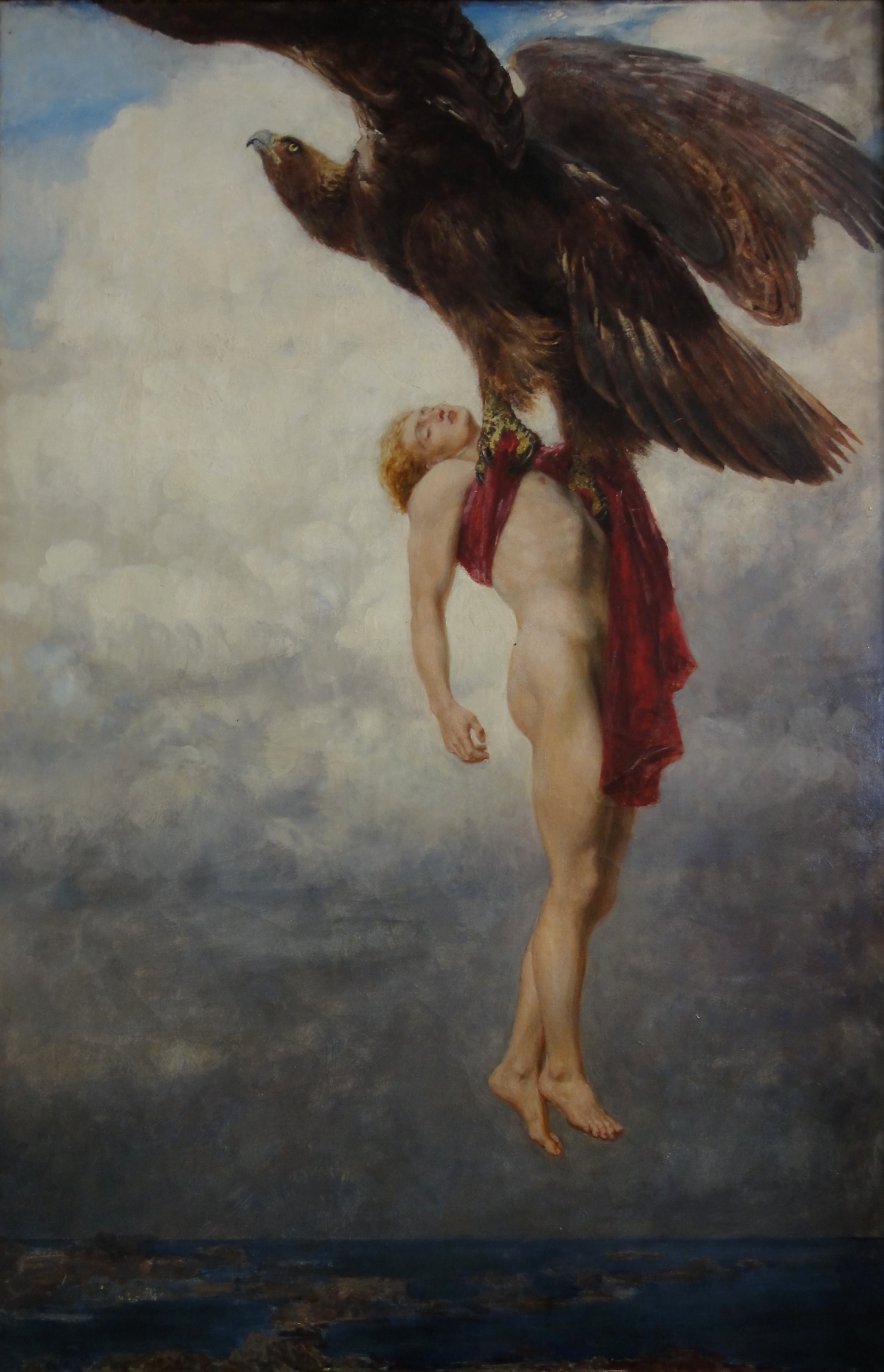
Briton RivièreThe Rape of Ganymede, 1879, oil on canvas. Private collection.

In Rivière’s Victorian interpretation, the drama of Ganymede’s abduction becomes a study in beauty and terror. The eagle’s powerful wings engulf the golden-haired youth, whose luminous body and upturned gaze capture the tension between divine rapture and human vulnerability.

A shepherd once stood on the green slopes of Mount Ida, watching his father’s flocks beneath the wide Trojan sky. His hair caught the sunlight, and even the wind seemed to linger around him. High above, the king of the gods looked down and was seized by a longing beyond reason. Taking the form of a mighty eagle, Zeus swept from Olympus, his wings darkening the heavens, and carried the youth Ganymede into the clouds. The people of Troy saw only feathers and light—then nothing. In heaven, the boy awoke amid thunder and gold, offered a cup of nectar to his captor, and became the immortal cupbearer of the gods, beloved of Zeus and eternal in beauty.

In Greek mythology, few mortal youths have been as endlessly reimagined as Ganymede, the beautiful Trojan prince who caught the eye of Zeus himself. The story is simple yet potent: Zeus, enraptured by Ganymede’s beauty, descends in the form of an eagle and carries him off to Olympus to serve as the gods’ cupbearer—and, as the myths gently imply, as the god’s divine beloved. It is a tale that has stirred the imagination for centuries: a mortal elevated to immortality, a human boy desired by a god, beauty taken skyward by power. To artists, poets, and later to those who found themselves drawn to same-sex desire, the myth became a mirror—of longing, transcendence, and the perilous allure of beauty.

A Symbol of Divine Desire

In ancient Greece, Ganymede’s story was not viewed as scandalous but rather idealized as the epitome of male beauty and youthful grace. The myth encapsulated a cultural ideal: that beauty—especially youthful male beauty—was divine in itself. Over time, depictions of Ganymede evolved, reflecting changing attitudes toward love, innocence, and power.

Ganymede in Art Through the Ages
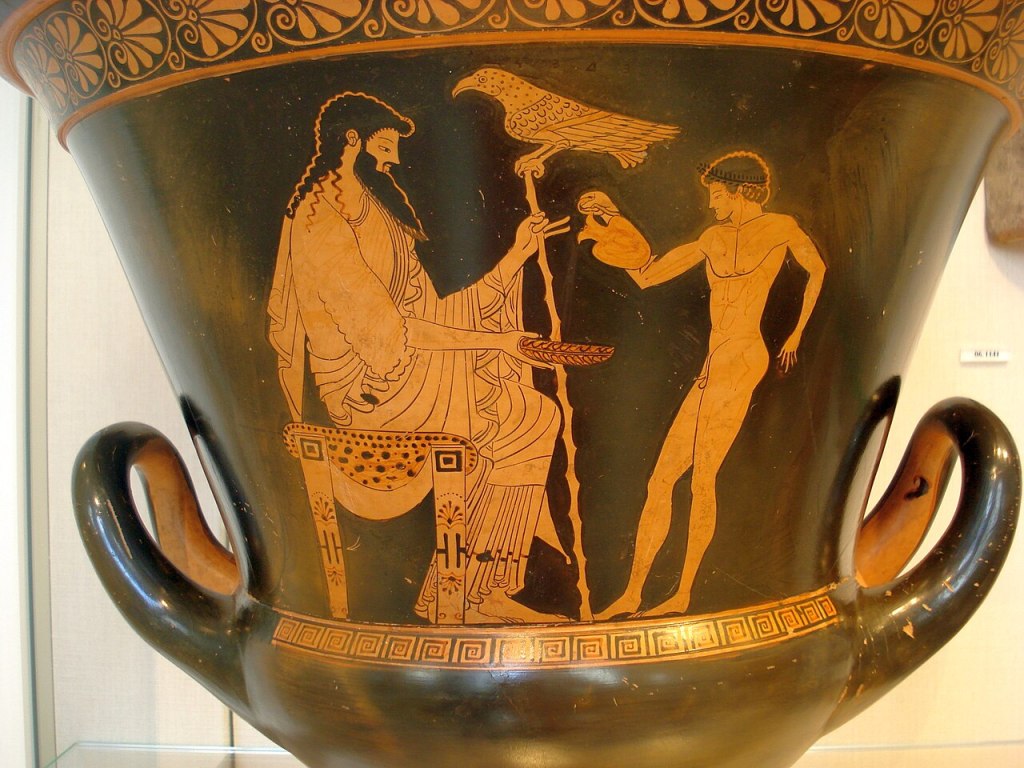
Ganymede pouring Zeus a libation. Attic red figure calyx krater by the Eucharides Painter, c. 490-480 BC. Metropolitan Museum of Art, New York.

The Eucharides Painter’s Ganymede Krater (c. 490–480 BCE)

One of the earliest known depictions of the myth appears on an Attic red-figure calyx krater attributed to the Eucharides Painter, now in the Louvre. The scene shows Zeus, bearded and dignified, reaching toward the beautiful youth, who holds a hoop and a bird—symbols of playfulness and innocence. The moment is not violent but charged with tension: a mortal about to be chosen by a god. Painted during the late Archaic period, when Athenian vase painters often explored themes of beauty and desire between men, it captures the myth’s earliest visual language—not yet abduction, but invitation. This subtle, coded eroticism would echo through centuries of artistic interpretations.
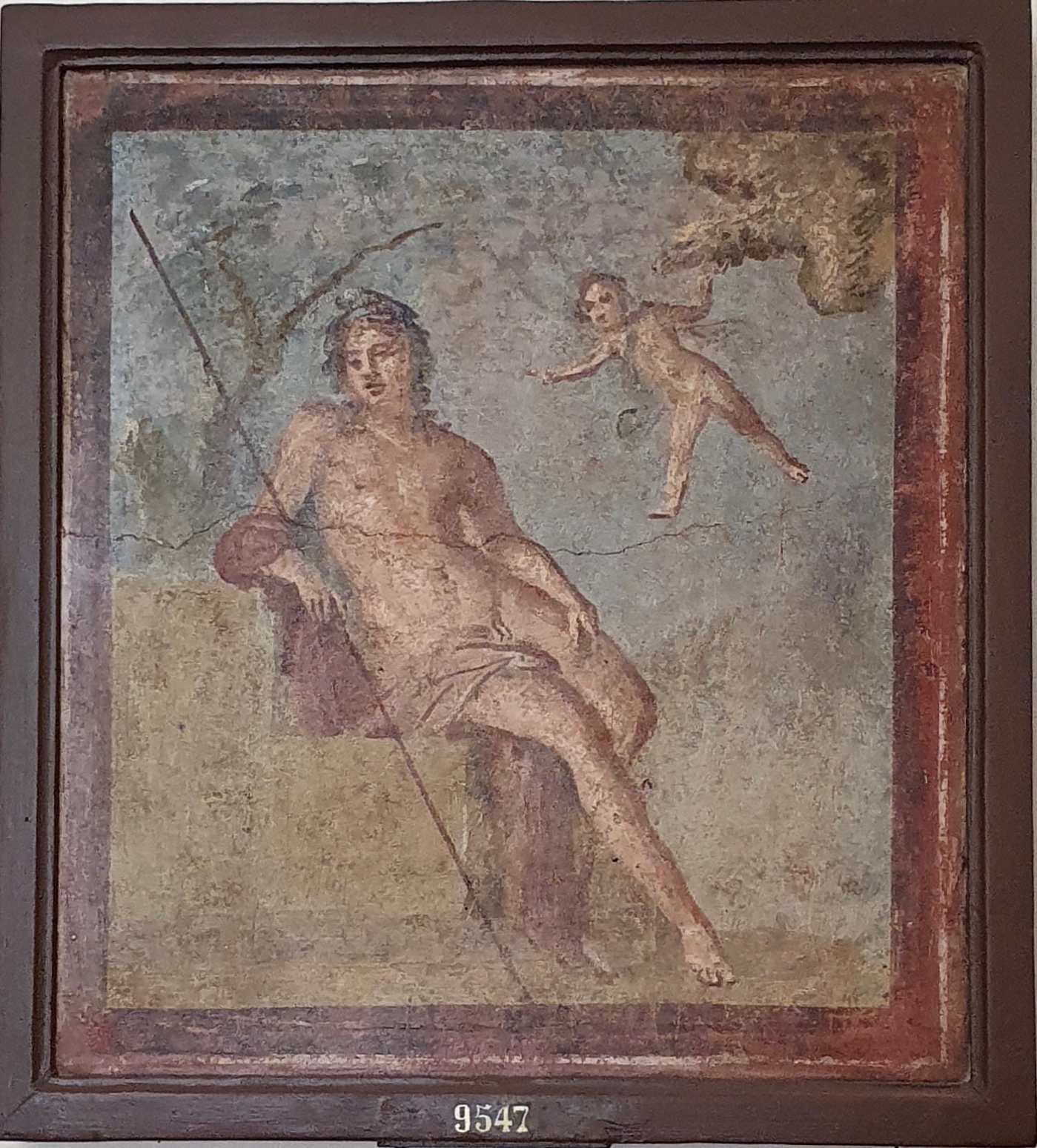
The Abduction of Ganymede, 1st century CE, fresco from Pompeii. Museo Archeologico Nazionale di Napoli.

Roman Frescoes from Pompeii (1st century CE)

Roman artists often delighted in mythic scenes of beauty and motion, and frescoes from Pompeii depict Ganymede as a symbol of youthful perfection. One particularly vivid wall painting shows the eagle swooping in, its talons gently gripping the boy’s thigh—a moment frozen between terror and ecstasy. The ambiguity of consent here fascinated later Renaissance artists, who saw in the myth both danger and divine invitation.

Peter Paul Rubens, The Rape of Ganymede, 1611–1612, oil on panel. Liechtenstein Museum, Vienna.

Rubens’s The Rape of Ganymede (1611–1612)

In Rubens’s dramatic Baroque vision, the story erupts with motion and passion. The muscular eagle bursts upward, wings slicing through the air as Ganymede twists in its grip, his luminous flesh contrasting the dark feathers. Rubens’s title, The Rape of Ganymede, reflects the 17th-century usage of “rape” to mean abduction, yet the erotic charge is unmistakable. His Ganymede is no helpless child but a radiant youth caught between resistance and surrender—a living embodiment of desire wrestled from earth to heaven. The intensity of movement, the clash of power and beauty, make this one of the most sensual and psychologically complex renderings of the myth.
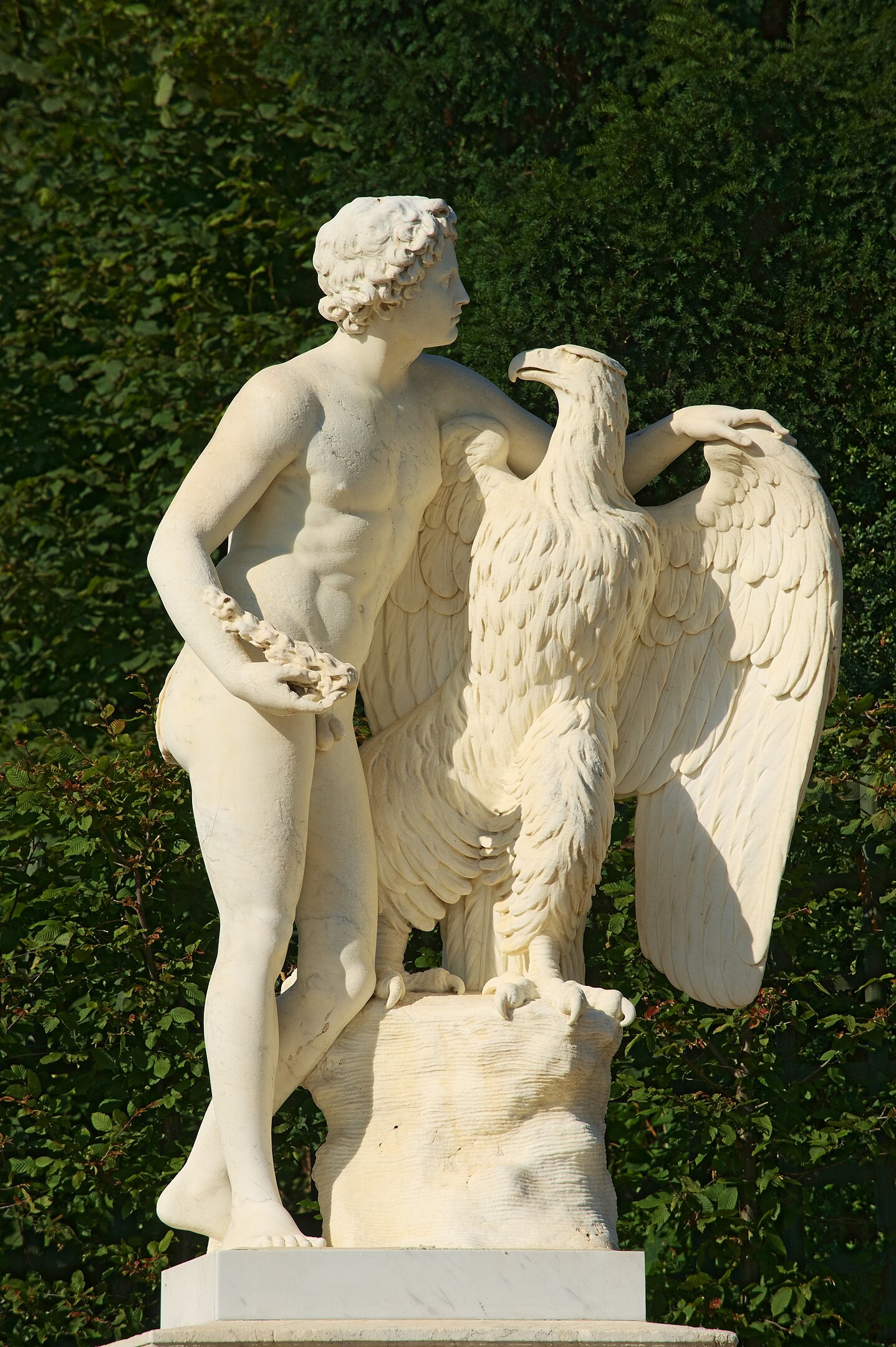
Pierre Laviron, Ganymède Médicis, 1684–1685, marble. Gardens of the Palace of Versailles, France.

Pierre Laviron’s Ganymède Médicis (1684–1685)

Laviron’s sculpture, commissioned for the gardens of Versailles, translates the myth into polished elegance. His Ganymede stands poised and composed, offering a cup to the eagle perched beside him. The Baroque drama of Rubens is replaced by serene theatricality: beauty tamed into courtly decorum. Created under the patronage of Louis XIV, who used classical myth to mirror divine kingship, Laviron’s figure hints at the fine line between power’s affection and possession—between being loved by a god and serving one.

José Álvarez Cubero, Ganymede, 1804, marble. Real Academia de Bellas Artes de San Fernando, Madrid.

José Álvarez Cubero’s Ganymede (1804)

Cubero’s Neoclassical marble returns Ganymede to the world of ideal form and measured grace. The youth’s body is sculpted with the purity of Greek statuary—calm, proportioned, untouched by struggle. The eagle looks up to him rather than seizing him, reversing the myth’s hierarchy. For Cubero and his Enlightenment contemporaries, Ganymede embodied beauty elevated by virtue rather than consumed by passion. Desire, in this vision, becomes enlightenment itself.
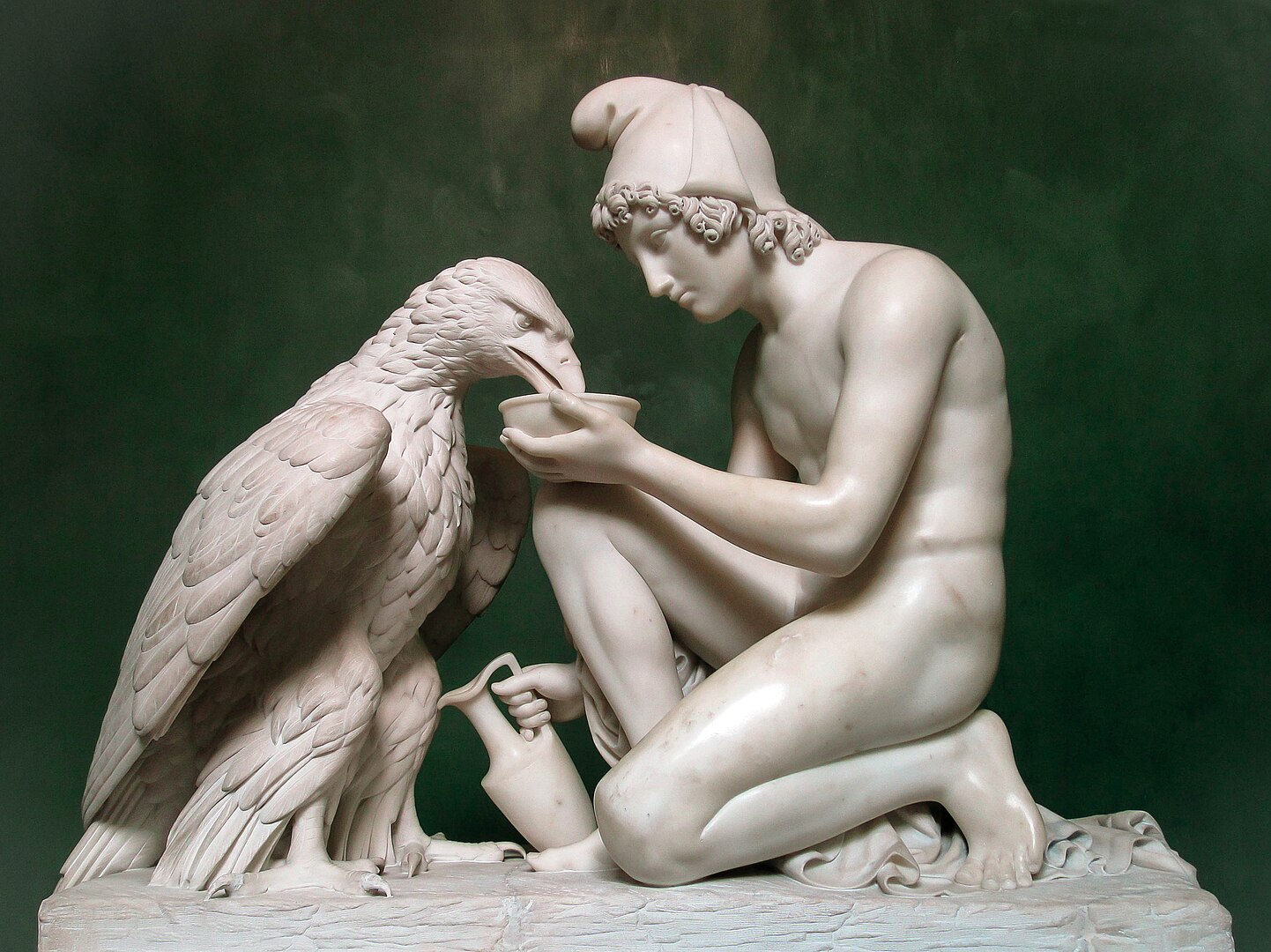
Bertel Thorvaldsen, Ganymede and the Eagle, 1817, marble. Thorvaldsens Museum, Copenhagen.

Bertel Thorvaldsen’s Ganymede and the Eagle (1817)

Thorvaldsen refined Neoclassical serenity even further. His marble sculpture shows Ganymede standing calmly beside Zeus’s eagle, cup in hand, offering nectar to the god. Here the boy is no longer abducted but accepted—a symbol of beauty at peace with power, devotion intertwined with dignity. For many in the 19th century, this was a way of transforming homoerotic desire into a language of noble aesthetics.

Hans (Jean) Arp, Ganymede, c. 1950s–60s, bronze (various casts). Private collections and galleries.

Hans (Jean) Arp’s Ganymede (c. 1950s–60s)

By the mid-20th century, Ganymede took flight again—not in flesh, but in form. In Arp’s abstract bronze and marble variations titled Ganymede, the myth dissolves into undulating shapes and organic curves, evoking both ascent and embrace. The human figure is no longer literal; it becomes pure motion, spirit, and metamorphosis. Arp’s biomorphic language connects the myth’s essence—beauty transformed, matter lifted toward divinity—to the modern search for unity between body and soul. In this Ganymede, there is no eagle, no Zeus, only the eternal rise of form seeking the divine.

Why Ganymede Endures

What is it about this myth that has captivated artists for millennia? Perhaps it lies in its paradox. Ganymede is both victim and beloved, mortal and divine, powerless yet exalted. The story dances between danger and desire, and between the human wish to be seen and the peril of being too beautiful to ignore. For queer viewers and artists in particular, Ganymede’s ascension to Olympus can be read as a coded allegory of forbidden love—the notion that same-sex desire, long condemned on earth, might find its rightful place among the heavens. The myth becomes not just about abduction, but about transcendence—an elevation of love beyond human judgment.

In art, Ganymede is never only a youth in the talons of an eagle. He is a symbol of longing, transformation, and divine recognition—the mortal who touched eternity through beauty. Across centuries, artists have reimagined his ascent: from Correggio’s soft luminosity to Rubens’s violent ecstasy, from Thorvaldsen’s calm reverence to Arp’s abstract motion. Each generation has remade Ganymede in its own image—sometimes erotic, sometimes spiritual, always yearning. By the time we reach Arp, the boy has dissolved into pure form, his body transfigured into rhythm and curve. The myth that began with the abduction of a shepherd becomes the eternal story of ascent itself: the soul drawn upward by beauty, still rising, forever beyond reach.

I haven’t added an Isabella Pic of the Week in a while, so here’s one for you:


Pic of the Day


Recipe Rabbit Hole

I almost forgot to write a post this morning. As I was making my coffee, I was thinking that I haven’t cooked any fish in a while and how much I’d like some rainbow trout. This recipe for baked rainbow trout is one I’ve made many times, and it always turns out delicious.

That little thought sent me down a rabbit hole that started with a recipe for balsamic glazed salmon. From there, I started thinking about one of my favorite dishes at a local Italian restaurant, Sarducci’s in Montpelier: Salmone Cucina — wood-roasted salmon with artichokes, red peppers, lemon, and capers in a white wine sauce, served with risotto. Because I’d love to recreate it at home, I asked ChatGPT to create a recipe based on the menu description. Here’s the result:

🐟 Home-Style Salmone Cucina Recipe

Ingredients (serves 2–4)

For the Salmon & Sauce:

  • 4 salmon fillets (6 oz each, skin-on or skinless)
  • Salt and freshly ground black pepper
  • 1–2 Tbsp extra-virgin olive oil
  • 1 small shallot, minced (or half a small onion)
  • 2 cloves garlic, minced ⅓ to ½ cup dry white wine (or substitute, see note below)
  • Juice of ½ lemon (plus lemon slices for garnish)
  • 1 Tbsp capers, drained
  • 1 small roasted red pepper (jarred or freshly roasted), sliced
  • ½ cup artichoke hearts (marinated or canned, drained and quartered)
  • Fresh herbs (parsley or thyme work nicely) m1 Tbsp butter (optional, to finish the sauce)

For the Risotto:

  • 1 cup Arborio rice
  • 1 Tbsp olive oil + 1 Tbsp butter (or all olive oil)
  • 1 small shallot or onion, finely chopped 4 cups chicken or vegetable stock, kept warm
  • ½ cup dry white wine (or substitute, see note below)
  • Salt and pepper to taste
  • ½ cup (or more) freshly grated Parmesan cheese
  • Optional: a splash of heavy cream or extra butter for added creaminess

Alcohol-free substitute:

If you avoid alcohol (even in cooking), you can replace the wine with a mixture of ¼ cup white grape juice + ¼ cup low-sodium broth + 1 teaspoon white wine vinegar or lemon juice for every ½ cup of wine.

Directions

1. Prepare the Risotto

  • Warm the stock in a saucepan over low heat.
  • In a separate large skillet or pot, heat olive oil and butter over medium heat.
  • Add chopped shallot or onion and sauté until translucent (2–3 minutes).
  • Add Arborio rice and stir to coat; cook 1 minute.
  • Pour in the wine (or substitute); stir until almost evaporated.
  • Begin adding warm stock, one ladle at a time, stirring often and letting the rice absorb each addition before adding more.
  • Continue until the rice is creamy and tender, about 18–20 minutes.
  • When nearly done, stir in Parmesan cheese, adjust seasoning, and add a bit of cream or butter for richness, if desired.

2. Cook the Salmon & Sauce

  • Preheat the oven to 425°F.
  • Pat salmon fillets dry and season lightly with salt and pepper.
  • In an ovenproof skillet, heat olive oil over medium-high heat.
  • Sear salmon for 1–2 minutes per side, just until lightly browned.
  • Transfer the salmon to a plate. In the same skillet, sauté shallot and garlic until fragrant (about 1 minute).
  • Add wine (or substitute), lemon juice, and zest; simmer 2–3 minutes.
  • Stir in capers, red pepper, and artichokes; cook briefly until heated through and the sauce thickens slightly.
  • Return the salmon to the skillet, spoon sauce over the fillets, and transfer to the oven.
  • Roast 5–8 minutes, or until the salmon flakes easily with a fork.

3. Serve

Plate a generous scoop of risotto, top with salmon, and spoon over the sauce with artichokes, red peppers, and capers. Garnish with fresh herbs and a squeeze of lemon.

Notes & Tips

For the roasted red pepper, you can use jarred to save time, or roast your own under the broiler until charred, then peel and slice. Rinse capers briefly if they’re very salty. If your sauce tastes too sharp, add a small pat of butter or pinch of sugar to mellow it out. A drizzle of olive oil over the finished plate adds richness and shine.

If you can’t make it to Sarducci’s, this version brings the same rustic Italian warmth to your own kitchen. I think I may have to pick up some salmon this weekend and give it a try myself.

Have a delicious Wednesday, everyone. Now I’m craving Italian food for dinner.


Pic of the Day

Since today’s poem is all about reflection and self-recognition, I thought a selfie was only fitting. After all, the phone is just another kind of camera—and sometimes, meeting ourselves begins with seeing ourselves clearly.

(This is not a selfie of me. His name is James.)


Meeting Ourselves

Meeting Ourselves
By Vachel Lindsay

We met ourselves as we came back
As we hiked the trail from the north.
Our foot-prints mixed in the rainy path
Coming back and going forth.
The prints of my comrade’s hob-nailed shoes
And my tramp shoes mixed in the rain.
We had climbed for days and days to the North
And this was the sum of our gain:
We met ourselves as we came back,
And were happy in mist and rain.
Our old souls and our new souls
Met to salute and explain—
That a day shall be as a thousand years,
And a thousand years as a day.
The powers of a thousand dreaming skies
As we shouted along the trail of surprise
Were gathered in our play:
The purple skies of the South and the North,
The crimson skies of the South and the North,
Of tomorrow and yesterday.

About the Poem

Vachel Lindsay’s “Meeting Ourselves” is a gentle yet profound reflection on life’s cyclical journey—how we travel forward only to encounter the echoes of our former selves. The poem captures a moment of recognition and renewal: two travelers retrace their steps and find their footprints mingling in the rain. It’s both literal and symbolic—an image of physical return and inner reconciliation.

Lindsay’s use of repetition and musical rhythm mirrors the rhythm of walking and the heartbeat of realization. The biblical echo—“a day shall be as a thousand years, and a thousand years as a day” (2 Peter 3:8)—reminds us that time itself folds and blurs when we reach moments of self-understanding or spiritual peace. The mingling of “old souls and new souls” beautifully suggests that transformation doesn’t erase who we were; it redeems and embraces it.

For LGBTQ+ readers, especially gay men, this poem may hold an added resonance. The act of meeting ourselves can evoke the powerful experience of coming out or reconciling with the self we once had to hide. Many queer people spend years walking in two directions at once—forward toward authenticity, backward toward fear or memory. When Lindsay writes, “We met ourselves as we came back / And were happy in mist and rain,” it can read as a quiet kind of liberation: joy found not in public sunlight, but in the private, tender mist where two selves—and perhaps two men—meet without shame.

The comrade whose footprints mingle with the speaker’s invites another layer of interpretation. In early 20th-century literature, male companionship often carried an intimacy that could not be spoken openly. The simple image of their tracks interlaced in the rain becomes, for a modern gay reader, a symbol of shared experience, endurance, and connection—love that exists naturally, though quietly, within the elements.

In that sense, the poem feels like a reconciliation not only of the self but of desire: the realization that one can walk beside another man and find peace, joy, and completeness—“happy in mist and rain.”

Ultimately, “Meeting Ourselves” speaks to anyone who has learned to love themselves after a long climb. It’s about journeying through struggle or distance, only to discover that the person waiting at the end of the trail is a wiser, gentler version of who we’ve always been.

The mingled footprints remind us that our past and present selves—and the people who’ve walked beside us—can coexist. We do not need to abandon the person we were to become the person we are. In mist and rain, under skies of “tomorrow and yesterday,” we find that the journey has brought us home to ourselves.

About the Poet

Vachel Lindsay (1879–1931) was an American poet known for his musical, chant-like verse and his belief that poetry should be spoken and performed aloud. Born in Springfield, Illinois, Lindsay traveled widely—often on foot—exchanging poems and drawings for food and lodging. His works often celebrated spiritual vision, democracy, and the common man, blending mysticism with American folk imagery.

“Meeting Ourselves” was written during Lindsay’s later period in the 1920s, when his poetry turned increasingly inward and mystical, exploring the soul’s search for renewal and divine connection. Though his fame waned late in life, Lindsay left a lasting mark on American poetry for his pioneering rhythmic style and his ability to transform ordinary experiences into moments of revelation.

While there is no definitive record of his sexuality, Lindsay’s poetry often conveys an intense affection for male companionship and an ideal of spiritual brotherhood that modern readers sometimes interpret through a queer lens. His recurring themes of duality, self-reconciliation, and soulful connection invite a range of readings—including those that speak deeply to LGBTQ+ experiences of identity and inner harmony.

“Meeting Ourselves,” like much of his work, reminds us that the greatest journeys are those that lead inward.


Pic of the Day


Layers of Monday

Many Americans aren’t working today because it’s Columbus Day. For some, particularly Italian Americans, the day remains a celebration of heritage, marked by parades, community gatherings, and tributes to Italian culture and contributions to the United States. These celebrations date back to the late 19th century when Italian immigrants sought to honor their ancestry and gain broader acceptance in American society.

However, across much of the country—including here in Vermont—the day is now observed as Indigenous Peoples’ Day, a time to honor and celebrate the history, culture, and resilience of Native peoples. The holiday serves as a reminder of the deep and complex history of this land long before European exploration and colonization, and it’s meant to center on Indigenous voices and stories that were too often ignored or silenced.

My university doesn’t officially recognize Columbus Day—or Indigenous Peoples’ Day—as a holiday, so while many Americans might have the day off work, I don’t. For most, it’s simply an excuse for stores to hold big sales anyway. I actually went shopping this weekend for some winter clothes. With the weight I’ve lost, I didn’t have a coat or much in the way of cold-weather clothing, and the temperatures are already dropping fast. So, I treated myself to two new coats—one casual and one more formal—and several new sweaters to help keep me warm. I’m very happy with my purchases.

Losing weight has felt great, but it does mean buying an entirely new wardrobe, which gets expensive quickly. Still, I’ve always enjoyed shopping for clothes, so I can’t complain too much.

Anyway, enough babbling for today. Whether you’re enjoying a long weekend, are retired and free from the Monday grind, or—like me—are working through the holiday, I hope you have a great day and a wonderful week ahead. Here’s hoping it’s less aggravating than last week!


Pic of the Day

This guy is what I’d imagine would be the result of Henry Cavill and Pietro Boselli having a baby together. His name is Niclas Kuri, if you’re curious.


The Cross Has Two Beams

“‘You shall love the Lord your God with all your heart, and with all your soul, and with all your mind.’ This is the first and greatest commandment. And the second is like it: ‘You shall love your neighbor as yourself.’ On these two commandments hang all the law and the prophets.”

— Matthew 22:37–40

In recent years, writers have contrasted two ways of thinking about morality in Christianity: vertical and horizontal.

Vertical morality measures righteousness by obedience to divine rules—what we do “upward” toward God. It’s the language of purity codes, of who’s in and who’s out. It focuses on sin as individual failure: what you drink, who you love, what you wear, how you pray.

Horizontal morality, on the other hand, measures faith by compassion—how we live in relationship with others. It’s the ethic Jesus embodied: touching lepers, feeding the hungry, lifting up the marginalized, and challenging systems of exclusion. It’s the moral vision of the Good Samaritan, who loved a stranger more faithfully than the priest and Levite who passed him by.

Writers like Phil Zuckerman and Randal Rauser have noted that what some call “MAGA Christianity” often confuses holiness with political power. When faith becomes about defending hierarchy rather than serving humanity, it loses sight of the Gospel’s radical equality.

Vertical morality alone lets people condemn LGBTQ+ Christians while excusing cruelty, greed, and injustice. It measures holiness by outward piety rather than inward compassion. As Jesus said of the Pharisees, “They tie up heavy burdens, hard to bear, and lay them on the shoulders of others; but they themselves are unwilling to lift a finger to move them.” (Matthew 23:4)

Jesus constantly redirected attention from vertical rule-keeping to horizontal compassion.

  • “Whatever you did for one of the least of these, you did for me.” (Matthew 25:40)
  • “Blessed are the merciful, for they shall receive mercy.” (Matthew 5:7)
  • “Let all that you do be done in love.” (1 Corinthians 16:14)

The Christian life is not a ladder reaching up to heaven—it’s a table stretching out to our neighbors. God doesn’t ask us to climb higher to prove our worth, but to reach wider to show God’s love.

For LGBTQ+ Christians, this distinction matters deeply. Too often, vertical moralism has been used to shame us for who we are, while ignoring the heart of Jesus’s message: “By this everyone will know that you are my disciples, if you have love for one another.” (John 13:35)

The cross itself is both vertical and horizontal—but the beams meet at love. The vertical reminds us that God’s love reaches down to us and our hearts rise to meet it. The horizontal reminds us that the measure of that love is how far we extend it toward others. When churches focus only upward, they risk becoming sanctuaries of self-righteousness instead of sanctuaries of grace.

True holiness isn’t found in who we exclude, but in how deeply we love.

This week, consider where your faith has been vertical when it might be called to be horizontal. Have we spent more time worrying about being “right with God” than being kind to one another? The beauty of horizontal faith is that every act of compassion—every word of encouragement, every defense of the marginalized—is an act of worship.

The cross has two beams for a reason. The vertical beam reminds us that God’s love flows freely between heaven and earth—unbroken, unwavering, unconditional. The horizontal beam stretches outward, calling us to carry that same love into the world. Together, they form the shape of the Gospel itself: love that reaches both upward toward God and outward toward our neighbor—a love wide enough to embrace us all.


Pic of the Day