
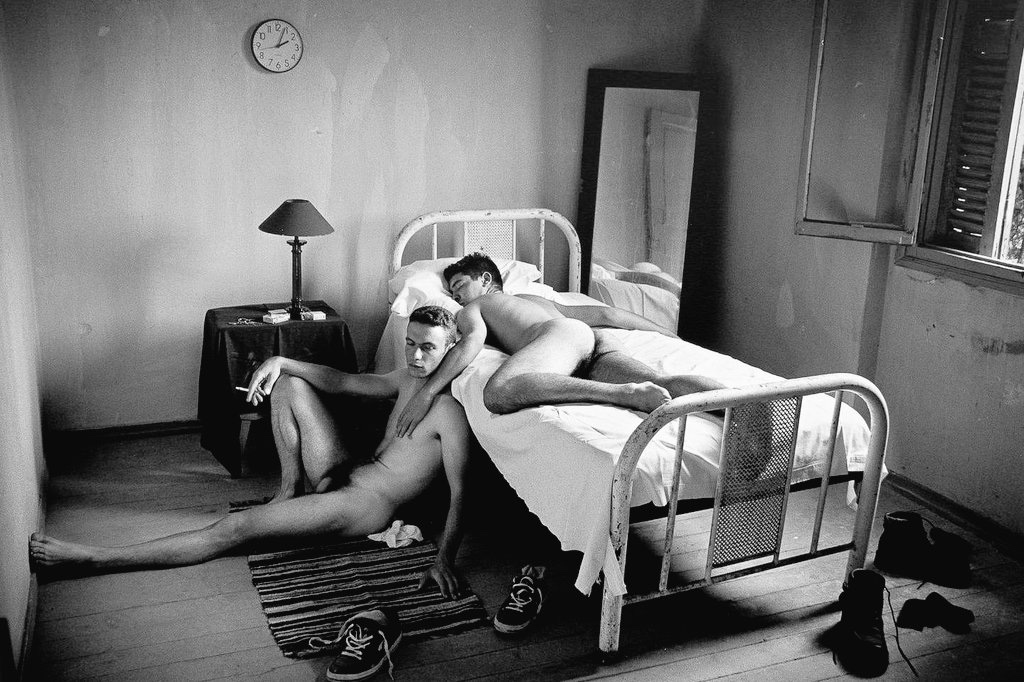
Night Was Done
By Mikhail Kuzmin
Night was done. We rose and after
Washing, dressing,—kissed with laughter,—
After all, the sweet night knows.
Lilac breakfast cups were clinking
While we sat like brothers drinking
Tea,—and kept our dominoes.
And our dominoes smiled greeting,
And our eyes avoided meeting
With our dumb lips’ secrecy.
“Faust” we sang, we played, denying
Night’s strange memories, strangely dying,
As though night’s twain were not we.
There is something exquisitely tender—and quietly defiant—about this small poem. It feels almost domestic, almost harmless. And yet, in its historical context, it is anything but.
In “Night Was Done,” Mikhail Kuzmin captures a morning after—a moment of intimacy between two men—rendered not with tragedy or shame, but with softness, playfulness, and quiet conspiracy.
The night has passed.
“They rose.”
They wash, dress—and kiss with laughter.
There is no guilt in the kiss. Only warmth.
But the world still exists outside the room.
The poem turns on that delicate tension between what is shared privately and what must be disguised publicly. The men sit “like brothers drinking / Tea.” The phrasing is deliberate. They perform normalcy. They cloak eros in fraternity. In a society where same-sex love could not be openly acknowledged, “like brothers” becomes a mask.
And yet the mask does not fully convince.
“Our dominoes smiled greeting.” Dominoes are a game, yes—but they are also a metaphor. Masks. Faces placed in order. Pieces aligned to create patterns. The game becomes a ritual of denial, something to fill the space where touch had been.
“And our eyes avoided meeting / With our dumb lips’ secrecy.”
That line is devastating. The lips are “dumb”—not because they lack speech, but because they must remain silent. The eyes avoid one another not from lack of feeling, but because looking would reignite memory. Looking would make the night real again.
They sing “Faust,” they play, they deny.
“As though night’s twain were not we.”
Twain—two. The night made them two-in-one. Morning separates them back into individual men, back into roles, back into something socially legible. But the poem refuses to let us forget: they were the night. They are the twain.
This is what makes the poem profoundly LGBTQ+. It is not flamboyant or declarative. It is intimate, coded, domestic. It understands the choreography of queer survival: laughter, breakfast cups, games, avoidance, denial. It shows how love must sometimes be folded into ordinary gestures to remain safe.
And yet the poem does not feel ashamed. It feels wistful. Tender. Almost smiling.
The sweet night knows.
About the Poem
“Night Was Done” was written during Russia’s Silver Age, a period of artistic experimentation and aesthetic refinement in the early 20th century. While much queer literature of the time leaned toward tragedy, pathology, or moral warning, Kuzmin’s poem offers something radically different: normalization.
There is no punishment in the poem. No fall. No moral reckoning. Instead, we see lovers sharing tea.
The poem’s power lies in its subtlety. The queerness is unmistakable—two men rising together after a night, kissing, performing brotherhood in daylight—but it is never sensationalized. This quietness is itself political. It asserts that same-sex intimacy can be ordinary, playful, and woven into daily life.
In this way, the poem anticipates later LGBTQ+ literature that focuses not just on suffering, but on tenderness and domestic intimacy.
It is a morning-after poem—but also a poem about survival. About how queer love lives in glances, in laughter, in games, in what is not said.
About the Poet
Mikhail Kuzmin (1872–1936) was one of the first major Russian writers to write openly and positively about homosexuality. A central figure of the Russian Silver Age, he was a poet, novelist, composer, and cultural tastemaker in St. Petersburg’s artistic circles.
In 1906, he published the groundbreaking novel Wings, which portrays a young man’s awakening to same-sex love without condemning it. This was extraordinary for its time. Kuzmin himself lived relatively openly within artistic communities and had long-term relationships with men.
After the Bolshevik Revolution, attitudes toward homosexuality hardened, and under Stalin it was recriminalized. Kuzmin’s later years were marked by marginalization, but his legacy endures as a pioneering queer voice in Russian literature.
What makes Kuzmin so important for LGBTQ+ readers today is not simply that he was gay—but that he wrote love without apology. He gave us mornings after. He gave us tea cups and laughter. He gave us the twain.
And in doing so, he reminds us that queer love has always existed—not only in rebellion, but in tenderness.



 Joe
Joe





 The Closet Professor
February 17th, 2026 at 7:27 am
That is clearly an old photograph. Some poor area of Europe at a guess. Italy? France? Greece? I wonder who the photographer was?