

Author Archives: Joe
About Joe

You Are Never Alone

And we know that in all things God works for the good of those who love him, who have been called according to his purpose.
– Romans 8:28
Life’s journey is often filled with joy and beauty, but it can also be marked by pain, rejection, and uncertainty. For many in the LGBTQ+ community, this path can feel especially lonely at times. Struggles with acceptance, identity, and faith may weigh heavily on your heart. But Romans 8:28 reminds us of a profound truth: God is always at work, shaping even our hardest moments into something beautiful.
You are not a mistake. You are not forgotten. You are not alone. Psalm 139:13-14 declares, “For you created my inmost being; you knit me together in my mother’s womb. I praise you because I am fearfully and wonderfully made.” God lovingly and intentionally made you just as you are. His love for you is not conditional—it is unwavering, steady, and eternal.
Footprints
One night I dreamed a dream.
As I was walking along the beach with my Lord.
Across the dark sky flashed scenes from my life.
For each scene, I noticed two sets of footprints in the sand,
One belonging to me and one to my Lord.
After the last scene of my life flashed before me,
I looked back at the footprints in the sand.
I noticed that at many times along the path of my life,
especially at the very lowest and saddest times,
there was only one set of footprints.
This really troubled me, so I asked the Lord about it.
“Lord, you said once I decided to follow you,
You’d walk with me all the way.
But I noticed that during the saddest and most troublesome times of my life,
there was only one set of footprints.
I don’t understand why, when I needed You the most, You would leave me.”
He whispered, “My precious child, I love you and will never leave you
Never, ever, during your trials and testings.
When you saw only one set of footprints,
It was then that I carried you.”
This message of God’s presence and faithfulness is also reflected in the famous poem “Footprints.” The poem describes a person looking back on their life as a walk alongside God, represented by two sets of footprints in the sand. However, during life’s most difficult moments, only one set of footprints appears. The person asks God, “Why did You leave me when I needed You most?” But God responds with a powerful truth: “During your times of trial and suffering, when you saw only one set of footprints, it was then that I carried you.”
How often do we feel abandoned during life’s hardest moments? Yet, just as in the poem, God never leaves us. Isaiah 41:10 reminds us, “So do not fear, for I am with you; do not be dismayed, for I am your God. I will strengthen you and help you; I will uphold you with my righteous right hand.” Even when you feel unseen, unheard, or misunderstood, God is carrying you. His love is the foundation that holds you up when everything else feels shaky.
As you continue on your journey, take comfort in knowing that God is not distant—He is right beside you. He has called you with purpose, and nothing can separate you from His love (Romans 8:38-39). When challenges come, remember that your life is a masterpiece in progress, and God is weaving every experience—both the joys and the struggles—into something beautiful.
If you ever feel weary or unsure of your place in the world, reflect on “Footprints.” Know that when you see only one set of footprints in your life, it is not because you have been abandoned, but because God is carrying you forward in love.
God always walking with us, even in the times we cannot feel Him. Sometimes, we may feel lost, but we must trust in His plan, knowing that He is working all things together for our good. When we feel alone, remember that God is carrying us.

Moment of Zen: Hot Showers








To see the rest of the last picture and one more bonus one, click “Continue Reading” below.
Continue reading
Waking Up

Thank goodness I’m working from home today. I didn’t sleep very well last night and woke up still feeling drowsy and having a migraine. It’s time for my next Botox treatment (next Thursday), and my headaches always get more intense and frequent. I have a few things that need doing today, but mostly I can take it easy. In fact, after I have breakfast, I may go back to bed for a bit.
I hope everyone has a great weekend!

Thursdays

I’m not sure where I read/heard this. It could have been on Facebook, the book I just finished, tv, or somewhere else. I guess it doesn’t matter where this was brought to my attention, but I found it interestingly accurate. Anyway, wherever I came across it, the quote said, “Thursdays are the worst day of the week. You are past the halfway point but not yet to the weekend.” I always say I hate Mondays, and I do, but the logic or illogic that Thursdays are the worst day has some merit. I have a love hate relationship with Thursdays. It’s sort of my Friday because I work from home most Fridays, so Thursdays are my last day in the office for the week. It’s also a teaching day for me, and I enjoy teaching and interacting with my students. However, it’s also just me and my boss in the office (my other coworker works from home on Thursdays), and the more I work with my boss the less I like working with her. There are numerous reasons for this, and I don’t see it getting better.
Anyone know of a museum that’s at a university and needs an educator or someone to manage their public outreach? If you do, let me know. I’m beginning to think I won’t be happy at my current workplace ever again unless we have some staff turnover soon. To tell you how bad it is, I recently applied for a position in the South. Ok, I also applied to that job because it would have doubled or tripled my salary, and it was in Atlanta. If I had to move South again, it would have to be Atlanta or another major city that’s liberal and LGBTQ+ friendly. There aren’t many: Birmingham (but it’s in Alabama), New Orleans, Savannah, or Asheville (NC). Nashville and Memphis are iffy, and Houston and Austin are in Texas. Plus, they are all hot and humid. Yuck! I really like Vermont and New England, and I’d rather stay in this area.
Also, on a completely different note, tonight is the blood moon eclipse (also known as the Blood Worm Moon), a total lunar eclipse when the earth moves between the sun and moon and causes the moon to turn red. I doubt I’ll be awake to watch it since it will take place between 2 am and 3 am, and here in Vermont, it’s probably going to be too cloudy to see much of this rare phenomenon.
Anyway, I’ve rambled enough for today. I hope everyone has a great day, and remember, tomorrow is Friday and the weekend will be even closer.
I almost forgot your Isabella pic of the week:




Bathers: Depictions of Victorian Male Nudity
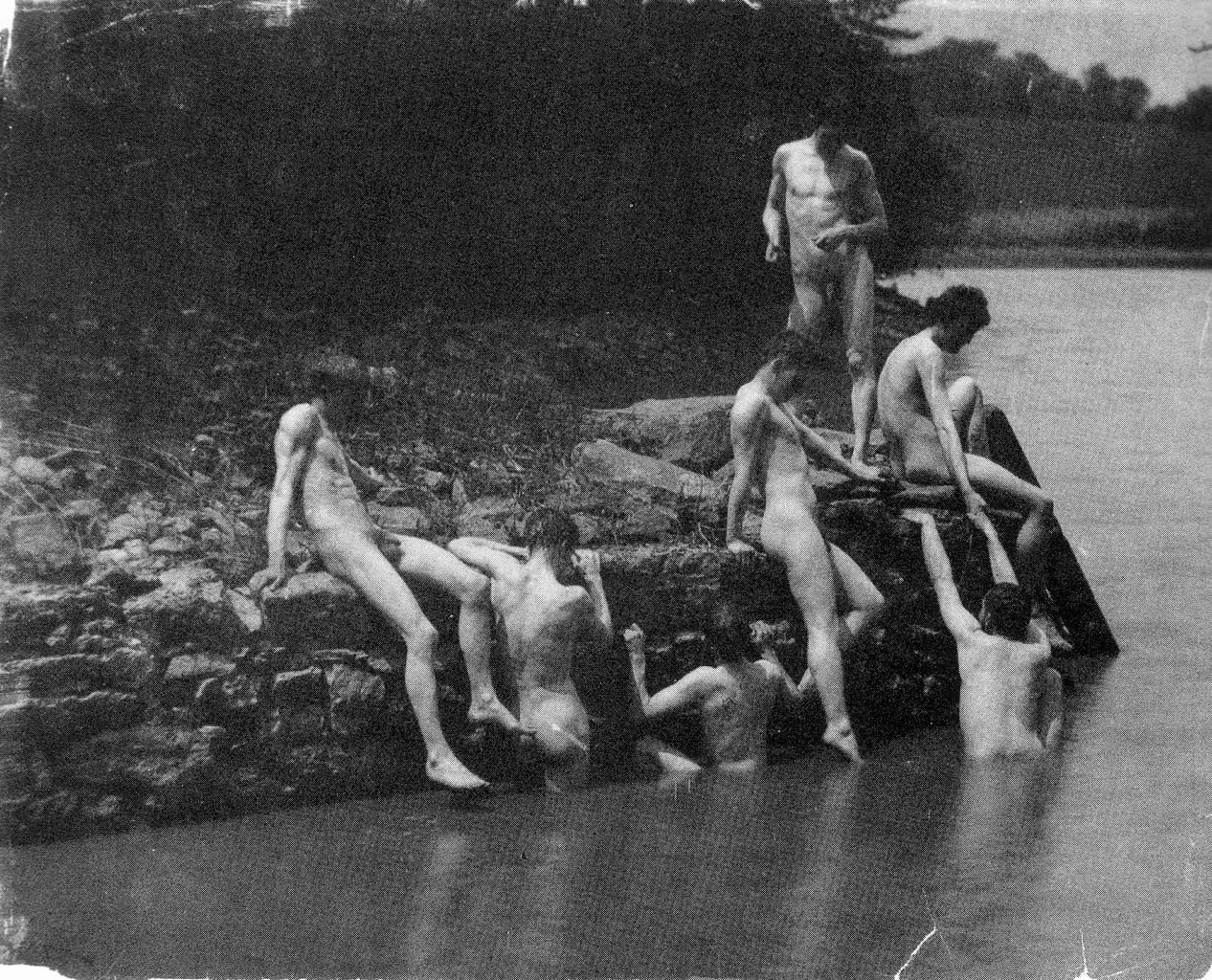


Thomas Eakins’ students swimming naked in Dove Lake, c. 1883–84
Four paintings—The Swimming Hole (1885) by Thomas Eakins, The Bathers (1898–1905) by Paul Cézanne, The Bathing Group (1914) by Henry Scott Tuke, and The Bathers (1885) by John Singer Sargent—each depict figures in or near water, a subject with deep art historical roots. They each depict the one of the few exceptions to the generally prudish Victorian attitude to nudity: swimming naked was widely accepted, and for males was seen as normal, even in public spaces. The other notable exceptions are depictions of nudes in classical, mythological, and allegorical art.
I have been looking at many 19th century artists, particularly American artists, for a class I am teaching, and one thing I have noticed that is remarkably different from Renaissance art is the lack of male nudes. In the Renaissance, some of the most famous pieces of art are of male nudes; Michelangelo’s and Donatello’s depictions of David come to mind. Yet, in 19th century America, few of the art produced are of nude men. However, female nudity abounds. The great American sculptor Hiram Powers’s The Greek Slave (1843) is of a young nearly naked woman in chains. The only depiction I know of Powers that was of a male nude is The Fisher Boy (1857). Both sculptures are of examples of classical and allegorical works.


The Greek Slave (1843) and The Fisher Boy (1857) by Hiram Powers
The four paintings by Eakins, Cézanne, Tuke, and Sargent are exceptions to the lack of male nudity. However, each approaches the theme of male nudity with distinct stylistic and thematic differences. The theme of male bathers has long been a subject in Western art, and like nearly all male nude artwork, the bathers often carry homoerotic undertones. The role of homoeroticism varies depending on the artist’s personal life, stylistic choices, and the cultural context in which they worked. Most of the known gay or bisexual men throughout history were artists. There are a few exceptions, and with nearly all of these historical figures, their sexuality has become a source of great debate. The sexuality of Eakins and Sargent are hotly contested in the art world. The sexuality of Cézanne has questioned for his personal detachment from women, lifelong male friendships, and repeated depictions of male figures in communal settings have led to some speculative interpretations. However, Tuke’s sexuality is not really debated. During the 1880s, Tuke met Oscar Wilde and other prominent poets and writers such as John Addington Symonds, most of whom were Uranian, an archaic term for homosexual men. Tuke’s art is sometimes referred to as Uranian art.

Eakins’ The Swimming Hole is a realist depiction of young men bathing in a natural setting. The composition is carefully structured, with figures arranged dynamically, demonstrating Eakins’ deep understanding of anatomy. He used photography as a reference, contributing to the work’s precision. The painting celebrates the male form, and some scholars suggest a homoerotic subtext, particularly given Eakins’ personal interest in male camaraderie and physicality. Eakins was deeply interested in the male nude, often using his students and friends as models in his photographic and painted studies. The Swimming Hole is notable for its emphasis on the beauty of the male form, with figures depicted in relaxed, intimate, and naturalistic poses. Eakins’ career was marked by controversy, particularly his insistence on using nude male models in his teaching, especially when women were present in class, which ultimately led to his dismissal from the Pennsylvania Academy of the Fine Arts. While Eakins’ sexuality remains debated, his work suggests an intense fascination with the male body that aligns with homoerotic artistic traditions.

Cézanne’s The Bathers presents a more abstracted and structural approach to the human form.. Cézanne’s approach to the male nude was more detached and formal, reducing figures to geometric forms and emphasizing composition over sensuality. He merges the men with the surrounding landscape. His brushwork and color palette are highly expressive, prioritizing form over detail. This painting is part of a series of bathers that played a crucial role in the development of modern art, influencing Cubism and abstraction. Rather than focusing on individuality, Cézanne treats the figures as part of a broader compositional harmony. While his Bathers paintings lack the overt homoeroticism seen in Eakins or Tuke, some scholars have suggested that Cézanne’s awkwardness around women and preference for male companionship may be reflected in his repeated depictions of groups of men in idealized, classical settings. His work was admired by later artists interested in queering traditional artistic forms, though it remains more intellectual than sensual.
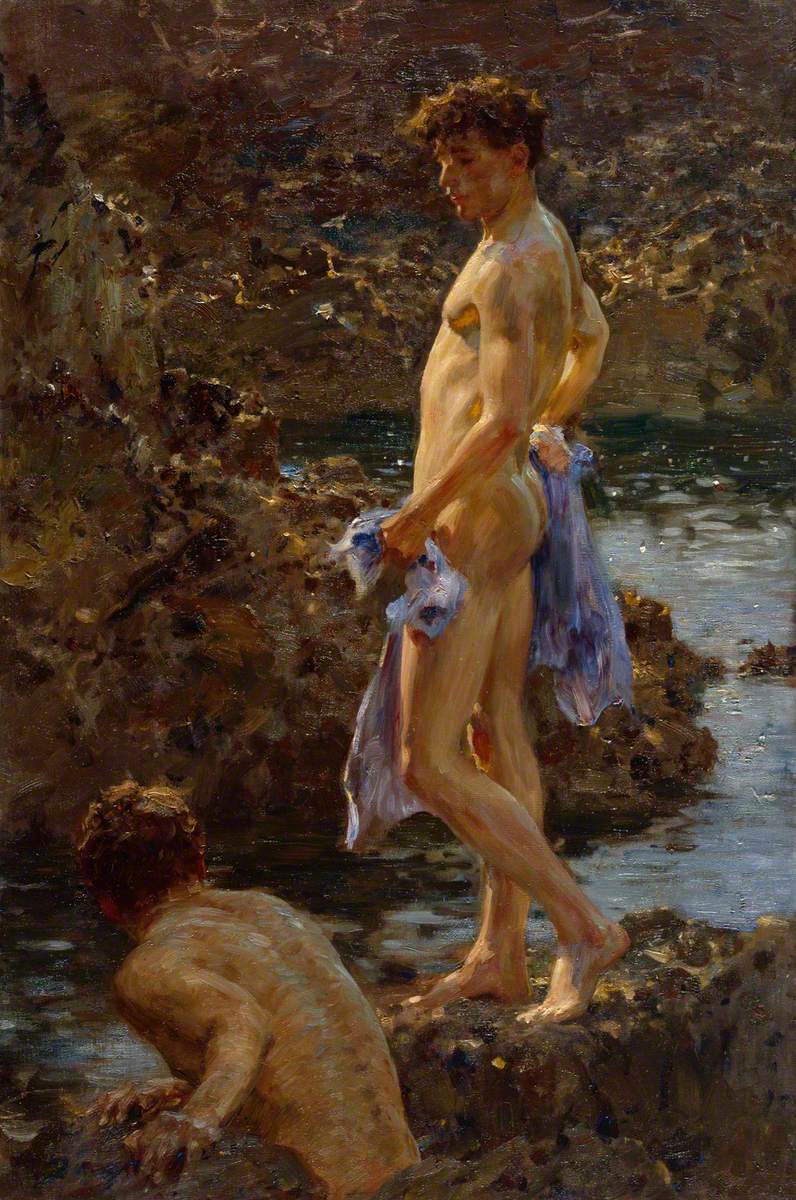
Tuke’s The Bathing Group shares thematic similarities with Eakins’ Swimming Hole, as it portrays young men bathing in a sunlit outdoor setting. However, Tuke’s work has a softer, impressionistic style with warm, glowing light that romanticizes the scene. His focus on adolescent male figures, combined with his use of color and light, creates an atmosphere of nostalgia and idealized youth. The painting reflects Tuke’s broader oeuvre, which often explored themes of male beauty and companionship in idyllic coastal settings. Tuke’s work is the most overtly homoerotic among the four painters. He frequently painted young, athletic men in idyllic seaside settings, often nude or minimally clothed, with a warm, romanticized glow. Unlike Eakins, whose realism could be read as clinical, Tuke’s impressionistic style and soft, golden lighting emphasize youth and sensuality. Tuke was known to have had close relationships with young men, and while his exact sexual orientation remains ambiguous, his work clearly celebrates male beauty in a way that aligns with homoerotic traditions in art.

Sargent’s The Bathers is more atmospheric and impressionistic than the others. It captures figures relaxing by the water, with loose brushwork and an emphasis on light and movement. Unlike Eakins’ rigorous realism or Cézanne’s abstraction, Sargent’s fluid style suggests spontaneity, capturing a fleeting moment rather than a structured composition. His interest in light and fabric is evident, as the painting conveys a sense of leisure and elegance characteristic of Sargent’s work. Sargent, like Tuke, has long been the subject of speculation regarding his sexuality. His portraits of both men and women often exude sensuality, and his friendships with men such as the poet and aesthete Vernon Lee suggest an affinity for male beauty. In The Bathers, Sargent takes a more impressionistic and fleeting approach to the subject, capturing a moment of leisure rather than lingering on the erotic possibilities of the male nude. However, his interest in male figures and fluid, suggestive brushwork align with the aesthetic codes often used to signal homoerotic desire. Sargent’s art is best known for his beautiful depictions of women in their finest clothing, and the majority of Sargent’s depictions of nude men were not discovered until after his death.
Each of these paintings offers a unique interpretation of the bathing scene and their homoerotic subtext reflect the respective artists’ styles, concerns, personal inclinations, and broader artistic movements. Eakins’ and Tuke’s paintings are more naturalistic, while Cézanne’s and, to some extent, Sargent’s approach abstraction or impressionism. Eakins prioritizes anatomical precision, while Cézanne breaks forms into geometric masses. Tuke and Sargent take a softer, more atmospheric approach. Eakins presents the male nude in a studied, naturalistic, and academic way, but his fascination with the subject led to controversy for potentially suggesting homoerotic undertones. Tuke romanticizes youth, while Cézanne constructs a timeless, almost mythological world, and Sargent captures a fleeting, elegant moment. Cézanne abstracts the figures, distancing them from direct sensuality but engaging with ideas of male camaraderie. Tuke openly romanticizes and celebrates youthful male beauty in a manner that strongly suggests queer desire. Sargent is more ambiguous, capturing fleeting moments of male interaction with a sensuous yet reserved touch. While only Tuke’s work seems directly intended to be read as homoerotic, all four artists contribute to a visual tradition in which the male nude serves as both a formal study and a space for exploring desire, intimacy, and beauty.


Authors
Recent Comments
Joe on Pic of the Day Benny S on Pic of the Day noisilycool3bc985058… on Pic of the Day iameverywhere1 on Pic of the Day Joe on Pic of the Day Top Posts & Pages




Amazon Associate

As an Amazon Associate I earn from qualifying purchases. So, if you click on a link that takes you to Amazon.com, I may earn a commission.
Trust me, it isn’t much, but every little bit helps.

 Joe
Joe


 The Closet Professor