Category Archives: Education

Percent Of Students Identify As LGBT On College’s New Application

Currently in the midst of its first-ever application cycle where it has asked prospective students to identify their sexual orientation or gender identity if they felt comfortable doing so, Elmhurst College reports that the vast majority of students have answered the question without hesitation.

Inside Higher Education reports that since the new policy began last fall at the private liberal arts school located in the western suburbs of Chicago, thought to be the first American campus to ask a question of the kind, about 5 percent of applicants have identified themselves as LGBT (lesbian, gay, bisexual or transgender).

Although some critics were concerned that the question would either make applicants feel uncomfortable or entice some straight students to pass themselves off as LGBT for a crack at the school’s diversity “enrichment scholarship,” worth one-third of Elmhurst’s $29,994 tuition, the school’s admissions dean Gary Rold said they have not run into these sorts of issues to date.
The new policy is intended to let prospective LGBT students know they are welcome at Elmhurst College. Rold said in August, when it was introduced, that the new question was part of the school’s commitment to “looking at diversity in all of its forms.” If students choose not to answer the question, they have the option of skipping it altogether.

“We took this step in an effort to better serve each of our students as a unique person,” Elmhurst President S. Alan Ray explained in a statement. “It also allows us to live out our commitments to cultural diversity, social justice, mutual respect among all persons and the dignity of every individual.”

According to the Chicago Tribune, of the 109 applicants who identified themselves as LGBT, 63 were accepted to the school. It is estimated that between 85 and 90 percent of prospective students responded to the question, which appears in a series of questions asking applicants about their religious affiliation, languages other than English spoken in their home and other factors.

Other schools are reportedly also considering adding their own comparable questions, most notably Harvard University. In November, the Harvard Crimsonreported that the school was contemplating the question as a means to “send a positive signal to students who are grappling with the issue of [sexual orientation] or gender identity.”

While The Common Application, a standard document used by over 450 colleges and universities, has also considered the question, the group’s board of directors ultimately rejected the idea last year as some feared that it could cause anxiety for some students during their already stressful college application process.

SOURCE: Huffington Post.


Changing the Game for LGBT Students in School

I came across the article and thought that it might interest my fellow GLBT educators out there.  I would love to hear what you have to say about it.  I know that with my school, we have a large amount of the faculty that do not support GLBT students, what’s worse our principal is one of them.  I hope that one day that will change and all students will be accepted, no matter how they identify themselves.

Changing the Game for LGBT Students in School

By Chris MurrayChris Murray is a social studies teacher and baseball coach at Walter Johnson High School in Bethesda, Md.

As a high school teacher and coach in Bethesda, Md., I have found our school to be a generally safe and wonderful place for our 2,500 students and faculty. However, like any community of this many people, there is a wide range of views and opinions in terms of acceptance for lesbian, gay, bisexual and transgender (LGBT) issues. But three specific and upsetting instances at school this year caused me to take action.

In September I had an idea for every teacher to display an equal sign in their classroom in order to show faculty support for all of our students. When I proposed this idea to the sponsor of our high school’s Gay-Straight Alliance (GSA), she questioned how many teachers would actually put them up. She added that the student club had tried this activity before and was met with resistance.

I was bewildered. It had never crossed my mind that a teacher would not be accepting of a student because of their sexual orientation or gender identity. Why would an educator bring their personal beliefs into the classroom when we’re supposed to support the needs of each student?Later, in December, I had the opportunity to meet two representatives from the Gay, Lesbian and Straight Education Network (GLSEN)at a social studies conference in Washington, D.C. During our conversation I mentioned that it seemed as if things had been getting better for LGBT people in the country. The look that I received was one of absolute astonishment, as if I were from another planet.

And really, I was. As a straight, white, upper-middle-class male, I have not had to face or endure any true injustice because of the personal characteristics that make me who I am. It was after listening to these representatives that I realized that the D.C. metropolitan area has come a long way but is still far from perfect in the level of acceptance of LGBT issues compared with the rest of the country and world.

But the latest instance was an eye opener and what pushed me to do something for LGBT students. It did not come from a fellow teacher, or a GLSEN representative, but from a member of our student body. I will call her “Emily.” I have known Emily as a student for a while, but I never had the chance to sit down and listen to her story. I was astounded by what she had to say.

Thanks to Emily’s courage to address the entire staff and administration of our school, she relayed to us with vivid detail what it means to be a gay student in high school. Emily shared the hurtful words and acts that often sprout up, making sure that we all understood that pretending away or ignoring the anti-gay jokes and comments heard in school was not only unacceptable but sending a negative message to all students. Emily made the point that our lack of intervention was telling students that it is not OK to be gay and that it is acceptable for a student to be hateful toward another student who is.

At that moment I knew I had to do more for students like Emily. I realized being a silent bystander was not only hurting people but in essence giving the green light to allow bullying and hatred to continue in my school. I thought a lot after hearing this 17-year-old girl pour her heart out to people in both educational and administrative roles. I couldn’t help but ask myself if this really was the kind of world that I wanted my own son to grow up in.

What troubled me even more was that some of my colleagues, mentors like me, didn’t applaud Emily for her courage in coming forward. They didn’t stand for the ovation at the end of her story and, more strikingly, didn’t even acknowledge her speaking. They instead focused on their smartphones.

I am a teacher, a husband, a father, a role model, and a mentor. I am also a coach. I know that my actions in each of these roles influence and affect hundreds of people. That is why I decided to take action and become an ally for students like Emily who are victims of bullying and harassment.

At our high school I am now encouraging all of my school’s teams and coaches to take the Team Respect Challenge, a part of Changing the Game: The GLSEN Sports Project. As a coach, I understand that this pledge recognizes the differences that strengthen both our school and community. Our teams have now become the role models by letting other students know that they will not stand by and allow their peers to be bullied or harassed because of their sexual orientation or gender identity, or, more importantly, because a student is different.

I want to thank all my students and players who have begun to accept people’s differences as part of what makes our school, community, and the world a better place. It takes a lot of courage to stand up for something that may be unpopular or not cool. But we will give a voice to our LGBT peers so that students like Emily won’t have to come forward and ask for something that every student should be offered without hesitation: a safe and affirming school in which to grow and discover their potential.


Exams, Exams, Exams

It’s the end of the semester and it is time for exams again.  My college exam is tonight, I know my students are dreading it, but it shouldn’t be that bad.  I will be reviewing with my high school kids on Monday and Tuesday for their exams which will be Wednesday through Friday.  Then Friday, I will be off work for two weeks for Christmas and New Year’s.  I can’t wait.

With exams coming up, I thought I would share a list of unintentionally funny exam answers on history exams.  I’ve never gotten these answers before, but I have had a few funny ones.  My all-time favorite that I received was that “There was nothing to do before the Industrial Revolution but hand jobs.”

1. Ancient Egypt was inhabited by mummies and they all wrote in hydraulics.They lived in the Sarah Dessert and traveled by Camelot. The climate of the Sarah is such that the inhabitants have to live elsewhere.
2. The Bible is full of interesting caricatures. In the first book of the Bible,Guinessis, Adam and Eve were created from an apple tree. One of their children,Cain, asked, “Am I my brother’s son?”
3. Moses led the Hebrew slaves to the Red Sea, where they made unleavened bread which is bread made without any ingredients. Moses went up on Mount Cyanide to get the ten commandments. He died before he ever reached Canada.
4. Solomom had three hundred wives and seven hundred porcupines.
5. The Greeks were a highly sculptured people, and without them we wouldn’t have history. The Greeks also had myths. A myth is a female moth.
6. Actually, Homer was not written by Homer but by another man of that name.
7. Socrates was a famous Greek teacher who went around giving people advice. They killed him. Socrates died from an overdose of wedlock. After his death, his career suffered a dramatic decline.
8. In the Olympic games, Greeks ran races, jumped, hurled the biscuits, and threw the java.
9. Eventually, the Romans conquered the Greeks. History calls people Romans because they never stayed in one place for very long.
10. Julius Caesar extinguished himself on the battlefields of Gaul. The Ides of March murdered him because they thought he was going to be made king. Dying, he gasped out: “Tee hee, Brutus.”
11. Nero was a cruel tyranny who would torture his subjects by playing the fiddle to them.
12. Joan of Arc was burnt to a steak and was cannonized by Bernard Shaw. Finally Magna Carta provided that no man should be hanged twice for the same offense.
13. In midevil times most people were alliterate. The greatest writer of the futile ages was Chaucer, who wrote many poems and verses and also wrote literature.
14. Another story was William Tell, who shot an arrow through an apple while standing on his son’s head.
15. Queen Elizabeth was the “Virgin Queen.” As a queen she was a success. When she exposed herself before her troops they all shouted “hurrah.”
16. It was an age of great inventions and discoveries. Gutenberg invented removable type and the Bible. Another important invention was the circulation of blood. Sir Walter Raleigh is a historical figure because he invented cigarettes and started smoking. And Sir Francis Drake circumcised the world with a 100 foot clipper.
17. The greatest writer of the Renaissance was William Shakespeare. He was born in the year 1564, supposedly on his birthday. He never made much money and is famous only because of his plays. He wrote tragedies,comedies, and hysterectomies, all in Islamic pentameter. Romeo and Juliet are an example of a heroic couplet. Romeo’s last wish was to be laid by Juliet.
18. Writing at the same time as Shakespeare was Miguel Cervantes. He wrote Donkey Hote. The next great author was John Milton. Milton wrote Paradise Lost. Then his wife died and he wrote Paradise Regained.
19. During the Renaissance America began. Christopher Columbus was a great navigator who discovered America while cursing about the Atlantic. His ships were called the Nina, the Pinta, and the Santa Fe.
20. Later, the Pilgrims crossed the ocean, and this was called Pilgrim’s Progress. The winter of 1620 was a hard one for the settlers. Many people died and many babies were born. Captain John Smith was responsible for all this.
21. One of the causes of the Revolutionary War was the English put tacks in their tea. Also, the colonists would send their parcels through the post without stamps. Finally the colonists won the War and no longer had to pay for taxis. Delegates from the original 13 states formed the Contented Congress. Thomas Jefferson, a Virgin, and Benjamin Franklin were two singers of the Declaration of Independence. Franklin discovered electricity by rubbing two cats backwards and declared, “A horse divided against itself cannot stand.”. Franklin died in 1790 and is still dead.
22. Soon the Constitution of the United States was adopted to secure domestic hostility. Under the constitution the people enjoyed the right to keep bare arms.
23. Abraham Lincoln became America’s greatest Precedent. Lincoln’s mother died in infancy, and he was born in a log cabin which he built with his own hands. Abraham Lincoln freed the slaves by signing the Emasculation Proclamation. On the night of April 14, 1865, Lincoln went to the theater and got shot in his seat by one of the actors in a moving picture show. The believed assinator was John Wilkes Booth, a supposedly insane actor. This ruined Booth’s career.
24. Meanwhile in Europe, the enlightenment was a reasonable time. Voltaire invented electricity and also wrote a book called Candy.
25. Gravity was invented by Issac Walton. It is chiefly noticeable in the autumn when the apples are falling off the trees.
26. Johann Bach wrote a great many musical compositions and had a large number of children. In between he practiced on an old spinster which he kept up in his attic. Bach died from 1750 to the present. Bach was the most famous composer in the world and so was Handel. Handel was half German half Italian and half English. He was very large.
27. Beethoven wrote music even though he was deaf. He was so deaf he wrote loud music. He took long walks in the forest even when everyone was calling for him. Beethoven expired in 1827 and later died for this.
28. The French Revolution was accomplished before it happened and catapulted into Napoleon. Napoleon wanted an heir to inherit his power, but since Josephine was a baroness, she couldn’t have any children.
29. The sun never set on the British Empire because the British Empire is In the East and the sun sets in the West.
30. Queen Victoria was the longest queen. She sat on a thorn for 63 years. She was a moral woman who practiced virtue. Her death was the final event which ended her reign.
31. The nineteenth century was a time of a great many thoughts and inventions. People stopped reproducing by hand and started reproducing by machine. The invention of the steamboat caused a network of river to spring up. Cyrus McCormick invented the McCormick raper, which did the work of a hundred men.
32. Louis Pasteur discovered a cure for rabbis. Charles Darwin was a naturalist who wrote the Organ of the Species. Madman Curie discovered radio. And Karl Marx became one of the Marx brothers.
33. The First World War, caused by the assignation of the Arch-Duck by an anahist, ushered in a new error in the anals of human history.


The Gay History Project

John Clevesy and Damien Barnes

I am going to brag for just a minute.  A very dear friend of mine gave me an iPad for my birthday and Christmas.  (Thank you, because I know you are reading this. I have thanked you numerous times for this very generous gift, but it needs repeating so you know how wonderful you are.)  The iPad is absolutely wonderful, and I love it.  One of the apps that I have downloaded is the Gay History Project.
The Gay History Project is the first and only iPhone/iPad app to be solely based on providing LGBT history to its users. It is a global interactive project started in 2009 by John Clevesy in an attempt to spread awareness about LGBT historical figures and events. It also features personal stories by Clevesy and any contributors who wish to share their experiences. Users can also contribute new articles about events as they occur to keep the project constantly growing.
In 2009, John Clevesy (born February 27, 1986 in Lawrence, Massachusetts) received the news that his husband Damien Barnes (born December 24, 1984 in Bristol, United Kingdom) would not be allowed to apply for a green card because of the Defense of Marriage Act (DOMA). Because this Act proclaims that one state does not have to recognize marriages performed in other states, the federal government does not recognize the Clevesy-Barnes union (which took place in Boston, MA, in 2008), nullifying Clevesy as a sponsor for his husband.

http://www.gayrightssite.com

Shocked to learn this, Clevesy decided to do something about it. As a student in graphic design at Northeastern University, in Boston, MA, Clevesy decided to focus his senior design project on spreading awareness about gay rights. Having some ties with media already as a photographer in association with Spectrum Literary Art Magazine and featured on websites such as Creative Photography Tips & Videos, he was familiar with mass media. He created an interactive application which features his story along with gay history spanning over four-thousand years of information and color-coded maps displaying where and when different territories from around the world began to create and void laws regarding homosexuals. Clevesy’s project was met with great reception from peers and professors and displayed in Northeastern’s 360 Gallery to be viewed by the public. It has since been published on GayRightsSite.com.
John Clevesy, however, was still not satisfied with the final outcome. Due to time constrictions of the class he was forced to omit a lot of information. He decided it was necessary to create a book which could hold much more information. As of June 2009, this book is still in production but can be preordered on the website.
Realizing that a book has a definite beginning and end, and because he wanted to reach more people, John Clevesy decided to take all of the information that is to be included in his book and create an iPhone App. The application entitled “Gay History Project” shares John’s story along with the articles from his senior project, over a hundred more write-ups, and a section for users to share their stories and news events as they occur around the world from their mobile devise, allowing the Gay History Project to grow as the information grows unendingly. This final outcome of Clevesy’s design project was released on the Apple iTunes App Store on June 23, 2009.
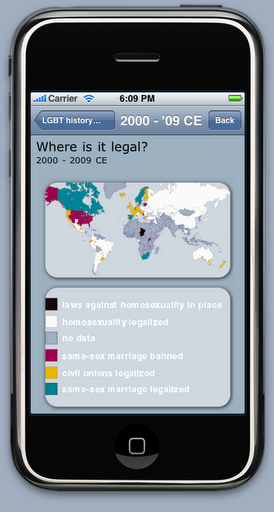
As of June 2009, the Gay History Project features over 150 built-in articles about LGBT events and people from around the world. The articles span over four-thousand years of history and are ordered chronologically. They are divided into nine categories: Ancient Times, The Roman Empire, England & America (1000CE – 1800CE), Life in the 1800s, The early 1900s, Social Revolution (1960-1979CE), The eighties, The nineties, and A new millennium. Clevesy’s personal story is also featured in a separate section entitled “Forward.” Each section contains articles relating to the time-period in which the user has selected along with an article that lists additional events that occurred during that timeframe. The sections relating to periods after the 1700s also include color-coded maps which display information about laws regarding homosexuals in various territories around the world.

The final section of the Gay History Project is an area in which users can write to inform others about new stories as they occur. This allows the Gay History Project to continue growing indefinitely through time. Because of the iPhone’s portability, news can be posted from anywhere the user has service even as the event is taking place. Users of the Gay History Project are, therefore, kept up to date on news regarding gay, lesbian, bisexual, and transgender people. By allowing the content to continually build and grow, this section allowed Clevesy to achieve the unending expansion of the Gay History Project.
In addition to news about people and events, this last section also includes other areas for users to write in. A person can ask questions to be answered by other users regarding anything informational that they could not find elsewhere. There is also an area for anyone to tell others their own personal stories in order to receive support with their own personal struggles or triumphs.


Quick Note…

I feel a bit overwhelmed today, much like the guy above.  However, instead of books, I am in the midst of grading papers for the end of the semester.  I love teaching, but I just wish I did not have to grade.  Are there any teachers out there who actually enjoy grading papers?


Undergraduate Majors in LGBT Studies

San Diego State University announced this week that it had received approval to offer an undergraduate major in lesbian, gay, bisexual, and transgender studies, and would begin accepting students into the multidisciplinary program next spring.

Esther Rothblum, a professor of women’s studies and the LGBT-studies academic adviser at San Diego State, said in a news release that the four-year major would be the first in California and the second in the United States. The other institution offering such a major is Hobart and William Smith Colleges, in New York, The San Diego Union-Tribune reported. Ms. Rothblum said the degree would be applicable to a variety of careers, and an asset for students applying to professional programs in areas like business, law, or medicine.

Graduates of a Bachelor’s degree program will have an excellent foundation for careers in social work, family planning, counseling, medicine, law, the ministry/rabbinate, human resources, and K-12 teaching (where people are allowed to teach about LGBT issues) in various subjects, as well as for advanced academic study in disciplines such as literature, history, sociology, the arts, or theology, just to name some of the obvious ones. There are more than 1500 non-profit organizations related to LGBT issues across the country that would benefit from educated people on this topic. There are colleges running multicultural student centers and student clubs that need advisors, research roles in private and government organizations, and I can think of many other places where an education in LGBT studies could be useful.

I wish I had been out at the time I was in undergrad and would have been able to be a double major in history and LGBT studies. Most of my knowledge of LGBT issues and history has come largely from my own personal research and yearning for knowledge on the subject. Many schools are now offering minors in LGBT studies or minors in Human Rights. There have already been gender studies programs which focus on a wide range of gender issues including LGBT issues, but I think this is wonderful that there are programs now for a four year degree in LGBT studies.


A "D" for Congress

Disdain, disinterest, disrespect…Shame on the US Congress during last night’s speech by the President.  I give them a solid D, and I think that is being very generous.  I am not writing to debate the merits of the President’s job’s plan, though much of it did seem to sound good, but was it just Washington rhetoric?  I don’t know, but I do know what three of the greatest problems with America’s politicians is…disdain, disinterest, disrespect, which is precisely what I saw in the faces of many of the members of Congress last night.

Why does this bother me so much?  I deal with this day in and day out.  How can we expect our students to succeed when what they see from America’s leaders  some of the major problems that teachers face in the schools?  Students, and sadly and increasingly parents, think that school is a babysitting service.  The students are disinterested in learning; they show disdain for authority, and they show disrespect for teachers and education as a whole.

Is it really so hard to show interest and respect for the most powerful man in the world?  You don’t have to agree with him, you don’t even have to like him, but you should show him the respect that he deserves.  You shouldn’t be rolling your eyes as you sit behind the President.  You shouldn’t be looking completely bored or like you would rather be anywhere else in the world.  Why is it so hard to show respect and good manners?  Maybe Congress should learn about the Golden Rule, and more importantly they should take their jobs seriously.  Read the Constitution and understand the importance of your job.  They are the leaders of the free world and should act like it instead of like petulant children.


Question About Coming Out

I recently saw this question asked to Joe Kort, a relationship expert, on 365gay.com and wanted to share it with you.  It’s quite an interesting question.

Question
I am going to be a senior in high school this year, and luckily I’m out of the closet. However…I just moved to another school. While I know that my sexuality is my business, and mine alone, being in the closet sucked. So…should I come out “again” at my new school? Or should I just hold out for the year and keep certain secrets, well, secret? —Anthony

Dear Anthony,
This is a good but tricky question.
While I am always one to lean more toward coming out of the closet, I am also always conscious of safety factors—both emotional and psychological.
I have seen it go both ways in high schools: teenagers come out and are embraced by their peers or they’re humiliated and ridiculed.
I often see it work out better for the teens who choose to come out when a gay student has a history with other students in his or her school – they’ve gone to middle school and elementary school together, for instance. When other youth have known you for a long time and have had many different kinds of experiences with you before knowing that you’re gay, it may be easier for them to accept you.
When you come out without your fellow students knowing you at all, all they see is gay and not who you are.
This is the risk you are taking by coming out as a new senior in a school where most of the kids have most likely known each other most of their lives.
I like to distinguish between privacy vs. secrecy. People tend to confuse the two and they are very different.
Privacy is a choice you make that considers your boundaries and personal choices and preferences when deciding how much you want to share about yourself . It doesn’t involve feelings of shame.
Someone might decide not to expose how much money they make for a living, political views, real hair color, or sexual fantasies and behaviors. No because they are ashamed of these things, but because they want to keep things personal for individual reasons.
Secrecy involves shame and a feeling of being damaged or flawed and tends to come into play when someone is hiding something not by their own choice. Secrets keep us sick, say some 12-step groups, and it’s true – the more you hide things about yourself of which you are ashamed, the more you will tend to act out problematic behaviors.
Shameful things often include histories of sexual abuse, weight gain or loss and addictions.
It sounds to me that if you decide not to come out that it will be a matter of privacy and not secrecy – because as you are already out!
So before you come out in your new school, I want you to make sure that you will not be risking your physical safety. Perhaps you could schedule a counseling session with one of the counselors and get a feel for what he or she thinks about the situation based on the students in the school.
But be aware that the counselor may have their own homophobia as well and the advice may be prejudiced, depending on how ga- informed and friendly they are.

I think Kort makes an excellent point about privacy v. secrecy.  The advice that I would have given Anthony is to be himself.  I wouldn’t go around announcing that I was gay, but I wouldn’t try to change who I was to hide it either.  Just let things progress naturally.  I can say this, I hope that Anthony has a good school environment.  Often, students espouse the fears and hatred that they hear from adults and in high school most of them have not become the person they will be, they have not formed their core identity yet, and their belief structure is still a work in progress.  If Anthony lives in a more liberal atmosphere, then the students will often reflect that in the way that they treat people.  However, if Anthony lives in a more conservative (Bible Belt) atmosphere,  then the students will often reflect that conservatism in the way that they treat people as well.

One commenter responded: As a teacher (retired), I would strongly urge anyone considering to come out at school, whether a student, teacher or other school community member to determine first if your school has a toxic, tolerating, accepting or celebrating atmosphere for LGBT and Questioning persons. If your school is toxic, you will not get any support and may be blamed as the cause of your own trouble. On the other end of the spectrum, a celebrating school welcomes both students, staff and parents who are from the LGBT community – and you will likely even find a Gay-Straight Alliance at that school. Tolerating schools and accepting schools fall in between the two ends of the spectrum. In a tolerating school, you may find limited support but will be told to keep your sexuality to yourself. In an accepting school, you will find staff who will stand up and support you, but only in a celebrating school are you likely to find teachers who are also “out.”

What advice would you give?


Straight But Not Narrow

I came across information for the Straight But Not Narrow (SBNN) organization on SECRETGUYSTUFF’S BLOG. More about SBNN in a moment, but I did want to take a second to say that SECRETGUYSTUFF’S BLOG is one of the coolest blogs that I have come across in a long time.  It’s a blog about “It’s guys talking about guy stuff. You know, the inside stuff, the stuff we want to know about, the stuff we want to discuss, the experiences we want to share, and the questions we can’t ask our moms. So share it, dare it, enjoy it.” From discussions about lubes to masturbation myths to body hair to the various degrees of sexuality. It is a blog about all of the stuff that I wondered about as a teenager and young adult. I eventually found many of the answers on my own, but I wish this blog had been around back then. I still learn a few things here and there, and this blog is a fun way to learn about the secret guy stuff and it is also a bit nostalgic for those of us who have already experienced these points in our lives.  So before I begin to talk about SBNN, I wanted to introduce you guys to SECRETGUYSTUFF’S BLOG.

Straight But Not Narrow is an organization that was started by asking that very question.  There have been a number of great campaigns and charities that have recently emerged to show support to gay youth and teens. However, SBNN noticed one significant niche missing in the efforts. the message to the young, straight male. Its an unfortunate reality that most of the bullying and harassment that gay teens face comes from them. It is for this reason that we are building a campaign that is primarily directed to the young, straight male by using comedy and their peers to positively influence their views on LGBT teens.

SBNN was founded by Avan Jogia.  Avan, an actor, musician, writer, and big picture thinker. His idea, his passion, his voice started it all.

Back to school should be a fun time for everyone. The sad truth is, this can be a tough time for a LGBTQ students. Straight But Not Narrow are rally their troops to do their part in making sure this back to school is awesome for everyone, regardless of sexual orientation.

They are asking allies to make a pledge.  Here’s the pledge:

“I will do my part to make sure this is a great school year for everyone. It doesn’t matter if you are gay, straight, or somewhere in between. Just be you, because it’s all good with me”. I’m Straight But Not Narrow (the last line is optional if, of course, it doesn’t apply to you).

SBNN has also had a series of YouTube videos to get their point across.  Here is one by Ryan Rottman (who I had to look up too, but he is very cute).

Ryan Rottman (born March 17, 1984) is an American actor. He is best known for his role as Joey Colvin on the TeenNick series Gigantic, which premiered October 8, 2010.  Ryan Rottman started his career in 2008 as an extra in the film The House Bunny. Before that he starred in the plays at Texas Tech University. In 2009, he appeared in films The Stuntman and The Open Road. Rottman’s other television credits are Viva Laughlin, Greek, Victorious and the webisode series Valley Peaks.

One of the most fascinating things that I have found while teaching at the conservative little private school where I teach is that I often hear the girls in the school say that they wished they had a “gay best friend.”  It is generally said in response to a homophobic comment from one of the boys in the class and sometimes it is just random.  They don’t know that I am gay, and it is probably better that way (mostly because of school politics), but the students know that I don’t tolerate derogatory language in my class in any form.  Therefore, it often gives me a warm fuzzy feeling when the girls put the guys in their places when they are being insensitive.  I also find it particularly funny that there are a few of the girls who have said that, who I am almost 100 percent sure that their male best friend is actually gay, they just don’t know it yet.  We have a few students at school who either have not yet admitted it to themselves or are still in the closet because of home and school prejudices.  I try my best to teach all of my students acceptance of those things they do not understand.  People are far too often scared of things they don’t understand and that fear turns into prejudices.  It is a sad state of affairs, but it is something that I am working to change.


Laziness

I have to admit something to you guys, I have been pretty damn lazy today.  It’s been a long tiring week of getting back into the schedule of things with school starting back, and since I was not able to sleep in on Saturday, I have used today to catch up on my sleep.  So I am just now waking up.  I know there are people out there, who have natural alarm clocks and wake up at a certain time each day, generally go to bed at a certain time each night, but I have never been one of those people.  Part of it is because I have always found it hard to fall asleep at night, then when I do, I find it difficult to wake in the morning.  Today, I really had nothing to do, not that couldn’t wait until the afternoon, so I slept in.

Considering my own laziness today, I wanted to ask my fellow educators out there how they deal with lazy students.  I think that part of this has to do with the lack of manners and courteousness that I spoke of on Friday, but I have noticed in the first week of school that no matter what I try to do, my students begin to complain as soon as I give them an assignment.  I try to make my classes fun and interesting, and I rarely give “busy work”  just so they will have something to do.  I find it particularly vexing with my 12th grade class.  Senioritis shouldn’t start until later in the year, but these kids have caught it way too early. By the way, for those who don’t know what I mean by Senioritis, Urban Dicitonary describes it as thus:

Senioritis: noun. A crippling disease that strikes high school seniors. Symptoms include: laziness, an over-excessive wearing of track pants, old athletic shirts, sweatpants, athletic shorts, and sweatshirts. Also features a lack of studying, repeated absences, and a generally dismissive attitude. The only known cure is a phenomenon known as Graduation.

Though most of it is very accurate, especially for Urban Dictionary, I hope that the only cure is not ” a phenomenon known as Graduation.”  If that is the only cure, I am afraid that some of these kids will not graduate.  They have required classes that they must pass this year, and even those they do not want to take seriously.  I hope this will change soon, but I would love to hear your advice, dear reader, on what I can do.  TIME Magazine published an article titled “How to Combat Senioritis” in May 2006, but this article did not seem particularly helpful. Kevin Quinn, a counselor at South Kingstown High School said, “Seniors need something to gravitate to and be re-energized by.”  So South Kingston High School began offering dual college enrollment.  My students are far too lazy at this point for dual enrollment with a college.  At least one last year during his senior year took some online courses with a state university, but I do not think that he is doing so this year. In this same article, TIME Magazine wrote: “The best cure for some cases of senioritis is a strong dose of reality. More than 50% of students entering college in the U.S. require remedial course work once on campus.”  The problem with this is that my students do not care about reality.  Most of them are quite spoiled rich kids (I teach at a private school), and they firmly believe that their parents’ money can literally buy them an education whether they do the work or not.  I have tried to explain to them the reality of this, and the reality of not going to college for the few who do not plan on furthering their education, but they are too stubborn to see reality.

So, what have you done to combat Senioritis?  How have you found the most effective way to motivate your students?  My past techniques of making class more interesting and interactive, do not seem to be working this semester, so I would love to hear any suggestions from my readers.