
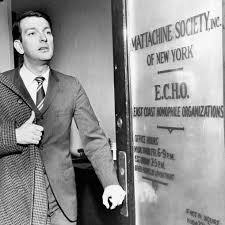
Most historians agree that the movement towards gay rights, at least, nominally began with the founding of the Mattachine Society in Los Angeles in 1950 as the first gay rights organization in history. Harry Hay founded the organization and gave it its name after the medieval group of court jesters who satirized the government and royalty by wearing masks to keep themselves anonymous. Mattachine went through two different phases in its development. Early leadership based the leadership of the organization on the cell structure of the Communist Party with a secret hierarchical structure and a very centralized leadership. The seven founding members of the Mattachine Society remained anonymous as the mysterious “fifth order” who ran the organization through their leadership. The organization had three primary goals: to unify homosexuals as a group and with the dominant heterosexual culture, to educate both homosexuals and heterosexuals on the subject of homosexuality, and to enter the realm of political action.[1]
Due to the insistence of the first Mattachine Society that homosexuals adapt to the homophobic society of the Cold War by adopting the social and cultural mores of heterosexuals, the organization began to lose influence and membership. By 1957, the organizations national headquarters moved from its base in Los Angeles to San Francisco where it remained until the national organization disbanded in 1961. With the end of the national organization and its insistence on conservative politics, the local chapters began to become more radical in their quest for gay liberation.[2] The Communist Party structure and tactics of the Mattachine Society ultimately hurt the organization more that it would help it. With the Red Scare during the Cold War, the politics of the movement had a difficult time getting any recognition. Besides its communist association, this early homophile organization was never that large of a political organization. The fear of being publicly discovered as a homosexual was worse than having freedoms during the 1950s, when coming out meant that you were considered mentally ill, a social deviant, often classified as a criminal, and were barred from holding civil service jobs.
In his examination of the radicalization of the gay liberation movement, historian Justin David Suran shifts the focus from the radicalization of local homophile organizations to the gay participation in the antiwar movement. Local homophile organizations were still working for homosexuals to be “normalized” by assimilating into imagethe heterosexual cultures, most by allowing gay men and women to serve discretely in the U.S. Armed Forces. With the ability to be deferred from the draft by being labeled homosexual, many young gay men saw the opportunity to stay out of the Vietnam War. As the war continued into the early seventies, the deferment for homosexuality would have to be proved by a doctor or an arrest report in order to receive the deferment because of the prevalence of heterosexual men posing as homosexuals to stay out of the military.[3]
[1]Martin Meeker, “Behind the Mask of Respectability: Reconsidering the Mattachine Society and Male Homophile Practice, 1950s and 1960s,” Journal of the History of Sexuality 10, no. 1 (2001): 83.
[2]Ibid., 79.
[3]Justin David Suran, “Coming Out Against the War: Antimilitarism and the Politicization of Homosexuality in the Era of Vietnam,” American Quarterly 53, no. 3 (2001): 458-463.
Next: The Anti-War Movement


 The previous two days' posts were written in 2011. The gay porn industry has changed quite dramatically since then. In 2011, Falcon Studios was mainly selling DVDs; now, Falcon is streaming most of their content. Yes, you can still buy DVDs of gay porn, but how many people actually do anymore? The internet has taken over the porn industry. Sites like Helix Studios, Sean Cody, Corbin Fisher, or Bel Ami are nearly all online now. Sean Cody has been bought by MindGeek, who owns Men.com and is arguably the largest of the studios at this point. Of the studios mentioned, Sean Cody is the only one who does not produce DVDs. Yet, the vast majority of their use is online.
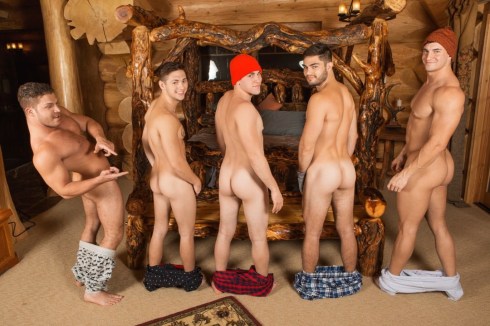 The main thing is that gay porn in the last six years has become virtual. While this trend was begun in the early 2000s, since 2011, it has become more and more web-based. Whether you are into twinks (Helix), military men (Active Duty), college frat boys (Corbin Fisher or Sean Cody), Europeans (Bel Ami), or more masculine men (Men.com), there is something for you. There are even more specialized/fetish sites like Bound Gods, SpankingCentral, and others that are able to produce web-based content to a specialized audience that DVDs just didn’t really allow.
 Gay porn has also changed in one other major way. It is nearly all condomless these day. PrEP has allowed barebacking to become legitimate in porn again. In 2011, gay porn studios were still using condoms. Only studios on the edge such as Treasure Island Media allowed for condomless porn, but with frequent STD testing and PrEP barebacking is all the rage in gay porn again. Falcon was one of the last studios to start using condoms and it was one of the last to end the use of condoms.

 Joe
Joe





 The Closet Professor