Category Archives: History

Phallus Impudicus: The Shameless Phallus

With Gay American History, Jonathan Ned Katz published the first book of documents relating to homosexuality in American history. This fascinating and compendious source ranges from the sixteenth century up to present times; its texts include everything from denunciations of sodomy in colonial America to modern protests against homosexual persecution.  By demonstrating the important presence of same-sex desires, friendships, and sexual practices throughout Western history, this book was crucial in opening up new fields for investigation.

Jonathan Katz’s Gay American History: Lesbians and Gay Men in the U.S.A. uses this illustration drawn by Henry David Thoreau of “Phallus impudicus” (the shameless phallus), among excerpts from Thoreau’s letters about his reaction after reading Whitman’s Leaves of Grass: “It is as if the beasts spoke. I think that men have not been ashamed of themselves without reason.”

I would love to be able to see this document myself and analyze it’s content; however, this picture of the “Phallus impudicus” drawing is not clear enough to tell much about it. This same drawing does appear in Thoreau’s Garden by H. Peter Loewer. In this volume, we can learn more about ferns and berries, goldenrods and grasses. More relevant to this post, readers can even get a glimpse of the “disgusting … yet very suggestive” fungus (Phallus impudicus) that Thoreau railed about in October 1856, pondering “Pray, what was Nature thinking of when she made this? She almost puts herself on a level with those who draw in privies.” Loewer used as his reference the index in the Dover two-volume reprint of Thoreau’s Journals, which is somewhat incomplete.

The question I pose is this:  Is Thoreau chronicling the plants in his garden, or is he presenting a critique of Whitman’s Leaves of Grass?  It is a question I would love to ponder further along with the relevant documents.


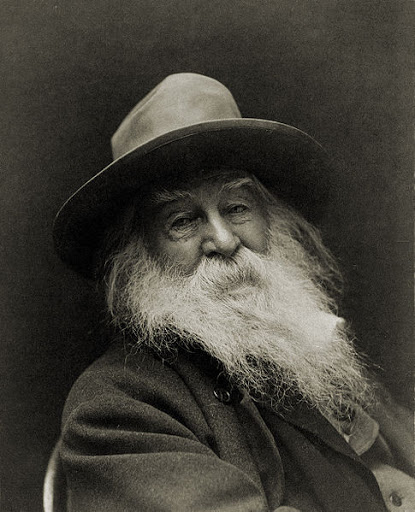
Ode to Walt Whitman

Eakins was profoundly influenced by the ideas of Walt Whitman, with whom he became close friends, after painting his portrait in 1887-1888. Eakins’ carefully composed images of naked youths in arcadian landscape settings (such as The Swimming Hole, 1893-1895) constitute visual equivalents of Whitman’s poems, celebrating male beauty and comradeship. Eakins often painted scenes of all-male athletic activities, such as rowing (for example, The Biglin Brothers Turning the Stake, 1873) and boxing (for example, Counting Out, 1888).

Ode to Walt Whitman
by Federico Garcia Lorca

By the East River and the Bronx
boys were singing, exposing their waists
with the wheel, with oil, leather, and the hammer.
Ninety thousand miners taking silver from the rocks
and children drawing stairs and perspectives.

But none of them could sleep,
none of them wanted to be the river,
none of them loved the huge leaves
or the shoreline’s blue tongue.

By the East River and the Queensboro
boys were battling with industry
and the Jews sold to the river faun
the rose of circumcision,
and over bridges and rooftops, the mouth of the sky emptied
herds of bison driven by the wind.

But none of them paused,
none of them wanted to be a cloud,
none of them looked for ferns
or the yellow wheel of a tambourine.

As soon as the moon rises
the pulleys will spin to alter the sky;
a border of needles will besiege memory
and the coffins will bear away those who don’t work.

New York, mire,
New York, mire and death.
What angel is hidden in your cheek?
Whose perfect voice will sing the truths of wheat?
Who, the terrible dream of your stained anemones?

Not for a moment, Walt Whitman, lovely old man,
have I failed to see your beard full of butterflies,
nor your corduroy shoulders frayed by the moon,
nor your thighs pure as Apollo’s,
nor your voice like a column of ash,
old man, beautiful as the mist,
you moaned like a bird
with its sex pierced by a needle.
Enemy of the satyr,
enemy of the vine,
and lover of bodies beneath rough cloth…

Not for a moment, virile beauty,
who among mountains of coal, billboards, and railroads,
dreamed of becoming a river and sleeping like a river
with that comrade who would place in your breast
the small ache of an ignorant leopard.

Not for a moment, Adam of blood, Macho,
man alone at sea, Walt Whitman, lovely old man,
because on penthouse roofs,
gathered at bars,
emerging in bunches from the sewers,
trembling between the legs of chauffeurs,
or spinning on dance floors wet with absinthe,
the faggots, Walt Whitman, point you out.

He’s one, too! That’s right! And they land
on your luminous chaste beard,
blonds from the north, blacks from the sands,
crowds of howls and gestures,
like cats or like snakes,
the faggots, Walt Whitman, the faggots,
clouded with tears, flesh for the whip,
the boot, or the teeth of the lion tamers.

He’s one, too! That’s right! Stained fingers
point to the shore of your dream
when a friend eats your apple
with a slight taste of gasoline
and the sun sings in the navels
of boys who play under bridges.

But you didn’t look for scratched eyes,
nor the darkest swamp where someone submerges children,
nor frozen saliva,
nor the curves slit open like a toad’s belly
that the faggots wear in cars and on terraces
while the moon lashes them on the street corners of terror.

You looked for a naked body like a river.
Bull and dream who would join wheel with seaweed,
father of your agony, camellia of your death,
who would groan in the blaze of your hidden equator.

Because it’s all right if a man doesn’t look for his delight
in tomorrow morning’s jungle of blood.
The sky has shores where life is avoided
and there are bodies that shouldn’t repeat themselves in the dawn.

Agony, agony, dream, ferment, and dream.
This is the world, my friend, agony, agony.
Bodies decompose beneath the city clocks,
war passes by in tears, followed by a million gray rats,
the rich give their mistresses
small illuminated dying things,
and life is neither noble, nor good, nor sacred.

Man is able, if he wishes, to guide his desire
through a vein of coral or a heavenly naked body.
Tomorrow, loves will become stones, and Time
a breeze that drowses in the branches.

That’s why I don’t raise my voice, old Walt Whitman,
against the little boy who writes
the name of a girl on his pillow,
nor against the boy who dresses as a bride
in the darkness of the wardrobe,
nor against the solitary men in casinos
who drink prostitution’s water with revulsion,
nor against the men with that green look in their eyes
who love other men and burn their lips in silence.

But yes against you, urban faggots,
tumescent flesh and unclean thoughts.
Mothers of mud. Harpies. Sleepless enemies
of the love that bestows crowns of joy.

Always against you, who give boys
drops of foul death with bitter poison.
Always against you,
Fairies of North America,
Pájaros of Havana,
Jotos of Mexico,
Sarasas of Cádiz,
Apios of Seville,
Cancos of Madrid,
Floras of Alicante,
Adelaidas of Portugal.

Faggots of the world, murderers of doves!
Slaves of women. Their bedroom bitches.
Opening in public squares like feverish fans
or ambushed in rigid hemlock landscapes.

No quarter given! Death
spills from your eyes
and gathers gray flowers at the mire’s edge.
No quarter given! Attention!
Let the confused, the pure,
the classical, the celebrated, the supplicants
close the doors of the bacchanal to you.

And you, lovely Walt Whitman, stay asleep on the Hudson’s banks
with your beard toward the pole, openhanded.
Soft clay or snow, your tongue calls for
comrades to keep watch over your unbodied gazelle.

Sleep on, nothing remains.
Dancing walls stir the prairies
and America drowns itself in machinery and lament.
I want the powerful air from the deepest night
to blow away flowers and inscriptions from the arch where you sleep,
and a black child to inform the gold-craving whites
that the kingdom of grain has arrived.

For more information and analysis of this poem, take a look at “Lorca’s Homographic Poetics of Nationalism” by Frederick Luis Aldama

Also see:

I would not consider this one of my favorite poems, but it is interesting in its own way. John K. Walsh speculates in his essay “Lorca’s Ode to Walt Whitman” that Lorca’s Cuban hiatus marked his “open passage into a homosexual mien, and the acknowledgment of his proclivities.”  As with most poetic coming outs, this is bold and expressive.

Moment of Zen: LGBT History Month

Today, October 1, 2011, begins LGBT History Month. LGBT History Month is a month-long annual observance of lesbian, gay, bisexual and transgender history, and the history of the gay rights and related civil rights movements. It is observed during October in the United States, to include National Coming Out Day on October 11.  This blog will, of course, be having a month long celebration of something that is near and dear to my own heart.

Background
In 1994, Rodney Wilson, a Missouri high school teacher, believed a month should be dedicated to the celebration and teaching of gay and lesbian history, and gathered other teachers and community leaders. They selected October because public schools are in session and existing traditions, such as Coming Out Day (October 11), occur that month.
Gay and Lesbian History Month was endorsed by GLAAD, the Human Rights Campaign, the National Gay and Lesbian Task Force, the National Education Association, and other national organizations. In 2006, Equality Forum assumed responsibility for providing content, promotion and resources for LGBT History Month.

Celebrate Our Heritage
The LGBT community is the only community worldwide that is not taught its history at home, in public schools or in religious institutions. LGBT History Month provides role models, builds community and makes the civil rights statement of our extraordinary national and international contributions.


A Sixty Year Romance

The picture above has a very interesting story attached to it.  However, because the story was originally published in the New York Times, I am not able to repost it here, but I urge you to check out the following link: On Carrie Bradshaw’s Block, Romance Over 6 Decades by Diane Cardwell.


Autumn Fires

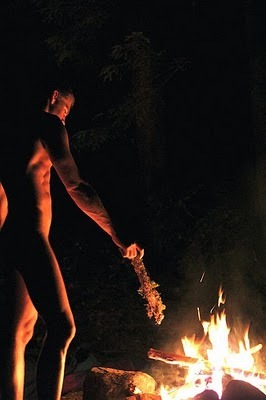
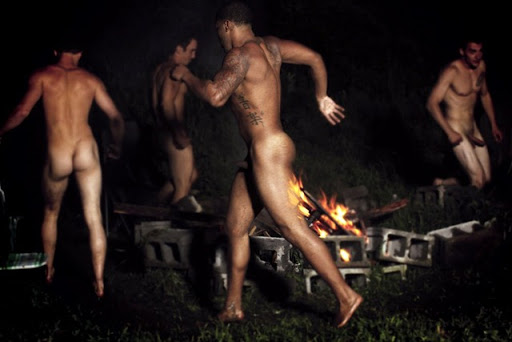
Bonfires always remind me of fall: the big bonfire before the homecoming game, sitting around a bonfire telling stories, ghost stories around the campfire. All these things remind me of autumn.

In some parts of the world, bonfires are identified, not with autumn, but with the summer solstice. In Latvia, Midsummer is called Jāņi . It is a national holiday celebrated on a large scale by almost everyone in Latvia and by people of Latvian origin abroad. Celebrations consist of a lot of traditional elements – eating Jāņu cheese, drinking beer, singing hundreds of Latvian folk songs dedicated to Jāņi, burning bonfire to keep light all through the night and jumping over it, wearing wreaths of flowers (for the women) and leaves (for the men) together with modern commercial products and ideas. Oak wreaths are worn by men named Jānis in honor of their name day. Small oak branches with leaves are attached to cars in Latvia during the festivity.

In the western town of Kuldīga, revellers mark the holiday by running naked through the town at three in the morning. The event has taken place for the past seven years. Runners are rewarded with beer, and police are on hand in case any “puritans” attempt to interfere with the naked run.

I just never got the chance to run around them naked, what about you? Do bonfires remind you of autumn? Have you ever run around one naked.

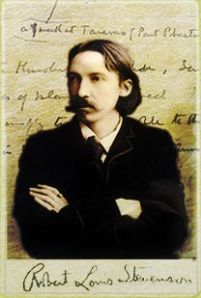
Just as I think of bonfires and autumn together, the following poem by Robert Louis Stevenson is not what I usually associate with Stevenson. I usually associate stories of pirates and life at sea. However, this poem shows that there was much more to Robert Louis Stevenson.

Autumn Fires
Robert Louis Stevenson (1913)

In the other gardens
And all up the vale,
From the autumn bonfires
See the smoke trail!
Pleasant summer over
And all the summer flowers,
The red fire blazes,
The gray smoke towers.
Sing a song of seasons!
Something bright in all!
Flowers in the summer,
Fires in the fall!

More about Robert Louis Stevenson after the jump.

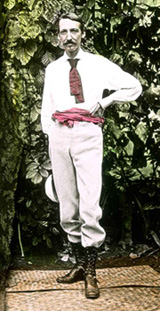
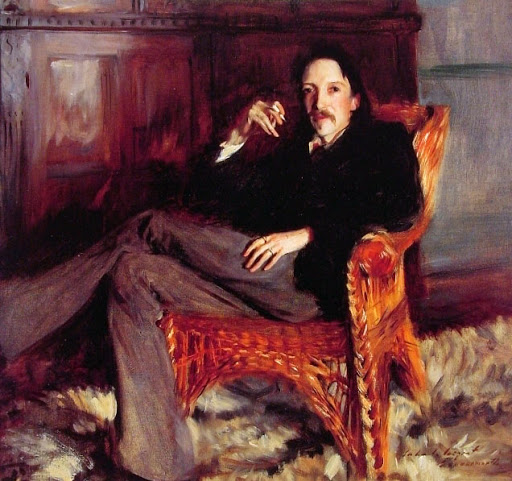
Robert Louis Stevenson
The Scottish novelist, essayist, and poet Robert Louis Stevenson (1850-1894) was one of the most popular and highly regarded British writers of the end of the 19th century. He played a significant part in the revival of the novel of romance.

During Robert Louis Stevenson’s youth the romantic novels of Sir Walter Scott and his followers had been eclipsed by the realism of William Makepeace Thackeray and Anthony Trollope. Writing in conscious opposition to this trend, Stevenson formulated his theoretical position in his essays “A Gossip on Romance” (1882), “A Humble Remonstrance” (1884), and “The Lantern-bearers” (1888). Romance, he wrote, is not concerned with objective truth but rather with things as they appear to the subjective imagination, with the “poetry of circumstance.” Romance, according to Stevenson, avoids complications of character and morality and dwells on action and adventure.

Stevenson was born on Nov. 13, 1850, in Edinburgh, the son of a noted lighthouse builder and harbor engineer. Though robust and healthy at birth, Stevenson soon became a victim of constant respiratory ailments that later developed into tuberculosis and made him skeletally thin and frail most of his life. By the time he entered Edinburgh University at the age of 16, ostensibly to study engineering, Stevenson had fallen under the spell of language and had begun to write. For several years he attended classes irregularly, cultivating a bohemian existence complete with long hair and velvet jackets and acquainting himself with Edinburgh’s lower depths.

Early Works

When he was 21 years old, Stevenson openly declared his intention of becoming a writer against the strong opposition of his father. Agreeing to study law as a compromise, Stevenson was admitted to the Scottish bar in 1875. Having traveled to the Continent several times for health and pleasure, he now swung back and forth between Scotland and a growing circle of artistic and literary friends in London and Paris. Stevenson’s first book, An Inland Voyage (1878), related his adventures during a canoe trip on the canals of Belgium and France.

In 1876 in France, Stevenson had met an American woman named Fanny Osbourne. Separated from her husband, she was 11 years older than Stevenson and had two children. Two years later Stevenson and Osbourne became lovers. In 1878 Osbourne returned to California to arrange a divorce, and a year later Stevenson followed her. After traveling across America in an emigrant train, Stevenson arrived in Monterey in poor health. After his marriage, a stay in an abandoned mining camp, later recounted in The Silverado Squatters (1883), restored his health. A year after setting out for the United States, Stevenson was back in Scotland. But the climate there proved impossible, and for the next 4 years he and his wife lived in Switzerland and in the south of France.

Despite ill health these years were productive. In his collections Virginibus puerisque (1881) and Familiar Studies of Men and Books (1882) Stevenson arrived at maturity as an essayist. Addressing his readers with confidential ease, he reflected on the common beliefs and incidents of life with a mild iconoclasm, a middling disillusionment.

The stories Stevenson collected in The New Arabian Nights (1883) and The Merry Men (1887) range from detective stories to Scottish dialect tales. The evocation of mood and setting that he practiced in his travel essays was used to great effect here. Despite his theory of romance, he was unable entirely to keep away from moral issues in these stories, but he was rarely successful in integrating moral viewpoint with action and scene.

Early Novels

Treasure Island (1881, 1883), first published as a serial in a children’s magazine, ranks as Stevenson’s first popular book, and it established his fame. A perfect romance according to Stevenson’s formula, the novel – riding over all the problems of morality and character that might have arisen – recounts a boy’s involvement with murderous pirates. Kidnapped (1886), set in Scotland shortly after the abortive Jacobite rebellion of 1745, has the same charm. In its sequel, David Balfour (1893), Stevenson could not avoid psychological and moral problems without marked strain. In The Strange Case of Dr. Jekyll and Mr. Hyde (1886) he dealt directly with the nature of evil in man and the hideous effects of a hypocrisy that seeks to deny it. This work pointed the way toward Stevenson’s more serious later novels. During this same period he published a very popular collection of poetry, A Child’s Garden of Verses (1885).

After the death of his father in 1887, Stevenson again traveled to the United States, this time for his health. He lived for a year at Saranac Lake, N.Y., in the Adirondacks. In 1889 Stevenson and his family set out on a cruise of the South Sea Islands. When it became clear that only there could he live in relative good health, he settled on the island of Upolu in Samoa. He bought a plantation (Vailima), built a house, and gained influence with the natives, who called him Tusifala (“teller of tales”). By the time of his death on Dec. 3, 1894, Stevenson had become a significant figure in island affairs. His observations on Samoan life were published in the collection In the South Seas (1896) and in A Footnote to History (1892). Of the stories written in these years, “The Beach of Falesá” in Island Nights’ Entertainments (1893) remains particularly interesting as an exploration of the confrontation between European and native ways of life.

Later Novels

The Master of Ballantrae (1889), set in the same period as Kidnapped, showed a new sophistication in Stevenson’s use of the elements of romance. Its basic theme involved complexities of character that his earlier romances had deliberately avoided. In the more advanced Weir of Hermiston, the legends of the romantic Scottish past saturate the setting and serve as a symbolic background for a tragic conflict between the primitive energies of a father and his sensitive, effete son. Left unfinished at his death, this novel would have ranked as Stevenson’s greatest work. While living in the South Pacific, Stevenson also collaborated on three novels with his stepson Lloyd Osbourne.

Further Reading

The best biographies of Stevenson are David Daiches, Robert Louis Stevenson (1947), and Joseph C. Furnas, Voyage to Windward: The Life of Robert Louis Stevenson (1951). Recommended critical studies include David Daiches, Stevenson and the Art of Fiction (1951); Robert Kiely, Robert Louis Stevenson and the Fiction of Adventure (1964), and Edwin M. Eigner, Robert Louis Stevenson and Romantic Tradition (1966).

Additional Sources

  • Bell, Ian, Dreams of exile: Robert Louis Stevenson, a biography, New York: H. Holt, 1993.
  • Hammond, J. R. (John R.), A Robert Louis Stevenson chronology, New York: St. Martin’s Press, 1996.
  • McLynn, F. J., Robert Louis Stevenson: a biography, New York:Random House, 1994.

Read more: http://www.answers.com/topic/robert-louis-stevenson#ixzz1Z0zi30n4


After Apple-Picking

After Apple-Picking


My long two-pointed ladder’s sticking through a tree
Toward heaven still,
And there’s a barrel that I didn’t fill
Beside it, and there may be two or three
Apples I didn’t pick upon some bough.
But I am done with apple-picking now.
Essence of winter sleep is on the night,
The scent of apples: I am drowsing off.
I cannot rub the strangeness from my sight
I got from looking through a pane of glass
I skimmed this morning from the drinking trough
And held against the world of hoary grass.
It melted, and I let it fall and break.
But I was well
Upon my way to sleep before it fell,
And I could tell
What form my dreaming was about to take.
Magnified apples appear and disappear,
Stem end and blossom end,
And every fleck of russet showing clear.
My instep arch not only keeps the ache,
It keeps the pressure of a ladder-round.
I feel the ladder sway as the boughs bend.

And I keep hearing from the cellar bin
The rumbling sound
Of load on load of apples coming in.
For I have had too much
Of apple-picking: I am overtired
Of the great harvest I myself desired.
There were ten thousand thousand fruit to touch,
Cherish in hand, lift down, and not let fall.
For all
That struck the earth,
No matter if not bruised or spiked with stubble,
Went surely to the cider-apple heap
As of no worth.
One can see what will trouble
This sleep of mine, whatever sleep it is.
Were he not gone,
The woodchuck could say whether it’s like his
Long sleep, as I describe its coming on,
Or just some human sleep.
–Robert Frost (1914)

Born in San Francisco, Frost spent most of his adult life in rural New England and his laconic language and emphasis on individualism in his poetry reflect this region. He attended Dartmouth and Harvard but never earned a degree, and as a young man with growing family he attempted to write poetry while working a farm or teaching school. American editors rejected his submitted poems. With considerable pluck Frost moved his family to England in 1912 and the following year a London publisher brought out his first book. After publishing a second book, Frost returned to America determined to win a reputation in his own country, which he gradually achieved, becoming one of the country’s best-loved poets. Unlike his contemporaries, Frost chose not to experiment with new verse forms but to employ traditional patterns, or as he said, he chose “the old-fashioned way to be new.” Despite the surface cheerfulness and descriptive accuracy of his poems, he often presents a dark, sober vision of life, and there is a decidedly thoughtful quality to his work.
In the poem above we see how, like Wordsworth, Frost takes an ordinary experience and transforms it into a meditative moment, a philosophical musing. Apple-picking slides gradually away from merely harvesting fruit to considering how life has been experienced fully but with some regrets and mistakes. The reference to winter coming on feels like the presence of mortalilty. The question about what kind of sleep to anticipate suggests untroubled oblivion or possibly some kind of new life just as the woodchuck reawakens to fresh life in the spring after his hibernation.


Sexual Freedom Day

Celebrate with The Woodhull Sexual Freedom Alliance and Federation in Washington, DC

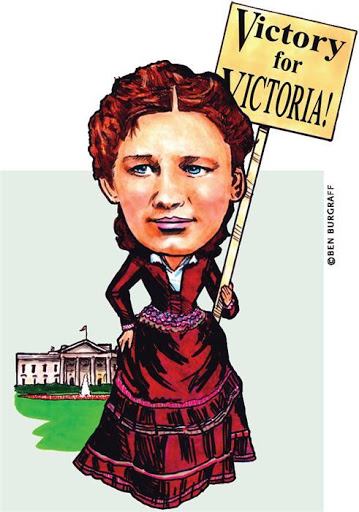
September 23, 2011, is the 173rd birthday of the Woodhull Freedom Foundation’s namesake, Victoria Woodhull. Every year on this day, Sexual Freedom advocates gather to learn, share ideas and celebrate the sexual freedom movement’s big day!

This year, the WFF focuses on freedom of sexual speech and expression is highlighted in their educational program, “Sexual Outlaws: The Prohibition of Pleasure.” WFF hopes you will join them to find out more about the war on sex and why right now is a crucial time for advocates of sexual freedom. WFF has already confirmed human rights leaders, academics, community advocates, writers, educators and performers and the WFF hopes they can count you in as well!

After the exciting afternoon of Sexual Freedom panels and discussions at the Pew Charitable Foundation Conference Center, WFF will be moving to the Hamilton Crowne Plaza for a Sexual Freedom Gala, a cocktail reception, fabulous raffles, an awards ceremony hosted by Carol Queen and Nina Hartley, and the fun and fabulous Pamala Stanley whose unparalleled voice encompasses everything from the most intimate whisper to the soaring “bel canto” that is her trademark.

Event Schedule

  • 1-5 p.m. “Sexual Outlaws: The Prohibition of Pleasure” Panel Discussion (PEW Conference Center)
  • 6-7 p.m. VIP Cocktail Reception (Hamilton Crowne Plaza)
  • 7-7:30 p.m. Cocktail Reception (Hamilton Crowne Plaza)
  • 7:30-10 p.m. Sexual Freedom Gala and Awards Ceremony hosted by Carol Queen and Nina Hartley with entertainment by the fabulous Pamala Stanley! (Hamilton Crowne Plaza)

Full schedule and event details here

About Victoria Woodhull

by Barbara Goldsmith

Recently, when I mentioned to a friend that the title of my book was Other Powers – The Age of Suffrage, Spiritualism and the Scandalous Victoria Woodhull, she asked: “Just who was Victoria Woodhull anyway?” It seems a simple question, but Victoria was not a simple person. She was conceived in 1837, during the frenzy of a religious revival in Homer, Ohio. Her father was an itinerant con man and a thief; her mother was illegitimate, illiterate and a religious fanatic. As a child, Victoria was raised in filth and squalor, beaten and starved, given little education and exploited in her father’s traveling carnival show as a clairvoyant and fortune-teller. Unexpectedly, she demonstrated such powers as accurately recalling past events and predicting future ones, finding missing objects and people, and affecting cures. She also relayed messages from loved ones who had “passed over.”

From childhood, Victoria maintained that she was guided and protected by the spirits, who occasionally let her visit a utopian world in heaven unlike the chaotic, miserable world in which she lived. Like Joan of Arc, she listened to voices that told her she would rise from poverty one day to become “ruler of the nation.” At 15, in order to escape her father’s brutality, Victoria eloped with an alcoholic doctor who fathered a retarded son and so botched the delivery of their daughter that the baby nearly bled to death. After five years, Victoria left him and struck out on her own. Eventually, her belief in the spirits enabled her to form alliances with such powerful men as Commodore Cornelius Vanderbilt, to become the first woman to own a Wall Street investment firm, to found her own newspaper, to speak before Congress demanding that women be given the vote and finally, to run for U.S. President in 1872 against the popular incumbent, Ulysses S. Grant, and the powerful newspaperman, Horace Greeley. In short, she set America on its ear.

In the decade that it took to write my book, I came to know Victoria Woodhull well, and she taught me a great many lessons – not the least of which was that the common wisdom on most subjects is frequently wrong. She made me realize that people must always think for themselves and never accept circumstances that seem unfair, unkind or uncomfortable.

Of course, Victoria’s time was a much more difficult one for women, who then had almost no rights to property or person. If a married woman worked, her wages were given directly to her husband. She could not dispose of her property upon death. If she divorced, she automatically forfeited custody of her children. Women could not enter universities, law schools or medical schools. They could not serve on juries, and they could not vote.

Most significantly, women had no control over their own bodies: There were no laws to protect them from physical abuse at the hands of their husbands or fathers, although some states stipulated the size of the objects that might be used to inflict discipline. They had no right to deny their husbands sexual access. The professions open to women were few: domestic drudgery, factory work, teaching, prostitution and, for the exceptional few, writing.

Men were allowed all means of sexual license, but a woman who committed adultery was subject to a jail sentence. In 1868, from the lecture platform, Victoria Woodhull boldly instructed women to demand a single sexual standard and not to accept the view that sexual desire in females was vulgar. “What! Vulgar!” she said. “The instinct that creates immortal souls vulgar…be honest…it is not the possession of strong powers that is to be deprecated. They are that necessary part of human character.”

Victoria preached a doctrine called “Free Love” that included the odd notion of marrying for love, as well as an easement of the divorce laws. She was radical even by today’s standards, asserting: “Women are entirely unaware of their power. Like an elephant led by a string, they are subordinated by just those who are most interested in holding them in slavery…Sexual freedom means the abolition of prostitution both in and out of marriage, means the emancipation of woman and her coming into control of her own body, means the end of her pecuniary dependence upon man…means the abrogation of forced pregnancy, of anti-natal murder of undesired children and the birth of love children only.” Ideas stated in the extreme make one think and question and argue, and that was what Victoria accomplished.

Victoria Woodhull was a fervent Spiritualist who searched for meaning in a society not so different from our own, in that most people felt overwhelmed by financial manipulations and technical achievements they could not comprehend. They felt they had little control over their own destinies. Women, in particular – even the strongest – desperately needed the courage to combat the criticism and isolation they felt in the battle for their most basic rights. Victoria’s belief in spirit guidance empowered her and her followers to challenge the law, the church and the entrenched male establishment.

Victoria’s spiritualism usually is dismissed as a fad by historians, but in studying her, I realized that many of her beliefs were a utopian version of what people already accepted. For example, the Spiritualists’ conviction that the dead can guide us did not differ radically from the view of the regular clergy. Even today, when our loved ones die, clergymen tell us that they are not gone – that they are with us still in thought and deed, that they are always by our side. Victoria’s friend, Isabella Beecher Hooker, summed it up when she wrote: “I know she [Victoria Woodhull] has visions and is inspired by spiritual influences, but her inspiration seems very like my own, a simple reliance on a Heavenly Father.”

Victoria demonstrated that a belief in oneself gives us the strength to accomplish a great deal. She was a pioneer in many things we think about today: diet, exercise, comfort in dress. In her day, many people ate seven-course dinners accompanied by liquor and wine, but Victoria adhered to the diet prescribed by Sylvester Graham (known for the tasty, ginger-colored crackers that still bear his name). Graham had been a sickly child and cured himself through proper diet. He recommended no alcohol, caffeine, meat, lard or other types of shortening.

Women of the day were thought desirable if they were languorous and frail, but Victoria advocated vigorous exercise, rode horseback and walked at least three miles a day. She said that drinking at least two pints of water a day and eating fresh fruit were accountable for her good health and vigor.

Whenever I see a woman tottering about on 5-inch stiletto heels, I have a fantasy that Victoria is walking down the street in her sensible boots and says to her, “My dear young girl, you are ruining your health and risking a terrible accident.” Women’s clothes in her time cinched in the waist so tightly that organs were often displaced. The dresses were so heavy that women moved like hobbled horses. Not Victoria. She often wore men’s clothing and urged other women to do the same.

While male physicians did not examine female bodies, they nonetheless prescribed morphine, isolation, purging, bloodletting and starvation as cures for most female ills. Victoria, on the other hand, embraced a benign alternative medicine. She practiced homeopathy, a treatment begun by Dr. Samuel Hahnemann, who took a minuscule amount of a disease-causing agent and diluted it with liquid to create what he called a “spiritlike essence.” Dr. Hahnemann believed that when this substance was introduced into the body, the person would be cured of the disease. Victoria was also a well-known “magnetic healer.” The use of therapeutic magnets dates to the ancient Greeks, who used them to halt bleeding, soothe inflammation, purge infection and promote general healing. The theory is that the magnets themselves do not heal, but induce the body to heal itself. Many of the medical treatments in which Woodhull believed are becoming increasingly popular today, as is the conviction that we are participants in our own good health and medical treatment.

Because Victoria Woodhull shocked and astounded and antagonized, a campaign was organized to bring her down. She was jailed repeatedly on charges of publishing pornography, and the press depicted her as “Mrs. Satan” and “The Prostitute Who Ran for President.” But, in truth, she was a woman who lived a century before her time. The lessons she taught – to question, to be honest, to believe in your power, to value your mind and body, to fight for what is right – are all lessons for today.


Adelphopoiia Rite

A Same Gender Union from the Eastern Orthodox Church
Translation by Nicholas Zymaris
Published in 1647
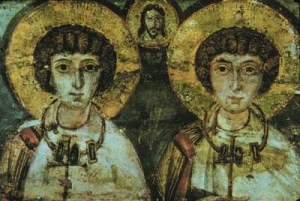
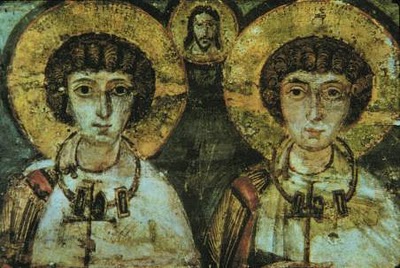
Sergius and Bacchus

This service is a rite of the Eastern Orthodox Church dating from very early times and assuming its present form between the fourth and ninth centuries AD. This service is translated from the Euchologion of Jacobus Goar, which was printed in 1647 and revised in 1730. A facsimile of the 1730 edition, published in Graz, Austria, in 1960, is the edition available in many theological libraries. With the rising influence of western ideas in recent centuries, this rite ceased to be practiced widely and was largely forgotten or ignored except in isolated areas, most notably Albania and other areas in the Balkans, where it flourished throughout the nineteenth century and up to at least 1935. Both men and women were united with this rite or similar ones.

This rite is called “spiritual” because the relationship between spiritual brothers is not one of blood-relation but of the Holy Spirit, and also to distinguish the rite from blood-brotherhood, which the Church opposed. In the service, the saint-martyrs Sergius and Bacchus are invoked, who were united in spiritual brotherhood “not bound by the law of nature but by the example of faith in the Holy Spirit”. These saints were tortured and martyred late in the third century AD. when they refused to worship the emperor’s idols. In their biography by Simeon Metaphrastes (available in J.P. Migne, Patrologia Graeca, vol. 115, pp. 1005-1032) they are described as sweet companions and lovers to each other.”

“This rite is incorporated into the Divine Liturgy. It begins with the usual blessing and prayers of a Liturgy. During the Great Synapte, petitions for the couple to be united in spiritual brotherhood are added to the usual petitions. After the First Antiphon, two special prayers are said for the couple, after which they kiss the Gospel Book and each other. After the priest sings a hymn, the Liturgy continues at “Have mercy on us, O God .. “. Accounts of the use of this rite (such as Nacke, _Jahrbuch fuer sexuelle Zwischenstufen_ 9 (1908),. 328) confirm that the spiritual brothers receive Holy Communion together, thereby forming the sacramental bond in this union. However, Goar mentions in a footnote that in some manuscripts, the couple is only blessed with holy water.”

PRIEST: Blessed is the kingdom of the Father and the Son and the Holy Spirit, now and ever and unto ages of ages. Holy God, Holy Mighty, Holy Immortal, have mercy on us. (3 times).
Glory to the Father and the Son and the Holy Spirit, now and ever and unto ages of ages. Amen.
All-Holy Trinity, have mercy on us.
Lord forgive our sins.
Master, pardon our transgressions.
Holy One, visit and heal our infirmities for your name’s sake.
Lord, have mercy. Lord, have mercy. Lord, have mercy.
Glory to the Father and the Son and the Holy Spirit, now and ever and unto ages of ages. Amen.
Our Father, who is in heaven, hallowed be your name. Your kingdom come. Your will be done, on earth as it is in heaven.
Give us this day our daily bread; and forgive us our trespasses, as we forgive those who trespass against us; and lead us not into temptation, but deliver us from evil. For yours is the kingdom and the power and the glory, of the Father and the Son and the Holy Spirit, now and ever and unto ages of ages. Amen.
(After this, the priest says the Troparion.)
Save, O Lord, your servants, and bless your inheritance.
(And the two who are about to be joined together in brotherly unity place their hands on the holy Gospel book, which has been prepared and placed on the table. And they hold in their hands lighted candles.)
(And the priest says the following, so that it is heard from above:
Save, O Lord, your servants. Followed by the Troparion of the day
Glory to the Father and the Son and the Holy Spirit.
Holy Apostles, intercede with the merciful God to grant our souls forgiveness of sins.
Now and ever and unto ages of ages. Amen.
Through the intercessions, O Lord, of all the saints and of the
Theotokos, grant us your peace and have mercy upon us, only merciful One.

THE GREAT SYNAPTE

(The responses of “Lord, have mercy” are understood.)
In peace let us pray to the Lord.
For the peace that is from above, and for the salvation of our souls, let us pray to the Lord.
For the peace of the entire world, the welfare of the holy churches of God, and the union of all of them, let us pray to the Lord.
For this holy house, and for those who enter it with faith, reverence, and fear of God, let us pray to the Lord.
For our Archbishop, the honorable priesthood, the deacons in Christ, and all of the clergy and laity, let us pray to the Lord.
For the servants of God who have approached to be blessed by Him, and for their love (agapesis) in God, let us pray to the Lord.
That they may be given full knowledge of the apostolic unity, let us pray to the Lord.
That they may be granted a faith unashamed, a love unfeigned, let us pray to the Lord.
That they may be deemed worthy to glory in the honorable Cross, let us pray to the Lord.
That both they and we may be delivered from all affliction, wrath, and distress, let us pray to the Lord.
Help us, save us, have mercy on us and keep us, O God, by your grace.
PEOPLE: Amen.
PRIEST: Having called to remembrance our all-holy, immaculate, most blessed, glorious Lady Theotokos and ever-virgin Mary, with all the Saints, let us commend ourselves and one another, and all our life unto Christ our God.
PEOPLE: To You, O Lord.
PRIEST (quietly): O Lord our God, whose might is beyond compare, whose glory is incomprehensible, whose mercy is infinite, and whose love toward mankind is ineffable; in Your tender compassion look down upon us Yourself, O Master, and upon this holy house, and grant us and those who pray with us Your rich mercies and compassion.
PRIEST (aloud): For to You are due all glory, honor, and worship; to the Father and the Son and the Holy Spirit, now and ever and unto ages of ages.
PEOPLE: Amen.
PRIEST: Let us pray to the Lord.
Lord our God, who has granted us all things for salvation, and who has commanded us to love one another and to forgive each others’ transgressions; now You Yourself, Master and Lover of mankind, to these Your servants who have loved each other with spiritual love, and who approach Your holy temple to be blessed by You, grant to them a faith unashamed, a love unfeigned. And as You gave Your holy disciples Your own peace, also grant these all the petitions for salvation, and eternal life. For You are a merciful and loving God, and to You we ascribe glory, to the Father and the Son and the Holy Spirit. Let us pray to the Lord.
Lord our God, the omnipotent, who made the heaven and the earth and the sea, who made man according to Your image and likeness, who was well-disposed to Your holy martyrs Sergius and Bacchus becoming brothers, not bound by the law of nature but by the example of faith of the Holy Spirit; Master, do send down Your Holy Spirit upon Your servants who have approached this temple to be blessed. Grant them a faith unashamed, a love unfeigned, and that they may be without hatred and scandal all the days of their lives. Through the prayers of Your immaculate Mother and of all the Saints. For Yours is the kingdom and the power and the glory, of the Father and the Son and the Holy Spirit, now and ever, and to the ages.
(And with the table made ready in the middle of the church, they place the holy Gospel upon it. And they kiss the Holy Gospel, and each other.)
THEN THE PRIEST SINGS: By the union of love the apostles join in the praying to the Master of all; themselves committed to Christ, they extended their beautiful feet, announcing the good news of peace to everyone.
PRIEST: Have mercy on us, O God.

(And continues the Liturgy.)

Source:  Adelphopoiia Rite (version one)


Modern Gayness and Medieval Friends: Homoeroticism and Homophilia

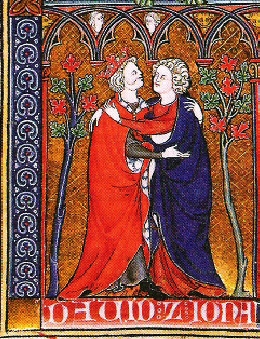
David and Jonathan

The following text is from People with a History: An Online Guide to Lesbian, Gay, Bisexual, and Trans* History. People with a History is a www site presenting history relevant to Lesbian, Gay, Bisexual and Transgendered people, through primary sources, secondary discussions, and images.  As will all of Fordham University’s Internet History Sourcebooks, this is a tremendous collection of primary sources and other documents from history.  I have many times used these sites in my classes.

What qualifies as “gay history”?

The issue is reasonably clear for the past hundred years. But before that there are complications. This is especially the case for Medieval studies.

Some commentators, both avowedly gay and otherwise, wish to distinguish sharply between historical evidence about same-sex sexual activity in the past and other evidence about same-sex relationships. In other words they wish to argue, as I take it, that while the evidence about sexual relationships may indeed relate to a history of homosexuality, other non-sexual affective relationships must be subsumed under the sign of “friendship”. Often, but not always, there seems to be a belief that while sexuality is complex and constructed in particular ways, “friendship” is an unproblematic category. Some commentators, religious ones in particular, seek to see “friendship” as in some sense “purer” and cleaner than sexual relationships.

Greek adelphopoiia relationships

When looking at same-sex relationships in the past, use of the sex/friendship dichotomy induces problems. We very rarely know that two people had sexual relations. For discussion of same-sexual activity, we are often thrown to legal codes, penitentials, denunciatory sermons and so forth. We very rarely have, before the late middle ages when court records begin to survive in number, any real idea of how laws were applied. Careful analysis of Byzantine documents – but not court records – from the 12th century on, for instance, seems to indicate that the provisions against sodomy of the Justinianic code were not applied; and yet such laws are frequently taken as indicators of social attitudes centuries after they were legislated. They are no more compelling, than for instance, the argument that anti-sodomy statutes in the US stop heterosexuals having oral sex.

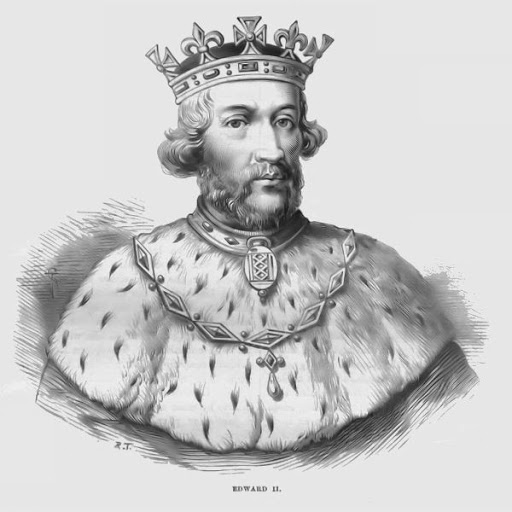
On the other hand we have a huge amount of material on same-sex emotional relationships: poems, letters, sometimes even sermons. We also have quite certain evidence that such relationships were, in various times and places, publically celebrated. (This is the minimal interpretation of the Greek adelphopoiia relationships: but has also been attempted, by Pierre Chaplais for instance, as an explanation of Edward II’s relationship with Piers Gaveston; similar interpretations have been given to medieval accounts of men sleeping in the same bed – for instance Philip Augustus and Richard the Lionheart.) Such relationships, it is asserted, were not “sexual” and reflect a variety of other forms of male-bonding.

Edward II

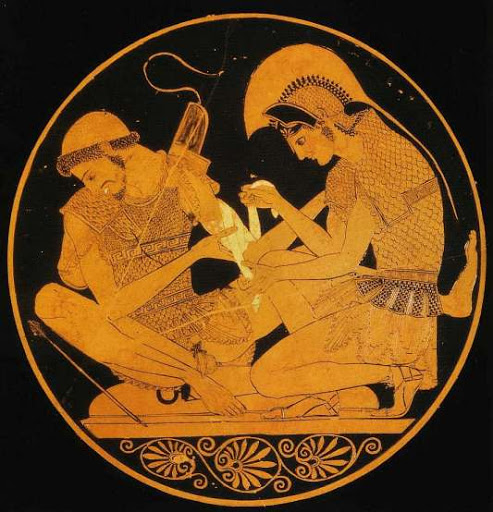
Let us, for a moment, accept such a point of view – that is that all the socially affirmed same-sex relationships we see in the past eschewed sexual activity: that David and Jonathan, Alexander and Hephaestion, Hercules and Hylas, Patroclus and Achilles, Tully and Octavius, Socrates and Alciabides – that all were never understood in the past to have had sexual relationships. What would such a point of view say about our own western society? We would have to note that a very narrow range of same-sex relationships are in fact possible. The intense emotional and affective relationships described in the past as “non-sexual” cannot be said to exist today: modern heterosexual men can be buddies, but unless drunk they cannot touch each other, or regularly sleep together. They cannot affirm that an emotional affective relationship with another man is the centrally important relationship in their lives. It is not going to far, is it, to claim that friendship – if used to translate Greek philia or Latin amicita – hardly exists among heterosexual men in modern Western society. Indeed we use the word “friendship” today to describe human relationships so different from those indicated in the ancient and medieval texts that to apply the word “friendship” to those past relationships seems, to me at least, to be actively misleading. I wish to acknowledge that this may indicate a serious failing in modern society, and to admit that I may simply not understand modern friendship.

Turning out attention to modern “gayness” we find a number of interesting points, points that affect how we understand the relationships of the past, and the texts which refer to and refract those relationships.

I use “gayness”, because it seems to me that altogether too many commentators have been willing to reduce “gayness” to sexual activity. In some parts of the world this may be true (leaders of the Egyptian gay community in New York have specifically claimed to me that same-sex sexuality in Egypt is “purely sexual”: whether this claim is true or not, I am in no position to judge). But in the modern West, “gayness” or its predecessors, have not been understood by gay writers in this way. From the mid 19th century on writer such as Karl Ulrichs in Germany, Edward Carpenter in England, and Walt Whitman in the US have claimed that same-sex relationships are much more than sex. Specific claims about “Uranian” (or “heavenly” love, a reference to Plato), or “homophile” love were made. Famously, the early gay male organizations in the US and Britain made use of the concept of “homophilia” to describe what they were concerned with.

Now it is true, gay leaders in the 1970s rejected the term “homophile” as conformist, and as a deliberate elision of sexuality. I think, for historical consideration at least, it may be time to resurrect this terminology. “Homophilia” points to a very important aspect of modern gayness – its support of a wide array of same-sex emotional relationships, with a an equally wide degree of sexual expression. Because of AIDS there are now many fairly well formed psychosocial studies of the gay male communities of large cities. I am most familiar with the Martin-Dean study conducted from Columbia Presbyterian School of Public Health in New York City. What these studies have found is that homophilia is a central aspect of modern gayness, in relationships between men whether sexually expressed or not. Some gay men form couples in which sex plays little or no part. Many other gay men form “families”, often of other gay men (some of whom may be former sexual partners) and sympathetic heterosexual women, families in which a high degree of emotional and personal closeness is achieved in a specifically “gay” context but where sex is not central.

Patroclus and Achilles

Given that human beings in the past do not “belong” to anyone modern group, I would still argue that “gay history”, as an aspect of “the history of human relationships” is specifically one focused on same-sex relationships. Since “gay” in modern use covers “homophilia” as well as “homosexuality”, I wish to continue to claim that placing the study of philia and amicita in the past exclusively under the sign of “friendship” and excluding from the sign of “gayness” is not only unnecessary but misleading.

Source: Paul Halsall, 3/27/96
http://www.fordham.edu/Halsall/pwh/medhomophil.asp


As I Lay with My Head in Your Lap Camerado

In honor of the official repeal of DADT today, I wanted to post a poem about homosexual love in the military. Long before DADT was an official policy, Walt Whitman was serving as a nurse for the US Army during the Civil War. Drum Taps (1865), Walt Whitman’s sequence of poems on the Civil War that reflects his experience as a hospital volunteer, includes several poems that appreciate soldiers in more or less homoerotic terms (for example, “First O Songs for a Prelude” and “O Tan-Faced Prairie-Boy”).

But it is elegies such as “Vigil Strange I Kept on the Field One Night,” “Reconciliation,” and “As I Lay with My Head in Your Lap Camerado” that allow Whitman to express himself unrestrainedly.

In “Reconciliation,” the speaker’s tenderness for the fallen soldier overpowers the enmity between armies, in terms that anticipate Wilfred Owen’s “Strange Meeting”: “my enemy is dead, a man divine as myself is dead, / I look where he lies white-faced and still in the coffin–I draw near, / Bend down and touch lightly with my lips the white face in the coffin.”

As I Lay with My Head in Your Lap Camerado

As I lay with my head in your lap camerado,
The confession I made I resume, what I said to you and the open air
I resume,
I know I am restless and make others so,
I know my words are weapons full of danger, full of death,
For I confront peace, security, and all the settled laws, to
unsettle them,
I am more resolute because all have denied me than I could ever have
been had all accepted me,
I heed not and have never heeded either experience, cautions,
majorities, nor ridicule,
And the threat of what is call’d hell is little or nothing to me,
And the lure of what is call’d heaven is little or nothing to me;
Dear camerado! I confess I have urged you onward with me, and still
urge you, without the least idea what is our destination,
Or whether we shall be victorious, or utterly quell’d and defeated.

Walt Whitman

In this particular poem, Whitman writes a brief, but beautiful confession and declaration of his own sexuality. It is a brief, but significant love poem, and the manner of Whitman’s “confession” can be explored in a number of ways, but it ultimately points to a homosexual relationship. The first obvious hint that this poem is linked to Whitman’s homosexuality is his adjustment of the word “camerado.” The original Spanish word is actually “camarada” with a feminine ending, and it means “friend” or comrade.” By changing this specific word to have a male ending, we know that Whitman is aiming and professing this poem to a male friend. The significance of this male friend becomes more apparent as Whitman continues with his poem.  His use of the actually word “confession” within the second line – “The confession I made I resume, what I said to you and the open air I resume” is another example of Whitman confessing openly his sexuality. As Whitman continues to describe this poem, he draws attention to the fact that it will make others “restless” and his words are “weapons full of danger, full of death.”

The intensity of the poem, although subtle but existent, is what ultimately points that nature of the poem has to do with love or at least intimacy. Whitman seems very determined in this poem, especially as he says “Dear camerado! I have urged you onward with me, and still urge you, without the least idea what is our destination or whether we shall be victorious, or utterly quell’d and defeated.” Whitman seems to be dismissing everything else, and urging this other person to do the same. He is rejecting any significance of heaven or hell, and embracing the fact that whatever road he is going down may bring hard times. Indeed, to announce homosexuality during Whitman’s era would have brought on a lot of criticism and grief.

Sources: