Category Archives: History

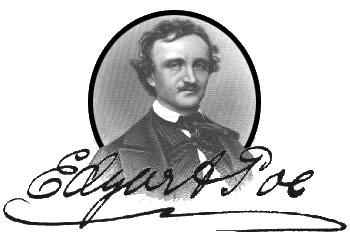
Dreams by Edgar Allan Poe

Dreams

Oh! that my young life were a lasting dream! 

My spirit not awakening, till the beam
Of an Eternity should bring the morrow.
Yes! tho’ that long dream were of hopeless sorrow,
‘Twere better than the cold reality
Of waking life, to him whose heart must be,
And hath been still, upon the lovely earth,
A chaos of deep passion, from his birth.
But should it be- that dream eternally
Continuing- as dreams have been to me
In my young boyhood- should it thus be given,
‘Twere folly still to hope for higher Heaven.
For I have revell’d, when the sun was bright
I’ the summer sky, in dreams of living light
And loveliness,- have left my very heart
In climes of my imagining, apart
From mine own home, with beings that have been
Of mine own thought- what more could I have seen?
‘Twas once- and only once- and the wild hour
From my remembrance shall not pass- some power
Or spell had bound me- ’twas the chilly wind
Came o’er me in the night, and left behind
Its image on my spirit- or the moon
Shone on my slumbers in her lofty noon
Too coldly- or the stars- howe’er it was
That dream was as that night-wind- let it pass.

I have been happy, tho’ in a dream.
I have been happy- and I love the theme:
Dreams! in their vivid coloring of life,
As in that fleeting, shadowy, misty strife
Of semblance with reality, which brings
To the delirious eye, more lovely things
Of Paradise and Love- and all our own!
Than young Hope in his sunniest hour hath known.

-Edgar Allan Poe


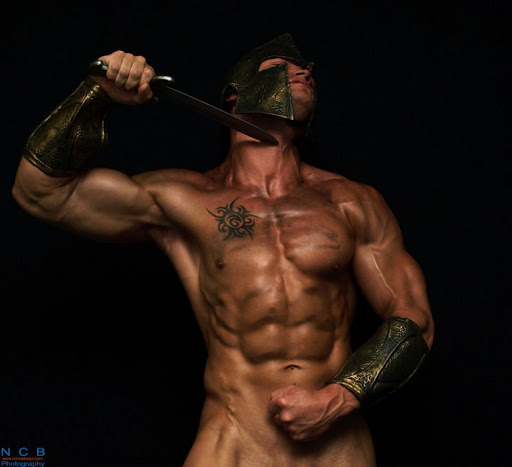
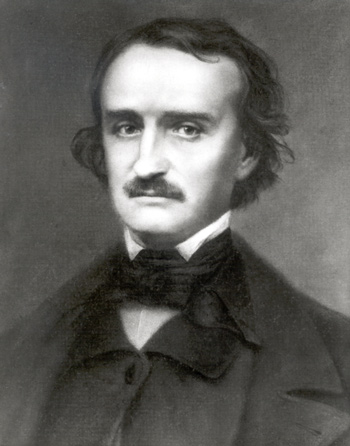
Poe was quite an interesting man, and for a full biography of the poet, click on “Read More” below.  However, I do want to share one the most famous legends surrounding the man.  Poe began attending West Point in 1830, and he quickly realized that he was not cut out for officer material and hated the military.  So he set out to get himself kicked out.  The legend says that Poe was a notorious prankster, and since West Point cadet regulations stated that cadets were to show up for drill wearing belt and gloves, Poe did just that.  He reported for drill wearing belts for his cartridges, his gloves, a smile and nothing else. The reality is probably much less colorful.  Tired of West Point by the beginning of 1831, Poe’s plan to get out was to neglect his duties. In January he was tried at a court-martial for having missed drills, parades, classes and church. However, I like the notorious naked legend better.


Who is Edgar Allan Poe?

The name Poe brings to mind images of murderers and madmen, premature burials, and mysterious women who return from the dead. His works have been in print since 1827 and include such literary classics as “The Tell-Tale Heart,” “The Raven,” and “The Fall of the House of Usher.” This versatile writer’s oeuvre includes short stories, poetry, a novel, a textbook, a book of scientific theory, and hundreds of essays and book reviews. He is widely acknowledged as the inventor of the modern detective story and an innovator in the science fiction genre, but he made his living as America’s first great literary critic and theoretician. Poe’s reputation today rests primarily on his tales of terror as well as on his haunting lyric poetry.

Just as the bizarre characters in Poe’s stories have captured the public imagination so too has Poe himself. He is seen as a morbid, mysterious figure lurking in the shadows of moonlit cemeteries or crumbling castles. This is the Poe of legend. But much of what we know about Poe is wrong, the product of a biography written by one of his enemies in an attempt to defame the author’s name.

The real Poe was born to traveling actors in Boston on January 19, 1809. Edgar was the second of three children. His other brother William Henry Leonard Poe would also become a poet before his early death, and Poe’s sister Rosalie Poe would grow up to teach penmanship at a Richmond girls’ school. Within three years of Poe’s birth both of his parents had died, and he was taken in by the wealthy tobacco merchant John Allan and his wife Frances Valentine Allan in Richmond, Virginia while Poe’s siblings went to live with other families. Mr. Allan would rear Poe to be a businessman and a Virginia gentleman, but Poe had dreams of being a writer in emulation of his childhood hero the British poet Lord Byron. Early poetic verses found written in a young Poe’s handwriting on the backs of Allan’s ledger sheets reveal how little interest Poe had in the tobacco business. By the age of thirteen, Poe had compiled enough poetry to publish a book, but his headmaster advised Allan against allowing this.

In 1826 Poe left Richmond to attend the University of Virginia, where he excelled in his classes while accumulating considerable debt. The miserly Allan had sent Poe to college with less than a third of the money he needed, and Poe soon took up gambling to raise money to pay his expenses. By the end of his first term Poe was so desperately poor that he burned his furniture to keep warm.

Humiliated by his poverty and furious with Allan for not providing enough funds in the first place, Poe returned to Richmond and visited the home of his fiancée Elmira Royster, only to discover that she had become engaged to another man in Poe’s absence. The heartbroken Poe’s last few months in the Allan mansion were punctuated with increasing hostility towards Allan until Poe finally stormed out of the home in a quixotic quest to become a great poet and to find adventure. He accomplished the first objective by publishing his first book Tamerlane when he was only eighteen, and to achieve the second goal he enlisted in the United States Army. Two years later he heard that Frances Allan, the only mother he had ever known, was dying of tuberculosis and wanted to see him before she died. By the time Poe returned to Richmond she had already been buried. Poe and Allan briefly reconciled, and Allan helped Poe gain an appointment to the United States Military Academy at West Point.

Before going to West Point, Poe published another volume of poetry. While there, Poe was offended to hear that Allan had remarried without telling him or even inviting him to the ceremony. Poe wrote to Allan detailing all the wrongs Allan had committed against him and threatened to get himself expelled from the academy. After only eight months at West Point Poe was thrown out, but he soon published yet another book.
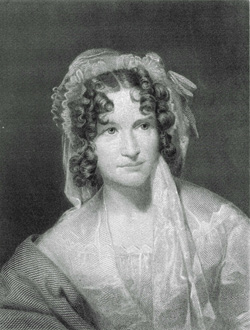
Broke and alone, Poe turned to Baltimore, his late father’s home, and called upon relatives in the city. One of Poe’s cousins robbed him in the night, but another relative, Poe’s aunt Maria Clemm, became a new mother to him and welcomed him into her home. Clemm’s daughter Virginia first acted as a courier to carry letters to Poe’s lady loves but soon became the object of his desire.

While Poe was in Baltimore, Allan died, leaving Poe out of his will, which did, however, provide for an illegitimate child Allan had never seen. By then Poe was living in poverty but had started publishing his short stories, one of which won a contest sponsored by the Saturday Visiter. The connections Poe established through the contest allowed him to publish more stories and to eventually gain an editorial position at the Southern Literary Messenger in Richmond. It was at this magazine that Poe finally found his life’s work as a magazine writer.

Within a year Poe helped make the Messenger the most popular magazine in the south with his sensational stories as well as with his scathing book reviews. Poe soon developed a reputation as a fearless critic who not only attacked an author’s work but also insulted the author and the northern literary establishment. Poe targeted some of the most famous writers in the country. One of his victims was the anthologist and editor Rufus Griswold.

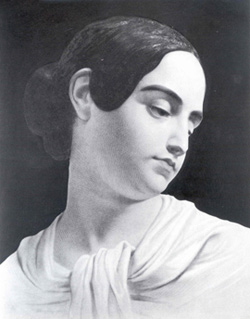
At the age of twenty-seven, Poe brought Maria and Virginia Clemm to Richmond and married his Virginia, who was not yet fourteen. The marriage proved a happy one, and the family is said to have enjoyed singing together at night. Virginia expressed her devotion to her husband in a Valentine poem now in the collection of the Enoch Pratt Free Library, and Poe celebrated the joys of married life in his poem “Eulalie.”

Dissatisfied with his low pay and lack of editorial control at theMessenger, Poe moved to New York City. In the wake of the financial crisis known as the “Panic of 1837,” Poe struggled to find magazine work and wrote his only novel, The Narrative of Arthur Gordon Pym.

After a year in New York, Poe moved to Philadelphia in 1838 and wrote for a number of different magazines. He served as editor of Burton’s and then Graham’s magazines while continuing to sell articles to Alexander’s Weekly Messengerand other journals. In spite of his growing fame, Poe was still barely able to make a living. For the publication of his first book of short stories, Tales of the Grotesque and Arabesque, he was only paid with twenty-five free copies of his book. He would soon become a champion for the cause of higher wages for writers as well as for an international copyright law. To change the face of the magazine industry, he proposed starting his own journal, but he failed to find the necessary funding.

In the face of poverty Poe was still able to find solace at home with his wife and mother-in-law, but tragedy struck in 1842 when Poe’s wife contracted tuberculosis, the disease that had already claimed Poe’s mother, brother, and foster mother.

Always in search of better opportunities, Poe moved to New York again in 1844 and introduced himself to the city by perpetrating a hoax. His “news story” of a balloon trip across the ocean caused a sensation, and the public rushed to read everything about it—until Poe revealed that he had fooled them all.

The January 1845 publication of “The Raven” made Poe a household name. He was now famous enough to draw large crowds to his lectures, and he was beginning to demand better pay for his work. He published two books that year, and briefly lived his dream of running his own magazine when he bought out the owners of the Broadway Journal. The failure of the venture, his wife’s deteriorating health, and rumors spreading about Poe’s relationship with a married woman, drove him out of the city in 1846. At this time he moved to a tiny cottage in the country. It was there, in the winter of 1847 that Virginia died at the age of twenty-four. Poe was devastated, and was unable to write for months. His critics assumed he would soon be dead. They were right. Poe only lived another two years and spent much of that time traveling from one city to the next giving lectures and finding backers for his latest proposed magazine project to be called The Stylus.

While on lecture tour in Lowell, Massachusetts, Poe met and befriended Nancy Richmond. His idealized and platonic love of her inspired some of his greatest poetry, including “For Annie.” Since she remained married and unattainable, Poe attempted to marry the poetess Sarah Helen Whitman in Providence, but the engagement lasted only about one month. In Richmond he found his first fiancée Elmira Royster Shelton was now a widow, so began to court her again. Before he left Richmond on a trip to Philadelphia he considered himself engaged to her, and her letters from the time imply that she felt the same way. On the way to Philadelphia, Poe stopped in Baltimore and disappeared for five days.

He was found in the bar room of a public house that was being used as a polling place for an election. The magazine editor Joseph Snodgrass sent Poe to Washington College Hospital, where Poe spent the last days of his life far from home and surrounded by strangers. Neither Poe’s mother-in-law nor his fiancée knew what had become of him until they read about it in the newspapers. Poe died on October 7, 1849 at the age of forty. The exact cause of Poe’s death remains a mystery.

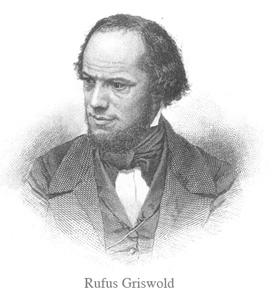
Days after Poe’s death, his literary rival Rufus Griswold wrote a libelous obituary of the author in a misguided attempt at revenge for some of the offensive things Poe had said and written about him. Griswold followed the obituary with a memoir in which he portrayed Poe as a drunken, womanizing madman with no morals and no friends. Griswold’s attacks were meant to cause the public to dismiss Poe and his works, but the biography had exactly the opposite effect and instead drove the sales of Poe’s books higher than they had ever been during the author’s lifetime. Griswold’s distorted image of Poe created the Poe legend that lives to this day while Griswold is only remembered (if at all) as Poe’s first biographer.

Source: http://www.poemuseum.org/life.php


If Sometimes in the Haunts of Men

If Sometimes in the Haunts of Men

If sometimes in the haunts of men 
    Thine image from my breast may fade,
The lonely hour presents again
    The semblance of thy gentle shade:
And now that sad and silent hour
    Thus much of thee can still restore,
And sorrow unobserved may pour
    The plaint she dare not speak before.

Oh, pardon that in crowds awhile
    I waste one thought I owe to thee,
And self-condemn’d, appear to smile,
    Unfaithful to thy memory:
Nor deem that memory less dear,
    That then I seem not to repine;
I would not fools should overhear
    One sigh that should be wholly thine.

If not the goblet pass unquaff’d,
    It is not drain’d to banish care;
The cup must hold a deadlier draught,
    That brings a Lethe for despair.
And could Oblivion set my soul
    From all her troubled visions free,
I’d dash to earth the sweetest bowl
    That drown’d a single thought of thee.
6a00d8341cc27e53ef01157144f88f970c-600wi
For wert thou vanish’d from my mind,
    Where could my vacant bosom turn?
And who could then remain behind
    To honour thine abandon’d Urn?
No, no–it is my sorrow’s pride
    That last dear duty to fulfil:
Though all the world forget beside,
    ‘Tis meet that I remember still.

Thomas Eakins - ArcadiaFor well I know, that such had been
    Thy gentle care for him, who now
Unmourn’d shall quit this mortal scene,
    Where none regarded him, but thou:
And, oh! I feel in that was given
    A blessing never meant for me;
Thou wert too like a dream of Heaven
    For earthly Love to merit thee.
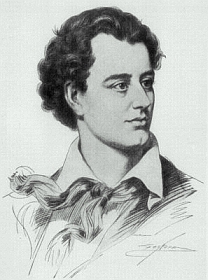
                                                                               -Lord Byron (1812)


George Gordon Noel Byron, 6th Baron Byron, was born 22 January 1788 in London and died 19 April 1824 in Missolonghi, Greece.  He was among the most famous of the English ‘Romantic’ poets; his contemporaries included Percy Shelley and John Keats.  He was also a satirist whose poetry and personality captured the imagination of Europe.  His major works include Childe Harold’s Pilgrimage (1812-18) and Don Juan (1819-24).  He died of fever and exposure while engaged in the Greek struggle for independence.

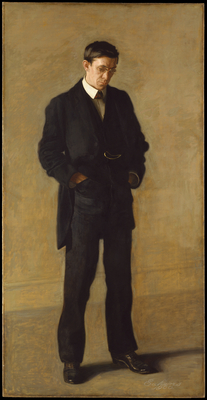
The images accompanying the poem above are by Thomas Eakins.  To read more about Eakins, click “More” below.


Thomas Eakins

“I never knew of but one artist, and this is Tom Eakins, who could resist the temptation to see what they think ought to be rather than what is.” – Walt Whitman

610_eakins_about
Thomas Eakins


When Thomas Eakins died in 1916, he left behind a body of work unprecedented in American art for its depth, strength, perception, character, and commitment to realism. Yet during his life, Eakins sold less than thirty paintings. Rejected by the public and the art establishment of his day, it was only after his death that a new generation of scholars and critics recognized Eakins as one of America’s greatest painters.

Born in 1844, Thomas Eakins lived most of his life in his home city of Philadelphia. After graduating high school he attended the Pennsylvania Academy of Fine Arts. He simultaneously took anatomy courses at Jefferson Medical College, in the hopes of creating more realistic pictures and gaining further insight into the human figure. In 1866 he left Philadelphia for Paris and later Spain, where he studied art and found the works of painters Diego Velásquez and Jusepe de Ribera. Along with Rembrant, these painters would be his greatest influences. A year later he returned to Philadelphia, never to go abroad again.

Throughout the 1870s Eakins painted the interior and exterior life of everyday America. He was concerned with the functioning of the physical world, as well as the inner lives of the people he painted. His paintings were both realistic and expressive. His attention to light, landscape, and the human form made Eakins stand far above his contemporaries. Among the most famous paintings of the time are his group portraits made at medical schools. Striking in their honesty and strict attention paid to the details of the human body, they shocked many in and out of the art world.
In the 1880s, Eakins’ interest in realism brought him in contact with the photographer Edward Muybridge. The two collaborated on photographing the movement of animals and humans. Though few painters took it seriously, Eakins believed the new photographic technology was a tool to better represent the physical world. Throughout much of the 1880s, Eakins brought these interests to students at the Pennsylvania Academy, encouraging them to study anatomy and work from live nude models. In 1886 his insistence on the use of nude models saw a great deal of criticism. Frustrated with the criticism, he eventually resigned.
Though he continued to teach at a number of different colleges, it wasn’t until long after his death that Eakins’ innovations in art education were recognized and adopted throughout the country. By the 1890s he had moved from his earlier outdoor works like “Max Schmitt in a Single Scull,” (1871), a perfectly rendered quiet picture of a rower on the Schuylkill River, to portraiture. In the many portraits completed over the last thirty years of his life, Eakins retained his passionate adherence to realist representation. Unlike most other portrait painters of the time, Eakins had little concern for flattering his subjects , and instead demanded from himself the most precise objective images. The results were thorough and telling portraits that seemed to carry with them the souls of their subjects.

During the final years of his life, Eakins began to receive a bit of the recognition he deserved. On June 25, 1916 he died in the Philadelphia home in which he was born. Against social demands for propriety and respectability, Eakins refused to compromise and painted his subjects as they really were, and not as they wished to be seen. His paintings reflected the passing of time, the awareness of mortality, and the nobility of everyday life. His courageous persistence in advocating his personal vision changed the nature of art education and provided future generations with a deeper view of the time in which he lived.


Machu Picchu

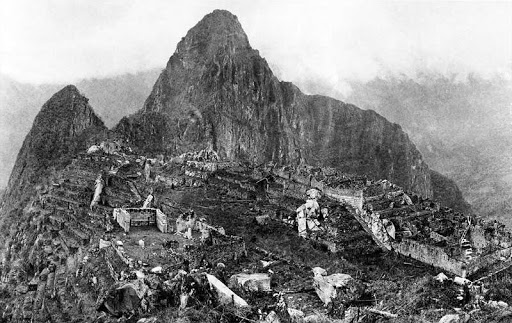
On July 24, 1911, that’s right 100 years ago today, Machu Picchu was found by an American historian, and this weekend many are celebrating the centennial of the “discovery” of the cloud city high in the Andes — one of the most remarkable archeological sites on the planet.

Now, of course, Peruvians say that the city was not discovered a century ago today, because they never lost it. But Americans give credit to Hiram Bingham III, who climbed the Andes and saw the remarkable city, surrounded by holy mountains and filled with houses, terraces and temples that with all our modern skills and machines would be impossible to build today.

Machu Picchu is a pre-Columbian 15th-century Inca site located 7,970 feet above sea level. It is situated on a mountain ridge above the Urubamba Valley in Peru, which is 50 miles northwest of Cusco and through which the Urubamba River flows. Most archaeologists believe that Machu Picchu was built as an estate for the Inca emperor Pachacuti (1438–1472). Often referred to as the “Lost City of the Incas”, it is perhaps the most familiar icon of the Inca World.

The Incas started building the “estate” around AD 1400, but abandoned it as an official site for the Inca rulers a century later at the time of the Spanish Conquest. Although known locally, it was unknown to the outside world before being brought to international attention in 1911 by the American historian Hiram Bingham. Since then, Machu Picchu has become an important tourist attraction. Most of the outlying buildings have been reconstructed in order to give tourists a better idea of what the structures originally looked like. By 1976, thirty percent of Machu Picchu had been restored. The restoration work continues to this day.

Since the site was never known to the Spanish during their conquest, it is highly significant as a relatively intact cultural site. Machu Picchu was declared a Peruvian Historical Sanctuary in 1981 and a UNESCO World Heritage Site in 1983. In 2007, Machu Picchu was voted one of the New Seven Wonders of the World in a worldwide Internet poll.

Machu Picchu was built in the classical Inca style, with polished dry-stone walls. Its three primary buildings are the Intihuatana, the Temple of the Sun, and the Room of the Three Windows. These are located in what is known by archaeologists as the Sacred District of Machu Picchu. In September 2007, Peru and Yale University almost reached an agreement regarding the return of artifacts which Yale has held since Hiram Bingham removed them from Machu Picchu in the early 20th century. In November 2010, a Yale University representative agreed to return the artifacts to a Peruvian university.

And if you want a fun read that centers around this wonderfully historic site (one which I hope to visit one day), you should check out William Maltese’s Beyond Machu.  From the first chapter, Beyond Machu is jam-packed with mystery, adventure and intrigue. Dan Green, travel photographer and investigative reporter extraordinaire, has a chance meeting with the mysterious and sexy Sloane Hendriks that results in Dan leaving his comfortable world and being thrust into an unexpectedly dangerous trip to the ancient Incan city of Machu Picchu. Sloane is a man with a dark past, which could be fatal, but Dan believes Sloane is the ticket to a newspaper story that will expose hidden ruins, illicit archeological finds, and long-lost treasure – if they can stay alive long enough to find it.

Sloane and Dan are captivating characters whose connection to one another only increases as the tension mounts. From the heights of Machu Picchu to the dangers of the South American rain forest, the reader is taken on a chaotic journey that can lead only to death–or riches beyond anyone’s wildest dreams. It’s Indiana Jones meets Allan Quatermain with enough man/man romance to make your toes tingle.


What Is Really to Blame?

My post on Bigotry has faced a number of criticisms in the comments section.  One of those criticisms, which I want to address first, is that my post made it sound as if there was an organized selective breeding program of slaves going on during the Antebellum South.  As Russ Manley of the blog “Blue Truck, Red State” wrote, “It’s important, though, not to give people the impression there was any organized program going on – all depended on the individual whims of slave owners, and antebellum accounts are full of complaints about the “lazy darkies” who had to be watched and prodded every minute to get their work done.”  I certainly didn’t mean it to sound that way, and one of the reasons that I love to have you guys comment is so that I can clear up misunderstandings in my posts.  I do that with my students as a way to get discussion going in the classroom.  As long as civility reigns, I very much appreciate comments and criticisms.


Furthermore, there was also much debate about religion being the main cause of homophobia and bigotry.  I admit, that it is part of the equation, but not the only reason.  When we choose one reason for homophobia then we are missing the larger picture.  Homophobia, or the hatred of same-sex intercourse, has been around much longer than Christianity of Judaism.  More than likely, it has been part of societies since the beginning of man.  Therefore, there are many parts to this equation.


In another criticism, Lonnie left the the following comment on my post about “Bigotry“:

I think John D’Emilio and Sherry Wolf give a much better account of the origins of gay oppression:
http://platypus1917.home.comcast.net/~platypus1917/demilio_captialismgayid.pdf

http://www.isreview.org/issues/37/gay_oppression.shtml

Since it was suggested, I read the two articles.  I found Wolf’s article to be particularly hard to stomach, but I read it anyway.  Both of these authors present a Marxist historiographical approach to the question of the origins of gay oppression.  In its most basic form, the Marxist historical tradition blames all of the problems of the world on capitalism and class struggles.  However, I have always found it deeply flawed.  For one, if you look at the sources used by Marxist historians, you will quickly find that more of those sources are from other Marxist historians.  They so narrow down their sources, until they ignore the larger historical picture, even though they claim to be looking at the larger historical picture.  In my opinion, this effectively removes their objectivity which is at the heart of true history.  They ignore those sources that contradict their point of view.  You cannot be an effective historian and dismiss the sources you do not agree with, you must take them into account.  History has many schools of historiography (the study of the history and methodology of the discipline of history), and Marxist interpretation is only one of them.


Before I continue, I want to say this, John D’Emilio is one of the greatest LGBT historians.  His books Sexual Politics, Sexual Communities: The Making of a Homosexual Minority in the United States, 1940-1970 and Intimate Matters:A History of Sexuality in America are two of the seminal books on LGBT American History.  The article suggested above by D’Emilio, and I do hope that each of you will go check these links out for yourself and not just take my opinion, was written while he was still a graduate student, which does not diminish his writing in the least, but his tone has changed since those early days in the 1980s when it was written.  Still, the two books above are well worth reading if you want a greater understanding of LGBT history in America.

Now that I have stated why I disagree strongly with Marxist interpretations, I want to address some of the semi-valid points in their arguments.  First of all, homosexual identity as it is seen today was nearly non-existent before the twentieth century; however, that does not mean that just because we did not have the word for it, that it did not exist.  I think it most certainly did, though it was quite rare and was not always practiced in the same way, it still existed.  The love between persons of the same sex existed before the advent of capitalism, which did not emerge until the end of mercantilism in the late 19th century.  D’Emilio and Wolf try to state the difference between homosexual behavior and homosexual identity.  Do you really think that no one before 1900 realized that they had an attraction to someone of the same sex and that they were not attracted to someone of the opposite sex?  Do you think that we become homosexual because family structure has broken down?  The answer to these questions is no.  The history of Florence, Italy during the Renaissance shows that homosexuality/sodomy was not illegal during that time period.  Some men married because they felt the need to procreate, but other did not.  They had homosexual relationships.  Also, the Inquisition records of the Catholic Church in Brazil during the 17th-19th centuries has numerous documented cases of homosexual persecution.  This was not a phenomenon of capitalism. Brazil only had a brief history of capitalism in the early twentieth century that was quashed by Getúlio Vargas and his corporatism from 1930-1954 and then largely under the control of the military until 1985. Likewise, Spain who continually persecuted homosexuals under Francisco Franco from c. 1936 to 1975, was not a capitalist country but was a hybrid of corporatism, fascism, and dictatorship.  Even in the late 19th century in America, there was talk of so-called “Boston Marriages,” a term is said to have been in use in New England in the decades spanning the late 19th and early 20th centuries to describe two women living together, independent of financial support from a man.  The term was believed to be first coined by Henry James in The Bostonians.  Since 2000, many mentions of “Boston marriage” cite as examples the same few literary figures, in particular the Maine local color novelist Sarah Orne Jewett and Annie Adams Fields her late life companion, the widow of the editor of The Atlantic Monthly. There is often an assumption that in the era when the term was in use, it denoted a lesbian relationship. However, there is no documentary proof that any particular “Boston marriage” included sexual relations, but there has been a great deal of speculation, some of which comes from what we know or the private life of Willa Cather.


Furthermore, these authors argue that same-sex segregation during World War II brought about modern day homosexuality.  First of all, World War II is not the first time that large numbers of men and women have been separated from their families. This has happened in all major modern wars.  In Europe, this had happened in the First World War, and to a lesser extent in America.  So I don’t think that you can pinpoint WWII as the starting point.  It had all happened before.  Wolf does not address that millions of men in Europe served in World War I, and that millions of women left their homes and family to either work in the military or in factories during World War I.  Because it is convenient for her argument, she dismisses the history of Europe when it is inconvenient, and then turns around and uses it when it is convenient and the same history in America in turn is inconvenient.  In addition, both authors cite WWII as the beginning of homosexual persecution in the military and that it has continued largely uninterrupted until the modern day.  The problem is that it was largely ignored during Vietnam, when men identified as homosexual to not be drafted, most of those men truly were homosexual, however, they were forced to serve in the military anyway.  The ban on homosexuals was largely ignored by the draft board and military during the Vietnam War.  Likewise, today, when America is fighting two wars, and there is an increasing need for soldiers in the war against Terrorism, they have repealed Don’t Ask, Don’t Tell.  It is not a coincidence in my opinion.


I have three more points that I want to make.  Both authors claim that sexual liberation, that is sex for enjoyment not for procreation, is capitalist invention/byproduct.  I cannot buy that explanation.  First of all, communism and socialism pushed for the ideas of free love, long before the flower children of the 1960s.  The sexual revolution was made much more visible because of birth control, but people have been having sex for reasons other than procreation since man first had an erection.  We are the only species who we know for sure have sex for enjoyment.  It is not a modern phenomenon.


I also want to point out that Wolf argues that the family has not always existed in human history.  If she would look at the anthropological studies, archeological studies, and historical studies of mankind, she would realize that it has always existed.  From the earliest humans, the family structure has been the governing structure.  The idea of the family or clan is the first political structure in any society.  As the family grows larger, the head of the family becomes the head of the clan.  From there, stronger clans take over weaker clans and form chiefdoms, which eventually grow into kingdoms and empires.  The family structure has always been the basis of human society.  Even as gay men and women today, we are not abandoning the family, we want families of our own.  We want marriage, and we want children (at least I do, and so do many others.)


The last point that I want to make is that urbanization has led to gay communities more so than capitalism. Urbanization has more to do with the industrial revolution than it does the rise of capitalism.  As fewer people were needed to work a farm, due in large part of the end of slavery and the mechanization of the farm, that excess labor moved to the cities to find work.  Most did not abandon the families, and a large family often lived together in a household trying to make a living wage.  However, the urbanization of America began before capitalism, and thus I feel that it is not the cause of the breakdown of the family, nor is it the cause of class warfare.  Class warfare has existed long before capitalism, and therefore, capitalism cannot be the blame for all the evil of the world.


Wolf is not totally wrong in all that she writes. In fact she (surprising to me) got this part of history correct:

In Paris and Berlin, medical and legal experts in the 1870s examined a new kind of “degenerate” to determine whether or not these people should be held responsible for their actions. The word “homosexuality”was first coined by a Hungarian physician named Karl Maria Benkert in 1869.  Homosexuality evolved in scientific circles from a “sin against nature” to a mental illness. The first popular study of homosexuality, Sexual Inversion by Havelock Ellis in 1897, put forward the idea that homosexuality was a congenital illness not to be punished, but treated. Nineteenth-century sexologists developed ideas about homosexuality as a form of mental insanity. One famous theory held that gayness was the result of “urning”–the female mind was trapped in a male body (or vice versa). Another theory widely disseminated referred to homosexuals as a third sex.

I do want to make one final point before I end this post.  Both D’Emilio and Wolf argue that there is not basis for being “born gay.”  This is a recent argument that I have actually come across several times in the last few weeks from LGBT activists and scholars.  Most of the recent attention to arguments against a biological component to homosexuality is because of the Lady Gaga song, “Born This Way,” to which some in the LGBT community are now starting to argue against.  This is a topic for a future post, so I won’t go into much detail right now. I merely wanted to mention this as part of the discussion.

I may have rambled a bit in this post, but I wanted to talk a bit about historical interpretation.  I hope that you will read those two articles cited above and give me your take on them. I do not believe that either author presented a convincing argument for the beginnings of gay oppression.  In fact, from my reading of the articles, it seems to me that both vaguely lay the blame on capitalism, but do a poor job of giving evidence to this claim. Do you think that I am completely off base or are they completely off base or are all of us a somewhat right and somewhat wrong?  I want to know what you think.  I personally think that the origins of gay oppression is a many faceted problem and cannot be explained in a simple historical method.  We have to look at all parts of the picture and not ignore those parts that we find inconvenient.


Song by Allen Ginsberg

Song 

The weight of the world
is love.
Under the burden
of solitude,
under the burden
of dissatisfaction

the weight,
the weight we carry
is love.

Who can deny?
In dreams
it touches
the body,
in thought
constructs
a miracle,
in imagination
anguishes
till born
in human–
looks out of the heart
burning with purity–
for the burden of life
is love,

but we carry the weight
wearily,
and so must rest
in the arms of love
at last,
must rest in the arms
of love.

No rest
without love,
no sleep
without dreams
of love–
be mad or chill
obsessed with angels
or machines,
the final wish
is love
–cannot be bitter,
cannot deny,
cannot withhold
if denied:

the weight is too heavy

–must give
for no return
as thought
is given
in solitude
in all the excellence
of its excess.

The warm bodies
shine together
in the darkness,
the hand moves
to the center
of the flesh,
the skin trembles
in happiness
and the soul comes
joyful to the eye–

yes, yes,
that’s what
I wanted,
I always wanted,
I always wanted,
to return
to the body
where I was born.

Allen Ginsberg


For more on Allen Ginsberg, click “More” below.

Allen Ginsberg, the visionary poet and founding father of the Beat generation inspired the American counterculture of the second half of the 20th century with groundbreaking poems such as “Howl” and “Kaddish.” Among the avant-garde he was considered a spiritual and sexually liberated ambassador for tolerance and enlightenment. With an energetic and loving personality, Ginsberg used poetry for both personal expression and in his fight for a more interesting and open society.
Allen Ginsberg was born in Newark, New Jersey on June 3, 1926. As a boy he was a close witness to his mother’s mental illness, as she lived both in and out of institutions. His father, Louis Ginsberg was a well-known traditional poet. After graduating from high school, Ginsberg attended Columbia University, where he planned to study law. There he became friends with Jack Kerouac and William Burroughs. Together the three would change the face of American writing forever.

With an interest in the street life of the city, Kerouac, Ginsberg and Burroughs found inspiration in jazz music and the culture that surrounded it. They encouraged a break from traditional values, supporting drug-use as a means of enlightenment. To many, their shabby dress and “hip” language seemed irresponsible, but in their actions could be found the seeds of a revolution that was meant to cast off the shackles of the calm and boring social life of the post-war era. While a nation tried desperately to keep from rocking the boat, Allen Ginsberg and the Beats saw the need for a more vibrant and daring society.
One of the primary first works of the Beats was Ginsberg’s long poem “Howl.” In an age plagued by intolerance, “Howl” (1956) was both a desperate plea for humanity and a song of liberation from that intolerant society. Ginsberg’s use of a gritty vernacular and an improvisational rhythmical style created a poetry which seemed haphazard and amateur to many of the traditional poets of the time. In “Howl” and his other poems, however, one could hear a true voice of the time, unencumbered by what the Beats saw as outdated forms and meaningless grammatical rules.
For its frank embrace of such taboo topics as homosexuality and drug use, “Howl” drew a great deal of criticism. Published by City Lights, the San Francisco based publisher of many of the Beats, the book was the subject of an obscenity trial. Eventually acquitted of the charges, City Lights came out with Ginsberg’s second book in 1961. “Kaddish, And Other Poems,” often considered Ginsberg’s greatest work, dealt again with a deep despair and addressed Ginsberg’s closeness with his mother while she was hospitalized and fighting insanity. The raw nature of the subject matter and Ginsberg’s desperate emotions found a perfect home in his poem “Kaddish.” Of “Kaddish,” Ginsberg wrote “I saw my self my own mother and my very nation trapped desolate…and receiving decades of life while chanting Kaddish the names of Death in many mind-worlds the self seeking key to life found at last our self.”
Throughout the 1960s, Ginsberg experimented with a number of different drugs, believing that under the influence he could create a new kind of poetry. Using LSD, peyote, marijuana and other drugs he attempted to expand his consciousness and wrote a number of books under the influence including the “Yage Letters” with William Burroughs. For much of the youth of the day, Ginsberg’s embrace of illegal drugs and unrestrained sexuality made him a central figure in the rebelling movements of the time. More than any other American poet of the 20th century, Ginsberg used his popularity for social change. Coining the phrase “flower power,” Ginsberg encouraged protesters of the 1960s to embrace a non-violent rebellion. By the 1970s, his fame had grown enormously, and though he cast aside drug use for an interest in Buddhism and yogic practices, he remained important to newly-formed youth movements.
By the 1980s, Ginsberg was the most famous living American poet. As a writer he continued to publish challenging and personal verse and as a celebrity he maintained an international presence as a spokesperson for peace and tolerance—working often as a teacher and lecturer . In the last decade of his life, Ginsberg wrote and performed at the prolific rate of his youth. He had sold millions of books and had often expanded into other genres. Among the collaborators of his final years were members of the bands Sonic Youth and U2. He died on April 5, 1997 at the age of seventy. At the time of his death, “Howl” had been reprinted more than fifty times, and the words of William Carlos Williams’ introduction still rang true—”This poet sees through and all around the horrors he partakes of in the very intimate details of his poem. He avoids nothing but experiences it to the hilt. He contains it. Claims it as his own—and, we believe, laughs at it and has the time and affrontery to love a fellow of his choice and record that love in a well-made poem.”


Happy Bastille Day!

bastille_day_fw

prise_de_la_bastilleOn this date in 1789, citizens of Paris rioted; they took over the Bastille prison, released the seven prisoners inside, and destroyed the fortress. Bastille Day (known in France as La Fête Nationale) has been celebrated on the event’s anniversary ever since, with feasting, parades and fireworks. It was the second of two pivotal events that started the French Revolution. The first one had taken place three weeks earlier, on June 20, 1789, when all but one of the 577 members of France’s Third Estate of the Estates-General — locked out of their meeting hall by Louis XVI’s soldiers — convened on a nearby tennis court. There they signed a declaration renaming their body the National Assembly and vowing to continue to meet until a constitution was written. This declaration became known as the Tennis Court Oath.

bastille-day-extravganza-flyer

Claude Monet, Rue Montorgueil, Paris, Festival of 30 June 1878

6a00d83451a23669e201157073a335970b-800wi


Brief History of GLBT Rights Around the World


Throughout history and across cultures, the regulation of sexuality reflects broader cultural norms.
Most of the history of sexuality is unrecorded. Even recorded norms do not always shed full light on actual practices, as it is sometimes the case that historical accounts are written by foreigners with cryptic political agendas.
Throughout Hindu and Vedic texts there are many descriptions of saints, demigods, and even the Supreme Lord transcending gender norms and manifesting multiple combinations of sex and gender. There are several instances in ancient Indian epic poetry of same sex depictions and unions by gods and goddesses. There are several stories of depicting love between same sexes especially among kings and queens.  Kamasutra, the ancient Indiann treatise on love talks about feelings for same sexes. Transsexuals are also venerated e.g. Lord Vishnu as Mohini and Lord Shiva as Ardhanarishwara (which means half woman).

In the earlier centuries of ancient Rome (particularly during the Roman Republic) and prior to its Christianization, the Lex Scantinia forbade homosexual acts. In later centuries during the Empire, men of status were free to have sexual intercourse, heterosexual or homosexual, with anyone of a lower social status, provided that they remained dominant during such interaction. During the reign of Caligula, prostitution was legalized and taxed, and homosexual prostitution was seen openly in conjunction with heterosexual prostitution. The Warren Cup (above left) is a rare example of a Roman artifact that depicts homosexuality that was not destroyed by Christian authorities, although it was suppressed. A fresco from the public baths of the once buried city of Pompeii depicts a homosexual and bisexual sex act involving two adult men and one adult woman. The Etruscan civilization left behind the Tomb of the Diver, which depicts homosexual men in the afterlife.

In feudal Japan, homosexuality was recognized, between equals (bi-do), in terms of pederasty (wakashudo), and in terms of prostitution. The Samurai period was one in which homosexuality was seen as particularly positive. In Japan, the younger partner in a pederastic relationship was expected to make the first move; the opposite was true in ancient Greece. Homosexuality was later briefly criminalized due to Westernization.
The berdache two-spirit class in some Native American tribes are examples of ways in which some cultures integrated homosexuals into their society by viewing them, not with the homosexual and heterosexual dichotomy of most of the modern world, but as twin beings, possessing aspects of both sexes.
The ancient Law of Moses (the Torah) forbids men lying with men (intercourse) in Leviticus 18 and gives a story of attempted homosexual rape in Genesis in the story of Sodom and Gomorrah, the cities being soon destroyed after that. The death penalty was prescribed.
Similar prohibitions are found across Indo-European cultures in Lex Scantinia in Ancient Rome and nith in protohistoric Germanic culture, or the Middle Assyrian Law Codes dating 1075 BC.
Laws prohibiting homosexuality were also passed in communist China. (The People’s Republic of China neither adopted an Abrahamic religion nor was colonized, except for Hong Kong and Macau which were colonized with Victorian era social mores and maintain separate legal system from the rest of the PRC.) Homosexuality was not decriminalized there until 1997. Prior to 1997, homosexual in mainland China was found guilty included in a general definition under the vague vocabulary of hooliganism, there are no specifically anti-homosexual laws.
In modern times eight countries have no official heterosexist discrimination. They are Argentina, Belgium, Iceland, Netherlands, Norway, Sweden, South Africa, and Spain. This full non-discrimination includes the rights of marriage and adoption. Two additional countries have marriage rights for same-sex couples, namely Portugal and Canada, but in Portugal this right does not include same-sex adoption, and in Canada it varies by jurisdiction (it is legal everywhere except in Nunavut and Yukon). The Canadian Blood Services’ policy indefinitely defers any man who has sex with another man, even once, since 1977. LGBT people in the US face different laws for certain medical procedures than other groups. For example, gay men have been prohibited from giving blood since 1983, and George W. Bush’s FDA guidelines barred them from being sperm donors as of 2005, even though all donated sperm is screened for sexually-transmitted diseases.

Source: http://en.wikipedia.org/wiki/LGBT_rights_by_country_or_territory


AIDS: The Thirty Years War

Thirty years ago, the AIDS epidemic began.  I was only a child then and it wasn’t until later that I came to understand what it was all about.  My mother was a public health nurse, and in the rural south there were few cases of it in those early years, though she of course understood (at least to some extent) what was going on. No one really thought it would reach us here, but it did.  I had a cousin who died of it in those early years, though he was gay, he probably contracted the disease from a blood transfusion.  It was shortly after the surgery that he received the transfusion, that he became sick.  He died shortly after that.  In the early days, the disease worked quickly.  His life partner died a year or so later.  It was not something that the family discussed much.  We were told by his parents that he had died of cancer.  However, once my mother heard who his doctor had been, it was no doubt he did not die just of cancer, but of AIDS.  This particular doctor only took AIDS patients and was the only doctor in the area who would. 

A few years later, a man who my aunt worked for contracted the disease.  He was a dentist, and at the time, they no longer allowed him to practice, so he had to retire a young man.  He was also gay, and though as a dentist he had money to allow him to survive for a while, he had one stroke of luck before he died.  He literally won the lottery.  With the treatment he could then afford, he was able to live several more years, but the drugs that now allow HIV positive people to live decades, were not around then.  He ultimately succumbed to the disease as well.  Since those early years, there have been major steps of improvement and life expectancy, but it is still ultimately a fatal disease.  Hopefully, one day it won’t be.  Until then, please remember to use a condom when you have sex, play it safe, and live a long and healthy life.

I saw the timeline below on the Advocate.com and wanted to share it with you. It is a timeline of the thirty years since the AIDS epidemic began in America.  There has been much speculation about when the disease first entered humans.  It is a date yet to be determined if ever.  In fact, we are not even sure that it first began in the US in 1981, but that is when it became known.  It would still be a number of years before healthcare officials really understood what it was they were dealing with, and there is much more work still to be done.

BMS_AIDS30

As AIDS enters its fourth decade, we look back at the events that changed the course of history

clip_image001It’s not a birthday to celebrate, but the 30th year of AIDS does remind us to appreciate how far we’ve come. From the early days of panic and paranoia to today’s promise, the world has seen monumental advances in not only prevention and treatment but also acceptance and tolerance. A diverse group, including scientists, politicians, and reality stars, helped contribute to these sweeping changes and increased the odds of AIDS not living to 40. Here are some of the people and moments that brought us to now…


1981
June: Due to reports of unusual outbreaks of pneumocystis carinii pneumonia (PCP) and the rare cancer Kaposi’s sarcoma among gay men in New York City and Los Angeles, the Centers for Disease Control and Prevention establishes a task force on Kaposi’s Sarcoma and opportunistic infections.
September: From his Manhattan apartment, activist Larry Kramer begins to mobilize gay New Yorkers with Kaposi’s sarcoma.


1982
clip_image002June: The CDC reports that there have been several cases of a syndrome involving PCP, Kaposi’s, and other opportunistic infections among gay men in California’s Los Angeles and Orange counties. This suggests the infectious agent may be sexually transmitted.
July: By the beginning of the month, 452 cases of the syndrome, from 23 states, have been reported to the CDC. 


1983
January: The Red Cross and other blood banks propose banning blood donations from gay males.
May: San Francisco Mayor Dianne Feinstein (below) declares the first week of the month AIDS Awareness Week
August: Activist Michael Callen (below left) and others testify during the first congressional hearing on AIDS.
September: The ACLU brings attention to an “AIDS Alert,” a list of people with AIDS circulated among Seattle police.


1984
October: In an effort to stop the spread of AIDS, the city of San Francisco shuts down gay bathhouses. In three years, 817 cases of AIDS had been reported in San Francisco.
December: Ryan White, a 13-year-old hemophiliac in Kokomo, Ind., is diagnosed with AIDS, having contracted HIV through tainted blood.


1985
Mclip_image003arch: The U.S. Food and Drug Administration licenses the first blood test for HIV antibodies.
April: The Normal Heart, Larry Kramer’s semiautobiographical play about the AIDS epidemic, premieres at New York City’s off-Broadway Public Theater.
July: Ann-Margret and Los Angeles mayor Tom Bradley participate in the city’s first AIDS Walk.
September: The American Foundation for AIDS research is formed with Elizabeth Taylor (left) as founding chairman.
October: Rock Hudson, 59, dies of AIDS complications at his Beverly Hills home.

1986
clip_image004February: The Reagan administration proposes rejecting immigrants who test positive for HIV.
February: A witty look at gay life in 1980s New York, the low-budget but much-loved Parting Glances features Steve Buscemi as an unrepentant rock star losing his battle with AIDS.
June: The federal government commits $100 million over five years to evaluate promising AIDS medications.

1987
clip_image005March: The FDA approves the first AIDS drug, AZT, marketed as Retrovir.
October: Congress overwhelmingly passes the Helms Amendment.
October: During the largest gay rights march in the nation’s history, activist Cleve Jones’s NAMES Project Memorial Quilt is unveiled to commemorate those lost to AIDS.


1988
May: The Centers for Disease Control and Surgeon General Koop distribute the pamphlet “Understanding AIDS” to each of the 107 million homes in America.
August: Presidential candidate George H.W. Bush endorses protections against discrimination for people with HIV/AIDS.
October: Congress passes an $800 million AIDS research package, with a provision from Sen. Jesse Helms requiring that testing confidentiality be dropped. 

1989
March: Three thousand AIDS demonstrators storm New York’s City Hall to draw attention to the problems within the city’s hospital system.
April: President George H.W. Bush is heckled for his inaction on AIDS at a nationally televised speech on the bicentennial of George Washington’s inauguration.
September: The AIDS charity album Red Hot + Blue is released, featuring reworked Cole Porter classics sung by artists including Annie Lennox, Tom Waits, and Debbie Harry.

clip_image0061990
February: Artist Keith Haring dies of AIDS-related complications at age 31.
May: Longtime Companion becomes one of the first American films to focus almost solely on AIDS.
August: Congress passes the Ryan White Comprehensive AIDS Resources Emergency Act, funding a variety of AIDS-related services.

clip_image0071991
June: Jeremy Irons is the first celebrity to wear the red AIDS awareness ribbon publicly, at the 1991 Tony Awards. The Red Ribbon Project was conceived by New York’s Visual AIDS Artists Caucus.
August: A major research study indicates that AZT can slow progression to AIDS in asymptomatic HIV-positive people.
October: A second anti-HIV drug receives FDA approval—didanosine, sold under the brand name Videx.
November: Freddie Mercury (right), the flamboyant lead singer of Queen, is the latest celebrity to die of AIDS-related causes. He was 45.

1992
January: To prevent the spread of HIV, the Los Angeles Unified School District approves the distribution of condoms in high schools.
August: Mary Fisher, an HIV-positive woman, addresses the Republican National Convention.
December: The Bush White House allows the Food and Drug Administration to fast-track experimental anti-HIV drugs.

1993
May: Tony Kushner’s Angels in America: Millennium Approaches, the first part of his AIDS epic, opens on Broadway. It wins a Tony award for Best Play and the Pulitzer Prize for Drama.
September: HBO’s dramatization of Randy Shilts’s groundbreaking book And the Band Played On premieres.
December: The film Philadelphia tells the story of a gay lawyer (Tom Hanks, right, in an Oscar-winning role) who sues his former firm after he’s fired for having AIDS.

1994
clip_image008November: A study indicates that AZT can cut mother-to-child transmission of HIV by two thirds.
November: The Real World: San Francisco follows the trials of HIV-positive AIDS activist Pedro Zamora.

1995
June:clip_image009President Clinton establishes the Presidential Advisory Council on HIV/AIDS by executive order.
December: The FDA approves saquinavir (brand name Invirase), the first in a new class of drugs called protease inhibitors, whose use with other drugs becomes known colloquially as a “cocktail.” 

1996
clip_image010July: Hopeful news emerges from the international AIDS conference in Vancouver. Scientists report that new drug combinations have dramatically improved the health of many people with AIDS.
September: On ER, heterosexual physician assistant Jeanie Boulet (played by Gloria Reuben, below) learns she has HIV.

1997
January: New York City health officials report the first documented drop in AIDS deaths—the number of city residents dying of the disease declined 30% from 1995 to 1996.
February: CDC officials say there were 13% fewer deaths in the first half of 1996 than in the same period in 1995. The trend is attributed to the new drug therapies.
June: The New York Times reports post-exposure prophylaxis, or PEP, medication is being offered to those who may have been exposed to the virus but have not tested positive for infection.

1998
February: Scientists announce that they detected HIV in an African man’s blood sample preserved from 1959, making it the oldest documented case of HIV infection.
June: The FDA approves the first human trial of an AIDS vaccine, to involve 5,000 volunteers throughout the United States.
November: The Joint United Nations AIDS Programme announces that HIV infections worldwide rose 10% over the past year, with great increases among women and youths.

1999
February: New York City health officials announce that a study of young gay men in the city shows 12% of them are infected with HIV.
May: The World Health Organization’s annual report says AIDS has become the fourth leading cause of death worldwide.
August: The CDC reports that deaths from AIDS continue to drop, but at a lower rate than they did immediately after the introduction of drug cocktails. U.S. AIDS deaths declined 42% from 1996 to 1997, but only 20% from 1997 to 1998.

2000
January: The CDC announces that 1998 marked the first time there were more AIDS diagnoses among black and Latino gay men than among white gay men.
February: New research indicates AIDS may have originated as far back as 1930.
November: The World Health Organization reports that new HIV infections rose during the year, but the infection rate stabilized in sub-Saharan Africa for the first time.

2001
February: Results from a study involving six large U.S. cities indicate that 30% of young black gay men are HIV-positive.
June: On the 20th anniversary of the epidemic, the United Nations devotes a special session to HIV and AIDS, the first for a public health issue. All 189 member countries sign a Declaration of Commitment on HIV and AIDS, which includes pledges to reduce HIV prevalence among young people by 25% in the hardest-hit nations by 2005, and to reduce it by 25% globally by 2010. 

2002
February: The American clip_image011version of the British drama Queer as Folk introduces Robert Gant’s Ben Bruckner as an HIV-positive love interest to Hal Sparks’s HIV-negative Michael Novotny.
April: The World Health Organization outlines steps to make antiretroviral drugs more accessible to people in poor nations.
November The FDA approves an HIV test than can provide results within 20 minutes.

2003
January: President George W. Bush outlines what will become PEPFAR—the President’s Emergency Plan for AIDS Relief, aimed at fighting AIDS in developing countries.
November: Results from a trial of the AidsVax vaccine show it failed to prevent HIV transmission. The trial was conducted among injection-drug users in Thailand.
December On World AIDS Day, the WHO announces its “3 by 5” plan, to have 3 million people in resource-poor countries on antiretroviral drugs by 2005.

2004
February: The first PEPFAR funds are distributed—$350 million to 14 countries, a month after congressional approval.
July: The Bill and Melinda Gates Foundation announces a $50 million donation to the Global Fund to Fight AIDS, Tuberculosis, and Malaria.
December Designers Against AIDS launches with the mission of using pop culture components to raise media awareness of HIV/AIDS.

2005
September: GlaxoSmithKline’s patent on Retrovir (AZT) expires, meaning any company can produce generic versions without paying royalties, and the FDA approves four generics.
November: The WHO announces that the 3 by 5 plan is far short of its goal, but it estimates that expanded access to treatment saved between 250,000 and 350,000 lives during the year.

2006
July:The FDA approves Atripla,clip_image012the first once-daily single-tablet regimen. From Bristol-Myers Squibb and Gilead Sciences, it combines efavirenz, emtricitabine, and tenofovir.
December: Results are in from two African studies that indicate male circumcision can help prevent HIV transmission, although there are fears that some populations may not accept the procedure and that it could lead to a lax approach to prevention. 

2007
January: A large-scale trial of a vaginal microbicide is stopped because the product is not preventing HIV and may even be enabling it.
March: Due to the studies released the preceding December, WHO endorses male circumcision as part of a comprehensive AIDS prevention strategy.
April: WHO reports that 2,000,000 people in low- and middle-income countries are receiving HIV drugs—only 28% of those who need such treatment.

2008
August: The annual report from UNAIDS notes AIDS deaths worldwide dropped.
November: German doctors announce that they have essentially cured an American patient of HIV.

2009
January: Barack Obama is inaugurated as U.S. president. He immediately lifts an executive order that had denied U.S. aid to international family planning organizations.
March: Pope Benedict XVI reiterates the Roman Catholic Church’s opposition to condom use, saying it may actually contribute to the spread of HIV.

2010
August: State and federal budget crises threaten AIDS Drug Assistance Programs in several states.
September: Project Runway contestant Mondo Guerra reveals that a design he created, featuring oversize plus signs, was inspired by his HIV-positive status.
November: The secretary of the Smithsonian, G. Wayne Clough, withdraws an edited version of A Fire in My Belly a silent film by artist David Wojnarowicz (who died of AIDS complications in 1992) from the exhibit ‘Hide/Seek: Difference and Desire in American Portraiture’ after complaints from the Catholic League.

2011
clip_image013March: U.N. secretary-general Ban Ki-moon releases a report urging world leaders to take bold action against the AIDS epidemic, warning that recent progress is fragile.
March: Elizabeth Taylor dies of congestive heart failure at age 79.
April: Larry Kramer’slandmark 1985 AIDS play The Normal Heart gets its first Broadway production.


One Year Anniversary

One year ago today, I began writing this blog.  If you didn’t know, I have another blog, that is definitely NSFW.  I had started the other blog as a place to put all of the porn that had accumulated on my hard drive, and as I found that I enjoyed blogging, I started to do some (somewhat) intellectual posts about gay history.  Some people loved them, most who read that blog didn’t much care, they were only there for the pictures and other naughty stuff.  So I decided to start another blog, one dedicated to GLBT Studies: History, Art, Literature, Politics, and Culture, with a wide range of topics that interested me and hopefully you.  I started by transferring most of the old history and cultural posts from my other blog to this one, and then this one took on a life of its own.  I think that I have been somewhat successful in doing this.  I still get roughly a tenth of the readers on this blog than on my other blog, but even though some of you read both, mostly each blog is geared toward a different type of reader:  the smut set and the smart set.

So when my one year anniversary was pending, I asked my readers for suggestions for this post.  I got several awesome suggestions, some of which will be future posts.  The one that most agreed was the best was from Writer, who suggested that I do a post on important gay events that coincide with today.  So I did a little search and surprisingly found a number of things. First thing first, we will look at some important birthdates.  Not all of which are gay, but do have a gay theme to them.

George Washington Carver is believed to have been born on this day in 1864 (according to some sources; the year and date are often disputed).  Carver was known as a botanist at the Tuskegee Institute in Tuskegee Institute.  His most important contributions were in the field of sweet potatoes (at least 118 uses), peanuts (over 300 uses, one reputed to be peanut butter), and soybeans, and he was an early advocate of crop rotation in the South. Why is he on this list of GLBT important dates?  Carver never married, and there is little documented information about his private life. He is included in the encyclopedia glbtq: An Encyclopedia of Gay, Lesbian, Bisexual, Transgender, and Queer Culture and books such as Out in All Directions: The Almanac of Gay and Lesbian America. Carver never married or expressed interest in dating women. While he taught at Tuskegee, there were reportedly rumors about his sexuality. Late in his career, Carver established a life and research partnership with the scientist Austin W. Curtis, Jr. The two men kept details of their lives discreet.  Carver bequeathed to Curtis his royalties from an authorized 1943 biography by Rackham Holt. After Carver died in 1943, Curtis was fired from Tuskegee Institute. He left Alabama and resettled in Detroit. He manufactured and sold peanut-based personal care products

Next on the list of birthdays is Oscar Hammerstein II, who was born July 12, 1895.  Although he was married with children and there is no indication that he was gay, he is one of the greatest contributors to the classic American musicals of Rodger and Hammerstein.  Hammerstein contributed the lyrics to 850 songs, according to The Complete Lyrics of Oscar Hammerstein II, edited by Amy Asch. Some well-known songs are “Ol’ Man River” from Show Boat, “Indian Love Call” from Rose Marie, “People Will Say We’re in Love” and “Oklahoma” (which has been the official state song of Oklahoma since 1953) from Oklahoma!, “Some Enchanted Evening”, from South Pacific, “Getting to Know You” from The King and I, and the title song, “The Sound of Music” as well as “Climb Ev’ry Mountain” and “Edelweiss”, which was the last song he wrote before his death.  Yes, the love of musicals is a stereotype of gay men, but I do love musicals and couldn’t resist including him in this list.

The next GLBT oriented birthday is that of Cheyenne Jackson (born July 12, 1975), the  American television and Broadway actor and singer.  He is openly gay and an LGBT rights supporter, as well as an ambassador for amfAR (The Foundation for AIDS Research) and the national ambassador for The Hetrick-Martin Institute. Jackson’s partner, Monte Lapka, is a physicist; they have been together since 2000.

And just as an aside, Julius Caesar was born on this day in 100 BC.  Some contemporary historians and political enemies claimed that he was “every woman’s man, and every man’s woman.” Also, Richard Simmons, the fitness and weight loss guru was born on this day in 1942.  Need I say why he is included on this list.

Other events today in GLBT History…

1730: In Frisia, a part of the Netherlands, Caspar Abrahams Berse is arrested after being accused of sodomy. He begged the policeman who arrested him to kill him, saying that he would later be executed.

1940: A directive from the Reich Main Security Office mandates that any homosexual who had seduced more than one partner would be put into protective custody (a concentration camp). Evidence of a sexual act was often absent in meeting the criteria.

1950: Elsie de Wolfe, socialite and premier designer, dies at age 85. She liked to call herself the first interior decorator, and actress, and madly in love with her husband, but was none of them. The interior arts had been developed long before her, her “modeling” of outrageous clothes on Broadway hardly made her an actress, and she was in fact in love with socialite Elizabeth Marbury. Elsie’s husband didn’t mind though, as he was gay, too.

1972: Jim Foster of San Francisco and Madeline Davis of New York become the first openly gay delegates at the Democratic National Convention.

1986: The International Lesbian & Gay Association votes almost unanimously not to revoke the membership of the South African Gay Association after testimony from a representative who stated that the organization is opposed to apartheid.

1998: The New York Times reports on the murder of Ali Forney, a 22-year-old homeless, black, gay transvestite who supported himself by occasionally working as a prostitute. He was the third transvestite prostitute to be murdered in New York City in 14 months.

1998: Poland’s gay pride demonstration is cancelled because city authorities refused to issue the necessary permits.

1999: Miller Brewing Company cancels a beer ad featuring shirtless male models on San Francisco based gay cable show QTV’s “Xposure” program.

2002: A Canadian court for the first time rules in favor of recognizing same-sex marriages when the Ontario Superior Court rules that prohibiting gay couples from marrying is unconstitutional. The court gives the province of Ontario two years to extend marriage rights to same-sex couples, but two weeks later the federal government steps in to appeal the ruling.

Today in LGBT History–July 12 – National Grassroots Equality | Examiner.com http://www.examiner.com/grassroots-equality-in-national/today-lgbt-history-july-12#ixzz1Rnylm9me


Bigotry

As a historian who has done most of his studies in the Southern United States, I have studied a great amount about race relations and the Civil Rights Movement.  I think that the fight for GLBT equality has a few things it can learn from history of bigotry in America.  Nearly a year ago, I wrote on this blog about my theories of the origins of homophobia.  I still believe that the origins of homophobia boils down to at its base a need for a larger population.  Yet, there is still more that can be added to the equation.  Why do homophobes fear/hate us, when studies like the one I discussed yesterday state that homophobic behavior is associated with penis arousal to male on male sex?  So if you look at that study about homophobic behavior, what does it have to do with racism?  This is why I want to look at the origins of racism and bigotry.

In the South during Reconstruction and afterward, the greatest fear that white males had was that their women would be taken sexually or found sexually attractive by black men.  They feared black male masculinity.  A trait that slave owners had tried to breed into their slaves.  Once the Transatlantic Slave Trade was discontinued, slave owners realized that they needed to breed their slaves in the same way they bred livestock in order to perpetuate production.  The vast majority of slave holders, and by the laws of southern states, perceived slaves as property, just as they did livestock.  (I’m getting to my point here, just bear with me.)  How do you make sure that you have the best livestock?  You breed the best of the species together.  Many slave owners did the same thing with slaves, either using the women and breeding them with the slave owners themselves for stronger stock, or by forcing the strongest male slaves to breed with the strongest female slaves to get sturdier workers.  How do you choose the best livestock to breed?  When livestock is young, the size of the testicles are measured to see who is the most fertile, therefore it is not hard to deduce that slave holders would have also taken the most virile men (those with the largest private parts, those most fertile, and/or the strongest) to breed with women who had the widest hips and largest breasts.  So in the end, slavery had produced strong, well-built, and handsome black men. (See the announcement for an 1855 slave auction in Kentucky to the left; pay attention to the descriptions of the slaves.)

The result of this is a terrifying prospect for the former southern slave holders.  With already a belief in African-American inferiority taught to southerners,  they feared that women might look to that African-American virility.  Thus groups like the KKK and others were formed to “protect southern womanhood.” Not only were numerous atrocities carried out by these groups against recently freed slaves, but also they began a move toward African-American demasculation/emasculation to make them seem less virile.  The same strategy was used by the North against former Confederates such as Jefferson Davis and was essentially a homophobic strategy.  The need to take away masculinity has long been a political tool used since ancient times.

But what does all of this have to do with why the most homophobic men tend to be aroused more than non-homophobic heterosexual men by male on male sex?  Homophobia and bigotry, in general, at its core is a fear of something that you most want to be or afraid to admit that we are.  It is internalized hate.  White men feared the masculinity and strength of African Americans (also in the North the same fear cause discrimination against blacks because of a fear that newly freed slaves could do jobs better than white men).  Slave holders had feared that black men would take advantage of white women in the same way that slave owners had taken advantage of slave women.  Slave holders also feared that white women might take advantage of black male virility just as white men had taken advantage of to black female sensuality.  The same is true of homophobia.  Homophobic men are afraid to admit their own attraction to other men.  The penis can’t lie like their mouths can, and so when shown gay pornography blood rushed to their dicks while they tried with their internalized homophobia to block out that arousal with their minds.

Bigotry often derives from a fear of what we secretly want most.  That fear breeds hatred which leads to internalized and externalized bigotry.  This is by no means the only answer to this question, but it is a theory of mine based on other historical theories taken to a reasonable conclusion.  I’m sure that I will get a lot of flack about this post, but know that it is only a theory and that I laid out some of the arguments presented by hate groups and those who have studied hate groups in order to explain my theory.  I personally think that bigotry and hatred are plain stupid.  We hate what we fear and don’t understand, whereas we should strive to learn more and get beyond the fear of the unknown and thus overcome hatred.  Better education is one of the things that I see as a way to end hatred and create harmony and peace.