Category Archives: History

Tennessee Williams: Born March 26, 1911

463px-tennessee-williams-with-cake-nywtsOne hundred years ago today, Edwina and Cornelius Williams gave birth to Thomas Lanier Williams III in Columbus, Mississippi.  Tom Williams grew up to become the greatest American playwright of the 20th century and is known to us today as Tennessee Williams.  Williams is my personal favorite playwright.  His plays, A Streetcar Named Desire, Suddenly, Last Summer, Cat on a Hot Tin Roof, The Night of the Iguana, The Glass Menagerie, and his novel, The Roman Spring of Mrs. Stone have inspired countless productions, numerous movies, and a host of enjoyment for millions.  The richness of his stories, though set in a time before my birth, are timeless and never lose their appeal.

Tennessee was close to his sister Rose, who was a slim and beautiful woman with a host of mental illnesses from a young age, including schizophrenia, for which she was later institutionalized and spent most of her adult life in mental hospitals. After various unsuccessful attempts at therapy, her parents eventually allowed a prefrontal lobotomy in an effort to treat her. The operation, performed in 1943, in Washington, D.C., went badly, and Rose remained incapacitated for the rest of her life. Rose’s failed lobotomy was a hard blow to Tennessee, who never forgave his parents for allowing the operation. It may have been one of the factors that drove him to alcoholism.

20081023_080741_ae24menagerie_300Characters in his plays are often seen to be direct representations of his family members. Laura Wingfield in The Glass Menagerie is understood to be modeled on Rose. Some biographers say that the character of Blanche DuBois in A Streetcar Named Desire is based on her as well. The motif of lobotomy also arises in Suddenly Last Summer. Amanda Wingfield in The Glass Menagerie can easily be seen to represent his mother. Many of his characters are autobiographical, including Tom Wingfield in The Glass Menagerie and Sebastian in Suddenly Last Summer.

In his memoirs, the playwright claims he became sexually active as a teenager; his biographer Lyle Leverich maintained this actually occurred later, in his late 20s. His first sexual affair with a man was at Provincetown, Massachusetts with a dancer named Kip Kiernan. He carried a photo of Kip in his wallet for many years. Having struggled with his sexuality throughout his youth, he came out as a gay man in private. When Kip left him for a woman and marriage, Williams was devastated. Williams was outed as gay by Louis Kronenberger in Time magazine in the 1950s.

990528.garden.pbAfter the success of The Glass Menagerie, Thomas Lanier Williams, later known as Tennessee, spent time in Mexico in late 1945. “I feel I was born in Mexico in another life,” he wrote in a letter from Mexico City. Over the years, other writers—from Katherine Anne Porter to Williams’ mentor, Hart Crane— had expressed the same sentiment. But luck was with Williams as he crossed la frontera at Piedras Negras/Eagle Pass: He met Pancho Rodriguez, a young Mexican American. The tale of that meeting would later be embellished—with Williams’ car breaking down and a border guard’s son helping to rescue a manuscript that border guards had confiscated.  The rising 34-year-old playwright was immediately smitten with the 24-year-old Pancho—the border guard’s son—and invited him to New Orleans as his live-in muse. The rest, as they say, is history. But the chronicle of their relationship was forgotten and, to a large extent, whitewashed from Williams’ life story.

frank_merloHis physical and emotional relationship with his secretary, Frank Merlo, lasted from 1947 until Merlo’s death from cancer in 1961, and provided the stability during which Williams produced his most enduring works. Merlo was a balance to many of Williams’s depressions, especially the fear that like his sister, Rose, he would become insane. The death of his lover drove Williams into a deep decade-long depression.

Conflicted over his own sexuality, Tennessee Williams wrote directly about homosexuality only in his short stories, his poetry, and his late plays. Williams’s gayness was an open secret he neither publicly confirmed nor denied until the post-Stonewall era when gay critics took him to task for not coming out, which he did in a series of public utterances, his Memoirs (1975), self-portraits in some of the later plays, and the novel, Moise and the World of Reason (1975), all of which document, often pathetically, Williams’s sense of himself as a gay man.

tennessee_williams-by-lessignetsdotcomThere are several volumes of witty, confessional letters to friends Donald Windham and Maria St. Just and a raft of cynical, exploitative kiss-and-tell books by men who claimed to know Williams well in his later, declining years. However, anyone who had read his stories and poems, in which Williams could be more candid than he could be in works written for a Broadway audience, had ample evidence of his homosexuality.

Tennessee Williams’s work poses fascinating problems for the gay reader. At his best, Williams wrote some of the greatest American plays, but though homosexuals are sometimes mentioned, they are dead, closeted safely in the exposition but never appearing on stage.  In his post-Stonewall plays, in which openly homosexual characters appear, they serve only to dramatize Williams’s negative feelings about his own homosexuality. In the 1940s and 1950s, Williams presented in his finest stories poetic renderings of homosexual desire, but homoeroticism was always linked to death. Only in his lyric poetry does one find positive expression of homoerotic desire.

bhon5lThese contradictions are not presented to damn Williams for not having a contemporary gay sensibility but to say that his attitude toward his own homosexuality reflected the era in which he lived. In the late 1940s and early 1950s, the McCarthy era, during which Williams wrote his best work, homosexuality branded one a traitor as well as a “degenerate.”

Williams’s best work was an expression of his homosexuality combined with the intense neuroses that fueled his imagination and crippled his life. Gay critics have debated in recent years whether Williams’s work is marked by “internalized homophobia” (Clum) or whether he is a subversive artist whose work can be best interpreted through the lens of leftist French theorists like Roland Barthes and Michel Foucault (Savran).
David Bergman sees Williams’s characteristic linking of homosexuality and cannibalism as both religious (the homosexual as martyr) and Freudian (homosexuality as accommodation to and rebellion against the father figure), as well as part of a central American gay literary tradition that has its roots in the work of Herman Melville.

The diverse but complementary work of these critics can be read as necessary counters to the heteTennessee Williamsrosexist critics of the past who either ignored Williams’s homosexuality altogether or saw it as the root of his personal and artistic failings.
Williams died on February 25, 1983 at the age of 71. Reports at the time indicated he choked on an eyedrop bottle cap in his room at the Hotel Elysee in New York. The reports said he would routinely place the cap in his mouth, lean back, and place his eyedrops in each eye. The police report, however, suggested his use of drugs and alcohol contributed to his death. Prescription drugs, including barbiturates, were found in the room, and Williams’ gag response may have been diminished by the effects of drugs and alcohol.

Suggested Further Readings:

For a more intimate look at Williams, click “More” below.
pajama
Here’s a rare find. Original PAJAMA (Paul Cadmus, Jared French, Margaret French) vintage gelatin silver print by Jared French (1905-1987) from the collection of Paul Cadmus.

A rare image of a nude Tennessee Williams (lower right) and Donald Windham to (upper left) dated 1943.


F. Holland Day: 1864-1933

day-youthstoneThe extremely controversial F. Holland Day is all but forgotten today as his fin de siécle images of young nude men—like the one pictured here— were eclipsed by rivals such as Alfred Steigltiz and other moderns. An American, he was the first in the U.S.A. to advocate that photography should be considered a fine art.
Day spent much time among poor immigrant children in Boston, tutoring them in reading and mentoring them. One in particular, the 13-year-old Lebanese immigrant Kahlil Gibran, went on to fame as the author of The Prophet.
day (1)Fred Holland Day was a wealthy eccentric and philanthropist from Massachusetts. As partner in the publishing firm Copeland and Day, which he founded in 1884, Day indulged his passion for English literature, publishing exquisite small-edition, hand-bound volumes by the likes of Dante Gabriel Rossetti and Day’s friend Oscar Wilde. Although Copeland and Day published ninety-eight books and periodicals, the firm was never financially successful.
Day began to photograph in 1886; and he wrote extensively about photography’s position as a fine art and organized international photography exhibitions to further his claim. He asked: “And if it chance that [a] picture is beautiful, by what name shall we call it? Shall we say that it is not a work of art, because our vocabulary calls it a photograph?”
fhdnudeFrederick Holland Day’s photographs of the male body concentrated on mythological and religious subject matter. In these photographs he tried to reveal a transcendence of spirit through an aesthetic vision of androgynous physical perfection. He reveled in the sensuous hedonistic beauty of what he saw as the perfection of the youthful male body. In the photograph “St. Sebastian,” for example, the young male body is presented for our gaze in the combined ecstasy and agony of suffering. In his mythological photographs Holland Day used the idealism of Ancient Greece as the basis for his directed and staged images. These are not the bodies of muscular men but of youthful boys (ephebes) in their adolescence; they seem to have an ambiguous sexuality. F.-Holland-Day5The models genitalia are rarely shown and when they are, the penis is usually hidden in dark shadow, imbuing the photographs with a sexual mystery. The images are suffused with an erotic beauty of the male body never seen before, a photographic reflection of a seductive utopian beauty seen through the desiring eye of a homosexual photographer.
His style was Pictorialist, and he favored platinum prints, which are distinguished by their fine detail and ability to render a full range of soft tones. He lost interest in photography when a shortage of platinum during World War I made printing prohibitively expensive and eventually impossible. He died twenty years later, in relative obscurity.
Day


David Hockney’s "Illustrations for Fourteen Poems from C P Cavafy"

Two Young Men, 23 to 24 Years Old
Bild 047He’d been sitting in the café since ten-thirty
expecting him to turn up any minute.
Midnight went by, and he was still waiting for him.
It was now after one-thirty, and the café was almost deserted.
He’d grown tired of reading newspapers
mechanically. Of his three lonely shillings
only one was left: waiting that long,
he’d spent the others on coffees and brandy.
He’d smoked all his cigarettes.
So much waiting had worn him out. Because
alone like that for so many hours,
he’d also begun to have disturbing thoughts
about the immoral life he was living.

But when he saw his friend come in—
weariness, boredom, thoughts vanished at once.

His friend brought unexpected news.
He’d won sixty pounds playing cards.

Their good looks, their exquisite youthfulness,
the sensitive love they shared
were refreshed, livened, invigorated
by the sixty pounds from the card table.
Now all joy and vitality, feeling and charm,
they went—not to the homes of their respectable families
(where they were no longer wanted anyway)—
they went to a familiar and very special
house of debauchery, and they asked for a bedroom
and expensive drinks, and they drank again.

And when the expensive drinks were finished
and it was close to four in the morning,
happy, they gave themselves to love.


Following the Recipe of Ancient Greco-Syrian Magicians
Bild 051Said an aesthete: “What distillation from magic herbs
can I find—what distillation, following the recipe
of ancient Greco-Syrian magicians—
that will bring back to me for one day (if its power
doesn’t last longer) or even for a few hours,
my twenty-third year,
bring back to me my friend of twenty-two,
his beauty, his love.
What distillation, following the recipe
of ancient Greco-Syrian magicians, can be found
to bring back also—as part of this return of things past—
even the little room we shared.”


In an Old Book
Bild 052Forgotten between the leaves of an old book—
almost a hundred years old—
I found an unsigned watercolor.
It must have been the work of a powerful artist.
Its title: “Representation of Love.”
“…love of extreme sensualists” would have been more to the point.
Because it became clear as you looked at the work
(it was easy to see what the artist had in mind)
that the young man in the painting
was not designated for those
who love in ways that are more or less healthy,
inside the bounds of what is clearly permissible—
with his deep chestnut eyes,
the rare beauty of his face,
the beauty of anomalous charm,
with those ideal lips that bring
sensual delight to the body loved,
those ideal limbs shaped for beds
that common morality calls shameless.


In the Boring Village
DavidHockney_InTheDullVillage_LGIn the boring village where he works—
clerk in a textile shop, very young—
and where he’s waiting out the two or three months ahead,
another two or three months until business falls off
so he can leave for the city and plunge headlong
into its action, its entertainment;
in the boring village where he’s waiting out the time—
he goes to bed tonight full of sexual longing,
all his youth on fire with the body’s passion,
his lovely youth given over to a fine intensity.
And in his sleep pleasure comes to him;
in his sleep he sees and has the figure, the flesh he longed for…


Their Beginning
hockn_beginningTheir illicit pleasure has been fulfilled.
They get up and dress quickly, without a word.
They come out of the house separately, furtively;
and as they move along the street a bit unsettled,
it seems they sense that something about them betrays
what kind of bed they’ve just been lying on.
But what profit for the life of the artist:
tomorrow, the day after, or years later, he’ll give voice
to the strong lines that had their beginning here.


One Night
P1188The room was cheap and sordid,
hidden above the suspect taverna.
From the window you could see the alley,
dirty and narrow. From below
came the voices of workmen
playing cards, enjoying themselves.
And there on that common, humble bed
I had love’s body, had those intoxicating lips,
red and sensual,
red lips of such intoxication
that now as I write, after so many years,
in my lonely house, I’m drunk with passion again.


In Despair
P1189He lost him completely. And he now tries to find
his lips in the lips of each new lover,
he tries in the union with each new lover
to convince himself that it’s the same young man,
that it’s to him he gives himself.
He lost him completely, as though he never existed.
He wanted, his lover said, to save himself
from the tainted, unhealthy form of sexual pleasure,
the tainted, shameful form of sexual pleasure.
There was still time, he said, to save himself.
He lost him completely, as though he never existed.
Through fantasy, through hallucination,
he tries to find his lips in the lips of other young men,
he longs to feel his kind of love once more.


David Hockney has enjoyed international fame ever since the early 1960s. He began his artistic training in 1953 to 1957 at the Bradford College of Art and continued studying at the Royal College of Art in London from 1959 to 1962. He exhibited his first works in 1960 and participated in the exhibition of the ‘London Group 1960’ in 1960 and was also presented for the first time with the ‘Young Contemporaries’ at the R.B.A. Galleries in London. He was awarded the Royal College Drawing Prize in the year he graduated. Hockney began working on his first engraved cycle ‘A Rake’s Progress’ as early as in 1961 – it was published in 1963. Hockney traveled to New York, Berlin and Egypt after having finished his studies, in order to find ideas for his illustrations. His friend, Henry Geldzahler, the curator at the Metropolitan Museum of Art in New York, encouraged him to move to Los Angeles in 1964. Hockney was offered a teaching post at the University of Iowa in the summer of the same year. His first one-man exhibition in the USA was successfully opened in the same year at the Alan Gallery in New York. He had other teaching posts until 1967 at the University of Colorado in Boulder, in Los Angeles and in Berkeley.
Hockney came across the Greek poet Konstantinos Kavafis, also called Cafavy, as early as in his studies. He was fascinated by Cafavy’s clear and unpretentious way of writing about homosexuality. Thus the idea for a cycle of etchings was born, which was, however, not solely due to his fascination for the Greek poet, but also because of his basic desire to create literature etchings. The project was not put into practice before 1966, as the translation of the poems which was in existence then could not be used for legal reasons. This is why Hockney decided to entrust his friend Stephen Spender, an English poet, and his colleague Nikos Stangos with a new translation of the poems. The project was completed in just 6 months. In general, the works of the cycle were not intended to be exact illustrations of the poem, but rather visual interpretations of Cafy’s poetry.
Hockney accepted a post as a guest professor at the Kunsthochschule in Hamburg in 1969. His international fame increased with his invitations to exhibit at the documenta 4 and 6 in Kassel in 1968 and 1977. He made numerous stage stets for ballets and operas by Mozart, Strawinsky, Wagner and Strauss from the mid 1970s to the 1990s. In 1982 Hockney began making Polaroid collages in a Cubist manner. He also began making color-copy prints, abstract computer graphics and fax drawings at the end of the 1980s. Hockney is often associated with Pop-Art, but he refuses to accept this labeling of his art.
Sources:

I only used seven of the fourteen poems featured in Hockney’s work, but these were the seven I found most intriguing. Each of the above poems were translated by Edmund Keeley/Philip Sherrard.  In Hockey’s book, they were translated by Stephen Spender and Nikos Stangos.


Happy 150th Birthday Italy!!!

tumblr_lfkmneYwmm1qbj844o1_500

On March 17, 1861, King Victor Emmanuel proclaimed the foundation of the kingdom of Italy. 

20110319_eum969

Reforms introduced by France into its Italian states in the Napoleonic period remained after the states were restored to their former rulers in 1815 and provided an impetus for the movement. Secret groups such as Young Italy advocated Italian unity, and leaders such as Camillo Cavour, who founded the journal Il Risorgimento (1847), Giuseppe Garibaldi, and Giuseppe Mazzini called for liberal reforms and a united Italy. After the failure of the Revolutions of 1848, leadership passed to Cavour and Piedmont, which formed an alliance with France against Austria (1859). The unification of most of Italy in 1861, followed by the annexation of Venetia (1866) and papal Rome (1870), marked the end of the Risorgimento.

Rome Oct. Week 1, 2006 042The Monumento Nazionale a Vittorio Emanuele II (National Monument of Victor Emmanuel II) or Altare della Patria (Altar of the Fatherland) or “Il Vittoriano” is a monument to honor Victor Emmanuel, the first king of a unified Italy, located in Rome, Italy. It occupies a site between the Piazza Venezia and the Capitoline Hill. The monument was designed by Giuseppe Sacconi in 1885; sculpture for it was parceled out to established sculptors all over Italy, such as Angelo Zanelli. It was inaugurated in 1911 and completed in 1935.


Oscar Wilde and Jefferson Davis

In continuing my look at Oscar Wilde for St. Patrick’s Day, I came across this very interesting.  As a southerner, It amazes me that Wilde and Davis met 1882. (My look at Cavefy will continue tomorrow).

Oscar Wilde
Playwright, wit, and gay icon

      meets

Jefferson Davis
Politician, traitor, and Confederate icon

tumblr_l5cpzhR0er1qcqz6qo1_1280

While on his tour of the United States in 1882, there was one man Wilde wanted to meet above all others. No, not Walt Whitman (although the two did meet—and share a kiss—at Whitman’s New Jersey home that January). It was Jefferson Davis, former president of the Confederacy. Wilde finally got his chance on June 27, 1882, when he blew through Beauvoir, Mississippi on his way to Montgomery, Alabama to deliver a lecture on “Decorative Art” at the local opera house. The seemingly mismatched pair actually found they had a lot in common. Wilde remarked on the similarities between the American South and his native Ireland: both had fought to attain self-rule and both had lost. He went on to declare that “The principles for which Jefferson Davis and the South went to war cannot suffer defeat.”

As for the ensuing lecture, that proved to be something of a letdown. “An immense assemblage of the morbidly curious will greet him,” declared the Selma Times in an article previewing the event. The Montgomery Advertiser was also eager to hear what the famous wit had to offer.  “No lady has heard of Mr. Wilde that is not anxious to see and hear him; and, ‘tis said, he ‘adores the fair sex.’” But the Irishman’s observations on aesthetics, delivered in such a strange and exotic accent, were wasted on the Southern audience. “The lecture was one of the peculiar nature that should be heard to be appreciated,” the Advertiser summed up afterwards, “and a synopsis or even a brief sketch will not be attempted.


Oscar Wilde’s Influence on Gay Identity

In honor of St. Patrick’s Day, I thought it would be appropriate to post this piece on the most famous Irish homosexual (it was Oscar Wilde or Graham Norton, I chose to be a bit more serious, LOL).  Happy St. Patrick’s Day!!!

After his 1895 trial for gross indecency, Oscar Wilde’s name became a byword for immorality. But in the 20th century, gay men embraced Wilde as an icon of gay history.

555314_com_ow1Oscar Wilde (1854-1900) was an Irish poet, playwright, critic, essayist, novelist, and the preeminent aesthete of the Victorian era, whose unparalleled genius for witty conversation and a well-turned aphorism elevated him to the height of English society in the 1880s and 1890s. But his 1895 trial for “gross indecencies” (homosexual acts), and his defense of love between men, made Wilde an inadvertent hero of the 20th century’s gay rights movement.

Wilde’s Impact on Victorian Social Propriety

Wilde studied with the critic Walter Pater at Oxford’s Magdalen College and adopted Pater’s appreciation of “Art for Art’s sake”—that is, to worship Beauty simply because it is beautiful. Some of Pater’s critics insinuated that Aestheticism was merely a euphemism for homosexuality.

oscar wilde sentenceWilde himself was the opposite of the stereotypically strapping, hale Victorian male: he wore his hair in long waves; the London World reported he favored a costume of “open-work embroidered shirt showing black silk lining, a large yellow silk handkerchief thrust in the breast of the coat, and a high stock [stocking] of the past ages,” and always wore an ostentatious flower (a lily, a green carnation) in his buttonhole.

Wilde’s only novel, The Picture of Dorian Gray (1891), told the fable of a young aesthete who embraces Youth and Beauty while his soul, embodied in a portrait of himself, reveals the depths of his moral decay. Nevertheless, young men in 1890s London knowingly imitated Wilde’s unique style of dress and comportment, perhaps recognizing Wilde’s coded homosexuality under a socially-acceptable veneer of aesthetic admiration.

Wilde’s Trials and Defense of Love Between Men

wildeIn 1891, Wilde had met and fallen in love with handsome Oxford student Lord Alfred Douglas (Bosie to his friends) to the unending chagrin of Bosie’s pugnacious father, the Marquess of Queensberry. In 1895 the Marquess accused Wilde of being a sodomite; Wilde sued him for libel and lost. Soon afterwards, the government charged Wilde with “gross indecencies.” Wilde was asked to define “the love that dare not speak its name,” a phrase from one of Bosie’s own poems:

“It is beautiful; it is fine; it is the noblest form of affection. It is intellectual and has existed repeatedly between an elder and a younger man when the elder has the intellect and the younger has all the joy and hope and glamour of life. That it should be so the world does not understand. The world mocks at it and sometimes puts one in the pillory for it.”

Victorian society, unfortunately, made a moral example of Wilde. He was convicted in May 1895 and sentenced to the maximum penalty of two years’ hard labor. Upon his conviction, producers erased his authorship from playbills, and his name connoted immorality, in particular the disgrace of homosexuality, for years after his death in 1900.

Gay men in the first few decades of the twentieth century, identifying with the symbol of homosexuality’s consequences, internalized the shame and self-loathing imposed on Wilde. In E.M. Forster’s novel Maurice, set in the Edwardian period, the title character seeks a cure for his homosexual feelings, admitting that he is “an unspeakable of the Oscar Wilde sort.”

Wilde’s Revival in Mid-to-Late Twentieth Century

As the infamy of his trial faded from memory, and as sexual mores relaxed after World War I, a more sympathetic light was cast on Wilde.

770093_com_owbWhen the gay rights movement erupted in the United States and Europe, LGBT people sought historical icons with which to identify. Wilde’s life seemed to encompass the extremes of being homosexual: possessing brilliance, wit, and beauty, but suffering shame, opprobrium, and fear in the name of love. Gays embraced this iconography in the 1960s and 1970s. As one example of Wilde’s reclamation, the Oscar Wilde Memorial Bookshop opened in New York’s Greenwich Village in 1967, one block from where the Stonewall rebellion would take place two years later. The bookstore closed on March 29, 2009.

Read more at Suite101: Oscar Wilde’s Influence on Gay Identity: Wilde’s Impact on 19th and 20th Century Gay Culture


The Ides of March

by Constantine P Cavafy

julcaehlFear grandeurs, O soul.
And if you cannot overcome
your ambitions, pursue them with hesitation
and caution. And the more you advance,
the more inquisitive, careful you must be.

And when you reach your peak, Caesar at last;
when you assume the form of a famous man,
then above all beware when you go out in the street,
a conspicuous ruler with followers,
if by chance from the mob approaches
some Artemidorus*, bringing a letter
and says hastily ‘Read this immediately,
these are grave matters that concern you,’
do not fail to stop; do not fail to push aside
all those who salute and kneel
(you can see them later); let even the Senate
itself wait, and immediately recognize
the grave writings of Artemidorus.

Vincenzo Camuccini, "Morte di Cesare", 1798,
Greek Original (for any of you who know Greek):

Μάρτιαι Ειδοί
Τα μεγαλεία να φοβάσαι, ω ψυχή.
Και τες φιλοδοξίες σου να υπερνικήσεις
αν δεν μπορείς, με δισταγμό και προφυλάξεις
να τες ακολουθείς. Κι όσο εμπροστά προβαίνεις,
τόσο εξεταστική, προσεκτική να είσαι.

Κι όταν θα φθάσεις στην ακμή σου, Καίσαρ πια·
έτσι περιωνύμου ανθρώπου σχήμα όταν λάβεις,
τότε κυρίως πρόσεξε σαν βγεις στον δρόμον έξω,
εξουσιαστής περίβλεπτος με συνοδεία,
αν τύχει και πλησιάσει από τον όχλο
κανένας Αρτεμίδωρος, που φέρνει γράμμα,
και λέγει βιαστικά «Διάβασε αμέσως τούτα,
είναι μεγάλα πράγματα που σ’ ενδιαφέρουν»,
μη λείψεις να σταθείς· μη λείψεις τους διαφόρους
που χαιρετούν και προσκυνούν να τους παραμερίσεις
(τους βλέπεις πιο αργά· ας περιμένει ακόμη
κ’ η Σύγκλητος αυτή, κ’ ευθύς να τα γνωρίσεις
τα σοβαρά γραφόμενα του Αρτεμιδώρου.

Constantine P Cavafy

(1863 – 1933)

[Cavafy]Cavafy, one of the most prominent Greek poets, was born on April 29, 1863 and died on the same date in 1933 in Alexandria (Egypt). Here’s a short biographical note by the poet himself:

I am from Constantinople by descent, but I was born in Alexandria — at a house on Seriph Street; I left very young, and spent much of my childhood in England. Subsequently I visited this country as an adult, but for a short period of time. I have also lived in France. During my adolescence I lived over two years in Constantinople. It has been many years since I last visited Greece.

My last employment was as a clerk at a government office under the Ministry of Public Works of Egypt. I know English, French, and a little Italian.

Constantine P. Cavafy, also known as Konstantin or Konstantinos Petrou Kavafis, orKavaphes (Greek: Κωνσταντίνος Π. Καβάφης) (April 29, 1863 – April 29, 1933) was a renowned Greek poet who lived in Alexandria and worked as a journalist and civil servant. In his poetry he examined critically some aspects of Christianity, patriotism, and homosexuality, though he was not always comfortable with his role as a nonconformist. He published 154 poems; dozens more remained incomplete or in sketch form. His most important poetry was written after his fortieth birthday.

After finding this poem, I did some research on Cavafy, who seems to be a very interesting poet.  Cavafy, a homosexual, wrote many sexually explicit poems. W. H. Auden noted as much in his introduction to the 1961 volume The Complete Poems of C. P. Cavafy when he wrote, “Cavafy was a homosexual, and his erotic poems make no attempt to conceal the fact.” Auden added: “As a witness, Cavafy is exceptionally honest. He neither bowdlerizes nor glamorizes nor giggles. The erotic world he depicts is one of casual pickups and short-lived affairs. Love, there, is rarely more than physical passion. . . . At the same time, he refuses to pretend that his memories of moments of sensual pleasure are unhappy or spoiled by feelings of guilt.”

More about Cavafy will be posted this week.

*Julius Caesar – Act 2, Scene 3 by William Shakespeare

SCENE III. A street near the Capitol.

   Enter ARTEMIDORUS, reading a paper

ARTEMIDORUS
    ‘Caesar, beware of Brutus; take heed of Cassius;
    come not near Casca; have an eye to Cinna, trust not
    Trebonius: mark well Metellus Cimber: Decius Brutus
    loves thee not: thou hast wronged Caius Ligarius.
    There is but one mind in all these men, and it is
    bent against Caesar. If thou beest not immortal,
    look about you: security gives way to conspiracy.
    The mighty gods defend thee! Thy lover,
    ‘ARTEMIDORUS.’
    Here will I stand till Caesar pass along,
    And as a suitor will I give him this.
    My heart laments that virtue cannot live
    Out of the teeth of emulation.
    If thou read this, O Caesar, thou mayst live;
    If not, the Fates with traitors do contrive.

    Exit


In Praise of Limestone

NCP25058843801In Praise of Limestone” is a poem written by W. H. Auden in Italy in May 1948. Central to his canon and one of Auden’s finest poems, it has been the subject of diverse scholarly interpretations. Auden’s limestone landscape has been interpreted as an allegory of Mediterranean civilization and of the human body. The poem, sui generis, is not easily classified. As a topographical poem, it describes a landscape and infuses it with meaning. It has been called the “first … postmodern pastoral”. In a letter, Auden wrote of limestone and the poem’s theme that “that rock creates the only human landscape.”

In December 1948, a few months after he had celebrated the maternal aspects of the flesh in “In Praise of Limestone,” Auden celebrated the male flesh in a less sacramental style. “Deciding that there ought to be one in the Auden corpus” — his choice of the noun is deliberate — “I am writing a purely pornographic poem, The Platonic Blow,” he told Kallman. He borrowed the nameless syncopated metre (“It was a Spring day, a day for a lay, when the air / Smelled like a locker-room”) invented by Charles Williams for the poems of his highly sacramental Taliessin through Logres, but the word “Platonic” in Auden’s title was an ironic spoof. The sexual act described by the poem in microscopic physiological detail is “Platonic” only in the popular sense that it is perfect of its kind — Auden asked friends to contribute their relevant ideas of perfection — and not in the sense that the bodies that perform the act are in any way transcended.


In Praise Of Limestone

Tuke,_Henry_Scott_(1858–1929)_-_1920_-_Youth_on_beachIf it form the one landscape that we, the inconstant ones,
Are consistently homesick for, this is chiefly
Because it dissolves in water. Mark these rounded slopes
With their surface fragrance of thyme and, beneath,
A secret system of caves and conduits; hear the springs
That spurt out everywhere with a chuckle,
Each filling a private pool for its fish and carving
Its own little ravine whose cliffs entertain
The butterfly and the lizard; examine this region
Of short distances and definite places:
What could be more like Mother or a fitter background
For her son, the flirtatious male who lounges
Against a rock in the sunlight, never doubting
That for all his faults he is loved; whose works are but
Extensions of his power to charm? From weathered outcrop
To hill-top temple, from appearing waters to
Conspicuous fountains, from a wild to a formal vineyard,
Are ingenious but short steps that a child’s wish
To receive more attention than his brothers, whether
By pleasing or teasing, can easily take.

Watch, then, the band of rivals as they climb up and down
Their steep stone gennels in twos and threes, at times
Arm in arm, but never, thank God, in step; or engaged
On the shady side of a square at midday in
Voluble discourse, knowing each other too well to think
There are any important secrets, unable
To conceive a god whose temper-tantrums are moral
And not to be pacified by a clever line
Tuke,_Henry_Scott_(1858–1929)_-_1921_-_Boys_bathing_on_rocksOr a good lay: for accustomed to a stone that responds,
They have never had to veil their faces in awe
Of a crater whose blazing fury could not be fixed;
Adjusted to the local needs of valleys
Where everything can be touched or reached by walking,
Their eyes have never looked into infinite space
Through the lattice-work of a nomad’s comb; born lucky,
Their legs have never encountered the fungi
And insects of the jungle, the monstrous forms and lives
With which we have nothing, we like to hope, in common.
So, when one of them goes to the bad, the way his mind works
Remains incomprehensible: to become a pimp
Or deal in fake jewellery or ruin a fine tenor voice
For effects that bring down the house, could happen to all
But the best and the worst of us…
That is why, I suppose,
The best and worst never stayed here long but sought
Immoderate soils where the beauty was not so external,
The light less public and the meaning of life
Something more than a mad camp. ‘Come!’ cried the granite wastes,
“How evasive is your humour, how accidental
Your kindest kiss, how permanent is death.” (Saints-to-be
Slipped away sighing.) “Come!” purred the clays and gravels,
“On our plains there is room for armies to drill; rivers
Wait to be tamed and slaves to construct you a tomb
In the grand manner: soft as the earth is mankind and both
Need to be altered.” (Intendant Caesars rose and
Left, slamming the door.) But the really reckless were fetched
By an older colder voice, the oceanic whisper:
“I am the solitude that asks and promises nothing;
That is how I shall set you free. There is no love;
Tuke_Henry_Scott_1858–1929_-_1914_ca_-_Two_boys_and_a_dogThere are only the various envies, all of them sad.”

They were right, my dear, all those voices were right
And still are; this land is not the sweet home that it looks,
Nor its peace the historical calm of a site
Where something was settled once and for all: A back ward
And dilapidated province, connected
To the big busy world by a tunnel, with a certain
Seedy appeal, is that all it is now? Not quite:
It has a worldy duty which in spite of itself
It does not neglect, but calls into question
All the Great Powers assume; it disturbs our rights. The poet,
Admired for his earnest habit of calling
The sun the sun, his mind Puzzle, is made uneasy
By these marble statues which so obviously doubt
His antimythological myth; and these gamins,
Pursuing the scientist down the tiled colonnade
With such lively offers, rebuke his concern for Nature’s
Remotest aspects: I, too, am reproached, for what
And how much you know. Not to lose time, not to get caught,
Not to be left behind, not, please! to resemble
The beasts who repeat themselves, or a thing like water
Or stone whose conduct can be predicted, these
Are our common prayer, whose greatest comfort is music
Which can be made anywhere, is invisible,
And does not smell. In so far as we have to look forward
SunBather_TukeTo death as a fact, no doubt we are right: But if
Sins can be forgiven, if bodies rise from the dead,
These modifications of matter into
Innocent athletes and gesticulating fountains,
Made solely for pleasure, make a further point:
The blessed will not care what angle they are regarded from,
Having nothing to hide. Dear, I know nothing of
Either, but when I try to imagine a faultless love
Or the life to come, what I hear is the murmur
Of underground streams, what I see is a limestone landscape.

W.H. Auden

The paintings are by Henry Scott Tuke.


W.H. Auden

This week I am going to focus on W. H. Auden.  You probably know by now how much I love poetry, and Auden is a beautiful poet.  The poem that I will feature tomorrow on this blog is the main reason that I decided to devote a week to Auden and his poetry.

W. H. Auden, (1907-1973)

Described by Edward Mendelson as “the most inclusive poet of the twentieth century, its most technically skilled, and its most truthful,” Auden is the first major poet to incorporate modern psychological insights and paradigms as a natural element of his work and thought. The foremost religious poet of his age, the most variously learned, and the one most preoccupied with existentialism, Auden is also an important love poet.

Although particularly concerned with the relationship of Eros and Agape and characteristically practicing a “poetry of reticence,” Auden celebrates erotic love as a significant element in his geography of the heart.

Born into an upper middle-class professional family in York in 1907 and educated at Christ Church College, Oxford, from which he received his B.A. in 1928, Wystan Hugh Auden was the third son of a physician and a nurse, from whom he imbibed scientific, religious, and musical interests and a love of the Norse sagas. Following his graduation, he spent a year in Berlin, where he enjoyed the city’s homosexual demimonde and absorbed German culture. He returned to teach in public schools in Scotland and England from 1930 to 1935.

In 1938, he married Erika Mann, daughter of the German novelist Thomas Mann, in order to enable her to obtain a British visa and escape Nazi Germany; the marriage was not consummated. In January 1939, disillusioned with the left-wing politics they had embraced, Auden and his friend and frequent collaborator, Christopher Isherwood, emigrated to the United States.

Settling in New York City, Auden soon fell in love with a precocious eighteen-year-old from Brooklyn, Chester Kallman, with whom he maintained a relationship for the rest of his life, sharing apartments in New York and, later, summer residences in first Ischia and then Austria. Auden died in Vienna on September 29, 1973.

Auden dominated the British literary scene of the 1930s, quickly emerging as the leading voice of his generation. With the publication of The Orators (1932) and the enlarged edition of Poems (1933), Auden became, by his mid-twenties, firmly established as an important literary presence, the leader of the “Auden Gang” that included Isherwood, Stephen Spender, C. Day Lewis, and Louis MacNeice.

Auden’s early poetry breathed an air of revolutionary freshness. In language at once exotic and earthy, alternately banal and elegant, colloquial yet faintly archaic, Auden’s verse diagnosed psychic disturbances with an extraordinary resonance. Although most of his early poems have their origins in his personal anxieties, especially those related to his homosexuality and his search for psychic healing, they seemed to voice the fears and uncertainties of his entire generation.

Auden may have initially regarded his gayness as a psychic wound, but he came to see it as a liberating force. In the prose poem “Letter to a Wound” (1932), he writes,

Thanks to you, I have come to see a profound significance in relations I never dreamt of considering before, an old lady’s affection for a small dog, the Waterhouses and their retriever, the curious bond between Offal and Snig, the partners in the hardware shop on the front. Even the close-ups in the films no longer disgust nor amuse me. On the contrary, they sometimes make me cry; knowing you has made me understand.

Auden’s acceptance of his gayness thus leads him to new insight into the universal impulse to love and enlarges his understanding of all kinds of relationships. At the same time, however, Auden is acutely aware of the limitations of eroticism.

His earliest love poems complain of his lack of sexual success, but his poems from the later 1930s such as “May with its light behaving” lament an emotional isolation that accompanies physical intimacy. In the poem beginning “Easily, my dear, you move,” erotic love and feverish political activity are both depicted as expressions of vanity and the desire for power. Auden finally reaches the conclusion that Eros and Agape are interdependent.
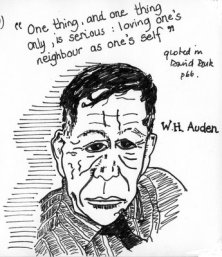
Auden’s recognition of the interdependence of Eros and Agape is at the heart of perhaps the greatest love poem of the century, the grave and tender “Lullaby” ([“Lay your sleeping head”] 1937), which moves so nimbly and with such grace among abstractions evoked so subtly that it may well be regarded as the premiere example of the poet’s intellectual lyricism. The luminous moment of fulfillment that the poem celebrates is placed in a context of mutability and decay that poignantly underlines the fragility of a love endangered from within by guilt, promiscuity, and betrayal, and from without by the “pedantic boring cry” of homophobic “fashionable madmen.”

Auden’s marriage to Kallman was not to prove entirely happy (primarily due to Kallman’s promiscuity), but it provided the poet with loving companionship and helped seal the permanence of his self-exile. Auden’s first flush of passion for Kallman immediately inspired several poems of fulfilled erotic love, including “The Prophets,” “Like a Vocation,” “The Riddle,” “Law Like Love,” and “Heavy Date,” in which he tells his lover, “I have / Found myself in you.”

Kallman introduced Auden to opera, an interest that would shape the curve of his career. The partners collaborated on several original libretti, including one for Stravinsky’s The Rake’s Progress (1951), and on translating others.

Auden movingly celebrates his relationship with Kallman in “The Common Life” (1965), which tellingly declares that “every home should be a fortress.” Also among Auden’s late poems is “Glad,” a light but deeply felt account of his relationship with a male hustler, “for a decade now / My bed-visitor, / An unexpected blessing / In a lucky life.”

In “Since,” a poem probably inspired by his relationship with Kallman, Auden suddenly remembers an August noon thirty years ago and “You as then you were.” He juxtaposes the memory of his youthful love-making with an account of the failures of Eros and Agape in the world since then and finds sustenance in the memory: “round your image / there is no fog, and the Earth / can still astonish.”

In a remarkable conclusion that bravely faces the issue of aging with unsentimental wit, he concludes, “I at least can learn / to live with obesity / and a little fame.” A stunning achievement, “Since” validates the vision of Eros as a life-sustaining experience that can compensate at least in part even for the inevitable failures of Agape.

Auden’s homosexuality is also expressed throughout his canon in the camp wit that discerns defensive fun in serious fear, as in the limerick “The Aesthetic Point of View” (1960). Moreover, the humorous self-revelations of the “Shorts” (1960), the “Marginalia” (1969), or “Profile” (1969), as well as the bawdy verse–such as “A Day for a Lay”–circulated among friends, helped establish for Auden a persona that has been particularly influential on younger gay poets, such as James Merrill, Richard Howard, and Howard Moss. In Merrill’s series of adventures with the Ouija board, for example, Auden is a ghostly presence, the embodiment of a homosexual artistic sensibility.

An essay by Claude J. Summers

Summers, Claude J., “Auden, W. H., ” glbtq: An Encyclopedia of Gay, Lesbian, Bisexual, Transgender, and Queer Culture, 2002.  URL: http://www.glbtq.com/literature/auden_wh.html.


Bibliography

Callan, Edward. Auden: A Carnival of Intellect. New York: Oxford University Press, 1983.

Carpenter, Humphrey. W.H. Auden: A Biography. London: Allen & Unwin, 1981.

Farnin, Dorothy J. Auden in Love. New York: Simon & Schuster, 1984.

Mendelson, Edward. Early Auden. New York: Viking, 1981.

Spender, Stephen, ed. W.H. Auden: A Tribute. New York: Macmillan, 1975.

Summers, Claude J. “American Auden.” Columbia History of American Poetry. Jay Parini, ed. New York: Columbia University Press, 1993.

_____. “‘And the Earth Can Still Astonish’: W.H. Auden and the Landscape of Eros.” The Windless Orchard 32 (1978): 27-36.

Wright, George T. W.H. Auden. Rev. ed. Boston: Twayne Publishers, 1981.


Onanism by Mark Twain

Did Mark Twain, nom de plume for Samuel Langhorne Clemens (1835-1910), really say that 95% of men masturbate and the other 5% lie about it (or statistics to that effect)? In any event, at about 44 years of age, here’s what he said as speaker at a dinner held in 1879 at a Paris supper club. Fellow diners were, to say the least, surprised by what they heard. Enjoy!

Some Thoughts on the Science of Onanism
by Mark Twain

[One evening in Paris in 1879, The Stomach Club, a society of American writers and artists, gathered to drink well, to eat a good dinner and hear an address by Mark Twain. He was among friends and, according to the custom of the club, he delivered a humorous talk on a subject hardly ever mentioned in public in that day and age. After the meeting, he preserved the manuscript among his papers. It was finally printed in a pamphlet limited to 50 copies 64 years later.]

My gifted predecessor has warned you against the “social evil–adultery.” In his able paper he exhausted that subject; he left absolutely nothing more to be said on it. But I will continue his good work in the cause of morality by cautioning you against that species of recreation called self-abuse to which I perceive you are much addicted. All great writers on health and morals, both ancient and modern, have struggled with this stately subject; this shows its dignity and importance. Some of these writers have taken one side, some the other.
Homer, in the second book of the Iliad says with fine enthusiasm, “Give me masturbation or give me death.” Caesar, in his Commentaries, says, “To the lonely it is company; to the forsaken it is a friend; to the aged and to the impotent it is a benefactor. They that are penniless are yet rich, in that they still have this majestic diversion.” In another place this experienced observer has said, “There are times when I prefer it to sodomy.”
Robinson Crusoe says, “I cannot describe what I owe to this gentle art.” Queen Elizabeth said, “It is the bulwark of virginity.” Cetewayo, the Zulu hero, remarked, “A jerk in the hand is worth two in the bush.” The immortal Franklin has said, “Masturbation is the best policy.”
Michelangelo and all of the other old masters–“old masters,” I will remark, is an abbreviation, a contraction–have used similar language. Michelangelo said to Pope Julius II, “Self-negation is noble, self-culture beneficent, self-possession is manly, but to the truly great and inspiring soul they are poor and tame compared with self-abuse.” Mr. Brown, here, in one of his latest and most graceful poems, refers to it in an eloquent line which is destined to live to the end of time–“None knows it but to love it; none name it but to praise.”
Such are the utterances of the most illustrious of the masters of this renowned science, and apologists for it. The name of those who decry it and oppose it is legion; they have made strong arguments and uttered bitter speeches against it–but there is not room to repeat them here in much detail. Brigham Young, an expert of incontestable authority, said, “As compared with the other thing, it is the difference between the lightning bug and the lightning.” Solomon said, “There is nothing to recommend it but its cheapness.” Galen said, “It is shameful to degrade to such bestial uses that grand limb, that formidable member, which we votaries of Science dub the Major Maxillary*–when they dub it at all–which is seldom, It would be better to amputate the os frontis** than to put it to such use.”
The great statistician Smith, in his report to Parliament, says, “In my opinion, more children have been wasted in this way than any other.” It cannot be denied that the high antiquity of this art entitles it to our respect; but at the same time, I think its harmfulness demands our condemnation. Mr. Darwin was grieved to feel obliged to give up his theory that the monkey was the connecting link between man and the lower animals. I think he was too hasty. The monkey is the only animal, except man, that practices this science; hence, he is our brother; there is a bond of sympathy and relationship between us. Give this ingenuous animal an audience of the proper kind and he will straightway put aside his other affairs and take a whet; and you will see by his contortions and his ecstatic expression that he takes an intelligent and human interest in his performance.
The signs of excessive indulgence in this destructive pastime are easily detectable. They are these: a disposition to eat, to drink, to smoke, to meet together convivially, to laugh, to joke and tell indelicate stories–and mainly, a yearning to paint pictures. The results of the habit are: loss of memory, loss of virility, loss of cheerfulness and loss of progeny.
Of all the various kinds of sexual intercourse, this has the least to recommend it. As an amusement, it is too fleeting; as an occupation, it is too wearing; as a public exhibition, there is no money in it. It is unsuited to the drawing room, and in the most cultured society it has long been banished from the social board. It has at last, in our day of progress and improvement, been degraded to brotherhood with flatulence. Among the best bred, these two arts are now indulged in only private–though by consent of the whole company, when only males are present, it is still permissible, in good society, to remove the embargo on the fundamental sigh.
My illustrious predecessor has taught you that all forms of the “social evil” are bad. I would teach you that some of these forms are more to be avoided than others. So, in concluding, I say, “If you must gamble your lives sexually, don’t play a lone hand too much.” When you feel a revolutionary uprising in your system, get your Vendome Column down some other way–don’t jerk it down.***


Note: Formal title of his Presentation was “Some Thoughts on the Science of Onanism.” Not that it would matter to Twain (who was well ahead of his time on masturbation), most biblical scholars today see Onan’s alleged “sin” as a reference to his disobedience of God’s alleged order to procreate. Instead, Onan engaged in coitus interruptus—withdrawing his penis before ejaculating. Masturbation had nothing to do with it.

* in the area of the sinuses (as best I can tell)
** frontal bone—forehead
***Twain’s satiric reference is to a penis-like column (pictured above), originally put in place by Napoleon, which rises majestically in Paris like an obelisk or erect phallus in the Place Vendôme. Napoleon himself stands on the head of this vertical shaft in full glory.
 
From: http://artofmalemasturbation.tumblr.com/MarkTwain.


For a more explicit view of masturbation, please visit my other blog.