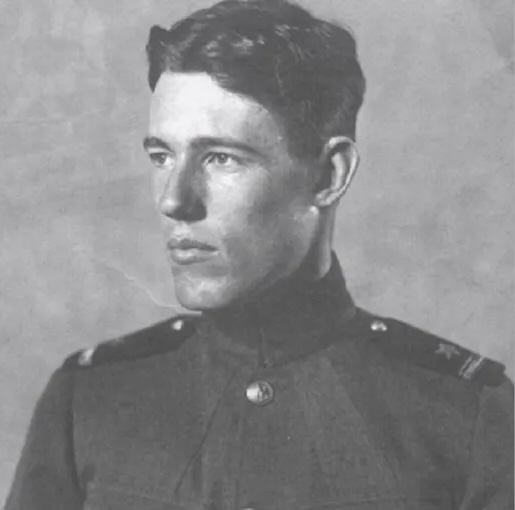
Prescott Townsend (1894-1973) was born into an old, wealthy Boston family. His mother was both a descendant of Myles Standish through her grandmother Susannah Perkins Staples (the sister of Yale Law School founder Seth Perkins Staples) and other Mayflower passengers, and the great-granddaughter of the American founding father Roger Sherman and his wife Rebecca Minot Prescott, through their son Roger Sherman, Jr. Townsend came out as a teenager, and his parents were accepting but told him to be cautious.
He attended the Volkman School, graduated in 1918 from Harvard University, and attended Harvard Law Schoolfor one year. He spent the summer of 1914 in logging camps in Montana and Idaho, and traveled to North Africa and the Soviet Union. After serving in World War I, Prescott lived in Paris for a time, becoming immersed in the bohemian culture of the era. He then “sought to establish an outpost of that culture” in his hometown of Boston and returned to Boston’s Beacon Hill neighborhood, where he began a relationship with theater producer Elliot Paul, with whom he founded the experimental Barn Theatre in 1922.
Paul introduced Townsend to numerous avant-garde creatives, including openly gay writer André Gide. Townsend operated speakeasies, restaurants, and theaters, cultivating a bohemian neighborhood on Beacon Hill’s Joy Street. He also spent time in Provincetown, where he became friendly with playwright Eugene O’Neill and other theater artists. He pioneered the popularity of A-frame houses, building several in Provincetown. He was later a founder of the Provincetown Playhouse, where the works of Eugene O’Neill were first performed.
Prescott was very happy to be a patron of the arts, and artists were very happy to take his money, However, the Great Depression ended all that.
By the 1930s, Prescott Townsend repeatedly addressed the Massachusetts legislature as an acknowledged homosexual man advocating for the repeal of sodomy legislation, urging the lawmakers “to legalize love.” He was indulged due to his family’s wealth and Boston Brahmin status, but he was ignored by lawmakers. While working at the shipyard during World War II, Townsend was arrested in 1943, for participating in an “unnatural and lascivious act.” He did not deny it, and was sentenced to eighteen months in the Massachusetts House of Corrections.
Shortly after, Prescott was officially stricken from both the New York and Boston Social Registers. In the 1950s, he held meetings at his home/bookstore, which he described as “the first social discussion of homosexuality in Boston.” In talks in Boston and Provincetown he promoted his “Snowflake Theory” of human personality and sexuality, stating that the human mind is like a snowflake in that no two are alike, and each has six opposing sides: I/You, He/She, Hit/Submit. He embraced a more in-your-face generation of activists in the late 1960s, marked by the uprising at New York City’s Stonewall Inn in 1969 and at age 76, he attended the first Pride parade in New York on the one-year anniversary of the Stonewall riots.
Toward the end of his life, his two remaining properties on the Hill were on its North Slope, traditionally the side where servants of patrician South Slope residents lived. He accommodated a motley collection of tenants, mostly young gay men, in an eight-unit building at 75 Phillips St. He always advocated for the outsider, the hippies, vagabonds, and runaway homeless queer youth his was a legacy of love, money and uplift.
Townsend died at age 78. He had, for years, been suffering from failing health brought on by Parkinson’s disease, and on May 23, 1973, his body was found in the Beacon Hill apartment of John Murray, who had been caring for him during the final years of his life. The police reported that “when we came in to take charge of the body, Mr. Townsend was found in a kneeling prayer position at his bedside.” Of his entire family, only one sister, a nephew and a great-nephew attended his memorial service at the Arlington Street Church.
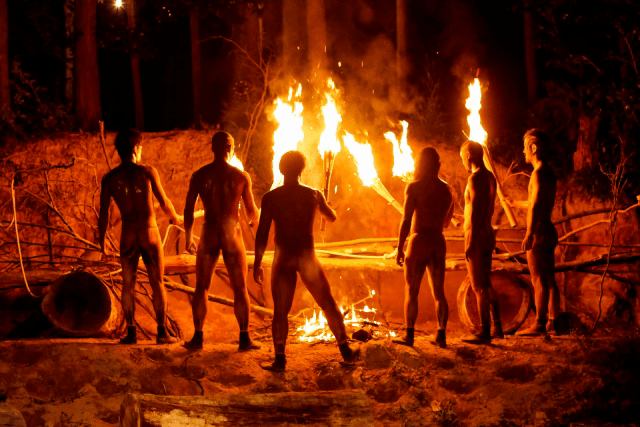
Last June, I went to a weekend escape to Easton Mountain, a gay men’s retreat in Greenwich, NY. One of the activities was a Cernunnos Fire Ceremony. The Cernunnos Ceremony is meant to tap into the energy of the wild ones in the woods that is meant to encourage a person to be free and listen to natures rhythms as a way of healing and self-expression. Cernunnos dates back to the ancient Celtic religion practiced freely in pre-Roman Europe. The picture above is of a modern Cernunnos Fire Festival, which is often performed nude in an effort to break down all barriers between nature and the body.
Cernunnos was a Celtic god who represented nature, flora, fauna, and fertility. He is frequently depicted with antlers, seated cross-legged, and is associated with stags, horned serpents, dogs, and bulls. He is usually shown holding or wearing a torc and sometimes holding a bag of coins (or grain) and a cornucopia. Cernunnos may have been one of the inspirations for depictions of Satan in Christian art and hero figures in the medieval literature of Wales and Ireland.
Cernunnos was perhaps the most important deity in the Celtic religion if we consider the frequency he is represented in ancient Celtic art from Ireland to Romania. Contrary to what many New Age beliefs, few facts are known about the Celtic religion, because there are no surviving native records of their beliefs. Evidence about their religion is gleaned from archaeology, Greco-Roman accounts (some of them hostile and probably not well-informed), and literature from the early Christian period.
The name Cernunnos originated because of a single instance of the name, an inscription and image on the 1st-century CE Nautae Parisiaci monument (see the image in the upper right of the inner cauldron below). It is also true that there were other Celtic gods with horns whose significance and associations remain unknown. It is important to restate that so little is known of Cernunnos that it is possible we are entirely misinterpreting representations of him in Celtic art. As the historian J. MacKillop notes: “our knowledge of Cernunnos is so tenuous that he may not be a divinity at all but rather a shaman-like priest with antlers affixed to his head”
Gundestrup Cauldron
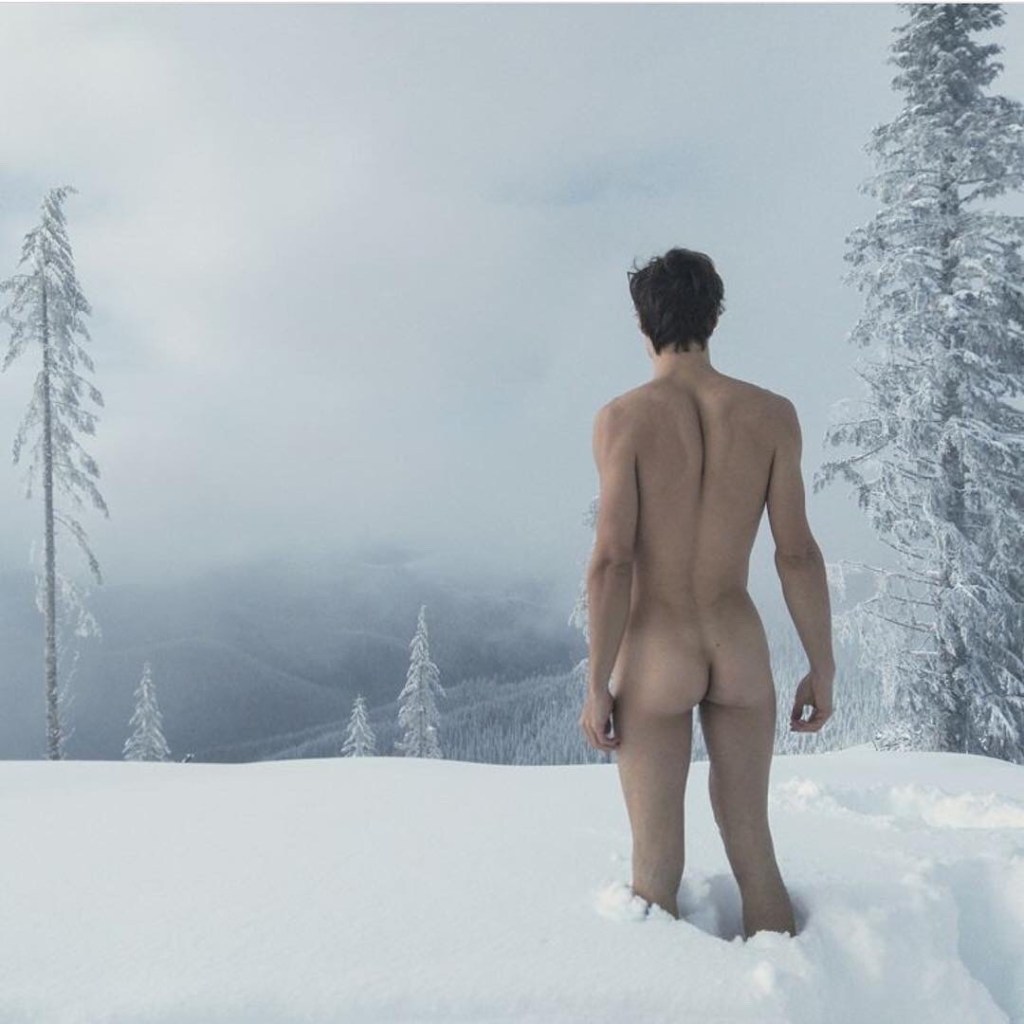
With global warming, dependency on technology, and even modesty, our connection to nature is often lost. As warmer weather is slowly returning to Vermont, I am hoping to have the chance to do more hiking this summer. I wasn’t able to do so last year because of the floods in Vermont that made the local hiking trails treacherous. Hopefully, this summer will be different. I’d love to be able to connect with nature more, and the exercise will be nice too.
When I saw this picture, I though he looked like a Vermonter, not a typical one (he doesn’t have a beard and he’s not wearing a flannel shirt), but maybe a preppy Vermonter. It’s the boots, socks, plaid blanket, and woodsy setting that made me think that. However, the model above, James Yates, is from England not Vermont. In Vermont he’d be known as a “flatlander,” much like I am. In Vermont, there are two types of people: woodchucks (native Vermonters) and flatlanders (everyone else).
Vermont Public radio have several different definitions and/origins for the term woodchuck to refer to Vermonters:
“In Vermont, the term woodchuck means someone who was born here.”
“…Second- or third-generation Vermonters.”
“Basically redneck or hillbilly…”“…A country person who, who literally chucked wood. I mean, they heated with wood.”
“Woodchuck is somebody that is very comfortable with machinery and guns and trucks.”
“Someone who, either real or perceived, has some sort of a relationship with the land.”
“…Grow their own food if they can, do their own plumbing, do their own wiring, do their own heating. In part because, well, when I first moved here, there wasn’t anyone else to do it.”
The term “flatlander” is easier to understand: Vermont is the Green Mountain State (Ver, from the French word for green, vert; and -mont from mountain.) Therefore, anyone not from Vermont is from flat land, though it’s a stretch as the Northeast has a lot of mountains.
If you’re wondering what an actual woodchuck is, it’s another name for a groundhog, of which, Vermont has plenty, and most people consider them a pest. I have several that live around my apartment. I see them quite regularly. So since today is Groundhog Day, (or maybe Woodchuck Day in Vermont) I thought I’d give you a little Vermont trivia.
Supposedly, there is a “Chinese Curse” that says: May you live in interesting times. While seemingly a blessing, the expression is normally said ironically. The idea is that “uninteresting times” are times of peace and tranquility, and “interesting times” are often periods of great turmoil. There’s one problem with this “curse,” it’s not Chinese. No equivalent saying exists in the Chinese lexicon.
The “curse” is most likely a British invention and is really from the speeches of the British politician Joseph Chamberlain. Chamberlain was the father of Austen Chamberlain, who received the Nobel Peace Prize for his work to reconcile the relationship between Germany and France after World War 1. By a different marriage, Chamberlain was also the father of British Prime Minister Neville Chamberlain, who so erroneously declared after the Munich Agreement in 1938, “I believe it is peace for our time.”
Austen and Neville lived disastrously in “interesting times.” While neither man is seen in history as a great leader, Austen probably delayed World War II by more than a decade with his negotiation of the Dawes Pact, and some historians are even reassessing Neville’s reputation. Neville Chamberlain no doubt knew he was not preventing a war with Germany, but knew the British were woefully unprepared for a war with Germany, and he needed to buy time Britain to arm for the war to come.
So, the fact that this week is not very interesting is, I guess, not a bad thing. I have something exciting happening on Friday, but I don’t want to “jinx” it. I’m not going to discuss it just yet, just know that it could result in some changes in my life.
Listen, my children, and you shall hear Of the midnight ride of Paul Revere, On the eighteenth of April, in Seventy-Five: Hardly a man is now alive Who remembers that famous day and year.
He said to his friend, “If the British march By land or sea from the town to-night, Hang a lantern aloft in the belfry-arch Of the North-Church-tower, as a signal-light,— One if by land, and two if by sea; And I on the opposite shore will be, Ready to ride and spread the alarm Through every Middlesex village and farm, For the country-folk to be up and to arm.”
Then he said “Good night!” and with muffled oar Silently rowed to the Charlestown shore, Just as the moon rose over the bay, Where swinging wide at her moorings lay The Somerset, British man-of-war: A phantom ship, with each mast and spar Across the moon, like a prison-bar, And a huge black hulk, that was magnified By its own reflection in the tide.
Meanwhile, his friend, through alley and street Wanders and watches with eager ears, Till in the silence around him he hears The muster of men at the barrack door, The sound of arms, and the tramp of feet, And the measured tread of the grenadiers Marching down to their boats on the shore.
Then he climbed to the tower of the church, Up the wooden stairs, with stealthy tread, To the belfry-chamber overhead, And startled the pigeons from their perch On the sombre rafters, that round him made Masses and moving shapes of shade,— By the trembling ladder, steep and tall, To the highest window in the wall, Where he paused to listen and look down A moment on the roofs of the town, And the moonlight flowing over all.
Beneath, in the churchyard, lay the dead, In their night-encampment on the hill, Wrapped in silence so deep and still That he could hear, like a sentinel’s tread, The watchful night-wind, as it went Creeping along from tent to tent, And seeming to whisper, “All is well!” A moment only he feels the spell Of the place and the hour, and the secret dread Of the lonely belfry and the dead; For suddenly all his thoughts are bent On a shadowy something far away, Where the river widens to meet the bay,— A line of black, that bends and floats On the rising tide, like a bridge of boats.
Meanwhile, impatient to mount and ride, Booted and spurred, with a heavy stride, On the opposite shore walked Paul Revere. Now he patted his horse’s side, Now gazed on the landscape far and near, Then impetuous stamped the earth, And turned and tightened his saddle-girth; But mostly he watched with eager search The belfry-tower of the old North Church, As it rose above the graves on the hill, Lonely and spectral and sombre and still. And lo! as he looks, on the belfry’s height, A glimmer, and then a gleam of light! He springs to the saddle, the bridle he turns, But lingers and gazes, till full on his sight A second lamp in the belfry burns!
A hurry of hoofs in a village-street, A shape in the moonlight, a bulk in the dark, And beneath from the pebbles, in passing, a spark Struck out by a steed that flies fearless and fleet: That was all! And yet, through the gloom and the light, The fate of a nation was riding that night; And the spark struck out by that steed, in his flight, Kindled the land into flame with its heat.
He has left the village and mounted the steep, And beneath him, tranquil and broad and deep, Is the Mystic, meeting the ocean tides; And under the alders, that skirt its edge, Now soft on the sand, now loud on the ledge, Is heard the tramp of his steed as he rides.
It was twelve by the village clock When he crossed the bridge into Medford town. He heard the crowing of the cock, And the barking of the farmer’s dog, And felt the damp of the river-fog, That rises when the sun goes down.
It was one by the village clock, When he galloped into Lexington. He saw the gilded weathercock Swim in the moonlight as he passed, And the meeting-house windows, blank and bare, Gaze at him with a spectral glare, As if they already stood aghast At the bloody work they would look upon.
It was two by the village clock, When he came to the bridge in Concord town. He heard the bleating of the flock, And the twitter of birds among the trees, And felt the breath of the morning breeze Blowing over the meadows brown. And one was safe and asleep in his bed Who at the bridge would be first to fall, Who that day would be lying dead, Pierced by a British musket-ball.
You know the rest. In the books you have read, How the British Regulars fired and fled,— How the farmers gave them ball for ball, From behind each fence and farmyard-wall, Chasing the red-coats down the lane, Then crossing the fields to emerge again Under the trees at the turn of the road, And only pausing to fire and load.
So through the night rode Paul Revere; And so through the night went his cry of alarm To every Middlesex village and farm,— A cry of defiance, and not of fear, A voice in the darkness, a knock at the door, And a word that shall echo forevermore! For, borne on the night-wind of the Past, Through all our history, to the last, In the hour of darkness and peril and need, The people will waken and listen to hear The hurrying hoof-beats of that steed, And the midnight message of Paul Revere.
About the Poem
“Paul Revere’s Ride” commemorates the actions of American patriot Paul Revere on April 18, 1775, although with significant inaccuracies. It was first published in the January 1861 issue of The Atlantic Monthly. It was later retitled “The Landlord’s Tale” in Longfellow’s 1863 collection Tales of a Wayside Inn.
The poem is spoken by the landlord of the Wayside Inn and tells a partly fictionalized story of Paul Revere. In the poem, Revere tells a friend to prepare signal lanterns in the Old North Church (North End, Boston) to inform him whether the British will attack by land or sea. He would await the signal across the river in Charlestown and be ready to spread the alarm throughout Middlesex County, Massachusetts. The unnamed friend climbs up the steeple and soon sets up two signal lanterns, informing Revere that the British are coming by sea. Revere rides his horse through Medford, Lexington, and Concord to warn the patriots.
Longfellow’s poem is credited with creating the national legend of Paul Revere, a previously little-known Massachusetts silversmith. Upon Revere’s death in 1818, for example, his obituary did not mention his midnight ride but instead focused on his business sense and his many friends. The fame that Longfellow brought to Revere, however, did not materialize until after the Civil War amidst the Colonial Revival Movement of the 1870s. In 1875, for example, the Old North Church mentioned in the poem began an annual custom called the “lantern ceremony” recreating the action of the poem. Three years later, the Church added a plaque noting it as the site of “the signal lanterns of Paul Revere.” Revere’s elevated historical importance also led to unsubstantiated rumors that he made a set of false teeth for George Washington. Revere’s legendary status continued for decades and, in part due to Longfellow’s poem, authentic silverware made by Revere commanded high prices. Wall Street tycoon J. P. Morgan, for example, offered $100,000 for a punch bowl Revere made.
In 1774 and 1775, the Boston Committee of Correspondence and the Massachusetts Committee of Safety employed Paul Revere as an express rider to carry news, messages, and copies of important documents as far away as New York and Philadelphia.
On the evening of April 18, 1775, Dr. Joseph Warren summoned Paul Revere and gave him the task of riding to Lexington, Massachusetts, with the news that British soldiers stationed in Boston were about to march into the countryside northwest of the town. According to Warren, these troops planned to arrest Samuel Adams and John Hancock, two leaders of the Sons of Liberty, who were staying at a house in Lexington. It was thought they would then continue on to the town of Concord, to capture or destroy military stores — gunpowder, ammunition, and several cannon — that had been stockpiled there. In fact, the British troops had no orders to arrest anyone — Dr. Warren’s intelligence on this point was faulty- but they were very much on a major mission out of Boston. Revere contacted an unidentified friend (probably Robert Newman, the sexton of Christ Church in Boston’s North End) and instructed him to hold two lit lanterns in the tower of Christ Church (now called the Old North Church) as a signal to fellow Sons of Liberty across the Charles River in case Revere was unable to leave town.
The two lanterns were a predetermined signal stating that the British troops planned to row “by sea” across the Charles River to Cambridge, rather than march “by land” out Boston Neck.
Revere then stopped by his own house to pick up his boots and overcoat and proceeded the short distance to Boston’s North End waterfront. There two friends rowed him across the river to Charlestown. Slipping past the British warship HMS Somerset in the darkness, Revere landed safely. After informing Colonel Conant and other local Sons of Liberty about recent events in Boston and verifying that they had seen his signals in the North Church tower, Revere borrowed a horse from John Larkin, a Charlestown merchant, and a patriot sympathizer. While there, a member of the Committee of Safety named Richard Devens warned Revere that there were a number of British officers in the area who might try to intercept him.
At about eleven o’clock Revere set off on horseback. After narrowly avoiding capture just outside of Charlestown, Revere changed his planned route and rode through Medford, where he alarmed Isaac Hall, the captain of the local militia, of the British movements. He then alarmed almost all the houses from Medford, through Menotomy (today’s Arlington) — carefully avoiding the Royall Mansion whose property he rode through (Isaac Royall was a well-known Loyalist) — and arrived in Lexington sometime after midnight.
In Lexington, as he approached the house where Adams and Hancock were staying, Sergeant Monroe, acting as a guard outside the house, requested that he not make so much noise. “Noise!” cried Revere, “You’ll have noise enough before long. The regulars are coming out!” According to tradition, John Hancock, who was still awake, heard Revere’s voice and said “Come in, Revere! We’re not afraid of you”. He entered the house and delivered his message.
About half past twelve, William Dawes, who had traveled the longer land route out of Boston Neck, arrived in Lexington carrying the same message as Revere. After both men “refreshed themselves” (i.e., had something to eat and drink), they decided to continue on to Concord, Massachusetts to verify that the military stores were properly dispersed and hidden away. A short distance outside of Lexington, they were overtaken by Dr. Samuel Prescott, who they determined was a fellow “high Son of Liberty.” A short time later, a British patrol intercepted all three men. Prescott and Dawes escaped; Revere was held for some time, questioned, and let go. Before he was released, however, his horse was confiscated to replace the tired mount of a British sergeant. Left alone on the road, Revere returned to Lexington on foot in time to witness the latter part of the battle on Lexington Green.
This story comes from several accounts written by Paul Revere after his Midnight Ride. To see one of them in his own handwriting, with a transcription, visit “Revere’s Own Words.”
About the Poet
Henry Wadsworth Longfellow was born in Portland, Maine—then still part of Massachusetts—on February 27, 1807, the second son in a family of eight children. His mother, Zilpah Wadsworth, was the daughter of a Revolutionary War hero. His father, Stephen Longfellow, was a prominent Portland lawyer and later a member of Congress.
After graduating from Bowdoin College, Longfellow studied modern languages in Europe for three years, then returned to Bowdoin to teach them. In 1831, he married Mary Storer Potter of Portland, a former classmate, and soon published his first book, a description of his travels called Outre Mer (“Overseas”). But, in November 1835, during a second trip to Europe, Longfellow’s life was shaken when his wife died during a miscarriage. The young teacher spent a grief-stricken year in Germany and Switzerland.
Longfellow took a position at Harvard in 1836. Three years later, at the age of thirty-two, he published his first collection of poems, Voices of the Night, followed in 1841 by Ballads and Other Poems. Many of these poems (“A Psalm of Life,” for example) showed people triumphing over adversity, and in a struggling young nation that theme was inspiring. Both books were very popular, but Longfellow’s growing duties as a professor left him little time to write more. In addition, Frances Appleton, a young woman from Boston, had refused his proposal of marriage.
Frances finally accepted Longfellow’s proposal the following spring, ushering in the happiest eighteen years of Longfellow’s life. The couple had six children, five of whom lived to adulthood, and the marriage gave him new confidence. In 1847, he published Evangeline, a book-length poem about what would now be called “ethnic cleansing.” The poem takes place as the British drive the French from Nova Scotia, and two lovers are parted, only to find each other years later when the man is about to die.
In 1854, Longfellow decided to quit teaching to devote all his time to poetry. He published Hiawatha, a long poem about Native American life, and The Courtship of Miles Standish and Other Poems. Both books were immensely successful, but Longfellow was now preoccupied with national events. With the country moving toward civil war, he wrote “Paul Revere’s Ride,” a call for courage in the coming conflict.
A few months after the war began in 1861, Frances Longfellow was sealing an envelope with wax when her dress caught fire. Despite her husband’s desperate attempts to save her, she died the next day. Profoundly saddened, Longfellow published nothing for the next two years. He found comfort in his family and in reading Dante’s Divine Comedy. (Later, he produced its first American translation, which led to American universities realizing the importance of modern languages, like Italian. Previously, the majority of colleges and universities in the United States only taught Latin, Greek, and Hebrew.) Tales of a Wayside Inn, largely written before his wife’s death, was published in 1863.
When the Civil War ended in 1865, the poet was fifty-eight. His most important work was finished, but his fame kept growing. In London alone, twenty-four different companies were publishing his work. His poems were popular throughout the English-speaking world, and they were widely translated, making him the most famous American of his day. His admirers included Abraham Lincoln, Charles Dickens, and Charles Baudelaire.
From 1866 to 1880, Longfellow published seven more books of poetry, and his seventy-fifth birthday in 1882 was celebrated across the country. But his health was failing, and he died the following month, on March 24. When Walt Whitman heard of the poet’s death, he wrote that, while Longfellow’s work “brings nothing offensive or new, does not deal hard blows,” he was the sort of bard most needed in a materialistic age: “He comes as the poet of melancholy, courtesy, deference—poet of all sympathetic gentleness—and universal poet of women and young people. I should have to think long if I were ask’d to name the man who has done more and in more valuable directions, for America.”
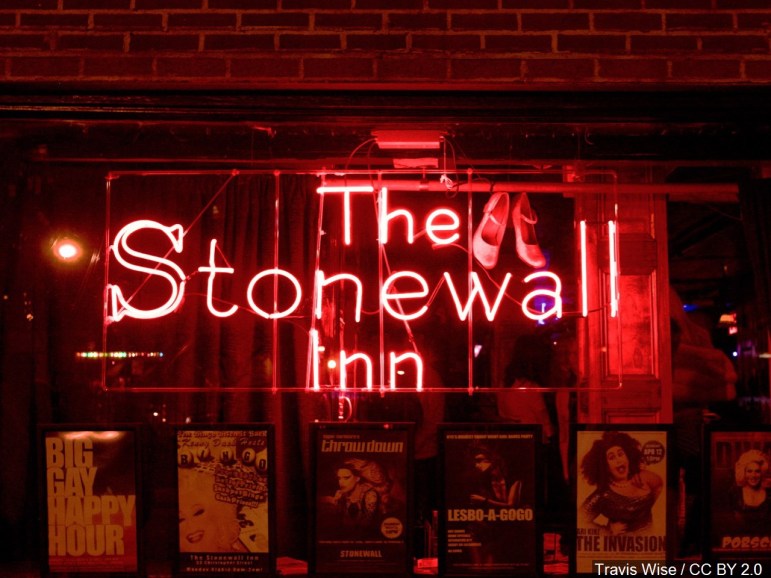
At 1:20 a.m. on Saturday, June 28, 1969, four plainclothes policemen in dark suits, two patrol officers in uniform, Detective Charles Smythe, and Deputy Inspector Seymour Pine, arrived at the Stonewall Inn’s double doors and announced, “Police! We’re taking the place!” The music was turned off, and the main lights were turned on. Raids of gay bars in New York City, particularly Greenwich Village, were not uncommon in the summer of 1969; what made the raid on the Stonewall on the night of June 27 so different was that the patrons of the bar resisted instead of going peacefully. Approximately 205 people were in the bar that night. Patrons who had never experienced a police raid were confused. A few who realized what was happening began to run for doors and windows in the bathrooms, but police barred the doors. The police had a standard procedure for these raids. They lined up the patrons and began checking identification. Any person appearing to be physically male and dressed as a woman would be arrested. This particular raid did not go as planned. Those dressed as women that night refused to go with the officers. Men in line began to refuse to produce their identification.
The New York Post was the first of the New York newspapers to report the raid and the first “melee” that followed the raid. The Post described the scene following the raid on the Stonewall Inn, “a tavern frequented by homosexuals at 53 Christopher St.” The raid was staged because of the unlicensed sale of liquor. On that first night, twelve people were arrested with charges ranging from assault to disorderly conduct because of the impromptu riot that soon ensued. As the police drove away with those in custody from the raid, the newspaper describes how “hundreds of passerby” shouted “Gay Power” and “We Want Freedom” while laying siege to the bar with “an improvised battering ram, garbage cans, bottles and beer cans in a protest demonstration.” More police were sent to 53 Christopher Street, where the disturbance raged for more than two hours.
For the next two days and again on July 3, the New York Times ran small pieces about the “Village Raid.” On June 29, the Times reported that shortly after 3 a.m. on the previous day, the bar had been raided. About two hundred patrons were thrown out of the bar and soon were joined by about two hundred more in protest of the raid. Police seized several cases of liquor from the establishment, which the police stated was operating without a liquor license. The Times reported that the “melee” lasted for only about forty-five minutes after the raid before the crowd dispersed, and thirteen people in all were arrested, with four policemen suffering injuries, one a broken wrist. The June 29 article also stated that the raid was one of three conducted in the last two weeks, and on the night of June 28, “throngs of young men congregated outside the inn. . .reading aloud condemnations of the police.”
The June 30 edition of the newspaper stated that on the early morning of June 29, a crowd of about four hundred gathered again on Christopher Street, and a Tactical Patrol Unit was called in to control the disturbance at about 2:15 a.m. The crowd was throwing bottles and lighting small fires. With their arms linked, the police made sweeps down Christopher Street from the Avenue of the Americas to Seventh Avenue, but the crowds merely moved into side streets and reformed behind the police. Those who did not move out of the way of the police line were pushed along, and two men were clubbed to the ground. Stones and bottles were thrown at the police, and twice, the police broke ranks to charge the crowd. Three people were arrested on charges of harassment and disorderly conduct. The June 30 article also stated that the crowd gathered again on the evening of June 29 to denounce the police for “allegedly harassing homosexuals.” Graffiti painted on the boarded-up windows of the inn stated, “Support gay power” and “Legalize gay bars.” A July 3 article in the New York Times stated that a chanting crowd of about five hundred gathered again outside the Stonewall Inn and had to be dispersed by the police while four protestors were arrested.
On July 3, 1969, The Village Voice published two more substantial articles on the incidents surrounding the Stonewall Inn. Of the two articles, Lucian Trusctott IV’s article is written in a tongue-in-cheek style focusing on the several days of riots that ensued after the first raid. Truscott reports that the crowd, which returned on Saturday night, was being led by “gay power” cheers: “We are the Stonewall girls/ We wear our hair in curls/ We have no underwear/ We show our pubic hair!” The article is mostly sympathetic to the gay cause and quotes Allen Ginsberg, a gay activist, stating, “Gay Power! Isn’t that great! We’re one of the largest minorities in the country–10 percent, you know. It’s about time we did something to assert ourselves.” Truscott is prophetic when he ended his article by stating:
We reached Cooper Square, and as Ginsberg turned to head toward home, he waved and yelled, “Defend the fairies!” and bounce on across the square. He enjoyed the prospect of “gay power” and is probably working on a manifesto for the movement right now. Watch out. The liberation is under way!
Gay liberation was underway.
No one really knows what set off the “flash of anger” that began the riots. Most of the people who were there just said that all of a sudden, the crowd grew angry and either began throwing bottles or trying to free one of the men in drag who were being arrested. Even if it cannot be determined what set off the anger that went through the crowd, it must be asked why that night. Many factors could have contributed to why the people in the Stonewall Inn fought back. It could have been because most of them had reached their breaking point, with the criminalization of their behavior to the Vietnam War that had raged for the last four years in the living rooms of every American with a television. One theory is that with Judy Garland’s funeral earlier that day, the men in the Stonewall Inn were distraught over losing their greatest icon. The heat in New York that summer was probably another factor. Also, the Stonewall raid occurred early in the morning. Usually, raids happened earlier in the evening so that the bar could open back up. The mafia ran the gay bars, and the police were being bribed. The raids were rarely major incidents, nor were the raids expected to be. But the night of June 27, 1969, was different for one reason or another.
Once the crowd began to fight back, the fervor of rebellion and the feeling that a revolution was happening among the gay community swept through the crowd. No longer were gays going to work with the system to make themselves feel more normal. They wanted to be accepted for who they were, not for who the establishment wanted them to be. African-Americans had made great strides in their civil rights struggle, and women were just beginning to make strides for women’s liberation and equality. As pointed out by Alan Ginsberg earlier, gays and lesbians were a large minority in the United States. If they could make themselves heard, this could change everything for them.
A catalyst had been sparked by the Stonewall Riots, and there was no turning back. From 1969 to today has been a bumpy road in the fight for LGBTQ+ rights. The AIDS epidemic set back the movement as many in the gay community died, but the fight lived on. In 1973, the board of the American Psychiatric Association voted to declassify homosexuality as a mental disorder. Eventually, the Supreme Court overturned sodomy laws and ruled in favor of gay marriage. The movement isn’t over, and we cannot rest on those and the many other small victories. With transgender rights being attacked in so many states, we have to continue to push for LGBTQ+ equality.
Near Clapham village, where fields began, Saint Edward met a beggar man. It was Christmas morning, the church bells tolled, The old man trembled for the fierce cold.
Saint Edward cried, “It is monstrous sin A beggar to lie in rags so thin! An old gray-beard and the frost so keen: I shall give him my fur-lined gaberdine.”
He stripped off his gaberdine of scarlet And wrapped it round the aged varlet, Who clutched at the folds with a muttered curse, Quaking and chattering seven times worse.
Said Edward, “Sir, it would seem you freeze Most bitter at your extremities. Here are gloves and shoes and stockings also, That warm upon your way you may go.”
The man took stocking and shoe and glove, Blaspheming Christ our Saviour’s love, Yet seemed to find but little relief, Shaking and shivering like a leaf.
Said the saint again, “I have no great riches, Yet take this tunic, take these breeches, My shirt and my vest, take everything, And give due thanks to Jesus the King.”
The saint stood naked upon the snow Long miles from where he was lodged at Bowe, Praying, “O God! my faith, it grows faint! This would try the temper of any saint.
“Make clean my heart, Almighty, I pray, And drive these sinful thoughts away. Make clean my heart if it be Thy will, This damned old rascal’s shivering still!”
He stooped, he touched the beggar man’s shoulder; He asked him did the frost nip colder? “Frost!” said the beggar, “no, stupid lad! ’Tis the palsy makes me shiver so bad.”
About the Poem
The Saint Edward referred to in this poem is Edward the Confessor (c. 1003 – 5 January 1066), one of the last Anglo-Saxon English kings. As king, Edward developed a reputation for living a simple, pious lifestyle and being generous with the poor. Some reports indicate that he longed for a monastic life and took a vow of celibacy, as he and his wife never had children. He was associated with legends including a story from towards the end of his life. Edward was riding by a church in Essex and an old man asked for alms. As the king had no money to give, he drew a large ring off his finger and gave this to the beggar. A few years later two pilgrims were travelling in the Holy Land and became stranded. They were helped by an old man, and when he knew they came from England, he told them he was St John the Evangelist and asked them to return the ring to Edward telling him that in six months he would join him in heaven. The story is one of fourteen scenes from the king’s life – real and legendary – carved on a mid-15th-century stone screen in Westminster Abbey. Also shown are his birth, his coronation, Christ appearing to Edward at Mass, and the dedication of a church, assumed to be the Abbey.
While Edward spent much of his life in exile in France, particularly Normandy, Edward’s love for the region of his childhood can be seen in one of his greatest architectural achievements, the building of Westminster Abbey. The story goes that Edward vowed that if he should return safely from exile in Normandy to his kingdom, he would make a pilgrimage to St Peter’s, Rome. But once on the throne he found it impossible to leave his subjects, and the Pope released him from his vow on condition that he should found or restore a monastery to St Peter. This led to the building of a new church in the Norman style to replace the Saxon church at Westminster.
The king’s piety had greatly endeared him to his people, and he came to be regarded as a saint long before he was officially canonized as Saint and Confessor by Pope Alexander III in 1161. His nickname reflects the traditional image of him as unworldly and pious. Edward’s reputation for piety and charity was widespread, and he was viewed with great veneration, even being considered a patron saint of England. In 1139, the prior of Westminster Abbey traveled to Rome to ask the pope to canonize Edward, but the appeal was rejected amid political disputes. Edward was buried in Westminster Abbey, which was completed shortly before his death. His body remains there today, although the abbey is now an Anglican church.
About the Poet
On July 24, 1895, Robert Graves was born in Wimbledon, near London. His father, Alfred Perceval Graves, was a Gaelic scholar and minor Irish poet. His mother, Amalie von Ranke Graves, was a relation of Leopold von Ranke, one of the founding fathers of modern historical studies. One of ten children, Robert was greatly influenced by his mother’s puritanical beliefs and his father’s love of Celtic poetry and myth. As a young man, he was more interested in boxing and mountain climbing than studying, although poetry later sustained him through a turbulent adolescence. Graves received his early education at a series of six preparatory schools, including King’s College School in Wimbledon, Penrallt in Wales, Hillbrow School in Rugby, Rokeby School in Kingston upon Thames and Copthorne in Sussex, from which last in 1909 he won a scholarship to Charterhouse.
Robert Graves was bisexual, having intense romantic relationships with both men and women, though the word he coined for it was “pseudo-homosexual.” Graves was raised to be “prudishly innocent, as my mother had planned I should be.” His mother, Amy, forbade speaking about sex, save in a “gruesome” context, and all skin “must be covered.” At his days in Penrallt, he had “innocent crushes” on boys; one in particular was a boy named Ronny, who “climbed trees, killed pigeons with a catapult and broke all the school rules while never seeming to get caught.” At Charterhouse, an all-boys school, it was common for boys to develop “amorous but seldom erotic” relationships, which the headmaster mostly ignored. Graves described boxing with a friend, Raymond Rodakowski, as having a “a lot of sex feeling.” And although Graves admitted to loving Raymond, he would dismiss it as “more comradely than amorous.” In his fourth year at Charterhouse, Graves met “Dick” (George “Peter” Harcourt Johnstone) with whom he would develop “an even stronger relationship.” Johnstone was an object of adoration in Graves’s early poems.
In 1913 Graves won a scholarship to continue his studies at St. John’s College, Oxford, but in August 1914 he enlisted as a junior officer in the Royal Welch Fusiliers. He fought in the Battle of Loos and was injured in the Somme offensive in 1916. While convalescing, he published his first collection of poetry, Over the Brazier. By 1917, though still an active serviceman, Graves had published three volumes. In 1918, he spent a year in the trenches, where he was again severely wounded.
During the war, Johnstone remained a “solace” to Graves. Despite Graves’s own “pure and innocent” view of Johnstone, Graves’s cousin Gerald wrote in a letter that Johnstone was: “not at all the innocent fellow I took him for, but as bad as anyone could be”. Johnstone remained a subject for Graves’s poems despite this. Communication between them ended when Johnstone’s mother found their letters and forbade further contact with Graves. Johnstone would later be arrested for attempting to seduce a Canadian soldier, which removed Graves’s denial about Johnstone’s infidelity, causing Graves to collapse.
In January 1918, at the age of twenty-two, he married eighteen-year-old Nancy Nicholson, with whom he was to have four children. Traumatized by the war, he went to Oxford with his wife and took a position at St. John’s College. Graves’s early volumes of poetry, like those of his contemporaries, deal with natural beauty and bucolic pleasures, and with the consequences of the First World War. Over the Brazier and Fairies and Fusiliers earned Graves his reputation as an accomplished war poet. After meeting the American poet and theorist Laura Riding in 1926, Graves’s poetry underwent a significant transformation.
In 1927, Graves and his first wife separated permanently, and in 1929 he published Goodbye to All That, an autobiography that announced his psychological accommodation with the residual horror of his war experiences. Shortly afterward, he departed to Majorca with Laura Riding. In addition to completing many books of verse while in Majorca, Graves also wrote several volumes of criticism, some in collaboration with Riding. During that period, he evolved his theory of poetry as spiritually cathartic to both the poet and the reader. Although Graves claimed that he wrote novels only to earn money, it was through these that he attained status as a major writer in 1934, with the publication of the historical novel I, Claudius, and its sequel, Claudius the God and His Wife Messalina. (During the 1970’s, the BBC adapted the novels into an internationally popular television series.)
At the onset of the Spanish Civil War in 1936, Graves and Riding fled Majorca, eventually settling in America. In 1939, Laura Riding left Graves for the writer Schuyler Jackson; one year later Graves began a relationship with Beryl Hodge that was to last until his death.
After World War II, Graves returned to Majorca, where he lived with Hodge and continued to write. By the 1950s, Graves had won an enormous international reputation as a poet, novelist, literary scholar, and translator. In 1962, W. H. Auden went as far as to assert that Graves was England’s “greatest living poet.” From 1961 to 1966, Graves returned to England to serve as a professor of poetry at Oxford. In the 1970s his productivity fell off; and the last decade of his life was lost in silence and senility. Robert Graves died in Majorca in 1985, at the age of ninety.
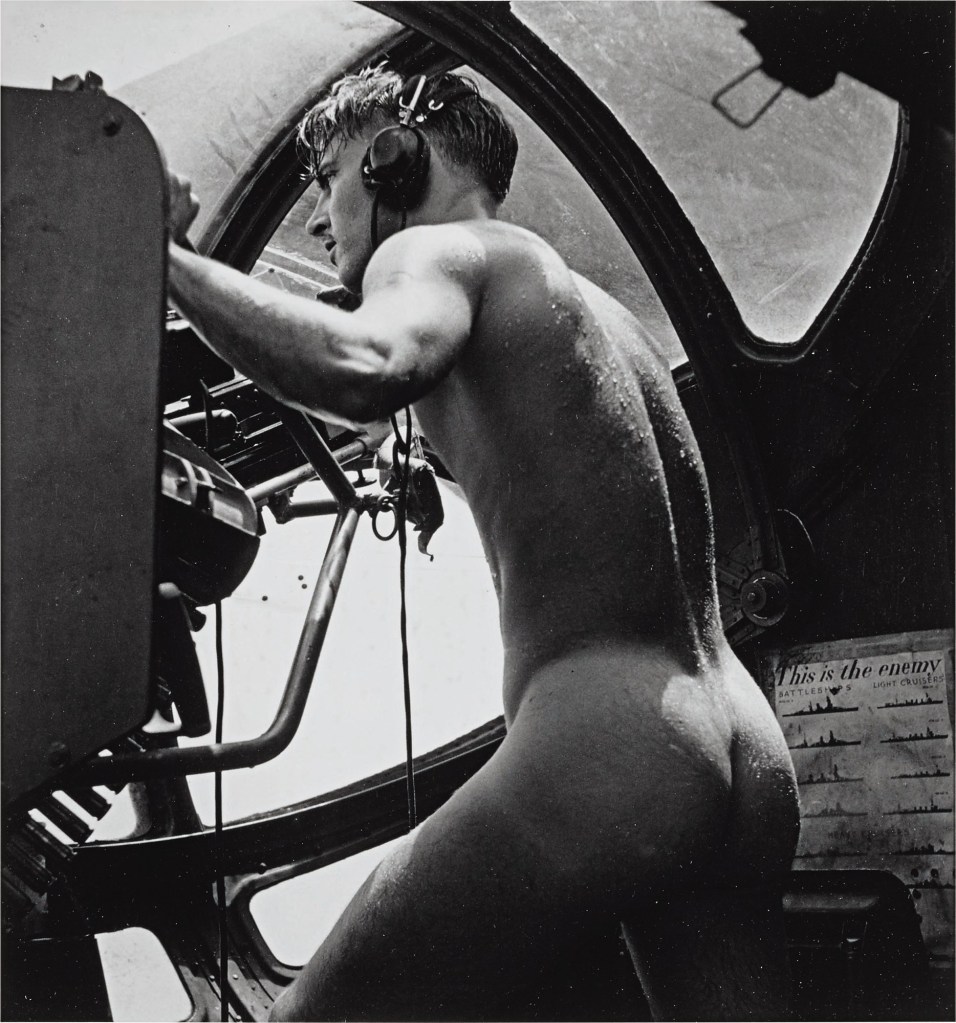
You have probably all seen this photograph by Horace Bristol form 1944. It has been widely reproduced and viewed as a symbol of bravery, loyalty, and erotic masculinity. In October 2020, the photo was included in a Sotheby’s auction of Classic Photographs. Lot 13, “HORACE BRISTOL | PBY BLISTER GUNNER, RESCUE AT RABAUL” sold for $ 27,720, well over the estimate of $ 8,000-$12,000.
“PBY Blister Gunner, Rescue at Rabaul, 1944” is one of the most iconic photos of the Pacific War. But the identity of the “Naked Gunner,” as it is popularly known, remains a mystery to this day. The photo was taken by Horace Bristol (1908-1997), a founding photojournalist for the illustrious Life magazine. In 1941, Bristol was recruited to the U.S. Naval Aviation Photographic Unit, as one of six photographers under the command of Captain Edward J. Steichen, documenting World War II in places such as South Africa and Japan. It is not known if the Bristol ever asked the soldier for his name as he captured his image. Sadly, we will never know. Bristol died in 1997, having kept a discreet silence on the bomber’s identity if, indeed, he ever knew it.
Bristol ended up being on the plane the gunner was serving on, which was used to rescue people from Japanese-held Rabaul Harbor (New Britain Island, Papua New Guinea) when this photograph was taken. In an article from a December 2002 issue of B&W Magazine he remembers:
“…we got a call to pick up an airman who was down in the Bay.
“The Japanese were shooting at him from the island, and when they saw us, they started shooting at us. The man who was shot down was temporarily blinded, so one of our crew stripped off his clothes and jumped in to bring him aboard. He couldn’t have swum very well wearing his boots and clothes.
“As soon as we could, we took off. We weren’t waiting around for anybody to put on formal clothes. We were being shot at and wanted to get the hell out of there. The naked man got back into his position at his gun in the blister of the plane.”
The fearless airman was deployed as part of a rescue campaign known as Operation Dumbo. Dumbo was the code name used by the United States Navy during the 1940s and 1950s to signify search and rescue missions, conducted in conjunction with military operations, by long-range aircraft flying over the ocean. The purpose of Dumbo missions was to rescue downed American aviators as well as seamen in distress. Dumbo aircraft were originally land-based heavy bomber aircraft converted to carry an airborne lifeboat to be dropped in the water near survivors. The name “Dumbo” came from Walt Disney’s flying elephant, the main character of the animated film Dumbo, appearing in October 1941. The campaign saved many Americans and their allies from a watery grave.
The PBY Catalina (a waterbomber) for which the naked man was a gunner, was an amphibious aircraft, recognized and celebrated by American aviators and flight crews for its vast range and endurance. According to the PBY Naval Air Museum, Washington website, the ‘versatile’ aircraft was capable of dropping “torpedoes, depth charges and bombs” while providing defense for their crews from “multiple high-caliber machine guns.” The airborne fleet, designed by Isaac Machlin Laddon and manufactured by the Consolidated Aircraft Corporation, was used all over the world, but particularly in coastal areas, to “patrol for enemy fleets and perform rescues.”
Labor Day, in the United States and Canada, is a holiday that falls on the first Monday in September and honors workers and recognizes their contributions to society. In the United States, Peter J. McGuire, a union leader who had founded the United Brotherhood of Carpenters in 1881, is generally given credit for the idea of Labor Day. In 1882 he suggested to the Central Labor Union of New York that there be a celebration honoring American workers. On September 5 some 10,000 workers, under the sponsorship of the Knights of Labor, held a parade in New York City. There was no particular significance to the date, and McGuire said that it was chosen because it fell roughly halfway between the Fourth of July holiday and Thanksgiving. In 1884 the Knights of Labor adopted a resolution that the first Monday in September be considered Labor Day.
The idea quickly spread, and by the following year Labor Day celebrations were being held in a number of states. Oregon became the first state, in 1887, to grant legal status to the holiday (although the state initially celebrated it on the first Saturday in June). That same year Colorado, New York, Massachusetts, and New Jersey established the holiday on the first Monday in September, and other states soon followed. In 1894 the Pullman strike in Illinois, as well as a series of unemployed workers’ riots on May Day in Cleveland, Ohio, prompted U.S. Pres. Grover Cleveland to propose a bill that would make Labor Day a national public holiday. The bill, which was crafted in part to deflect attention from May Day (an unofficial observance rooted in socialist movements), was signed into law in June of that year.
Over the years, particularly as the influence of unions waned, the significance of Labor Day in the United States changed. For many people it became an end-of-summer celebration and a long weekend for family get-togethers. At the same time, it has continued to be celebrated with parades and speeches, as well as political rallies, and the day is sometimes the official kickoff date for national political campaigns.
In Canada the first parades of workers were held in 1872 in Ottawa and Toronto, and later in that year the law making labour unions illegal was repealed. McGuire was invited to speak at the celebration in 1882. In 1894 Parliament officially recognized the holiday in Canada.
Most other countries honor workers on May Day (May 1). The day was a major holiday in communist countries, and it continues to be important where left-wing political parties and labor movements wield influence.
Then King David went in and sat before the Lord; and he said: “Who am I, O Lord God? And what is my house, that You have brought me this far? And yet this was a small thing in Your sight, O God; and You have also spoken of Your servant’s house for a great while to come, and have regarded me according to the rank of a man of high degree, O Lord God.
—1 Chronicles 17:16-17
It’s been quite a while since I used a hymn as my Sunday devotional. During my high school and college years, I was the song leader at the small country church I grew up attending. Half the people at that church were like family to me, and the other half were my family. The song leader I grew up with became unable to lead the singing, so he asked me if I would it. I had taken piano lessons when I was younger, so I had a little musical ability, i.e. I could almost carry a tune. I was never a very good song leader, and I only knew about two dozen or so songs well enough to be able to lead the congregation in singing.
If you don’t know, I was raised in the church of Christ (by the way, it is customary to not capitalize “church” in the name of the denomination, though churches of Christ do not believe they are a denomination nor Protestant, but a restoration of the original church). The churches of Christ have no musical instruments, though some of the more liberal ones today do. The churches of Christ believe that if it is not in the bible, then it should not be part of the religious service. So, the inspiration for a capella singing comes from Ephesians 5:19, “Speaking to one another in psalms and hymns and spiritual songs, singing and making melody in your heart to the Lord.” Being a song leader in a church of Christ is not the easiest task. There are no musical instruments to carry the tune. It is completely up to the song leader to do so. All I can say is, that I tried my best. I was never very good at it, and quite honestly, even after doing it for years, I was never comfortable at it. When I went away to graduate school, they found someone else to take over. I was so relieved.
I had a few favorite song: “When the Roll Is Called up Yonder,” “Send the Light,” “Shall We Gather at the River?,” “The Old Rugged Cross,” and a few others. “Amazing Grace” was always a favorite of mine. The service always began with two songs sung while seated before the main prayer. Then, we would stand for the third song just before the preacher got up to give his sermon, and I often sang “Amazing Grace” for this song. After the sermon, we would sing the invitational, a call for those who wanted to join the church and be baptized. After the invitational, we served communion. Communion, or the Lord’s Supper, is served every Sunday in the church of Christ. After communion, we sang the closing song, my favorite being “I Know That My Redeemer Lives” and “Unclouded Day.” The latter begins with “O they tell me of a home far beyond the skies,” and as long as I could get out the “O” in the right key, this one always went smoothly because someone else would pick it up and keep it going in tune.
Amazing Grace By John Newton
Amazing grace! how sweet the sound, that saved a wretch like me! I once was lost, but now am found, was blind, but now I see.
‘Twas grace that taught my heart to fear, and grace my fears relieved; how precious did that grace appear the hour I first believed!
Through many dangers, toils and snares I have already come: ’tis grace has brought me safe thus far, and grace will lead me home.
When we’ve been there ten thousand years, Bright shining as the sun, We’ve no less days to sing God’s praise Than when we first begun.
“Amazing Grace” is one of the best-loved and most often sung hymns in North America. It expresses John Newton’s personal experience of conversion from sin as an act of God’s grace. At the end of his life, Newton (1725-1807) said, “There are two things I’ll never forget: that I was a great sinner, and that Jesus Christ is a greater Savior!” This hymn is Newton’s spiritual autobiography, but the truth it affirms—that we are saved by grace alone—is one that all Christians may confess with joy and gratitude. I, however, believe that it takes faith and good works. James 2:26 says, “For as the body without the spirit is dead, so faith without works is dead also.” Now, back to Newton’s story.
Newton was born into a Christian home, but his godly mother died when he was seven, and he joined his father at sea when he was eleven. His licentious and tumultuous sailing life included a flogging for attempted desertion from the Royal Navy and captivity by a slave trader in West Africa. After his escape, he himself became the captain of a slave ship. Several factors contributed to Newton’s conversion: a near-drowning in 1748, the piety of his friend Mary Catlett (whom he married in 1750), and his reading of Thomas à Kempis’s Imitation of Christ.
In 1754 he gave up the slave trade and, in association with William Wilberforce, eventually became an ardent abolitionist. After becoming a tide-surveyor (customs inspector) in Liverpool, England, Newton came under the influence of George Whitefield and John and Charles Wesley and began to study for the ministry. He was ordained in the Church of England and served in Olney (1764-1780) and St. Mary Woolnoth, London (1780-1807). His legacy to the Christian church includes his hymns as well as his collaboration with William Cowper in publishing Olney Hymns (1779), to which Newton contributed 280 hymns, including “Amazing Grace.”
Newton wrote “Amazing Grace” to illustrate a sermon on New Year’s Day of 1773. It is unknown if there was any music accompanying the verses; it may have been chanted by the congregation. It debuted in print in 1779 in Newton and Cowper’s Olney Hymns. “Amazing Grace” was published in six stanzas with the heading “1 Chronicles 17:16-17, Faith’s review and expectation.” After being published, the hymn settled into relative obscurity in England.
In the United States, “Amazing Grace” became a popular song used by Baptist and Methodist preachers as part of their evangelizing, especially in the South, during the Second Great Awakening of the early 19th century. It has been associated with more than twenty melodies. In 1835, American composer William Walker set it to the tune known as “New Britain” in a shape note format; this is the version most frequently sung today.
With the message that forgiveness and redemption are possible regardless of sins committed and that the soul can be delivered from despair through the mercy of God, “Amazing Grace” is one of the most recognizable songs in the English-speaking world.









 Joe
Joe





 The Closet Professor