




O Holy Night
English translation by John Sullivan Dwight, 1855
O holy night, the stars are brightly shining;
It is the night of the dear Saviour’s birth.
Long lay the world in sin and error pining,
Till He appeared and the soul felt its worth.
A thrill of hope, the weary world rejoices,
For yonder breaks a new and glorious morn!
Fall on your knees! O hear the angel voices!
O night divine, O night when Christ was born!
O night divine! O night, O night divine!
Led by the light of faith serenely beaming,
With glowing hearts by His cradle we stand.
So led by light of a star sweetly gleaming,
Here came the wise men from the orient land.
The King of kings lay thus in lowly manger,
In all our trials born to be our friend.
He knows our need, to our weakness no stranger.
Behold your King, before Him lowly bend!
Behold your King, your King, before Him lowly bend!
Truly He taught us to love one another;
His law is love and His gospel is peace.
Chains shall He break, for the slave is our brother;
And in His name all oppression shall cease.
Sweet hymns of joy in grateful chorus raise we;
Let all within us praise His holy name.
Christ is the Lord! Then ever, ever praise we!
His power and glory evermore proclaim!
His power and glory evermore proclaim!
When I think of “O Holy Night,” I always think of it being sung by Mahalia Jackson, an American gospel singer and widely considered one of the most influential vocalists of the 20th century. I had a Christmas album when I was young that included Jackson’s version of the song, and it has always stuck with me as the best version I’ve ever heard.
Cantique de Noël
By Placide Cappeau, 1847
Minuit ! Chrétiens, c’est l’heure solennelle
Où l’homme Dieu descendit jusqu’à nous,
Pour effacer la tache originelle
Et de son père arrêter le courroux:
Le monde entier tressaille d’espérance
A cette nuit qui lui donne un sauveur
Peuple à genoux, attends ta délivrance
Noël ! Noël ! Voici le Rédempteur !
Noël ! Noël ! Voici le Rédempteur !
De notre foi que la lumière ardente
Nous guide tous au berceau de l’enfant
Comme autrefois, une étoile brillante
Y conduisit les chefs de l’Orient
Le Roi des Rois naît dans une humble crèche,
Puissants du jour fiers de votre grandeur,
A votre orgueil c’est de là qu’un Dieu prêche,
Courbez vos fronts devant le Rédempteur !
Courbez vos fronts devant le Rédempteur !
Le Rédempteur a brisé toute entrave,
La terre est libre et le ciel est ouvert
Il voit un frère où n’était qu’un esclave
L’amour unit ceux qu’enchaînait le fer,
Qui lui dira notre reconnaissance?
C’est pour nous tous qu’il naît, qu’il souffre et meurt:
Peuple, debout ! chante ta délivrance,
Noël ! Noël! chantons le Rédempteur !
Noël ! Noël! chantons le Rédempteur !
About “O Holy Night” / “Cantique de Noël”
“O Holy Night” began as a French poem titled “Minuit, chrétiens” (“Midnight, Christians”) in 1843. It was written by Placide Cappeau, a wine merchant and poet from the small French town of Roquemaure. Cappeau was asked to write a Christmas poem to celebrate the renovation of the local church organ. Although not deeply religious himself, he drew inspiration from the Gospel of Luke, which describes the birth of Jesus. Subsequently, Cappeau’s poem was set to music by Adolphe Adam, a well-known French composer, in 1847. Adam, famous for composing operas and ballets, created a melody that beautifully reflected the poem’s reverence and emotion. The song quickly gained popularity in France.
In 1855, an American Unitarian minister named John Sullivan Dwight translated the song into English. Dwight was an abolitionist who was deeply moved by the song’s themes of hope, peace, and liberation. He particularly connected with the line:
“Chains shall He break, for the slave is our brother;
And in His name, all oppression shall cease.”
At the time, the United States was deeply divided over slavery, and this message resonated strongly with the abolitionist movement.
Over time, “O Holy Night” spread across the world, becoming one of the most cherished Christmas hymns in both its original French and English forms. It has been performed by countless artists in various languages, solidifying its status as a timeless classic.
The lyrics of “O Holy Night” focus on the sacred and transformative night of Jesus Christ’s birth. The song emphasizes the arrival of the Savior, bringing hope and salvation to a fallen world. The lyrics describe the “thrill of hope” that comes with Christ’s birth. The call to “fall on your knees” reflects humility, reverence, and worship. It encourages listeners to acknowledge and celebrate the significance of Christ’s incarnation. The line about breaking chains and ending oppression highlights the transformative power of Christ’s message. This aligns with Christian teachings of justice, love, and freedom for all people.
“O Holy Night” was the first song ever broadcast on the radio. On December 24, 1906, Canadian inventor Reginald Fessenden played a violin rendition and sang the song during a historic radio transmission. It has been recorded by numerous artists across genres, including opera singers, pop stars, and choirs. Iconic versions include renditions by artists like Mariah Carey, Josh Groban, and Nat King Cole. As I said above, Mahalia Jackson’s version is my favorite, and Andrea Bocelli does a superb job in the original French. I apologize if there is a better French version, but I am not very familiar with many French singers. Regardless of who sings it or in what language, the song’s universal message of peace, hope, and redemption continues to resonate with people around the world during the Christmas season. “O Holy Night” is a song with a deep spiritual message, a rich historical background, and an enduring impact on Christmas traditions. It’s beautiful lyrics and melody continue to inspire awe and reverence for the meaning of Christmas.

I’ve Got My Love to Keep Me Warm
By Irving Berlin
The snow is snowing, and the wind it is blowing,
But I can weather the storm.
What do I care how much it may storm?
I’ve got my love to keep me warm.
I cannot remember the worst December,
Just watch those icicles form.
What do I care if icicles form?
I’ve got my love to keep me warm.
Off with my overcoat off with my gloves,
Who needs an overcoat I’m burning with love?
My heart’s on fire and the flame grows higher,
So, I will weather the storm.
What do I care how much it may storm?
I’ve got my love to keep me warm.
I thought you ought to know my heart’s on fire,
The flames, they just leap higher,
So, I will weather the storm.
How do I care how much it storms?
I’ve got my love,
To keep me warm.
I’ve got my love to keep me warm.
It has been snowing since last Wednesday. Sometimes, it has been light, other times heavy. We have not gotten near the amount of snow that areas close to the Great Lakes have gotten. Lake effect snow is mind boggling to me. At the most, we have gotten five inches, and it never accumulated over about three inches because it stayed above freezing during the worst of the snow. However, we have not gotten over freezing in several days, and we are not expecting to get above freezing until next week. From Wednesday through Saturday, we may get up to ten inches of snow, thankfully not all at once. Anyway, as it began snowing last night, the above song kept playing on repeat in my head. So, I thought I’d use it as my poem for the day.
“I’ve Got My Love to Keep Me Warm” is a classic American song written by Irving Berlin in 1937. It is a romantic, upbeat tune that has become a standard in the winter and holiday music canon. Irving Berlin wrote the song for the 1937 movie On the Avenue, which starred Dick Powell, Alice Faye, and Madeleine Carroll. Powell and Faye performed the song in the movie, which added to its popularity. While the song is associated with winter due to its lyrics, it is not explicitly a Christmas song. It celebrates love as a source of warmth and comfort during cold weather. The lyrics cleverly juxtapose the chill of winter with the warmth of romantic love. Berlin’s songwriting captures a playful yet sincere tone, reflecting his ability to create timeless standards.
After its debut, “I’ve Got My Love to Keep Me Warm” quickly became a hit, with various artists recording their own versions over the decades. Some notable recordings include renditions by Billie Holiday, Ella Fitzgerald and Louis Armstrong, Dean Martin, Frank Sinatra, and Doris Day. The song’s enduring appeal lies in its versatility—it has been interpreted in swing, jazz, and pop styles. The song has become a winter classic, frequently featured in holiday playlists and films. Its cheerful message and memorable melody make it a favorite for performances and recordings during the holiday season.
Irving Berlin was a prolific American composer and lyricist, widely regarded as one of the greatest songwriters in American history. Born Israel Beilin on May 11, 1888, in Tyumen, Russia, he emigrated to the United States with his family in 1893 to escape anti-Jewish pogroms. Growing up in New York City’s Lower East Side, Berlin left school at an early age to help support his family, working as a street singer and later as a singing waiter.
Berlin wrote his first hit song, “Alexander’s Ragtime Band,” in 1911, which helped popularize ragtime music. Over his 60-year career, he wrote more than 1,500 songs, including classics like “White Christmas,” “God Bless America,” “Cheek to Cheek,” and “Puttin’ on the Ritz.” He composed scores for Broadway shows and Hollywood films, including Annie Get Your Gun and Top Hat. Berlin could only play piano in one key (F-sharp major) and used a transposing piano to create music in different keys.
Berlin married Ellin Mackay, a Catholic heiress, in 1926, despite public controversy over their interfaith relationship. They had four children and remained married until her death in 1988. His songs often reflected his immigrant background and patriotism, particularly during World War I and World War II.
Irving Berlin’s music shaped the American cultural landscape, blending genres and addressing themes of love, hope, and belonging. Berlin’s ability to capture the spirit of the American experience through music has cemented him as a defining figure in 20th-century popular culture. Over the years, Berlin demonstrated his genius by crafting songs that have remained relevant and cherished for decades. He passed away on September 22, 1989, at the age of 101, leaving behind a timeless legacy celebrated worldwide.

God is our refuge and strength, A very present help in trouble.
-Psalm 46:1
Rock of Ages
Rock of Ages, cleft for me,
let me hide myself in thee;
let the water and the blood,
from thy wounded side which flowed,
be of sin the double cure;
save from wrath and make me pure.
Not the labors of my hands
can fulfill thy law’s demands;
could my zeal no respite know,
could my tears forever flow,
all for sin could not atone;
thou must save, and thou alone.
Nothing in my hand I bring,
simply to the cross I cling;
naked, come to thee for dress;
helpless, look to thee for grace;
foul, I to the fountain fly;
wash me, Savior, or I die.
While I draw this fleeting breath,
when mine eyes shall close in death,
when I soar to worlds unknown,
see thee on thy judgment throne,
Rock of Ages, cleft for me,
let me hide myself in thee.
“Rock of Ages” is a popular Christian hymn written by the Reformed Anglican minister Augustus Toplady, an Anglican cleric and hymn writer. He was a major Calvinist opponent of John Wesley (founder of the Methodist Church). Toplady is best remembered as the author of the “Rock of Ages.”
“Rock of Ages” has always been a popular hymn, and it’s one of my favorites. Through the song, Toplady speaks of how God is our refuge and strength. As Psalm 46:1 says, “God is our refuge and strength, A very present help in trouble.” God will be with us in our time of need. He may not always present Himself in the way we want, but it is in the way He deems we need the most. God answers all of our prayers, but sometimes that answer may be “no.” However, no matter what, we can draw strength from our belief in God.
There is a popular, but probably apocryphal, story about the origin of this hymn text that started 122 years after publication of the hymn text by a letter published in the Times of London on June 3, 1898 from Dean Lefroy of Norwich, together with one from Sir W. H. Wills on the same matter. The burden of Lefroy’s correspondence is based on a claim made by Sir W. H. Wills regarding the origin of this hymn. Wills’ claim asserted that Toplady drew his inspiration from an incident in the gorge of Burrington Combe in the Mendip Hills in England. Toplady, then a curate (assistant Church of England preacher) in the nearby village of Blagdon, was travelling along the gorge when he was caught in a storm. Finding shelter in a gap in the gorge, he was struck by the title and scribbled down the initial lyrics.
According to E. J. Fasham, a more likely inspiration for the text is a 1673 sermon by Daniel Brevint (who had been the Dean of Durham Cathedral). This sermon had been partially quoted in the preface to Charles Wesley’s Hymns of the Lord’s Supper (1745), which was in common use amongst a number of ministers of the period. The similarity between the passages from Brevint’s sermon and the hymn suggests this was the starting point for Toplady’s text. Regardless of the origins of the hymn, we can still draw great strength and inspiration from it.
The text of this hymn from Toplady’s July 1776 ‘alt’ version has been substantially edited since its publication by different denominations over the years creating a number of versions of the hymn text used by different churches around the world. An example of an edit made to Toplady’s text is: “When my eyes shall close in death” was originally written as “When my eye-strings break in death”. Notwithstanding the bitter pamphlet war between Augustus Toplady and John Wesley over the correctness of Calvinist (souls are predestined for heaven or hell) versus Arminian (souls are saved through God’s grace) theology, there has been speculation by some, that although Toplady was a Calvinist, the edited version of the words, “Be of sin the double cure, Save from wrath, and make me pure,” suggest he agreed with the teachings of the Methodist preacher under whom he received his religious conversion, and of his contemporary, John Wesley, who taught the “double cure”, in which a sinner is saved by the atonement of Jesus, and cleansed from sin by being filled with the Holy Spirit.

But a certain Samaritan, as he journeyed, came where he was. And when he saw him, he had compassion. So he went to him and bandaged his wounds, pouring on oil and wine; and he set him on his own animal, brought him to an inn, and took care of him.
—Luke 10:33-34
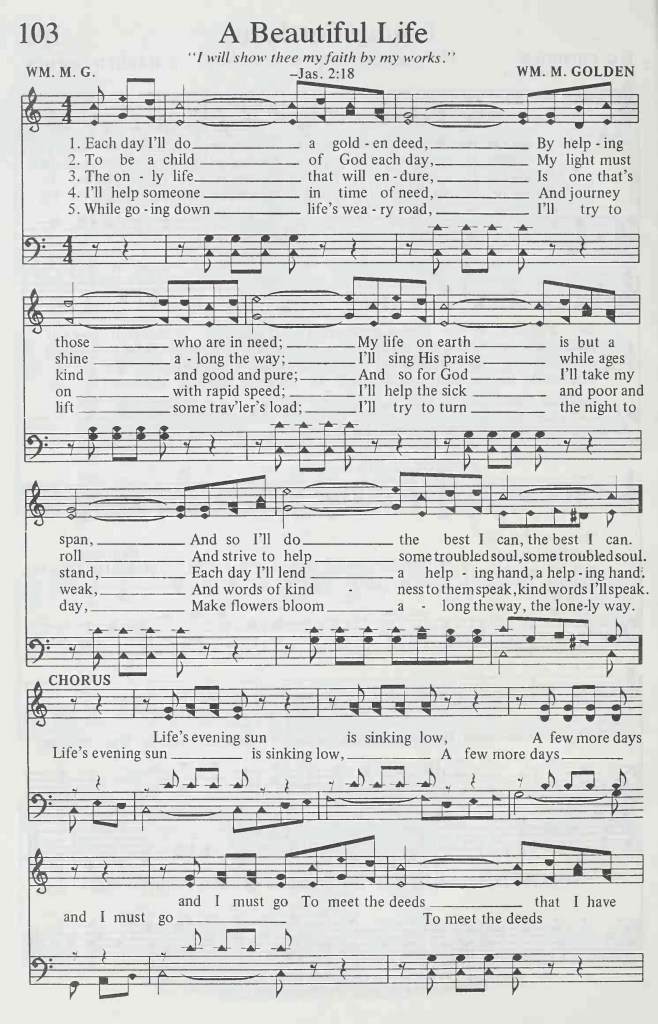
A Beautiful Life
By William M. Golden (1918)
1
Each day I’ll do a golden deed,
By helping those who are in need;
My life on earth is but a span,
And so I’ll do the best I can, (the best I can).
Life’s evening sun is sinking low,
A few more days and I must go,
To meet the deeds that I have done,
Where there will be no setting sun. (no setting sun.)
2
To be a child of God each day,
My light must shine along the way;
I’ll sing His praise while ages roll
And strive to help some troubled soul, (some troubled soul).
Life’s evening sun is sinking low,
A few more days and I must go,
To meet the deeds that I have done,
Where there will be no setting sun. (no setting sun.)
3
The only life that will endure,
Is one that’s kind and good and pure;
And so for God I’ll take my stand,
Each day I’ll lend a helping hand, (a helping hand).
Life’s evening sun is sinking low,
A few more days and I must go,
To meet the deeds that I have done,
Where there will be no setting sun. (no setting sun.)
4
I’ll help someone in time of need,
And journey on with rapid speed;
I’ll help the sick and poor and weak,
And words of kindness to them speak, (kind words I’ll speak).
Life’s evening sun is sinking low,
A few more days and I must go,
To meet the deeds that I have done,
Where there will be no setting sun. (no setting sun.)
5
While going down life’s weary road,
I’ll try to lift some trav’ler’s load;
I’ll try to turn the night today,
Make flowers bloom along the way, (the lonely way).
Life’s evening sun is sinking low,
A few more days and I must go,
To meet the deeds that I have done,
Where there will be no setting sun. (no setting sun.)
Back when I was a teenager, I was the song leader at my church, even though I am a terrible singer. I could usually at least get a song going before someone else will pick it up and actually lead the song for the congregation. I only had a small repertoire of songs that I knew well enough to sing, but not all of them could be sang by our small congregation. This was one of the songs that was quite difficult to lead because the song’s refrain needs a group to sing tenor and a group to sing base. It’s difficult for a small congregation and most likely easier for a choir to sing. It is also one that works better with musical instruments than a capella which is what we sing in the Church of Christ (we have no musical accompaniment).
Even though “A Beautiful Life” was not a song I ever lead, my mother used to play it on the piano, and I have always loved it. The song encourages us to do good deeds for others in an effort to influence righteousness in this world. We are to lead by example. In Matthew 25:34-40, Jesus says that on the Day of Judgement, the Lord will say:
“Come, you blessed of My Father, inherit the kingdom prepared for you from the foundation of the world: for I was hungry and you gave Me food; I was thirsty and you gave Me drink; I was a stranger and you took Me in; I was naked and you clothed Me; I was sick and you visited Me; I was in prison and you came to Me.
“Then the righteous will answer Him, saying, ‘Lord, when did we see You hungry and feed You, or thirsty and give You drink? When did we see You a stranger and take You in, or naked and clothe You? Or when did we see You sick, or in prison, and come to You?’ And the King will answer and say to them, ‘Assuredly, I say to you, inasmuch as you did it to one of the least of these My brethren, you did it to Me.’”
Jesus is telling us that if we help others, then God will favor us. It doesn’t matter how much faith you proclaim to have, if you are not following that faith with good deeds, then your faith is not real. It is merely a proclamation. For if you truly believe, then you will try to live a life that imitates that of Christ. We are commanded to feed, clothes, shelter, nurse and lift up those who are downtrodden and in need. If we refuse these things to our fellow man, then we are refusing them to God as well. Of course, we have to do what we reasonably can. We may make sacrifices to help others, but we can only do so much. What we can’t do is place conditions on the goods deeds that we do.
“A Beautiful Life” suggests several things that we can do to be a good influence on others. Christianity is a religion that must be practiced daily and affect our daily lives, and therefore, every day we should be concerned about those who are in need. God wants us to be His spiritual children; however, as His children, He wants us to let our lights so shine that men may see our good works and glorify Him. One way to do this is to sing His praise that we might be an example to others. Our lives are more than just our physical existence, and to have an enduring quality they must be influenced by Christ. A life that is truly influenced by Christ will be characterized by kindness, and such a life will also not be ashamed to take a stand for God so that it can be a help to others.
We should be willing to help those who are in need because we love our neighbor as ourselves. Again, we need to show this love while we have the time because we are journeying on with rapid speed. Showing our love means helping the sick and poor and weak. We can lift the traveler’s load by showing our faith in giving him what he needs. We can help turn the night to day by showing our love in assisting others in need. We can make flowers bloom along the way by being an influence for righteousness.
The chorus of “A Beautiful Life” re-emphasizes the need to be doing these things because of the brevity of life. God has eternal life planned for His people in heaven. However, to be made fit for such a wonderful dwelling place, we must strive while we journey here on this earth to have “A Beautiful Life.”

How Would That Feel
Performed by Christina Chong
Songwriters: Kay Hanley and Tom Polce
Did I hear that right?
Did she just shine a spotlight
On her innermost feelings
Like it’s no big deal
Say whatever, whenever you like
You’d presume with all my mastery
To pursue flights of fancy, easy
Who am I kidding, I’ve never found that part of me
‘Cause I’m designed to color inside the lines
Cool and methodical
Way too responsible
I can’t help it
Sometimes I peek through a keyhole and see people happy
I admit
It might be time to change my paradigm
If only I can let go of the wheel
My fear replaced with total faith
I’m fiercely free and really real
Flying blind
How would that feel?
This all makes me so uncomfortable
I want to let go
Be vulnerable
Who am I kidding, I’ve never met that side of me
In my defense
The truth has a consequence
I won’t watch the whole thing spin out of control
If I have the chance
It might be time to change my paradigm
If I can only let go of the wheel
My fear replaced with total faith
I’m fiercely free and really real
Flying blind
How would that feel?
In another time we had a life together
Could time repeat
Or will it unravel?
Be careful what you start
Make one mistake and blow it all apart
Or worse
Break my own heart
Who am I kidding, I’ve never found that part of me
It might be time to change my paradigm
If only I can let go of the wheel
It’s nice to dream that I could change my mind
Deep down, I know
I will never let go
My fear is staked
I have no faith
Contented freedom is not real
Flying blind
How would that feel?
Because June is Pride Month, I have been focusing on LGBTQ+ poems and poets. “How Would That Feel” from the second season of Star Trek: Strange New Worlds episode “Subspace Rhapsody” might seem like an odd choice, but for me, the lyrics of this song (and I always think of songs as poems set to music) really resonated with me about my own experience as a gay man. But first, a little about the song. In this episode, Captain Christopher Pike and the crew of the USS Enterprise encounter a naturally occurring fold in subspace which, when interacted with, causes the entire crew to start singing their private thoughts and feelings. The episode is a musical, the first in the history of the Star Trek franchise. It’s one of my favorite Star Trek episodes.
“How Would That Feel” is the third song in the show after “Status Report,” which introduces us to the musical theme of the episode, and “Connect to Your Truth,” in which Una Chin-Riley, commonly and originally only known as Number One and Pike’s first officer, and James T. Kirk, the future captain of the Starship Enterprise, engage in a duet in which she advises him on how to serve in a command role. When La’an Noonien-Singh sees the interaction between Una and Kirk, La’an begins feeling emotional towards Kirk with whom she had a relationship in an alternate timeline. She goes to her quarters and sings about becoming a different person who takes chances.
Growing up gay in Alabama, whether I fully realized that’s what made me different at the time or not, made me hesitant to ever “say whatever, whenever” I like. When you’re closeted, you have to choose your words and mannerisms carefully to hide your true self, because as the song says, “In my defense / The truth has a consequence.” For La’an, it’s her heritage of being a descendant of one of Earth’s most villainous dictators and whether or not that means the same evil lives within her. For me, it was whether or not anyone would accept me, or would I lose everything if I came out?
I was considered very intelligent as a kid, some people still think I am, so when La’an sang, “You’d presume with all my mastery / To pursue flights of fancy, easy / Who am I kidding, I’ve never found that part of me / ‘Cause I’m designed to color inside the lines,” it felt like she was singing about my own story. I always felt that I could not be the real me. I didn’t even know who the real me was, so I did not pursue my “flights of fancy” about being attracted to other guys. I never let myself find that part of me; it was too hidden away because of the shame I was made to feel. So, I kept to what was expected of me and colored “inside the lines.” I studied hard because I wasn’t able to show my “masculinity” by playing sports. I was not athletic, so I had to fall back on my brains. I was a very serious kid. I was “Cool and methodical / Way too responsible.” I remember looking at other people who really enjoyed having romantic partners and I felt like I was peeking “through a keyhole and see people happy” when I was not. If I was free to be me, “How would that feel?”
I eventually came to understand that I could be happy if I changed “my paradigm / If only I can let go of the wheel / My fear replaced with total faith / I’m fiercely free and really real,” but I never felt like that was my reality. I could not be free, nor could I be real, my true self. I couldn’t watch my life “spin out of control” because I did not “have the chance” at that happiness. Once I came out to myself, I could come out to others, but as the song says, “This all makes me so uncomfortable.” I wanted to let go, be vulnerable, be myself, but was I? I had never “met that side of me” because I’d never allowed myself to be “fiercely free and really real.” I felt like if I ever allowed myself to meet that side of me, then my whole life might “spin out of control.”
The only part of the song that I didn’t fully identify with is:
In another time we had a life together
Could time repeat
Or will it unravel?
Be careful what you start
Make one mistake and blow it all apart
Or worse
Break my own heart
Who am I kidding, I’ve never found that part of me
I have to admit though, I have always wondered about the possibility of reincarnation. Catholics believe in purgatory (the condition, process, or place of purification or temporary punishment in which, according to medieval Christian and Roman Catholic belief, the souls of those who die in a state of grace are made ready for heaven.) What if purgatory was actually previous lives we live. Religions, even some sects of Christianity, and especially the Indian religions such as Hinduism, Buddhism, Jainism, and Sikhism, have reincarnation as the central tenet of their faith. When the soul is passed from one being to the next until reaches cumulative virtues allows it to finally ascend into paradise. I could definitely get very metaphysical about this verse of the song, but this verse is more about La’an’s emotions towards Kirk who she has had a relationship in an alternate timeline. La’an knows that if she tells Kirk about her feelings, it could change the course of history, so she knows she cannot be herself and let her emotions out.
Ultimately, by the end of the song, La’an decides that she can’t allow herself to be who she is and take the steps to make try to make a better life for herself. She feels that she must keep everything bottled up inside. For many gay men out there, the dream of coming out never feels like it can become reality. This was the case for me for a long time. In some ways, I still hold myself back and think, “It’s nice to dream that I could change my mind” and let go a little more in an effort to make myself happy. I’m still resisting letting go completely because “Deep down, I know / I will never let go / My fear is staked,” and in some ways, I know that “Contented freedom is not real.” I will continue to work on who I want to be and try to be more comfortable with who I am. I have come a long way in fully accepting myself, even if I sometimes feel that I held myself back too long and now it’s too late to ever find that person who is meant for me to spend my life with. I still wonder “How would that feel?” to finally let go, allow myself to fly blind and not try to control everything. Could I “let go of the wheel” and create a better life for myself by letting go of my past and just be “really real.”
You might find my thoughts on this song silly, but I think we all have a song that speaks to our soul. It may not have meant to tell our personal story, but when we really look at the words and put it in a different context, then it fits. To me, that’s the makings of a truly great song. It’s a song that may have been made to be seen in a particular context, but it speaks to you in a way that the writer never considered. Poetry is oftentimes the same way. It’s up to our own interpretation. For me, that song is “How Would That Feel” because it feels like my personal story. I can’t help but belt it out when I listen to it, and I am sure all of you are very glad you have never had to hear me sing this song to the top of my lungs as I am driving down the road.

In the movie White Christmas, the main characters are on a train heading for Vermont, and they sing “Snow” by Irving Berlin:
Snow, snow, snow, snow, snow
It won’t be long before we’ll all be there with snow
Snow
I want to wash my hands, my face and hair with snow
Snow
I long to clear a path and lift a spade of snow
Snow
Oh, to see a great big man entirely made of snow
Where it’s snowing
All winter through
That’s where I want to be
Snowball throwing
That’s what I’ll do
How I’m longing to ski
Through the
Snow
Those glist’ning houses that seem to be built of snow
Snow
Oh, to see a mountain covered with a quilt of snow
What is Christmas with no snow
No white Christmas with no snow
Snow
I’ll soon be there with snow
I’ll wash my hair with snow
And with a spade of snow
I’ll build a man that’s made of snow
I’d love to stay up with you but I recommend a little shuteye
Go to sleep
And dream
Of snow.
When they get to Vermont, there is no snow to be seen. If they arrived in Vermont today, they’d find plenty of snow. We got our first major snowfall last night. Where I live, we received 3-4” of snow. By the time I woke up, the snow had mainly stopped, and we were getting freezing rain. When the sun rises, that freezing rain is expected to turn into regular rain which is supposed to last for the rest of the morning.
I wish I could just stay in and enjoy the scenery, but I need to run to the grocery store. I hate grocery shopping the day before Thanksgiving, but I wasn’t able to do it yesterday. I was in the grocery store when I developed a terrible migraine, and I just went to check out with the few items I’d already picked up. My headache remained for tye rest of the day and night, and I woke up with it again this morning. However, I’m hoping that it will be better by the time they’ve plowed my parking lot, and I am able to go to the grocery store.

He Went to Paris
By Jimmy Buffett
He went to Paris looking for answers
To questions that bothered him so
He was impressive, young and aggressive
Saving the world on his own
But the warm Summer breezes
The French wines and cheeses
Put his ambition at bay
And Summers and Winters
Scattered like splinters
And four or five years slipped away
Then he went to England, played the piano
And married an actress named Kim
They had a fine life, she was a good wife
And bore him a young son named Jim
And all of the answers and all of the questions
He locked in his attic one day
‘Cause he liked the quiet clean country living
And twenty more years slipped away
Well the war took his baby, the bombs killed his lady
And left him with only one eye
His body was battered, his world was shattered
And all he could do was just cry
While the tears were falling, he was recalling
The answers he never found
So he hopped on a freighter, skidded the ocean
And left England without a sound
Now he lives in the islands, fishes the pilin’s
And drinks his green label each day
He’s writing his memoirs and losing his hearing
But he don’t care what most people say
Through 86 years of perpetual motion
If he likes you he’ll smile then he’ll say
Jimmy, some of it’s magic, some of it’s tragic
But I had a good life all the way
And he went to Paris looking for answers
To questions that bother him so
Jimmy Buffett is probably best known for his tropical rock music, which often portrays a lifestyle described as “island escapism.” With his Coral Reefer Band, he is best known for songs like the hit “Margaritaville” and its namesake restaurants and for a sense of humor and irony exhibited in songs like “Cheeseburger In Paradise” and “Why Don’t We Get Drunk” (which originally had the words “and screw” added to the end but was dropped from the title by a lot of online retailers and websites). With this last weekend being Labor Day weekend, I can’t fail to mention “Come Monday.” But what often escapes the notice of so many is that this guy really is an accomplished, and often very serious, songwriter with hundreds of original titles to his credit. His songwriting gift showed up early in pieces like the much-lauded 1973 story song “He Went To Paris.” Though people know many of his other songs, many Jimmy Buffett fans (or Parrotheads, as they call themselves) might tell you that “He Went To Paris” is their favorite song. (My personal favorites are “Stars Fell on Alabama” and “Pencil Thin Mustache.”)
From his album A White Sport Coat And A Pink Crustacean, Buffett wrote the third-person narrative “He Went To Paris” about a Spanish Civil War veteran and one-armed pianist he’d met named Eddie Balchowsky. Released as the album’s final single, it didn’t chart, but in recent years, it has become well known, especially since Bob Dylan named it as one of his favorites and Buffett began to perform it live. With an unusual construction, the song opens and closes with the lines, “He went to Paris/Looking for answers/To questions that bothered him so.” In between those lines are four long verses that chronicle a life of 86 years that saw war, music, tragedy, and world travels, with the subject finally, gratefully and graciously, telling the singer, “Jimmy, some of it’s magic, some of it’s tragic/But I had a good life all of the way.”
Buffett once explained the song’s origins, “The song was actually about a guy I met in Chicago, and he was the cleanup guy at a club called the Quiet Knight [where several prominent singer/songwriter careers were launched]. He had one arm. And so he started telling me stories about his days fighting in the Spanish Civil War, and when he got wounded, he came back to Paris for his treatment. The song is more reflective of stories that Eddie told me. All they did was accentuate the history in the books that I was familiar with from Hemingway and Fitzgerald. That song was written actually in Chicago of all places, and it was written based on the stories of Eddie. At that point I don’t believe I’d ever been to Paris. You put all that stuff together and mix it like a gumbo.”
Buffett was born on December 25, 1946, in Pascagoula, Mississippi, and spent part of his childhood in Mobile and Fairhope, Alabama. After graduating from McGill Institute for Boys, a Catholic high school in Mobile, in 1964, Buffett enrolled at Auburn University and began playing the guitar after seeing a fraternity brother playing surrounded by a group of girls. Buffett left Auburn after a year due to his grades and continued his college years at Pearl River Community College and the University of Southern Mississippi in Hattiesburg, Mississippi, where he received a bachelor’s degree in history in 1969. After graduating in 1969, Buffett moved to New Orleans, often held street performances for tourists on Decatur Street, and played for drunken crowds in the former Bayou Room nightclub on Bourbon Street. I’m pretty sure I’ve read that Auburn granted him a degree after he became famous, even though he flunked out of the university.
Aside from his career in music, Buffett was also a bestselling author and was involved in two restaurant chains named after two of his best-known songs; he owned Jimmy Buffett’s Margaritaville restaurant chain and co-developed the now defunct Cheeseburger in Paradise restaurant chain. Buffett was one of the world’s richest musicians, with a net worth of $1 billion in 2023. Buffett was involved in many charity efforts. In 1981, Buffett and former Florida governor Bob Graham founded the Save the Manatee Club. In 1989, legislation in Florida introduced the “Save the Manatee” license plate, featuring an image of a West Indian manatee, and earmarked funding for the Save the Manatee Club. Buffett was also a longtime supporter of and major donor to the Gulf Specimen Marine Laboratory. He has organized several benefit concerts for hurricane relief and for the 2010 BP oil spill that devastated marine life in the Gulf of Mexico. Buffett was also a lifelong Democratic and hosted fundraisers for Democratic politicians, including several for Hillary Clinton in 2016.
After entering hospice care just five days prior, Buffett passed away peacefully in his sleep on September 1, 2023, at his home in Sag Harbor, New York, at the age of 76 from skin cancer (diagnosed in 2019) that had turned into lymphoma. I think it can safely be said that Jimmy himself would say of his life, “Some of it’s magic, some of it’s tragic, but I had a good life all the way.” I hope God and Jimmy are having margaritas together and enjoying cheeseburgers in paradise.
Here is a live version from earlier this year (2/9/23):
I tried to find live recordings of the songs I provided links for throughout the post.

I saw on Colton Haynes’ Instagram a post about a music video he had done for the new Tyler Childers song, “In Your Love.” I no longer keep up to date with country music, so I was not familiar with Tyler Childers or his music. Wikipedia describes his music as “a mix of neotraditional country, bluegrass, and folk.” I didn’t know what to expect when I searched for the song to watch the music video. I certainly wasn’t expecting a video set in 1950s Appalachia chronicling the romance between two male coal miners. I was also not expecting how much it pulled at my heartstrings. I was in tears by the end, so be forewarned. I hope you will watch it anyway.
Last week, Jason Aldean’s release of a disgusting video of fearmongering and aggression dominated the conversation. Childers release is the antithesis to that with a moving, cinematic clip for his new song “In Your Love.” Just under five minutes in length, the video has the ability to emotionally wreck you as it watches the men fall in love, grapple with the violent reactions of their co-workers, and ultimately launch a new life together on a country farm. It features a romantic and ultimately heartbreaking love story between two men: “Arrow” star Colton Haynes and “You’s” James Scully.
The storyline comes from Silas House, the Poet Laureate of Kentucky, who wrote the video’s story from an idea he had with his husband, Jason Kyle Howard. A statement from House about the video, directed by Bryan Schlam and starring Colton Haynes and James Scully, echoes the desire for representation in country music that many still find themselves denied. “As a gay teenager who loved country music, I could have never imagined seeing myself in a video. That visibility matters,” House said. “Tyler and I both felt the attention to detail about rural life was very important, so we made sure that the house and the people looked realistic for the time period instead of the stereotypes of country people that have become so ingrained in the public consciousness… We wanted to tell as complex a story as we could in four minutes, not only about a gay couple but also about rural people. We wanted to show their joy and their sorrow—all the things that make up a complex life. Too often, simplistic notions are pushed about both rural and LGBTQ people, so we did everything we could to make this story as rich and layered as possible.”
For our citizenship is in heaven, from which we also eagerly wait for the Savior, the Lord Jesus Christ, who will transform our lowly body that it may be conformed to His glorious body, according to the working by which He is able even to subdue all things to Himself.
— Philippians 3:20-21
Never Grow Old
By James Cleveland Moore, Sr.
I have heard of a land
On the faraway strand,
’Tis a beautiful home of the soul;
Built by Jesus on high,
There we never shall die,
’Tis a land where we never grow old.
Refrain:
Never grow old,
Where we’ll never grow old,
In a land where we’ll never grow old;
Never grow old,
Where we’ll never grow old,
In a land where we’ll never grow old.
In that beautiful home
Where we’ll nevermore roam,
We shall be in the sweet by and by;
Happy praise to the King
Through eternity sing,
’Tis a land where we never shall die. [Refrain]
When our work here is done
And the life crown is won,
And our troubles and trials are o’er,
All our sorrows will end,
And our voices will blend
With the loved ones who’ve gone on before. [Refrain]
This song has been in my head over the past week. Eleven years ago today, my beloved grandmother went to the land where she “will never grow old.” I have always loved this song. To me, it’s just simple and beautiful. Most people are afraid of dying, and while I hope it’s a long way away for me, if we have faith, there is nothing to fear. Heaven is “a land where we never shall die. The third verse may be my favorite:
When our work here is done
And the life crown is won,
And our troubles and trials are o’er,
All our sorrows will end,
And our voices will blend
With the loved ones who’ve gone on before.
I’ll be happy when that day comes because I see again, “the loved ones who’ve gone on before.”
“Never Grow Old” usually refers to an old Southern Gospel song of the same name, technically called “Where We’ll Never Grow Old”, written by James Cleveland Moore, Sr. on April 22, 1914. I wonder if he knew that in four short months a war would begin in which millions of young men with so much life before them would go the land where they never grow old. It’s hard for me to think of the year 1914 without thinking of what was about to begin in August of that year.
James Cleveland Moore had intended to become a Baptist preacher. He was educated at Draketown Baptist Institute, Mercer University in Macon, Georgia, and the University of Florida. He received musical training. At 26 years old, while a seminary student at Mercer, Moore visited his hometown church to preach at Draketown Baptist Church. His father, Charles Robert Moore, had led the singing for years. Hearing his father’s voice failing him, Moore knew that he would not hear his father sing much longer due to his father’s advanced age. After returning to school, Moore produced the hymn and dedicated his song as: “Dedicated to My Father and Mother.” The song was not published until around 1930.


 | noisilycool3bc985058… on Dr. McDreamy |
 | Joe on Dr. McDreamy |
 | poetrybeautiful3d840… on Dr. McDreamy |
| Joe on Dr. McDreamy |
| noisilycool3bc985058… on Dr. McDreamy |


As an Amazon Associate I earn from qualifying purchases. So, if you click on a link that takes you to Amazon.com, I may earn a commission.
Trust me, it isn’t much, but every little bit helps.


 The Closet Professor