Let me not to the marriage of true minds Admit impediments; love is not love Which alters when it alteration finds, Or bends with the remover to remove. O no, it is an ever-fixèd mark That looks on tempests and is never shaken; It is the star to every wand’ring bark Whose worth’s unknown, although his height be taken. Love’s not time’s fool, though rosy lips and cheeks Within his bending sickle’s compass come. Love alters not with his brief hours and weeks, But bears it out even to the edge of doom: If this be error and upon me proved, I never writ, nor no man ever loved.
About the Poem
Along with Sonnets 18 (“Shall I compare thee to a summer’s day?”) and 130 (“My mistress’ eyes are nothing like the sun”), Sonnet 116 is one of the most famous sonnets. Traditionally, this sonnet has been almost universally read as a sonnet of praise or triumph to ideal and eternal love, with which all readers could easily identify, adding their own dream of perfection to what they found within it, modern criticism makes it possible to look beneath the idealism and to see some hints of a world which is perhaps slightly more disturbed than the poet pretends. In the first place it is important to see that the sonnet belongs in the sequence of Shakespeare’s sonnets. Sonnet 116 is sandwiched between three sonnets which discuss the philosophical question of how love deceives a person’s eyes, mind, and judgement. Sonnet 116 is then followed by four others which attempt to excuse the poet’s own unfaithfulness and betrayal of the beloved.
Most scholars thought agree that Sonnet 116 is about love in its most ideal form. The poet praises the glories of lovers who have come to each other freely and enter into a relationship based on trust and understanding. The first four lines reveal the poet’s pleasure in love that is constant and strong and will not “alter when it alteration finds.” The following lines proclaim that true love is indeed an “ever-fix’d mark” which will survive any crisis. In lines 7-8, the poet claims that we may be able to measure love to some degree but does not mean we fully understand it. Love’s actual worth cannot be known and remains a mystery. The remaining lines of the third quatrain (9-12), reaffirm the perfect nature of love that is unshakeable throughout time and remains so “ev’n to the edge of doom,” i.e., death. In the final couplet, the poet declares that, if he is mistaken about the constant, unmovable nature of perfect love, then he must take back all his writings on love, truth, and faith. Moreover, he adds that, if he has in fact judged love inappropriately, no man has ever really loved, in the ideal sense that the poet professes.
As every blossom fades
and all youth sinks into old age,
so every life’s design, each flower of wisdom,
attains its prime and cannot last forever.
The heart must submit itself courageously
to life’s call without a hint of grief,
A magic dwells in each beginning,
protecting us, telling us how to live.
High purposed we shall traverse realm on realm,
cleaving to none as to a home,
the world of spirit wishes not to fetter us
but raise us higher, step by step.
Scarce in some safe accustomed sphere of life
have we establish a house, then we grow lax;
only he who is ready to journey forth
can throw old habits off.
Maybe death’s hour too will send us out new-born towards undreamed-lands, maybe life’s call to us will never find an end Courage my heart, take leave and fare thee well.
Stufen By Hermann Hesse
Wie jede Blüte welkt und jede Jugend
Dem Alter weicht, blüht jede Lebensstufe,
Blüht jede Weisheit auch und jede Tugend
Zu ihrer Zeit und darf nicht ewig dauern.
Es muß das Herz bei jedem Lebensrufe
Bereit zum Abschied sein und Neubeginne,
Um sich in Tapferkeit und ohne Trauern
In andre, neue Bindungen zu geben.
Und jedem Anfang wohnt ein Zauber inne,
Der uns beschützt und der uns hilft, zu leben.
Wir sollen heiter Raum um Raum durchschreiten
An keinem wie an einer Heimat hängen,
Der Weltgeist will nicht fesseln uns und engen,
Er will uns Stuf’ um Stufe heben, weiten.
Kaum sind wir heimisch einem Lebenskreise
Und traulich eingewohnt, so droht Erschlaffen,
Nur wer bereit zu Aufbruch ist und Reise,
Mag lähmender Gewöhnung sich entraffen.
Es wird vielleicht auch noch die Todesstunde Uns neuen Räumen jung entgegen senden Des Lebens Ruf an uns wird niemals enden… Wohlan denn, Herz, nimm Abschied und gesunde!
About the Poem
Hermann Hesse wrote “Stufen” in 1941. You may be familiar with Hesse’s novels Siddhartha or Steppenwolf, which revolve around the inner transformations of their characters, a theme that is also found in Hesse’s shorter works. “Stufen”, or “Steps” (also translated as “Stages”), reads like the themes in his novels edited down to a single poem. But like most poetry, it’s not written in simple and direct language. You’ll probably find new meaning in lines each time you read the poem and understand them differently each time. There are numerous translations of the poem, and this one was translated line by line. Often translations of poems either try to simply translate the words, others try to keep it in the original poetic form, and others try more to capture the theme of the poem than translate word for work. I don’t often use translated poems, because native speakers of the language often find fault with the translation.
About the Poet
Hermann Hesse (born July 2, 1877, Calw, Germany—died August 9, 1962, Montagnola, Switzerland) was a German-Swiss poet, novelist, and painter. His best-known works include Demian, Steppenwolf, Siddhartha, and The Glass Bead Game, each of which explores an individual’s search for authenticity, self-knowledge, and spirituality. His characters attempt to break out of the established modes of civilization so as to find an essential spirit and identity.
He received the Nobel Prize in Literature in 1946.
How calmly does the orange branch Observe the sky begin to blanch Without a cry, without a prayer, With no betrayal of despair,
Sometime while night obscures the tree The zenith of its life will be Gone past forever, and from thence A second history will commence.
A chronicle no longer gold, A bargaining with mist and mould, And finally the broken stem The plummeting to earth; and then
An intercourse not well designed For beings of a golden kind Whose native green must arch above The earth’s obscene, corrupting love.
And still the ripe fruit and the branch Observe the sky begin to blanch Without a cry, without a prayer, With no betrayal of despair.
O Courage, could you not as well Select a second place to dwell, Not only in that golden tree But in the frightened heart of me?
Nearly 30 years ago while I was still in high school, I was attending a summer honors program at the University of Alabama. (It was a momentous summer in many ways, but those are stories for another time.) We took three college classes along with other summer students at Alabama, and every week, we had to attend several honors seminars. One of those seminars was about Tennessee Williams.
The next week, we were taken by bus down to Montgomery to see Williams’s play “The Night of the Iguana” at the Alabama Shakespeare FestivaL. I’ve seen many plays and musicals at ASF, and while not all of the plays were great (I always found the plays that were part of their Southern Writers Series to be godawful), they were all very well produced. I was awed by “The Night of the Iguana” because they made it rain onstage. This might not sound that impressive to everyone, but I always thought it was one of the coolest things.
If you are not familiar with “The Night of the Iguana,” the play portrays the story of Reverend Shannon, a defrocked Episcopal clergyman gone astray, torn between his passions and his devotion, who leads a bus-load of middle-aged Baptist women on a religious-themed tour of the Mexican coast and comes to terms with past demons in re-evaluating his life.
Throughout the play, in a secondary story about a woman, Hannah, and her aging poet-grandfather, the grandfather attempts to finish a poem he feels will be his masterpiece. The poem comes at the end of the play when the grandfather recites his “last” poem while Hannah transcribes it for him. The grandfather dies a few moments later.
The poem represents Tennessee Williams’s poetic view of human nature and the human story. Williams wrote many flawed or tragic characters who might survive, adapt, or make significant change if they only had the courage and confidence that goes with that important quality. Tennessee Williams is not to everyone’s taste, but I have always greatly admired his writing. Of Mississippi literary figures, I consider Williams to be the greatest by far.
Self-Portrait as Combination Taco Bell / Pizza Hut / KFC By Aaron Tyler Hand
the unholy trinity of suburban late-night salvation barring seemingly endless options of worship
bean burrito breadsticks and mashed potatoes or a soft taco pan pizza and a buttered biscuit
an unimaginable combination of food flavors for people not ready to go home to their parents
and yet none of the options feel quite right so maybe I should call it Self-Portrait as idling
in a drive-thru with your friends crammed across the sunken bench seats avoiding
the glow of the check engine light with black tape pressed with a precision unseen anywhere else
in their lives as a fractured voice says don’t worry take your time and order whenever you’re ready
from behind a menu backlit like the window inside of a confessional booth as the hands
of the driver open up like a collection basket for the wadded-up bills and loose change
that slowly stack up as the years go by and I’m not sure what I’m supposed to be
in this analogy but I know about masking warning signs and hearing out of tune
voices scream WE’RE THE KIDS WHO FEEL LIKE DEAD ENDS so instead I’ll call it Self-
Portrait as From Under the Cork Tree or maybe even Self-Portrait as whatever
album people listen to when they love their friends and still want to feel connected
to the grass walls of a teenage wasteland that they can’t help but run away from
About This Poem
“I love using poetry to capture the malaise of growing up in the suburbs. When you spend your life in a place that feels defined by its monotony, it’s hard to find a sense of personal identity that isn’t mass produced. In order to feel like you have any control over your life, you have to find the small rebellions that lead to a sense of belonging. That aimlessness and escapism is what I tried to capture in this poem.”—Aaron Tyler Hand
This poem was the Academy of American Poets’ Poem-a-Day yesterday. While I found the title intriguing, I found the scene it sets nostalgic. I did not grow up in the suburbs, but in rural Alabama;, however, when I was in undergraduate and graduate school, I remember the late nights of getting Taco Bell, though in graduate school, it was often Krystal’s, which was open 24 hours and a block from my first apartment.
The title itself made me think of probably what all of us thought the first time we saw a combination “Taco Bell / Pizza Hut / KFC”: fast food with a personality disorder. It does seem kind of lost in what it is trying to do. I usually only see Taco Bells and KFCs together these days, but it’s still an odd combination.
About the Poet
Aaron Tyler Hand (@airinhand) is a creative writer with an MFA from Texas State University. He has previously been published in San Antonio Express-News, Houston Chronicle, Faultline Journal, GASHER Journal, HASH Journal, Funicular Magazine, Meniscus, among others. In addition to his own creative writing pursuits, Aaron volunteers his time to the prison teaching non-profit Rough Draft and hosts the poetry podcast The Personhood Project.
is even more fun than going to San Sebastian, Irún, Hendaye, Biarritz, Bayonne or being sick to my stomach on the Travesera de Gracia in Barcelona partly because in your orange shirt you look like a better happier St. Sebastian partly because of my love for you, partly because of your love for yoghurt partly because of the fluorescent orange tulips around the birches partly because of the secrecy our smiles take on before people and statuary it is hard to believe when I’m with you that there can be anything as still as solemn as unpleasantly definitive as statuary when right in front of it in the warm New York 4 o’clock light we are drifting back and forth between each other like a tree breathing through its spectacles
and the portrait show seems to have no faces in it at all, just paint you suddenly wonder why in the world anyone ever did them I look at you and I would rather look at you than all the portraits in the world except possibly for the Polish Rider occasionally and anyway it’s in the Frick which thank heavens you haven’t gone to yet so we can go together for the first time and the fact that you move so beautifully more or less takes care of Futurism just as at home I never think of the Nude Descending a Staircase or at a rehearsal a single drawing of Leonardo or Michelangelo that used to wow me and what good does all the research of the Impressionists do them when they never got the right person to stand near the tree when the sun sank or for that matter Marino Marini when he didn’t pick the rider as carefully as the horse it seems they were all cheated of some marvelous experience which is not going to go wasted on me which is why I’m telling you about it
About the Poem
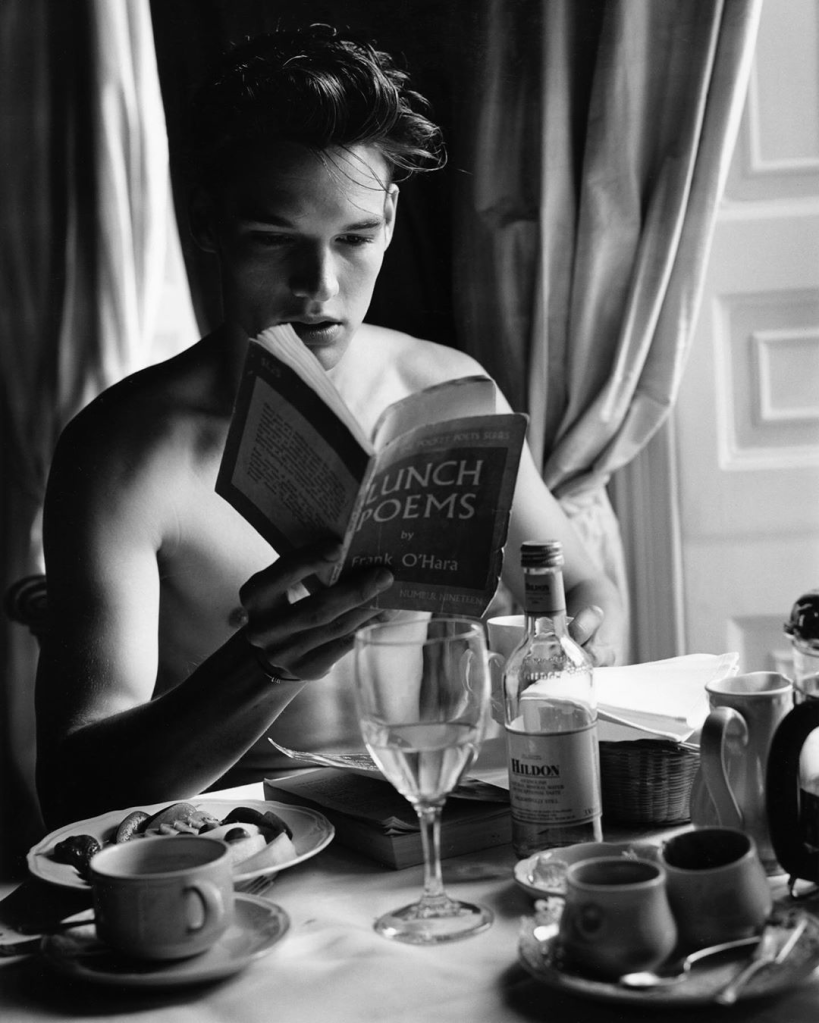
First published in a small magazine Love, “Having a Coke with You” was also included in the 1965 book Lunch Poems, which I mentioned a few weeks ago. It is a typically spontaneous O’Hara work, unconventional and open-hearted, dashed off with enthusiasm.
Frank O’Hara was known as ‘a poet among the painters’ because of his association with a group of New York artists, the abstract expressionists, with whom he collaborated for a number of years. A livewire and party animal, he worked as an assistant curator at MoMA. Though not prolific, his carefree style, which he termed ‘Personism’, went against the grain of tradition. He hated literary pretension and wanted his poetry to reflect his dynamic interest in and involvement with cutting-edge cultural activity. Manhattan, his stomping ground, was certainly full of that.
“Having A Coke With You” was written when O’Hara returned from a trip to Spain in April 1960 and focused on the intimate relationship between two people enjoying a drink and alludes to art and religion. It’s an unorthodox poem that contrasts a beautiful lover with fine art and saintliness. The poem celebrates the mundane and the present moment, contrasting it with the formalism of traditional art. It’s conversational tone and colloquial language differ from O’Hara’s previous poems, which were often more experimental and abstract. Compared to his earlier works, this poem showcases a shift towards simplicity and accessibility. O’Hara emphasizes the immediate and personal experience, rejecting the grand narratives and artistic conventions of the past. The poem also reflects the cultural shift of the post-war era, where artists sought to break away from traditional forms and engage with everyday life.
By praising the beauty and authenticity of everyday moments, “Having a Coke with You” challenges the notion that art must be monumental or grand to be meaningful. Instead, it asserts the value of the ordinary and the subjective experience.
About the Poet
On March 27, 1926, Frank (Francis Russell) O’Hara was born in Maryland. He grew up in Massachusetts, and later studied piano at the New England Conservatory in Boston from 1941 to 1944. O’Hara then served in the South Pacific and Japan as a sonarman on the destroyer USS Nicholas during World War II.
Following the war, O’Hara studied at Harvard College, where he majored in music and worked on compositions and was deeply influenced by contemporary music, his first love, as well as visual art. He also wrote poetry at that time and read the work of Arthur Rimbaud, Stéphane Mallarmé, Boris Pasternak, and Vladimir Mayakovsky.
While at Harvard, O’Hara met John Ashbery and soon began publishing poems in the Harvard Advocate. Despite his love for music, O’Hara changed his major and left Harvard in 1950 with a degree in English. He then attended graduate school at the University of Michigan, Ann Arbor, and received his MA in 1951. That autumn, O’Hara moved into an apartment in New York. He was soon employed at the front desk of the Museum of Modern Art and continued to write seriously.
O’Hara’s early work was considered both provocative and provoking. In 1952, his first volume of poetry, A City Winter, and Other Poems, attracted favorable attention; his essays on painting and sculpture and his reviews for ArtNews were considered brilliant. O’Hara became one of the most distinguished members of the New York School of poets*, which also included Ashbery, James Schuyler, and Kenneth Koch.
O’Hara’s association with painters Larry Rivers, Jackson Pollock, and Jasper Johns, also leaders of the New York School, became a source of inspiration for his highly original poetry. He attempted to produce with words the effects these artists had created on canvas. In certain instances, he collaborated with the painters to make “poem-paintings,” paintings with word texts.
O’Hara’s most original volumes of verse, Meditations in an Emergency (1956) and Lunch Poems (1964), are impromptu lyrics, a jumble of witty talk, journalistic parodies, and surrealist imagery.
O’Hara continued working at the Museum of Modern Art throughout his life, curating exhibitions and writing introductions and catalogs for exhibits and tours. On July 25, 1966, while vacationing on Fire Island, Frank O’Hara was killed in a sand buggy accident. He was forty years old.
*About the New York School of Poetry
The New York School of poetry began around 1960 in New York City and included poets such as John Ashbery, Barbara Guest, Kenneth Koch, and Frank O’Hara. Heavily influenced by Surrealism and Modernism, the poetry of the New York School was serious but also ironic and incorporated an urban sensibility into much of the work. An excerpt from Ashbery’s poem “My Philosophy of Life” demonstrates this attitude:
Just when I thought there wasn’t room enough for another thought in my head, I had this great idea— call it a philosophy of life, if you will. Briefly, it involved living the way philosophers live, according to a set of principles. OK, but which ones?
Abstract Expressionist art was also a major influence, and the New York School poets had strong artistic and personal relationships with artists such as Jackson Pollock and Willem DeKooning. Both O’Hara and James Schuyler worked at the Museum of Modern Art, and Guest, Ashbery, and Schuyler were critics for Art News. O’Hara also took inspiration from artists, entitling two poems “Joseph Cornell” and “On Seeing Larry Rivers’ Washington Crossing the Delaware at the Museum of Modern Art.” O’Hara’s poem “Why I am Not a Painter” includes the lines “I am not a painter, I am a poet. / Why? I think I would rather be / a painter, but I am not.”
A second generation of New York School poets arose during the 1960s and included Ted Berrigan, Ron Padgett, Anne Waldman, and Joe Brainard. These poets were also influenced by art, and their work contained much of the same humor and collaborative spirit. Their scene grew up around downtown New York and was associated with the Poetry Project at St. Mark’s Church, a poetry organization that started in the mid-1960s.
The New York School continues to influence poets writing today. Recently published books such as Daniel Kane’s All Poets Welcome: The Lower East Side Poetry Scene in the 1960s and David Lehman’s The Last-Avant Garde: The Making of the New York School of Poets are important histories of this poetic movement that still captures readers today.
In that great journey of the stars through space About the mighty, all-directing Sun, The pallid, faithful Moon, has been the one Companion of the Earth. Her tender face, Pale with the swift, keen purpose of that race, Which at Time’s natal hour was first begun, Shines ever on her lover as they run And lights his orbit with her silvery smile. Sometimes such passionate love doth in her rise, Down from her beaten path she softly slips, And with her mantle veils the Sun’s bold eyes, Then in the gloaming finds her lover’s lips. While far and near the men our world call wise See only that the Sun is in eclipse.
About the Poet
Ella Wheeler Wilcox was born on November 5, 1850, in Johnstown Center, Wisconsin. She was a popular writer characterized mainly by her upbeat and optimistic poetry, though she was also an activist. Her poetry collections include Poems of Passion (W. B. Conkey Company, 1883) and Poems of Peace (Gay & Bird, 1906). She died in Connecticut on October 30, 1919.
Reflections on the Eclipse
Where I live in Vermont was in the path of totality for yesterday’s total eclipse. As the moon slowly moved over the sun blocking out its rays, the sky became darker. It was a truly awesome experience.
As I watched the eclipse, I was not only thinking about the beautiful strangeness that is a total eclipse, but I was also thinking about what a total eclipse would have been like for people in history who were not as knowledgeable about astronomy as we are today. It must have been terrifying, especially for people like the Ancient Egyptians or Inca who worshipped the Sun. There would have been religious leaders who better understood the cosmos, but for the average person who just watched as the sun slowly disappeared and day turned to night, it probably seemed like the end was near. Their relief as the sun reappeared in the sky must have come as a great relief, but I can see how many people with primitive knowledge would have believed this event foretold a great disaster.
Come, let us be friends, you and I, E’en though the world doth hate at this hour; Let’s bask in the sunlight of a love so high That war cannot dim it with all its armed power.
Come, let us be friends, you and I, The world hath her surplus of hatred today; She needeth more love, see, she droops with a sigh, Where her axis doth slant in the sky far away.
Come, let us be friends, you and I, And love each other so deep and so well, That the world may grow steady and forward fly, Lest she wander towards chaos and drop into hell.
About This Poem
“Come Let Us Be Friends” appears in Sarah Lee Brown Fleming’s poetry collection Clouds and Sunshine (The Cornhill Company, 1920). In Afro-American Women Writers, 1746–1933: An Anthology and Critical Guide (G.K. Hall, 1988), American journalist and associate librarian, Ann Allen Shockley, remarks that Fleming “has been unnoticed as an early novelist and poet of the twentieth century. Her books were not mentioned in Jet’s brief historical capsule about her. She is remembered more for her social and civic contributions than for her writing. […] [A]nd despite the energy she poured into community work, she managed to write songs, plays, musicals, skits, short stories, and essays. She felt that her writing would be better, however, if she were able to improve her mind. Thus, she tried to strengthen her educational background by taking correspondence courses, particularly in creative writing.” In the anthology Shadowed Dreams: Women’s Poetry of the Harlem Renaissance (Rutgers University Press, 2006), author and editor Maureen Honey notes that “although [Fleming’s] poetry never made it into journals of the Harlem Renaissance, she exemplifies many of the movement’s tenets in her determination to combine political, intellectual, and creative work as a way to move the race forward.”
About the Poet
Sarah Lee Brown Fleming, born on January 10, 1875, in Charleston, South Carolina, was an activist and a writer. She also became the first African American teacher in Brooklyn’s educational system. Fleming authored a novel, Hope’s Highway (The Neale Publishing Company, 1918), and a poetry collection, Clouds and Sunshine (The Cornhill Company, 1920). She died on January 5, 1963.
This poem is in the public domain. Published in Poem-a-Day on March 17, 2024, by the Academy of American Poets.
How funny you are today New York like Ginger Rogers in Swingtime and St. Bridget’s steeple leaning a little to the left here I have just jumped out of a bed full of V-days (I got tired of D-days) and blue you there still accepts me foolish and free all I want is a room up there and you in it and even the traffic halt so thick is a way for people to rub up against each other and when their surgical appliances lock they stay together for the rest of the day (what a day) I go by to check a slide and I say that painting’s not so blue
where’s Lana Turner she’s out eating and Garbo’s backstage at the Met everyone’s taking their coat off so they can show a rib-cage to the rib-watchers and the park’s full of dancers and their tights and shoes in little bags who are often mistaken for worker-outers at the West Side Y why not the Pittsburgh Pirates shout because they won and in a sense we’re all winning we’re alive
the apartment was vacated by a gay couple who moved to the country for fun they moved a day too soon even the stabbings are helping the population explosion though in the wrong country and all those liars have left the U N the Seagram Building’s no longer rivalled in interest not that we need liquor (we just like it)
and the little box is out on the sidewalk next to the delicatessen so the old man can sit on it and drink beer and get knocked off it by his wife later in the day while the sun is still shining
oh god it’s wonderful to get out of bed and drink too much coffee and smoke too many cigarettes and love you so much
1961
About this Poem
“Steps” is from Lunch Poems, a book of poetry by Frank O’Hara published in 1964 by Lawrence Ferlinghetti’s City Lights, number 19 in their Pocket Poets series. The collection was commissioned by Ferlinghetti as early as 1959, but O’Hara delayed in completing it. Ferlinghetti would badger O’Hara with questions like, “How about lunch? I’m hungry.” “Cooking,” O’Hara would reply. O’Hara enlisted the help of Donald Allen who had published O’Hara’s poems in New American Poetry in 1960. Allen says in his introduction to The Collected Poems of Frank O’Hara, “Between 1960 and 1964 O’Hara and I worked intermittently at compiling Lunch Poems, which in the end became a selection of work dating from 1953 to 1964.”
The poems in this collection contain O’Hara’s characteristically breezy tone, containing spontaneous reactions to things happening in the moment. Like “Steps,” any of them appear to have been written on O’Hara’s lunch hour. The poems contain numerous references to pop culture and literary figures, New York locations, and O’Hara’s friends. One common theme is a desire for personal connection, whether the one-on-one connection of two friends or two lovers or a broader connection to strangers, in the face of tragedy, for example.
O’Hara’s “Steps” is an ode to New York City in the 1950s. It captures the city’s energy, diversity, and humor in a series of vivid vignettes. The poem walks the reader through various scenes in New York City and alludes to a wide variety of places and people. The poet begins by describing waking up and getting out of bed. This is followed by references to Lana Turner, Greta Garbo, and the Seagram Building.
O’Hara makes jumps between images that are sometimes hard to understand but that work to help readers interpret the ever-moving chaos of New York City that the poet cared so deeply for. The poem moves quickly from one image to the next, creating a sense of urgency and excitement. O’Hara uses everyday language and pop culture references to make the city feel both familiar and surreal. It also reflects the social changes of the time, as well as the city’s role as a hub of creativity and culture.
Compared to O’Hara’s other works, “Steps” is more optimistic and straightforward. It lacks the irony and darkness of some of his other poems and instead celebrates the simple joys of life in New York City. The poem’s brevity and lack of punctuation contribute to its sense of immediacy and spontaneity. The reader is pulled along by O’Hara’s enthusiasm, sharing in his experience of the city. “Steps” is a love letter to New York City, capturing its energy and beauty in a way that is both personal and universal.
About the Poet
Francis Russell “Frank” O’Hara (March 27, 1926 – July 25, 1966) was an American writer, poet, and art critic. A curator at the Museum of Modern Art, O’Hara became prominent in New York City’s art world. O’Hara is regarded as a leading figure in the New York School, an informal group of artists, writers, and musicians who drew inspiration from jazz, surrealism, abstract expressionism, action painting, and contemporary avant-garde art movements.
O’Hara’s poetry is personal in tone and content and has been described as sounding “like entries in a diary.” Poet and critic Mark Doty has said O’Hara’s poetry is “urbane, ironic, sometimes genuinely celebratory and often wildly funny” containing “material and associations alien to academic verse” such as “the camp icons of movie stars of the twenties and thirties, the daily landscape of social activity in Manhattan, jazz music, telephone calls from friends.” O’Hara’s writing sought to capture in his poetry the immediacy of life, feeling that poetry should be “between two persons instead of two pages.”
Sound the flute! Now it’s mute! Birds delight, Day and night, Nightingale, In the dale, Lark in sky,— Merrily, Merrily, merrily to welcome in the year.
Little boy, Full of joy; Little girl, Sweet and small; Cock does crow, So do you; Merry voice, Infant noise; Merrily, merrily to welcome in the year.
Little lamb, Here I am; Come and lick My white neck; Let me pull Your soft wool; Let me kiss Your soft face; Merrily, merrily we welcome in the year.
About the Poem
In the poem, “Spring,” the poet introduces a vivid picture of spring’s beauty clamped with springtime activities. The speaker happens to be a little child. The sound of flute welcomes the spring season and so does the other merry sounds after the long silence of winter. The child bids to play the flute and Nature seem to embrace the child’s request. The Nightingale and Skylark welcomes the spring followed by other birds and crow.
Blake spoke of the Skylark, the Nightingale, the little boy, the little girl, the lamb and the crow. The first five characters in the poem perfectly portray the theme of innocence, but this is not so with the crow. We don’t usually consider a crow to be an angel of innocence. The second stanza is actually an illustration of the happiness. Both the little boy and the little girl are happy. All are happy and merrily welcomes the season of spring. The third stanza stands as a unified joyful welcome. By introducing the character of the lamb and creating a bond with the child, the poet actually wishes to welcome the Spring universally.
Blake’s last lines again to understand the implied meaning. Notice the last line, “Merrily, merrily, we welcome in the year.” He replaces the word “to” with “we” in the third iteration of the line above. Blake does it in the best way, uniting the little boy with the lamb, for a purpose. Mark, he has devoted 8 lines out of 27 to create the bond between the lamb and the little boy. Is it only to welcome the Spring (or the New Year) together or something deeper?
Spring’ may be thought as a rendering for the children. The expressions are akin to lullabies yet the poem possesses inner significance. The very anonymous opening lines “Sound the flute…” signifies the breaking of the dark silence of the night and marks the onset of the Spring after the deep Winter slumber.
The poet dedicates the entire third paragraph to the lamb, considered as the highest symbolization of Innocence. The child (the narrator of the poem) says, “Let me kiss your soft face;” makes the reader think of the inner implications of the lines. William Blake closely attenuates his thought of innocence with age! To Blake, everything is young and playful. He seems to be parallel with Mark Twain’s idea of aging – “Age is an issue of mind over matter. If you don’t mind, it doesn’t matter.”
About the Poet
William Blake (28 November 1757 – 12 August 1827) was an English poet, painter, and printmaker. Largely unrecognized during his life, Blake is now considered a seminal figure in the history of the poetry and visual art of the Romantic Age. What he called his “prophetic works” were said by 20th-century critic Northrop Frye to form “what is in proportion to its merits the least read body of poetry in the English language.” While he lived in London his entire life, except for three years spent in Felpham, he produced a diverse and symbolically rich collection of works, which embraced the imagination as “the body of God,” or “human existence itself.”
Ah! sunflower, weary of time, Who countest the steps of the sun, Seeking after that sweet golden clime Where the traveller’s journey is done;
Where the youth pined away with desire, And the pale virgin shrouded in snow, Arise from their graves and aspire; Where my sunflower wishes to go.
About the Poem
‘Ah! Sun-flower’ by William Blake is a multi-layered poem that depicts a weary sunflower, tired from counting the sun’s progress. Despite seeming quite simple, this poem is fairly complicated. There are numerous different possible readings, and it is likely that most readers will come away with different interpretations of what the sunflower is supposed to represent. In the second stanza, after explaining that the sunflower is “weary of time,” the speaker says that it wants to join the “Youth” and the “Virgin” in what is presumably Heaven.
Blake’s mysterious “Ah! Sun-flower” suggests that life itself is a state of longing. The poem’s image of a sunflower reaching towards the light and warmth of the sun evokes the human longing to be reunited with God in heaven. In this interpretation of the poem, life on earth is a journey back to God’s loving embrace.
About the Poet
William Blake (28 November 1757 – 12 August 1827) was an English poet, painter, and printmaker. Largely unrecognized during his life, Blake is now considered a seminal figure in the history of the poetry and visual art of the Romantic Age. What he called his “prophetic works” were said by 20th-century critic Northrop Frye to form “what is in proportion to its merits the least read body of poetry in the English language.” While he lived in London his entire life, except for three years spent in Felpham, he produced a diverse and symbolically rich collection of works, which embraced the imagination as “the body of God,” or “human existence itself”.











 Joe
Joe




 The Closet Professor