Sitting under the mistletoe (Pale-green, fairy mistletoe), One last candle burning low, All the sleepy dancers gone, Just one candle burning on, Shadows lurking everywhere: Some one came, and kissed me there.
Tired I was; my head would go Nodding under the mistletoe (Pale-green, fairy mistletoe), No footsteps came, no voice, but only, Just as I sat there, sleepy, lonely, Stooped in the still and shadowy air Lips unseen—and kissed me there.
About the Poet
Walter de la Mare was born on April 25, 1873, in London. He is the author of numerous books, including The Listeners (Constable & Company, 1912) and The Veil and Other Poems (Constable & Company, 1921).
Walter de la Mare is considered one of modern literature’s chief exemplars of the romantic imagination. His complete works form a sustained treatment of romantic themes: dreams, death, rare states of mind and emotion, fantasy worlds of childhood, and the pursuit of the transcendent.
Near Clapham village, where fields began, Saint Edward met a beggar man. It was Christmas morning, the church bells tolled, The old man trembled for the fierce cold.
Saint Edward cried, “It is monstrous sin A beggar to lie in rags so thin! An old gray-beard and the frost so keen: I shall give him my fur-lined gaberdine.”
He stripped off his gaberdine of scarlet And wrapped it round the aged varlet, Who clutched at the folds with a muttered curse, Quaking and chattering seven times worse.
Said Edward, “Sir, it would seem you freeze Most bitter at your extremities. Here are gloves and shoes and stockings also, That warm upon your way you may go.”
The man took stocking and shoe and glove, Blaspheming Christ our Saviour’s love, Yet seemed to find but little relief, Shaking and shivering like a leaf.
Said the saint again, “I have no great riches, Yet take this tunic, take these breeches, My shirt and my vest, take everything, And give due thanks to Jesus the King.”
The saint stood naked upon the snow Long miles from where he was lodged at Bowe, Praying, “O God! my faith, it grows faint! This would try the temper of any saint.
“Make clean my heart, Almighty, I pray, And drive these sinful thoughts away. Make clean my heart if it be Thy will, This damned old rascal’s shivering still!”
He stooped, he touched the beggar man’s shoulder; He asked him did the frost nip colder? “Frost!” said the beggar, “no, stupid lad! ’Tis the palsy makes me shiver so bad.”
About the Poem
The Saint Edward referred to in this poem is Edward the Confessor (c. 1003 – 5 January 1066), one of the last Anglo-Saxon English kings. As king, Edward developed a reputation for living a simple, pious lifestyle and being generous with the poor. Some reports indicate that he longed for a monastic life and took a vow of celibacy, as he and his wife never had children. He was associated with legends including a story from towards the end of his life. Edward was riding by a church in Essex and an old man asked for alms. As the king had no money to give, he drew a large ring off his finger and gave this to the beggar. A few years later two pilgrims were travelling in the Holy Land and became stranded. They were helped by an old man, and when he knew they came from England, he told them he was St John the Evangelist and asked them to return the ring to Edward telling him that in six months he would join him in heaven. The story is one of fourteen scenes from the king’s life – real and legendary – carved on a mid-15th-century stone screen in Westminster Abbey. Also shown are his birth, his coronation, Christ appearing to Edward at Mass, and the dedication of a church, assumed to be the Abbey.
While Edward spent much of his life in exile in France, particularly Normandy, Edward’s love for the region of his childhood can be seen in one of his greatest architectural achievements, the building of Westminster Abbey. The story goes that Edward vowed that if he should return safely from exile in Normandy to his kingdom, he would make a pilgrimage to St Peter’s, Rome. But once on the throne he found it impossible to leave his subjects, and the Pope released him from his vow on condition that he should found or restore a monastery to St Peter. This led to the building of a new church in the Norman style to replace the Saxon church at Westminster.
The king’s piety had greatly endeared him to his people, and he came to be regarded as a saint long before he was officially canonized as Saint and Confessor by Pope Alexander III in 1161. His nickname reflects the traditional image of him as unworldly and pious. Edward’s reputation for piety and charity was widespread, and he was viewed with great veneration, even being considered a patron saint of England. In 1139, the prior of Westminster Abbey traveled to Rome to ask the pope to canonize Edward, but the appeal was rejected amid political disputes. Edward was buried in Westminster Abbey, which was completed shortly before his death. His body remains there today, although the abbey is now an Anglican church.
About the Poet
On July 24, 1895, Robert Graves was born in Wimbledon, near London. His father, Alfred Perceval Graves, was a Gaelic scholar and minor Irish poet. His mother, Amalie von Ranke Graves, was a relation of Leopold von Ranke, one of the founding fathers of modern historical studies. One of ten children, Robert was greatly influenced by his mother’s puritanical beliefs and his father’s love of Celtic poetry and myth. As a young man, he was more interested in boxing and mountain climbing than studying, although poetry later sustained him through a turbulent adolescence. Graves received his early education at a series of six preparatory schools, including King’s College School in Wimbledon, Penrallt in Wales, Hillbrow School in Rugby, Rokeby School in Kingston upon Thames and Copthorne in Sussex, from which last in 1909 he won a scholarship to Charterhouse.
Robert Graves was bisexual, having intense romantic relationships with both men and women, though the word he coined for it was “pseudo-homosexual.” Graves was raised to be “prudishly innocent, as my mother had planned I should be.” His mother, Amy, forbade speaking about sex, save in a “gruesome” context, and all skin “must be covered.” At his days in Penrallt, he had “innocent crushes” on boys; one in particular was a boy named Ronny, who “climbed trees, killed pigeons with a catapult and broke all the school rules while never seeming to get caught.” At Charterhouse, an all-boys school, it was common for boys to develop “amorous but seldom erotic” relationships, which the headmaster mostly ignored. Graves described boxing with a friend, Raymond Rodakowski, as having a “a lot of sex feeling.” And although Graves admitted to loving Raymond, he would dismiss it as “more comradely than amorous.” In his fourth year at Charterhouse, Graves met “Dick” (George “Peter” Harcourt Johnstone) with whom he would develop “an even stronger relationship.” Johnstone was an object of adoration in Graves’s early poems.
In 1913 Graves won a scholarship to continue his studies at St. John’s College, Oxford, but in August 1914 he enlisted as a junior officer in the Royal Welch Fusiliers. He fought in the Battle of Loos and was injured in the Somme offensive in 1916. While convalescing, he published his first collection of poetry, Over the Brazier. By 1917, though still an active serviceman, Graves had published three volumes. In 1918, he spent a year in the trenches, where he was again severely wounded.
During the war, Johnstone remained a “solace” to Graves. Despite Graves’s own “pure and innocent” view of Johnstone, Graves’s cousin Gerald wrote in a letter that Johnstone was: “not at all the innocent fellow I took him for, but as bad as anyone could be”. Johnstone remained a subject for Graves’s poems despite this. Communication between them ended when Johnstone’s mother found their letters and forbade further contact with Graves. Johnstone would later be arrested for attempting to seduce a Canadian soldier, which removed Graves’s denial about Johnstone’s infidelity, causing Graves to collapse.
In January 1918, at the age of twenty-two, he married eighteen-year-old Nancy Nicholson, with whom he was to have four children. Traumatized by the war, he went to Oxford with his wife and took a position at St. John’s College. Graves’s early volumes of poetry, like those of his contemporaries, deal with natural beauty and bucolic pleasures, and with the consequences of the First World War. Over the Brazier and Fairies and Fusiliers earned Graves his reputation as an accomplished war poet. After meeting the American poet and theorist Laura Riding in 1926, Graves’s poetry underwent a significant transformation.
In 1927, Graves and his first wife separated permanently, and in 1929 he published Goodbye to All That, an autobiography that announced his psychological accommodation with the residual horror of his war experiences. Shortly afterward, he departed to Majorca with Laura Riding. In addition to completing many books of verse while in Majorca, Graves also wrote several volumes of criticism, some in collaboration with Riding. During that period, he evolved his theory of poetry as spiritually cathartic to both the poet and the reader. Although Graves claimed that he wrote novels only to earn money, it was through these that he attained status as a major writer in 1934, with the publication of the historical novel I, Claudius, and its sequel, Claudius the God and His Wife Messalina. (During the 1970’s, the BBC adapted the novels into an internationally popular television series.)
At the onset of the Spanish Civil War in 1936, Graves and Riding fled Majorca, eventually settling in America. In 1939, Laura Riding left Graves for the writer Schuyler Jackson; one year later Graves began a relationship with Beryl Hodge that was to last until his death.
After World War II, Graves returned to Majorca, where he lived with Hodge and continued to write. By the 1950s, Graves had won an enormous international reputation as a poet, novelist, literary scholar, and translator. In 1962, W. H. Auden went as far as to assert that Graves was England’s “greatest living poet.” From 1961 to 1966, Graves returned to England to serve as a professor of poetry at Oxford. In the 1970s his productivity fell off; and the last decade of his life was lost in silence and senility. Robert Graves died in Majorca in 1985, at the age of ninety.
[I’m happiest now when most away] By Emily Brontë – 1818-1848
I’m happiest now when most away I can tear my soul from its mould of clay, On a windy night when the moon is bright, And my eye can wander through worlds of light.
When I am not, and none beside, Nor earth, nor sea, nor cloudless sky, But only spirit wandering wide Through infinite immensity.
About the Poem
“I’m Happiest When Most Away” by novelist Emily Brontë is short and meaningful. The speaker in this poem enjoys taking time alone to disengage from the world and contemplate life. The poem can be interpreted in many ways– one of which is that peaceful, quiet contemplation can have a positive impact on one’s life. Readers can infer that the speaker’s life wouldn’t be worth living without this time for contemplation.
About the Poet
Emily Jane Brontë, born on July 30, 1818, in Thornton, England, was a novelist and poet from the Romantic era. She is the author of the novel Wuthering Heights (Thomas Cautley Newby, 1847), today regarded as a classic of English literature. She died on December 19, 1848.
This evening, I sat by an open window and read till the light was gone and the book was no more than a part of the darkness. I could easily have switched on a lamp, but I wanted to ride this day down into night, to sit alone and smooth the unreadable page with the pale gray ghost of my hand.
Tomorrow, I will turn 45. Somedays, I can’t believe I am 45 years old, then other days, I feel every minute of my age. However, the depiction of “A Happy Birthday” in this poem by Ted Kooser, sounds like a pretty good way to end a day.
About Ted Kooser Poet Laureate of the United States, 2004-2006
Ted Kooser was born in Ames, Iowa on April 25, 1939. He received his BA from Iowa State and his MA in English from the University of Nebraska-Lincoln, where he is currently a visiting professor in the English department.
He is the author of twelve collections of poetry published from 1980 to as recent as 2018. He has written several fiction and nonfiction books including Local Wonders: Seasons in the Bohemian Alps (Bison Books, 2002), which won the Nebraska Book Award for Nonfiction in 2003. His honors and awards include two NEA fellowships in poetry, a Pushcart Prize, the Stanley Kunitz Prize from Columbia, and a Merit Award from the Nebraska Arts Council. In the fall of 2004, Kooser was appointed the thirteenth United States Poet Laureate.
So God created man in His own image; in the image of God He created him; male and female He created them.
—Genesis 1:27
Jesus at the Gay Bar By Jay Hulme
He’s here in the midst of it – right at the centre of the dance floor, robes hitched up to His knees to make it easy to spin.
At some point in the evening a boy will touch the hem of His robe and beg to be healed, beg to be anything other than this;
and He will reach His arms out, sweat-damped, and weary from dance. He’ll cup the boy’s face in His hand and say,
my beautiful child there is nothing in this heart of yours that ever needs to be healed.
About the Poem
I saw this posted on Wilson Cruz’s Instagram (@wcruz73), and it just grabbed my heart and nearly brought tears to my eyes. It is such a beautiful poem and a sentiment that we should all remember: “my beautiful child / there is nothing in this heart of yours / that ever needs to be healed.” Genesis 1:27 tells us, “So God created man in His own image; in the image of God He created him; male and female He created them.” It does not say God created man in the image of other men or what other men want you to be. He said we were created in “His own image…male and female He created them.” It’s a beautiful thing to remember. No matter what others tell you that you should be, remember, you are who you are because God created you that way, whether that is gay or straight, cisgender or transgender, male or female, or any of the colors of the rainbow, God created you that way.
About the Poet
Jay Hulme is an award-winning transgender performance poet, speaker, and educator. Alongside his writing and regular performances, he teaches in schools, performs sensitivity reads and consults, and speaks at events and conferences on the importance of diversity in the media, and, more specifically, transgender inclusion and rights. In 2017 he gave a TED talk and was featured in Nationwide Building Society’s “Voices” advertising campaign, with him and his work appearing in both TV and radio adverts.
In recent years Jay has worked alongside and/or consulted with Amnesty International, The Centre for Literacy in Primary Education, Stop Funding Hate, and The Carnegie and Kate Greenaway Awards, among other groups, on inclusion and diversity in literature, especially YA and children’s literature, and has performed confidential inclusion and sensitivity reads for a number of large publishers, improving the quality and accuracy of transgender representation in a number of books.
Jay is currently Poet-in-Residence at ‘The Poet’s Church’, St Giles-in-the-Fields in Central London.
Writer
Jay performs his poetry across the country regularly, as both stand-alone sets, and as part of larger events. He occasionally writes essays as well as poetry, and his work has been published in a number of magazines and journals, as well as anthologies by both independent and well-known publishers, including Bloomsbury and the Ladybird imprint of Penguin Random House.
He has been focusing, most recently, on poetry for children and young adults, and the five-poet collection “Rising Stars”, of which he was a part, was Highly Commended in the 2018 CLiPPA awards – the UK’s biggest award for children’s poetry collections.
His most recent collection, “Clouds Cannot Cover Us” is aimed at teenagers, was published by Troika Books in October 2019, and has been nominated for the 2021 Carnegie Medal – ‘the UK’s oldest and best-loved children’s book award’ (their words).
Speaker
As a speaker, he has given a number of high-profile talks, almost all of which also included the performance of one or more of his poems. Most notably, he’s spoken at 2019’s London Book Fair, the 2018 Children’s Media Conference, and 2017’s TEDx Teen. He has also spoken in Parliament about trans rights, alongside Stonewall and PinkNews, and has worked with large and small companies on LGBT inclusion, as well as working with a number of NHS Hospital Trusts, giving talks and staff training focused on ensuring transgender patients are provided with dignity and adequate medical care.
Educator
As an educator, Jay has taught poetry to adults and children and has worked in libraries and a number of schools, primary and secondary, state and private, working alongside the curriculum to not just expand the pupils’ knowledge of poetry but to generate enthusiasm and excitement for a form that is so often seen as difficult and intimidating. Pupils often express how their perspective on poetry has changed, and their teachers report that their enthusiasm for and engagement with poetry remains long after their visits. Jay also teaches poetry to adults through lectures at universities and through workshops, at venues as varied as libraries and theatres, and at festival sites and pubs. He has also been the coach of the Durham University Slam Poetry Team since its first year. The team has, under his tutelage, won ‘Slam of the North’, and come third in ‘UniSlam’, the UK’s biggest team poetry slam competition.
Jay gained a BA (honours) degree in English Literature and Journalism in 2018, focusing, in his final year, on Victorian Sensation novels, and how they informed and reflected the morality and social mores of mid-19th century British society. He has also taken part in short training courses in order to develop his own practice and educational skills, including a course with the National Literacy Trust focused specifically on working with primary school students, and a course run by Pop-Up Projects and Historic Royal Palaces on the use of heritage sites in literary education and as stimuli for creative writing, something which is very much a passion of his.
Gettin’ together to smile an’ rejoice, An’ eatin’ an’ laughin’ with folks of your choice; An’ kissin’ the girls an’ declarin’ that they Are growin’ more beautiful day after day; Chattin’ an’ braggin’ a bit with the men, Buildin’ the old family circle again; Livin’ the wholesome an’ old-fashioned cheer, Just for awhile at the end of the year.
Greetings fly fast as we crowd through the door And under the old roof we gather once more Just as we did when the youngsters were small; Mother’s a little bit grayer, that’s all. Father’s a little bit older, but still Ready to romp an’ to laugh with a will. Here we are back at the table again Tellin’ our stories as women an’ men.
Bowed are our heads for a moment in prayer; Oh, but we’re grateful an’ glad to be there. Home from the east land an’ home from the west, Home with the folks that are dearest an’ best. Out of the sham of the cities afar We’ve come for a time to be just what we are. Here we can talk of ourselves an’ be frank, Forgettin’ position an’ station an’ rank.
Give me the end of the year an’ its fun When most of the plannin’ an’ toilin’ is done; Bring all the wanderers home to the nest, Let me sit down with the ones I love best, Hear the old voices still ringin’ with song, See the old faces unblemished by wrong, See the old table with all of its chairs An’ I’ll put soul in my Thanksgivin’ prayers.
About the Poet
On August 20, 1881, Edgar Guest was born in Birmingham, England, to Edwin and Julia Wayne Guest. The family settled in Detroit, Michigan, in 1891. When Edwin lost his job in 1893, eleven-year-old Edgar between working odd jobs after school. In 1895 he was hired as a copy boy for the Detroit Free Press, where he would work for almost sixty-five years. His father died when the poet was seventeen, and Guest was forced to drop out of high school and work full time at the newspaper. He worked his way up from a copy boy to a job in the news department. His first poem appeared on December 11, 1898. His weekly column, “Chaff,” first appeared in 1904; his topical verses eventually became the daily “Breakfast Table Chat,” which was syndicated to over three-hundred newspapers throughout the United States.
Guest married Nellie Crossman in 1906. The couple had three children. His brother Harry printed his first two books, Home Rhymes and Just Glad Things, in small editions. His verse quickly found an audience and the Chicago firm of Reilly and Britton began to publish his books at a rate of nearly one per year. His collections include Just Folks(1917), Over Here (1918), When Day Is Done (1921), The Passing Throng (1923), Harbor Lights of Home (1928), and Today and Tomorrow (1942).
From 1931 to 1942, Guest broadcast a weekly program on NBC radio. In 1951, “A Guest in Your Home” appeared on NBC TV. He published more than twenty volumes of poetry and was thought to have written over 11,000 poems. Guest has been called “the poet of the people.” Most often, his poems were fourteen lines long and presented a deeply sentimental view of everyday life. He considered himself “a newspaper man who wrote verses.” Of his poem he said, “I take simple everyday things that happen to me and I figure it happens to a lot of other people and I make simple rhymes out of them.” His Collected Verse appeared in 1934 and went into at least eleven editions. Edgar Guest died on August 5, 1959.
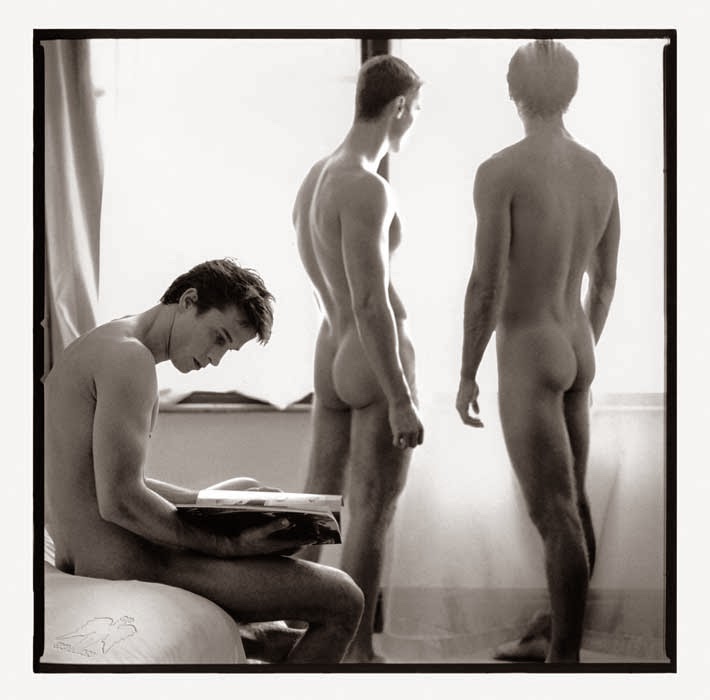
His artfully unkempt strawberry blonde head sports outsized headphones. Like a contemporary bust. Behold the innocence of the freckles, ripe pout of cherry lips. As if the mere sight of the world hurts him, he squints greenly and applies saline drops. You dream him crying over you. For the duration of a subway ride you fall blindly in love. Until he exits. Or you exit, returning home to the one you truly love to ravish him.
About the Poem
This is not the typical poem that I post. It does not have the usual poetic structure that I prefer. The only structure seems to be that the poem is justified, not aligned on the left or right margin. I probably don’t need to explain this but when you justify text, you give your text straight edges on both sides of the paragraph. Justifying extends each line of your text to the left and right margins. Justifying text might make the last line of text in a paragraph considerably shorter than the other lines. I have to wonder if the justifying of the text is an allegory itself. Sometimes poets use the structure of a poem for a particular purpose. It might be the case with this poem. Maybe the text is justified because the poet is justifying his short-lived obsession with the strawberry blonde he sees on the subway. I think sometimes we feel guilty over carnal thoughts about other men, but we shouldn’t. Yet, the poet describes the man as innocent because of his “freckles, ripe pout of cherry lips.”
Then again, the poem may have just come to Legaspi as he was riding the subway and saw a handsome young man near him. Whether there is a hidden meaning or just a fleeting thought put to paper, I like the “story” that it tells. I think the poem itself is self-explanatory. We have probably all been there and had these same thoughts.
About the Poet
Joseph O. Legaspi was born in the Philippines, where he lived before immigrating to Los Angeles with his family at age twelve. He received a BA from Loyola Marymount University and an MFA from New York University’s Creative Writing Program. A Fulbright scholar and two-time NYSCA/New York Foundation for the Arts poetry fellow, Legaspi is the author of Threshold (CavanKerry Press, 2017) and Imago (CavanKerry Press, 2007), winner of a Global Filipino Literary Award; and the chapbooks Postcards (Ghost Bird Press, 2019); Aviary, Bestiary (Organic Weapon Arts, 2014); and Subways (Thrush Press, 2013). In 2004, he cofounded Kundiman, a national organization serving generations of writers and readers of Asian American literature. He works at Columbia University, teaches at New York University and Fordham University, and lives with his husband in Queens, New York.
My sorrow, when she’s here with me, Thinks these dark days of autumn rain Are beautiful as days can be; She loves the bare, the withered tree; She walks the sodden pasture lane.
Her pleasure will not let me stay. She talks and I am fain to list: She’s glad the birds are gone away, She’s glad her simple worsted grey Is silver now with clinging mist.
The desolate, deserted trees, The faded earth, the heavy sky, The beauties she so truly sees, She thinks I have no eye for these, And vexes me for reason why.
Not yesterday I learned to know The love of bare November days Before the coming of the snow, But it were vain to tell her so, And they are better for her praise.
About the Poem
The title of this poem seemed apropos for today. It’s November, and I have a guest coming. However, I hope my guest’s visit will be a happier one than in “My November Guest.”
“My November Guest” was published in Robert Frost’s first published volume of Frost’s poetry, A Boy’s Will, (1913), which is among the best of Frost’s poems in which he speaks of Fall in rural New Hampshire.
The poem is about sorrow. At some point in his life, the poet must have experienced extreme pain and sorrow during the month of November. There is an air of familiarity created by the poet, and he and his guest have walked and talked along the “sodden pasture lane.” Sorrow is personified as a woman – a friend, companion, and she is considered a regular visitor, and “a guest” She is someone the poet dearly loves. He is very comfortable in her company and doesn’t wish to be separated from her – “She talks and I am fain to list.” She is dressed for the weather – that time of year in New England before the first snows of winter – wearing “simple worsted grey.”
In the very first line, “My Sorrow, when she’s here with me,” marks the peak of the poet’s togetherness with sorrow.
My Sorrow, when she’s here with me, Thinks these dark days of autumn rain Are beautiful as days can be;
Walking with the poet, she (Sorrow) speaks of the beautiful Autumn days, finds ecstasy in the withered trees, and the autumnal browns. Fall is a season marked with desolate earth, deserted trees, the “sodden pasture lane,” and the departure of the birds. The poet’s Sorrow finds beauty in the Autumn days. She reprimands the poet for not being able to experience the joy in Autumn and asks for an explanation. The phrase “Simple worsted grey is silver now with clinging mist” reflects the mood of the poem, the coexistence of joy and sorrow.
Not yesterday I learned to know The love of bare November days Before the coming of the snow, But it were vain to tell her so, And they are better for her praise
In the first three stanzas the poet is forced to listen to his ‘guest” extol the virtues of Autumn, “the dark days of autumn rain” and she seems convinced that he has “no eye for” the beauty that surrounds him at this time of year. Those of us familiar with the poetry of Frost know this to be false and we know that he does appreciate these beauties. However, the constant repetition of “She” creates a sense of easy familiarity with his guest, “She walks,” “She talks,” “She thinks,” “She’s glad” and, out of respect or deference, he doesn’t make any effort to correct his companion, for ‘they are better for her praise.” In actual fact, it was not just yesterday that he discovered this fact, he has known it for many a long day:
Not yesterday I learned to know The love of bare November days
Once upon a midnight dreary, while I pondered, weak and weary, Over many a quaint and curious volume of forgotten lore— While I nodded, nearly napping, suddenly there came a tapping, As of some one gently rapping, rapping at my chamber door— “‘Tis some visitor,” I muttered, “tapping at my chamber door— Only this and nothing more.”
Ah, distinctly I remember it was in the bleak December; And each separate dying ember wrought its ghost upon the floor. Eagerly I wished the morrow;—vainly I had sought to borrow From my books surcease of sorrow—sorrow for the lost Lenore— For the rare and radiant maiden whom the angels name Lenore— Nameless here for evermore.
And the silken, sad, uncertain rustling of each purple curtain Thrilled me—filled me with fantastic terrors never felt before; So that now, to still the beating of my heart, I stood repeating, “‘Tis some visitor entreating entrance at my chamber door— Some late visitor entreating entrance at my chamber door;— This it is and nothing more.”
Presently my soul grew stronger; hesitating then no longer, “Sir,” said I, “or Madam, truly your forgiveness I implore; But the fact is I was napping, and so gently you came rapping, And so faintly you came tapping, tapping at my chamber door, That I scarce was sure I heard you”—here I opened wide the door;— Darkness there and nothing more.
Deep into that darkness peering, long I stood there wondering, fearing, Doubting, dreaming dreams no mortal ever dared to dream before; But the silence was unbroken, and the stillness gave no token, And the only word there spoken was the whispered word, “Lenore?” This I whispered, and an echo murmured back the word, “Lenore!”— Merely this and nothing more.
Back into the chamber turning, all my soul within me burning, Soon again I heard a tapping somewhat louder than before. “Surely,” said I, “surely that is something at my window lattice; Let me see, then, what thereat is, and this mystery explore— Let my heart be still a moment and this mystery explore;— ‘Tis the wind and nothing more!”
Open here I flung the shutter, when, with many a flirt and flutter, In there stepped a stately Raven of the saintly days of yore; Not the least obeisance made he; not a minute stopped or stayed he; But, with mien of lord or lady, perched above my chamber door— Perched upon a bust of Pallas just above my chamber door— Perched, and sat, and nothing more.
Then this ebony bird beguiling my sad fancy into smiling, By the grave and stern decorum of the countenance it wore, “Though thy crest be shorn and shaven, thou,” I said, “art sure no craven, Ghastly grim and ancient Raven wandering from the Nightly shore— Tell me what thy lordly name is on the Night’s Plutonian shore!” Quoth the Raven “Nevermore.”
Much I marvelled this ungainly fowl to hear discourse so plainly, Though its answer little meaning—little relevancy bore; For we cannot help agreeing that no living human being Ever yet was blest with seeing bird above his chamber door— Bird or beast upon the sculptured bust above his chamber door, With such name as “Nevermore.”
But the Raven, sitting lonely on the placid bust, spoke only That one word, as if his soul in that one word he did outpour. Nothing further then he uttered—not a feather then he fluttered— Till I scarcely more than muttered “Other friends have flown before— On the morrow he will leave me, as my hopes have flown before.” Then the bird said “Nevermore.”
Startled at the stillness broken by reply so aptly spoken, “Doubtless,” said I, “what it utters is its only stock and store Caught from some unhappy master whom unmerciful Disaster Followed fast and followed faster till his songs one burden bore— Till the dirges of his Hope that melancholy burden bore Of ‘Never—nevermore.'”
But the Raven still beguiling my sad fancy into smiling, Straight I wheeled a cushioned seat in front of bird, and bust and door; Then, upon the velvet sinking, I betook myself to linking Fancy unto fancy, thinking what this ominous bird of yore— What this grim, ungainly, ghastly, gaunt and ominous bird of yore Meant in croaking “Nevermore.”
This I sat engaged in guessing, but no syllable expressing To the fowl whose fiery eyes now burned into my bosom’s core; This and more I sat divining, with my head at ease reclining On the cushion’s velvet lining that the lamp-light gloated o’er, But whose velvet violet lining with the lamp-light gloating o’er, She shall press, ah, nevermore!
Then, methought, the air grew denser, perfumed from an unseen censer Swung by Seraphim whose foot-falls tinkled on the tufted floor. “Wretch,” I cried, “thy God hath lent thee—by these angels he hath sent thee Respite—respite and nepenthe, from thy memories of Lenore; Quaff, oh quaff this kind nepenthe and forget this lost Lenore!” Quoth the Raven “Nevermore.”
“Prophet!” said I, “thing of evil!—prophet still, if bird or devil!— Whether Tempter sent, or whether tempest tossed thee here ashore, Desolate yet all undaunted, on this desert land enchanted— On this home by Horror haunted—tell me truly, I implore— Is there—is there balm in Gilead?—tell me—tell me, I implore!” Quoth the Raven “Nevermore.”
“Prophet!” said I, “thing of evil—prophet still, if bird or devil! By that Heaven that bends above us—by that God we both adore— Tell this soul with sorrow laden if, within the distant Aidenn, It shall clasp a sainted maiden whom the angels name Lenore— Clasp a rare and radiant maiden whom the angels name Lenore.” Quoth the Raven “Nevermore.”
“Be that word our sign in parting, bird or fiend!” I shrieked, upstarting— “Get thee back into the tempest and the Night’s Plutonian shore! Leave no black plume as a token of that lie thy soul hath spoken! Leave my loneliness unbroken!—quit the bust above my door! Take thy beak from out my heart, and take thy form from off my door!” Quoth the Raven “Nevermore.”
And the Raven, never flitting, still is sitting, still is sitting On the pallid bust of Pallas just above my chamber door; And his eyes have all the seeming of a demon’s that is dreaming, And the lamp-light o’er him streaming throws his shadow on the floor; And my soul from out that shadow that lies floating on the floor Shall be lifted—nevermore!
About the Poem
Just as it’s hard to post a poem about autumn without using a Robert Frost poem, it’s hard to post a poem for Halloween without a poem by Edgar Allan Poe. Whenever I read “The Raven,” I almost always hear it in the voice of Vincent Price. Is there anyone more perfect to read a Poe poem? Listen to it for yourself:
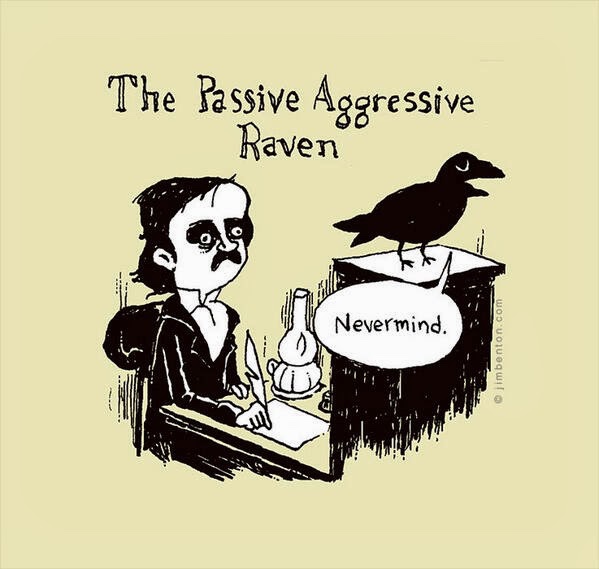
“The Raven” is a narrative poem by American writer Edgar Allan Poe. First published in January 1845, the poem is often noted for its musicality, stylized language, and supernatural atmosphere. It tells of a talking raven’s mysterious visit to a distraught lover, tracing the man’s slow descent into madness. The lover, often identified as a student, is lamenting the loss of his love, Lenore. Sitting on a bust of Pallas, the raven seems to further distress the protagonist with its constant repetition of the word “Nevermore.” The poem makes use of folk, mythological, religious, and classical references.
Poe claimed to have written the poem logically and methodically, intending to create a poem that would appeal to both critical and popular tastes, as he explained in his 1846 follow-up essay, “The Philosophy of Composition”. The poem was inspired in part by a talking raven in the novel Barnaby Rudge: A Tale of the Riots of Eighty by Charles Dickens. Poe based the complex rhythm and meter on Elizabeth Barrett’s poem “Lady Geraldine’s Courtship”, and makes use of internal rhyme as well as alliteration throughout.
“The Raven” was first attributed to Poe in print in the New York Evening Mirror on January 29, 1845. Its publication made Poe popular in his lifetime, although it did not bring him much financial success. The poem was soon reprinted, parodied, and illustrated. Critical opinion is divided as to the poem’s literary status, but it nevertheless remains one of the most famous poems ever written.
About the Poet
Like his life’s work, Edgar Allan Poe’s death remains shrouded in mystery. It was raining in Baltimore on October 3, 1849, but that didn’t stop Joseph W. Walker, a compositor for the Baltimore Sun, from heading out to Gunner’s Hall, a public house bustling with activity. It was Election Day, and Gunner’s Hall served as a pop-up polling location for the 4th Ward polls. When Walker arrived at Gunner’s Hall, he found a man, delirious and dressed in shabby second-hand clothes, lying in the gutter. The man was semi-conscious, and unable to move, but as Walker approached the him, he discovered something unexpected: the man was Edgar Allan Poe. Worried about the health of the addled poet, Walker stopped and asked Poe if he had any acquaintances in Baltimore that might be able to help him. Poe gave Walker the name of Joseph E. Snodgrass, a magazine editor with some medical training. Immediately, Walker penned Snodgrass a letter asking for help:
Baltimore City, Oct. 3, 1849
Dear Sir,
There is a gentleman, rather the worse for wear, at Ryan’s 4th ward polls, who goes under the cognomen of Edgar A. Poe, and who appears in great distress, & he says he is acquainted with you, he is in need of immediate assistance.
Yours, in haste,
JOS. W. WALKER
To Dr. J.E. Snodgrass.
On September 27—almost a week earlier—Poe had left Richmond, Virginia, bound for Philadelphia to edit a collection of poems for Mrs. St. Leon Loud, a minor figure in American poetry at the time. When Walker found Poe in delirious disarray outside of the polling place, it was the first anyone had heard or seen of the poet since his departure from Richmond. Poe never made it to Philadelphia to attend to his editing business. Nor did he ever make it back to New York, where he had been living, to escort his aunt back to Richmond for his impending wedding. Poe was never to leave Baltimore, where he launched his career in the early 19th- century, again—and in the four days between Walker finding Poe outside the public house and Poe’s death on October 7, he never regained enough consciousness to explain how he had come to be found, in soiled clothes not his own, incoherent on the streets. Instead, Poe spent his final days wavering between fits of delirium, gripped by visual hallucinations. The night before his death, according to his attending physician Dr. John J. Moran, Poe repeatedly called out for “Reynolds”—a figure who, to this day, remains a mystery.
Poe’s death—shrouded in mystery—seems ripped directly from the pages of one of his own works. He had spent years crafting a careful image of a man inspired by adventure and fascinated with enigmas—a poet, a detective, an author, a world traveler who fought in the Greek War of Independence and was held prisoner in Russia. But though his death certificate listed the cause of death as phrenitis, or swelling of the brain, the mysterious circumstances surrounding his death have led many to speculate about the true cause of Poe’s demise. “Maybe it’s fitting that since he invented the detective story,” says Chris Semtner, curator of the Poe Museum in Richmond, Virginia, “he left us with a real-life mystery.”
In 1867, one of the first theories to deviate from either phrenitis or alcohol was published by biographer E. Oakes Smith in her article “Autobiographic Notes: Edgar Allan Poe.” “At the instigation of a woman, ” Smith writes, “who considered herself injured by him, he was cruelly beaten, blow upon blow, by a ruffian who knew of no better mode of avenging supposed injuries. It is well known that a brain fever followed. . . .” Other accounts also mention “ruffians” who had beaten Poe senseless before his death. As Eugene Didier wrote in his 1872 article, “The Grave of Poe,” that while in Baltimore, Poe ran into some friends from West Point, who prevailed upon him to join them for drinks. Poe, unable to handle liquor, became madly drunk after a single glass of champagne, after which he left his friends to wander the streets. In his drunken state, he “was robbed and beaten by ruffians, and left insensible in the street all night.”
Others believe that Poe fell victim to a practice known as cooping, a method of voter fraud practiced by gangs in the 19th century where an unsuspecting victim would be kidnapped, disguised and forced to vote for a specific candidate multiple times under multiple disguised identities. Voter fraud was extremely common in Baltimore around the mid 1800s, and the polling site where Walker found the disheveled Poe was a known place that coopers brought their victims. The fact that Poe was found delirious on election day, then, is no coincidence.
Over the years, the cooping theory has come to be one of the more widely accepted explanations for Poe’s strange demeanor before his death. Before Prohibition, voters were given alcohol after voting as a sort of reward; had Poe been forced to vote multiple times in a cooping scheme, that might explain his semi-conscious, ragged state.
Around the late 1870s, Poe’s biographer J.H. Ingram received several letters that blamed Poe’s death on a cooping scheme. A letter from William Hand Browne, a member of the faculty at Johns Hopkins, explains that “the general belief here is, that Poe was seized by one of these gangs, (his death happening just at election-time; an election for sheriff took place on Oct. 4th), ‘cooped,’ stupefied with liquor, dragged out and voted, and then turned adrift to die.”
“A lot of the ideas that have come up over the years have centered around the fact that Poe couldn’t handle alcohol,” says Semtner. “It has been documented that after a glass of wine he was staggering drunk. His sister had the same problem; it seems to be something hereditary.”
Months before his death, Poe became a vocal member of the temperance movement, eschewing alcohol, which he’d struggled with all his life. Biographer Susan Archer Talley Weiss recalls, in her biography “The Last Days of Edgar A. Poe,” an event, toward the end of Poe’s time in Richmond, that might be relevant to theorists that prefer a “death by drinking” demise for Poe. Poe had fallen ill in Richmond, and after making a somewhat miraculous recovery, was told by his attending physician that “another such attack would prove fatal.” According to Weiss, Poe replied that “if people would not tempt him, he would not fall,” suggesting that the first illness was brought on by a bout of drinking.
Those around Poe during his finals days seem convinced that the author did, indeed, fall into that temptation, drinking himself to death. As his close friend J. P. Kennedy wrote on October 10, 1849: “On Tuesday last Edgar A. Poe died in town here at the hospital from the effects of a debauch. . . . He fell in with some companion here who seduced him to the bottle, which it was said he had renounced some time ago. The consequence was fever, delirium, and madness, and in a few days a termination of his sad career in the hospital. Poor Poe! . . . A bright but unsteady light has been awfully quenched.”
Though the theory that Poe’s drinking lead to his death fails to explain his five-day disappearance, or his second-hand clothes on October 3, it was nonetheless a popular theory propagated by Snodgrass after Poe’s death. Snodgrass, a member of the temperance movement, gave lectures across the country, blaming Poe’s death on binge drinking. Modern science, however, has thrown a wrench into Snodgrasses talking points: samples of Poe’s hair from after his death show low levels of lead, explains Semtner, which is an indication that Poe remained faithful to his vow of sobriety up until his demise.
In 1999, public health researcher Albert Donnay argued that Poe’s death was a result of carbon monoxide poisoning from coal gas that was used for indoor lighting during the 19th century. Donnay took clippings of Poe’s hair and tested them for certain heavy metals that would be able to reveal the presence of coal gas. The test was inconclusive, leading biographers and historians to largely discredit Donnay’s theory.
While Donnay’s test didn’t reveal levels of heavy metal consistent with carbon monoxide poisoning, the tests did reveal elevated levels of mercury in Poe’s system months before his death. According to Semtner, Poe’s mercury levels were most likely elevated as a result of a cholera epidemic he’d been exposed to in July of 1849, while in Philadelphia. Poe’s doctor prescribed calomel, or mercury chloride. Mercury poisoning, Semtner says, could help explain some of Poe’s hallucinations and delirium before his death. However, the levels of mercury found in Poe’s hair, even at their highest, are still 30 times below the level consistent with mercury poisoning.
In 1996, Dr. R. Michael Benitez was participating in a clinical pathologic conference where doctors are given patients, along with a list of symptoms, and instructed to diagnose and compare with other doctors as well as the written record. The symptoms of the anonymous patient E.P., “a writer from Richmond” were clear: E.P. had succumbed to rabies. According to E.P.’s supervising physician, Dr. J.J. Moran, E.P. had been admitted to a hospital due to “lethargy and confusion.” Once admitted, E.P.’s condition began a rapid downward spiral: shortly, the patient was exhibiting delirium, visual hallucinations, wide variations in pulse rate and rapid, shallow breathing. Within four days—the median length of survival after the onset of serious rabies symptoms—E.P. was dead.
E.P., Benitez soon found out, wasn’t just any author from Richmond. It was Poe whose death the Maryland cardiologist had diagnosed as a clear case of rabies, a fairly common virus in the 19th century. Running counter to any prevailing theories at the time, Benitez’s diagnosis ran in the September 1996 issue of the Maryland Medical Journal. As Benitez pointed out in his article, without DNA evidence, it’s impossible to say with 100 percent certainty that Poe succumbed to the rabies virus. There are a few kinks in the theory, including no evidence of hydrophobia (those afflicted with rabies develop a fear of water, Poe was reported to have been drinking water at the hospital until his death) nor any evidence of an animal bite (though some with rabies don’t remember being bitten by an animal). Still, at the time of the article’s publication, Jeff Jerome, curator of the Poe House Museum in Baltimore, agreed with Benitez’s diagnosis. “This is the first time since Poe died that a medical person looked at Poe’s death without any preconceived notions,” Jerome told the Chicago Tribune in October of 1996. “If he knew it was Edgar Allan Poe, he’d think, ‘Oh yeah, drugs, alcohol,’ and that would influence his decision. Dr. Benitez had no agenda.”
One of the most recent theories about Poe’s death suggests that the author succumbed to a brain tumor, which influenced his behavior before his death. When Poe died, he was buried, rather unceremoniously, in an unmarked grave in a Baltimore graveyard. Twenty-six years later, a statue was erected, honoring Poe, near the graveyard’s entrance. Poe’s coffin was dug up, and his remains exhumed, in order to be moved to the new place of honor. But more than two decades of buried decay had not been kind to Poe’s coffin—or the corpse within it—and the apparatus fell apart as workers tried to move it from one part of the graveyard to another. Little remained of Poe’s body, but one worker did remark on a strange feature of Poe’s skull: a mass rolling around inside. Newspapers of the day claimed that the clump was Poe’s brain, shriveled yet intact after almost three decades in the ground.
We know, today, that the mass could not be Poe’s brain, which is one of the first parts of the body to rot after death. But Matthew Pearl, an American author who wrote a novel about Poe’s death, was nonetheless intrigued by this clump. He contacted a forensic pathologist, who told him that while the clump couldn’t be a brain, it could be a brain tumor, which can calcify after death into hard masses.
According to Semtner, Pearl isn’t the only person to believe Poe suffered from a brain tumor: a New York physician once told Poe that he had a lesion on his brain that caused his adverse reactions to alcohol.
A far less sinister theory suggests that Poe merely succumbed to the flu—which might have turned into deadly pneumonia—on this deathbed. As Semtner explains, in the days leading up to Poe’s departure from Richmond, the author visited a physician, complaining of illness. “His last night in town, he was very sick, and his [soon-to-be] wife noted that he had a weak pulse, a fever, and she didn’t think he should take the journey to Philadelphia,” says Semtner. “He visited a doctor, and the doctor also told him not to travel, that he was too sick.” According to newspaper reports from the time, it was raining in Baltimore when Poe was there—which Semtner thinks could explain why Poe was found in clothes not his own. “The cold and the rain exasperated the flu he already had,” says Semtner, “and maybe that eventually lead to pneumonia. The high fever might account for his hallucinations and his confusion.”
In his 2000 book Midnight Dreary: The Mysterious Death of Edgar Allan Poe, author John Evangelist Walsh presents yet another theory about Poe’s death: that Poe was murdered by the brothers of his wealthy fiancée, Elmira Shelton. Using evidence from newspapers, letters and memoirs, Walsh argues that Poe actually made it to Philadelphia, where he was ambushed by Shelton’s three brothers, who warned Poe against marrying their sister. Frightened by the experience, Poe disguised himself in new clothes (accounting for, in Walsh’s mind, his second-hand clothing) and hid in Philadelphia for nearly a week, before heading back to Richmond to marry Shelton. Shelton’s brothers intercepted Poe in Baltimore, Walsh postulates, beat him, and forced him to drink whiskey, which they knew would send Poe into a deathly sickness. Walsh’s theory has gained little traction among Poe historians—or book reviewers; Edwin J. Barton, in a review for the journal American Literature, called Walsh’s story “only plausible, not wholly persuasive.” “Midnight Dreary is interesting and entertaining,” he concluded, “but its value to literary scholars is limited and oblique.”
—
For Semtner, however, none of the theories fully explain Poe’s curious end. “I’ve never been completely convinced of any one theory, and I believe Poe’s cause of death resulted from a combination of factors,” he says. “His attending physician is our best source of evidence. If he recorded on the mortality schedule that Poe died of phrenitis, Poe was most likely suffering from encephalitis or meningitis, either of which might explain his symptoms.”












 Joe
Joe




 The Closet Professor