He slept with his back towards me, a ladder I’d learn to climb even if it took till dawn— we who wanted to live past the expiration date that was printed on the condom wrapper neither of us had wanted to tear open—
Do Not Disturb By Timothy Liu
Offshore salt lapping up against a lighthouse flashing red, my husband next to me in a waterbed by the sea with “Do Not Disturb” signs hung on every door— my lover on the other side of the ocean, unable to tell if the fog will roll out as the day’s first headlights make their way down a coastal road as he texts me a face I cannot touch, a mystical rose that keeps its own scent. What good would it do to say I miss him when saying nothing makes me miss him all the more?
I Need Your Body Near Me By Timothy Liu
An ocean is nothing, there is no separation between two lovers. And I knew just what it took: six hours, two meals with a movie in between, blinders over eyes, plugs in ears as I tried to get some sleep. When I awoke, I knew I’d crossed more than a time zone for my body was always nearer to yours than anyone else’s still sleeping in your bed—
About the Poet
Timothy Liu (Liu Ti Mo) was born in 1965 in San Jose, California, to parents from the Chinese mainland. He studied at Brigham Young University, the University of Houston, and the University of Massachusetts at Amherst.
He is the author of Luminous Debris: New & Selected Legerdemain 1992-2017 (Barrow Street Books, 2018); Kingdom Come: A Fantasia (Talisman House, 2017); Don’t Go Back To Sleep (Saturnalia, 2014); Polytheogamy (Saturnalia, 2009); Bending the Mind Around the Dream’s Blown Fuse (Talisman House, 2009); For Dust Thou Art (Southern Illinois University Press, 2005); Of Thee I Sing (University of Georgia Press, 2004), selected by Publishers Weekly as a 2004 Book-of-the-Year; Hard Evidence (Talisman House, 2001); Say Goodnight (Copper Canyon Press, 1998); Burnt Offerings (Copper Canyon Press, 1995); and Vox Angelica (Alice James Books, 1992), which won the Poetry Society of America’s Norma Farber First Book Award.
About Liu’s work, the poet Fanny Howe has said, “Timothy Liu writes out of an angry materialism, ill-fitting body, disappointment at every turn. He takes on his point of view wholeheartedly and compresses the consequences into phrases that echo and mimic each other, thereby increasing the sensation of claustrophobia and fever.”
Liu’s honors and awards include a Pushcart Prize and the Open Book Beyond Margins Award. He is also the editor of Word of Mouth: An Anthology of Gay American Poetry, (Talisman House, 2000).
He has served as a core faculty member at Bennington College’s Writing Seminars and is currently an associate professor at William Paterson University. He lives in Manhattan.
A ghost, though invisible, still is like a place
your sight can knock on, echoing; but here
within this thick black pelt, your strongest gaze
will be absorbed and utterly disappear:
just as a raving madman, when nothing else
can ease him, charges into his dark night
howling, pounds on the padded wall, and feels
the rage being taken in and pacified.
She seems to hide all looks that have ever fallen
into her, so that, like an audience,
she can look them over, menacing and sullen,
and curl to sleep with them. But all at once
as if awakened, she turns her face to yours;
and with a shock, you see yourself, tiny,
inside the golden amber of her eyeballs
suspended, like a prehistoric fly.
About This Poem
Have you ever feared a black cat crossing your path? This is from ancient superstitions where people thought this meant bad luck. For many cultures and historical settings, black cats were actually meant for positive things. So, to try and dispel these myths about black cats, National Black Cat Appreciation Day was created to be celebrated on August 17 every year. Today, pop culture loves black cats. There’s the sarcastic Thackery Binx in Hocus Pocus, Salem, in Sabrina, the Teenage Witch, and Pyewacket in the classic Bell, Book, and Candle, and we can’t forget the classic cartoon black cat, Luna in Sailor Moon. Black cats are seen as loyal companions, and this is what they were seen as for a lot of cultures in history too.
So, who’s to blame for this negative black cat spin? Superstition! But mostly because during the Middle Ages, people (mainly the Catholic Church) saw witches as shape-shifting black cats and the damage was done. From then on, black cats were seen as evil entities for years and years to follow. The Rilke poem “Black Cat” follows in this vein. The poem was originally published in Rilke’s 1923 collection Duino Elegies. Rilke began writing this collection in 1912, but it remained unfinished for a decade before being completed and published.
So why this poem today? Since 2011, cat lovers around the world have celebrated Black Cat Appreciation Day on August 17th. It is a day to celebrate and appreciate the black cats in your life. Today, I celebrate my little companion, Isabella, a beautiful, sleek black cat. Black Cat Appreciation Day was created by a man named Wayne H. Morris, in honor of his late sister, June, who passed away at age 33, a few years before the first official Black Cat Appreciation Day. This date was chosen as a memorial of June’s passing. June deeply loved her own black cat, Sinbad, who lived to be 20 years old. Sadly, Sinbad was reunited with June two months after her passing.
Black cats are often the least adopted and most overlooked cats in animal shelters, resulting in many of these wonderful animals being euthanized when they can’t find a loving home. Because they are less likely to be adopted from shelters, they need a special holiday in their honor to bring awareness to this issue, and to encourage people to adopt these amazing animals. Black cats are often misunderstood and overlooked because of their coat color and the superstitions surrounding them. Also, many shelters will not allow adoptions of black cats in October because people adopt them for Halloween and then discard them afterward. The life of a black cat in shelters can be very sad because there are several stupid and silly reasons why people looking to adopt a cat are less likely to adopt black cats.
They have long been associated with bad luck, misfortune, and witchcraft. Even in our modern times, there are still people who believe these silly superstitions. You would be surprised to learn how many people still believe that black cats bring bad luck or cause misfortune to anyone who crosses their path. Many religious people also fear them because of their association with witchcraft. These superstitions are not only silly and untrue but are also harmful to beautiful black cats who are in search of forever homes.
Another reason why people may be less inclined to want to adopt a black cat is that they consider dark solid coats to be “boring,” and prefer a flashier tabby, calico, or other uniquely marked cats. This is an unfair assessment, as black cats are beautiful creatures with luxurious black coats. They look like majestic miniature black panthers roaming around your home and are just as beautiful and charming as any other cat. Besides, black matches almost anything, so you will always look fashionable next to your black cat friend.
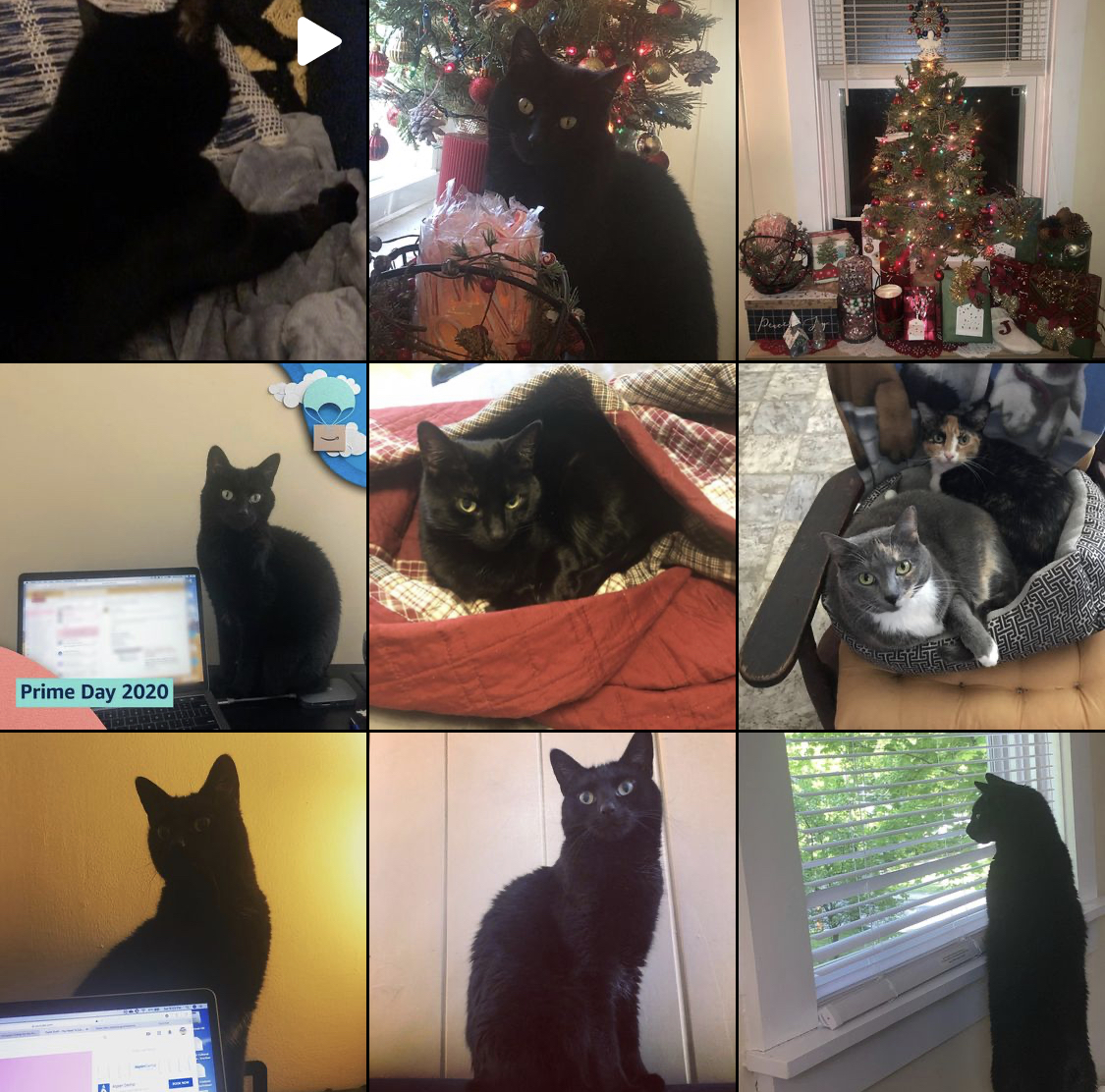
In our social media-obsessed world, some people also shy away from adopting black cats because they believe that they don’t show up as well in pictures. Many people today want pets that they feel they can show off on the internet. Black cats can be just as photogenic as any other cat. Just look at Isabella, she often is a great subject for pictures. With the proper lighting, background, and photography technique, your cat will look stunning on your Instagram feed!
Many prospective pet owners use the internet to find their new furry friends, so they are likely to overlook animals that are not photographed well. Because black cats are a bit harder to photograph than pets with lighter coat colors, they may be overlooked by prospective owners browsing online adoptable pet listings. It is important for shelters to photograph the adoptable pets in their best light to help them to find their forever homes.
Black cats are beautiful creatures that make a wonderful addition to any home. In some countries, including England, Scotland, and Japan, they are considered good luck. In Japan, it is believed that a single woman who owns a black cat will have many suitors. In England, they are commonly thought to bring good luck to anyone who crosses their path. In Scotland, it is said that a strange black cat arriving at your home will bring good fortune and prosperity.
Many cat owners (I would not be one of them) agree that their black cats are often the most affectionate and playful cats they’ve ever had. For me, Isabella is not very affectionate. She wants to be near me most of the time and sometimes wants to lay on me, but she never cuddles and hates to be held. Others claim black cats are known for their unique personalities and cuddly dispositions. Some researchers also claim that black cats are more resistant to disease. There is some research to suggest that at least two genes associated with melanism may also help them resist certain diseases.
So if you are looking to adopt a cat, consider a black cat. They need the love, and they will love you back. Isabella might not be the most affectionate, but she constantly shows her love and appreciation for me, and isn’t that what we all want from our pets, especially our cats who often seem so indifferent to their human companions. I have spent most of the pandemic working from home, and when I first started working from home, Isabella was never far away. I think she has probably gotten a little tired of me being home so much and she’s not as close by all the time these days, but I have returned to working at the museum five days a week, so she will have her alone time again. I’ve had cats in the past who show how mad they are at you for leaving them for any amount of time. Isabella has never been that way. Most of the time, she greets me at the door, and if she hears me in the stairway, and I don’t come into my apartment quick enough, she makes her impatience known. She is a wonderful little companion, and I feel so blessed to have her.
About the Poet
On December 4, 1875, Rainer Maria Rilke was born in Prague. His parents placed him in military school with the desire that he become an officer—a position Rilke was not inclined to hold. With the help of his uncle, who realized that Rilke was a highly gifted child, Rilke left the military academy and entered a German preparatory school. By the time he enrolled in Charles University in Prague in 1895, he knew that he would pursue a literary career: he had already published his first volume of poetry, Leben und Lieder, the previous year. At the turn of 1895-1896, Rilke published his second collection, Larenopfer (Sacrifice to the Lares). A third collection, Traumgekrönt (Dream-Crowned) followed in 1896. That same year, Rilke decided to leave the university for Munich, Germany, and later made his first trip to Italy.
In 1897, Rilke went to Russia, a trip that would prove to be a milestone in Rilke’s life, and which marked the true beginning of his early serious works. While there the young poet met Tolstoy, whose influence is seen in Das Buch vom lieben Gott und anderes (Stories of God), and Leonid Pasternak, the nine-year-old Boris’s father. At Worpswede, where Rilke lived for a time, he met and married Clara Westhoff, who had been a pupil of Rodin. In 1902 he became the friend, and for a time the secretary, of Rodin, and it was during his twelve-year Paris residence that Rilke enjoyed his greatest poetic activity. His first great work, Das Stunden Buch (The Book of Hours), appeared in 1905, followed in 1907 by Neue Gedichte (New Poems) and Die Aufzeichnungen des Malte Laurids Brigge (The Notebooks of Malte Laurids Brigge). Rilke would continue to travel throughout his lifetime; to Italy, Spain, and Egypt among many other places, but Paris would serve as the geographic center of his life, where he first began to develop a new style of lyrical poetry, influenced by the visual arts.
When World War I broke out, Rilke was obliged to leave France and during the war, he lived in Munich. In 1919, he went to Switzerland where he spent the last years of his life. It was here that he wrote his last two works, the Duino Elegies (1923) and the Sonnets to Orpheus (1923). He died of leukemia on December 29, 1926. At the time of his death, his work was intensely admired by many leading European artists but was almost unknown to the general reading public. His reputation has grown steadily since his death, and he has come to be universally regarded as a master of verse.
Wonderful were the long secret nights you gave me, my Lover, Palm to palm breast to breast in the gloom. The faint red lamp, Flushing with magical shadows the common-place room of the inn With its dull impersonal furniture, kindled a mystic flame In the heart of the swinging mirror, the glass that has seen Faces innumerous & vague of the endless travelling automata, Whirled down the ways of the world like dust-eddies swept through a street, Faces indifferent or weary, frowns of impatience or pain, Smiles (if such there were ever) like your smile and mine when they met Here, in this self-same glass, while you helped me to loosen my dress, And the shadow-mouths melted to one, like sea-birds that meet in a wave– Such smiles, yes, such smiles the mirror perhaps has reflected; And the low wide bed, as rutted and worn as a high-road, The bed with its soot-sodden chintz, the grime of its brasses, That has borne the weight of fagged bodies, dust-stained, averted in sleep, The hurried, the restless, the aimless–perchance it has also thrilled With the pressure of bodies ecstatic, bodies like ours, Seeking each other’s souls in the depths of unfathomed caresses, And through the long windings of passion emerging again to the stars… Yes, all this through the room, the passive & featureless room, Must have flowed with the rise & fall of the human unceasing current; And lying there hushed in your arms, as the waves of rapture receded, And far down the margin of being we heard the low beat of the soul, I was glad as I thought of those others, the nameless, the many, Who perhaps thus had lain and loved for an hour on the brink of the world, Secret and fast in the heart of the whirlwind of travel, The shaking and shrieking of trains, the night-long shudder of traffic, Thus, like us they have lain & felt, breast to breast in the dark, The fiery rain of possession descend on their limbs while outside The black rain of midnight pelted the roof of the station; And thus some woman like me, waking alone before dawn, While her lover slept, as I woke & heard the calm stir of your breathing, Some woman has heard as I heard the farewell shriek of the trains Crying good-bye to the city & staggering out into darkness, And shaken at heart has thought: “So must we forth in the darkness, Sped down the fixed rail of habit by the hand of implacable fate– So shall we issue to life, & the rain, & the dull dark dawning; You to the wide flare of cities, with windy garlands and shouting, Carrying to populous places the freight of holiday throngs; I, by waste lands, & stretches of low-skied marsh To a harbourless wind-bitten shore, where a dull town moulders & shrinks, And its roofs fall in, & the sluggish feet of the hours Are printed in grass in its streets; & between the featureless houses Languid the town-folk glide to stare at the entering train, The train from which no one descends; till one pale evening of winter, When it halts on the edge of the town, see, the houses have turned into grave-stones, The streets are the grassy paths between the low roofs of the dead; And as the train glides in ghosts stand by the doors of the carriages; And scarcely the difference is felt–yea, such is the life I return to…” Thus may another have thought; thus, as I turned may have turned To the sleeping lips at her side, to drink, as I drank there, oblivion….
About the Poem
Wharton fell in love with Europe and the freedom and intellectual stimulation she found there. While seemingly a conventional Edwardian, often photographed corseted and draped in pearls, furs, and silk, Wharton was quietly rebelling against her family, country, American high society, and empty hours. She read, wrote, travelled adventurously, and collected friends. Eventually, she met a wholly unsuitable man—the elusive, bisexual, and philandering journalist Morton Fullerton. Morton has been described as “Singularly attaching… a dashing well-tailored man with large Victorian moustache and languid eyes, a bright flower in his buttonhole, and the style of a ‘masher’.” (A masher is a fashionable man in the late Victorian era, especially one who makes often unwelcome advances to women.)
After graduating, Morton was intimate with philosopher, essayist, poet, and novelist George Santayana and close to American art historian Bernard Berenson. Upon moving to London, he befriended English poet, songwriter, and novelist Charles Hamilton Aidé and became the lover of British sculptor Lord Ronald Gower, who was famously implicated, along with several society figures, in the Cleveland Street Scandal, where a male brothel was raided by police. From 1906 to 1909 Morton famously had an affair with Wharton. They met in the summer of that year after being introduced by mutual friend Henry James. She undoubtedly considered him the love of her life, describing him as her “ideal intellectual partner”. However, they were never ‘officially’ together, as Wharton was already married, and Fullerton’s highly promiscuous personality prevented him from ever committing to a serious relationship.
Morton would surface, and she adored him. Then he would drop out of sight. While quite taken with her, Fullerton had a sordid and rakish, but appealing nature and moved from woman to woman, and apparently from man to man as well. Months of stolen meetings left Wharton euphoric and yet fearful: the cost of opening herself up could be high, and she worried about the possibility of scandal and blackmail, and, no small issue, what the servants would think. After the affair ended, Wharton, who was fiercely guarded when it came to her private life, requested that Fullerton destroy every letter she had ever sent him to avoid any scandal. The affair itself, although suspected, was not confirmed until the 1980s. Fullerton had ignored Wharton’s request and had kept all her letters, which were eventually published as a book, The Letters of Edith Wharton, in 1988.
During the affair, Wharton sturgged to find a place for the two to meet without prying eyes. Finally, in 1909, Wharton found an unlikely secret place to meet her lover, in the small moments of her life, while in transit, without servants. Their rendezvous was in an unromantic Victorian terminal hotel, which fronted a London railway station with six platforms. The Charing Cross Hotel had been a place to catch or meet a train and break a journey since Victorian times. In dingy Room 91, something rather extraordinary happened. Forty-five-year-old Wharton became a “sensual heroine” and made passionate love for perhaps the first time. And as she lay in her lover’s arms, she felt profoundly connected to humanity, to travelers who had also loved in just this kind of place. Out of the experience, she wrote the poem “Terminus”:
…And lying there hushed in your arms, as the waves of rapture receded, And far down the margin of being we heard the low beat of the soul, I was glad as I thought of those others, the nameless, the many, Who perhaps thus had lain and loved for an hour on the brink of the world, Secret and fast in the heart of the whirlwind of travel,…
Fullerton proved faithless and Wharton, a tough-minded realist, broke off the affair. But she gained from the experience and never forgot: “I have drunk the wine of life at last,” she confided in her diary. “I have known the thing best worth knowing, I have been warmed through and through never to grow quite cold again until the end…” She thereafter wrote of love from personal experience and went on to live a brave and spirited life. She divorced, relocated to France permanently, wrote more novels, and created beautiful gardens; she entertained and proved a loyal friend.
Her experience in Room 91 at the Charing Cross Hotel mirrors those fleeting moments many gay men have had through history, whether it was a hotel where proprietors turned a blind eye, a public restroom, or in the wooded areas of a park. Gay men often found themselves in these brief moments of passion where like Wharton, “something rather extraordinary happened.” Unlike Wharton though, gay men had the possibility of being caught and imprisoned for sodomy. While things have gotten better for most gay men, there are still closeted gay men, and some very out gay men, who still use cruising, or as many do, hook-up apps, as a means of anonymous, and sometimes not so anonymous, moments of ecstasy. While “Terminus” is about Morton and Wharton, it could, with a few changes in gender, be any number of gay male experiences throughout history.
About Edith Wharton
Edith Wharton’s vocation was confirmed already in childhood, when her most “intense & enduring” pastime was improvising long narratives before she had even learned to read: “This devastating passion grew on me to such an extent that my parents became alarmed.” When in 1902 she showed her first novel, set in eighteenth-century Italy, to Henry James, he expressed admiration for her writing (“exquisitely studied and so brilliant & interesting from a literary point of view”) but strongly encouraged her to turn her attention to her own time and place: “There it is round you. Don’t pass it by—the immediate, the real, the ours, the yours, the novelist’s that it waits for. . . Do New York! The 1st-hand account is precious.” The immediate fruit of this advice was a masterpiece, The House of Mirth, in which Wharton cast a revealing light on the world of privilege in which she grew up, and whose dissection of the hidden social barriers and pressures among the upper classes of turn-of-the-century New York remains unsurpassed. A long series of masterful novels and stories followed, ironic, richly detailed, and capturing both the high comedy and the tragic contradictions of her world.
I personally have always enjoyed the writings of Edith Wharton. I read Ethan Frome in high school and The Age of Innocence in graduate school. Probably my favorite is her short story “Roman Fever,” which begins with the sentence, “From the table at which they had been lunching two American ladies of ripe but well-cared-for middle age moved across the lofty terrace of the Roman restaurant and, leaning on its parapet, looked first at each other, and then down on the outspread glories of the Palatine and the Forum, with the same expression of vague but benevolent approval.” Few authors have ever evoked imagery the way Wharton did. When reading Wharton’s work, I always felt like I was there in the places that she wrote. Not everyone enjoys Wharton’s writing like I do, but as Henry James said, her writing was “exquisitely studied and so brilliant & interesting.”
Taking Your Olympic Measure By Alberto Ríos – 1952-
—Poetry was an Olympic event from 1912-1948.
Think of the records you have held: For one second, you were the world’s youngest person.
It was a long time ago, but still. At this moment, you are living
In the farthest thousandth-of-a-second in the history of time. You have beaten yesterday’s record, again.
You were perhaps the only participant, But in the race to get from your bedroom to the bathroom,
You won. You win so much, all the time in all things.
Your heart simply beats and beats and beats— It does not lose, although perhaps one day.
Nevertheless, the lists of firsts for you is endless— Doing what you have not done before,
Tasting sake and mole, smelling bergamot, hearing Less well than you used to—
Not all records are for the scrapbook, of course— Sometimes you are the best at being the worst.
Some records are secret—you know which ones. Some records you’re not even aware of.
In general, however, at the end of a long day, you are— Unlikely as it may seem—the record holder of note.
About the Poet
Born in 1952, Alberto Ríos is the inaugural state poet laureate of Arizona and the author of many poetry collections, including A Small Story about the Sky (Copper Canyon Press, 2015). In 1981, he received the Walt Whitman Award for his collection Whispering to Fool the Wind (Sheep Meadow Press, 1982). He served as a Chancellor of the Academy of American Poets from 2014 to 2020.
I’ve been meaning to tell you how the sky is pink here sometimes like the roof of a mouth that’s about to chomp down on the crooked steel teeth of the city,
I remember the desperate things we did and that I stumble down sidewalks listening to the buzz of street lamps at dusk and the crush of leaves on the pavement,
Without you here I’m viciously lonely
and I can’t remember the last time I felt holy, the last time I offered myself as sanctuary
*
I watched two men press hard into each other, their bodies caught in the club’s bass drum swell, and I couldn’t remember when I knew I’d never be beautiful, but it must have been quick and subtle, the way the holy ghost can pass in and out of a room. I want so desperately to be finished with desire, the rushing wind, the still small voice.
About the Poem
“Boston” shows loneliness and a yearning for someone that is no longer there. The poem is about how empty and lost we can feel when we are missing someone and no longer able to find comfort in them. During these times, the world seems too big and vast and it feels as though we cannot find ourself. The speaker of the poem remembers back to how he used to feel and how what he used to do now only adds to how deserted he feels. In the poem, the speaker has lost a sense for who he is, saying how he “couldn’t remember when [he] knew [he’d] never be beautiful, but it must have been quick and subtle, the way the holy ghost can pass in and out of a room.” He doesn’t even feel like he’s living because the person he loves is no longer with him. The speaker is trying to find strength around him, but the city he’s in is not providing him with any solace.
Although this poem is depressing, the audience is meant to be able to relate to it. Smith writes in a way that makes the reader feel the emptiness of both Boston and the space around the speaker without the person he loves by his side. The poem does not portray loneliness as a negative thing, instead, the audience feels the pain of the speaker and, if they have ever experienced a similar situation, is able to empathize with him.
We’ve all felt lonely in our lives. When I went to Italy for my dissertation research, I was alone and I remember how lonely I felt, even though I was surrounded by people. Ironically, I also went on a research trip to Boston, but I had a friend with me, so that was not somewhere I felt lonely. In fact, I had a constant companion on that research trip, but in Italy, I was all alone and knew no one. The loneliest I think I ever felt was when I first moved to Vermont, especially after a close friend died. I felt as if my life had fallen apart and no one could relate. Susan helped me through that period more than anyone. Even so, I felt a void in my life from the loss of my friend. The poem paints the feeling of missing someone in a beautiful way, so that while reading it, you can connect to the speaker’s pain and, for me, share in the speakers feelings of loneliness.
About the Poet
Aaron Smith is the author of two collections of poetry both published by the Pitt Poetry Series: Appetite, finalist for the Paterson Poetry Prize, the Lambda Literary Award, and the Thom Gunn Award, and Blue on Blue Ground, winner of the Agnes Lynch Starrett prize. His work has appeared in numerous publications including Ploughshares and The Best American Poetry 2013. He is assistant professor in creative writing at Lesley University in Cambridge, Massachusetts.
Dear train wreck, dear terrible engines, dear spilled freight, dear unbelievable mess, all these years later I think to write back. I was not who I am now. A sail is a boat, a bark is a boat, a mast is a boat and the train was you and me. Dear dark, dear paper, dear files I can’t toss, dear calendar and visitation schedule, dear hello and goodbye. If a life is one thing and then another; if no grasses grow through the tracks; if the train wreck is a red herring; if goodbye then sincerely. Dear disappeared bodies and transitions, dear edge of a good paragraph. Before the wreck, we misunderstood revision. I revise things now. I teach pertinence. A girl in class told us about some boys who found bodies on the tracks then went back and they were gone, the bodies. It was true that this story was a lie, like all things done to be seen. I still think about this story, what it would be like to be a boy finding bodies out in the woods, however they were left—and think of all the ways they could be left. There I was, teaching the building of a good paragraph, dutiful investigator of sentences, thinking dear boys, dear stillness in the woods, until, again, there is the boy I knew as a man whose father left him at a gas station, and unlike the lie of the girl’s story, this one is true—he left him there for good. Sometimes this boy, nine and pale, is sitting next to me, sitting there watching trains go past the gas station in Wyoming, thinking there is a train going one way, and a train going the other way, each at different and variable speeds: how many miles before something happens that feels like answers when we write them down— like solid paragraphs full of transitional phrases and compound, complex sentences, the waiting space between things that ends either in pleasure or pain. He keeps showing up, dear boy, man now, and beautiful like the northern forest, hardwoods iced over.
About this Poem
“I was thinking about synecdoche and the mathematics of meaning—how one thing can be something else, or a piece of it, and how this washes through a life. I wanted, also, to write a letter to the idea of leaving, and so this poem began to be what it is. What ends up being true, I think, is that meaning slips and slides; writing tries to catch it and hold it still.”—Kerrin McCadden
If you’re like me, you read this poem and though, “Huh?” Shes kind of all over the place, and it’s certainly a stream of consciousness. To be honest, this is how my mind sometimes works. I am thinking of one thing, and it leads me to think of something else. Then, that leads me to think of something else entirely different, and on and on it goes, which is why at any given time, there might be a dozen tabs open on my web browser. So that’s kind of how I see this poem. If you read McCadden’s description of the poem, I don’t think it makes any more sense that the poem did. Honestly, I had to look up the word synecdoche, which is a figure of speech in which a part of something stands for the whole (for example, “I’ve got wheels” for “I have a car,” or a description of a worker as a “hired hand”). It is related to metonymy, which I also had to look up. When a poet refers to something by one of its characteristics rather than its name – for example, referring to a country’s ‘strength’ rather than ‘armies’ – it is known as metonymy. It differs from synecdoche, in that these are abstract qualities rather than concrete parts.
I never taught synecdoche and metonymy when I taught poetry. Honestly, it would have been beyond my high school students, who were mostly football players. It was hard enough to get them to understand metaphors. I remember trying to teach them the meanings of Shakespeare’s Sonnet 18 (Shall I compare thee to a summer’s day?). I decided to take them outside and use our surroundings to teach about the metaphors, such as “Sometime too hot the eye of heaven shines,” which is when I pointed up to the sun. Eventually, they got it. I never had the easiest time teaching those guys English Literature. I think we spent nine weeks on Macbeth alone. I always had fun teaching them Macbeth, because after we read the play and discussed it (and I got to read it using various voices, which they probably thought was silly), we would watch two movies: Scotland, PA and the version of Macbeth with Patrick Stewart. Scotland, PA was probably an inappropriate movie to show high school students because of some implied themes and language, but it’s basically a modernized version of Macbeth set in a McDonald’s style fast food joint called Macbeth’s. Christopher Walken plays Lieutenant McDuff. It’s a fun movie if you like Macbeth. (And yes, I realize this paragraph is basically my example of a stream of consciousness similar to how the poem above seems to be.)
About the Poet
Kerrin McCadden received an MFA from Warren Wilson College. She is the author of Landscape with Plywood Silhouettes (New Issues, 2014), which received the 2013 New Issues Poetry Prize as well as the 2015 Vermont Book Award. McCadden has received fellowships and awards from the National Endowment for the Arts, the Sustainable Arts Foundation, and the Vermont Arts Council, among others. She lives in Montpelier, Vermont.
Shall I compare thee to a summer’s day? (Sonnet 18) By William Shakespeare – 1564-1616
Shall I compare thee to a summer’s day? Thou art more lovely and more temperate. Rough winds do shake the darling buds of May, And summer’s lease hath all too short a date. Sometime too hot the eye of heaven shines, And often is his gold complexion dimmed; And every fair from fair sometime declines, By chance, or nature’s changing course, untrimmed; But thy eternal summer shall not fade, Nor lose possession of that fair thou ow’st, Nor shall death brag thou wand’rest in his shade, When in eternal lines to Time thou grow’st. So long as men can breathe, or eyes can see, So long lives this, and this gives life to thee.
This sonnet is certainly the most famous in the sequence of Shakespeare’s sonnets; it may be the most famous lyric poem in English. It’s also one of my favorite Shakespearean sonnet. Among Shakespeare’s works, only lines such as “To be or not to be” and “Romeo, Romeo, wherefore art thou Romeo?” are better-known. This is not to say that it is at all the best or most interesting or most beautiful of the sonnets; but the simplicity and loveliness of its praise of the beloved has guaranteed its place.
On the surface, the poem is simply a statement of praise about the beauty of the beloved; summer tends to unpleasant extremes of windiness and heat, but the beloved is always mild and temperate. Summer is incidentally personified as the “eye of heaven” with its “gold complexion”; the imagery throughout is simple and unaffected, with the “darling buds of May” giving way to the “eternal summer”, which the speaker promises the beloved. The beloved’s “eternal summer” shall not fade precisely because it is embodied in the sonnet: “So long as men can breathe or eyes can see,” the speaker writes in the couplet, “So long lives this, and this gives life to thee.” The language, too, is comparatively unadorned for the sonnets; it is not heavy with alliteration or assonance, and nearly every line is its own self-contained clause—almost every line ends with some punctuation, which effects a pause.
queer me shift me transgress me tell my students i’m gay tell chick fil a i’m queer tell the new york times i’m straight tell the mail man i’m a lesbian tell american airlines i don’t know what my gender is like me liking you like summer blockbuster armrest dates armrest cinematic love elbow to forearm in the dark humor me queerly fill me with laughter make me high with queer gas decompress me from centuries of spanish inquisition & self-righteous judgment like the blood my blood that has mixed w/ the colonizer & the colonized in the extinct & instinct to love bust memories of water & heat & hot & breath beating skin on skin fluttering bruise me into vapors bleed me into air fly me over sub-saharan africa & asia & antarctica explode me from the closet of my fears graffiti me out of doubt bend me like bamboo propose to me divorce me divide me into your spirit 2 spirit half spirit & shadow me w/ fluttering tongues & caresses beyond head heart chakras fist smashing djembes between my hesitations haiku me into 17 bursts of blossoms & cold saki de-ethnicize me de-clothe me de-gender me in brassieres & prosthetic genitalias burn me on a brazier wearing a brassiere in bitch braggadocio soprano bass magnificat me in vespers of hallelujah & amen libate me in halos heal me in halls of femmy troubadors announcing my hiv status or your status i am not afraid to love you implant dialects as if they were lilacs in my ear medicate me with a lick & a like i am not afraid to love you so demand me reclaim me queerify me













 Joe
Joe





 The Closet Professor