When wit, and wine, and friends have met And laughter crowns the festive hour In vain I struggle to forget Still does my heart confess thy power And fondly turn to thee!
But Octavia, do not strive to rob My heart, of all that soothes its pain The mournful hope that every throb Will make it break for thee!
—attributed to Edgar Allan Poe
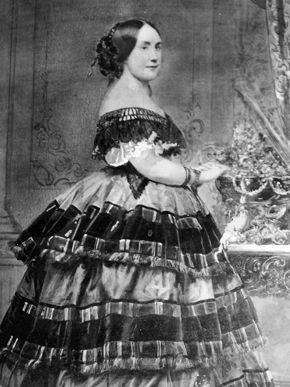
Octavia Walton Le Vert
Octavia Walton Le Vert was born at her maternal grandmother’s home, Belle Vue, near Augusta, Georgia. She spent her early years in Georgia and was educated by her mother and paternal grandmother. In 1821, her family moved to Pensacola, Florida, where Le Vert learned French, Spanish, and the local Seminole dialect. During her father’s long tenure in Florida, her mother frequently took the children on tours along the Eastern Seaboard. Historians and literary scholars believe that it was during one of these trips in the late 1820s that Octavia Walton Le Vert encountered Edgar Allan Poe, with whom she continued correspondence until his death. After her death the poem above, the text of which was authenticated as being written in Poe’s hand, was found in one of her personal albums. The date “May 1, 1827” was written in her hand on the poem. While traveling with her mother and brother in 1832, Le Vert shared an Alabama stagecoach with writer Washington Irving, who encouraged her to begin keeping a journal. The following year, she made her social debut in Washington, D.C. She also attended Congressional debates and became friends with Senator Henry Clay.
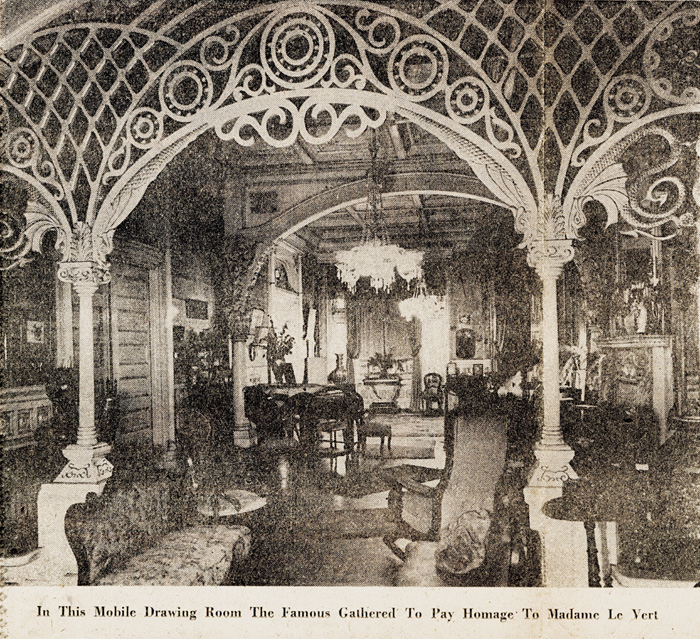
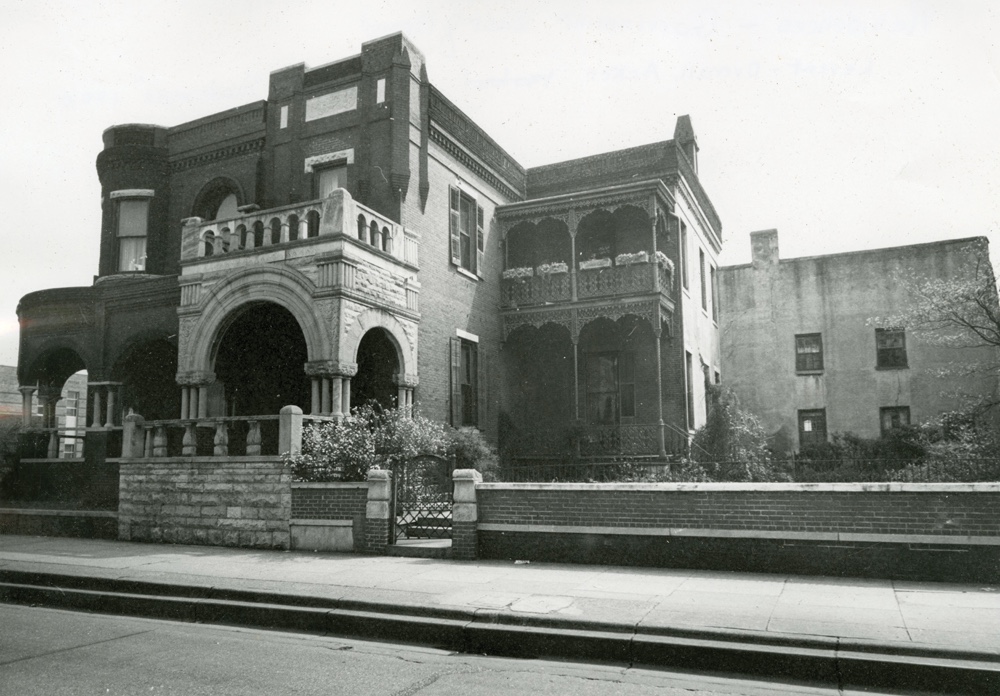
In 1835, Le Vert’s family moved from Pensacola to Mobile, Alabama, and she met and married a local doctor, Henry Strachey LeVert. Dr. LeVert spelled his last name as one word, but Octavia soon changed that and began having people call her Madame Le Vert. While in Mobile, she became known as the “Countess of Mobile,” because of her reputation as one of the nation’s leading socialites during the 1850s. The couple entertained widely, including in their circle theatrical and literary figures. As the quintessential Southern hostess who reigned over Mobile society before the Civil War, Le Vert held lavish parties in her mansion downtown on Government Street and entertaining notables from America and Europe.
Madame Le Vert’s pen pals included Henry Clay, Washington Irving, Edgar Allan Poe and General P.G.T. Beauregard. She was so close to Clay, who visited her in Mobile in 1844, that she wrote a eulogy for his funeral, for which Irving commended her. Le Vert made two trips to Europe in the mid-1850s. Some of her letters about her experiences were published in newspapers, and Le Vert was persuaded by friends to create a book from her letters and journal entries. Souvenirs of Travel was published in 1857. Millard Fillmore, the 13th U.S. president, was her escort at some of her appearances at parties in Europe. During her travels, she was presented to Queen Victoria and Prince Albert in London. She joined the guests at the court of Napoleon III in Paris and attended the New York ball in honor of the Prince of Wales, later King Edward VII. She was also a guest of Robert and Elizabeth Barrett Browning in Florence.
Le Vert’s mansion on Government Street in Mobile
During the Civil War, the citizens of Mobile became suspicious of Mobile’s leading socialite believing she sympathized with the Yankees. At the very least, she was known to be opposed to secession and slavery. Le Vert was far more cosmopolitan and educated than many of her peers in Mobile, which I am sure caused some jealousy. As the city received news of Appomattox, Le Vert committed a major faux pas when she ran to the nearby home of Admiral Raphael Semmes to cheer about General Robert E. Lee’s surrender. Legend has it that Semmes’ daughter angrily asked her to leave the premises. Her attempts to befriend the occupying troops only made things worse; her neighbors were horrified when she entertained Yankee officers in her home. For this, Le Vert was ostracized by Mobile society, and she soon left to visit friends in the North.
Along with many other wealthy Southerners, she became destitute after the war – her husband had died in 1864. In 1869, she moved to Augusta, Georgia to live with relatives in her birthplace, Belle Vue. Le Vert spent several years in the mid-1870s traveling as a public lecturer, but she returned to Belle Vue in 1876 and she died there of pneumonia the following year.
I first came across the story of Octavia Walton Le Vert when I was conducting dissertation research at the Alabama Department of Archives and History. I was searching for Alabamians who had traveled to Italy and left behind firsthand accounts. During this research I came across Le Vert’s diary from 1846-1860. The diary contained descriptions of Le Vert’s travels in Italy and other places in Europe. Her European experiences made a lasting impression on her. The poverty and misery experienced by European working women led her to work for the welfare of women working in sweat shops, cotton fields, and theatre troupes, as wells as those pioneering new fields for women. Le Vert is largely forgotten today, and her home in Mobile was demolished. She was a very interesting woman who spoke many languages and travelled widely. Too bad more people don’t know about her.
Warning: This is a long poem, but one of the most famous of the eighteenth century. The importance of this poem and the reason for choosing it is in the comments below.
An Elegy Wrote in a Country Churchyard
By Thomas Gray
The Curfeu tolls the Knell of parting Day, The lowing Herd wind slowly o’er the Lea, The Plow-man homeward plods his weary Way, And leaves the World to Darkness, and to me.
Now fades the glimmering Landscape on the Sight, And all the Air a solemn Stillness holds; Save where the Beetle wheels his droning Flight, And drowsy Tinklings lull the distant Folds.
Save that from yonder Ivy-mantled Tow’r The mopeing Owl does to the Moon complain Of such, as wand’ring near her sacred Bow’r, Molest her ancient solitary Reign.
Beneath those rugged Elms, that Yew-Tree’s Shade, Where heaves the Turf in many a mould’ring Heap, Each in his narrow Cell for ever laid, The rude Forefathers of the Hamlet sleep.
The breezy Call of Incense-breathing Morn, The Swallow twitt’ring from the Straw-built Shed, The Cock’s shrill Clarion, or the echoing Horn, No more shall rouse them from their lowly Bed.
For them no more the blazing Hearth shall burn, Or busy Houswife ply her Evening Care: No Children run to lisp their Sire’s Return, Or climb his Knees the envied Kiss to share.
Oft did the Harvest to their Sickle yield, Their Furrow oft the stubborn Glebe has broke; How jocund did they drive their Team afield! How bow’d the Woods beneath their sturdy Stroke!
Let not Ambition mock their useful Toil, Their homely Joys, and Destiny obscure; Nor Grandeur hear with a disdainful Smile, The short and simple Annals of the Poor.
The Boast of Heraldry, the Pomp of Pow’r, And all that Beauty, all that Wealth e’er gave, Awaits alike th’ inevitable Hour. The Paths of Glory lead but to the Grave.
Forgive, ye proud, th’ involuntary Fault, If Memory to these no Trophies raise, Where thro’ the long-drawn Isle and fretted Vault The pealing Anthem swells the Note of Praise.
Can storied Urn or animated Bust Back to its Mansion call the fleeting Breath? Can Honour’s Voice provoke the silent Dust, Or Flatt’ry sooth the dull cold Ear of Death!
Perhaps in this neglected Spot is laid Some Heart once pregnant with celestial Fire, Hands that the rod of Empire might have sway’d, Or wak’d to Extacy the living Lyre.
But Knowledge to their Eyes her ample Page Rich with the Spoils of Time did ne’er unroll; Chill Penury repress’d their noble Rage, And froze the genial Current of the Soul.
Full many a Gem of purest Ray serene The dark unfathom’d Caves of Ocean bear: Full many a Flower is born to blush unseen, And waste its Sweetness on the desart Air.
Some Village-Hampden, that with dauntless Breast The little Tyrant of his Fields withstood; Some mute inglorious Milton here may rest, Some Cromwell guiltless of his Country’s Blood.
Th’ Applause of list’ning Senates to command, The Threats of Pain and Ruin to despise, To scatter Plenty o’er a smiling Land, And read their Hist’ry in a Nation’s Eyes,
Their Lot forbad: nor circumscrib’d alone Their growing Virtues, but their Crimes confin’d; Forbad to wade through Slaughter to a Throne, And shut the Gates of Mercy on Mankind;
The struggling Pangs of conscious Truth to hide, To quench the Blushes of ingenuous Shame, Or heap the Shrine of Luxury and Pride With Incense, kindled at the Muse’s Flame.
Far from the madding Crowd’s ignoble Strife, Their sober Wishes never learn’d to stray; Along the cool sequester’d Vale of Life They kept the noiseless Tenor of their Way.
Yet ev’n these Bones from Insult to protect Some frail Memorial still erected nigh, With uncouth Rhimes and shapeless Sculpture deck’d, Implores the passing Tribute of a Sigh.
Their Name, their Years, spelt by th’ unletter’d Muse, The Place of fame and Elegy supply: And many a holy Text around she strews, That teach the rustic Moralist to die.
For who to dumb Forgetfulness a prey, This pleasing anxious Being e’er resign’d, Left the warm Precincts of the chearful Day, Nor cast one longing ling’ring look behind!
On some fond Breast the parting Soul relies, Some pious Drops the closing Eye requires; Even from the Tomb the Voice of Nature cries Awake, and faithful to her wonted Fires.
For thee, who, mindful of th’ unhonour’d Dead, Dost in these lines their artless Tale relate; If chance, by lonely Contemplation led, Some hidden Spirit shall inquire thy Fate,
Haply some hoary-headed Swain may say, “Oft have we seen him at the Peep of Dawn Brushing with hasty Steps the Dews away To meet the Sun upon the upland Lawn.
“There at the Foot of yonder nodding Beech That wreathes its old fantastic Roots so high, His listless Length at Noontide wou’d he stretch, And pore upon the Brook that babbles by.
“Hard by yon Wood, now smiling as in Scorn, Mutt’ring his wayward Fancies he wou’d rove; Now drooping, woeful wan, like one forlorn, Or craz’d with Care, or cross’d in hopeless Love.
“One Morn I miss’d him on the custom’d Hill, Along the Heath and near his fav’rite Tree; Another came; nor yet beside the Rill, Nor up the Lawn, nor at the Wood was he.
“The next with Dirges due in sad Array, Slow thro’ the Church-way Path we saw him born. Approach and read (for thou can’st read) the Lay, Grav’d on the Stone, beneath yon aged Thorn.”
THE EPITAPH. Here rests his Head upon the Lap of Earth A Youth to Fortune and to Fame unknown: Fair Science frown’d not on his humble Birth, And Melancholy mark’d him for her own.
Large was his Bounty, and his Soul sincere, Heav’n did a Recompence as largely send: He gave to Mis’ry all he had, a Tear: He gain’d from Heav’n (’twas all he wish’d) a Friend.
No farther seek his Merits to disclose, Or draw his Frailties from their dread Abode, (There they alike in trembling Hope repose) The Bosom of his Father and his God.
About the Poem
Thomas Gray’s famous poem “An Elegy Wrote in a Country Churchyard” was written in 1750. The poem was composed at a time of change within English poetry when poets were trying to move away from the influence of John Milton and Edmund Spenser. While Gray avoids obvious imitation, there is no mistaking the Spenserian tone of a sober melancholy. The Elegy became the single most popular eighteenth-century poem, endlessly reprinted and eventually memorized by millions of schoolchildren.
The poem’s origins are unknown, but it is believed to have been partly inspired by Gray’s thoughts following the death of the poet Richard West in 1742. Gray wrote a number of poems to West, expressing his love and his increasing agony over his sexuality. Both men were homosexual in a time when being a “sodomite” carried a possible death sentence if convicted. Critics have said that the depressive quality of the Elegy, which oddly makes it so pleasant to many readers, stems not merely from Gray’s specific grief at the loss of West (the “friend” of the epitaph) some fifteen years earlier, but also from the ongoing suppression of his homosexual identity. The nature of the speaker’s “sensibility” has come under renewed scrutiny, as several critics have argued that the term was virtually code for “homosexuality” at this time, and that the Elegy’s speaker finds in the unrealized potential of the dead a parallel for his own homosexual desires.
I chose this poem today because I have been reading Bosom Friends: The Intimate World of James Buchanan and William Rufus King by Thomas J. Balcerski. The book looks at the friendship of the bachelor politicians James Buchanan (1791-1868) of Pennsylvania and William Rufus King (1786-1853) of Alabama which has excited much speculation through the years. Why did neither marry? Were they gay? Or was their relationship a very intimate, but not a romantic friendship. I am only about a third of the way through the book, but the life of King definitely seems suspicious.
King was one of the founders of Selma, Alabama, the state’s first U.S. Senator, and Vice President of the United States in 1853, a position he held for only 45 days. He is the only Vice President to take the oath of office outside of the United States and to never serve as Vice President in Washington. King was ill with tuberculosis and had traveled to Cuba in an effort to regain his health. Because of this, he was unable to make it back to Washington for the inauguration. Shortly after taking the oath of office, he returned to his home near Selma, where he died before returning to Washington to assume the vice presidency.
Like the poet Thomas Gray, King never married. Neither even seems to have formed any meaningful attachments to women. King always said that he had loved but once and could never love again. The story goes that in 1816, he became the Secretary of the Legation for William Pinkney during Pinkney’s appointment as Minister to Russia and special diplomatic mission in Naples. While at the Court of St. Petersburg, King claimed that when he set his eyes on the future Czarina Maria Feodorovna, he instantly fell in love and almost committed a diplomatic faux pas when, as the King family tradition has it, he passionately kissed the hand of the future czarina, a risky move that could have landed him in serious jeopardy. This instance is the only time he admitted to having any romantic feelings for a woman, and it occurred halfway around the world where no one could confirm or deny the story. He would often relate this story when his bachelorhood was questioned.
King and Buchanan lived together for a number of years but separated when King became the U.S. Minister to France. King wrote Buchanan from Paris: “I am selfish enough to hope you will not be able to procure an associate who will cause you to feel no regret at our separation. For myself, I shall feel lonely in the midst of Paris, for here I shall have no Friend with whom I shall commune as with my own thoughts.”
Around the same time, Buchanan wrote a letter to a friend complaining about being alone and not being able to find the right gentleman partner:
“I am now ‘solitary and alone,’ having no companion in the house with me. I have gone a wooing to several gentlemen, but have not succeeded with any one of them. I feel that it is not good for man to be alone; and should not be astonished to find myself married to some old maid who can nurse me when I am sick, provide good dinners for me when I am well, and not expect from me any very ardent or romantic affection.”
While Buchanan at times did try to find a wife, it appears that King never did. King was known to be one of the most fashionable and handsome men in Washington. He was also known to be very fastidious in his appearance. King was a lover of literature and often quoted poetry in his letters. In one such letter, he quoted the poem above. Being well versed in literature, King was likely to have known the same-sex desires alluded to in Gray’s “An Elegy Wrote in a Country Churchyard.” Rumors have circulated for nearly two hundred years that William Rufus King was gay, and I suspect there is some truth to the rumors. Buchanan on the other hand may have been bisexual, or he simply pursued women to further his political aspirations. However, both men were politicians in a Washington that had few women and bachelorhood was seen as an advantage because a man did not have a family to worry about at home. It was not until Andrew Jackson’s presidency that women began to come with their husbands to Washington and create an exclusive social atmosphere for the women of Washington’s political elite, an event that took many years to come to fruition.
Whether King and Buchanan were lovers or merely very intimate friends, they certainly turned heads at the time and fostered a great deal of speculation. Much of their letters to one another were destroyed by family members; however, the length and intimacy of the surviving letters illustrate the affection of a special friendship between King and Buchanan, with no way to know for certain whether it was a romantic relationship.
Shall I compare thee to a summer’s day? (Sonnet 18) By William Shakespeare – 1564-1616
Shall I compare thee to a summer’s day? Thou art more lovely and more temperate. Rough winds do shake the darling buds of May, And summer’s lease hath all too short a date. Sometime too hot the eye of heaven shines, And often is his gold complexion dimmed; And every fair from fair sometime declines, By chance, or nature’s changing course, untrimmed; But thy eternal summer shall not fade, Nor lose possession of that fair thou ow’st, Nor shall death brag thou wand’rest in his shade, When in eternal lines to Time thou grow’st. So long as men can breathe, or eyes can see, So long lives this, and this gives life to thee.
The Song of the Chattahoochee By Sidney Lanier – 1842-1881
Out of the hills of Habersham, Down the valleys of Hall, I hurry amain to reach the plain, Run the rapid and leap the fall, Split at the rock and together again, Accept my bed, or narrow or wide, And flee from folly on every side With a lover’s pain to attain the plain Far from the hills of Habersham, Far from the valleys of Hall.
All down the hills of Habersham, All through the valleys of Hall, The rushes cried ‘Abide, abide,’ The willful waterweeds held me thrall, The laving laurel turned my tide, The ferns and the fondling grass said ‘Stay,’ The dewberry dipped for to work delay, And the little reeds sighed ‘Abide, abide, Here in the hills of Habersham, Here in the valleys of Hall.’
High o’er the hills of Habersham, Veiling the valleys of Hall, The hickory told me manifold Fair tales of shade, the poplar tall Wrought me her shadowy self to hold, The chestnut, the oak, the walnut, the pine, Overleaning, with flickering meaning and sign, Said, ‘Pass not, so cold, these manifold Deep shades of the hills of Habersham, These glades in the valleys of Hall.’
And oft in the hills of Habersham, And oft in the valleys of Hall, The white quartz shone, and the smooth brook-stone Did bar me of passage with friendly brawl, And many a luminous jewel lone — Crystals clear or a-cloud with mist, Ruby, garnet and amethyst — Made lures with the lights of streaming stone In the clefts of the hills of Habersham, In the beds of the valleys of Hall.
But oh, not the hills of Habersham, And oh, not the valleys of Hall Avail: I am fain for to water the plain. Downward the voices of Duty call — Downward, to toil and be mixed with the main, The dry fields burn, and the mills are to turn, And a myriad flowers mortally yearn, And the lordly main from beyond the plain Calls o’er the hills of Habersham, Calls through the valleys of Hall.
About the Poet
The Montgomery County Board of Education voted last Tuesday night to change the names of Jefferson Davis, Robert E. Lee, and Sidney Lanier High Schools — each named after men who were members of the Confederacy. I agree that Jefferson Davis and Robert E. Lee High Schools needed to be changed, but I’m not so sure it is appropriate to change the name of Sidney Lanier High School. Established in 1910 on the southern outskirts of downtown Montgomery, Alabama, the school was named for a Southern poet, Sidney Lanier, who lived in Montgomery during 1866–67. The school has one of its focuses on the arts, and Lanier (February 3, 1842 – September 7, 1881) was far more famous for being a poet and a musician than being a private in the Confederate army, where he spent most of his time as a prisoner of war. While being held in prison, Lanier contracted tuberculosis. The disease eventually killed him at age 39. Lanier was mostly forgotten for decades after his death until, in the 1920s the United Daughters of the Confederacy (UDC) worked to enhance Lanier’s posthumous reputation and succeeded in making him a symbol of the Lost Cause. The UDC called him the “Poet of the Confederacy.”
The connection with Lanier and the Lost Cause is a sad epilogue to his career. Lanier was a young man of 19 when the war broke out, and he was a southerner and a product of his time. I don’t think his legacy should be tarnished because of that. During his lifetime, Lanier published an anti-war novel about his war experiences, Tiger Lilies (1867), as well as a collection of poems, a series of adventure stories for children, and a work of criticism. His Poems (1877) brought him renown and led to his appointment as lecturer at Johns Hopkins University in 1879. He died just two years later. Lanier was considered a minor poet in his own times, and although his fame has steadily risen in recent years, he remains obscure in comparison to the giants of the 19th century such as Edgar Allan Poe, Walt Whitman, Ralph Waldo Emerson, and Henry Wadsworth Longfellow. Nonetheless, Lanier is a notable poet in the American canon because his style of writing poetry is so utterly distinct from almost every other English-language author of his era. Greatly influenced by the Anglo-Saxon poets of the Old English period, Lanier gradually developed a style of poetry written in a loose imitation of Anglo-Saxon meter that utilized extremely creative and musical alliteration and sound effects to create poetry unlike anything else written in America.
About the Poem
Lanier composed “Song of the Chattahoochee” in November 1877 for a small paper in West Point, Georgia. At the time he considered it the best poem he had ever written, and critics have generally agreed that it is one of his finer efforts. Originally from Macon, Georgia, Lanier travelled much in Georgia, Maryland, Florida, and North Carolina for employment and for his health. Lanier was able to see much of the South’s natural beauty, and he found much religious and spiritual significance in it. “Song of the Chattahoochee” is primarily a musical poem whose words flow very much like the river that is its speaker. The river’s aim is to do its duty, answering the call of God.
“Song of the Chattahoochee” describes the Chattahoochee River which begins in Georgia, has a significant portion which divides Alabama and Georgia, and empties into the Gulf of Mexico in the Florida Panhandle. The poem describes for readers the river’s journey, from its headspring in Habersham county to its end in Georgia’s East Gulf coastal plains, where, in Lanier’s time, it fed into another river that led to the Gulf of Mexico. Lanier’s style in this poem copies the rushing, shifting, gurgling motion of a true river, giving readers a little bit of the experience of following the water on its journey. He gives the river a human personality, ascribing to it human motivation. This helps to make this natural phenomenon more understandable to people who are not familiar with it and to make readers who are familiar with rivers experience the feeling of them anew.
The river is introduced as being on a mission, to water the dry fields of Georgia and to turn the water wheels that power the grain mills. Similarly, the other natural objects that the Chattahoochee passes seem to have a human motivation. They all want the river to stop, or “abide.” Most of the natural objects in the poem are presented as calling for the river to stop its motion. The waterweeds hold the river, the trees command “pass not,” the gemstones try to lure it to stay with them, etc. Nature, in general, is presented as favoring passive behavior over action. The river is presented here as an exception to nature, as being almost unnatural in its rush to keep on moving. This idea is supported by the fact that the river’s “Duty” (which is capitalized in the poem, to show its connection to God’s will) is not to aid nature, but to aid humanity in the commercial enterprises of farming and milling. The river, though natural, rushes like a human in order to fulfill its human responsibilities.
We wear the mask that grins and lies, It hides our cheeks and shades our eyes,— This debt we pay to human guile; With torn and bleeding hearts we smile, And mouth with myriad subtleties.
Why should the world be over-wise, In counting all our tears and sighs? Nay, let them only see us, while We wear the mask.
We smile, but, O great Christ, our cries To thee from tortured souls arise. We sing, but oh the clay is vile Beneath our feet, and long the mile; But let the world dream otherwise, We wear the mask!
“We Wear the Mask” was written by African American poet and novelist Paul Laurence Dunbar in 1895. Like much of Dunbar’s work, “We Wear the Mask” is a reaction to the experience of being black in America in the late 19th century, following the Civil War—a period when life seemed to have improved for black Americans yet in reality was still marked by intense racism and hardship. Dunbar compares surviving the pain of oppression to wearing a mask that hides the suffering of its wearer while presenting a more joyful face to the world.
The poem itself does not specifically mention race; its message is applicable to any circumstance in which marginalized people are forced to present a brave face in order to survive in an unsympathetic, prejudiced society. The poem begins with the speaker stating that “We,” a reference to all of humankind, put on masks. We wear them and others use them to ignore the problems that exist in modern society. They have a deep impact on our understanding of ourselves and others. Hearts are changed through tearing and mouths contain endless expressions.
“We Wear the Mask” talks about hiding behind masks to disguise our true selves, much like the LGBTQ community and the closet. Today, it feels like it could have a different meaning. Wearing a mask to help prevent the spread of COVID-19 tells us a lot about others. Those who don’t wear them are not only putting themselves at risk but also those around them. By not wearing a mask, they are committing a selfish act. By wearing a mask, we not only protect ourselves, but we show we have compassion for those around us. While politicians and their supporters fight over the topic of wearing masks, a growing number of scientific studies support the idea that masks are a critical tool in curbing the spread of the coronavirus.
Wearing a mask doesn’t take the place of other important COVID-19 prevention protocols, such as social distancing and handwashing. You can go out in public areas without a mask only if there is no one nearby. Otherwise, regardless if it’s close quarters or spaced out, you should wear a mask with others around. This is precaution and courtesy to yourself and those nearby you. Medical experts tell us that during the first wave of the pandemic, those countries that implemented masking early were more successful than others at reducing the spread of the virus. Wearing a mask doesn’t mean that you are weak or afraid or a coward. Not wearing it however tells those around you how selfish you are. It’s a way to protect the vulnerable around you. It’s our duty to keep each other healthy. So, please wear your masks.
The city’s all a-shining Beneath a fickle sun, A gay young wind’s a-blowing, The little shower is done. But the rain-drops still are clinging And falling one by one — Oh it’s Paris, it’s Paris, And spring-time has begun.
I know the Bois is twinkling In a sort of hazy sheen, And down the Champs the gray old arch Stands cold and still between. But the walk is flecked with sunlight Where the great acacias lean, Oh it’s Paris, it’s Paris, And the leaves are growing green.
The sun’s gone in, the sparkle’s dead, There falls a dash of rain, But who would care when such an air Comes blowing up the Seine? And still Ninette sits sewing Beside her window-pane, When it’s Paris, it’s Paris, And spring-time’s come again.
About Sara Teasdale On August 8, 1884, Sara Trevor Teasdale was born in St. Louis, Missouri, into an old, established, and devout family. She was home-schooled until she was nine and traveled frequently to Chicago, where she became part of the circle surrounding Poetry magazine and Harriet Monroe. Teasdale published Sonnets to Duse, and Other Poems, her first volume of verse, in 1907. Her second collection, Helen of Troy, and Other Poems, followed in 1911, and her third, Rivers to the Sea, in 1915.
In 1914 Teasdale married Ernst Filsinger; she had previously rejected a number of other suitors, including Vachel Lindsay.* She moved with her new husband to New York City in 1916. In 1918, she won the Columbia University Poetry Society Prize (which became the Pulitzer Prize for poetry) and the Poetry Society of America Prize for Love Songs, which had appeared in 1917. She published three more volumes of poetry during her lifetime: Flame and Shadow (1920), Dark of the Moon (1926), and Stars To-night (1930). Teasdale’s work had always been characterized by its simplicity and clarity, her use of classical forms, and her passionate and romantic subject matter. These later books trace her growing finesse and poetic subtlety. She divorced in 1929 and lived the rest of her life as a semi-invalid. Weakened after a difficult bout with pneumonia, Teasdale died by suicide on January 29, 1933. Her final collection, Strange Victory appeared posthumously that same year.
* Vachel Lindsay was famous in the early 20th century as a traveling bard whose dramatic delivery in public readings helped keep appreciation for poetry as a spoken art alive in the American Midwest; he called these performances the “Higher Vaudeville.”
I. “Will you walk into my parlour?” said a spider to a fly; ” ‘Tis the prettiest little parlour that ever you did spy. The way into my parlour is up a winding stair, And I have many pretty things to shew when you are there.” “Oh no, no!” said the little fly, “to ask me is in vain, For who goes up your winding stair can ne’er come down again.”
II. “I’m sure you must be weary, with soaring up so high, Will you rest upon my little bed?” said the spider to the fly. “There are pretty curtains drawn around, the sheets are fine and thin; And if you like to rest awhile, I’ll snugly tuck you in.” “Oh no, no!” said the little fly, “for I’ve often heard it said, They never, never wake again, who sleep upon your bed!”
III. Said the cunning spider to the fly, “Dear friend, what shall I do, To prove the warm affection I’ve always felt for you? I have, within my pantry, good store of all that’s nice; I’m sure you’re very welcome—will you please to take a slice?” “Oh no, no!” said the little fly, “kind sir, that cannot be,” I’ve heard what’s in your pantry, and I do not wish to see.”
IV. “Sweet creature!” said the spider, “you’re witty and you’re wise. How handsome are your gauzy wings, how brilliant are your eyes! I have a little looking-glass upon my parlour shelf, If you’ll step in one moment, dear, you shall behold yourself.” “I thank you, gentle sir,” she said, “for what you’re pleased to say, And bidding you good morning now, I’ll call another day.”
V. The spider turned him round about, and went into his den, For well he knew, the silly fly would soon come back again: So he wove a subtle web, in a little corner, sly, And set his table ready, to dine upon the fly. Then he went out to his door again, and merrily did sing, “Come hither, hither, pretty fly, with the pearl and silver wing; Your robes are green and purple—there’s a crest upon your head; Your eyes are like the diamond bright, but mine are dull as lead.”
VI. Alas, alas! how very soon this silly little fly, Hearing his wily, flattering words, came slowly flitting by; With buzzing wings she hung aloft, then near and nearer drew, Thinking only of her brilliant eyes, and green and purple hue:— Thinking only of her crested head, poor foolish thing!—At last Up jumped the cunning spider, and fiercely held her fast.
VII. He dragged her up his winding stair, into his dismal den, Within his little parlour—but she ne’er came out again! —And now, dear little children, who may this story read, To idle, silly, flattering words, I pray you ne’er give heed: Unto an evil counsellor, close heart, and ear, and eye, And take a lesson from this tale, of the Spider and the Fly.
“The Spider and the Fly” is a poem by Mary Howitt (1799–1888), published in 1829. The story tells of a cunning spider who entraps a fly into its web through the use of seduction and manipulation. The poem is a cautionary tale against those who use flattery and charm to disguise their true intentions.
About the Author:
Mary Botham Howitt was a 19th century English author who is best remembered for her famous children’s poem “The Spider and the Fly.” Her literary output was considerable and, collaborating on many projects with her husband, she had over 180 books to her name.
Besides her large output of fictional work Howitt also wrote factual books such as The Literature and Romance of Northern Europe, published in 1852, and two volumes of a Popular History of the United States in 1859. Her renown as a writer won her many awards including a civil list pension of £100 per year from April 1879.
Having converted to Catholicism late in life (she’d been raised a Quaker), she was selected as one of a delegation chosen to meet the Pope on the 10th January 1888. Unfortunately within three weeks of this great occasion, she was dead. Howitt contracted bronchitis and died in Rome on the 30th January 1888 at the age of 88. She was remembered as a spreader of “good and innocent literature,” a description that appeared in her Times Obituary.
Come with a man on your shoulders, come with a hundred men in your hair, come with a thousand men between your breasts and your feet, come like a river full of drowned men which flows down to the wild sea, to the eternal surf, to Time!
Bring them all to where I am waiting for you; we shall always be alone, we shall always be you and I alone on earth to start our life!
[original Spanish text]
Antes de mí no tengo celos.
Ven con un hombre a la espalda, ven con cien hombres en tu cabellera, ven con mil hombres entre tu pecho y tus pies, ven como un río lleno de ahogados que encuentra el mar furioso, la espuma eterna, el tiempo!
Tráelos todos adonde yo te espero: siempre estaremos solos, siempre estaremos tú y yo solos sobre la tierra para comenzar la vida!
1. We are marching, truly marching Can’t you hear the sound of feet? We are fearing no impediment We have never known defeat.
2. Like Job of old we have had patience, Like Joshua, dangerous roads we’ve trod Like Solomon we have built out temples. Like Abraham we’ve had faith in God.
3. Up the streets of wealth and commerce, We are marching one by one We are marching, making history, For ourselves and those to come.
4. We have planted schools and churches, We have answered duty’s call. We have marched from slavery’s cabin To the legislative hall.
5. Brethren can’t you catch the spirit? You who are out just get in line Because we are marching, yes we are marching To the music of the time.
6. We are marching, steady marching Bridging chasms, crossing streams Marching up the hill of progress Realizing our fondest dreams.
7. We are marching, truly marching Can’t you hear the sound of feet? We are fearing no impediment We shall never know defeat.
Yesterday, in the landmark decision Bostock v. Clayton County, Georgia, the Supreme Court ruled in a 6-3 decision that Title VII of the Civil Rights Act of 1964 protects employees against discrimination due to their sexual orientation or gender identity. The ruling was met with widespread praise among LGBTQ rights groups, which have long argued against such employment discrimination. While this year, the LGBTQ community cannot physically march in Pride parades around the country, we are symbolically marching closer to equality through the courts, and if Joe Biden wins the presidency in November, we will be making even greater strides.
Carrie Law Morgan Figgs was born in 1878. A teacher, community leader, playwright, and poet, Figgs was the author of Poetic Pearls (Edward Waters College Press, 1920) and Nuggets of Gold (Jaxon Printing Company, 1921), as well as several plays. She died in 1968.
Who is that creature
and who does he want?
Me, I trust. I do not
attempt to call out his
name for fear he will
tread on me. What do
you believe, he asks.
That we all want to be
alone, I reply, except when
we do not; that the world
was open to my sorrow
and ate most of it; that
today is a gift and I am
ready to receive you.
About Kathryn Starbuck:
Journalist, essayist, and newspaper editor, Kathryn Starbuck started writing poems in her 60s. Though she was a practiced prose writer, it was the experience of grief that led her to writing poetry. After the deaths of her husband, the poet George Starbuck, her parents, and others close to her, she found that her “scribbling” in notebooks was taking the form of poetry. She has edited the Milford, New Hampshire, weekly newspaper Cabinet. She has traveled widely and lives in Tuscaloosa, Alabama.