Category Archives: Poetry

My Son Wants to Know Who His Biological Father Is

My Son Wants to Know Who His Biological Father Is
by Blas Falconer

My son wants to know
his name. What does he look like? What does
he like? My son swims
four days a week. When my son swims
underwater, he glides
between strokes. When he glides underwater, he is
an arrow aimed
at a wall. Four days a week, his coach says,
Count—1…2…—before
coming up for air.
My father had blue eyes, blonde hair,
though mine are brown.
My father could not speak
Spanish and wondered, How can you love
another man? We rarely touched.
When my son
is counting, I count
with him. I say, I am
your father, too. 1…2…

About this Poem

“One day I was listening to my son’s swim coach and her feedback on his breaststroke, how he couldn’t muscle his way across the pool, how stillness and patience were important components of good technique. To encourage this, she had him count while his head was under the water, and it seemed like good advice for a lot of things, bearing what troubles you, for example, or writing a poem that is particularly challenging.”
Blas Falconer


To Television

To Television
by Robert Pinsky

Not a “window on the world”
But as we call you,
A box a tube

Terrarium of dreams and wonders.
Coffer of shades, ordained
Cotillion of phosphors
Or liquid crystal

Homey miracle, tub
Of acquiescence, vein of defiance.
Your patron in the pantheon would be Hermes

Raster dance,
Quick one, little thief, escort
Of the dying and comfort of the sick,

In a blue glow my father and little sister sat
Snuggled in one chair watching you
Their wife and mother was sick in the head
I scorned you and them as I scorned so much

Now I like you best in a hotel room,
Maybe minutes
Before I have to face an audience: behind
The doors of the armoire, box
Within a box–Tom & Jerry, or also brilliant
And reassuring, Oprah Winfrey.

Thank you, for I watched, I watched
Sid Caesar speaking French and Japanese not
Through knowledge but imagination,
His quickness, and Thank You, I watched live
Jackie Robinson stealing

Home, the image–O strung shell–enduring
Fleeter than light like these words we
Remember in, they too winged
At the helmet and ankles.


March Evening

March Evening
by Amy Lowell, 1874 – 1925

Blue through the window burns the twilight;
Heavy, through trees, blows the warm south wind.
Glistening, against the chill, gray sky light,
Wet, black branches are barred and entwined.

Sodden and spongy, the scarce-green grass plot
Dents into pools where a foot has been.
Puddles lie spilt in the road a mass, not
Of water, but steel, with its cold, hard sheen.

Faint fades the fire on the hearth, its embers
Scattering wide at a stronger gust.
Above, the old weathercock groans, but remembers
Creaking, to turn, in its centuried rust.

Dying, forlorn, in dreary sorrow,
Wrapping the mists round her withering form,
Day sinks down; and in darkness to-morrow
Travails to birth in the womb of the storm.


Love the Light-Giver

Love the Light-Giver
by Michelangelo Buonarroti

To Tommaso De’ Cavalieri

Veggio co’ bei vostri occhi.*

With your fair eyes a charming light I see,
For which my own blind eyes would peer in vain;
Stayed by your feet, the burden I sustain
Which my lame feet find all too strong for me;
Wingless upon your pinions forth I fly;
Heavenward your spirit stirreth me to strain;
E’en as you will, I blush and blanch again,
Freeze in the sun, burn ’neath a frosty sky.
Your will includes and is the lord of mine;
Life to my thoughts within your heart is given;
My words begin to breathe upon your breath:
Like to the moon am I, that cannot shine
Alone; for lo! our eyes see nought in heaven
Save what the living sun illumineth.

*Wonder with your beautiful eyes.


Sometimes I Cry

Sometimes I Cry
By DJ

I told a million lies now it’s time to tell a single truth
Sometimes I cry
It’s hard dealing with my pride
Not knowing whether to fight or flee
Sometimes I cry
Hard to maintain this image of a tough guy
When deep down inside I am terrified
If I ever told you I wasn’t scared I lied
Struggling to make it back
To society and my family
I cry
I cry for my son who I barely see
Due to these mountains
And me and his mom’s beef
I cry for my siblings who never knew their older brother
Because he stayed in the streets
I cry for my grandma who is now deceased
I cry for my life, half of which they took for me
I cry for my anger and rage
The only emotions I can show in this place
I cry for how we treat each other inside these walls
I cry for the lack of unity we have most of all
When will it end I want to know
Till then all I can do is let these tears flow

About This Poem
This poem was published in partnership with Free Minds Book Club & Writing Workshop, an organization based in Washington, DC. They are committed to elevating and amplifying the voices of those directly impacted by the prison system. Through creative writing, job readiness training, and violence prevention outreach, Free Minds assists members who are incarcerated or formerly incarcerated youths and adults to realize their own potential. The poet’s last name is withheld on request in consideration of their privacy.

To add to this description, I think there are times we all cry. I know last week, I had a day when I just wanted to sit down and cry. There was no particular reason. Nothing bad had happened. I just felt like crying. It’s possible this was a reaction to one of my medications that can make me hyperemotional, but I think many of us have down days. If you have had days like this more often than not in the past two weeks, I urge you to seek out your doctor and let him/her know what is going on. Depression is a serious illness that can be treated.

Furthermore, sometimes we also cry for certain events in our life; we cry for our now deceased Grandmama or we cry for the pet we just lost. It may be that we miss a friend or that we feel overwhelmed. There are many reasons to cry. And do you know what the best solution is? Let yourself cry. It will make you feel so much better.

He who learns must suffer. And even in our sleep pain that cannot forget falls drop by drop upon the heart, and in our own despair, against our will, comes wisdom to us by the awful grace of God. Aeschylus


The Mortal Lease

The Mortal Lease
byEdith Wharton

II.

Because our kiss is as the moon to draw
The mounting waters of that red-lit sea
That circles brain with sense, and bids us be
The playthings of an elemental law,
Shall we forego the deeper touch of awe
On love’s extremest pinnacle, where we,
Winging the vistas of infinity,
Gigantic on the mist our shadows saw?

Shall kinship with the dim first-moving clod
Not draw the folded pinion from the soul,
And shall we not, by spirals vision-trod,
Reach upward to some still-retreating goal,
As earth, escaping from the night’s control,
Drinks at the founts of morning like a god?


On Joy and Sorrow

On Joy and Sorrow
by Kahlil Gibran

Then a woman said, Speak to us of Joy and Sorrow.
And he answered:
Your joy is your sorrow unmasked.
And the selfsame well from which your laughter rises was oftentimes filled with your tears.
And how else can it be?
The deeper that sorrow carves into your being, the more joy you can contain.
Is not the cup that holds your wine the very cup that was burned in the potter’s oven?
And is not the lute that soothes your spirit, the very wood that was hollowed with knives?
When you are joyous, look deep into your heart and you shall find it is only that which has given you sorrow that is giving you joy.
When you are sorrowful look again in your heart, and you shall see that in truth you are weeping for that which has been your delight.

Some of you say, “Joy is greater than sorrow,” and others say, “Nay, sorrow is the greater.”
But I say unto you, they are inseparable.
Together they come, and when one sits alone with you at your board, remember that the other is asleep upon your bed.

Verily you are suspended like scales between your sorrow and your joy.
Only when you are empty are you at standstill and balanced.
When the treasure-keeper lifts you to weigh his gold and his silver, needs must your joy or your sorrow rise or fall.


Birches

Birches
Robert Frost, 1874 – 1963

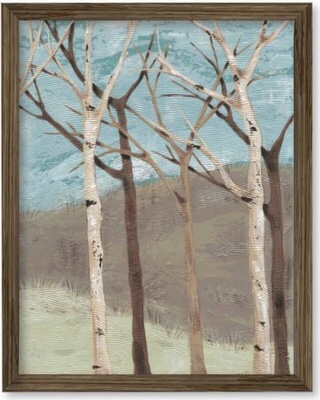
When I see birches bend to left and right
Across the lines of straighter darker trees,
I like to think some boy’s been swinging them.
But swinging doesn’t bend them down to stay
As ice-storms do. Often you must have seen them
Loaded with ice a sunny winter morning
After a rain. They click upon themselves
As the breeze rises, and turn many-colored
As the stir cracks and crazes their enamel.
Soon the sun’s warmth makes them shed crystal shells
Shattering and avalanching on the snow-crust–
Such heaps of broken glass to sweep away
You’d think the inner dome of heaven had fallen.
They are dragged to the withered bracken by the load,
And they seem not to break; though once they are bowed
So low for long, they never right themselves:
You may see their trunks arching in the woods
Years afterwards, trailing their leaves on the ground
Like girls on hands and knees that throw their hair
Before them over their heads to dry in the sun.
But I was going to say when Truth broke in
With all her matter-of-fact about the ice-storm
I should prefer to have some boy bend them
As he went out and in to fetch the cows–
Some boy too far from town to learn baseball,
Whose only play was what he found himself,
Summer or winter, and could play alone.
One by one he subdued his father’s trees
By riding them down over and over again
Until he took the stiffness out of them,
And not one but hung limp, not one was left
For him to conquer. He learned all there was
To learn about not launching out too soon
And so not carrying the tree away
Clear to the ground. He always kept his poise
To the top branches, climbing carefully
With the same pains you use to fill a cup
Up to the brim, and even above the brim.
Then he flung outward, feet first, with a swish,
Kicking his way down through the air to the ground.
So was I once myself a swinger of birches.
And so I dream of going back to be.
It’s when I’m weary of considerations,
And life is too much like a pathless wood
Where your face burns and tickles with the cobwebs
Broken across it, and one eye is weeping
From a twig’s having lashed across it open.
I’d like to get away from earth awhile
And then come back to it and begin over.
May no fate willfully misunderstand me
And half grant what I wish and snatch me away
Not to return. Earth’s the right place for love:
I don’t know where it’s likely to go better.
I’d like to go by climbing a birch tree,
And climb black branches up a snow-white trunk
Toward heaven, till the tree could bear no more,
But dipped its top and set me down again.
That would be good both going and coming back.
One could do worse than be a swinger of birches.


Winter-Lull

Winter-Lull
by D. H. Lawrence

Because of the silent snow, we are all hushed
Into awe.
No sound of guns, nor overhead no rushed
Vibration to draw
Our attention out of the void wherein we are crushed.

A crow floats past on level wings
Noiselessly.
Uninterrupted silence swings
Invisibly, inaudibly
To and fro in our misgivings.

We do not look at each other, we hide
Our daunted eyes.
White earth, and ruins, ourselves, and nothing beside.
It all belies
Our existence; we wait, and are still denied.

We are folded together, men and the snowy ground
Into nullity.
There is silence, only the silence, never a sound
Nor a verity
To assist us; disastrously silence-bound!


The Trumpet

The Trumpet
by Edward Thomas

Rise up, rise up,
And, as the trumpet blowing
Chases the dreams of men,
As the dawn glowing
The stars that left unlit
The land and water,
Rise up and scatter
The dew that covers
The print of last night’s lovers—
Scatter it, scatter it!

While you are listening
To the clear horn,
Forget, men, everything
On this earth new-born,
Except that it is lovelier
Than any mysteries.
Open your eyes to the air
That has washed the eyes of the stars
Through all the dewy night:
Up with the light,
To the old wars:
Arise, arise.

Edward Thomas was born on March 3, 1878. His books include Poems (H. Holt and Company, 1917) and Last Poems (Selwyn and Blount, 1918), among others. He died in battle on April 9, 1917, in Arras, France.