Category Archives: Poetry

Two Loves

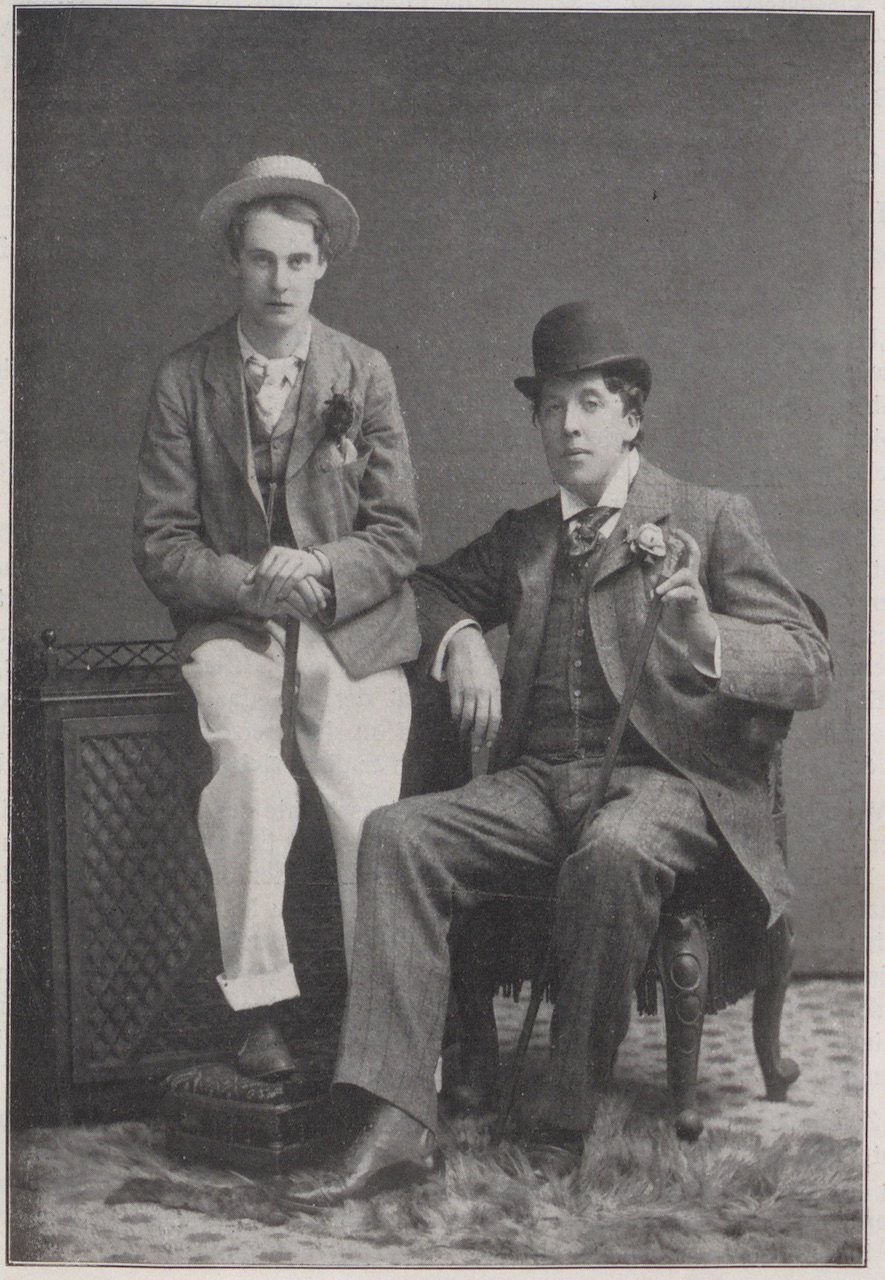
Lord Alfred Douglas and Oscar Wilde (circa 1894)

Two Loves
By Lord Alfred Douglas

I dreamed I stood upon a little hill,
And at my feet there lay a ground, that seemed
Like a waste garden, flowering at its will
With buds and blossoms. There were pools that dreamed
Black and unruffled; there were white lilies
A few, and crocuses, and violets
Purple or pale, snake-like fritillaries
Scarce seen for the rank grass, and through green nets
Blue eyes of shy peryenche winked in the sun.
And there were curious flowers, before unknown,
Flowers that were stained with moonlight, or with shades
Of Nature’s willful moods; and here a one
That had drunk in the transitory tone
Of one brief moment in a sunset; blades
Of grass that in an hundred springs had been
Slowly but exquisitely nurtured by the stars,
And watered with the scented dew long cupped
In lilies, that for rays of sun had seen
Only God’s glory, for never a sunrise mars
The luminous air of Heaven. Beyond, abrupt,
A grey stone wall, o’ergrown with velvet moss
Uprose; and gazing I stood long, all mazed
To see a place so strange, so sweet, so fair.
And as I stood and marvelled, lo! across
The garden came a youth; one hand he raised
To shield him from the sun, his wind-tossed hair
Was twined with flowers, and in his hand he bore
A purple bunch of bursting grapes, his eyes
Were clear as crystal, naked all was he,
White as the snow on pathless mountains frore,
Red were his lips as red wine-spilith that dyes
A marble floor, his brow chalcedony.
And he came near me, with his lips uncurled
And kind, and caught my hand and kissed my mouth,
And gave me grapes to eat, and said, ‘Sweet friend,
Come I will show thee shadows of the world
And images of life. See from the South
Comes the pale pageant that hath never an end.’
And lo! within the garden of my dream
I saw two walking on a shining plain
Of golden light. The one did joyous seem
And fair and blooming, and a sweet refrain
Came from his lips; he sang of pretty maids
And joyous love of comely girl and boy,
His eyes were bright, and ’mid the dancing blades
Of golden grass his feet did trip for joy;
And in his hand he held an ivory lute
With strings of gold that were as maidens’ hair,
And sang with voice as tuneful as a flute,
And round his neck three chains of roses were.
But he that was his comrade walked aside;
He was full sad and sweet, and his large eyes
Were strange with wondrous brightness, staring wide
With gazing; and he sighed with many sighs
That moved me, and his cheeks were wan and white
Like pallid lilies, and his lips were red
Like poppies, and his hands he clenched tight,
And yet again unclenched, and his head
Was wreathed with moon-flowers pale as lips of death.
A purple robe he wore, o’erwrought in gold
With the device of a great snake, whose breath
Was fiery flame: which when I did behold
I fell a-weeping, and I cried, ‘Sweet youth,
Tell me why, sad and sighing, thou dost rove
These pleasent realms? I pray thee speak me sooth
What is thy name?’ He said, ‘My name is Love.’
Then straight the first did turn himself to me
And cried, ‘He lieth, for his name is Shame,
But I am Love, and I was wont to be
Alone in this fair garden, till he came
Unasked by night; I am true Love, I fill
The hearts of boy and girl with mutual flame.’
Then sighing, said the other, ‘Have thy will,
I am the love that dare not speak its name.’
I am the Love that dare not speak its name.

About the Poem

“I am the Love that dare not speak its name.”

At first glance, this simple line may not seem radical, but it became one of the most infamous phrases in queer literary history. It appears at the end of “Two Loves,” a lyrical, decadent poem by Lord Alfred Douglas that depicts two personified versions of love—one conventional and socially accepted, the other mysterious and sorrowful. The speaker walks in a dreamlike landscape and is approached by two male figures. One exudes joy and ease; the other, pale and burdened, declares himself “the Love that dare not speak its name.” It is a powerful and poetic metaphor for same-sex desire in a world that condemns it.

The phrase was later used by prosecutors in Oscar Wilde’s 1895 trial, where Wilde was asked to explain it. Wilde’s eloquent defense—describing a deep, spiritual love between older and younger men, as seen in Greek culture—only further scandalized the court. The line became symbolic not only of homosexual love in the Victorian era but also of the shame and silence that society forced upon it. Yet, in Wilde’s and Douglas’s hands, it also carried dignity and beauty.
“Two Loves” is part of a larger tradition of homoerotic poetry written in code, metaphor, or allegory—common for queer writers in repressive eras. But Douglas, influenced by the aesthetic movement and emboldened by his association with Wilde, pushes further into clarity. The poem’s final admission is not whispered but proudly declared, even if society cannot bear to hear it. As such, the poem resonates today as both a historical artifact and a testament to the enduring defiance of queer love.

About the Poet

While Douglas is best remembered for his association with Oscar Wilde, he was a poet in his own right. Born in 1870 into British nobility, Lord Alfred Bruce Douglas—nicknamed “Bosie”—was the third son of the Marquess of Queensberry. He was well-educated at Winchester and briefly at Oxford, where he cultivated both his love of literature and his increasingly strained relationship with traditional morality. In 1891, he met Wilde, who was already a renowned playwright and wit. Their relationship was passionate, tumultuous, and deeply influential on both their lives and careers.

Douglas encouraged Wilde to explore more overtly homoerotic themes, even contributing translations of classical gay texts. However, his relationship with Wilde led to public scandal and ultimately Wilde’s imprisonment. After Wilde’s trial and release, Douglas distanced himself from his former lover and, in later life, became a conservative Catholic and vocal critic of homosexuality—a tragic turn that reflects the intense pressures and contradictions of his era.
Despite this retreat, Douglas’s early poetry—particularly “Two Loves”—remains a cornerstone of queer literary history. It captures the longing, the repression, and the quiet bravery of same-sex love at the close of the 19th century. During Pride Month, revisiting Douglas’s work reminds us how far we’ve come—and how the words of those who dared to speak when it was dangerous continue to echo in the hearts of LGBTQ+ readers today.



Beauty and Beauty

Beauty and Beauty
By Rupert Brooke

When Beauty and Beauty meet     All naked, fair to fair, The earth is crying-sweet,     And scattering-bright the air, Eddying, dizzying, closing round,     With soft and drunken laughter; Veiling all that may befall     After—after— Where Beauty and Beauty met,     Earth’s still a-tremble there, And winds are scented yet,     And memory-soft the air, Bosoming, folding glints of light,     And shreds of shadowy laughter; Not the tears that fill the years     After—after—

About the Poem

Rupert Brooke is often remembered as the handsome golden boy of early 20th-century English poetry—a soldier-poet who wrote idealistic verses before his untimely death in World War I. But beyond the patriotic sonnets and romanticized nationalism, there are quieter, more intimate poems where something deeper—perhaps more revealing—emerges. One such poem is “Beauty and Beauty,” a short but evocative lyric that resists easy categorization. 

At first glance, the poem reads like a celebration of romantic or sensual union—two abstracted figures (or perhaps lovers), meeting in a moment of rapture, dissolving into something transcendent. The language is lush and tactile: “naked, fair to fair,” “ecstasy double,” “clasp and the joy and the heat.” The entire scene evokes physicality, longing, and fleeting perfection. What’s striking is the absence of gender. The poem does not say he and she, nor even they in a way that suggests duality of sex. Instead, it speaks of Beauty and Beauty—two mirrored forces, equal in form and attraction. This mirroring—“fair to fair”—can be read as a poetic device, but also as something more intimate: a union of likeness, not difference.

Some scholars have long speculated about Rupert Brooke’s sexuality. He was part of Cambridge circles that included queer intellectuals like E.M. Forster and Maynard Keynes. His letters reveal emotionally intense relationships with both men and women, though concrete evidence of same-sex relationships remains elusive—partly because queerness at the time was veiled, coded, or suppressed altogether. But poetry has always been a place for what could not be said directly.

If we allow ourselves to read “Beauty and Beauty” through a queer lens, we can begin to see it not just as a love poem, but as a celebration of two men—fair and fair, entwined in a moment of passion and transcendence. There is no need to disguise desire in gendered roles. The love here is elemental, luminous, and fleeting. It begins with naked beauty and ends with the world asleep, spent from witnessing their union.

Brooke’s language in the poem is deeply sensual but avoids vulgarity. It is about the merging of two forces—perhaps two bodies, perhaps two souls. And the line “melt into one perfect sphere” feels almost mythic, like Aristophanes’ description in Plato’s Symposium of original humans as spherical beings split apart, ever longing to be whole again. That myth, often invoked in queer readings of classical texts, frames love between men not as deviation, but as origin—a kind of primal longing. Brooke may have known this, or at least felt it. His poem offers a vision of beauty that dares to be symmetrical, unashamed, and fleetingly divine.

“Beauty and Beauty” is a short poem, but its power lies in what it refuses to define. It leaves open a space for same-sex love—not overtly, but unmistakably. Whether or not Brooke intended it as a reflection of his own desires, the poem speaks to anyone who has ever found beauty in someone who mirrors their own longing. In that way, it becomes a quiet act of defiance. A poem that, in just twelve lines, opens the door to a love that dares not speak its name—yet sings, briefly, with crystalline clarity.

About the Poet

Rupert Brooke (1887–1915) occupies a unique space in the history of English literature—a poet whose fame was built as much on his classical beauty and tragic death as on the haunting lyricism of his verse. A product of Rugby School and King’s College, Cambridge, Brooke rose to prominence just before the First World War with a body of poetry that was elegant, wistful, and suffused with longing. His early poems explored themes of love, nature, and transience, often in language that was sensuous and delicately melancholic. His most famous work, the 1914 sonnet sequence—including the much-anthologized The Soldier—framed patriotic sacrifice in romantic and spiritual terms, offering a vision of war that felt noble and redemptive. It struck a chord with a nation on the brink of catastrophe.

Yet there is more to Rupert Brooke than patriotic verse. Beneath the idealized imagery of sacrifice lies a poet deeply attuned to beauty and desire, whose emotional life was complex and, at times, tortured. Brooke had relationships with women, but his most intense emotional connections were often with men. He moved in intellectual circles that included many queer figures of the day—such as Virginia Woolf, Lytton Strachey, and E.M. Forster—and his letters and friendships suggest an internal struggle with identity and intimacy. While modern scholars stop short of labeling him definitively gay or bisexual, there is a growing consensus that his sexuality was fluid and that his poetry often masks or sublimates homoerotic longing.

Poems like Beauty and Beauty hint at a love that transcends gendered norms, offering brief, luminous glimpses of physical and emotional union that resist definition. His use of idealized forms—beauty, ecstasy, the merging of bodies—evokes classical and Platonic traditions that have long resonated with queer readers. That Brooke rarely wrote overtly of same-sex love is perhaps unsurprising given the social pressures of Edwardian England, but the emotional intensity and coded language of his verse leave space for queer interpretation.

Brooke’s life was cut tragically short during World War I. Commissioned as a sub-lieutenant in the Royal Naval Division, he died of sepsis from an infected mosquito bite aboard a French hospital ship in the Aegean Sea in 1915. He was 27 years old. His death, just months before the slaughter of the Somme and the disillusionment that followed, helped enshrine him as the quintessential tragic youth—a symbol of innocence lost to war. Yet his legacy endures not only in patriotic myth but also in the more private, lyrical moments of his poetry, where longing and beauty converge in ways still deeply moving—and, perhaps, more revealing than even he intended.


Love Returned

Love Returned
By Bayard Taylor

He was a boy when first we met;
  His eyes were mixed of dew and fire,
And on his candid brow was set
  The sweetness of a chaste desire:
But in his veins the pulses beat
  Of passion, waiting for its wing,
As ardent veins of summer heat
  Throb through the innocence of spring.

As manhood came, his stature grew,
  And fiercer burned his restless eyes,
Until I trembled, as he drew
  From wedded hearts their young disguise.
Like wind-fed flame his ardor rose,
  And brought, like flame, a stormy rain:
In tumult, sweeter than repose,
  He tossed the souls of joy and pain.

So many years of absence change!
  I knew him not when he returned:
His step was slow, his brow was strange,
  His quiet eye no longer burned.
When at my heart I heard his knock,
  No voice within his right confessed:
I could not venture to unlock
  Its chambers to an alien guest.

Then, at the threshold, spent and worn
  With fruitless travel, down he lay:
And I beheld the gleams of morn
  On his reviving beauty play.
I knelt, and kissed his holy lips,
  I washed his feet with pious care;
And from my life the long eclipse
  Drew off; and left his sunshine there.

He burns no more with youthful fire;
  He melts no more in foolish tears;
Serene and sweet, his eyes inspire
  The steady faith of balanced years.
His folded wings no longer thrill,
  But in some peaceful flight of prayer:
He nestles in my heart so still,
  I scarcely feel his presence there.

O Love, that stern probation o’er,
  Thy calmer blessing is secure!
Thy beauteous feet shall stray no more,
  Thy peace and patience shall endure!
The lightest wind deflowers the rose,
  The rainbow with the sun departs,
But thou art centred in repose,
  And rooted in my heart of hearts!

About the Poem

Bayard Taylor is not a household name today, but in the 19th century, he was known as a celebrated American poet, travel writer, and diplomat. A close contemporary of figures like Walt Whitman and Ralph Waldo Emerson, Taylor’s work was steeped in romantic idealism, emotional intensity, and the mystique of distant lands. One of his lesser-known but deeply resonant poems, “Love Returned,” offers a quiet but powerful meditation on lost love.

At first glance, “Love Returned” seems to be about an emotionally bruised speaker reckoning with the unexpected return of a former beloved. The title suggests something joyful, even redemptive. And yet, the tone of the poem is anything but triumphant. Instead of welcoming love back with open arms, the speaker responds with hesitation, guardedness, and sorrow. There’s a clear sense that too much time has passed, too much pain has been endured. The love that once flourished now feels shadowed by distance and distrust.

Lines such as:

“Thou com’st too late, O love of mine…”

reveal the speaker’s reluctance to embrace this returning affection. We sense a deep internal struggle: the heart that once yearned is now tempered by hard-won wisdom and past wounds. Love may return, but the damage of its absence lingers. The emotional register here is raw and sincere, placing it squarely among the more moving poetic treatments of love’s ambivalence and timing.

In “Love Returned,” the use of abstract, universal terms like “Love,” “thou,” and “mine” allows readers of any gender or orientation to find themselves in the speaker’s position. But for LGBTQ readers—particularly those who have experienced the painful dynamics of love delayed, denied, or hidden—the emotional undercurrents may feel particularly resonant. The poem evokes that aching space between longing and fulfillment, a space many queer people have inhabited at some point in their lives.

Moreover, the speaker’s refusal to immediately accept the returning love is layered with meaning. It’s not just about betrayal or abandonment. It might also speak to the fear of being hurt again, of trusting love that once had to be hidden, or of reckoning with the societal forces that prevented it from being fully realized the first time. It is a deeply human moment, but also one that echoes the specific emotional terrain of queer lives lived in secrecy.

About the Poet

Bayard Taylor (1825–1878) was a prolific American poet, novelist, journalist, travel writer, and diplomat. Born in Kennett Square, Pennsylvania, Taylor demonstrated a precocious talent for language and literature from a young age. He began publishing poetry in his teens and soon embarked on the first of many extensive journeys abroad—travels that would inspire a series of widely read books chronicling his experiences in Europe, the Middle East, and Asia. Taylor became a household name in mid-19th century America for his vivid travel writing and poetry, including the popular Views Afoot (1846) and Poems of the Orient (1854). He served as a diplomat in Russia and later as U.S. Minister to Prussia (now part of Germany), where he died in 1878 at the age of 53.

While Taylor married and led a respected public life, modern scholars have noted homoerotic undertones in much of his poetry and correspondence, suggesting that Taylor experienced same-sex attraction, particularly in his youth, but he lived in a time when open expressions of same-sex love were dangerous—legally, socially, and professionally. His early poems often feature idealized male figures and deep emotional bonds between men, framed in ways that were common among queer writers of the 19th century who had to navigate a society that criminalized or pathologized homosexuality. Like many queer writers of the 19th century, Taylor often employed gender-neutral language, making it possible for his expressions of love to be read in multiple ways. This ambiguity was not just a poetic device; it was a shield, allowing intimacy and affection to pass under the radar of a society that punished queer expression.

Taylor’s personal letters and early poetry hint at a rich and complex emotional world in which same-sex desire played a significant role. Though he later married and maintained a public heterosexual persona, he had deep emotional bonds with men—some of which appear to have crossed into romantic or erotic territory. Scholars have identified several of Taylor’s poems, including “To a Young Soldier” and several of his Eastern-themed verses, as part of a larger tradition of 19th-century queer poetics—works that expressed forbidden feelings through coded language, aesthetic distancing, and allegory.

Taylor’s relationships with male friends—intense, affectionate, and sometimes suggestively romantic—reflect a pattern familiar to LGBTQ+ historians: a life of coded expression, emotional sublimation, and poetic longing. While he did not (and likely could not) openly identify as queer in his time, Taylor’s body of work contains a rich undercurrent of queer sensibility, especially in poems like “Love Returned” and “To a Young Soldier.” Today, Bayard Taylor is recognized not only as a pioneering American literary voice but also as an important figure in early queer literary history, whose writings offer a window into the inner lives of men who loved other men in an era of silence.


If I Could Tell You

If I Could Tell You
By W H Auden

Time will say nothing but I told you so,
Time only knows the price we have to pay;
If I could tell you I would let you know.

If we should weep when clowns put on their show,
If we should stumble when musicians play,
Time will say nothing but I told you so.

There are no fortunes to be told, although,
Because I love you more than I can say,
If I could tell you I would let you know.

The winds must come from somewhere when they blow,
There must be reasons why the leaves decay;
Time will say nothing but I told you so.

Perhaps the roses really want to grow,
The vision seriously intends to stay;
If I could tell you I would let you know.

Suppose all the lions get up and go,
And all the brooks and soldiers run away;
Will Time say nothing but I told you so?
If I could tell you I would let you know.

About this Poem

W. H. Auden’s “If I Could Tell You” is one of the most elegant and haunting examples of the villanelle* form in 20th-century poetry. Written in 1940, during a time of global uncertainty and personal introspection, the poem reflects Auden’s preoccupations with fate, time, and the limits of human understanding. Through the disciplined repetition inherent to the villanelle structure, Auden explores the futility of attempting to predict or control the future, as well as the painful inability to articulate certain emotional truths. The poem is widely celebrated not only for its formal mastery but also for the quiet emotional resonance it achieves within the constraints of a tightly ordered verse.

The speaker begins with the striking line, “Time will say nothing but I told you so,” immediately positioning time as a silent but omniscient force. This refrain recurs throughout the poem, becoming a kind of mantra that expresses the speaker’s sense of resignation. Time, in Auden’s conception, offers no guidance or foresight; it speaks only after events have unfolded and merely to affirm what could not be known beforehand. The second refrain—“If I could tell you, I would let you know”—is equally suggestive. It conveys a deep desire to communicate something essential, perhaps a truth about love, destiny, or mortality, yet the speaker admits that such knowledge lies beyond the reach of speech. This interplay between knowing and unknowing, between expression and silence, gives the poem its emotional power.

Throughout the poem’s six stanzas, Auden employs the villanelle form to echo the very limitations he describes. The repetition of the refrains mirrors the cyclical nature of thought, especially when grappling with uncertainties about the future or love. Each repetition slightly alters in context, accumulating new emotional weight as the poem progresses. This structural device reinforces the central themes: human beings return again and again to the same questions about time, fate, and communication, but definitive answers remain elusive. The fixed form, with its repeated lines and rhyme scheme, becomes a metaphor for the limits of human perspective—we can frame questions and revisit them, but we may never escape their orbit.

Despite its philosophical tone, the poem also carries a deeply personal undercurrent. There is an implicit intimacy in the speaker’s voice, a sense that this is a private confession addressed to someone the speaker longs to reach. Lines such as “Suppose the lions all get up and go, / And all the brooks and soldiers run away” evoke surreal imagery that suggests a world in flux, where nothing can be counted on to stay or behave as expected. The poem ultimately resists clarity or conclusion; instead, it invites readers to dwell in uncertainty. This refusal to offer easy resolution is part of what makes the poem so enduring—it captures a universal human condition with spare, deliberate language.

“If I Could Tell You” is also a classic example of the villanelle because of how skillfully Auden uses the form to enhance, rather than restrict, meaning. The villanelle’s strict pattern of nineteen lines—five tercets and a final quatrain, with two alternating refrains—often leads poets toward predictability or formal stiffness. Auden, however, embraces these limitations to serve the poem’s meditation on fate. The refrains are not static repetitions but dynamic reframings, deepening with each recurrence. The rhyme scheme (ABA throughout, with the final stanza ABAA) provides musicality without drawing undue attention to itself. This seamless integration of structure and sentiment is what makes Auden’s villanelle exemplary.

In conclusion, “If I Could Tell You” is a masterwork of poetic form and philosophical inquiry. It demonstrates how the villanelle, often associated with obsessive or lyrical themes, can also express complex reflections on time, knowledge, and emotional truth. Auden’s use of the form allows for a careful layering of meaning, where each return to the refrain evokes not repetition, but revelation. The poem lingers in the reader’s mind long after the final lines, not because it offers answers, but because it gives voice to the yearning for them. Through its elegant structure and aching restraint, “If I Could Tell You” stands as one of the most affecting and enduring villanelles in English literature.

Villanelles and sonnets are my two favorite poetic forms. The rigidity of the rules of these forms takes a truly dedicated person to write. I love the repetition in a villanelle, and sonnets always have that little twist at the end. In case you are not familiar with the rigid structure of these poems:

villanelle is a 19-line poem composed of five tercets followed by a quatrain, with two repeating refrains and a strict ABA rhyme scheme. The first and third lines of the opening stanza alternate as the final lines of the subsequent stanzas and both reappear in the concluding quatrain. This repetitive structure creates a lyrical, cyclical effect often used to express obsession, longing, or inevitability. 

sonnet is a 14-line poem written in iambic pentameter with a specific rhyme scheme and structure. The two most common types are the Petrarchan (Italian) sonnet, which divides into an octave and a sestet (usually ABBAABBA CDECDE), and the Shakespearean (English) sonnet, which has three quatrains and a final couplet (ABAB CDCD EFEF GG). Sonnets traditionally explore themes like love, time, beauty, and mortality.

About the Poet

W. H. Auden (Wystan Hugh Auden) was born on February 21, 1907, in York, England, and raised in an intellectually vibrant household in Birmingham. He studied English literature at Christ Church, Oxford, where he emerged as a brilliant and unconventional young poet. In the 1930s, Auden became a central figure in British literary and political life, known for his formal innovation, sharp intellect, and engagement with social and psychological themes. His early poetry often reflected a concern with war, oppression, and spiritual crisis, influenced by his travels in Germany and Spain during periods of political upheaval.

Auden was gay, and while he never publicly identified as such in a modern political sense—given the cultural and legal constraints of his time—his sexuality was a formative aspect of his identity and creative life. Though often discreet in public, he was relatively open within his artistic circles and close relationships. His lifelong partnership with the American poet Chester Kallman, beginning in 1939, deeply shaped both his personal life and literary output, even as their romantic relationship eventually evolved into a complicated, platonic companionship. Many of Auden’s poems, particularly his love lyrics, carry a tone of longing, vulnerability, and emotional depth that reflect his experiences as a gay man seeking intimacy in a world that often denied him open recognition.

Auden emigrated to the United States in 1939 and became a U.S. citizen in 1946. This move marked a shift in both geography and poetic style: his later work became more philosophical, often concerned with theology, morality, and the inner life. Still, the emotional resonance of his early relationships and romantic disappointments lingered in his poetry. Works like “Lullaby,” “Funeral Blues,” and “The Sea and the Mirror” delicately explore themes of homoerotic desire, loss, and spiritual reconciliation, even when not explicitly naming the gender of the beloved. Auden’s ability to navigate such personal material through layered language and formal control allowed him to speak of love and pain in ways that transcended the boundaries of his era.

He spent his final years between New York and Austria, continuing to write, lecture, and influence generations of poets. W. H. Auden died on September 29, 1973, in Vienna. Today, he is remembered not only as one of the most technically gifted and intellectually adventurous poets of the 20th century but also as a pioneering voice in the canon of LGBTQ+ literature. His work stands as a testament to the quiet, resilient dignity with which he lived his life and articulated a deeply personal vision of love, loneliness, and human connection.


On Avarice

On Avarice
By Hatim al-Tai

translated from the Arabic by Joseph Dacre Carlyle

How frail are riches and their joys!
Morn builds the heap which eve destroys;
Yet can they leave one sure delight—
The thought that we’ve employed them right.

What bliss can wealth afford to me,
When life’s last solemn hour I see?—
When Mavia’s sympathising sighs
Will but augment my agonies?

Can hoarded gold dispel the gloom
That death must shed around his tomb?
Or cheer the ghost which hovers there,
And fills with shrieks the desert air?

What boots it, Mavia, in the grave
Whether I loved to waste or save?
The hand that millions now can grasp
In death no more than mine shall clasp.

Were I ambitious to behold
Increasing stores of treasured gold,
Each tribe that roves the desert knows
I might be wealthy, if I chose.

But other joys can gold impart;
Far other wishes warm my heart;—
Ne’er may I strive to swell the heap
Till want and woe have ceased to weep.

With brow unaltered I can see
The hour of wealth of poverty:
I’ve drunk from both the cups of Fate,
Nor this could sink, nor that elate.

With fortune blest, I ne’er was found
To look with scorn on those around;
Nor for the loss of paltry ore,
Shall Hatem seem to Hatem poor.

حاتم الطائي
وَإِنِّي لَعَفُّ الفَقْرِ مُشْتَرَكُ الغِنَى
وَوُدُّكَ شَكْلٌ لا يُوافِقُهُ شَكْلِي
وَشَكْلِيَ شَكْلٌ لا يَقُومُ لِمِثْلِهِ
مِنَ النَّاسِ إِلَّا كُلُّ ذِي خُلُقٍ مِثْلِي
وَلِي نِيقَةٌ في المَجْدِ وَالبَذْلِ لَمْ يَكُنْ
تَأَنَّقَها فِيمَنْ مَضَى أَحَدٌ قَبْلِي
وَأَجْعَلُ مالِي دُونَ عِرْضِيَ جُنَّةً
لِنَفْسِي فَأَسْتَغْنِي بِما كَانَ مِنْ فَضْلِي
وَلِي مَعَ بَذْلِ المالِ وَالبَأْسِ صَوْلَةٌ
إِذَا الحَرْبُ أَبْدَتْ عَنْ نَوَاجِذِهَا العُصْلِ
وَمَا سَرَّنِي أَنْ سَارَ سَعْدٌ بِأَهْلِهِ
وَأَفْرَدَنِي في الدَّارِ لَيْسَ مَعِي أَهْلِي
سَيَكْفِي ابْتِنَائِي المَجْدَ سَعْدَ بنَ حَشْرَجٍ
وَأَحْمِلُ عَنْكُمْ كُلَّ مَا حَلَّ في أَزْلِي
وَمَا مِنْ لَئِيمٍ عَالَهُ الدَّهْرُ مَرَّةً
فَيَذْكُرَهَا إِلَّا اسْتَمَالَ إِلَى البُخْلِ

About this Poem

Hatim al-Tai was a legendary figure in Arabic folklore, who was mentioned in Hadiths of Mohammed (the sayings and actions of the Prophet Muhammad) as a celebrated sixth-century poet and an enlightened tribal king, revered for the generosity he extended to his people and all others. When invoked today, the phrase ‘more generous than Hatim’ refers to those who act toward others with benevolence, magnanimity, and hospitality (attributes that are commonplace throughout the Arab world). Though Hatim lived before the Islam, one of the Five Pillars of Islam, the core beliefs and practices required of Muslims, is Zakat (Charity), giving a portion of one’s wealth to the poor and needy.

Hatim’s poem “On Avarice,” as translated by Joseph Dacre Carlyle, offers a timeless meditation on the transience of wealth and the virtues of generosity and humility. Structured in rhyming couplets, the poem reflects the speaker’s contemplative tone and stoic philosophy. Hatim presents wealth as fleeting—“Morn builds the heap which eve destroys”—and argues that its only enduring value lies in how it is used to benefit others. Rather than hoarding riches, the poet asserts that righteous use of wealth provides a “sure delight,” one that transcends material gain and persists beyond death. This moral perspective sets the tone for the entire poem, encouraging readers to reject avarice and embrace a life of purpose and benevolence.

Throughout the poem, Hatim emphasizes that wealth cannot protect against death or ease the inevitable suffering that accompanies it. Gold cannot “dispel the gloom / That death must shed around his tomb” nor bring comfort to the soul. The poet further underscores his stoic attitude by claiming emotional resilience in both prosperity and hardship: “I’ve drunk from both the cups of Fate, / Nor this could sink, nor that elate.” His experiences with wealth and poverty have granted him a philosophical outlook, allowing him to view fortune and loss with equal serenity. This acceptance of life’s impermanence and the steadfast refusal to let riches define his worth reveal the poem’s central moral teaching.

The final stanzas reaffirm Hatim’s humility and moral strength. He declares that he never looked down upon the poor during times of prosperity, nor does he consider himself diminished when wealth is lost. This balance reflects not only personal virtue but also a cultural ideal. In Arab culture, especially in the pre-Islamic period, generosity (karam) was a defining attribute of nobility and honor. This reputation deeply informs the tone and themes of “On Avarice.” Rather than merely offering abstract wisdom, the poem serves as a personal creed, embodying the values for which Hatim was revered. His reflections are not philosophical musings detached from real life, but principles proven by action and legend. In this way, “On Avarice” transcends its historical setting to offer a universal message: that the true measure of a person lies not in the wealth they accumulate, but in the integrity, generosity, and humility with which they live.

About this Poet

Born in Ha’il, in the region that is now northern Saudi Arabia, Hatim al-Tai lived during the pre-Islamic era, a time known in Arab history as the Jahiliyyah or “Age of Ignorance.” Despite the often harsh and competitive tribal environment of the time, Hatim’s virtues set him apart. His acts of selfless giving, including sharing his wealth and food even in times of scarcity, became legendary. Poets and storytellers praised him not only for his material generosity but also for his wisdom, humility, and poetic skill, which secured his place in the oral traditions of Arab culture.

Hatim’s reputation endured far beyond his lifetime. He became a symbol of karam (generosity), an essential virtue in Arab ethics, and was frequently cited as a moral exemplar in both pre-Islamic and Islamic literature. His name became synonymous with munificence; to this day, the phrase “more generous than Hatim” is used across the Arab world. Early Muslim scholars and poets, while living in a new religious context, still admired Hatim’s virtues and preserved many anecdotes and poems attributed to him. His moral legacy influenced not only Arabic literature but also wider cultural values regarding hospitality and charity, making him an enduring figure of admiration throughout Islamic history.

Later Islamic writers and theologians incorporated Hatim al-Tai into their moral teachings as an example of fitrah—the innate human disposition toward goodness that Islam recognizes even in those who lived before the Prophet Muhammad’s revelation. Though Hatim himself was not Muslim, his generosity and humility were seen as universal virtues that aligned with Islamic ethical ideals. Sufi poets in particular admired Hatim, often invoking his name as a symbol of spiritual generosity—the giving not only of material wealth but also of compassion, wisdom, and love. Through these reinterpretations, Hatim al-Tai became not just a figure of tribal legend, but a lasting moral archetype who bridged the cultural values of the pre-Islamic and Islamic worlds.

If only the leaders and wealthy in the United States could learn from Hatim al-Tai.

The image above is of the Middle Eastern gay identical twins Michael and Zak Zakar.


“Hope” is the thing with feathers

“Hope” is the thing with feathers
By Emily Dickinson

“Hope” is the thing with feathers –
That perches in the soul –
And sings the tune without the words –
And never stops – at all –

And sweetest – in the Gale – is heard –
And sore must be the storm –
That could abash the little Bird
That kept so many warm –

I’ve heard it in the chillest land –
And on the strangest Sea –
Yet – never – in Extremity,
It asked a crumb – of me.

About the Poem

Emily Dickinson’s poem “Hope” is the thing with feathers is one of her most beloved and widely anthologized works. In it, she personifies hope as a small bird—a familiar metaphor made profound through Dickinson’s spare, enigmatic style. 

At its core, this poem explores the resilience and constancy of hope, even in the face of extreme hardship. Dickinson employs her characteristic style: short lines, slant rhyme, and dashes that suggest pause and thoughtfulness. Through this seemingly simple image of a bird, she conveys a powerful and deeply felt emotional truth.

Dickinson begins with a metaphor: hope is a bird. It lives within us—“perching in the soul”—ready to lift us even when we don’t notice it. Its song has no lyrics (“sings the tune without the words”), emphasizing that hope is felt emotionally rather than intellectually. It’s also unceasing, suggesting that even in the darkest moments, it hums quietly in the background.

This second stanza emphasizes that hope is most powerful during hardship (“the Gale” symbolizing struggle). Even when storms rage, hope endures. The line “sore must be the storm / That could abash the little Bird” implies that only the gravest suffering could silence hope—yet even then, it remains difficult to truly extinguish.

In the final stanza, Dickinson draws from the natural world to show that hope has accompanied her across metaphorical landscapes of isolation, cold, and unfamiliarity. No matter how desolate or distant she has felt, hope has been present. Her final lines,

Yet – never – in Extremity, / It asked a crumb – of Me.

underscore the selflessness of hope. Unlike other comforts or companions, hope demands nothing in return. It offers its song freely.

Dickinson’s use of common meter mimics the rhythm of a hymn, reinforcing a spiritual dimension (in music, the most common meter is 4/4*). The use of dashes creates a meditative, breath-like pacing, and her idiosyncratic capitalization imbues certain words (like “Hope,” “Gale,” “Bird”) with almost symbolic weight.

Dickinson, a poet known for her reclusiveness and introspection, often explored intangible inner states. Here, hope becomes both fragile and formidable—a quiet but persistent companion. The poem has a soothing, almost lullaby-like quality, which makes it deeply comforting to readers experiencing doubt, fear, or grief.

“Hope” is the thing with feathers is a deceptively simple poem, yet it speaks profoundly to the indomitable spirit of the human heart. Dickinson’s ability to express such depth in such few words is part of what makes her work timeless. The image of a bird quietly singing through storms and over seas remains one of the most enduring representations of hope in all of American poetry.

The common meter in music is 4/4. Songs such as “The Battle Hymn of the Republic,” “The Yellow Rose of Texas,” The House of the Rising Sun,” and the theme song to Gilligan’s Island. Therefore, nearly all of Dickinson’s poems, most of which are in common meter, can be sung to the tune of any of these songs.

About the Poet

Emily Dickinson (1830–1886) was an American poet known for her reclusive life and innovative, deeply introspective verse. Born in Amherst, Massachusetts, into a prominent and well-educated family, she received a strong early education and briefly attended Mount Holyoke Female Seminary. Though she rarely left her hometown, Dickinson maintained a rich inner world and corresponded widely with friends, relatives, and literary figures. Her poetry, characterized by its compressed style, slant rhyme, and idiosyncratic punctuation, often explored themes of nature, death, love, faith, and the soul.

During her lifetime, only a handful of Dickinson’s nearly 1,800 poems were published—and often heavily edited to fit conventional 19th-century poetic norms. After her death in 1886, her sister Lavinia discovered her cache of handwritten poems and worked with editors to bring them to the public. Over time, Dickinson’s originality and brilliance were recognized, and she came to be regarded as one of the most important figures in American literature. Her work, at once enigmatic and emotionally powerful, continues to influence poets and readers around the world.


Moment of Zen: Men Who Wear Glasses

I’m sure you’ve heard this saying before about “men seldom make passes…,” but did you know that it was actually a short poem by Dorothy Parker?

News Item
By Dorothy Parker

Men seldom make passes
At girls who wear glasses.

Thankfully, men do make passes at men who wear glasses, or at least, they should by the looks of these men.


A Certain Weariness

A Certain Weariness
By Pablo Neruda

I don’t want to be tired alone,
I want you to grow tired along with me.
How can we not be weary
of the kind of fine ash
which falls on cities in autumn,
something which doesn’t quite burn,
which collects in jackets
and little by little settles,
discoloring the heart.

I’m tired of the harsh sea
and the mysterious earth.
I’m tired of chickens
we never know what they think,
and they look at us with dry eyes
as though we were unimportant.

Let us for once – I invite you –
be tired of so many things,
of awful aperitifs,
of a good education.

Tired of not going to France,
tired of at least one or two days in the week
which have always the same names
like dishes on the table,
and of getting up-what for?
and going to bed without glory.

Let us finally tell the truth:
we never thought much
of these days
that are like houseflies or camels.

I have seen some monuments
raised to titans,
to donkeys of industry.
They’re there, motionless,
with their swords in their hands
on their gloomy horses.
I’m tired of statues.
Enough of all that stone.

If we go on filling up
the world with still things,
how can the living live?

I am tired of remembering.

I want men, when they’re born,
to breathe in naked flowers,
fresh soil, pure fire,
not just what everyone breathes.

Leave the newborn in peace!
Leave room for them to live!
Don’t think for them,
don’t read them the same book;
let them discover the dawn
and name their own kisses.

I want you to be weary with me
of all that is already well done,
of all that ages us.

Of all that lies in wait
to wear out other people.
Let us be weary of what kills
and of what doesn’t want to die.

About the Poem

Pablo Neruda’s poem “A Certain Weariness” (original Spanish title: “Cansancio”) is a brief yet profound meditation on the nature of human fatigue—not just physical tiredness, but an existential weariness that creeps in when one confronts the ceaseless demands of life, selfhood, and time. The tone is introspective and slightly melancholic. It is not a dramatic despair but a soft, measured surrender to a moment of emotional depletion. The poem’s mood is quiet, tender, and philosophical—more reflective than sorrowful.

Neruda expresses a feeling that goes beyond ordinary tiredness. It is the soul’s fatigue—the weariness that stems from the need to perform, to act, to continually be someone in the world. There is an underlying longing for retreat, even erasure—just to stop doing and being for a while. This is a subtle nod toward the idea of non-being or nothingness, not as despair but as relief. In being always himself, the speaker feels alienated—trapped in his own name, his own presence, his own continuity. This can be interpreted as a critique of the burdens of self-consciousness and identity.

Pablo Neruda often wrote poems about love, politics, nature, and death, but he also explored solitude and alienation with great lyrical depth. In “A Certain Weariness,” he enters a deeply private space—a confession of burnout and disconnection. It reflects the same existential concerns found in poets like Rilke or even Camus, where consciousness itself becomes exhausting.

“A Certain Weariness” is not merely about being tired—it’s about being overwhelmed by the sheer weight of existing. In it, Neruda captures a universally human moment: when the performance of life feels too heavy, and all one wants is to dissolve for a while into silence, into stillness, into the unknown.

About the Poet

Pablo Neruda, born Ricardo Eliécer Neftalí Reyes Basoalto on July 12, 1904, in Parral, Chile, was one of the most influential and beloved poets of the 20th century. Writing with extraordinary lyricism and political passion, Neruda’s work spanned love, politics, nature, and the human condition—imbued always with a deep sense of sensuality and moral conviction.

Neruda began publishing poetry in his teens, adopting the pen name Pablo Neruda—partly to avoid conflict with his father, who disapproved of his literary ambitions. His breakout collection, Twenty Love Poems and a Song of Despair(1924), written while he was still a young man, gained international acclaim for its raw intimacy and bold eroticism. From these early romantic verses, his poetry evolved into more politically charged and surrealist work, particularly after his experiences as a diplomat and his travels in Asia and Europe.

A committed Marxist, Neruda served as a Chilean consul in several countries and later became a Senator for the Chilean Communist Party. His political activism—particularly his support of the Spanish Republicans during the Spanish Civil War and his criticism of fascism and imperialism—heavily shaped his later poetry, including the monumental Canto General (1950), a sweeping epic chronicling Latin America’s history and identity.

Despite political persecution that forced him into hiding and exile, Neruda remained a cultural icon in Chile and abroad. In 1971, he was awarded the Nobel Prize in Literature, honored as a poet “who brings alive a continent’s destiny and dreams.”

Neruda died on September 23, 1973, just days after the military coup in Chile led by Augusto Pinochet. Though officially attributed to cancer, his death remains the subject of ongoing investigation and speculation due to possible foul play.

Today, Pablo Neruda is remembered not only as a literary giant but as a man who lived at the intersection of beauty and resistance—his words as likely to speak of a lover’s body as of a people’s struggle. His legacy endures in the verses that continue to move hearts across languages and generations.


Migraines have their say

Migraines have their say
By Teri Ellen Cross Davis

Whitney cottage, Hermitage Artist Retreat

You could write about the windows
all nine of them. You could write about

the gulf, red tide strangling Florida’s
shore, the opaque eyes of dead fish

caught in the algal bloom. You could write
about the sky—long as a yawn, sky blue

chasing cerulean away, stretched wisps
of white determined to be the canvas

for another sunset showstopper. But the body
has its own narrative in mind. Neurons hustling

pain blank out any page. No writing can be done
when an electric snare corrals the brain. No ear

searching for song while one temple pulses
an arrhythmic lament. Mercifully there’s triptan,

a black curtain over this inflammatory act. Strike
through today, uncap the pen again tomorrow.

About this Poem

Teri Ellen Cross Davis’s poem “Migraines have their say” offers a poignant exploration of the debilitating impact of migraines, particularly when they intrude upon moments meant for creativity and reflection. Written during her time at the Hermitage Artist Retreat, Davis captures the profound frustration of having one’s artistic aspirations overshadowed by physical suffering.

In the poem, Davis vividly describes the serene environment of the retreat—the expansive windows, the vast sky, and the Gulf’s horizon—elements that typically inspire artistic expression. However, the onset of a migraine transforms this idyllic setting into a backdrop of torment, as the pain eclipses her ability to engage with her surroundings or channel them into her work.

Davis’s personal history with migraines adds depth to the poem’s narrative. Diagnosed at thirteen, she endured prolonged episodes of pain before effective treatments became available. Even with medication, migraines continue to claim significant portions of her time, making their intrusion during an artist’s retreat feel especially cruel—a “special kind of theft,” as she describes.

The poem resonates with many who have experienced chronic pain, articulating the internal conflict between the desire to create and the incapacitation imposed by illness. It underscores the broader theme of how physical ailments can stifle self-expression and the pursuit of one’s passions.

For those interested in experiencing the poem firsthand, Davis’s reading is available through the Academy of American Poets’ “Poem-a-Day” series, offering an intimate connection to her words and experiences.

In “Migraines have their say,” Davis not only sheds light on the personal toll of chronic migraines but also invites a broader conversation about the intersection of health and creativity, and the resilience required to navigate both.

About the Poet

Teri Ellen Cross Davis is a distinguished American poet and advocate for the arts. Born in Cleveland, Ohio, she pursued her undergraduate studies in journalism and international affairs at Ohio University. She later earned a Master of Fine Arts in Creative Writing from American University. 

Davis has authored two notable poetry collections: Haint (Gival Press, 2016), which received the 2017 Ohioana Book Award for Poetry, and a more perfect Union (Mad Creek Books, 2021), winner of the 2019 Journal/Charles B. Wheeler Poetry Prize. 

Her commitment to the literary community is evident through her fellowships and residencies at esteemed institutions such as Cave Canem, the Virginia Center for Creative Arts, Hedgebrook, the Community of Writers Poetry Workshop, and the Fine Arts Work Center in Provincetown. Additionally, Davis has received grants from the Sustainable Arts Foundation and The Freya Project. 

Davis’s poetry has been featured in various anthologies, including Bum Rush The Page: A Def Poetry Jam, Full Moon on K Street: Poems About Washington, DC, and The Golden Shovel Anthology: New Poems Honoring Gwendolyn Brooks. Her work also appears in journals such as Poet Lore, North American Review, Gargoyle, Natural Bridge, and Tin House.  Currently, she serves as the O.B. Hardison Poetry Series Curator and Poetry Programs Manager at the Folger Shakespeare Library in Washington, D.C.  Davis resides in Maryland with her husband, poet Hayes Davis, and their two children.

PS As you might can guess, I woke up with a migraine today. I would love to stay in bed and call in sick, but I cancelled classes last week because I was in the hospital and don’t feel like I can cancel any more. Also, I have a follow up appointment at my doctor’s office to see how I am doing since I’ve was discharged from the hospital.


Spring

Spring
By Louise Imogen Guiney

With a difference —Hamlet.

Again the bloom, the northward flight,
The fount freed at its silver height,
And down the deep woods to the lowest,
The fragrant shadows scarred with light.

O inescapable joy of spring!
For thee the world shall leap and sing;
But by her darkened door thou goest
Forever as a spectral thing.

About the Poem

Louise Imogen Guiney’s poem “Spring” is a lyrical meditation on the renewal and beauty of nature as the season changes. Guiney, a late 19th and early 20th-century poet, was known for her refined, often pastoral poetry that blended classical influences with a keen appreciation for the natural world. The poem captures the essence of spring as a time of rebirth, hope, and rejuvenation. It highlights the transition from winter’s barrenness to the lush vibrancy of spring, reflecting nature’s cyclical pattern.  

Guiney employs rich and delicate imagery, describing blossoming flowers, fresh greenery, and the return of birdsong. She uses sensory details to create a vivid picture of the changing landscape, engaging the reader’s sight, smell, and hearing. The tone is celebratory and reverent, appreciating nature’s beauty and its connection to the human spirit. There is a sense of awe in how nature renews itself effortlessly, contrasting with human struggles. 

Guiney’s style often incorporates classical references, and “Spring” may allude to mythology or poetic traditions that celebrate the season’s return. She employs a lyrical structure reminiscent of Romantic and Victorian poetry. Beyond a simple depiction of nature, the poem may suggest deeper themes of hope, resurrection, and the passage of time. Spring symbolizes a fresh start, not just for nature but metaphorically for the human soul.  

Guiney’s “Spring” exemplifies her ability to blend refined, classical poetics with an intimate, heartfelt appreciation for nature’s beauty. The poem resonates with the universal joy of witnessing the world awaken after winter’s dormancy.

About the Poet

Louise Imogen Guiney (1861–1920) was an American poet, essayist, and critic known for her lyrical and refined verse, often inspired by classical and religious themes. Born in Roxbury, Massachusetts, she was the daughter of an Irish-American Civil War general, which instilled in her a deep appreciation for history and heroism. Guiney was educated at the Convent of the Sacred Heart in Providence, Rhode Island, where she developed a love for literature. Throughout her life, she was deeply involved in Boston’s literary circles, forging friendships with other poets and writers, including Alice Brown and Thomas Wentworth Higginson. Her poetry was influenced by English metaphysical and Romantic poets, reflecting a stylistic elegance and devotion to themes of faith, chivalry, and nature.

In the 1890s, Guiney moved to England, where she pursued her passion for medieval and Renaissance literature, dedicating herself to literary research rather than poetry. She worked as a librarian and scholar, focusing on editing and promoting lesser-known poets of the past. Despite her literary contributions, she struggled with financial difficulties and poor health, which limited her output in later years. She passed away in Chipping Campden, England, in 1920, leaving behind a legacy of poetry and essays that reflected her erudition, spiritual depth, and love for the poetic traditions of the past. Her work, though not widely known today, remains an important part of late 19th-century American literature.