Category Archives: Poetry

Sonnet to Winter

IMG_6200.JPG

Sonnet to Winter
By Emily Chubbuck Judson

Thy brow is girt, thy robe with gems inwove;
And palaces of frost-work, on the eye,
Flash out, and gleam in every gorgeous dye,
The pencil, dipped in glorious things above,
Can bring to earth. Oh, thou art passing fair!
But cold and cheerless as the heart of death,
Without one warm, free pulse, one softening breath,
One soothing whisper for the ear of Care.
Fortune too has her Winter. In the Spring,
We watch the bud of promise; and the flower
Looks out upon us at the Summer hour;
And Autumn days the blessed harvest bring;
Then comes the reign of jewels rare, and gold,
When brows flash light, but hearts grow strangely cold.

About This Poem

Emily Chubbuck Judson was born in Eaton, New York, in 1817. Her books include An Olio of Domestic Verses (1852) and Charles Linn, or, How to Observe the Golden Rule: with Other Stories (1841). “Sonnet to Winter” was published in Judson’s book Alderbrook (W. D. Ticknor and company, 1847). Judson died in 1854.


I Thank You

2015/01/img_9980.jpg

Sonnet: I Thank You
By Henry Timrod

I thank you, kind and best beloved friend,
With the same thanks one murmurs to a sister,
When, for some gentle favor, he hath kissed her,
Less for the gifts than for the love you send,
Less for the flowers, than what the flowers convey;
If I, indeed, divine their meaning truly,
And not unto myself ascribe, unduly,
Things which you neither meant nor wished to say,
Oh! tell me, is the hope then all misplaced?
And am I flattered by my own affection?
But in your beauteous gift, methought I traced
Something above a short-lived predilection,
And which, for that I know no dearer name,
I designate as love, without love’s flame.

Source: The Collected Poems of Henry Timrod (1965)

Since Henry Timrod’s output before the Civil War was limited to verse sufficient only for a single volume—published in December 1859—his literary reputation at the time was modest. The political activities surrounding the formation of a new nation and the impact of the war itself aroused Timrod’s poetic imagination, however, and he quickly became widely known as the literary spokesman and eventually as the so-called poet laureate of the Confederacy, an unofficial title he has retained ever since. After the war, poor health associated with the complications of tuberculosis and abject poverty related to political and social conditions in South Carolina during Reconstruction made it impossible for Timrod to fulfill the promise or equal the achievement of his wartime performance, and he died in 1867, two months before his thirty-ninth birthday.

As a southern man who love poetry, history, and lost causes, who better to give my heartfelt thanks than the poet laureate of the Confederacy, Henry Timrod. When I wrote my post on Monday, I was not prepared for the response I received. I had merely wanted to explain my situation, though it took an extra post and a lot of soul searching and gut wrenching realizations. I agonized over both of those posts. I wrote and revised Monday’s post many times over the weekend, and revised and revised my post on Tuesday many times before I was satisfied with it. Like I said, I was not prepared nor had I even expected the outpouring of comments and emails. So many of you have been so encouraging and understanding of the position I find myself in currently. You all have given me hope and renewed my spirit. Thank my friends for I “know no dearer name, I designate as love, without love’s flame.” For I will hold the flame of love close to my heart until it burns brightly for a man for whom I can share my life and passions.


Whitman’s Twenty-Eight Young Men

IMG_0027.JPG

Twenty-eight young men bathe by the shore,
Twenty-eight young men and all so friendly;
Twenty-eight years of womanly life and all so lonesome.
She owns the fine house by the rise of the bank,
She hides handsome and richly drest aft the blinds of the window.
Which of the young men does she like the best?
Ah the homeliest of them is beautiful to her.
Where are you off to, lady? for I see you,
You splash in the water there, yet stay stock still in your room.
Dancing and laughing along the beach came the twenty-ninth bather,
The rest did not see her, but she saw them and loved them.
The beards of the young men glisten’d with wet, it ran from their long hair,
Little streams pass’d all over their bodies.
An unseen hand also pass’d over their bodies,
It descended tremblingly from their temples and ribs.
The young men float on their backs, their white bellies bulge to the sun,
they do not ask who seizes fast to them,
They do not know who puffs and declines with pendant and bending arch,
They do not think whom they souse with spray.

Walt Whitman, Song of Myself, sec 11 in Leaves of Grass bk ii (1855)

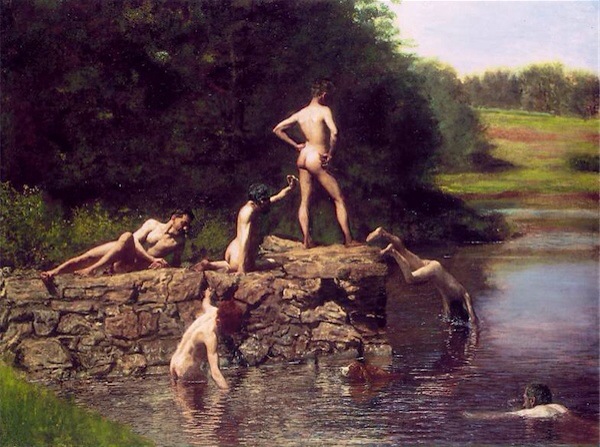
In 1887, Renoir painted the “Large Bathers,” and in 1885 Eakins painted the “Swimming Hole.” There is a good deal connecting these paintings. Both present swimmers in full nudity, testing the prudery of the day (though in a context that was acceptable on the margins). Both have a frank eroticism which could easily have provoked scandal. But then there are also important differences, and among them the fact that Eakins painted men and Renoir women. There is also a sort of national sense of aesthetics. Renoir’s work is undeniably French, and Eakins’s is a masterwork of the American realist school. But Eakins work is more interesting to me. It’s carefully composed but it hopes to be a glimpse of an everyday outing to a favorite swimming hole. It’s drawn, like much of Eakins’s painting, from photographic masters.

It’s popular today to talk about Eakins and his work (and this one more than others) as homoerotic. That may well be. But not necessarily. It follows an obsession that Eakins had with the human body and its movement throughout his life; nearly all of Eakins works are in some way a study of the body, and his most famous works, the two clinic paintings, are studies of studies of the human body. He aspires to show it gracefully and naturally. And he also aims to provoke. He detests the prudishness of the Victorian age; its obsession with tightly fitting and uncomfortable clothing and its sense of shame over the human body. “Eakins was a deep student of life, and with a great love he studied humanity frankly,” said his friend Robert Henri. “He was not afraid of what his study revealed to him.” His entire life was marked by controversy surrounding this point, and students who worked with him noted his preference for nudity—he posed for them and they posed for him. In this painting he presents himself in the right foreground in an almost voyeuristic pose.

Eakins’s ideas about the human body find an interesting parallel in the poetry of Walt Whitman, and indeed, they may have been acquired from Whitman, at least to a degree. This attachment to Whitman survives from the records of Eakins’s students—they called themselves “the Whitmans.” Eakins admired Walt Whitman tremendously. He painted Whitman’s portrait and developed a rapport with the poet, and Whitman appreciated Eakins extraordinary vision–calling on him to speak at a testimonial dinner and then remembering that Eakins did his speaking through a medium other than words. Eakins was particularly taken by the Song of Myself. The painting “The Swimming Hole” seems unmistakably inspired by the passage quoted above from it, and Eakins himself, referring to it as one of “his Whitmans,” would support this reading. It’s a remarkable example of a poem realized in oil and canvas.

This article was originally published in Harper’s Magazine and written by Scott Horton. I was inspired to use this poem because it was mentioned in the book I am currently reading, Skylar M Cates’ The Only Guy. There is a scene where one man observes another swimming in the lake and watches for a minute while he contemplates joining him. It’s a beautiful scene and the character begins to quote this poem as he looks on at the other man. I can’t wait to review The Only Guy for my readers.


Passers-by

IMG_8915.JPG

Passers-by
By Carl Sandburg

Passers-by,
Out of your many faces
Flash memories to me
Now at the day end
Away from the sidewalks
Where your shoe soles traveled
And your voices rose and blent
To form the city’s afternoon roar
Hindering an old silence.

Passers-by,
I remember lean ones among you,
Throats in the clutch of a hope,
Lips written over with strivings,
Mouths that kiss only for love,
Records of great wishes slept with,
Held long
And prayed and toiled for:

Yes,
Written on
Your mouths
And your throats
I read them
When you passed by.

Carl Sandburg (January, 1878 – July, 1967) was an American writer and editor, best known for his poetry. He won two Pulitzer Prizes, one for his poetry and another for a biography of Abraham Lincoln. Sandburg was born in Galesburg, Illinois to Swedish immigrants. At the age of thirteen he left school and began driving a milk wagon. He subsequently became a bricklayer and a farm laborer on the wheat plains of Kansas. After an interval spent at Lombard College in Galesburg, he became a hotel servant in Denver, then a coal-heaver in Omaha. He began his writing career as a journalist for the Chicago Daily News. Later he wrote poetry, history, biography, novels, children’s literature, and film reviews. Sandburg also collected and edited books of ballads and folklore. He spent most of his life in the Midwest before moving to North Carolina. He once said, “All politicians should have three hats – one to throw into the ring, one to talk through, and one to pull rabbits out of if elected.” He also believed that, “Ordering a man to write a poem is like commanding a pregnant woman to give birth to a red-headed child.”

Carl Sandburg published Chicago Poems in 1916, as an ode to a city. It’s a clear eyed and unapologetic love letter: where you tell your true-love you love them not in spite of their imperfections but because of them. This was Sandburg’s first volume of poetry, written in the years just after 1912 when he moved to Chicago. “Passers-by” is one of the poems from this collection.

In some ways, Sandburg’s writing was before its time–more like the social realism you associate with the later 1920s and 1930s–think Grant Wood’s American Gothic, think Dorothea Lange’s Migrant Mother. This was a time when industry, agriculture, and the worker were the heroes of popular art.


We Wear the Masks

IMG_9921.JPG

We Wear the Mask
by Paul Laurence Dunbar (1872-1906)

We wear the mask that grins and lies,
It hides our cheeks and shades our eyes,—
This debt we pay to human guile;
With torn and bleeding hearts we smile,
And mouth with myriad subtleties.

Why should the world be over-wise,
In counting all our tears and sighs?
Nay, let them only see us, while
We wear the mask.

We smile, but, O great Christ, our cries
To thee from tortured souls arise.
We sing, but oh the clay is vile
Beneath our feet, and long the mile;
But let the world dream otherwise,
We wear the mask!

Born on June 27, 1872, Paul Laurence Dunbar was one of the first African-American poets to gain national recognition. His parents Joshua and Matilda Murphy Dunbar were freed slaves from Kentucky. His parents separated shortly after his birth, but Dunbar would draw on their stories of plantation life throughout his writing career.

By 1895, Dunbar’s poems began appearing in major national newspapers and magazines, such as The New York Times. With the help of friends, he published the second collection, Majors and Minors (1895). The poems written in standard English were called “majors,” and those in dialect were termed “minors.” Although the “major” poems outnumber those written in dialect, it was the dialect poems that brought Dunbar the most attention. The noted novelist and critic William Dean Howells gave a favorable review to the poems in Harper’s Weekly.

The above poem appeared in Dunbar’s first professionally published volume, Lyrics of Lowly Life, in 1896 by Dodd, Mead, and Company. It also appeared in the volume Majors and Minors from the previous year.

To get by in America of the late 19th Century, blacks frequently concealed their pain, frustration, and anger from whites, as well as from one another. For blacks to reveal publicly their true feelings about whites’ maltreatment of them would have been to risk dangerous retaliation. After all, prejudice was official policy in Dunbar’s lifetime–governmentally and otherwise–and whites vastly outnumbered blacks. Sometimes, blacks even withheld their true feelings from one another, for defeat and desperation were difficult to articulate–and could impose deep anxiety upon loved ones. So it was that many blacks wore a mask that suggested happiness and contentment but concealed acute distress and pain.

Since Dunbar avoids specifically mentioning blacks and their suffering, the poem could stand as a lament on behalf of all people forced to wear a “mask”–the girl who hides her pregnancy from her parents, the boy who defensively humors an abusive parent, the soldier under fire who writes home that all is well when all is not well. One may fairly argue that the poem is about every human being. Who, after all, has not worn a mask on occasion to conceal hurt, frustration, disappointment?

As gay men, we often wear a mask, especially if we are in the closet. We can’t be our true selves, we conceal our love of other men, we conceal the pain from friends and family when they make homophobic comments, we face the anger and frustration in near silence because we fear for our jobs and out livelihood. In many ways this is changing in some parts of the United States, but not in all parts. Even in areas where out LGBT people are able to be more out and proud, there still exists homophobia and discrimination.

I remember on the movie The Normal Heart, Larry Kramer’s character wanted to be very vocal about the AIDS epidemic, but even those in the movement with him were afraid of being too vocal. Even today, we have people within the LGBT community that preach constant civility, even when we are very angry and hurt. I admit, I do think politeness is the way to go, but within the LGBT community, we should be open and honest, and we should have more opportunities to be who we are. We all wear masks, but one day, and one day soon, I hope that there will no longer be a need for those masks. We will have the protections we need and deserve to be fully equal citizens, no matter where we live in this country or in the world.


The Old Year

IMG_9764.JPG

The Old Year
By John Clare

The Old Year’s gone away
To nothingness and night:
We cannot find him all the day
Nor hear him in the night:
He left no footstep, mark or place
In either shade or sun:
The last year he’d a neighbour’s face,
In this he’s known by none.

All nothing everywhere:
Mists we on mornings see
Have more of substance when they’re here
And more of form than he.
He was a friend by every fire,
In every cot and hall–
A guest to every heart’s desire,
And now he’s nought at all.

Old papers thrown away,
Old garments cast aside,
The talk of yesterday,
Are things identified;
But time once torn away
No voices can recall:
The eve of New Year’s Day
Left the Old Year lost to all.

The year of our Lord two-thousand fourteen is almost over. I will not say that it has been an exceedingly good year, nor an exceedingly had year. It’s just been another year. I will reflect more on 2014 in my post tomorrow, but for now, let’s hope for a prosperous and healthy 2015 to friends, family, and my readers.

IMG_9765.JPG


A Christmas Carol

IMG_9588.JPG

A Christmas Carol
George Wither

So now is come our joyful feast,
Let every man be jolly;
Each room with ivy leaves is dressed,
And every post with holly.
Though some churls at our mirth repine,
Round your foreheads garlands twine,
Drown sorrow in a cup of wine,
And let us all be merry.

Now all our neighbors’ chimnies smoke,
And Christmas blocks are burning;
Their ovens they with baked meats choke,
And all their spits are turning.
Without the door let sorrow lie,
And if for cold it hap to die,
We’ll bury it in a Christmas pie,
And evermore be merry.

Now every lad is wondrous trim,
And no man minds his labor;
Our lasses have provided them
A bagpipe and a tabor.
Young men and maids, and girls and boys,
Give life to one another’s joys;
And you anon shall by their noise
Perceive that they are merry.

Rank misers now do sparing shun,
Their hall of music soundeth;
And dogs thence with whole shoulders run,
So all things aboundeth.
The country-folk themselves advance,
For crowdy-mutton’s come out of France;
And Jack shall pipe and Jill shall dance,
And all the town be merry.

Ned Swatch hath fetched his bands from pawn,
And all his best apparel;
Brisk Nell hath bought a ruff of lawn
With droppings of the barrel.
And those that hardly all the year
Had bread to eat or rags to wear,
Will have both clothes and dainty fare,
And all the day be merry.

Now poor men to the justices
With capons make their errands;
And if they hap to fail of these,
They plague them with their warrants.
But now they feed them with good cheer,
And what they want they take in beer,
For Christmas comes but once a year,
And then they shall be merry.

Good farmers in the country nurse
The poor, that else were undone;
Some landlords spend their money worse,
On lust and pride at London.
There the roisters they do play,
Drab and dice their land away,
Which may be ours another day;
And therefore let’s be merry.

The client now his suit forbears,
The prisoner’s heart is eased;
The debtor drinks away his cares,
And for the time is pleased.
Though others’ purses be more fat,
Why should we pine or grieve at that;
Hang sorrow, care will kill a cat,
And therefore let’s be merry.

Hark how the wags abroad do call
Each other forth to rambling;
Anon you’ll see them in the hall,
For nuts and apples scrambling;
Hark how the roofs with laughters sound,
Anon they’ll think the house goes round;
For they the cellar’s depths have found,
And there they will be merry.

The wenches with their wassail-bowls
About the streets are singing;
The boys are come to catch the owls,
The wild mare in is bringing.
Our kitchen boy hath broke his box,
And to the dealing of the ox
Our honest neighbors come by flocks,
And here they will be merry.

Now kings and queens poor sheep-cotes have,
And mate with everybody;
The honest now may play the knave,
And wise men play at noddy.
Some youths will now a mumming go,
Some others play at rowland-hoe,
And twenty other gameboys moe;
Because they will be merry.

Then wherefore in these merry days
Should we, I pray, be duller?
No, let us sing some roundelays
To make our mirth the fuller.
And whilst we thus inspired sing,
Let all the streets with echoes ring;
Woods, and hills, and everything
Bear witness we are merry.



When Giving Is All We Have

IMG_7005.JPG

When Giving Is All We Have
By Alberto Ríos

                                        One river gives.
.                                       Its journey to the next.                  

We give because someone gave to us.
We give because nobody gave to us.

We give because giving has changed us.
We give because giving could have changed us.

We have been better for it,
We have been wounded by it—

Giving has many faces: It is loud and quiet,
Big, though small, diamond in wood-nails,

Its story is old, the plot worn and the pages too,
But we read this book, anyway, over and again:

Giving is, first and every time, hand to hand,
Mine to yours, yours to mine.

You gave me blue and I gave you yellow.
Together we are simple green. You gave me

What you did not have, and I gave you
What I had to give—together, we made

Something greater from the difference.

About This Poem
“This is a poem of thanks to those who live lives of service, which, I think, includes all of us—from the large measure to the smallest gesture, from care-giving to volunteerism to being an audience member or a reader. I’ve been able to offer these words to many groups, not only as a poem but also as a recognition. We give for so many reasons, and are bettered by it.”
— Alberto Ríos

Alberto Ríos is a Chancellor of the Academy of American Poets and the author of The Dangerous Shirt (Copper Canyon Press, 2009). He teaches at Arizona State University and lives in Chandler, Arizona.


Sonnet 97

IMG_0105.JPG

Sonnet 97
By William Shakespeare

How like a winter hath my absence been
From thee, the pleasure of the fleeting year!
What freezings have I felt, what dark days seen!
What old December’s bareness every where!
And yet this time remov’d was summer’s time;
The teeming autumn, big with rich increase,
Bearing the wanton burden of the prime,
Like widow’d wombs after their lords’ decease:
Yet this abundant issue seem’d to me
But hope of orphans and unfather’d fruit;
For summer and his pleasures wait on thee,
And, thou away, the very birds are mute:
Or, if they sing, ’tis with so dull a cheer,
That leaves look pale, dreading the winter’s near.


Windows: Two Poems By D. H. Lawrence

IMG_2914.JPG

At the Window
By D. H. Lawrence

The pine-trees bend to listen to the autumn wind as it mutters
Something which sets the black poplars ashake with hysterical laughter;
While slowly the house of day is closing its eastern shutters.

Further down the valley the clustered tombstones recede,
Winding about their dimness the mist’s grey cerements, after
The street lamps in the darkness have suddenly started to bleed.

The leaves fly over the window and utter a word as they pass
To the face that leans from the darkness, intent, with two dark-filled eyes
That watch for ever earnestly from behind the window glass.

From a College Window
By D. H. Lawrence

The glimmer of the limes, sun-heavy, sleeping,
Goes trembling past me up the College wall.
Below, the lawn, in soft blue shade is keeping,
The daisy-froth quiescent, softly in thrall.

Beyond the leaves that overhang the street,
Along the flagged, clean pavement summer-white,
Passes the world with shadows at their feet
Going left and right.

Remote, although I hear the beggar’s cough,
See the woman’s twinkling fingers tend him a coin,
I sit absolved, assured I am better off
Beyond a world I never want to join.

I’ve always been fascinated by the symbolism of windows. A window is a spiritual entrance through which your soul can travel. If you choose to let it go, your soul can break the glass boundaries created by the window and travel into the greater world; soaking in the sounds, the smells, the sights. Windows symbolize our senses. Our senses are like windows to our minds and our souls that allow both the negative and positive of the world to enter, making its impression on us thus allowing bright ideas to flourish or dull and dismal thoughts to suppress our potentials.

The soul has a window, as does the mind. The soul is like an enclosed space of our inner world, where our experiences, ideas, thoughts, hopes and dreams are stored and from whence they seek to find a window into the outer world going free, breaking forth and taking flight into the vast expanse of achievements.

A window is a portal; allowing your thoughts to roam around freely. It symbolizes freedom, a passage to and from a space into the vast expanse of the world and the passage, where light, air, sounds, knowledge, objects etc., may pass through, coming and going. However, a window creates boundaries, as your soul can only travel as far as your eyes can see. You cannot move right, or left; you move in an unwavering straight line. As you gaze out the window, you watch life go by, failing to contribute any involvement. It is a passive response. Looking out a window is a means of search for something. It signifies the need to find something missing in your life or a solution to a problem.

It is said that “the eyes are the windows to the soul,” meaning when others engage us our facial expressions, beginning with our eye movements and body language give others a momentary glimpse [a window, an opening] to see into our heart and soul, or our mind and it’s thinking.