Category Archives: Poetry
Two Poems By Cyrus Cassells
Moment of Zen: Spring
The year’s at the spring
And day’s at the morn;
Morning’s at seven;
The hillside’s dew-pearled;
The lark’s on the wing;
The snail’s on the thorn;
God’s in His heaven –
All’s right with the world!
~ Robert Browning
“The only thing that could spoil a day was people. People were always the limiters of happiness except for the very few that were as good as spring itself.” ~ Ernest Hemingway
St. Patrick’s Day
The Guitar

Underwear

The Dream
The Dream
By Edna St. Vincent Millay
Love, if I weep it will not matter,
And if you laugh I shall not care;
Foolish am I to think about it,
But it is good to feel you there.
Love, in my sleep I dreamed of waking, —
White and awful the moonlight reached
Over the floor, and somewhere, somewhere,
There was a shutter loose, —it screeched!
Swung in the wind, — and no wind blowing! —
I was afraid, and turned to you,
Put out my hand to you for comfort, —
And you were gone! Cold, cold as dew,
Under my hand the moonlight lay!
Love, if you laugh I shall not care,
But if I weep it will not matter, —
Ah, it is good to feel you there!
O Captain! My Captain!
Walt Whitman, 1819 – 1892
O Captain! my Captain! our fearful trip is done, The ship has weather’d every rack,
the prize we sought is won, The port is near, the bells I hear, the people all exulting,
While follow eyes the steady keel, the vessel grim and daring; But O heart! heart! heart!
O the bleeding drops of red, Where on the deck my Captain lies, Fallen cold and dead.
O Captain! my Captain! rise up and hear the bells; Rise up- for you the flag is flung- for
you the bugle trills,
For you bouquets and ribbon’d wreaths- for you the shores
a-crowding,
For you they call, the swaying mass, their eager faces turning;
Here Captain! dear father!
This arm beneath your head!
It is some dream that on the deck,
You’ve fallen cold and dead.
My Captain does not answer, his lips are pale and still,
My father does not feel my arm, he has no pulse nor will,
The ship is anchor’d safe and sound, its voyage closed and done,
From fearful trip the victor ship comes in with object won;
Exult O shores, and ring O bells!
But I with mournful tread,
Walk the deck my Captain lies,
Fallen cold and dead.
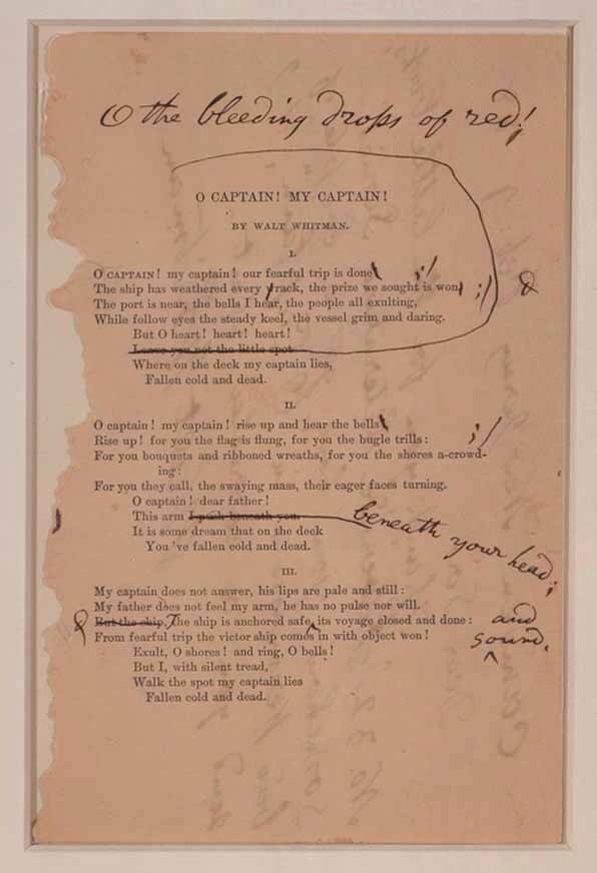
Since yesterday was Presidents Day and I’ve never featured this poem, I thought it would be a wonderful tribute, as this poem was meant to be. When President Abraham Lincoln was assassinated on April 14, 1865, a war-weary nation was plunged into shock. The last great battles of the Civil War were still a recent memory, and the murder of the president seemed to be a bloody, pointless coda to four years of conflict and instability. There was a great outpouring of grief across the country, and poems and songs were written mourning the nation’s loss.
One American who grieved for the fallen president was the poet Walt Whitman. Whitman had lived in Washington for most of the war and was a great admirer of Lincoln, whom he felt embodied the American virtues of plain-spokenness, courage, and “horse-sense.” He often saw the president riding around town on horseback, and the two men sometimes exchanged cordial bows.
Lincoln’s death inspired Whitman to write one of his most memorable works—a simple, three-stanza poem of sorrow that bore little resemblance to his other, more experimental writings. “O Captain! My Captain!” was published in New York’s Saturday Press in November of 1865, and was met with immediate acclaim. The poem’s evocation of triumph overshadowed by despair spoke to readers throughout the shattered nation, and it was widely reprinted and published in anthologies. “O Captain! My Captain!” became one of the most popular poems Whitman would ever write, and helped secure for him a position as one of the greatest American poets of the 19th century.
Whitman was very particular about the appearance of his poems and paid careful attention to every detail of spelling and punctuation. When Whitman noticed several errors in one edition of “O Captain! My Captain!” he mailed the page to the publishers with his corrections marked in ink. As you read this version of the poem, look at Whitman’s notes and ask yourself how his changes contributed to the poem’s impact.
Sick
Sick
By Shel Silverstein, 1930 – 1999
“I cannot go to school today,”
Said little Peggy Ann McKay.
“I have the measles and the mumps,
A gash, a rash and purple bumps.
My mouth is wet, my throat is dry,
I’m going blind in my right eye.
My tonsils are as big as rocks,
I’ve counted sixteen chicken pox
And there’s one more–that’s seventeen,
And don’t you think my face looks green?
My leg is cut–my eyes are blue–
It might be instamatic flu.
I cough and sneeze and gasp and choke,
I’m sure that my left leg is broke–
My hip hurts when I move my chin,
My belly button’s caving in,
My back is wrenched, my ankle’s sprained,
My ‘pendix pains each time it rains.
My nose is cold, my toes are numb.
I have a sliver in my thumb.
My neck is stiff, my voice is weak,
I hardly whisper when I speak.
My tongue is filling up my mouth,
I think my hair is falling out.
My elbow’s bent, my spine ain’t straight,
My temperature is one-o-eight.
My brain is shrunk, I cannot hear,
There is a hole inside my ear.
I have a hangnail, and my heart is–what?
What’s that? What’s that you say?
You say today is. . .Saturday?
G’bye, I’m going out to play!”
Oh, if it were only Saturday and I’d be well. Unlike Peggy Ann McKay, I am very much sick.
Sonnet to Winter
Sonnet to Winter
By Emily Chubbuck Judson
Thy brow is girt, thy robe with gems inwove;
And palaces of frost-work, on the eye,
Flash out, and gleam in every gorgeous dye,
The pencil, dipped in glorious things above,
Can bring to earth. Oh, thou art passing fair!
But cold and cheerless as the heart of death,
Without one warm, free pulse, one softening breath,
One soothing whisper for the ear of Care.
Fortune too has her Winter. In the Spring,
We watch the bud of promise; and the flower
Looks out upon us at the Summer hour;
And Autumn days the blessed harvest bring;
Then comes the reign of jewels rare, and gold,
When brows flash light, but hearts grow strangely cold.
About This Poem
Emily Chubbuck Judson was born in Eaton, New York, in 1817. Her books include An Olio of Domestic Verses (1852) and Charles Linn, or, How to Observe the Golden Rule: with Other Stories (1841). “Sonnet to Winter” was published in Judson’s book Alderbrook (W. D. Ticknor and company, 1847). Judson died in 1854.
I Thank You
Sonnet: I Thank You
By Henry Timrod
I thank you, kind and best beloved friend,
With the same thanks one murmurs to a sister,
When, for some gentle favor, he hath kissed her,
Less for the gifts than for the love you send,
Less for the flowers, than what the flowers convey;
If I, indeed, divine their meaning truly,
And not unto myself ascribe, unduly,
Things which you neither meant nor wished to say,
Oh! tell me, is the hope then all misplaced?
And am I flattered by my own affection?
But in your beauteous gift, methought I traced
Something above a short-lived predilection,
And which, for that I know no dearer name,
I designate as love, without love’s flame.
Source: The Collected Poems of Henry Timrod (1965)
Since Henry Timrod’s output before the Civil War was limited to verse sufficient only for a single volume—published in December 1859—his literary reputation at the time was modest. The political activities surrounding the formation of a new nation and the impact of the war itself aroused Timrod’s poetic imagination, however, and he quickly became widely known as the literary spokesman and eventually as the so-called poet laureate of the Confederacy, an unofficial title he has retained ever since. After the war, poor health associated with the complications of tuberculosis and abject poverty related to political and social conditions in South Carolina during Reconstruction made it impossible for Timrod to fulfill the promise or equal the achievement of his wartime performance, and he died in 1867, two months before his thirty-ninth birthday.
As a southern man who love poetry, history, and lost causes, who better to give my heartfelt thanks than the poet laureate of the Confederacy, Henry Timrod. When I wrote my post on Monday, I was not prepared for the response I received. I had merely wanted to explain my situation, though it took an extra post and a lot of soul searching and gut wrenching realizations. I agonized over both of those posts. I wrote and revised Monday’s post many times over the weekend, and revised and revised my post on Tuesday many times before I was satisfied with it. Like I said, I was not prepared nor had I even expected the outpouring of comments and emails. So many of you have been so encouraging and understanding of the position I find myself in currently. You all have given me hope and renewed my spirit. Thank my friends for I “know no dearer name, I designate as love, without love’s flame.” For I will hold the flame of love close to my heart until it burns brightly for a man for whom I can share my life and passions.