Henry David Thoreau was cautious about the effect of technological progress on mankind, feeling that it often could be a distraction from the inner life. In his book Walden he famously writes, “We do not ride on the railroad; it rides upon us.”
About This Poet
Henry David Thoreau was born in Concord, Massachusetts, on July 12, 1817. He is perhaps best known for his works Walden, which touches upon the virtues of nature and simple living, and Civil Disobedience, which promotes peaceful resistance to acts by an unjust government. Thoreau died in 1862.
To realise the futility of pea-picking,
its broken-backed and bruised-kneed endurance
tested up and down the crowded rows
of squat, green, sparsely bearing bushes;
the side-of-the-finger-splitting ritual,
left and right forefingers and thumbs
cut and bruised bloody, the neck breaking
under the bludgeoning sun, the eyes, ears, nose
and lips crawling with stickybeaking flies;
the stink or perfume (sometimes vaguely both)
of your fellow pickers beside and ahead of you;
to understand why you are doing this at all
day after blistering day for four shillings
a bushel or two kerosene tins full you had to be
either seventeen and desperately
in need of more than two pounds to buy the Collected
Letters of John Keats (that is ten bushels
when you were averaging four bushels a day
for the several days allotted to the picking).
Or perhaps you had to be Aboriginal
and aged from fifteen to sixty-five (male or female)
and be able to knock off ten bushels a day,
bushes and all, when you were supposed to pick
selectively, that is to leave the younger,
smaller pods for a second picking. Or you
might have even needed to be the farmer
himself. Too busy to supervise; keeping up
with most of the Aboriginals, only picking
selectively. Up five chains of bushes
and down five chains of bushes for about
five or six aching hours a day. I say
“futility” for I was too tired each day
to read the book when I had it; the Aboriginals
spent most of their pay on headache engendering wine;
and the farmer, my uncle, always seemed to time
his pickings to coincide with a glutted market.
The whole thing was an exercise in futility.
The old hands had pads of cloth or soft leather tied
to their knees and kept their backs fairly straight.
But if you were seventeen as I was then
and uninstructed you simply agonised
on sore knees shuffling forward boustrophedon
in a more or less literal way, knee-nudging over
soft and lumpy strips of bare earth
getting to feel a tiny twig or pebble,
even the compressed soil’s own modifications
and innate consistencies of texture. The bushes
themselves becoming flayers of raw thumb
and finger-pad, splitters and groovers of nails,
the plump pods’ contents edible but eventually
uninviting. Something like a vestigial
competitive spirit drove one to try and at least
keep up. The dust of earth and leaf-dust crimping
the nostrils, the heat of days turning the tongue
into a strap of hide cleaving to white paste.
The crazy fantasies: would Toulouse-Lautrec
have walked on his half-length legs and have merely plucked
the bushes’ burdens without even looking down?
Would the Aboriginal girl in front have underwear
beneath her sack-like skirt, or a brassiere under
the off-white shirt? No, you saw small breasts
and purple-brown nipples once, and when she saw
you looking she smiled but not invitingly.
The black folk smelt of wood smoke and leaf mould.
I had been told I would smell to them of sour milk
and rancid butter. There were several deodorants
on sale even then but none of us thought to use them.
The girls had thin legs, thin thighs, and almost all
were waistless. But their faces were like a friendly
fruit, large, dark, with rounded features full
and ripe until the faces of my own kind
soured and flattened out to thin diminished
creases, cracks and bumps. At day’s end I
would go to wash and eat and sleep at the farmhouse.
The Aboriginal pickers lolled or squatted
in the big barn’s earth floored musty gloom, gathering
beside the several loaned hurricane lanterns
and about the central fire of sticks on which
a frying pan sputtered blessings on eggs and bacon
and later the communal billy black
as the brew it smokily and sweetly boiled.
Aperitifs of muscat and sweet sherry
were passed from hand to hand in the habitual
surreptitious manner, and the pouches
or battered tins lay open between crossed legs,
rice paper stuck to bottom lips as coarse
tobacco was reduced to fragrant shreds
in hands still acrid with the bushes’ juices.
Then soft guitar accompanied song and softer
talk and sudden swallowed shouts as someone
gulped who should have sipped. And I awake
upon a sheeted bed two hundred feet
away, aware would lie and wonder if
the younger ones would go into the night
and love, as I would have given Keats’s Letters
so to do. And out across the back
verandah of the farm I’d peer into
the starlit dark—so large the distant stars—
while through the barn’s gapped timber walls the lanterns
and the dull glow of the compact cooking fire
showed, even the spark-sized crimson points
of hand-rolled cigarettes would wink and almost
beckon. Now I think the only ones
to leave the barn a while went to excrete.
More privacy was needed than a darkened
cow-bail or a tree’s wide bole to lure
those shyest lovers out. They slept together
in a tribal dream of tiresome work and welcome
food and memoried rest. No taboos but
commonsense and something like distaste
to elevate a white farm to the statute
of home-ground. The elder ones, perhaps, while partly
drunk may have partly scored, but when the last
birds had quietened and the only sound
was cattle foraging about the dry lawn’s
dew-soaked chaff, both barn and farmhouse turned
lights down and out. And then across the cooling
fields came mistily and fragrantly
sleep to all and Alchera’s dreams to some.
Bruce Beaver (1928 – 2004)
Bruce Beaver was born in the Sydney seaside suburb of Manly on 14 February 1928. His childhood and adolescence were unhappy. He wrote his first poem at 17 – a response to the bombing of Hiroshima – and at the same age he began to suffer from what became a life-long problem, manic-depressive illness. He worked in various occupations, travelled in New South Wales and New Zealand, married, and returned to Manly to live and write for most of his life. His first book, Under the Bridge, was published in 1961, and his fourth, a breakthrough volume, Letters to Live Poets, in 1969. In all, he published more than a dozen volumes of poems and ten novels, as well as the autobiographical As It Was (1979).
Risng to prominence in the 1960s, Beaver’s work had a considerable influence on the development on the ‘Generation of 1968’ and the ‘New Australian Poetry’ of the 1970s. Over the course of his career, he won several major Australian literary awards, including the Grace Leven Poetry Prize (1970, for Letters to Live Poets), the C. J. Dennis Prize (1995, for Anima and Other Poems), the Fellowship of Australian Writers Christopher Brennan Award (1982), and the Patrick White Award (1982). In 1991, he was made a Member of the Order of Australia, for service to literature. He died on 17 February 2004.
* * * * *
I decided to use this poem today because I spent yesterday afternoon helping my neighbor pick peas. We picked what we could before the rain started. My share was the equivalent to two messes of peas. If your unfamiliar with what a “mess of peas” is, it’s the amount of peas needed for a meal. Also, these were pink-eye purple hull peas; probably the most delicious peas ever. I can’t wait to cook them along with some pork chops, and fried cornbread. Served with some sliced cucumbers, tomatoes, and onions. I might even fry some green tomatoes. It will be delicious.
Who has gone farthest? for I would go farther,
And who has been just? for I would be the most just person of the
earth,
And who most cautious? for I would be more cautious,
And who has been happiest? O I think it is I–I think no one was ever
happier than I,
And who has lavish’d all? for I lavish constantly the best I have,
And who proudest? for I think I have reason to be the proudest son
alive–for I am the son of the brawny and tall-topt city,
And who has been bold and true? for I would be the boldest and truest
being of the universe,
And who benevolent? for I would show more benevolence than all the
rest,
And who has receiv’d the love of the most friends? for I know what it
is to receive the passionate love of many friends,
And who possesses a perfect and enamour’d body? for I do not believe
any one possesses a more perfect or enamour’d body than mine,
And who thinks the amplest thoughts? for I would surround those
thoughts,
And who has made hymns fit for the earth? for I am mad with
About This Poem
Excelsior is a Latin term meaning “ever upward”; it is the official motto of the State of New York. A slightly different version of this poem first appeared as “Poem of the Heart of the Son of Manhattan Island” in the second edition of Leaves of Grass.
Walt Whitman was born in Huntington, New York, on May 31, 1819. He is best known for Leaves of Grass, a prodigious collection of poetry that he continually revised for most of his life. Whitman died in 1892. He is one of America’s most celebrated gay poets.
“In Memoriam” consists of 131 smallerpoems of varying length, of which the above poem is an excerpt. Tennyson wrote “In Memoriam” after he learned that his beloved friend Arthur Henry Hallam had died suddenly and unexpectedly of a fever at the age of 22. Hallam was not only the poet’s closest friend and confidante, but also the fiancé of his sister. After learning of Hallam’s death, Tennyson was overwhelmed with doubts about the meaning of life and the significance of man’s existence. He composed the short poems that comprise “In Memoriam” over the course of seventeen years (1833-1849) with no intention of weaving them together, though he ultimately published them as a single lengthy poem in 1850.
A year ago today, my beloved Grandmama passed away. I wanted to post a poem that would be in memory of her. The above poem is not perfect for this purpose, but it works to an extent. I mourn Grandmama’s life each day. Last night I read the post I did last year right after she died. I sat and cried. I couldn’t help myself. Then I read the loving comments of my readers, and my spirits were lifted a little. Though she is now gone, she will forever live in my heart.
Struck out by a steed that flies fearless and fleet:
That was all! And yet, through the gloom and the light,
The fate of a nation was riding that night;
And the spark struck out by that steed, in his flight,
Kindled the land into flame with its heat.
He has left the village and mounted the steep,
And beneath him, tranquil and broad and deep,
Is the Mystic, meeting the ocean tides;
And under the alders, that skirt its edge,
Now soft on the sand, now loud on the ledge,
Is heard the tramp of his steed as he rides.
It was twelve by the village clock
When he crossed the bridge into Medford town.
He heard the crowing of the cock,
And the barking of the farmer’s dog,
And felt the damp of the river-fog,
That rises when the sun goes down.
It was one by the village clock,
When he galloped into Lexington.
He saw the gilded weathercock
Swim in the moonlight as he passed,
And the meeting-house windows, blank and bare,
Gaze at him with a spectral glare,
As if they already stood aghast
At the bloody work they would look upon.
It was two by the village clock,
When be came to the bridge in Concord town.
He heard the bleating of the flock,
And the twitter of birds among the trees,
And felt the breath of the morning breeze
Blowing over the meadows brown.
And one was safe and asleep in his bed
Who at the bridge would be first to fall,
Who that day would be lying dead,
Pierced by a British musket-ball.
You know the rest. In the books you have read,
How the British Regulars fired and fled,–
How the farmers gave them ball for ball,
From behind each fence and farmyard-wall,
Chasing the red-coats down the lane,
Then crossing the fields to emerge again
Under the trees at the turn of the road,
And only pausing to fire and load.
So through the night rode Paul Revere;
And so through the night went his cry of alarm
To every Middlesex village and farm,–
A cry of defiance, and not of fear,
A voice in the darkness, a knock at the door,
And a word that shall echo forevermore!
For, borne on the night-wind of the Past,
Through all our history, to the last,
In the hour of darkness and peril and need,
The people will waken and listen to hear
The hurrying hoof-beats of that steed,
And the midnight message of Paul Revere.
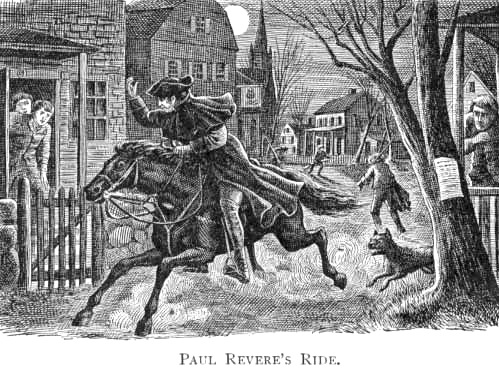
Thursday is Independence Day, so I thought I would post a patriotic poem. Though the events of this poem occurred on April 18-19, 1775, over a year before the signing of the Declaration of Independence, it is one of the most famous events of the American Revolution. In 1774 and the Spring of 1775 Paul Revere was employed by the Boston Committee of Correspondence and the Massachusetts Committee of Safety as an express rider to carry news, messages, and copies of resolutions as far away as New York and Philadelphia.
On the evening of April 18, 1775, Paul Revere was sent for by Dr. Joseph Warren and instructed to ride to Lexington, Massachusetts, to warn Samuel Adams and John Hancock that British troops were marching to arrest them. After being rowed across the Charles River to Charlestown by two associates, Paul Revere borrowed a horse from his friend Deacon John Larkin. While in Charlestown, he verified that the local “Sons of Liberty” committee had seen his pre-arranged signals. (Two lanterns had been hung briefly in the bell-tower of Christ Church in Boston, indicating that troops would row “by sea” across the Charles River to Cambridge, rather than marching “by land” out Boston Neck. Revere had arranged for these signals the previous weekend, as he was afraid that he might be prevented from leaving Boston).
On the way to Lexington, Revere “alarmed” the country-side, stopping at each house, and arrived in Lexington about midnight. As he approached the house where Adams and Hancock were staying, a sentry asked that he not make so much noise. “Noise!” cried Revere, “You’ll have noise enough before long. The regulars are coming out!” After delivering his message, Revere was joined by a second rider, William Dawes, who had been sent on the same errand by a different route. Deciding on their own to continue on to Concord, Massachusetts, where weapons and supplies were hidden, Revere and Dawes were joined by a third rider, Dr. Samuel Prescott. Soon after, all three were arrested by a British patrol. Prescott escaped almost immediately, and Dawes soon after. Revere was held for some time and then released. Left without a horse, Revere returned to Lexington in time to witness part of the battle on the Lexington Green.
The events of that night were immortalized by Henry Wadsworth Longfellow to commemorates Revere’s actions. Longfellow’s poem is not historically accurate but his “mistakes” were deliberate. He had researched the historical event, using works like George Bancroft’s History of the United States, but he manipulated the facts for poetic effect. He was purposely trying to create American legends, much as he did with works like The Song of Hiawatha (1855) and The Courtship of Miles Standish (1858). Longfellow was inspired to write the poem after visiting the Old North Church and climbing its tower on April 5, 1860. He began writing the poem the next day. It was first published in the January 1861 issue of The Atlantic Monthly. It was later re-published in Longfellow’s Tales of a Wayside Inn as “The Landlord’s Tale” in 1863. The poem served as the first in a series of 22 narratives bundled as a collection, similar to Geoffrey Chaucer’s The Canterbury Tales, and was published in three installments over 10 years.
The poem is spoken by the landlord of the Wayside Inn and tells a partly fictionalized story of Paul Revere. In the poem, Revere tells a friend to prepare signal lanterns in the Old North Church to inform him if the British will attack by land or sea. He would await the signal across the river in Charlestown and be ready to spread the alarm throughout Middlesex County, Massachusetts. The unnamed friend climbs up the steeple and soon sets up two signal lanterns, informing Revere that the British are coming by sea. Revere rides his horse through Medford, Lexington, and Concord to warn the patriots.
November like a train wreck— as if a locomotive made of cold had hurtled out of Canada and crashed into a million trees, flaming the leaves, setting the woods on fire.
The sky is a thick, cold gauze— but there’s a soup special at the Waffle House downtown, and the Jack Parsons show is up at the museum, full of luminous red barns.
—Or maybe I’ll visit beautiful Donna, the kickboxing queen from Santa Fe, and roll around in her foldout bed.
I know there are some people out there who think I am supposed to end up in a room by myself
with a gun and a bottle full of hate, a locked door and my slack mouth open like a disconnected phone.
But I hate those people back from the core of my donkey soul and the hatred makes me strong and my survival is their failure,
and my happiness would kill them so I shove joy like a knife into my own heart over and over
and I force myself toward pleasure, and I love this November life where I run like a train deeper and deeper into the land of my enemies.
“Reasons to Survive November,” Tony Hoagland, from What Narcissism Means to Me (Graywolf Press).
Once upon a midnight dreary, while I pondered, weak and weary,
Over many a quaint and curious volume of forgotten lore,
While I nodded, nearly napping, suddenly there came a tapping,
As of someone gently rapping, rapping at my chamber door.
“‘Tis some visitor,” I muttered, “tapping at my chamber door;
Only this, and nothing more.”
Ah, distinctly I remember, it was in the bleak December,
And each separate dying ember wrought its ghost upon the floor.
Eagerly I wished the morrow; vainly I had sought to borrow
From my books surcease of sorrow, sorrow for the lost Lenore,.
For the rare and radiant maiden whom the angels name Lenore,
Nameless here forevermore.
And the silken sad uncertain rustling of each purple curtain
Thrilled me—filled me with fantastic terrors never felt before;
So that now, to still the beating of my heart, I stood repeating,
” ‘Tis some visitor entreating entrance at my chamber door,
Some late visitor entreating entrance at my chamber door.
This it is, and nothing more.”
Presently my soul grew stronger; hesitating then no longer,
“Sir,” said I, “or madam, truly your forgiveness I implore;
But the fact is, I was napping, and so gently you came rapping,
And so faintly you came tapping, tapping at my chamber door,
That I scarce was sure I heard you.” Here I opened wide the door;—
Darkness there, and nothing more.
Deep into the darkness peering, long I stood there, wondering, fearing
Doubting, dreaming dreams no mortals ever dared to dream before;
But the silence was unbroken, and the stillness gave no token,
And the only word there spoken was the whispered word,
Lenore?, This I whispered, and an echo murmured back the word,
“Lenore!” Merely this, and nothing more.
Back into the chamber turning, all my soul within me burning,
Soon again I heard a tapping, something louder than before,
“Surely,” said I, “surely, that is something at my window lattice.
Let me see, then, what thereat is, and this mystery explore.
Let my heart be still a moment, and this mystery explore.
“‘Tis the wind, and nothing more.”
Open here I flung the shutter, when, with many a flirt and flutter,
In there stepped a stately raven, of the saintly days of yore.
Not the least obeisance made he; not a minute stopped or stayed he;
But with mien of lord or lady, perched above my chamber door.
Perched upon a bust of Pallas, just above my chamber door,
Perched, and sat, and nothing more.
Then this ebony bird beguiling my sad fancy into smiling,
By the grave and stern decorum of the countenance it wore,
“Though thy crest be shorn and shaven thou,” I said, “art sure no craven,
Ghastly, grim, and ancient raven, wandering from the nightly shore.
Tell me what the lordly name is on the Night’s Plutonian shore.”
Quoth the raven, “Nevermore.”
Much I marvelled this ungainly fowl to hear discourse so plainly,
Though its answer little meaning, little relevancy bore;
For we cannot help agreeing that no living human being
Ever yet was blessed with seeing bird above his chamber door,
Bird or beast upon the sculptured bust above his chamber door,
With such name as “Nevermore.”
But the raven, sitting lonely on that placid bust, spoke only
That one word, as if his soul in that one word he did outpour.
Nothing further then he uttered; not a feather then he fluttered;
Till I scarcely more than muttered, “Other friends have flown before;
On the morrow he will leave me, as my hopes have flown before.”
Then the bird said, “Nevermore.”
Startled at the stillness broken by reply so aptly spoken,
“Doubtless,” said I, “what it utters is its only stock and store,
Caught from some unhappy master, whom unmerciful disaster
Followed fast and followed faster, till his songs one burden bore,—
Till the dirges of his hope that melancholy burden bore
Of “Never—nevermore.”
But the raven still beguiling all my sad soul into smiling,
Straight I wheeled a cushioned seat in front of bird, and bust and door;
Then, upon the velvet sinking, I betook myself to linking
Fancy unto fancy, thinking what this ominous bird of yore —
What this grim, ungainly, ghastly, gaunt and ominous bird of yore
Meant in croaking “Nevermore.”
Thus I sat engaged in guessing, but no syllable expressing
To the fowl, whose fiery eyes now burned into my bosom’s core;
This and more I sat divining, with my head at ease reclining
On the cushion’s velvet lining that the lamplight gloated o’er,
But whose velvet violet lining with the lamplight gloating o’er
She shall press, ah, nevermore!
Then, methought, the air grew denser, perfumed from an unseen censer
Swung by seraphim whose footfalls tinkled on the tufted floor.
“Wretch,” I cried, “thy God hath lent thee — by these angels he hath
Sent thee respite—respite and nepenthe from thy memories of Lenore!
Quaff, O quaff this kind nepenthe, and forget this lost Lenore!”
Quoth the raven, “Nevermore!”
“Prophet!” said I, “thing of evil!–prophet still, if bird or devil!
Whether tempter sent, or whether tempest tossed thee here ashore,
Desolate, yet all undaunted, on this desert land enchanted–
On this home by horror haunted–tell me truly, I implore:
Is there–is there balm in Gilead?–tell me–tell me I implore!”
Quoth the raven, “Nevermore.”
“Prophet!” said I, “thing of evil–prophet still, if bird or devil!
By that heaven that bends above us–by that God we both adore–
Tell this soul with sorrow laden, if, within the distant Aidenn,
It shall clasp a sainted maiden, whom the angels name Lenore—
Clasp a rare and radiant maiden, whom the angels name Lenore?
Quoth the raven, “Nevermore.”
“Be that word our sign of parting, bird or fiend!” I shrieked, upstarting–
“Get thee back into the tempest and the Night’s Plutonian shore!
Leave no black plume as a token of that lie thy soul hath spoken!
Leave my loneliness unbroken! — quit the bust above my door!
Take thy beak from out my heart, and take thy form from off my door!”
Quoth the raven, “Nevermore.”
And the raven, never flitting, still is sitting, still is sitting
On the pallid bust of Pallas just above my chamber door;
And his eyes have all the seeming of a demon’s that is dreaming.
And the lamplight o’er him streaming throws his shadow on the floor;
And my soul from out that shadow that lies floating on the floor
Shall be lifted—nevermore!
The Raven is my favorite Poe poem (second is probably The Bells). I absolutely adore the rhythm of Poe’s poetry, and I always here Vincent Price reading it in my mind when I read it.
Edgar Allan Poe wrote an essay on the creation of “The Raven,” entitled “The Philosophy of Composition.” In that essay Poe describes the work of composing the poem as if it were a mathematical problem, and derides the poets that claim that they compose “by a species of fine frenzy – an ecstatic intuition – and would positively shudder at letting the public take a peep behind the scenes.” Whether Poe was as calculating as he claims when he wrote “The Raven” or not is a question that cannot be answered; it is, however, unlikely that he created it exactly like he described in his essay. The thoughts occurring in the essay might well have occurred to Poe while he was composing it.
In “The Philosophy of Composition,” Poe stresses the need to express a single effect when the literary work is to be read in one sitting. A poem should always be written short enough to be read in one sitting, and should, therefore, strive to achieve this single, unique effect. Consequently, Poe figured that the length of a poem should stay around one hundred lines, and “The Raven” is 108 lines.
The most important thing to consider in “Philosophy” is the fact that “The Raven,” as well as many of Poe’s tales, is written backwards. The effect is determined first, and the whole plot is set; then the web grows backwards from that single effect. Poe’s “tales of ratiocination,” e.g. the Dupin tales, are written in the same manner. “Nothing is more clear than that every plot, worth the name, must be elaborated to its denouement before anything be attempted with the pen”.
It was important to Poe to make “The Raven” “universally appreciable.” It should be appreciated by the public, as well as the critics. Poe chose Beauty to be the theme of the poem, since “Beauty is the sole legitimate province of the poem.” After choosing Beauty as the province, Poe considered sadness to be the highest manifestation of beauty. “Beauty of whatever kind in its supreme development invariably excites the sensitive soul to tears. Melancholy is thus the most legitimate of all the poetical tones.”
Of all melancholy topics, Poe wanted to use the one that was universally understood, and therefore, he chose Death as his topic. Poe (along with other writers) believed that the death of a beautiful woman was the most poetical use of death, because it closely allies itself with Beauty.
After establishing subjects and tones of the poem, Poe started by writing the stanza that brought the narrator’s “interrogation” of the raven to a climax, the third verse from the end, and he made sure that no preceding stanza would “surpass this in rhythmical effect.” Poe then worked backwards from this stanza and used the word “Nevermore” in many different ways, so that even with the repetition of this word, it would not prove to be monotonous.
Poe builds the tension in this poem up, stanza by stanza, but after the climaxing stanza he tears the whole thing down, and lets the narrator know that there is no meaning in searching for a moral in the raven’s “nevermore”. The Raven is established as a symbol for the narrator’s “Mournful and never-ending remembrance.” “And my soul from out that shadow, that lies floating on the floor, shall be lifted – nevermore!”
Shadowy fields that are scentless but full of singing,
Never a bird, but the passionless chant of insects,
Ceaseless, insistent.
The grasshopper’s horn, and far-off, high in the maples,
The wheel of a locust leisurely grinding the silence
Under a moon waning and worn, broken,
Tired with summer.
Let me remember you, voices of little insects,
Weeds in the moonlight, fields that are tangled with asters,
Let me remember, soon will the winter be on us,
Snow-hushed and heavy.
Over my soul murmur your mute benediction,
While I gaze, O fields that rest after harvest,
As those who part look long in the eyes they lean to,
Lest they forget them.
Originally published in Poetry, March 1914.
Sara Teasdale
1884–1933
Sara Teasdale received public admiration for her well-crafted lyrical poetry which centered on a woman’s changing perspectives on beauty, love, and death. Many of Teasdale’s poems chart developments in her own life, from her experiences as a sheltered young woman in St. Louis, to those as a successful yet increasingly uneasy writer in New York City, to a depressed and disillusioned person who would commit suicide in 1933. Although many later critics would not consider Teasdale a major poet, she was popular in her lifetime with both the public and critics. She won the first Columbia Poetry Prize in 1918, a prize that would later be renamed the Pulitzer Prize for Poetry.
Critics found much of Teasdale’s poetry to be unsophisticated but full of musical language and evocative emotion. A New York Times Book Review contributor, writing about the 1917 edition of Love Songs, asserted that “Miss Teasdale is first, last, and always a singer.” Reviewing the 1915 volume Rivers to the Sea, another New York Times Book Review contributor deemed the book “a little volume of joyous and unstudied song.”
Teasdale’s work in the 1926 book Dark of the Moon demonstrates her sensitivity to language, according to New York Times Book Review contributor Percy A. Hutchison. Hutchison praised “the exquisite refinement of Sara Teasdale’s lyric poetry,” which “shows how near Sara Teasdale can come to art’s ultimate goals.” Marguerite Wilkinson, writing in the New York Times Book Review and Magazine, commented on Teasdale’s poetic development in 1920’s Flame and Shadow, noting that “Sara Teasdale has found a philosophy of life and death,” having “grown intellectually since the publication of her earlier books” and displaying a “growth in artistry.” Wilkinson concluded that Flame and Shadow “is a book to read with reverence of joy.”
Saturday Review of Literature contributor Louis Untermeyer, reviewing Strange Victory shortly after the poet’s death, also commented on Teasdale’s development. Untermeyer insisted that Strange Victory “must be ranked among her significant works,” that its “beauty is in the restraint” of its “ever-present though never elaborated theme.” Reviewing the 1984 collection Mirror of the Heart: Poems of Sara Teasdale,Choice contributor J. Overmyer voiced similar opinions of Teasdale’s poetry, as its “simply stated thoughts are complex . . . and reverberate in the mind.”
Creeley was born in Arlington, Massachusetts in 1926. When his father died in 1930, he was raised by his mother and sister in Acton. An accident when he was four left him blind in one eye. He attended Holderness School in Plymouth, New Hampshire, on a scholarship, and his articles and stories appeared regularly in the school’s literary magazine. Creeley was admitted to Harvard in 1943, but admitted later that he had felt discouraged by “the sardonic stance of my elders.” He left Harvard to serve in the American Field Service in 1944 and 1945, and drove an ambulance in India and South-East Asia. Creeley returned to Harvard after the war, though he never graduated. He began corresponding with William Carlos Williams, who seems to have put him in touch with Charles Olson, a poet who was to have a substantial influence on the direction of his future work. Excited especially by Olson’s ideas about literature, Creeley began to develop a distinctive and unique poetic style.Once known primarily for his association with the group called the “Black Mountain Poets,” at the time of his death in 2005, Robert Creeley was widely recognized as one of the most important and influential American poets of the twentieth century. His poetry is noted for both its concision and emotional power. Albert Mobilio, writing in the Voice Literary Supplement, observed: “Creeley has shaped his own audience. The much imitated, often diluted minimalism, the compression of emotion into verse in which scarcely a syllable is wasted, has decisively marked a generation of poets.” Throughout the 1950s, Creeley was associated with the “Black Mountain Poets,” a group of writers including Denise Levertov, Ed Dorn, Fielding Dawson, and others who had some connection with Black Mountain College, an experimental, communal college in North Carolina that was a haven for many innovative writers and artists of the period. Creeley edited the Black Mountain Review and developed a close and lasting relationship with Olson, who was the rector of the college. The two engaged in a lengthy, intensive correspondence about literary matters that has been collected and published in ten volumes as Charles Olson and Robert Creeley: The Complete Correspondence (Volume 1, 1980). Olson and Creeley together developed the concept of “projective verse,” a kind of poetry that abandoned traditional forms in favor of a freely constructed verse that took shape as the process of composing it was underway. Olson called this process “composition by field,” and his famous essay on the subject, “Projective Verse,” was as important for the poets of the emerging generation as T. S. Eliot‘s “Tradition and the Individual Talent” was to the poets of the previous generation. Olson credited Creeley with formulating one of the basic principles of this new poetry: the idea that “form is never more than an extension of content.” Creeley was a leader in the generational shift that veered away from history and tradition as primary poetic sources and gave new prominence to the ongoing experiences of an individual’s life. Because of this emphasis, the major events of his life loom large in his literary work. Creeley’s marriage to Ann MacKinnon ended in divorce in 1955. The breakup of that relationship is chronicled in fictional form in his only novel, The Island(1963), which drew upon his experiences on the island of Mallorca, off the coast of Spain, where he lived with MacKinnon and their three children in 1953 and 1954. After the divorce Creeley returned to Black Mountain College for a brief time before moving west. He was in San Francisco during the flowering of the “San Francisco Poetry Renaissance” and became associated for a time with the writers of the Beat Generation: Allen Ginsberg, Jack Kerouac, Michael McClure, and others. His work appeared in the influential “beat” anthology The New American Poetry: 1945-1960 (1960), edited by Donald Allen. In 1956 Creeley accepted a teaching position at a boys’ school in Albuquerque, New Mexico, where he met his second wife, Bobbie Louise Hall. Though Creeley published poetry and fiction throughout the 1950s and 1960s and had even established his own imprint, the Divers Press, in 1952, his work did not receive important national recognition until Scribner published his first major collection, For Love: Poems 1950-1960, in 1962. This book collected work that he had been issuing in small editions and magazines during the previous decade. When For Love debuted, Mobilio wrote, “it was recognized at once as a pivotal contribution to the alternative poetics reshaping the American tradition. . . . The muted, delicately contrived lyrics . . . were personal and self-contained; while they drew their life from the everyday, their techniques of dislocation sprang from the mind’s naturally stumbled syntax.” The very first poem in For Love, “Hart Crane,” with its unorthodox, Williams-like line breaks, its nearly hidden internal rhymes, and its subtle assonance and sibilance, announces the Creeley style—a style defined by an intense concentration on the sounds and rhythms of language as well as the placement of the words on the page. In a piece for the London Review of Books, Stephen Burt wrote that “We recognise Creeley’s poems first by what they leave out: he uses few long or rare words, no regular metres and almost no metaphors,” and, noting how little that style changed, “Creeley kept for five decades a way of writing whose markers include parsimonious diction, strong enjambment, two to four-line stanzas and occasional rhyme. What changed over his career was not his language but the use he made of it, the attitudes and goals around which the small, clear crystals of his verse might form.” Though For Love and Words (1967) both received critical acclaim, by the late ’60s Creeley was already abandoning the spare style which had made him famous. In Pieces,A Day Book,Thirty Things, and Hello: A Journal, February 29-May 3, 1976, all published between 1968 and 1978, Creeley attempts to break down the concept of a “single poem” by offering his readers sequential, associated fragments of poems with indeterminate beginnings and endings. All of these works are energized by the same heightened attention to the present that characterizes Creeley’s earlier work, and many of the poems in Hello (1976) refer to the last days of Creeley’s relationship with his second wife, Bobbie. That marriage ended in divorce in 1976, the same year he met Penelope Highton, his third wife, while traveling in New Zealand. For all of Creeley’s experimentation, he has always been in some ways an exceedingly domestic poet; his mother, children, wives, and close friends are the subjects of his best work. Because Creeley’s second marriage lasted nearly twenty years, the sense of a major chunk of his life drifting away from him is very strong in Hello. Creeley here conveys the traumatic emotional state that almost always accompanies the breakup of long-term relationships. Creeley’s next major collection, Later (1979), is characterized by a greater emphasis on memory, a new sense of life’s discrete phases, and an intense preoccupation with aging. In “Myself,” the first poem in Later, he writes: “I want, if older, / still to know / why, human, men / and women are / so torn, so lost / why hopes cannot / find a better world / than this.” This futile but deeply human quest captures the spirit of Creeley’s later work. It embodies a commonly shared realization: one becomes older but still knows very little about essential aspects of life, particularly the mysteries of human relationships. The ten-part title poem was written over a period of ten days in September of 1977. The poem begins by evoking lost youth—youth, in later life, can only become a palpable part of the present through the power of memory—and presents a kaleidoscopic view of Creeley’s life, both past and present: a lost childhood dog and memories of his mother, friends and neighbors are all mapped onto the poetry he is composing in an attic room in Buffalo, September, 1977. The Collected Poems of Robert Creeley, 1945-1975 was published in 1982. The poems Creeley wrote in the last decades of his life increasingly remember and reflect on memory and the past. As Stephen Burt described them: “The later poems are more traditional than their predecessors, in their sounds and in their goals. They rhyme more often. They have recognisable closure. Few are so short as to pose conceptual puzzles about what a poem is. When they are bad they are prosy or repetitive, not insubstantial or nonsensical. They never sound like Olson (much less like Ginsberg), and at their best they recall Thomas Hardy: they are, in the end, mostly poems of old age.” Life and Death (1998) examines the poet’s increasing age and mortality. Reviewing the book, Forrest Gander acknowledged Creeley’s lasting importance to American poetry: “Robert Creeley has forged a signature style in American poetry, an idiosyncratic, highly elliptical, syntactical compression by which the character of his mind’s concentrated and stumbling proposals might be expressed . . . Reading his poems, we experience the gnash of arriving through feeling at thought and word.” Creeley was a prolific poet, even late in life: the volumes after Life and Death came in regular succession, including Loops: Ten Poems (1995); Ligeia: A Libretto (1996); So There: Poems 1976-83 (1998); En Famille: A Poem by Robert Creeley (1999); Thinking(2000); Just In Time: Poems, 1984-1994 (2001); and If I Were Writing This (2003). R. D. Pohl in the Buffalo News, praised If I Were Writing This, declaring that it “contains some of the starkest and most memorable poems Creeley has written.” Pohl and a Publishers Weekly reviewer both saw If I Were Writing This as a companion volume to Life and Death, each of them “composed primarily of poems dedicated to family and friends (dead and living), collaborative verses, and such poems as ‘For You’ in which intimacy of tone coincides with cryptic, lyrical abstraction.” Pohl noted that If I Were Writing This is the first major volume to appear since Creeley joined the ranks of such poetic giants as Ezra Pound, William Carlos Williams, Wallace Stevens and John Ashbery by winning the prestigious Yale University Bollingen Prize in 1999. He continued: “The fragility of our common experience in language and the world resonates through every line of Creeley’s recent work.” Creeley also wrote a considerable amount of prose and was editor of a number of volumes, including Best American Poetry 2002. Creeley’s prose includes a novel, essays, and short stories, as well as a play, collected letters, and an autobiography, published in 1990. Creeley taught for over 30 years at the State University of New York-Buffalo, helping to turn its English and Poetics program into one of the most famous havens for avant-garde writing in the world. In 2003 he was appointed distinguished professor of English at Brown University. In an appreciation of Creeley written for the Poetry Project Newsletter, Peter Gizzi said, “He was a devoted teacher, undeterred by the persistent critique of the role of poets in universities. Conversely, on the Black Mountain model, he was more interested in bending institutions to support poetry. That was one of his labors.“Also noted for his enthusiastic support of other poets, Robert Creeley served as a mentor and friend to many, many poets. Charles Bernstein, a colleague of Creeley’s at SUNY-Buffalo wrote in the Brooklyn Rail: “So many poets had an intimate relation with Creeley; he had a way of connecting with each of us in particular and, through that connection with him, to a company of poets in the U.S. and around the world.”Creeley died in 2005 in Odessa, Texas, of complications resulting from lung disease. He had been completing a residency for the Lannan Foundation in Marfa, Texas.
Don Byrd quoted him in Contemporary Poets: “I write to realize the world as one has come to live in it, thus to give testament. I write to move inwords, a human delight. I write when no other act is possible.” Asked about “good” poems, Creeley, who had written in the introduction to Best American Poetry 2002 that the poem is “that place we are finally safe in” where “understanding is not a requirement. You don’t have to know why. Being there is the one requirement,” responded, “If one only wrote ‘good’ poems, what a dreary world it would be.” (Biography updated by the Poetry Foundation, 2009)
In a scene in which she is in conversation with the chess pieces White King andWhite Queen, Alice finds a book written in a seemingly unintelligible language. Realising that she is travelling through an inverted world, she recognises that the verse on the pages are written in mirror-writing. She holds a mirror to one of the poems, and reads the reflected verse of “Jabberwocky”. She finds the nonsense verse as puzzling as the odd land she has walked into, later revealed as a dreamscape.
“Jabberwocky” is considered one of the greatest nonsense poems written in English.Its playful, whimsical language has given us nonsense words and neologisms such as “galumphing” and “chortle”.
Click “more” below for some possible explanations of the words of the poem.
Possible interpretations of words
Bandersnatch: A swift moving creature with snapping jaws, capable of extending its neck. A ‘bander’ was also an archaic word for a ‘leader’, suggesting that a ‘bandersnatch’ might be an animal that hunts the leader of a group.
Beamish: Radiantly beaming, happy, cheerful. Although Carroll may have believed he had coined this word, it is cited in the Oxford English Dictionary in 1530.
Borogove: Following the poem Humpty Dumpty says, ” ‘borogove’ is a thin shabby-looking bird with its feathers sticking out all round, something like a live mop.” In explanatory book notes Carroll describes it further as “an extinct kind of Parrot. They had no wings, beaks turned up, made their nests under sun-dials and lived on veal.” In Hunting of the Snark, Carroll says that the initial syllable ofborogove is pronounced as in borrow rather than as in worry.
Brillig: Following the poem, the character of Humpty Dumpty comments: ” ‘Brillig’ means four o’clock in the afternoon, the time when you begin broiling things for dinner.”According to Mischmasch, it is derived from the verb to bryl or broil.
Burbled: In a letter of December 1877, Carroll notes that “burble” could be a mixture of the three verbs ‘bleat’, ‘murmer’, and ‘warble’, although he didn’t remember creating it.
Chortled: “Combination of ‘chuckle’ and ‘snort’.” (OED)
Frumious: Combination of “fuming” and “furious”. In Hunting of the Snark Carroll comments, “[T]ake the two words ‘fuming’ and ‘furious’. Make up your mind that you will say both words, but leave it unsettled which you will say first. Now open your mouth and speak. If your thoughts incline ever so little towards ‘fuming’, you will say ‘fuming-furious’; if they turn, by even a hair’s breadth, towards ‘furious’, you will say ‘furious-fuming’; but if you have the rarest of gifts, a perfectly balanced mind, you will say ‘frumious’.”
Galumphing: Perhaps used in the poem a blend of ‘gallop’ and ‘triumphant’.Used later by Kipling, and cited by Webster as “To move with a clumsy and heavy tread”
Gyre: “To ‘gyre’ is to go round and round like a gyroscope.”Gyre is entered in the OED from 1420, meaning a circular or spiral motion or form; especially a giant circular oceanic surface current. However, Carroll also wrote in Mischmasch that it meant to scratch like a dog.The g is pronounced like the /g/ in gold, not like gem.
Jabberwocky: When a class in the Girls’ Latin School in Boston asked Carroll’s permission to name their school magazine The Jabberwock, he replied: “The Anglo-Saxon word ‘wocer’ or ‘wocor’ signifies ‘offspring’ or ‘fruit’. Taking ‘jabber’ in its ordinary acceptation of ‘excited and voluble discussion,'”
Jubjub bird: ‘A desperate bird that lives in perpetual passion’, according to the Butcher in Carroll’s later poem The Hunting of the Snark.‘Jub’ is an ancient word for a jerkin or a dialect word for the trot of a horse (OED). It might make reference to the call of the bird resembling the sound “jub, jub”.
Manxome: Possibly ‘fearsome’; A portmanteau of “manly” and “buxom”, the latter relating to men for most of its history; or relating toManx people.
Mome rath: Humpty Dumpty says following the poem: “A ‘rath’ is a sort of green pig: but ‘mome” I’m not certain about. I think it’s short for ‘from home’, meaning that they’d lost their way”. Carroll’s notes for the original in Mischmasch state: “a species of Badger [which] had smooth white hair, long hind legs, and short horns like a stag [and] lived chiefly on cheese”Explanatory book notes comment that ‘Mome’ means to seem ‘grave’ and a ‘Rath’: is “a species of land turtle. Head erect, mouth like a shark, the front forelegs curved out so that the animal walked on its knees, smooth green body, lived on swallows and oysters.”In the 1951 animated film adaptation of the book’s prequel, the mome raths are depicted as small, multi-colored creatures with tufty hair, round eyes, and long legs resembling pipe stems.
Outgrabe: Humpty says ” ‘outgribing’ is something between bellowing and whistling, with a kind of sneeze in the middle”.Carroll’s book appendices suggest it is the past tense of the verb to ‘outgribe’, connected with the old verb to ‘grike’ or ‘shrike’, which derived ‘shriek’ and ‘creak’ and hence ‘squeak’.
Slithy: Humpty Dumpty says: ” ‘Slithy’ means ‘lithe and slimy’. ‘Lithe’ is the same as ‘active’. You see it’s like a portmanteau, there are two meanings packed up into one word.”The original in MischMaschnotes that ‘slithy’ means “smooth and active”The i is long, as inwrithe.
Tove: Humpty Dumpty says ” ‘Toves’ are something like badgers, they’re something like lizards, and they’re something like corkscrews. […] Also they make their nests under sun-dials, also they live on cheese.”Pronounced so as to rhyme with groves.They “gyre and gimble,” i.e. rotate and bore.
Tulgey: Carroll himself said he could give no source for Tulgey. Could be taken to mean thick, dense, dark.
Uffish: Carroll noted “It seemed to suggest a state of mind when the voice is gruffish, the manner roughish, and the temper huffish”.
Vorpal: Carroll said he could not explain this word, though it has been noted that it can be formed by taking letters alternately from “verbal” and “gospel”.
Wabe: The characters in the poem suggest it means “The grass plot around a sundial”, called a ‘wa-be’ because it “goes a long way before it, and a long way behind it”.In the original MischMasch text, Carroll states a ‘wabe’ is “the side of a hill (from its being soaked by rain)”.













 Joe
Joe





 The Closet Professor