Category Archives: Poetry

The Raven

The Raven
By Edgar Allan Poe

Once upon a midnight dreary, while I pondered, weak and weary,
Over many a quaint and curious volume of forgotten lore—
While I nodded, nearly napping, suddenly there came a tapping,
As of some one gently rapping, rapping at my chamber door—
“’Tis some visitor,” I muttered, “tapping at my chamber door—
        Only this and nothing more.”

Ah, distinctly I remember it was in the bleak December;
And each separate dying ember wrought its ghost upon the floor.
Eagerly I wished the morrow;—vainly I had sought to borrow
From my books surcease of sorrow—sorrow for the lost Lenore—
For the rare and radiant maiden whom the angels name Lenore—
        Nameless here for evermore.

And the silken, sad, uncertain rustling of each purple curtain
Thrilled me—filled me with fantastic terrors never felt before;
So that now, to still the beating of my heart, I stood repeating,
“’Tis some visitor entreating entrance at my chamber door—
Some late visitor entreating entrance at my chamber door;—
        This it is and nothing more.”

Presently my soul grew stronger; hesitating then no longer,
“Sir,” said I, “or Madam, truly your forgiveness I implore;
But the fact is I was napping, and so gently you came rapping,
And so faintly you came tapping, tapping at my chamber door,
That I scarce was sure I heard you”—here I opened wide the door;—
        Darkness there and nothing more.

Deep into that darkness peering, long I stood there wondering, fearing,
Doubting, dreaming dreams no mortal ever dared to dream before;
But the silence was unbroken, and the stillness gave no token,
And the only word there spoken was the whispered word, “Lenore?”
This I whispered, and an echo murmured back the word, “Lenore!”—
        Merely this and nothing more.

Back into the chamber turning, all my soul within me burning,
Soon again I heard a tapping somewhat louder than before.
“Surely,” said I, “surely that is something at my window lattice;
Let me see, then, what thereat is, and this mystery explore—
Let my heart be still a moment and this mystery explore;—
       ’Tis the wind and nothing more!”

Open here I flung the shutter, when, with many a flirt and flutter,
In there stepped a stately Raven of the saintly days of yore;
Not the least obeisance made he; not a minute stopped or stayed he;
But, with mien of lord or lady, perched above my chamber door—
Perched upon a bust of Pallas just above my chamber door—
        Perched, and sat, and nothing more.

Then this ebony bird beguiling my sad fancy into smiling,
By the grave and stern decorum of the countenance it wore,
“Though thy crest be shorn and shaven, thou,” I said, “art sure no craven,
Ghastly grim and ancient Raven wandering from the Nightly shore—
Tell me what thy lordly name is on the Night’s Plutonian shore!”
        Quoth the Raven “Nevermore.”

Much I marvelled this ungainly fowl to hear discourse so plainly,
Though its answer little meaning—little relevancy bore;
For we cannot help agreeing that no living human being
Ever yet was blest with seeing bird above his chamber door—
Bird or beast upon the sculptured bust above his chamber door,
        With such name as “Nevermore.”

But the Raven, sitting lonely on the placid bust, spoke only
That one word, as if his soul in that one word he did outpour.
Nothing further then he uttered—not a feather then he fluttered—
Till I scarcely more than muttered “Other friends have flown before—
On the morrow he will leave me, as my hopes have flown before.”
        Then the bird said “Nevermore.”

Startled at the stillness broken by reply so aptly spoken,
“Doubtless,” said I, “what it utters is its only stock and store
Caught from some unhappy master whom unmerciful Disaster
Followed fast and followed faster till his songs one burden bore—
Till the dirges of his Hope that melancholy burden bore
        Of ‘Never—nevermore.’”

But the Raven still beguiling my sad fancy into smiling,
Straight I wheeled a cushioned seat in front of bird, and bust and door;
Then, upon the velvet sinking, I betook myself to linking
Fancy unto fancy, thinking what this ominous bird of yore—
What this grim, ungainly, ghastly, gaunt and ominous bird of yore
        Meant in croaking “Nevermore.”

This I sat engaged in guessing, but no syllable expressing
To the fowl whose fiery eyes now burned into my bosom’s core;
This and more I sat divining, with my head at ease reclining
On the cushion’s velvet lining that the lamp-light gloated o’er,
But whose velvet violet lining with the lamp-light gloating o’er,
        She shall press, ah, nevermore!

Then, methought, the air grew denser, perfumed from an unseen censer
Swung by Seraphim whose foot-falls tinkled on the tufted floor.
“Wretch,” I cried, “thy God hath lent thee—by these angels he hath sent thee
Respite—respite and nepenthe, from thy memories of Lenore;
Quaff, oh quaff this kind nepenthe and forget this lost Lenore!”
        Quoth the Raven “Nevermore.”

“Prophet!” said I, “thing of evil!—prophet still, if bird or devil!—
Whether Tempter sent, or whether tempest tossed thee here ashore,
Desolate yet all undaunted, on this desert land enchanted—
On this home by Horror haunted—tell me truly, I implore—
Is there—is there balm in Gilead?—tell me—tell me, I implore!”
        Quoth the Raven “Nevermore.”

“Prophet!” said I, “thing of evil—prophet still, if bird or devil!
By that Heaven that bends above us—by that God we both adore—
Tell this soul with sorrow laden if, within the distant Aidenn,
It shall clasp a sainted maiden whom the angels name Lenore—
Clasp a rare and radiant maiden whom the angels name Lenore.”
        Quoth the Raven “Nevermore.”

“Be that word our sign in parting, bird or fiend!” I shrieked, upstarting—
“Get thee back into the tempest and the Night’s Plutonian shore!
Leave no black plume as a token of that lie thy soul hath spoken!
Leave my loneliness unbroken!—quit the bust above my door!
Take thy beak from out my heart, and take thy form from off my door!”
        Quoth the Raven “Nevermore.”

And the Raven, never flitting, still is sitting, still is sitting
On the pallid bust of Pallas just above my chamber door;
And his eyes have all the seeming of a demon’s that is dreaming,
And the lamp-light o’er him streaming throws his shadow on the floor;
And my soul from out that shadow that lies floating on the floor
      Shall be lifted—nevermore!

This is a long post (3 pages), so if you want to read about the poem or about Edgar Allan Poe, make sure to click on the #2 and #3 below.


Ghosts

Ghosts
By Ella Wheeler Wilcox

    There are ghosts in the room.
As I sit here alone, from the dark corners there
They come out of the gloom,
And they stand at my side and they lean on my chair

    There’s a ghost of a Hope
That lighted my days with a fanciful glow,
In her hand is the rope
That strangled her life out. Hope was slain long ago.

    But her ghost comes to-night
With its skeleton face and expressionless eyes,
And it stands in the light,
And mocks me, and jeers me with sobs and with sighs.

    There’s the ghost of a Joy,
A frail, fragile thing, and I prized it too much,
And the hands that destroy
Clasped its close, and it died at the withering touch.

    There’s the ghost of a Love,
Born with joy, reared with hope, died in pain and unrest,
But he towers above
All the others—this ghost; yet a ghost at the best,

  I am weary, and fain
Would forget all these dead: but the gibbering host
Make my struggle in vain—
In each shadowy corner there lurketh a ghost.

About this Poem

“Ghosts” appeared in the Poetical Works of Ella Wheeler Wilcox (W. P. Nimmo, Hay, & Mitchell, 1917), in the section titled “Poems of Hope.” In her essay, “Symmetrical Womanhood: Poetry in the Woman’s Building Library,” published by the University of Texas Press, poet and scholar Angela Sorby affirmed, “While Wilcox’s poems—with their ringing rhymes, facile forms, and inflated emotions—are clearly products of the genteel idealist sensibility, they are distinctive in one striking respect: they are rooted, firmly and explicitly, in the female body. Her poems neither veil the self in sentimental modesty nor escape into an ideal disembodied universalism. Instead, they make the author’s desires into a driving force. […] Ella Wheeler Wilcox embodies the contradictions of the period because her poems’ speakers are independent but also limited in their range of motion and emotion. Her poems are middlebrow, self-assured, daring (but not too daring), and committed to expressing specific ambitions that can be realized within a mainstream poetic framework.”

“Ghosts” is a poignant exploration of memory and the emotional remnants of relationships. The poem uses the metaphor of ghosts to illustrate how past experiences and lost loved ones continue to affect the living. The poem suggests that memories can be as powerful and persistent as ghosts. The speaker reflects on how these memories intrude upon daily life, evoking both pain and nostalgia. Wilcox delves into the enduring nature of love, emphasizing that even after a person is gone, their influence remains. The emotional bonds we create do not disappear; they linger in our hearts and minds. The poem captures a sense of solitude, as the speaker confronts these haunting memories alone. This isolation emphasizes the depth of the emotional impact that these “ghosts” have.

Wilcox employs vivid imagery to evoke feelings associated with memories and loss. The ghosts symbolize not just the deceased but also unresolved emotions and past experiences. The tone is reflective and melancholic, inviting readers to empathize with the speaker’s sense of longing and introspection. The “ghosts” symbolize both the past and the emotional weight carried forward into the present, highlighting the inescapable nature of our experiences. Overall, “Ghosts” serves as a meditation on how the past shapes our identity and emotional landscape. Wilcox’s poignant reflections encourage readers to acknowledge their own “ghosts,” recognizing that while they may haunt us, they also contribute to the richness of our human experience.

About the Poet

Ella Wheeler Wilcox was born on November 5, 1850, in Johnstown, Wisconsin. She was the daughter of a farmer and received a basic education in local schools. From an early age, she showed a talent for writing, often composing poems and stories.

Wilcox began publishing her poetry in local newspapers and gained wider recognition in the 1880s. Her first major collection, “Poems of Passion” (1883), was controversial for its candid treatment of love and desire but established her as a significant literary voice. She continued to write prolifically, producing numerous collections and essays throughout her career. Wilcox’s poetry often reflected themes of love, nature, and human emotions, characterized by a straightforward and accessible style. Her optimistic outlook resonated with many readers, making her work popular in her time. One of her most famous poems, “Solitude,” emphasizes the importance of self-reflection and personal growth.

Beyond her literary work, Wilcox was an outspoken advocate for women’s rights and social issues. She was involved in various reform movements and used her platform to address topics such as suffrage, education, and social justice. Wilcox married Robert Wilcox in 1871, and they lived in various locations, including Chicago and New York. The couple had one son, but their marriage faced challenges, including financial difficulties and differing views on social issues.

Wilcox continued to write until her death on October 30, 1919. Her work, though sometimes criticized for its sentimentality, has been appreciated for its emotional depth and ability to capture the complexities of human experience. Today, she is remembered as a prominent figure in American literature, with her poems continuing to resonate with readers.


October

October
By Robert Frost

O hushed October morning mild,
Thy leaves have ripened to the fall;
To-morrow’s wind, if it be wild,
Should waste them all.
The crows above the forest call;
To-morrow they may form and go.
O hushed October morning mild,
Begin the hours of this day slow,
Make the day seem to us less brief.
Hearts not averse to being beguiled,
Beguile us in the way you know;
Release one leaf at break of day;
At noon release another leaf;
One from our trees, one far away;
Retard the sun with gentle mist;
Enchant the land with amethyst.
Slow, slow!
For the grapes’ sake, if they were all,
Whose leaves already are burnt with frost,
Whose clustered fruit must else be lost—
For the grapes’ sake along the wall.

About the Poem

Robert Frost’s poem “October” expresses a plea to nature to slow down the passage of time, particularly during the autumn season. The speaker reflects on the beauty of October, a month often associated with transition and the impending arrival of winter. In the poem, the speaker urges nature to hold off winter’s arrival for as long as possible, savoring the fleeting beauty of the fall.

“October” highlights the inevitability of change, with autumn being a metaphor for the cycle of life, decline, and death. The speaker wants to hold on to the present moment, delaying the cold and lifeless winter. Frost’s love for nature shines through, with the poem vividly describing the beauty of the season and expressing a desire to savor every moment of it. The speaker’s wish to prolong the season also reflects a deeper human desire to slow down the passage of time and, by extension, the progression of life toward its inevitable end.

Ultimately, “October” is a meditation on time, beauty, and the natural cycles of life, using autumn as a symbol of both transience and the longing to pause and appreciate the fleeting moments of beauty in the world.

About the Poet

Robert Frost (1874–1963) was an American poet known for his depictions of rural life and his use of everyday language to explore complex social and philosophical themes. He is widely regarded as one of the most significant American poets of the 20th century. Frost’s poetry often focuses on the landscapes of New England, where he lived for much of his life, and his works frequently touch on themes like nature, isolation, and human emotion.

Frost’s poetry is noted for its simplicity of language, which masks the depth of his themes. His work often revolves around rural life, but these settings serve as backdrops for exploring universal human experiences, such as decision-making, loneliness, and the passage of time. Some of his best-known poems include “The Road Not Taken,” “Stopping by Woods on a Snowy Evening,” “Mending Wall,” and “Birches.” These poems often reflect on choices, boundaries, and humanity’s relationship with nature. 

Frost was highly celebrated in his lifetime. He won four Pulitzer Prizes for Poetry, more than any other poet, and received numerous other honors. He was also invited to recite his poetry at the inauguration of President John F. Kennedy in 1961. Though sometimes associated with traditional forms and settings, Frost’s poetry delves into darker, existential themes, including the struggles of the human condition, the uncertainty of life, and the nature of free will. His work often reveals a tension between the idyllic pastoral life and the complexities of human existence.

Frost’s ability to balance simple, relatable imagery with profound philosophical insights makes his poetry resonate with readers of all backgrounds, and his influence continues to be felt in American literature.


Autumn

Autumn
By Siegfried Sassoon

October’s bellowing anger breaks and cleaves
The bronzed battalions of the stricken wood
In whose lament I hear a voice that grieves
For battle’s fruitless harvest, and the feud
Of outraged men. Their lives are like the leaves
Scattered in flocks of ruin, tossed and blown
Along the westering furnace flaring red.
O martyred youth and manhood overthrown,
The burden of your wrongs is on my head.

About this Poem

“Autumn” by Siegfried Sassoon is a poem that captures the melancholy and reflective mood associated with the season of autumn, using vivid imagery and a sense of quiet contemplation. The poem is notable for its emotional depth, drawing on themes of transience, decay, and the passage of time.

Autumn is often seen as a metaphor for the later stages of life, and Sassoon’s poem reflects this. The season is traditionally associated with the death of nature as leaves fall, and the world grows colder and darker, symbolizing the inevitable end of life. Sassoon’s use of autumn as a symbol of mortality aligns with the natural cycle of life and death, where the beauty of nature slowly fades away.

Sassoon employs strong visual imagery to depict the autumnal landscape. He paints a picture of nature in a state of decline, using the colors and sensations of autumn to evoke a sense of fading beauty. The poem often contrasts the richness of autumn’s colors with the knowledge that these colors will soon disappear, enhancing the reader’s awareness of impermanence.

There’s a deep sense of melancholy running through the poem, as it reflects on the inevitability of decline and loss. Autumn’s beauty is tinged with sadness, as the poem emphasizes the fleeting nature of life’s joys. Sassoon’s reflective tone may invite readers to contemplate their own mortality and the passage of time.

Sassoon’s language is simple yet evocative, creating a direct emotional connection with the reader. His use of personification and metaphors, such as autumn being portrayed as a time when “the ghost of summer comes” or “the wind moans,” enhances the poem’s emotional impact. The poem is concise but heavy with meaning, a hallmark of Sassoon’s style.

Though “Autumn” isn’t explicitly about war, it’s worth considering that Sassoon is best known as a war poet, and much of his poetry is informed by his experiences in World War I. The themes of loss, decay, and the passage of time in “Autumn” may also subtly reflect the trauma and destruction Sassoon witnessed during the war. The sense of inevitability in the poem may mirror the sense of loss and grief associated with the war.

Siegfried Sassoon’s “Autumn” is a poignant meditation on the season as a metaphor for life’s inevitable decline. The poem’s imagery, mood, and themes of mortality evoke a bittersweet sense of beauty, where nature’s splendor is tempered by the awareness of its impermanence. This aligns with Sassoon’s broader body of work, which often grapples with profound emotional and existential themes.

About the Poet

Siegfried Sassoon (1886–1967) was a British poet, writer, and soldier, best known for his poetry that vividly depicts the horrors of World War I. His work made him one of the leading war poets of the time. Here is an overview of his life and contributions:

Sassoon was born into a wealthy, well-educated Jewish family in Kent, England. He was educated at Marlborough College and briefly attended Cambridge University, though he left without earning a degree. Before the war, Sassoon led a relatively quiet life, pursuing literature and fox-hunting.

In 1915, during World War I, Sassoon enlisted in the British Army. Initially, he was a patriotic soldier, eager to fight for his country. However, his experiences on the front lines in France, particularly in the trenches, profoundly changed his views. He became disillusioned with the war and its leadership, and this shift is reflected in his poetry.

Sassoon was renowned for his bravery, earning the nickname “Mad Jack” for his near-suicidal acts of valor on the battlefield. He was awarded the Military Cross for his courage, but his feelings about the war grew increasingly bitter over time.

In 1917, Sassoon publicly protested the continuation of the war. He wrote a letter titled “A Soldier’s Declaration,” which was read in the British House of Commons. In it, he condemned the war as unnecessary slaughter and criticized the government for prolonging it.

Instead of being court-martialed, Sassoon was declared mentally unfit for duty and sent to a military hospital, Craiglockhart, where he met fellow war poet Wilfred Owen, who became a close friend. Sassoon played a significant role in encouraging Owen to express his experiences of the war through poetry.

Sassoon’s war poems are among his most famous works. They are characterized by their stark, unsentimental descriptions of life in the trenches and their anger at the futility and brutality of war. His poetry often satirized the patriotic sentiment of the time, critiquing both the military leadership and the public’s romanticized view of war.

After the war, Sassoon continued writing, though he shifted his focus from war poetry to memoirs and other literary works. His most notable post-war work is his semi-autobiographical trilogy, The Memoirs of George Sherston, which detailed his experiences before, during, and after the war.

Sassoon also wrote novels, essays, and poetry on a variety of topics. In his later years, he converted to Catholicism and wrote religious poetry as well.

Siegfried Sassoon is remembered as one of the greatest war poets, capturing the horror and disillusionment of soldiers in World War I. His poetry had a significant impact on the way future generations viewed war, stripping away the romanticized notions of heroism and instead presenting the grim realities of conflict. His influence can still be seen in war literature and anti-war movements today. He died in 1967 at the age of 80, leaving behind a profound literary legacy.


October

October
By Evalyn Callahan Shaw

October is the month that seems
All woven with midsummer dreams;
She brings for us the golden days
That fill the air with smoky haze,
She brings for us the lisping breeze
And wakes the gossips in the trees,
Who whisper near the vacant nest
Forsaken by its feathered guest.
Now half the birds forget to sing,
And half of them have taken wing,
Before their pathway shall be lost
Beneath the gossamer of frost.
Zigzag across the yellow sky,
They rustle here and flutter there,
Until the boughs hang chill and bare,
What joy for us—what happiness
Shall cheer the day the night shall bless?
’Tis hallowe’en, the very last
Shall keep for us remembrance fast,
When every child shall duck the head
To find the precious pippin red.

About this Poem

“October” by Evalyn Callahan Shaw is a poem that reflects on the beauty and transience of life, as symbolized by the month of October. October is often seen as a time of transition, where nature shifts from the vibrancy of summer to the decay and dormancy of winter. In literature and poetry, this month often represents both endings and the subtle beauty of change.

Shaw’s poem can be interpreted as a meditation on the fleeting nature of life and the inevitable passage of time. The vivid imagery typically associated with October — falling leaves, crisp air, shorter days — evokes both a sense of nostalgia and acceptance. The poem may emphasize how, just like the changing seasons, life moves through cycles, with each phase having its own unique beauty, even as it leads to eventual decline.

Though not as widely known as some classic poems, “October” likely touches on themes of impermanence, reflection, and the bittersweet beauty found in the natural world during autumn.

About the Poet

Evalyn Callahan Shaw was a poet born around 1861 in Wagoner, Indian Territory, a part of the Creek Nation. She is often associated with various names, including Eva, Evelyn, or Jane Evylin. Shaw’s work reflects her background as the daughter of Samuel Benton Callahan, a prominent figure within the Creek Nation.


Dream Variations

Dream Variations
By Langston Hughes

To fling my arms wide
In some place of the sun,
To whirl and to dance
Till the white day is done.
Then rest at cool evening
Beneath a tall tree
While night comes on gently,
Dark like me—
That is my dream!
To fling my arms wide
In the face of the sun,
Dance! Whirl! Whirl!
Till the quick day is done.
Rest at pale evening . . .
A tall, slim tree . . .
Night coming tenderly
Black like me.

About the Poem

“Dream Variations” by Langston Hughes is a powerful poem that reflects themes of freedom, identity, and racial pride. In the poem, Hughes contrasts the oppressive reality faced by African Americans in the early 20th century with the speaker’s dream of a world where they can freely express themselves and live without fear.

The poem is an expression of Hughes’ vision for racial equality and his longing for a world where Black individuals can live freely, with pride in their heritage and identity. The “dream” in the poem represents not only personal freedom but also the collective aspirations of African Americans during the Harlem Renaissance, a time when many Black artists, writers, and thinkers sought to redefine their place in society.

Through “Dream Variations,” Hughes communicates a yearning for both freedom from oppression (represented by the day) and a peaceful self-acceptance (represented by the night).

About the Poet

Langston Hughes (1902–1967) was an influential American poet, social activist, novelist, playwright, and one of the key figures of the Harlem Renaissance, a cultural and artistic movement in the 1920s and 1930s that celebrated African American heritage. Known for his powerful and accessible writing, Hughes is regarded as one of the most important literary voices of the 20th century, especially in capturing the Black experience in America.

Hughes is often celebrated for being one of the first Black writers to make a living from his work and for championing the richness of Black culture as worthy of artistic expression.


Sonnets 55 and 73

Not marble nor the gilded monuments (Sonnet 55)
By William Shakespeare

Not marble nor the gilded monuments
Of princes shall outlive this powerful rhyme,
But you shall shine more bright in these contents
Than unswept stone besmeared with sluttish time.
When wasteful war shall statues overturn,
And broils root out the work of masonry,
Nor Mars his sword nor war’s quick fire shall burn
The living record of your memory.
’Gainst death and all-oblivious enmity
Shall you pace forth; your praise shall still find room
Even in the eyes of all posterity
That wear this world out to the ending doom.
    So, till the Judgement that yourself arise,
    You live in this, and dwell in lovers’ eyes.

That time of year thou mayst in me behold (Sonnet 73)
By William Shakespeare

That time of year thou mayst in me behold
When yellow leaves, or none, or few, do hang
Upon those boughs which shake against the cold,
Bare ruined choirs, where late the sweet birds sang.
In me thou see’st the twilight of such day
As after sunset fadeth in the west;
Which by and by black night doth take away,
Death’s second self, that seals up all in rest.
In me thou see’st the glowing of such fire,
That on the ashes of his youth doth lie,
As the deathbed whereon it must expire,
Consumed with that which it was nourished by.
    This thou perceiv’st, which makes thy love more strong,
    To love that well which thou must leave ere long.

About the Poem

If you have been a longtime reader of this blog, you may remember that I love sonnets. When I used to teach British literature, my students and I spent a lot of time studying sonnets, their various forms, themes, meter, etc. I was talking to a friend yesterday and brought up Shakespeare’s Sonnet 55 (“Not marble nor the gilded monuments”) to tell him about taking my students to a cemetery to as a way to look at the sonnet’s themes of  time and immortalization. This made me think of other sonnets by Shakespeare, while I knew there was a sonnet about autumn, I had to use the Academy of American Poets’ find a poem feature and search for a poem with an “autumn” theme in a “sonnet” form. Sonnet 73 was the result. This sonnet focuses on three metaphors: Autumn, the passing of a day, and the dying out of a fire. 

Sonnets 55 and 73 are part of a sequence of Shakespeare’s sonnets (1-126) that talk about the “Fair Youth,” unnamed young man addressed in these sonnets who is handsome, self-centered, universally admired, and much sought after. The sequence begins with the poet urging the young man to marry and father children (sonnets 1–17). It continues with the friendship developing with the poet’s loving admiration, which at times is homoerotic in nature. Then comes a set of betrayals by the young man, as he is seduced by the Dark Lady, and they maintain a liaison (sonnets 133, 134 & 144), all of which the poet struggles to abide. It concludes with the poet’s own act of betrayal, resulting in his independence from the fair youth (sonnet 152).

“Sonnet 55” is all about the endurance of love, preserved within the words of the sonnet itself. It will outlive material things such as grand palaces, royal buildings and fine, sculptured stone; it will outlive war and time itself, even to judgement day. This is because the poem will always be a “living record”; the memory of love will stay alive within the sonnet, come what may. The effects of time, the destructive forces of war—they count for nothing.

“Sonnet 73 is one of the four sonnets Shakespeare wrote on the subject of time, the aging process and mortality. It’s a thoughtful, reflective sonnet, the voice of a person getting older, aimed at a partner whose love the speaker obviously needs. You can imagine Shakespeare writing this in late autumn (fall) or early winter when the leaves are turning yellow, orange and red, when cold weather makes the bare branches tremble and summer is long gone. The speaker hints that the music has changed along with the season.

About the Poet

William Shakespeare, regarded as the foremost dramatist of his time, wrote more than thirty plays and more than one hundred sonnets, all written in the form of three quatrains and a couplet that is now recognized as Shakespearean.

Health Update

A quick update on my health. I was able to see one of the nurse practitioners at my doctor’s office yesterday. My doctor did not have any available appointments. She believes that I have a stomach or intestinal infection, probably enteritis. She drew blood to be tested in an effort to narrow down what has been causing this pain. When I asked her if I could go back to work, she said “Absolutely not!” She said, “You obviously look like you don’t feel good and that alone is good enough reason not to let you return to work, but I also want to see what these tests show and make sure you are not contagious before I release you to return to work.” She said even if the tests come back fine, it doesn’t mean that I am not sick, it just means that it’s clearing up, and I should be back to normal in a day or so. So, I am home today awaiting the results from the blood tests.


Incurable

Incurable
By Dorothy Parker

And if my heart be scarred and burned,
The safer, I, for all I learned;
The calmer, I, to see it true
That ways of love are never new—
The love that sets you daft and dazed
Is every love that ever blazed;
The happier, I, to fathom this:
A kiss is every other kiss.
The reckless vow, the lovely name,
When Helen walked, were spoke the same;
The weighted breast, the grinding woe,
When Phaon fled, were ever so.
Oh, it is sure as it is sad
That any lad is every lad,
And what’s a girl, to dare implore
Her dear be hers forevermore?
Though he be tried and he be bold,
And swearing death should he be cold,
He’ll run the path the others went.…
But you, my sweet, are different.

About the Poem

“Incurable” is part of Dorothy Parker’s poetry collection Sunset Gun (Boni & Liveright, 1928). In 1934, The English Journal published Mark Van Doren’s essay “Dorothy Parker.” Van Doren criticized Parker’s poetics, stating, “[Her] poetry is of a consistent and unvarying sort, differing little from volume to volume. Enough Rope (1926) contains eerie measure and every theme employed either in Sunset Gun (1928) or in Death and Taxes (1931), the only novelty being that each volume has been shorter than its predecessor, and, perhaps, in view of its refusal to cut any new paths, less interesting. Mrs. Parker’s poetry, then, may be seen at once to have its unity and its wholeness. What should be said of it? It is neat and clear, and it is mordant; it is also—and this may be the reason for its popularity—sentimental.” Unable to gauge Parker’s contribution to American poetry and her longstanding impact on literature, Van Doren went on to say, “She may please many people at the moment, but considering what English poetry can be and has been there is not the slightest chance, unless she sets out deliberately to improve her product, that she will be numbered among the good.”

About the Poet

Dorothy Parker, born on August 22, 1893, in West End, New Jersey, was an editor, writer, and early Modernist poet. She authored several literary works, including the poetry collection, Enough Rope (Boni & Liveright, 1926). Parker, best known as a key member of the famed Algonquin Round Table, was inducted into the American Academy of Arts and Letters in 1959. She died on June 6, 1967.


The River

The River
By Manuel José Othón

    translated from the Spanish by Alice Stone Blackwell

With graceful waves, ye waters, frolic free;
    Uplift your liquid songs, ye eddies bright,
    And you, loquacious bubblings, day and night,
Hold converse with the wind and leaves in glee!
O’er the deep cut, ye jets, gush sportively.
    And rend yourselves to foamy tatters white,
    And dash on boulders curved and rocks upright,
Golconda’s pearls and diamonds rich to see!
I am your sire, the River. Lo, my hair
    Is moonbeams pale: of yon cerulean sky
        Mine eyes are mirrors, as I sweep along.
Of molten spray is my forehead fair;
Transparent mosses for my beard have I;
   The laughter of the Naiads’ is my song.

El río

Soneto

Triscad, oh linfas, con la grácil onda,
gorgoritas, alzad vuestras canciones.
y vosotros, parleros borbollones,
dialogad con el viento y con la fronda.

Chorro garrulador, sobre la honda
cóncava quiebra, rómpete en jirones
y estrella contra riscos y peñones
tus diamantes y perlas de Golconda.

Soy vuestro padre el río. Mis cabellos
son de la luna pálidos destellos,
cristal mis ojos del cerúleo manto.

Es de musgo mi barba transparente,
ópalos desleídos son mi frente
y risa de las náyades mi canto.

About this Poem

“The River” first appeared as “El río” in Noche rústica de Walpurgis (Imprenta de Ignacio Escalante, 1907). Later, an English translation of the poem by Alice Stone Blackwell was published in Hispanic Anthology: Poems Translated from the Spanish by English and North American Poets, edited by Thomas Walsh (G. P. Putnam’s Sons, 1920). In Mexican Poetry: An Anthology, edited by Octavio Paz and translated by Samuel Beckett (Grove Press, 1985), Paz notes in the foreword that “Manuel José Othón is an inheritor of the academic tradition. There is no attempt at innovation in his work. If he shunned romanticism, he showed little taste for the ‘modernistic’ rhetoric which was carrying all before it at the end of his life. Much of his work is indeed indistinguishable in theme and intention from that of [Joaquín Arcadio] Pagaza, a poet to whom he is related not only by a community of taste but also by a similar aesthetic outlook.”

About the Poet

Manuel José Othón, born on June 14, 1858, was a Mexican editor, dramatist, and poet famous for his sonnet sequences. He authored several poetry collections, such as Nuevas poesías (San Luis Potosí, B. E. García Typography, 1883) and Noche rústica de Walpurgis [Rustic Night of Walpurgis]. The latter was published posthumously in 1907 by Imprenta de Ignacio Escalante. Othón died on November 28, 1906.

About the Translator

Alice Stone Blackwell, born on September 14, 1857, in East Orange, New Jersey, was a journalist, translator, women’s rights activist, and civil rights activist. She is the translator of Studies in Spanish-American Literature (Brentano’s Publishers, 1920) and Armenian Poems: Rendered into English Verse (Roberts Brothers, 1896), among other titles. She died on March 15, 1950.


The Love Of Narcissus

The Love of Narcissus
By Alice Meynell

Like him who met his own eyes in the river,
  The poet trembles at his own long gaze
  That meets him through the changing nights and days
From out great Nature; all her waters quiver
With his fair image facing him for ever;
  The music that he listens to betrays
  His own heart to his ears; by trackless ways
His wild thoughts tend to him in long endeavour.

His dreams are far among the silent hills;
  His vague voice calls him from the darkened plain
With winds at night; strange recognition thrills
  His lonely heart with piercing love and pain;
He knows his sweet mirth in the mountain rills,
  His weary tears that touch him with the rain.

About the Poem

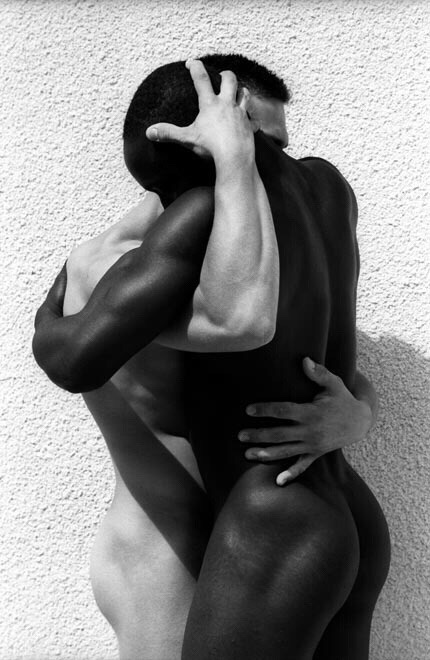
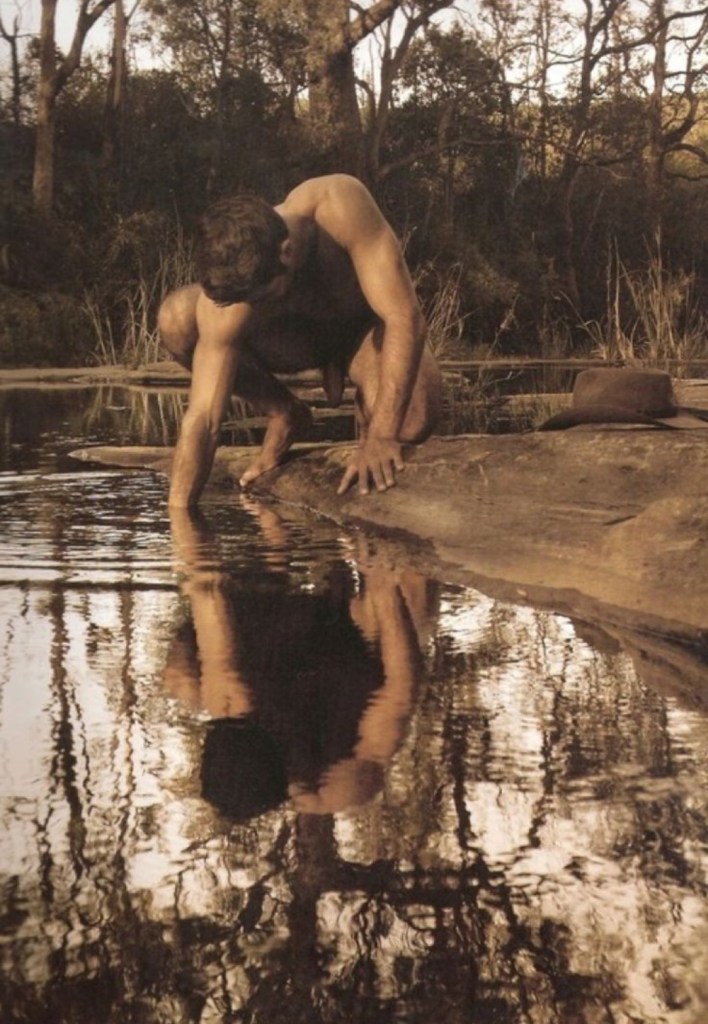
If you are not familiar with the Greek myth about Narcissus, he was born in Thespiae in Boeotia, the son of Cephissus (the personification of the Boeotian river of the same name) and the nymph Liriope. His mother was warned one day by the seer Teiresias that her son would live a long life as long as “he never knows himself.” Narcissus was known for his incredible beauty, and as he reached his teenage years, the handsome youth never found anyone that could pull his heartstrings. He left in his wake a long trail of distressed and broken-hearted maidens and even spurned the affections of one or two young men. Then, one day, he chanced to see his own reflection in a pool of water and, thus, discovered the ultimate in unrequited love: he fell in love with himself. Naturally, this one-way relationship went nowhere, and Narcissus, unable to draw himself away from the pool, pined away in despair until he finally died of thirst and starvation. Immortality, at least of a kind, was assured, though, when his corpse (or in some versions the blood from his self-inflicted stab wound) turned into the flowers which, thereafter, bore his name.

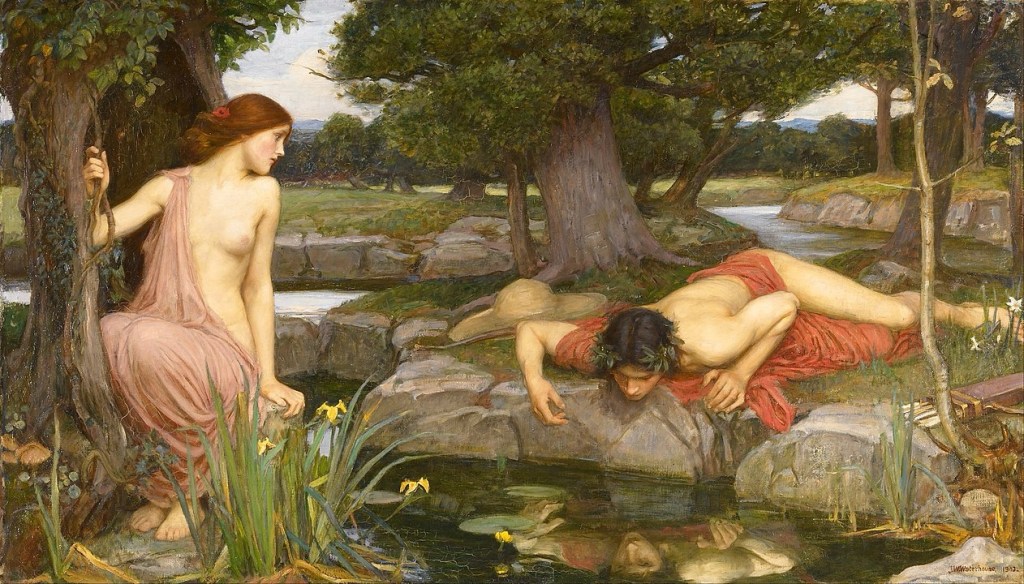
Echo and Narcissus by John William Waterhouse (1903 oil painting) 

Narcissus appears in other myths as well, especially the myths surrounding mountain nymph Echo. Another version of the myth appears in the work of the Roman writer Ovid. In this telling, Narcissus is as handsome as ever but cruelly refuses the advances of Echo. The lovely nymph, heartbroken, wastes away and dies with only her voice remaining to echo her plight. As a punishment for his neglect, Narcissus is then killed. Another version has Echo punished by Hera because she kept the goddess distracted with stories while the lovers of her husband Zeus, the mountain nymphs, escaped Mt. Olympus without notice. This explains why Echo could only repeat what others said to her. It is Echo in this form that Narcissus comes across one day while hunting deer in the forest. After a useless exchange of repeated words and statements, Echo tries to embrace the youth, but he rejects her and dashes off back home. Echo then pines away in the forest so that her body eventually perishes and only her voice remains.

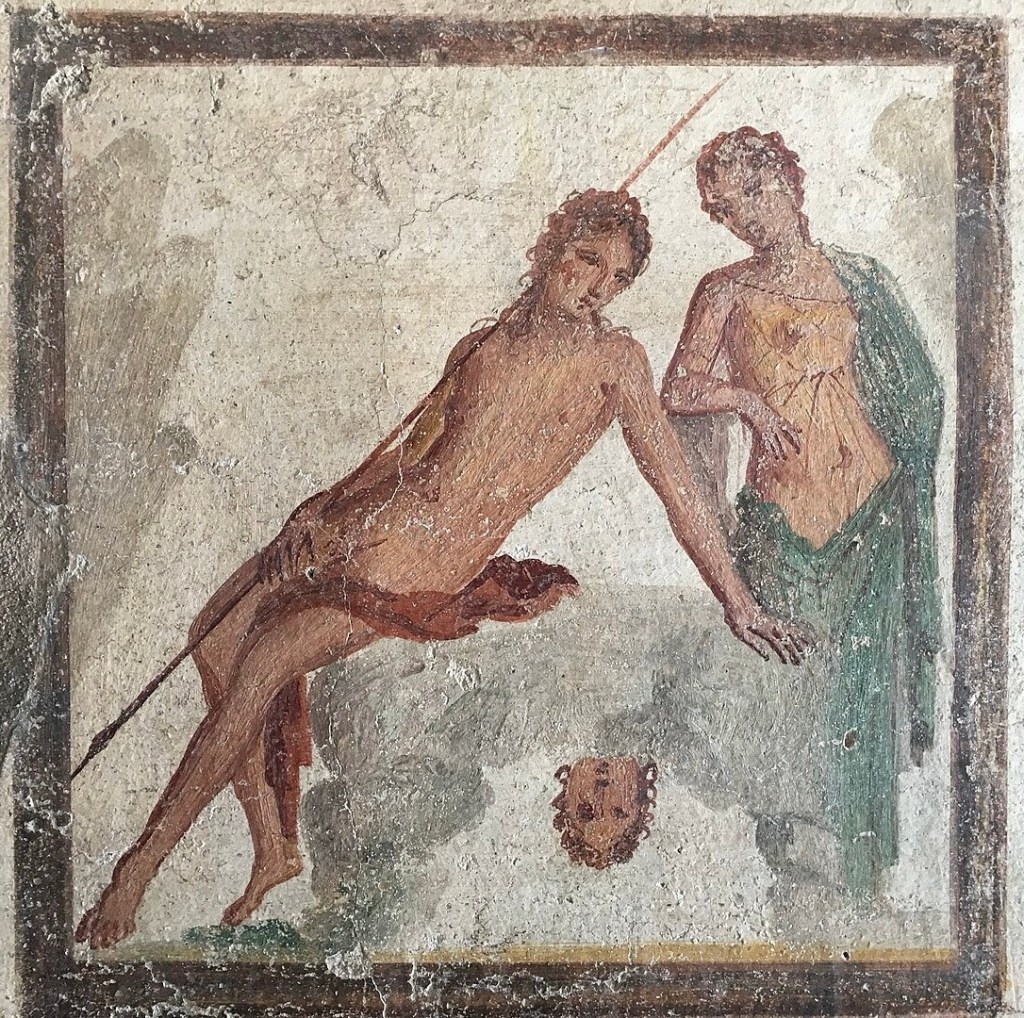
Echo (right) with Narcissus, from a fresco in Pompeii

Unlike for Greek artists, the Roman version of Narcissus and Echo was a very popular subject in Roman art and is seen in almost 50 wall paintings at Pompeii alone. Renaissance art also took a shine to Narcissus; the story involving light, and reflection proved irresistible to Caravaggio, who captured the myth in his celebrated 16th-century CE oil painting. Finally, his name lives on today in psychoanalysis where narcissism refers to the personality disorder of excessive self-admiration and preoccupation with one’s appearance. 

In the poem above, Meynell describes a poet as being similar to Narcissus looking back on himself through his poetry as a form of vanity. In this way, similar to Narcissus who lives on as the flower, the poet lives on forever through his poetry.

About the Poet

Alice Christiana Gertrude Meynell was born on October 11, 1847, in Barnes, west London, to Thomas Thompson, a lover of literature and friend of Charles Dickens, and Christiana Weller, a noted painter and concert pianist. Thompson insisted on a classical education for his children, who were homeschooled. This education, as well as the verses of Elizabeth Barrett Browning and Christina Rossetti, inspired Meynell to try writing poetry as a teen.

Her poetry is characterized by its formal precision and intellectual rigor. She often explores themes of faith, nature, and the human condition with a restrained and understated elegance. Her focus on the musicality of language and concise imagery makes her work continue to be studied and enjoyed today. 

Meynell suffered from poor health throughout her childhood and adolescence. In 1868, while she was recuperating from one of these bouts of illness, she converted to Roman Catholicism. It was also during this time that she fell in love with Father Augustus Dignam, a young Jesuit who had helped with her conversion and received her into the church. Dignam inspired some of her early love poems, including “After a Parting” and the popular “Renouncement.” Meynell and Dignam continued to correspond for two years until they fell out of touch.

She was influenced by the Pre-Raphaelite poets, an artistic movement founded in 1848 by the poet and painter Dante Gabriel Rossetti and the painters John Everett Millais and William Holman Hunt, who is often credited with the group’s name, which indicates not a dismissal of the Italian painter Raphael, but rejection of strict aesthetic adherence to the principles of composition and light characteristic of his style. The Pre-Raphaelites’ commitment to sincerity, simplicity, and moral seriousness is evident in the contemplative but uncomplicated subjects of its poetry and in the religious, mythical, and literary subjects depicted in its paintings. Meynell shared their interest in symbolism and aesthetic beauty, but her poetry also displays a strong intellectual and spiritual depth influenced by her Catholic faith. Meynell’s work was admired by contemporaries such as George Meredith, Coventry Patmore, and John Ruskin, and she played a significant role in shaping the literary landscape of her time.

In 1875, Meynell published her first poetry collection, Preludes (Henry S. King & Co.), which was received with great success. English poet and novelist Walter de la Mare called her one of the few poets “who actually think in verse.” Two years later she married Wilfred Meynell, another Catholic convert who was working as a journalist for a number of Catholic periodicals in London. He soon became the successful editor of the monthly magazine Merry England. Alice Meynell joined her husband at Merry England as coeditor, helping to keep the magazine at the helm of the Catholic literary revival. Her writing won her the recognition of other members of the literary elite of the time, such as Coventry Patmore, Francis Thompson, Oscar Wilde, and W. B. Yeats.

Meynell balanced her time between her journalism work with Merry England, her social life among the literati, her home life (she mothered eight children, one of whom died as an infant), and her social activism. She worked to improve slum conditions and prevent cruelty to animals, but she was best known for her work for women’s rights. Meynell worked with the Women’s Suffrage Movement and fought for workers’ rights for women. During this busy period, Meynell did not write much poetry; her second book, Poems (Elkin Matthews & John Lane, 1893), was published nearly two decades after the release of her debut. She published several more poetry collections in her lifetime: Ten Poems (Romney Street Press, 1915); Collected Poems of Alice Meynell (Burns and Oates, 1913); Later Poems (John Lane, 1901); and Other Poems, which was self-published in 1896. Restrained, subtle, and conventional in form, Meynell’s poems are reflections on religious spirit and belief, love, nature, and war.

She was twice considered for the post of Poet Laureate of England—upon the deaths of Alfred, Lord Tennyson, in 1892 and Alfred Austin in 1913. Elizabeth Barrett Browning is the only other woman who had been considered for the post up to that point. Meynell continued writing until her death. After a series of illnesses, she died on November 27, 1922. A final collection, Last Poems (Burns and Oates), was published posthumously a year later.