Category Archives: Politics

A Polarized America

In the last 30 years, Americans have become increasingly divided over politics. The gap between the policies endorsed by the Republican and Democratic Parties is growing, as is the animosity between people who identify with different parties. Partisan politics first came to a head in the election of 1800. The First Party System of the United States featured the Federalist Party and the Democratic-Republican Party (also called “Jeffersonian Republican”). The Federalist Party grew from the national network of Washington’s Secretary of the Treasury, Alexander Hamilton, who favored a strong united central government, close ties to Britain, a centralized banking system, and close links between the government and men of wealth. James Madison and Thomas Jefferson, who strongly opposed Hamilton’s agenda, founded the Democratic-Republican Party. The Jeffersonians came to power in 1800, and the Federalists were too elitist to compete effectively. The Federalists survived in the Northeast, but their refusal to support the War of 1812 verged on secession and was a devastating blow when the war ended well. The Era of Good Feelings under President James Monroe (1816–1824) marked the end of the First Party System and a brief period in which partisanship was minimal.

There is not an Era of Good Feelings today. Donald Trump has made sure of that. He has polarized this nation more than ever. The Republican Party, which can be traced back to the Federalists, and Democrats, whose origins are in the Democratic-Republican Party, are more divided along ideological lines – and partisan antipathy is more profound and more extensive – than at any point in the last three decades. It could be the most polarized the United States has ever been except for the Civil War. These trends manifest in myriad ways, both in politics and in everyday life. Partisan animosity has increased considerably since the beginning of the Clinton presidency in 1992. In each party, the political polarization has more than doubled since the “Republican Revolution” of 1994. Most of these intense partisans believe the opposing party’s policies “are so misguided that they threaten the nation’s well-being.”

We have been so ingrained to think about polarization: black and white, Republican or Democrat, Christian and Atheist, gay and straight, etc. Politics like sexuality is a spectrum, but when people in a political party are afraid of having their ability to compromise and come to a mutually agreed solution becomes a weapon against them, we become so polarized that we can’t see the truth of what needs to be done. Republicans couldn’t even vote for the impeachment of a president who clearly committed treason, bribery, and election fraud because they were too scared of that the president and voters would turn on them. They simply couldn’t do the right thing for this country because of political affiliation. Joe Biden said last night in the ABC town hall that the political parties in America need to come together and not be afraid of retribution from the president. He talked about getting people together and working out solutions instead of temper tantrums and stalled legislation. The polarization of American politics is nothing new.

If we look back at the contentious election of 1800, we see that the Federalist incumbent John Adams ran against the rising Democratic-Republican Thomas Jefferson. The extremely partisan and outright nasty campaign failed to provide a clear winner because of a constitutional quirk. Presidential electors were required to vote for two people for the offices of president and vice-president. The individual receiving the highest number of votes would become president. Unfortunately, Jefferson and his vice-presidential running mate Aaron Burr both received an equal number of electoral votes, and the House of Representatives voted to break the tie. When Adams’s Federalists attempted to keep Jefferson from the presidency, Adams set the stage for the first critical constitutional crisis of the new American federal republic. However, rationality prevailed, and the first peaceful transition of political power between opposing parties in U.S. history occurred. The election had far-reaching significance and resulted in the 12th Amendment. Jefferson appreciated the momentous change, and his inaugural address called for reconciliation by declaring that, “We are all Republicans, we are all Federalists.”

However, before Jefferson was inaugurated, there was a lot of uncertainty and political divide. On January 25, 1800, there occurred an impressive exchange on Washington politics. Abigail Adams, the president’s wife, and one of the contenders for John Adam’s replacement offered their impressions of a partisan in a “curious conversation” over supper that night. The give-and-take was frank and unrestrained. Jefferson said he avoided attending the House of Representatives, writing, “I am sure there are persons there who would take a pleasure in saying something, purposely to affront me.” He complained and worried about a partisan Congress, adding that he found “more candor and liberality upon one side than there is upon the other.” Abigail Adams was equally candid, noting prophetically, “Some are mere Brutes, others are Gentlemen— but party Spirit, is a blind spirit.”

The problems with parties are now the worst it has ever been as opponents deride politicians for even attempting to compromise. Today’s increase in partisanship in the U.S. also has significant harmful effects. Most importantly, polarization and partisan conflict lead to inaction, as “my way or the highway,” ideologically rigid mentalities lower the probability of achieving the compromise that should be at the heart of legislative functioning. We saw this “destroy the village in order to save it” mentality with the shutdown of the U.S. government, which has occurred five times since 1990. Partisans on both sides increasingly see institutions in the U.S. not as beneficial and necessary but as part of an effort by the other side to gain advantage and to perpetuate its power and philosophical positions. Liberals and Democrats today, for example, have lower trust in “traditional” family and religious institutions. They question the problems of the current economic system that intensifies inequality in the United States. Republicans have lower trust in the scientific process, higher education, the mass media, and the role of the government. These skeptical views of institutions and social structures skew us toward distrust, anger, and internal infighting — not actionable efforts to fix problems and address threats.

A healthy skepticism of the way things operate in society is often warranted. But our society must continue to function, and that functioning requires an underlying agreement in the legitimacy of societal institutions. This is particularly true today when there are increasing external threats to our society and way of life from all sides, ranging from rogue states to terrorists to changes in weather and climate patterns to shifting world economies and massively unstable populations. At some point, the United States must balance the partisan conflicts resulting from differences in views of the world with a broader agreement on how we, as a society, adapt to external threats and achieve societal objectives. What will it take to do that? Presumably, we need leaders who don’t focus as much on taking advantage of and stoking partisan differences as they do looking at the larger picture. That’s a difficult challenge, but one to which the American public may well be quite receptive. Bipartisan cooperation is a perspective that Joe Biden has long advocated. 

While it is usually easier to criticize than to make efforts to agree on solutions, we are going to need more emphasis on cooperation in the years ahead if our society is to thrive and survive. If Donald Trump is elected for another four years, the divide may be so great when he leaves the White House that it can never be salvaged. We are at a crossroads. I hope that Joe Biden can heal the wounds of partisan politics, but I do not doubt that Donald Trump will widen the divide and the work to destroy our most sacred institutions of democracy. Nikki commented yesterday, “I’m so tired of thinking about Trump every day! And worrying worrying worrying. His Supreme Court pick is horrendous for gay rights and women’s rights. Exhausting.” I couldn’t agree more. I think we will have a collective case of PTSD by the time Trump leaves the Oval Office. We just have to hope there is an United States to salvage when he finally leaves office.



A State of Fugue

The United States is teetering on the edge of its breaking point. As one historian recently put it, “Americans teeter on the brink of a state of collective fugue.” A fugue is a psychiatric state of mind caused by extreme distress in the aftermath of one or more cataclysmic events. A fugue state causes a person to fail to recall basic recognizable personal characteristics and to no longer remember what they believed in the past; those things they knew to be true no longer exist. This dissociative mental state erodes one’s fundamental concept of self. Under Donald Trump’s disastrous and destructive presidency, our collective memory and awareness of who we are as a people and our shared aspirations to perfect our union appear to be at the point of dissolution.

Many people forget what it was like to have a somewhat normal person as president, someone who you could find something within them to admire. Trump has distorted the truth so much with his thousands of lies that we no longer expect him to speak the truth. His lies have become so routine that when he announced that he and Melania had contracted COVID-19, people across America wondered if it was true and what was his personal and political motivation behind the announcement. We quickly found out that while he appears to have really had COVID-19 and through recklessness spread it to dozens of others, he has now downplayed the seriousness of the virus. While he gasped for breath on the White House balcony imitating Italy’s fascist dictator Benito Mussolini, he was defiant in his proclamation that he was back in perfect health, not mentioning that he had received experimental treatments not available to the average person with COVID-19.

Some of us remember what the United States foundational philosophy is: “all men are created equal, that they are endowed by their Creator with certain unalienable Rights, that among these are Life, Liberty and the pursuit of Happiness.” While the United States has not always lived up to the words of the Declaration of Independence, men and women have fought since 1776 for those ideals. However, for the same length of time, men and women have fought against these ideals applying to all Americans. Today, we have met with the most critical threat to the United States’ ideals in the administration of Donald J. Trump. The president has worked to divide us on race, sexual orientation, the right to healthcare, immigration, etc. Think of any issue, and the current Republican Party is on the wrong side of it. We are at war because of political ineptitude. 

We are not at war with a conventional army, yet our nation is in utter chaos. Over 215,000 American lives have been lost to COVID-19, and with winter on the horizon, a second wave of the pandemic is emerging in Europe. The United States leads the world in the number of people infected with the virus and in the number of COVID-19 deaths, despite the nation’s exceptional biomedical and health-related research and infrastructures. Under Trump’s leadership, we have fallen further and further behind the rest of the world in handling the current pandemic. We are now facing the most dangerous threat to democratic ideals in the United States since the Civil War. We are a nation so divided that people cannot even be convinced to wear a face mask to protect others because our current president refuses to acknowledge their effectiveness or the pandemic’s seriousness.

Further, despite the United States’ instinct to lecture the world about minority rights and good governance, police brutality against Black people in the United States is dramatically displayed in media across the globe. The ensuing continental uprising for civil rights, far-reaching economic spasms, and governance crisis are exacerbated by the reflexive responses of an unpredictable President. We are no longer, in the words of Woodrow Wilson, “making the world safe for democracy” because we have a Republican Party that is doing all they can to erode our own democracy. In his famous “Four Freedoms” Speech, President Franklin D. Roosevelt outlined the ideals of America:

The basic things expected by our people of their political and economic systems are simple. They are: Equality of opportunity for youth and for others. Jobs for those who can work. Security for those who need it. The ending of special privilege for the few. The preservation of civil liberties for all.

Later in the speech, FDR said:

We should bring more citizens under the coverage of old-age pensions and unemployment insurance. We should widen the opportunities for adequate medical care. We should plan a better system by which persons deserving or needing gainful employment may obtain it.

Let us not forget that even in the 1940s, the Republican Party was fighting against the basic needs of Americans. We are at even greater risk today from Donald Trump and his cronies.

The Republican party is literally letting poor people starve, just as Herbert Hoover did in the early years of the Great Depression. In a recent debate with his opponent Amy McGrath, Senate Majority leader Mitch McConnell pointed out he had helped pass the first rounds of relief in the spring and suggested the lack of action was the fault of the Democrats who wanted to spend money on things unrelated to the crisis. McGrath was aggressive in her response, saying,  “The House passed a bill in May, and the Senate went on vacation. I mean, you just don’t do that. You negotiate. Senator, it is a national crisis.” And, do you know how McConnell reacted? He laughed. He is laughing at the suffering of the American people and showing full-on contempt for the needy.

Sadly, the pretend attempts at action by Republican in the Senate with pitifully insufficient aid is pay off for McConnell in one crucial way. A majority of Americans believe both parties should share blame for the impasse. They think it is the fault of both parties that people cannot receive the help they desperately need. McConnell’s laugh gives lie to that belief, demonstrating the heartlessness and cruelty at the heart of the Republican project. It’s been a 40-year effort by the Republican Party to tear down the framework of the New Deal and return the United States to a meaner, nastier country where individual citizens are left to fend for themselves, even as the wealthiest Americans and largest businesses receive tax breaks and regulatory relief that leaves us all poorer. And now McConnell is so confident that his plans will succeed, he couldn’t even be bothered to fake empathy onstage for a few hours on Monday night. His knowing laugh makes it clear what a continued Republican majority in the Senate means: that Americans will continue to get treated with contempt by politicians who claim to be acting on their behalf.

There has been a transition from the United States exercising most of the cultural, economic, and military influence to a world where power is shared amongst many nations without a single world leader. The emergence of financial centers in the East and the subsequent erosion of Pax Americana, accelerated by Trump and his cronies, compound our unease and search for identity. These seismic shifts nationally and internationally only serve to perpetuate our state of heightened anxiety. 

The erosion of our centuries-old governmental institutions is particularly distressing. In the wake of the death of Supreme Court Associate Justice Ruth Bader Ginsburg, we are now forced to put aside our national mourning and deal with the political ramifications of her passing. The Republican Party has become so desperate for any grasp of power before an election that polls show them far behind, that they are pushing forward with an ideologue who matches their views of the destruction of personal liberty and safety for Americans. We must reckon with the seemingly assured confirmation of Amy Coney Barrett as Ginsburg’s replacement. The socially conservative Barrett would certainly erode the civil rights of minorities, the healthcare gains of the contemporary era, the procedural rights of ordinary Americans in the justice system, and workers’ bargaining power. The death of Ginsburg, a champion of rights, promises the potential to regress to a darker past.

Trump and his cronies claim to have the mandate from the American people and are preparing their Senate allies to complete the confirmation process within the span of a few weeks, just before a presidential election. Mitch McConnell’s pledge to support the President ignores a precedent he declared only four years ago – not to appoint a Justice during an election year – which we are now expected to erase from our collective memory. In many instances, particularly at the Supreme Court level, the American judicial system has been predictable in rendering judgments based on Justices’ and other appointed federal judges’ partisan political suasions. Notwithstanding, the near balance of opposition forces within the Supreme Court provided stability. It prevented the abrupt tilting of the scales of justice, such that they overwhelm their point of balance and implode the judicial system. 

The Republicans obstructed President Obama’s appointments for federal judges during his tenure as a political maneuver, albeit with an underlying racial element. Yet, in under four years, Trump has appointed over 300 federal judges. It is particularly troubling that judges view their outlook on national issues through a political lens, as a President who lost the popular vote and a Republican Senate whose members represent a minority of the nation have pushed the courts sharply rightward. Republicans abandoned their legal philosophy when it was no longer expedient and backpedaled from their position after the death of Justice Antonin Scalia just four years ago. They have manipulated and confused the American people into thinking their reactions to what the Republican Party is doing are so far off base that the American people themselves are the crazy ones. They claim that what we see and hear is not true. They ask us to forget what they committed to in 2016, to question everything, and to dispute the existence of what we know to be true.

Judge Amy Coney Barrett flatly refused on Tuesday to pledge that she would recuse herself if a dispute over the November 3rd election came before the Supreme Court, insisting that despite her nomination by President Trump, she would not “allow myself to be used as a pawn to decide this election for the American people.” After days of questioning Barrett over her opposition to Obamacare, Democrats dismissed her assurances as essentially meaningless. The truth of the matter is, Trump did not need to secure any specific promises from Barrett. The president selected her precisely because her established legal views would achieve the end he was after. Barrett’s refusal to discuss specific cases or commit to recusing from particular matters was nothing new as it has been a decades-old answer used by Supreme Court nominees to avoid giving substantive answers during confirmation hearings. But her attempts to deflect such questions were more conspicuous than usual, given how explicit Trump has been about how he would want his nominees to rule. The president has stated that he wants Barrett confirmed by Election Day, given that he anticipates an election dispute and is “counting” on the court to “look at the ballots.” And he has said he wants justices who would “do the right thing” and invalidate the Affordable Care Act.

Through a similar distortion of memories, Trump and his cronies have denied the existence of systemic racism that underpins police killings of unarmed Black people or the warming of our planet. They’ve attempted to erase what is real from our memory. These unprecedented events have brought the nation to the abyss of a political state of amnesia. Republicans are determined to push us into the abyss. When confronted with existential social and political crises, they provoke political subterfuge with campaigns of disinformation. For example, Bob Woodward disclosed that in February, President Trump was fully aware of the fatal potential of the coronavirus. Trump not only failed to share this information with the American public; he actively downplayed its deadly potential to the public and strongly encouraged his followers to ignore preventive measures. The President had promised before his election in 2016 to end American carnage. Paradoxically, his words foreshadowed what his legacy would be – the attacking of the American dream and reaching the milestone of hundreds of thousands of preventable American deaths during his presidency.

The Republican lies continue to grow like a cancerous tumor, but the election can act as a surgery to remove that cancerous growth. Republicans are currently using fear tactics to get their supporters to believe that a Democratic coup is in the works, when Trump himself has basically said he would invalidate any election he did not win by laying the seeds of voter fraud. In one version of the right-wing conspiracy theories, commentators claimed, without proof, that Biden would not concede if he lost the election, merely projecting Trump’s own words on the former Vice President. They also said that Biden’s supporters would riot. “If a defeated Biden does not concede and his party’s rioters take to the streets in a coup attempt against President Trump, will the military be needed to stop them?” tweeted Mark Levin, the Fox News’ Host of Life, Liberty & Levin, on September 18. After The New York Times contacted him, Levin published a note on Facebook saying his tweet had been a “sarcastic response to the Democrats.” Levin’s assertions are a page right out of Trump’s Facebook. When Trump has said anything dangerous, outrageous, or untrue, such as injecting bleach into people to prevent/cure COVID-19, he has said he was being sarcastic or joking.

Trump has departed from nearly every convention of the office of the president over the past four years, but perhaps none has been more visible than his keeping of a personal Twitter account. He has used it to announce policy, move markets, attack the press, dispute reports, insult enemies, and energize his base — all unvarnished by a journalist’s interpretation. One of the reasons Trump remains politically competitive is that many Americans are delusional enough to credit him with being authentic, even if he goes too far. Too many people take this farce of a president seriously, especially when it comes to believing his thousands of lies. He’s tweeted the term “fake news” more than 800 times since his inauguration to discredit any information that is not flattering him.

Mike Caulfield, a digital literacy expert at Washington State University Vancouver, has stated that misinformation translating to real-world action is a growing problem. “What we’ve seen over the past four years is an increasing capability” of believers to turn conspiracy narratives “into direct physical actions,” Caulfield said. In recent days, the FBI discovered a group of men plotting to kidnap and kill Michigan Governor Gretchen Whitmer and Virginia Governor Ralph Northam. The men felt emboldened by president Trump’s rhetoric plot to rid of the nation of two Democratic governors.

This is not the first time that Republican rhetoric has caused serious threats to Democrats. On January 8, 2011, Representative Gabby Giffords of Arizona was shot in the head outside a Safeway grocery store in Casas Adobes, Arizona, a suburban area northwest of Tucson, during a gathering to meet constituents. Giffords was a proponent of gun control. The gunman ran up to the crowd and began firing a 9mm pistol hitting 19 people, and killing six, including federal judge John Roll and a 9-year-old child, Christina-Taylor Green. At the time, commentators criticized the use of harsh political rhetoric in the United States gun activists and conservatives for the shooting. In particular, Sarah Palin, the former Republican Vice Presidential nominee, was criticized for a poster by her political action committee that featured stylized crosshairs on an electoral map, which included Giffords. Luckily, Giffords survived, but on January 22, 2012, Giffords announced in a video statement that she intended to resign her seat to focus on her recovery. The Republican rhetoric had not killed Giffords, but it did remove her from office. The rhetoric of the type used by Palin and Donald Trump is taken seriously by mentally unstable people. It is extremely dangerous because of those who are influenced by it have a disconnect with reality.

If re-elected, after another four years of a Trump presidency, the Justice Department, Supreme Court, and other institutions of the American democracy will not be recognizable. Our system of checks and balances, the foundation of the American democracy, will be dismantled. Our identity and who we are as Americans and our aspirations for a more perfect union will cease to exist. Our government will be so fundamentally altered from what we know it to be; we will have entered a collective political fugue.


Anti-LGBTQ+ Dog Whistles

During yesterday’s Senate confirmation hearings for Amy Coney Barrett, Senator Dianne Feinstein of California asked the nominee whether she shared her late mentor Justice Antonin Scalia’s hostility toward gay rights. During her nomination ceremony last month, Barrett stated that she has adopted the “judicial philosophy” of the Scalia, a conservative judge who delivered the dissenting opinion in the 2015 landmark decision requiring states to grant and recognize same-sex marriages. If confirmed, Feinstein asked, would Barrett, like Scalia, “be a consistent vote to roll back hard-fought freedoms and protections for the LGBT community”? Barrett responded that she had “no agenda,” a line Scalia also used during his confirmation hearing. She then elaborated: “I do want to be clear that I have never discriminated on the basis of sexual preference and would not discriminate on the basis of sexual preference.” 

Barrett wouldn’t say whether she agrees with Scalia on the issue of same-sex marriage, adding that no one should “assume” she would make the same decisions Scalia did. “It’s rather a fundamental point for large numbers of people I think in this country,” Feinstein pressed her. She added: “You identify yourself with a justice that … would be a consistent vote to roll back hard-fought freedoms and protections for the LGBT community. And what I was hoping you would say is that this would be a point of difference, where those freedoms would be respected and you haven’t said that.”

Senator Mazie Hirono of Hawaii schooled Barrett on her use of “sexual preference” later in the hearing. “Sexual preference is an offensive and outdated term. It is used by anti-LGBTQ activists to suggest that sexual orientation is a choice. It is not. Sexual orientation is a key part of a person’s identity,” Hirono said. “That sexual orientation is both a normal expression of human sexuality and immutable, was a key part of the majority’s opinion in Obergefell.” Hirono ended her remarks saying, “Which, by the way, Scalia did not agree with,” without allowing Barrett to respond. After the next committee member, Senator Joni Ernst of Iowa, began, Barrett asked to speak directly to Hirono’s comments. Barrett then attempted to clarify that she intended to suggest no hostility with her use of the term and offered an “apology.” “I certainly didn’t mean and would never mean to use a term that would cause any offense to the LGBTQ community,” Barrett said. “So, if I did, I greatly apologize for that. I simply meant to be referring to Obergefell’s ruling with respect to same sex marriage.” The problem with Barrett’s clarification is that she says she had not intended any hostility to the LGBTQ+ community; however, she did not apparently say sexual orientation is not a choice.

Even with this weak apology, Barrett’s use of “sexual preference” is alarming for good reason. The archaic phrase suggests that sexuality is a choice, that gay and bisexual people simply prefer to partner with people of the same sex—a preference that, with enough willpower, can be changed. This is an argument I have had for many years with my family. I did not choose to be gay. I love being gay because I have come to accept myself, but if there had been a choice, I would not have chosen it. I dated several women who would have loved to have had me as a husband, and the only choice I ever made was that I would not marry a woman because I would make her and me miserable. This may not be the case for everyone, but it was the case for me. I knew I would never be happy married to a woman. 

Journalist Kyle Griffin sums up the issue very well:

American psychologist, writer, and academic Jesse Bering explained in 2013 that the term “sexual preference” is similar to other expressions, like “the gay lifestyle” or “avowed homosexual,” that were once common but are now considered offensive. These phrases play into the anti-gay fabrication that sexual minorities are not a discrete and insular minority deserving of constitutional protections but rather deviants who should not be rewarded for their abnormal sexuality. Today, the term “sexual preference” has almost universally been replaced with “sexual orientation,” which acknowledges that sexuality is a fundamental human trait. But the religious right often refuses to use “orientation,” fearing that it will legitimize homosexuality. For instance, when Scalia dissented from the Supreme Court’s first ruling in favor of gay rights, he put the word “orientation” in scare quotes, speaking only of “homosexual ‘orientation.’ ” Scalia also refused to use the phrase “sexual orientation” in the court’s next three gay rights decisions. Instead, he deployed the term “homosexual conduct.” Like “sexual preference,” this expression implies that homosexuality isn’t something you are but something you do—and, by extension, something you can (and should) stop doing. Consider this passage from Scalia’s dissent in Lawrence v. Texas, which legalized same-sex intimacy:

Many Americans do not want persons who openly engage in homosexual conduct as partners in their business, as scoutmasters for their children, as teachers in their children’s schools, or as boarders in their home. They view this as protecting themselves and their families from a lifestyle that they believe to be immoral and destructive.

Barrett’s use of “sexual preference” yesterday brought Scalia’s words to the mind of many LGBTQ+ activists and the news media. The term indicates that she might share the Alliance Defending Freedom (ADF) positions, which opposes LGBTQ+ nondiscrimination laws. They support the criminalization of homosexuality, and they consistently reject the validity of LGBTQ+ identities. Barrett has given paid speeches to the organization on five occasions. When Al Franken questioned her during the September 6, 2017 confirmation hearing for the Appellate Court about whether she supports the organization’s full agenda, she said she did not look into the group’s beliefs before agreeing to the speaking engagement:

ADF regularly asks the Supreme Court to legalize discrimination against LGBTQ+ people and roll back our constitutional equality. The group is currently urging the Supreme Court to rule that Philadelphia must provide public funding to a foster care agency that refuses to work with same-sex parents. SCOTUS will hear the case in November—shortly after Barrett is confirmed if Republicans’ current timeline holds.

In yesterday’s hearing, Senator Patrick Leahy of Vermont also brought up Barrett association with the ADF program, Blackstone Legal Fellowship. She has given paid speeches to Blackstone fellows, law students from around the nation, on five occasions. Leahy mentioned that ADF had celebrated the recriminalization of gay sex in India, and told Barrett, “Whether you believe being gay is right or wrong is irrelevant to me, but my concern is you worked with an organization working to criminalize people for loving a person that they’re in love with.” Barrett said her Blackstone lectures were on constitutional law and had nothing to do with any type of discrimination.

What’s more, Barrett’s claim that she has “never” discriminated based on sexuality drew scrutiny given her ties to Trinity Schools Inc., a group of private Christian schools that has spoken out against same-sex marriage. Barrett served as a trustee on the board of Trinity Schools from 2015 to 2017, and some of her children attend the Trinity School at Greenlawn in South Bend, Indiana. In 2014, Trinity Schools adopted an admissions policy that effectively excluded children of same-sex couples, former Trinity staffers told The New York Times. A person involved in Barrett’s confirmation process said Barrett did not participate in creating the policy, but former Trinity staffers said it was enforced during her tenure, according to the Times.

A “cultural statement” issued by the school during the 2018-19 school year stated, “the only proper place for human sexual activity is marriage, where marriage is a legal and committed relationship between one man and one woman,” reported Politico. It also defined “homosexual acts” as “at odds with Scripture.” According to Politico, a spokesperson for Trinity Schools said the language was changed around that time, suggesting it was in place during Barrett’s tenure on the board and well after the Supreme Court legalized same-sex marriage nationwide in 2015.

In light of Barrett’s long affiliation with anti-gay organizations, we cannot dismiss her coded language as a poor choice of words. She knew exactly what she was saying. She strikes me as a woman who chooses her words very carefully. If there is any way that she didn’t know exactly what she was saying, she needs to withdraw her nomination for being a complete idiot and an insensitive human being, but I have no doubt she knew. Republicans selected her, in part, to reward the Christian right for its loyalty to Donald Trump. Eroding constitutional equality for LGBTQ+ people is a key priority of the Republican Party platform. Barrett has given us every reason to expect that she will shore up a conservative majority that is ready and willing to condemn gay Americans to second-class citizenship once again.


Presidential Health

In the last week since Trump was released from Walter Reed, there have been speculations about the effects COVID-19 may have had on his mental health. Part of the speculation has been because his doctor was caught lying to the press and the number of lies Trump and his administration routinely tells. All of the lies naturally have a lot of people questioning the truth about Trump’s health. The problem with someone lying in almost everything they say makes it hard to believe them even when they may be telling the truth. Think of the fable, “The Boy Who Cried Wolf.” Of course, Trump is not the first president to lie about his health, and he is unlikely to be the last.

The most significant issue is that we are only now beginning to understand the long-term effects of COVID-19. COVID-19 has been compared to the 1918 Spanish flu epidemic since it began spreading around the world. Luckily, medicine has progressed considerably since 1918, and it is unlikely to cause the number of worldwide deaths that the Spanish flu caused. Five hundred million people were infected with the Spanish flu, which was one-third of the world’s population at the time. Estimates of deaths range from 17 million to 50 million to as high as 100 million. Hopefully, an effective vaccine will be found before too long, and millions of lives will be saved.

Just as with Trump contracting COVID-19, the president of the United States also caught the Spanish flu in 1919 while at the Paris Peace Conference. Several members of the American delegation got influenza, and, like COVID-19, influenza can be transmitted before symptoms appear. Some of my readers may know this, but the United States’ involvement in the First World War is my academic specialty. So, I am very familiar with Woodrow Wilson and the Paris Peace Conference, which was an integral part of my master’s thesis. However, I am embarrassed to say that I had not previously known that Wilson contracted the Spanish flu. I knew he had a stroke while trying to convince Americans to support the United States joining the League of Nations, but there is much more to the story.

On Thursday, April 3, 1919, Wilson suddenly fell ill. White House physician Cary Grayson noted he was seized by “violent paroxysms of coughing, which were so severe and frequent that it interfered with his breathing,” followed by such other symptoms as high fever. Grayson tried to keep the illness secret, but word leaked out that Wilson was sick, and Grayson lied, insisting Wilson simply had a bad cold. Afraid of another leak, Grayson wrote a note to be hand-delivered to Wilson’s chief of staff, which said, “That night was one of the worst through which I have ever passed. I was able to control the spasms of coughing, but his condition looked very serious.”

Like the 1918 flu virus, COVID-19 impacts virtually every organ in the body, including the brain. Most problematic are cardiovascular and neurological impacts. For COVID-19, cardiovascular complications, including stroke, are so common that some experts consider this and not the lung, the primary problem. And according to a study in Annals of Neurology, 25 percent of patients have some neurological dysfunction, and 7 percent have “impaired consciousness.” Another study in Clinical Neurology and Neurosurgery found 36.4 percent of patients to have neurological symptoms. In 1918, it was much the same. The single most comprehensive study of the 1918 pandemic concluded, “The effect of the influenza virus on the nervous system is hardly second to its effect on the respiratory tract. … From the delirium accompanying many acute attacks to the psychoses that develop as ‘post-influenzal’ manifestations, there is no doubt that the neuropsychiatric effects of influenza are profound.”

For Wilson and the world, the effects were indeed profound. He became paranoid, convinced he was being spied on. Herbert Hoover, who was at the time, was in charge of the American food relief efforts for the devastated Europe, believed Wilson’s mind lost “resiliency” and its ability to reason clearly “in coming to conclusions.” Others made similar comments. Nonetheless, after five days in bed and too ill to go out, Wilson insisted on rejoining the peace negotiations. British and French Prime Ministers David Lloyd George and Georges Clemenceau — whose nickname was “the tiger” — came to his room. They, too, found a different man. Lloyd George commented on Wilson’s “nervous and spiritual breakdown in the middle of the Conference.”

Nothing in Wilson’s prior history suggests he would compromise on any principle. Before his illness, he had insisted upon “peace without victory,” his Fourteen Points, and supporting self-determination around the world. But over the next few days, he gave way on almost every point to Clemenceau and agreed to a peace deal that punished Germany and preserved other nations’ imperial ambitions. Historians agree that the treaty contributed significantly to the rise of Adolf Hitler and the start of World War II. A few months later, Wilson’s influenza attack very likely contributed to his debilitating stroke while campaigning across the country to get the support of the American people for the Versailles Treaty.

Today, the case mortality for a 65 to 74-year-old man — Trump is 74 — is 3.1 percent and somewhat higher for those who required oxygen, as Trump did, so the odds of recovery are strongly in his favor, especially given his immediate treatment with remdesivir and experimental monoclonal antibodies, and now dexamethasone (treatments most Americans do not have access to). But recovery may leave him not only fatigued for an extended time but also with an increased chance of stroke or neurological impacts. Since being released from the hospital, Trump’s judgment has been more in question than ever. Trump could just be desperate because he is behind in the polls, and thus he has increased his efforts to give credence to his base’s wild conspiracy theories. His recent appearances on Fox News and Rush Limbaugh show him seemingly more unhinged than ever. Whatever is going on with the president’s health may take years, if ever, for us to find out the extent of his COVID-19 infection and its effects. Only time will tell, but one thing is for sure, we cannot allow him to get reelected.


Our Rights Hang in the Balance

Social media personalities PK Creedon and Mike Van Reekum getting engaged on August 30, 2020. Aren’t they just the sweetest?

The Supreme Court had overruled more than 300 of its cases. With a Senate confirmation of Amy Coney Barrett, there should be a real concern that many landmark cases could be overturned. In recent years, the Supreme Court has been split four liberal, four conservative, and one swing vote. Chief Justice John Roberts now seems to be the swing vote replacing Justice Anthony Kennedy to bring balance to the Court. If Amy Coney Barret is confirmed, the balance will shift to three liberal, five conservative, and one swing vote. That puts Roe v. Wade in jeopardy, it puts the Affordable Care Act in jeopardy, and it puts Obergefell v. Hodges in jeopardy. Barrett has already indicated that she would like to see Roe v. Wadeoverturned. She has been critical of the Affordable Care Act. She has also voiced her disagreement with the 2015 Obergefell v. Hodges decision, which declared that same-sex couples have a constitutional right to marry under the 14th Amendment guarantee to equal protection of the law.

Her stance on Obergefell v. Hodges should be the most concerning for many in the LGBTQ+ community, especially after the news that Justices Clarence Thomas and Samuel Alito issued a strongly worded and scathing attack against the Court’s 2015 same-sex marriage decision on Monday. The justices issued the broadside when the Court declined to hear a case brought by a former Kentucky county clerk who refused to issue a marriage license for same-sex couples. The two justices agreed with the decision not to hear the case but used the occasion to make a strong statement about their disagreement with Obergefell v. Hodges. Writing for himself and Alito, Thomas said that the Court’s decision “enables courts and governments to brand religious adherents who believe that marriage is between one man and one woman as bigots, making their religious liberty concerns that much easier to dismiss.”

His words came in a case brought by Kim Davis, a former county clerk in Kentucky, who refused to issue marriage licenses to same-sex couples and was sued in the aftermath of the same-sex marriage decision. “Davis may have been one of the first victims of this court’s cavalier treatment of religion in its Obergefell decision,” Thomas and Alito wrote. But they agreed that the Court properly decided not to take up Davis’ case because, they said, it does not “cleanly” present the issues in the Court’s 5-4 decision five years ago. Nevertheless, they said, the case “provides a stark reminder” of the consequences of the same-sex marriage decision. By choosing to endorse “a novel constitutional right over the religious liberty interests explicitly protected in the First Amendment, and by doing so undemocratically, the court has created a problem that only it can fix,” they said. “Until then, Obergefell will continue to have ruinous consequences for religious liberty.”

The fact that Thomas and Alito chose this moment to issue their blast provoked dismay in the LGBTQ+ community and elsewhere. At a time when the Supreme Court judicial balance is precarious, it is particularly alarming that there are justices who want to overrule ObergefellObergefell is a precedent the Court has reaffirmed and has allowed hundreds of thousands of couples to get married and legally affirm their commitment to each other. We have to ask ourselves, what would happen if Obergefell is overturned? It would lead to the end of same-sex marriage, but would it also invalidate the marriages that have already occurred? This would be a disastrous setback for LGBTQ+ rights. The Court is usually hesitant to overturn its own decisions, but it has famously been done several times and quietly many more times. 

Chief Justice Roberts, who dissented in the 2015 decision along with Thomas, Alito, and the late Justice Antonin Scalia, did not sign on to the Thomas-Alito statement in the case, which could be a positive sign for a changed opinion from him. Trump appointees Neil Gorsuch and Brett Kavanaugh also did not sign the statement. But Barrett has indicated her disagreement with the 2015 decision, and Roberts, Gorsuch, Kavanaugh, and Barrett have all been staunch supporters of robust religious rights, de-emphasizing the concept of separation between church and state and emphasizing the importance of the free exercise of religion.

A conservative Court, especially one who disregards the separation of church and state, is a frightening proposition, making it all the more imperative to get out and vote. We have to win the Senate and the White House while retaining the House of Representatives. The Republican Party is barreling ahead with its effort to install Barrett mere weeks before Election Day. The reckless rush to vote indicates the desperate and corrosive power grab at play, one that places the future of the Court at risk. If Republicans succeed, and Democrats win the Senate and the White House in November, Democrats will have no choice but to add seats for additional justices—not as a means of political one-upmanship, but, paradoxically, to save the Court. 

For the past few years, court-packing has mostly been a fringe idea, and the Democratic establishment has been resistant to the notion because Republicans would someday surely try to respond in kind. The current battle over the Supreme Court changes everything; if Barrett is confirmed and Trump loses the election, adhering to norms and accepting the status quo on January 20 poses a greater harm than expanding the Court would. Because of the damage Barrett’s confirmation could do to the nation, adding justices may be the only way to restore the institutional legitimacy of the Court.

Consider the nature of McConnell’s gamble in pushing forward Barrett’s nomination. If Trump wins, there is little upside to the current rush to fill the late Justice Ginsburg’s seat; the Senate would easily be able to confirm Barrett just a few weeks later, and with far broader public confidence. However, if Trump loses, Republicans might not have enough votes during the lame-duck session to confirm Barrett because a handful of Republican senators—particularly senators from states that seem poised to break for Biden—could hesitate to disregard the will of voters so brazenly. The fact that Trump advisers and allies are pushing so hard to vote on Barrett’s confirmation before the election is a sign of how many of them believe he’s likely to lose. They are desperate. Their desperation seems even truer now that McConnell is determined to push through with his original confirmation schedule despite the spread of the coronavirus among Senate Republicans. By forcing a vote before Election Day, McConnell is ensuring that electoral loss—which is to say, the public’s will—won’t prevent conservatives from filling the seat.

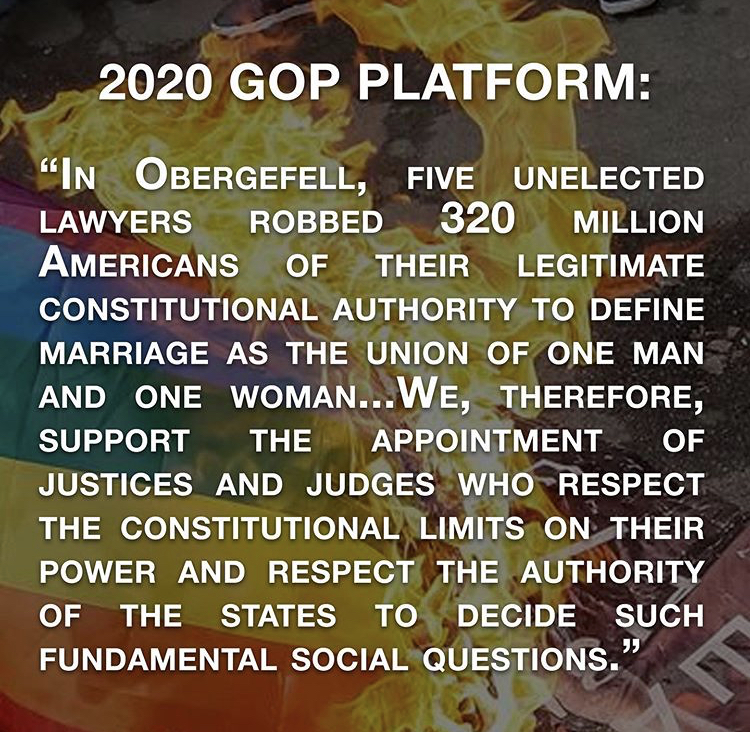
So let me say this loud and clear if you are LGBTQ+ or an Ally, which I assume you are since you’re reading this blog, it is imperative that you vote for Joe Biden for president and vote for Democrats down the ballot. We must preserve our rights. At this point, a vote for a Republican is a vote against LGBTQ+ rights. The following is from the 2020 Republican Party Platform:

There are many other reasons that I have mentioned numerous times for voting for Democrats in this election, but if you care about our right to marry, our right to have jobs without the fear of losing them over our sexuality, or maybe you want to adopt a child, all of this hangs in the balance in this election. While I doubt I will ever get married (I’m older and not in the best of shape, and I live in Vermont where there are slim pickings), I still want the ability to get married if I ever meet the right person. I want equality for all members of the LGBTQ+ community, and that is in jeopardy with the current administration. If you were considering not voting, think again. You cannot afford not to vote. Our lives depend on voting blue in this election. Every vote is needed to defeat the current president and the disastrous policies of the Republican Party. We are literally in a fight for our lives, and we must let our voices be heard loud and clear.


Pic of the Day


A National Disgrace

The first presidential debate was, thanks to Trump’s participation, anything but presidential. Trump was a national disgrace. Even by the bizarre standards of the Trump era, the debate was a painful tour of Trump’s erratic psyche, as he bounced from football to Biden’s alma mater to the size of his crowds. In one sense, at least, Trump was successful: he made it all about him, which highlighted all the horrible things about him. It wasn’t what Trump wanted. Trump’s strategy all along has been to create chaos, and that’s what he did during the debate. Taken individually, Trump’s statements were ridiculous and irrational. Taken together, it was a pathologically incoherent, repetitious, incessant, and obsessive assault on Biden and reality. Trump believes that he can dominate anyone, and that was clearly his intent during the debate. Instead, it made him look like an incoherent fool.

His strategy was a risky bet for Trump, something he often takes in his business dealings and always fails. Trump was appealing to his base, but his base is not big enough to get him re-elected. All you need to do is look at the polls. Because Trump can’t focus on anything for an extended period of time, he threw wild punches at Biden including taking a shot at Biden’s son Hunter. When Biden was talking about his late son Beau’s military service, Trump attacked Biden’s other son, Hunter, and brought up his past cocaine use. It backfired. “My son, like a lot of people you know at home, he had a drug problem,” Biden said. “He’s overtaken it. He’s fixed it. He’s worked on it. And I’m proud of him.” In contrast to Trump, Biden kept coming back to his core messages: primarily, that the election is about the voters’ needs not about Trump’s needs/ego. But Biden was also blunt about how he viewed the president, calling him a racist, a liar, and a clown – something that would have been unheard of in any previous presidential debate. 

Trump made some very serious errors pandering to his base. Notably, Trump never bothered to refute the racist label. Chris Wallace, the moderator, asked Trump to condemn violent right-wing groups and white supremacists, and Biden goaded him to call out the Proud Boys, who are neo-fascist, racist, and anti-LGBTQ+. Needless to say, Trump never condemned them. Instead, he said, “Proud Boys, stand back and stand by.” STAND BY? Stand fucking by? He was telling his supporters to wait for now, but attack if he doesn’t win the election, and the Proud Boys are now using Trump’s words as part of a new logo. He is building up his own Blackshirts (the paramilitary wing of the Mussolini’s Italian National Fascist Party) and Brownshirts (the SA or paramilitary wing of Hitler’s Nazi Party). Yesterday, Trump claimed he didn’t know who the Proud Boys were, which means he’s either a liar or stupid. I’m betting on both. He could have just used Google like normal people do. Proud Boys organizer Joe Biggs posted after the debate that he was “standing by,” and he said the president “basically said to go fuck them up.”

What’s more, Trump would not urge his followers to remain peaceful as votes are counted, including if there are delays in reporting the results. “I’m urging my supporters to go into the polls and watch very carefully because that’s what has to happen,” Trump said, adding, “If it’s a fair election, I am 100% on board. If I see tens of thousands of ballots being manipulated, I can’t go along with that.” When Trump was asked directly whether he will tell his voters not to engage in any sort of violence or “civil unrest” while the votes are being counted on and beyond November 3, the President of the United States not only refused to do so but also reiterated his call to his supporters to go to polling places and “watch” people casting votes. Furthermore, when he was asked whether he was going to tell his people to take to the streets if the election results are either not decided on November 3 or not decided in his favor, Trump responded, “It means you have a fraudulent election. You’re sending out 80 million ballots.” Trump is telling Americans loud and clear that he will only accept the election if he wins, and he’s going to do everything he can to encourage his followers to intimidate voters. These statements about not accepting the election are the only thing he said Tuesday night that is probably true. The rest was lie after lie after lie.

Trump tried his best to paint Biden as a socialist, or at least beholden to the “radical left.” But on issue after issue—”Medicare for All,” defunding the police, the Green New Deal—Biden disavowed policies the Trump campaign has tried to attach to him. Biden just restated his positions, which line up with the middle of the electorate, far more than Trump’s policy positions do. I think that had the potential to harm Biden with the progressive left, particularly when it comes to the Green New Deal, but only if Trump hadn’t gone quite so, well, Trump and made a complete fool of himself.

While this might not have been Biden’s greatest debate, it is not his fault. Trump’s constant interruptions and Wallace’s total ineptitude in getting control of the debate made Tuesday night a disgrace. I will credit Wallace with asking some tough questions, but what Wallace really needed was a mute button for Trump’s microphone. (Something that is rumored to be considered by the Commission on Presidential Debates [CPD] for the final two debates.) Biden tried to play by the rules, and he did remarkably well under the circumstances. Biden said several times, “Will you shut up, man?” and called Trump a “clown” more than once. Biden missed an opportunity when it came to the discussion of the pandemic. For example, when Trump was talking about the role of masks in preventing the spread of the coronavirus, Biden should have interjected more forcefully to talk about Trump’s largely maskless rallies. When Trump claimed his rallies caused no harm, Biden should have pointed out the spike in coronavirus cases after Trump’s pitifully attended Tulsa rally. Some pundits are saying that Biden missed the opportunity to say whether he would add justices to the Supreme Court — “pack the court” — if Judge Amy Coney Barrett, Trump’s nominee to succeed Ruth Bader Ginsburg, is confirmed, but I wholeheartedly disagree. Biden was absolutely right to refuse to say one way or the other. I agree with his response that if he had made a statement on adding justices to the Supreme Court, it would dominate the campaign for the rest of the election.

The bottom line is simple: Trump’s bullying, cajoling, and constant interruptions in the first 2020 general election debate with Biden on Tuesday night made the whole affair confusing and difficult to follow. Trump looked and acted like a petulant child not getting his way and lies when he gets caught doing wrong. If the CPD enacts new rules that Trump doesn’t like, I predict that Trump will refuse to debate Biden anymore. He will claim that the process is unfair towards him, even though he was the one disregarding the rules most often. I suspect that Trump will refuse to play by rules that are fair, and he will take his toys and leave, going back to his dangerous and largely maskless campaign rallies.


The Art of Tax Evasion

In 2009, I had my first teaching job; it paid pennies. If you factor in my debt, mostly from student loans, I may have been just above the poverty level. I was forced to pay nearly half my gross income in student loan payments. I was forced to have two jobs: teaching grades 7-12 at a private school and working as an adjunct instructor at a local college. Neither paid well. I was still barely making ends meet. When I did my taxes for that year, I owed over a thousand dollars because having two jobs put me in a higher tax bracket, and neither job had taken out enough tax from my paychecks. I didn’t have the money, and I was scared to death. I finally scrounged up enough money to pay my federal income tax though it meant I didn’t always get to eat, and I still could not come up with enough to pay my Alabama state income tax. They eventually garnished that amount from my 2010 tax refund. I’d gotten a minuscule tax refund that year, because I had lost my second job which lowered my income drastically.

Therefore, it makes me angry when politicians run on a platform of reducing taxes; it’s usually Republicans, and the only people who get the reduced taxes are the wealthy. The poorest among us rarely get tax cuts, and yes, some of the middle class received more money in their checks after Trump’s tax cut, but mine was only a few dollars. I doubt it has amounted to even $100 a year since it went into effect. However, taxes on wealthy Americans have fallen sharply in recent decades. Many still pay a lot to the federal government. A typical billionaire pays tens of millions of dollars in federal income taxes each year, but what is that compared to ordinary people like me paying nearly 25 percent of my annual salary? The wealthy’s tax rate may be higher than mine, but they have numerous ways to lower their tax burden with deductions. In 2018, I did not get a tax break because I moved into a slightly higher paying job and into a new tax bracket; I went from paying 15 percent to 22 percent. 

While most billionaires do pay some taxes, President Trump is apparently different. On Sunday, The New York Times(NYT) published an investigation of his finances based on thousands of pages of documents not previously made public. The Times exposé of the President’s tax returns revealed a pitifully inept businessman and a serial tax evader crushed by massive debt that could expose him to conflicts of interest given his position as President with the power to help undisclosed lenders. The number one reason for being denied top-level security clearance is debt; it makes you susceptible to bribery and blackmail. His personal debt underscores a long-time fear about his administration—that he is managing US diplomacy to prioritize his own personal and financial goals rather than the broader national interests. Trump receives millions of dollars in income from countries like Turkey and the Philippines led by autocrats whom he has praised but who infringe on traditional US values like human rights. 

The NYT article showed that Trump paid no taxes in 11 of the 18 years between 2000 and 2017. In both 2016 and 2017, he paid only $750. That means in 2010 when I had to pay an exorbitant tax bill because I was working two jobs to survive and still ended up doing without in order to pay that tax bill, Donald Trump paid nothing in taxes. Trump was able to do so both because many of his businesses reported losing vast sums of money—which reduces his taxable income—and because he has engaged in questionable tax practices. Even while declaring losses, he managed to enjoy a lavish lifestyle by taking tax deductions on what most people would consider personal expenses including residences, aircraft, and $70,000 in hairstyling for television—all of this during a period when I went without food and had to work two jobs.

The publication of the well-researched article, based on more than two decades of his tax information obtained by The Times, came just days before the first presidential debate, and 37 days before an election in which he appears to be trailing Biden. It poses a serious challenge to a presidency that Trump may need to preserve to outrun creditors with hundreds of millions of dollars in loans soon coming due. It leaves the president facing many questions about his morals, behavior, and patriotism since he appears to be paying more in taxes to several foreign nations than he is to the United States. The reporting also raises the possibility that Trump’s deceptive accounting practices, already the focus of several investigations in New York, could open him up to serious legal issues when he leaves office. For instance, The Timesreport says the president has been battling the Internal Revenue Service for years over whether losses he claimed should have resulted in a staggering tax refund of $73 million. 

The fact that Trump paid just $750 in taxes in two straight years should be the most damning since it is so identifiable and strikes such a clear comparison to the larger figure almost all Americans pay. If a man with his own airliner, gold-leafed homes, and a string of golf resorts can get away with that who is to argue the system is not permanently biased against regular people? Seth Hanlon, a Democratic policy adviser, pointed out, “In 2017, a single worker without children who made $18,000 would have paid $760 in federal income tax. Donald Trump paid $750.” Biden recently made this very explicit in a new ad that came out Sunday night:

Which Donald Trump is the true Donald Trump? Is he the business mastermind who has been lying to the IRS about his losses? Or is he the failed businessman who has been lying to the American people about his success as a businessman? It seems every time Donald Trump is caught in a new lie or yet another political scandal, there’s always a tweet from the president’s past that makes him look like a hypocrite on the issue of the day. He is a Republican after all; it’s the party of hypocrisy. Here is what he said about Barack Obama’s taxes in 2012:

To compare Trump to his predecessors, the federal taxes paid by presidents over the past 40 years during their first year in office are as follows:

  • Ronald Reagan: $165,202
  • George H.W. Bush: $101,382
  • Bill Clinton: $62,670
  • George W. Bush: $250,221
  • Barack Obama: $1,792,414
  • Donald Trump: $750

Lily Batchelder, the Robert C. Kopple Family Professor of Taxation at New York University School of Law, said, “Trump’s tax returns suggest he has only ever been successful as a showman, not at running actual businesses.” I realize these revelations about Trump’s finances and tax evasion are unlikely to change his strong emotional and cultish connection to his followers. He has been successful constructing alternative political realities while discrediting journalists and with the help of propaganda from conservative media. After all, his supporters have ignored numerous stories about Trump’s refusal to pay his creditors, casino bankruptcies, and morally questionable business practices that have been circulating for years. Throughout a political career filled with scandal, Trump has rarely paid a price for any of his scandals, outrages, and insults—any one of which would have doomed a normal politician. His brand is well known; he is a rule-breaker and a successful businessman. He may be a rule-breaker, i.e., a criminal and a fraud, he is definitely not a successful businessman according to his finances. In the past, he has explained that avoiding taxes shows he is a smart businessman and is an approach anyone would take if they could. Yet, what he has been doing is equivalent to tax evasion. On Sunday, Trump quickly adopted his typical tactic of trying to pass off serious revelations as nothing to concern voters because he said, “It’s fake news. It’s totally fake news. Made-up, fake.”

For any of my readers who continue to support Trump, I have some questions: What will it take for Trump to lose your support? His amoral, misogynistic, homophobic, racist behavior didn’t do it. His shady dealings with foreign countries haven’t done it. His rude and arrogant behavior hasn’t done it. His disdain for the press and our veterans hasn’t done it. His lack of business acumen and his penchant for tax evasion for over a decade are apparently not going to do it. What would change your mind? Can anything change it? Can you not see what is wrong with supporting this man?


The Art of Debate

The Art of Debate
By Anna Hopper

For most of my life
I’ve walked around blind
Never watching the news
Kept an open mind

One day I was informed
“You sound like a liberal”
I felt rather scorned
The subject was literal

I took a step back
And replied, “okay”
I love the blacks
And respect the gays

Perhaps the left wing
Has a vacant seat
But what shall I bring
I refuse kissing feet

So very unworthy
To judge another
When my hands are dirty
Dear sister, brother

But I’ve come to see
Accusations weren’t true
You don’t know me
As I don’t know you

Not defined by race
Class or career
We all deserve grace
Redneck or queer

I’m tired of the hate
And our pride being burned
The art of debate
Is yet to be learned

There will be a lot of debate over the next several weeks. Tonight begins the first in a series of presidential debates. They’re always unpredictable. There will also be debates over the Supreme Court nomination hearings. The politics in America will get nastier and nastier as we draw closer to the election, and I don’t expect it will end with election night. We have a hard fight ahead of us on all fronts. In the debate tonight and the ones in the future, I hope Biden crushes Trump, but I’d be stupid not to worry a little about the debates. If you think you know what will happen in the coming presidential debates, think again. Even the best debaters have stumbled during debates in the national spotlight.

The first Kennedy-Nixon debate in 1960, when the two candidates squared off in the first televised presidential debate, is a good example. Most commentators expected Richard Nixon to win the debate handily. Not only did he have eight years of experience as vice president, but he also had a reputation as a skilled debater. But when the camera came on and began to broadcast, Nixon came across as pale and weak. John F. Kennedy appeared cool, tanned, and in command. Nixon, unlike Kennedy, seemed nervous and declined to wear makeup. While Nixon fared better in the second and third debates, and on October 21, when the candidates met to discuss foreign affairs in their fourth and final debate, Nixon’s one-point polling edge before the first debate turned into a three-point lead for Kennedy after the debate. JFK went on to win the election by a hair.

In 2000, observers expected Vice President Al Gore, a capable debater, to wipe the floor with Texas Governor George W. Bush, who was not then and is still not known for his eloquence. But that’s not what happened. In their first debate, Gore sighed, huffed and puffed, and left a poor impression. It was an impression that was lampooned on Saturday Night Live, and it stuck with him throughout the race. His pre-debate lead was wiped out. After all three debates, it was Bush who emerged the winner of the election, but not without controversy (see Gore v. Bush).

Debates, however, are lost, not won. That was apparent in 1976 when President Ford intimated that Eastern Europe was not under Soviet domination. It was a big blunder that played into the negative stereotype of Ford as dimwitted. Jimmy Carter didn’t win that debate, Gerald Ford lost it — and with it the election. Self-inflicted injuries are the worst kind. Americans like debates. They offer voters a chance to see candidates side-by-side. They motivate supporters and serve as tiebreakers for undecided voters. Debates can make voters more comfortable with candidates and lessen doubts. The smartest debaters use them to identify with the nation’s political temperament.

Debates have big audiences with enormous media buildups. They work best for candidates who use them to clarify the choice that voters are about to make. They offer valuable opportunities to sharpen messages and sort out issues that have become jumbled in the fog of campaign warfare. That’s why the question Reagan posed at the end of his debate with Carter—“Are you better off than you were four years ago?”—was so effective. It’s a question everyone needs to consider in this election. There are many unknowns when going into a debate, and one thing is for certain, Trump is full of surprises. He will lie about anything and say anything to get a positive reaction from his base, which they will believe because he has them believing anything they disagree with is fake news. However, in debates, surprise can kill––putting the target, and sometimes the aggressor, at risk. 

As the underdog in the polls, Trump has less to lose. He needs to change the dynamics of the race. He will likely position himself as the only defense against a takeover by the radical left and portray Biden as a left-wing zealot, which Biden is decidedly not. Viewers will be watching this debate to see what happens. For supporters of Trump, it will be an opportunity to reinforce cult-like devotion; for his opponents, it will be an opportunity to reinforce deepening revulsion. For the percentage of the electorate that is undecided or not happy with either candidate, it could be an opportunity for them to actually make a choice. 

There is little doubt that Trump will be nasty in his remarks and try to bully Biden. Biden needs to stand firm. Trump’s usual dirty political tactics could open himself up for tough counterattacks, especially if Biden goes after Trump on the coronavirus and healthcare and emphasizes the Trump administration’s uncaring and reckless policies. Biden will need to hammer Trump on his and the Republican strategy of ramming a conservative judge through the Supreme Court confirmation process before they lose the election. Biden needs to focus on the hypocrisy of the Republicans. The revelations about Trump not paying taxes for a decade will surely be a topic that is discussed, and Biden has a chance to show the American people that Trump is a liar, a cheater, and a fraud. 

Anything goes in this election. And in the debate tonight, anything can happen. The stakes couldn’t be higher. Trump has a lot to answer for, and if Biden stays calm, hits back hard and effectively, and doesn’t falter or stumble, Biden will most likely come out on top in this debate. There is a lot of opportunities to make Trump look small, weak, and petulant. There is little that Trump can claim the higher ground on, and therefore, he will hit below the belt and show his lousy temperament, which will not sway his cult followers who love that about him, but it could sway the undecided against him if Biden plays his cards right. Biden needs to remember what Michelle Obama always says, “When they go low, we go high.” There is no doubt that Trump will go low, but Biden needs to stay above that and come across as a strong defender of democracy.


Remember the Beatitudes

And seeing the multitudes, He went up on a mountain, and when He was seated His disciples came to Him. Then He opened His mouth and taught them, saying:

 “Blessed are the poor in spirit,
 For theirs is the kingdom of heaven.
 Blessed are those who mourn,
 For they shall be comforted.
 Blessed are the meek,
 For they shall inherit the [a]earth.
 Blessed are those who hunger and thirst for righteousness,
 For they shall be filled.
 Blessed are the merciful,
 For they shall obtain mercy.
 Blessed are the pure in heart,
 For they shall see God.
 Blessed are the peacemakers,
 For they shall be called sons of God.
 Blessed are those who are persecuted for righteousness’ sake,
 For theirs is the kingdom of heaven.

Blessed are you when they revile and persecute you, and say all kinds of evil against you falsely for My sake. Rejoice and be exceedingly glad, for great is your reward in heaven, for so they persecuted the prophets who were before you.

—Matthew 5:1-12 (NKJV)

Kurt Vonnegut, an atheist and a humanist, is not someone I usually look to for religious views. He never showed disdain for those who sought the comfort of religion but instead acknowledged church associations as a type of extended family. Vonnegut proclaimed he was a “Christ-worshipping agnostic” and sometimes called himself a “Christ-loving atheist.” Vonnegut was an admirer of Jesus’ Sermon on the Mount, particularly the Beatitudes, and incorporated it into his principles. In his 2005 essay collection, A Man Without a Country, Vonnegut wrote:

“For some reason, the most vocal Christians among us never mention the Beatitudes (Matthew 5). But, often with tears in their eyes, they demand that the Ten Commandments be posted in public buildings. And of course, that’s Moses, not Jesus. I haven’t heard one of them demand that the Sermon on the Mount, the Beatitudes, be posted anywhere. “Blessed are the merciful” in a courtroom? “Blessed are the peacemakers” in the Pentagon? Give me a break!”

Vonnegut has a very valid point. In 2003, Roy Moore, then Alabama Supreme Court Chief Justice (for the first time), installed a 5,280-pound granite block monument (that broke the floor) of the Ten Commandments in the rotunda of the Alabama Judicial Building in the dead of night (done without the consent or knowledge of the eight associate justices and later caused him to be removed from office for the first of two times). Moore never mentioned the Beatitudes, the basis of Christ’s message, but instead focused on the Ten Commandments. Moore’s actions over the years clearly show that he does not follow the Beatitudes. He prefers media attention to faith. As Governor Kay Ivey’s spokeswoman said last week when asked about Moore filing a lawsuit against Ivey over the mask mandate in Alabama, “It appears this is another attempt to garner some press attention.” Moore is known more for his hate and outrageous statements and actions than for his devout Christianity, which he apparently does not possess.

The United States would be a better place if Christians followed the message of Jesus and did not pick and choose only from the sections of the Bible they want to follow and ignore those they deem inconvenient. Just as Trump supporters pick and choose what they want to believe about him and his policies, the conservative Christian Right picks and chooses what they want to follow of the Bible. Trump is doing the same thing with the Constitution. I have no idea where Trump gets inspiration and comfort, but I don’t believe it is the Bible, or he would be a very different person. He seems to lack all morals, and he is too erratic to have a foundation for his ever-changing belief.

In contrast, when Joe Biden seeks inspiration and comfort, he turns to his faith. His speeches are woven with references to God and biblical language. When Biden spoke to the faith-based anti-poverty group the Poor People’s Campaign, he described the United States under President Trump as a “nation in the wilderness.” Biden told the group, “All of you remind me of how Scripture describes a calling born out of the wilderness. A calling to serve, not to be served. A calling toward justice, healing, hope — not hate. To speak the good news and followed by some good deeds. It’s not just enough to speak the good news, but good deeds.”

This wasn’t a one-off religious reference; this is how Biden routinely speaks. He launched his candidacy by referring to his campaign as a “battle for the soul of the nation.” It was the central theme of his primary run and remains a core belief of his campaign. If elected, Biden would become only the second Catholic president in American history. It’s not a detail he highlights, but people who know him well say his Catholic faith is central to how he sees the world.

Biden carries a rosary in his pocket and attends Mass every Sunday, while Trump plays golf. Trump supporters dismiss Biden’s faith even though he is described by all who know him as a deeply devout person of faith. Ironically, even though we have a president who has shown no sign of being a Christian, especially a deeply devout one, Biden will likely lose the states in the Bible Belt. Biden has framed this election as a clear moral contrast between Trump and himself, but many of Trump’s supporters see Biden as amoral only because he is a Democrat. However, Biden is running perhaps the most overtly devout Democratic presidential campaign since Jimmy Carter in 1976. 

During Holy Week this past spring, the campaign released a video in which Biden spoke about faith seeing best in the dark, juxtaposed with images of the coronavirus pandemic. And when he delivered a eulogy for George Floyd and called for racial justice, he spoke of growing up with a Catholic social doctrine that taught him “faith without works is dead.”

Biden’s faith informs his values, and, in turn, his values shape his politics. Biden focuses on faith, rather than religious doctrine; he prays with voters, rather than proselytizes. And yet for some religious conservatives, all of that pales in comparison to the single issue of abortion. Trump has tried to portray Biden as a heathen. Last month the president attacked the Democratic nominee for being a man “against God.” And more broadly, Trump and his supporters have made religion a cultural issue, painting Democrats as the party against religious freedom. The struggle for Trump in defining Biden as a godless man is that Biden’s faith has been in public view for decades.

To heal the United States, we need a president that believes in the tenets of the Beatitudes. We need someone who believes “faith without works is dead.” James 2:14-17 says:

What does it profit, my brethren, if someone says he has faith but does not have works? Can faith save him? If a brother or sister is naked and destitute of daily food, and one of you says to them, “Depart in peace, be warmed and filled,” but you do not give them the things which are needed for the body, what does it profit? Thus also faith by itself, if it does not have works, is dead.

For four years, Trump has relentlessly pursued an economic agenda that rewards wealth over work and favors multinational corporations over small businesses. But middle-class Americans have been largely left out. Trump has not only refused to deliver for struggling working families; he is now pushing for another misguided tax giveaway for America’s wealthiest families. That’s the fundamental difference between Trump and Biden — Trump is focused on further enriching billionaires like himself, while Biden wakes up every day asking how he can help the middle and lower classes in America.

Biden cares about the weakest among us, those who are in the most danger. It is a moral failing and a national shame when children are separated from their parents and locked away in overcrowded detention centers, where the government seeks to keep them there indefinitely. It’s shameful when President Trump uses family separation as a weapon against desperate mothers, fathers, and children seeking safety and a better life. It’s disgraceful when children die while in custody due to a lack of adequate care. Trump has waged an unrelenting assault on our values and our history as a nation of immigrants. Leviticus 19:33-34 says, “And if a stranger dwells with you in your land, you shall not mistreat him. The stranger who dwells among you shall be to you as one born among you, and you shall love him as yourself; for you were strangers in the land of Egypt: I am the Lord your God.” This is a recurring theme for the ancient Hebrews. They were told to remember their treatment/enslavement by the Egyptians and not do the same for foreigners in their territory. 

Unless your ancestors were native to these shores, or forcibly enslaved and brought here as part of our original sin as a nation, most Americans can trace their family history back to a choice–a choice to leave behind everything that was familiar in search of new opportunities and a new life. Biden understands that is an irrefutable source of our strength, like the original, though unofficial, motto of the United States says, “E pluribus unum”—out of many, one. Generations of immigrants have come to this country with little more than the clothes on their backs, the hope in their hearts, and a desire to claim their piece of the American Dream. It’s why we have been continuously able to renew ourselves, grow better and stronger as a nation, and meet new challenges. Immigration is essential to who we are as a nation, our core values, and our aspirations for our future. Biden will assure that we never turn our backs on who we are or what makes us uniquely and proudly American. The United States deserves an immigration policy that reflects our highest values as a nation. 

The challenges we face will not be solved by a constitutionally dubious “national emergency” to build a wall, separate families, or deny asylum to people fleeing persecution and violence. Addressing the Trump-created humanitarian crisis at our border, bringing our nation together, reasserting our core values, and reforming our immigration system will require real leadership and real solutions. As Deuteronomy 10:18-19 says, “He administers justice for the fatherless and the widow, and loves the stranger, giving him food and clothing. Therefore love the stranger, for you were strangers in the land of Egypt.” As the Hebrews were strangers in Egypt, so were all of us once strangers on this continent. We need someone who will fight for the justice deserved by the foreigners among us today.

Matthew 14:14 says, “And when Jesus went out He saw a great multitude; and He was moved with compassion for them, and healed their sick.”  Jesus was the Great Physician. He was a healer and cared for people’s health, both physically and spiritually. In Luke 10:9, Jesus commands his disciples, “And heal the sick there, and say to them, ‘The kingdom of God has come near to you.’” We currently have an administration that is attempting to take away millions of Americans’ healthcare as they attack the Affordable Care Act (ACA). I won’t pretend that the ACA is perfect. It needs reforms, especially in healthcare costs and the control insurance companies have over treatments doctors prescribe to patients. However, we know that there are parts of the ACA that are vitally important. As president, Biden will protect the Affordable Care Act from these continued attacks. He opposes every effort to get rid of this historic law, including Republicans’ efforts and efforts by Democrats. Instead of starting from scratch and getting rid of private insurance, he has a plan to build on the Affordable Care Act by giving Americans more choice, reducing health care costs, and making our health care system less complex to navigate.

For Biden, this is personal. He believes that every American has a right to the peace of mind that comes with knowing they can access affordable, quality health care. He knows that no one in this country should have to lay in bed as I do at night staring at the ceiling wondering, “How am I going to pay for the treatment I so desperately need?” Biden knows there is no peace of mind if you cannot afford the care you need because of a pre-existing condition because you’ve reached a point where your health insurer says “no more,” or because you have to decide between putting food on the table and going to the doctor or filling a prescription. 

In Matthew 25:34-36, Jesus says, “Then the King will say to those on His right hand, ‘Come, you blessed of My Father, inherit the kingdom prepared for you from the foundation of the world: for I was hungry and you gave Me food; I was thirsty and you gave Me drink; I was a stranger and you took Me in; I was naked and you clothed Me; I was sick and you visited Me; I was in prison and you came to Me.’” We must help feed the poor among us. Eating well should be a right, not a privilege. We need a government that will help make nutritional and healthy foods affordable to all Americans. Biden believes Americans should have the ability to have secure housing and live in a safe community. Housing should be a right, not a privilege. Tens of millions of Americans spend more than 30 percent of their income on housing – leaving them with nowhere near enough money left over to meet other needs, from groceries to prescription drugs. Americans need someone who cares and who will help make the United States better for all.

Finally, Biden believes that every human being should be treated with respect and dignity and live without fear no matter who they are or who they love. During the Obama-Biden Administration, the United States made historic strides toward LGBTQ+ equality—from the repeal of “Don’t Ask, Don’t Tell” to Biden’s historic declaration in support of marriage equality on Meet the Press in 2012 to the unprecedented advancement of protections for LGBTQ+ Americans at the federal level. But this fight’s not over. Donald Trump and Mike Pence have given hate against LGBTQ+ individuals safe harbor and rolled back critical protections for the LGBTQ+ community. By blocking the ability of transgender individuals to openly serve their country, denying LGBTQ+ people access to critical health care, proposing policies allowing federally funded homeless shelters to turn away transgender people and federally funded adoption agencies to reject same-sex couples, and failing to address the epidemic of violence against transgender people—particularly transgender women of color—the Trump-Pence Administration has led a systematic effort to undo the progress President Obama and Vice President Biden made. With Trump’s latest Supreme Court nominee, the Religious Right is gloating over the possibility of taking away all of the gains made in LGBTQ+ rights. Brian Brown, a co-founder of the hate group National Organization for Marriage (NOM), said in an email that the Supreme Court nomination would “pave the way for the restoration of marriage to our laws and scrapping the illegitimate, anti-constitutional imposition of same-sex ‘marriage’ on the nation.” He went on to say:

It will mean that religious liberty will be restored to its rightful place as a foundational constitutional right, and that the fake “rights” that are constantly demanded by the left – including special rules for homosexuals and the so-called transgendered – will no longer see the light of day.

We need protection of our rights, not someone who will work hard to destroy our freedoms. Trump’s nominee Amy Coney Barrett will be a disaster for our rights. Barrett is also a profoundly conservative thinker. Barrett makes clear that in matters of constitutional interpretation, she would not hesitate to overturn decisions with which she disagrees. On Barrett’s chopping block could be the right of same-sex couples to marry; the existence of affirmative action programs at colleges and universities; the constitutional protections against discrimination based on gender that Ginsburg made the center of her career; the Affordable Care Act, which she has publicly criticized; and environmental protections and other regulatory efforts enacted as part of the congressional power to oversee interstate commerce. Our rights as LGBTQ+ individuals depend on electing Biden as president.

Biden wants to bring about a better United States. Trump has worked for four years to divide this country and tear it down. Trump has ignored the duties of the president and has ignored the fundamental values of democracy and freedom. Biden will answer the call to be the kind of leader the United States needs in a president. He will be guided by his faith to take care of all Americans and bring greater equality to all. He will not use religion to oppress us. He will value democracy and freedom as he has for the past 50 years of service to this nation. We need a man who has faith. We need a man who has morals. We need a man who believes in the tenets of the Beatitudes. We need Joe Biden as president. Remember the Beatitudes in all you do, that includes when you vote in November.