Category Archives: Politics

Obergefell v. Hodges 

 
Obergefell v. Hodges presented a lot of back and forth on the issue of same sex marriage at the Supreme Court on Tuesday, which was deeply divided as it heard oral arguments in the case.  Obergefell v. Hodges is a case which is likely to go down in the history books alongside other landmark civil rights cases.  This one centers on two questions: first, whether there is a constitutional right to gay marriage, and second, if not, whether states that have bans on gay marriage have to recognize gay marriages performed in other states where it’s legal.  The first question seems to be the most important, and I have tired to sum up the SCOTUS proceedings as succinctly as possible, but it turned out to be way too long.  The best summary I’ve read is from a New York Times article by Adam Liptak.  I read over numerous articles about the proceedings, and the one by Liptak seemed to be one of the best. So if you want to read about the arguments presented and the questions asked by the justices, then click on the link for the Liptak article.

Let’s face it, most of the arguments against same sex marriage are ridiculous.  Opponents argue that same sex marriage:  would destroy the institution of marriage, Marriage is for procreation, polygamy would follow, voters should be able to decide, tradition and history, and religious concerns.  Those six are the arguments that opponents seem to want to argue most.  So let’s look at these one at a time.  Same-sex marriage will have no effect on opposite-sex marriage.  Quite simply, it will not affect a heterosexual marriage in any way.  Also, if marriage is for procreation only, then barren couples should have their marriages invalidated, no one should be able to marry a post-menopausal woman, and couples who do not want children should not be allowed to marry.  However, opponents of same-sex marriage still say that LGBT couples should not be allowed to marry because the marriage cannot produce children.  What is equal about that?  As for polygamy, one of the arguments is for religious freedom, but we deny those whose religion allows polygamy to practice it.  So why not allow polygamy?  I want only one man in my life, but if you’re Islamic or Mormon, you should have the right to have multiple wives, as long as one woman can also have multiple husbands.  Furthermore, if voters were able to decide all issues about equality, the American South would still be segregated, interracial marriage would still be illegal, and sodomy would still be illegal (and for those who would think that it should still be illegal [none of my readers I hope] then please remember that most sodomy laws included any sex that was not in the missionary position).  The American voters cannot be trusted with protecting the rights of minorities, which is why we have the 14th Amendment.  As for tradition and history, if we are speaking strictly of American history, numerous Native American tribes allowed not only for transgender but also for same-sex marriage.  It is only the introduction of Christianity that those tribals laws changed.  Which brings me to my last point, America’s Founding Fathers believed in separation of church and state, therefore religious need not apply.

Preliminary indications are that the Court is ready to rule 5-4 in favor of marriage equality. However, while even those opposed to marriage equality concede as much, a win — especially one in which marriage equality is affirmed as a civil rights issue — is no guarantee.  The Supreme Court will release its ruling on Obergefell v. Hodges in June. While there’s reason to be optimistic, the oral arguments did not provide a clear win for the LGBT community, and even if marriage equality is affirmed, it could be affirmed in narrow terms that aren’t transferrable to other LGBT cases involving discrimination unrelated to marriage.  My greatest fear is that the Supreme Court will issue a very narrow decision in favor of same-sex marriage and those states who allow same-sex marriage will be allowed to continue and other states will be forced to wait, therefore, having two Americas, one with LGBT Americans having marriage equality in some states and others states where LGBT Americans will be deemed second class citizens.  I personally am hoping for a broad opinion written by Ginsberg.


General Apathy

 We have less than a month to go in school and I couldn’t be happier (actually I could if Friday was the last day of school, or better yet today had been).  I began thinking about how students just don’t care anymore.  Yes, there are a (very) select few who do, but so many just don’t care.  Students don’t listen.  Students show no respect to the teachers, and neither do the parents.  Teachers are blamed for the students failures.  Students don’t care if the fail.  Some students go to school only because their parents make them, and if their parents aren’t paying attention, then they just don’t come to school at all.  Students think school is just one big social gathering instead of a place of learning.  Most years, I’d blame student apathy on it being close to the end of the school year, but this has been going on all year long.  The problem seems to get worse every year.

As I was thinking about the students, it made me think about other parts of society that just doesn’t care anymore.  The parents of kids don’t care anymore, and students get their attitude from their parents.  Most parents only seem to care about grades when it comes down to whether or not their child will be eligible to play a sport or not.  The student does nothing to improve their grades, but whine that the teacher is singling them out because the teacher doesn’t like athletes or have a personal grudge against the student.  Parents rarely see how spoiled rotten their children are, how hateful their children’s attitude is, or just how pure damn lazy their child is.  Instead the fault is with the teacher.  BULLSHIT!!!

But the problem isn’t just with parents and students but with society as a whole.  In churches, ministers and deacons don’t go see parishioners when they are in the hospital.  Neighbors don’t check on one another anymore.  In the South, people would often go out of their way to be friendly, but you’re lucky if someone holds a door open anymore.  Most times people will rush to beat you to the door and then do their best to make sure it closes before you get there.

Then we get to politicians.  Take for example the Alabama legislature.  Instead of spending money and passing a budget that makes sense, or even raise taxes when it is necessary, they decide to drastically cut the state budget.  Here are a few things the Alabama legislature is proposing to do:

— As many as 25 Army National Guard armories would close and the National Air Guard wings in Birmingham and Montgomery would have diminished capabilities.

— The loss of as many as 1,625 Army National Guard soldiers and 170 Air National Guard airmen.

— The Environmental Protection Agency would take over water-related functions of the Alabama Department of Environmental Management, resulting in 148 layoffs and delays and over-regulation that would hurt business.

— The Department of Corrections would close Ventress Correctional Facility and Red Eagle Honor Farm, forcing relocation of 2,000 inmates, increasing prison overcrowding and eliminating 159 state jobs.

— Courts would have to lay off more than 600 employees and probably close for two days a week.

— State law enforcement would lose 99 state troopers, 25 investigators and eight Capitol police officers.

–Close 15 of the 22 state parks, and putting 600 state park employees out of a job.

— Thirty-three of 78 stand-alone driver’s license offices would close.

— The Department of Human Resources would lose $190 million in federal funds, resulting in more than 15,000 children losing subsidized child care and more than 30,000 children losing Temporary Assistance for Needy Families benefits.

Not to mention that the governor has cost the state millions of dollars by refusing to expand Medicaid and forcing thousands to be without any form of insurance, just because he and Alabama Republicans hate the president.  Why don’t we first cut the $1.6 million salaries of the nine Alabama Supreme Court justices who don’t even understand the laws they have sworn to uphold, and before they lay off 600 court employees, they need to cut the over $108 million in salaries for Alabama judges, who like to play willy nilly with the law, ignoring it when it suits their political agenda.  And let’s not forget the over $6 million paid to probate judges who refuse to perform their duties (marriage certificates and wedding), not because the state constitution requires them to perform these duties, but because their “morals” (ahem, BIGOTRY & HOMOPHOBIA) tell them not to do so, even though higher federal courts have told them to do so.

Nobody seems to care anymore.  It’s all about what they can get out of it, not how they can help others.  I was going over something for a test on Christianity for my world history students.  It’s a passage from Matthew 25: 31-46:

31-33 “When he finally arrives, blazing in beauty and all his angels with him, the Son of Man will take his place on his glorious throne. Then all the nations will be arranged before him and he will sort the people out, much as a shepherd sorts out sheep and goats, putting sheep to his right and goats to his left.

34-36 “Then the King will say to those on his right, ‘Enter, you who are blessed by my Father! Take what’s coming to you in this kingdom. It’s been ready for you since the world’s foundation. And here’s why:

     I was hungry and you fed me,
     I was thirsty and you gave me a drink,
     I was homeless and you gave me a room,
     I was shivering and you gave me clothes,
     I was sick and you stopped to visit,
     I was in prison and you came to me.’

37-40 “Then those ‘sheep’ are going to say, ‘Master, what are you talking about? When did we ever see you hungry and feed you, thirsty and give you a drink? And when did we ever see you sick or in prison and come to you?’ Then the King will say, ‘I’m telling the solemn truth: Whenever you did one of these things to someone overlooked or ignored, that was me—you did it to me.’

41-43 “Then he will turn to the ‘goats,’ the ones on his left, and say, ‘Get out, worthless goats! You’re good for nothing but the fires of hell. And why? Because—

     I was hungry and you gave me no meal,
     I was thirsty and you gave me no drink,
     I was homeless and you gave me no bed,
     I was shivering and you gave me no clothes,
     Sick and in prison, and you never visited.’

44 “Then those ‘goats’ are going to say, ‘Master, what are you talking about? When did we ever see you hungry or thirsty or homeless or shivering or sick or in prison and didn’t help?’

45 “He will answer them, ‘I’m telling the solemn truth: Whenever you failed to do one of these things to someone who was being overlooked or ignored, that was me—you failed to do it to me.’

46 “Then those ‘goats’ will be herded to their eternal doom, but the ‘sheep’ to their eternal reward.”

I fear that many people int he world today are headed to eternal doom, but few to their eternal reward.  We’ve forgotten how to care about and for one another.  I still try to inspire my students and push them to do better.  I go next door to check on my neighbors, often taking them dinner, especially when I’ve cooked too much.  I hold the door open for other people.  By no means am I saying that I’m perfect.  I am far from it, but I try every day to live a better life.  Sometimes, I get so discouraged that I fail, but I pick myself (and the person I may have “knocked down”) up and try again.  I still get discouraged by those who don’t care,  the their are days when someone shows such great kindness, someone helps me with medical bills or a friend sends me a little gift or a card to brighten my day, and my faith in humanity is restored.


Turn The Internet Red #LoveCantWait

 You may have noticed that my header and profile picture are now tinted red.  On April 28, the U.S. Supreme Court will hear oral arguments in Obergefell v Hodges, a case originating in Ohio. In January, the Supreme Court announced that it would hear Obergefell along with three other cases from Michigan, Kentucky, and Tennessee. The arguments have been consolidated and the case has formally been named Obergefell.

The HRC is hoping to make lightning strike twice and to do so, they need our help. As we await the Supreme Court‘s decisions on two historic marriage equality cases, we have a great opportunity to turn the web red once again in the name of equality and love.


To demonstrate the incredible support for marriage equality, we’re asking everyone to make the red equal sign their social media profile picture once again — NOW through decision day, whenever that is. 

Red

If you participated in our campaign to turn the Internet red for marriage equality back in March, you know how meaningful it was. Missed the March marriage madness? Now is your chance to show your support.

Update your profile picture with a red logo so your entire social network knows that you’re standing on the right side of history. Go to http://www.hrc.org/red to easily convert your Facebook or Twitter profile picture to a blended picture of your profile and the red marriage equality sign.  And then ask your friends and family to join you! And if you’re sharing on Instagram, use the hashtag #time4marriage to participate in our marriage equality photo collage, Picturing Equality.

For the latest and breaking news from the Supreme Court, be sure to stay tuned to www.hrc.org/supremecourt.

The HRC will be launching brand new, innovative engagement tools throughout the month to help us show our support and connect with an expansive community of fair-minded Americans. 


Tolerance and Diversity: Part II 


 Two of my favorite movies about the U.S. Presidency are Dave and a movie that Ethan mentioned in his comment yesterday, The American President. (I’m also a little partial to My Fellow Americans, because how can you not love a movie with Jack Lemmon and James Garner.) But I’m off topic.  I wanted to use the quote from The American President that Ethan used because I think it makes an excellent point:

America isn’t easy. America is advanced citizenship. You gotta want it bad, ’cause it’s gonna put up a fight. It’s gonna say “You want free speech? Let’s see you acknowledge a man whose words make your blood boil, who’s standing center stage and advocating at the top of his lungs that which you would spend a lifetime opposing at the top of yours. You want to claim this land as the land of the free? Then the symbol of your country can’t just be a flag; the symbol also has to be one of its citizens exercising his right to burn that flag in protest. Show me that, defend that, celebrate that in your classrooms. Then, you can stand up and sing about the “land of the free”. 

I’ve always loved that quote and I’m glad that Ethan brought it up.  The American President came out at a time when flag burning was the hot topic of conservatives to rant against.  They even proposed a constitutional amendment to make it illegal.  Now the hot button topic is gay rights, particularly gay marriage and conservatives again are calling for a constitutional amendment to prohibit it.  The reasons amendments like these would never pass is because all of the 27 amendments to the constitution guarantee rights and protect them, none take away rights and legalize discrimination.  Again, I’m a bit off topic, so bear with me.

The point I’m making is that LGBT issues are in the spotlight right now.  We are finally becoming more accepted by American society, especially outside a few pockets of staunch conservatism.  In order to continue gaining ground, we need to make more allies ryan enemies.  We need them not only as friends who can offer love and support but as critical community members to further our cause. As much as we wish to fight our own battles, it is often our allies in the majority who have chosen to fight for the minority cause who can have the greatest impact. They can serve as intermediaries, given the time and space to say and be heard saying the same things that the minority group has been preaching for years. And it is only through changing hearts and minds in the majority that we can reshape the dominant views that we spend hours debating in LGBT circles. 

In “Is the gay community scaring away our straight allies?” by Mason Hsieh as featured in the Huffington Post and brought to my attention by a friend who received it in a diversity email from his employer Walmart, Hsieh suggest five ways to be better to our allies, particularly the new ones.

  1. View alliances as a continuum.
  2. Leave room for political incorrectness.
  3. Remember the big picture.
  4. Take pride in small victories.
  5. Be an ally to your allies.

And I want to take a closer look at these five suggestions, because I think Hsieh makes very valid points.

1. View alliances as a continuum.

Often allyship is painted as all-or-nothing: If you don’t support all our beliefs, you’re not an ally. We must remember that, like any self-identity, allyship is an ongoing process, made up of small, gradual steps. It is a “becoming” process that grows and develops over time, and not always following a linear trajectory.  I have friends who if I had to agree with everything they believe or they agree with all of my beliefs, I’d have no friends at all.  You will not see eye to eye with everyone.  Even countries who are allies don’t always agree on each other’s policies. So why should we think that our allies must support ALL of our beliefs?  Maybe this would be the case in a perfect world, but we all know that this world is far from perfect.

2. Leave room for political incorrectness.

While checking our privilege and engaging in conscientious discourse are great ways to practice thoughtful and inclusive speech and action, we must leave room for political incorrectness. We have to give people, particularly newcomers to the cause, the benefit of the doubt whenever possible and consider making room for political incorrectness in everyday life. There is a difference between fighting homophobia and scrutinizing everything a person says or believes. While the two are not mutually exclusive, the latter can be tiring and lead you further from what you are actually fighting for.  People who are newcomers to our cause can be ignorant to some of the things we find offensive, so we need to be understanding and educate them in a way that doesn’t drive them away.

3. Remember the big picture.

Pick your battles and keep the bigger picture in mind. I find this true of so much in life.  Some battles just aren’t worth fighting and can be handled with a different tactic.  When discussing difficult or touchy topics, give people room to voice their opinions. Let them say their piece, and rather than formulating a retort for every problematic assertion, step back and listen for the bigger picture. What is the most important part of this discussion?  Quite honestly, we do this everyday.  We don’t need a Pyrrhic victory,  we need new allies.  Pick your battles and know when to use more subtle approaches.  True southerners are known for our way of knowing when to be subtle and when to be blunt.  It’s an art that more people should learn.  Besides, both done correctly just makes us more charming, and some activists (and it doesn’t matter the cause) need to learn how to be charming and not caustic.

4. Take pride in small victories.

Minds are not typically changed overnight or through one impassioned debate. Remember that everyone is on his or her own learning curve, and that small steps in the right direction are still steps.  For all the teachers out there, you know how true this is.  We don’t get many victories, but the small ones are worth our weight in gold.  I’m not an out and proud gay activist, mainly because I’m a closeted teacher in a small private school, but I also don’t tolerate derogatory speech in my presence.  It’s a small way that I am helping.  I do my best to teach tolerance, often I use religious lessons (because I can and its something these kids have been taught to respect) to get my point about tolerance across.  It’s a small victory, but it’s a victory.

5. Be an ally to your allies.

Standing up for a community that you are not inherently a part of can be scary and leave a potential ally feeling vulnerable. Welcome newcomers, make room for them in your circles, and remember that alliances go both ways. Support your supporters.


Tolerance and Diversity: Part I


When I think of gay-friendly businesses, Walmart does not immediately come to mind.  In fact for many years, I’ve often thought of them as a great evil for gaining a near monopoly on retail stores in small towns (which is still kind of true, but we do live in a capitalist society).  However, my overall opinion of Walmart has changed in the last six months.  A friend of mine went to work in their corporate office.  He is openly gay, and at first, I was a little worried about him moving from a gay Midwestern haven to Bentonville, Arkansas, smack dab in the Bible Belt.  So before he even moved, I did a little research, and I was quite surprised at what I found out.  In 2014, the HRC’s Equality Index gave Walmart a score of 90 (the same as the very gay-friendly Starbucks).  When one looks at the HRC report, you see that they offer the same benefits to same-sex partners as they do the opposite sex partners. Furthermore, sexual orientation has been included in their non-discrimination policy available in the employee handbook (since 2003, and they include gender identity.  All employees are required to attend LGBT diversity training and even has written guidelines concerning employees who transition genders on the job.  They market and advertise to LGBT consumers and support LGBT organizations.  They also have a PRIDE Resource Group to help LGBT employees.  With all of that, why did Walmart get a 90/100?  It’s because they do not cover transgender benefits in their health coverage. 

Since my friend began working for Walmart, I have increasingly became more impressed by them.  When Arkansas tried a Religious Freedoms Restoration Act like Indiana, Walmart pressured the governor to not sign it.  Instead, the governor sent the bill back and said he’d only sign it if it had the same language as the federal law already in place.  I’m glad Walmart stood up, because as much money as the Walton family has, as many employees as Walmart has, and the impact Walmart has on the Arkansas economy, I doubt any candidate could be elected if Walmart put its might behind opposing them.

With all that I have already mentioned, I have to tell you what impressed me the most.  Each Monday, Walmart send its employees a corporate diversity email covering topics about women, African-American, and LGBT issues.  My friend has shared with me several of these emails, but this week’s email really caught my eye.  Included in the email was a link to a Huffington Post article, “Is the gay community scaring away our straight allies?” by Mason Hsieh.  In the article, which I plan to discuss in more depth tomorrow, it begins with this story:

Hearing straight men identify as allies to the LGBT community always makes my heart melt a little. So when one of my new straight-male friends asked if he could sit in on a QSA meeting, I immediately said yes and took him to a panel on LGBT dating, hoping to show him how cool the queer community is. The discussion was mostly civil, until my fledgling ally worked up the courage to ask one simple question on a topic he was genuinely interested in: “In gay dating, who’s the girl?” This question did not go over well.
Within milliseconds the P.C. police had descended on him, vehemently demanding that he check his straight-cis-male privilege as well as his narrow-minded assumptions about dating and gender roles. He should be ashamed, they said.

Hsieh notes that he understands that his friend did not phrase the question in the most politically correct way, but, honestly, how many of our straight friends have asked us that same question in one form or another?  Straight people always wonder that, just as they often wonder “what do lesbians do in bed?” (Not a question I want to ponder too much, but most of our straight male friends can answer from watching porn.). Hsieh’s point is that why should we get offended by a question that was not meant to be mean spirited.  Just like with my students when they make an insensitive or ignorant remark, I explain to them what was wrong with what they said.  It amazes me the number of people who do not understand that some of the things they say are offensive, so it’s our job to educate them and try to make this a better world.

So I want to ask you two questions.  Does knowing that Walmart makes an effort to be supportive of the LGBT community and to foster a comfortable working environment for LGBT employees, change your preconceived notions of Walmart?  And, I’d like to know your opinions (before I wrote more about Hsieh’s article) about how to handle our LGBT allies who want to help but aren’t always politically correct?  


Blurred Lines

In the early 1950s when the homophile movement (the early name for the gay rifts movement) began, the U.S. government didn’t differentiate between homosexual rights manifestos, gay erotica or dirty pictures. All were considered illegal, and using the postal service to distribute any of them could and did result in long prison sentences.
 
So perhaps it’s not surprising that pornographers, who had years of experience fighting those battles, were often prominent figures in the emerging homophile movement’s leadership. Jim Kepner, founder of the ONE National Gay and Lesbian Archives, was a noted author of gay erotica. Hal Call, one of the first presidents of the Mattachine Society, the pioneering gay rights organization in San Francisco, was an adult film director and owner of the Adonis Bookstore.
 
Chuck Holmes made a fortune as the founder of the Falcon Studios, a wildly successful gay porn studio who was one of the first to switch from film to videocassette in the 1980s.  He later directed his fortune toward philanthropy, funding HIV/AIDS outreach programs, as well as San Francisco Community Center Project, Amnesty International, Global Green, Sierra Club, The Gay and Lesbian Victory Fund and the Human Rights Campaign. He was also active in supporting political campaigns both locally in San Francisco, and at the national level.
In 2002, Holmes’ name was installed over the San Francisco LGBT Center, and public outrage was swift. Detractors called the move, which was in recognition of the late gay mogul’s $1 million bequest to the beleaguered center, “insane.”  The detractors feared it would only fuel right-wing allegations about the gay community’s obsession with sex. What those critics missed, and what continues to missed over a decade later, is the role pornographers like Holmes played in building the gay rights movement we know today.
 
In 2013, Equality Florida’s Tampa Steering Committee presented Jason Gibson, CEO and founder of Corbin Fisher, a leading “amateur” gay porn website, with its Service and Leadership Award.  The award honors an individual whose tremendous support has directly contributed to Equality Florida’s ability to break through to a new level of outreach and effectiveness in the effort to secure full equality for Florida’s lesbian, gay, bisexual and transgender community.
 
Corbin Fisher and Gibson gave more than $120,000 to Equality Florida in recent years, and employees have also contributed video editing and production skills to public service announcements. During the 2008 campaign seasons, Corbin Fisher assisted Equality Florida in developing a mobile voting website and provided legal services to the organization. These contributions continued even after Corbin Fisher moved its base of operations from Florida to Nevada in 2010.  Since arriving in Nevada, Corbin Fisher and Gibson have contributed more than $25,000 to local and national LGBT advocacy organizations, Las Vegas’ arts and culture community, and the city’s new gay and lesbian center. Beyond financial contributions to LGBT groups and non-profits, the company said it encourages activism and philanthropy among staff — all employees of the company are given paid time off to volunteer for charitable organizations, continuing its policy where charitable donations made by individual employees to non-profit groups are matched by the company.
Rather than be a liability, pornographers can provide a strategic advantage to the movement. They not only know the legal restrictions and how to get around them both then and now,  but the early gay pornographers had the money to fight the obscenity battles that cleared the way for greater discussions of sexuality. Pornographers were the advance troops of our sexual revolution.
 
Homophile organizations like Mattachine and Daughters of Bilitis had publications, of course, but their reach was miniscule compared to that of “posing strap” magazines like Physique Pictorial and Tomorrow’s Man. It wasn’t political tracts, but pornography that provided most gay men with their first connection to — and awareness of — a larger gay culture.  The same exists today with the internet, though the GLBT community is presented more in the mainstream media as well.
 
From the early days of gay liberation, porn has been embraced as a vital part of our cultural fabric. The very first issue of The Advocate celebrated a court victory won by two pornographers, Conrad Germain and Lloyd Spinar, who had faced 145 years in prison for sending nudes through the mail, on its front page. Gay sexuality was dangerous and subversive, and any chance to speak it, explicitly or otherwise, was a strike for freedom and visibility.
 
And at a time when mainstream media portrayed homosexuals as pathological, depressive and criminal, porn offered a sunny alternative. We might scoff at porn theaters now, but looking up at that screen, a closeted man could see a promise of gay life that was open and positive, with larger-than-life men who were bold and unashamed in ways he might only aspire to be.
For those who lived outside city centers, that same promise came in the form of mail-order magazines and 8mm loops, which was Chuck Holmes’ business. As the owner of the legendary Falcon Studios, Holmes had the widest reach of the early pornographers, and he was vocal about creating imagery that would make gay men feel proud of their sexuality. For tens of thousands of closeted customers in small towns across the country, those Falcon films were the “It Gets Better” videos of their day.
 
Pornographers contributed in thousands of other ways, of course — by funding the movement directly, by lending resources and distribution, by educating audiences about safer sex during the AIDS crisis, and by lending their mailing lists to fledgling organizations like the Human Rights Campaign Fund. Holmes served on the HRC’s Board of Directors.
 
But as the movement moved more into the mainstream, adult filmmakers were less and less welcome; their contributions pushed back into the closet. Checks, literally and metaphorically, were returned. Despite his tireless work on behalf of gay and progressive causes, only in recent years have pornographers been welcomed with open arms as Jason Gibson has been.
 
Some of you may see this history as a black eye on the movement, something that will hurt us in political fights over issues like marriage. I believe detractors and anti-gay politicians will always find something to hurt us until attitudes across America change enough that homophobic comments will only hurt those who say them.  If we allow our sexuality to be a source of shame, and hide our history to appease our critics, we’re not nearly as out or proud as we think we are.

A Temporary Setback


Probate judges in Alabama’s 67 counties were caught in a tug of war between state and federal courts over the issue of same-sex marriage on Tuesday and were ordered by the state supreme court to stop issuing the licenses.

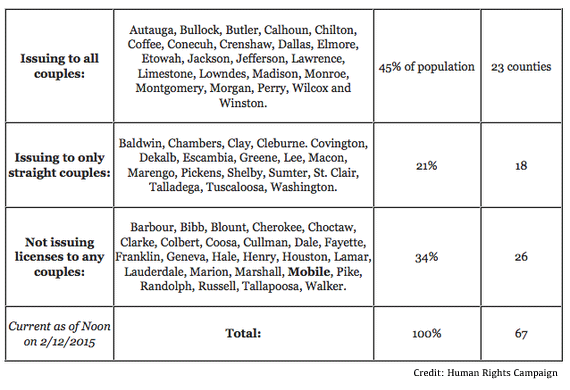
As of noon Wednesday, the Human Rights Campaign had identified 42 counties it said had stopped issuing same-sex licenses as of today. Another 19 never issued the licenses and the status of six — Bullock,  Crenshaw, Lamar, Macon, Monroe,  Sumter — is unclear, the advocacy group reported.

“Because of the Alabama Supreme Court’s willingness to ignore their oath of office, all Alabama’s counties appear to be in conflict with the intent of a federal court order,” HRC Legal Director Sarah Warbelow said in a press release. “This is only a temporary setback on the road to equality, but the message it sends to LGBT Alabamians is despicable.”

Same-sex couples will likely appeal up to the U.S. Supreme Court if necessary to block the latest state supreme court ruling, said Ben Cooper, chairman of Equality Alabama. “It’s important to understand that this is not nearly the end of this,” he said.

The federal government does not take kindly to states getting in the way of their rulings.  Attorney Shelley Bilbrey notes, “You know at some point, we end up with the George Wallace standing at the school-house door situation.”

Let’s say a probate judge wants to issue a same-sex marriage license. Let’s say they want to side with the federal court and ignore the state ruling.  Why not?

Bilbrey answers, “They would be fearful of a contempt citing.”  She’s saying probate judges could be jailed for following a federal court decision.  You can see why they may be reluctant to issue the same-sex marriage licenses, no matter their own feelings on the legality or morality of the issue.  Bilbrey adds, “Regardless of what he believes about the issue, I certainly would never want to risk a contempt citing.”  Because the ruling itself shows the state supreme court is using a lot of the powers at their disposal.  As for contempt, Bilbrey assesses, “I wouldn’t doubt that they would exercise that, since they’ve already taken this drastic measure.”

The Republicans in our state house and in our courthouses promised smaller, less intrusive government, but right now they are trying, instead, to write our marriage vows for us. And that love and cherish and sweet old fashioned notion stuff just got struck right out.  The Alabama Supreme Court has ruled that love is not a factor in marriage.  Have they decided to send us back hundreds of years to arranged marriages, when we weren’t able to choose who we’d marry?  No, these perverse judges instead want to look in our underpants to make sure our parts are compatible for baby-making.  


Same-Sex Marriage and Alabama

2015/02/img_0279.jpg

There has been one major advantage to being out sick this week with the flu, I have been able to be glued to the television and internet news coverage of same-sex marriage coming to Alabama. A few years ago, I’d have never thought this day would come, and up until last month, I thought Alabama would be the 50th state to recognize same-sex marriage, but I am glad that I was wrong. I wasn’t wrong that it would happen with Alabamian officials kicking and screaming and trying to relive the conservative, states’ rights “glory days” of the 1960s.

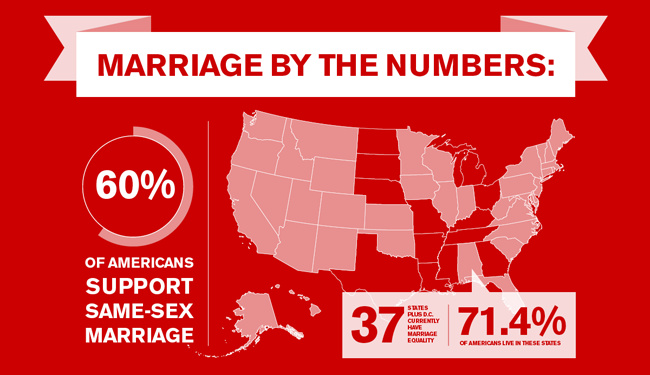
Alabama’s same-sex marriage ban began crumbling in January, when U.S. District Judge Callie Granade found it unconstitutional. At the request of the state attorney general, Granade put a two-week stay on her ruling so the state could ask the U.S. Supreme Court to intervene and delay it even longer. On Monday morning, however, the Supreme Court declined to get involved, and Alabama became the 37th state where gay marriage is legal.

Despite the ruling, dozens of probate judges around the state have refused to comply with Granade’s ruling. According to the Human Rights Campaign, which advocates for lesbian, gay, bisexual and transgender rights, as of Thursday afternoon, only 23 of the state’s 67 counties were issuing marriage licenses to all couples.

2015/02/img_0278.gif

Their defiance is due to instructions from Alabama Supreme Court Chief Justice Roy Moore (R), who sent an order to the state’s probate judges Sunday night not to issue marriage licenses to same-sex couples. He argued that they were not bound to follow the federal ruling.

To further the confusion for Alabama’s probate judges, the state’s Attorney General is refusing to advise county probate judges in the matter of issuing same-sex marriage licenses. AG Strange claims that it is not part of his job to advise elected officials in the state concerning the law. First of all, Strange is a dumbass like so many officials in the state and he apparently has no idea what his job description is. The Attorney General in Alabama is the chief lawyer of the state. He is called upon as the chief defender of the laws of Alabama, the lawyer for state officials and represents the state in all matters brought before a court of law or tribunal. The Attorney General also provides advisory opinions to local and state governments when questions arise about the constitutionality of proposed laws and regulations. Therefore, when Judge Grenade ordered him not to enforce Alabama’s same-sex marriage bans on the grounds that they are unconstitutional, that seems pretty clear to me that she ordered him to advise county probate judges to issue marriage licenses to same-sex and opposite-sex couples.

Furthermore, the governor is playing dumb, as he usually does and refuses to make any comment. At the same time that he wants to prevent same-sex marriage, he doesn’t want to go down in history as the George Wallace of the LGBT rights movement. Governor Bentley is merely a fence sitter. He has made only one clear decision in his time as governor and that is to refuse federal aid for ObamaCare, which any healthcare worker who deals with the poor will tell you has been a major mistake, since it left many Alabamians uninsured because they couldn’t pay the high cost of health coverage and they did not qualify for Alabama’s income level for Medicaid. He has been wishy-washy over casinos and every other issue before the state. He’s useless.

On the bright side, at least out Lt. Governor Kay “I have other people to do my thinking for me” Ivey hasn’t seemed to weigh in on the topic. God only knows what stupidity that old woman’s advisors would have her say. Half the time I wonder what the hell she does anyway, but then again, I have no doubt that she wonders the same thing. The other day, I was reading a blog post from Michael-in-Norfolk where he wrote “The batshitery and insanity coming out of Alabama or more particularly the Alabama Republican Party seems to be increasing hourly. As I’ve done before, I cannot help but wonder WTF happened to the state where I lived for four years.” The only issue I have with what Michael says is that, it was just as bat shot crazy four years ago. Four years ago we elected a dermatologist as governor, a man who calls himself “Big Luther” as AG, a state treasurer named Young Boozer, a Public Service Commissioner named Twinkle, who ran on a platform to dismantle the PSC and end the last minor protections we have against public utilities, and Kay Ivey as Lt Governor, who said on her election night when asked about an important issue at the time, and I quote, “I don’t know, I pay people to do my thinking for me.”

They may have closed Bryce’s Mental Hospital in Tuscaloosa a few years ago, but apparently the residents were all let lose to run the Alabama government and right now the loudest lunatic is a clown in black robes named Roy Moore. The voters of the state of Alabama should be absolutely ashamed of themselves. I am totally embarrassed, even though I didn’t vote for a single one of these lunatics. It’s sad to say that I haven’t voted for a single winning candidate in a state or local election in over ten years. Yet, all that most people look at in the state of Alabama is party affiliation not the candidate. Quite honestly, who in their right mind would elect a man who shows wanton disregard for the legal system to head the Alabama Judicial System as Chief Justice. Moore has a history of defying federal decisions. In 2003, Alabama’s judicial ethics panel voted to remove Moore, who was chief justice at the time, from office after he refused to follow a federal order to take down his Ten Commandments monument in the state judicial building. Moore was elected as chief justice again in 2012.

Roy Moore has stated over and over that the lowest federal court does not overrule a state’s highest court; however, the 1859 Supreme Court case Ableman v. Booth clearly states that State courts cannot issue rulings on federal law that contradict the decisions of federal courts. Moore consistently makes up his own laws and opinions to suit his needs instead of following the dictates of his office. The Alabama Court of the Judiciary needs to once again remove him from office. Once removed, this time Moore could never again have the chance to be a judge in Alabama. At 68, he will turn 70 before the next election and Alabama law bars anyone over 70 years of age from being elected to the bench.

HRC Legal Director Sarah Warbelow said in a statement yesterday “It is time for the judicial chaos that Chief Justice Roy Moore has caused to end. Both the law and Judge Granade’s action today are crystal clear: refusing to follow the law has consequences. All probate judges should do their duties as public servants and begin to issue licenses to committed, loving same-sex couples immediately.” Warbelow is saying exactly what AG Strange should have said on Monday when the US Supreme Court refused to extend the stay and allowed for same sex marriage to begin in Alabama.

I have been wanting to write about this last week, so if I’ve been a little over zealous in this post, please forgive me. The defiance of federal court rulings is something Alabama should have learned it’s lesson about fifty years ago, yet elected officials still want to show their ignorance and backwards thinking. I haven’t felt like putting my thought together until now, so it all came out at once. Thankfully, I am feeling better. I’ll be heading back to school today. It will be a short day, so I think I can handle it. Thank you all for your well wishes. I think I’m in the clear now.


Gay marriage comes to Alabama over chief judge’s objections

IMG_0399

MONTGOMERY, Ala. (AP) – Alabama’s chief justice built his career on defiance: In 2003, Roy Moore was removed from the bench for defying a federal court order to remove a boulder-size Ten Commandments monument from the state courthouse.

On Monday, as Alabama became the 37th state where gays can legally wed, Moore took a defiant stand again, employing the kind of states’ rights language used during the Civil War and again during the civil rights movement.

He argued that a federal judge’s Jan. 23 ruling striking down the Bible Belt state’s gay-marriage ban was an illegal intrusion on Alabama’s sovereignty. And he demanded the state’s probate judges not issue any marriage licenses to same-sex couples.

“It’s my duty to speak up when I see the jurisdiction of our courts being intruded by unlawful federal authority,” the 67-year-old Republican chief justice of Alabama’s Supreme Court said in an interview Monday.

His stand did not succeed in stopping gay couples from tying the knot. And it brought forth another round of criticism of Moore at a time when the movie “Selma” has reminded many Americans of Alabama’s segregationist defiance of the federal government in the 1960s.

Richard Cohen, president of the Southern Poverty Law Center, a major civil rights organization, branded Moore the “Ayatollah of Alabama.”

Moore’s office in the Alabama judicial building is down the street from the Alabama Capitol, where in 1963 Gov. George Wallace promised “segregation now, segregation tomorrow, segregation forever” and vowed to fight what he portrayed as the tyranny of the federal government.

“Moore is using the religion issue to further his political career, just as Wallace used the race issue to further his,” Cohen said.

The Southern Poverty Law Center filed a judicial complaint against Moore accusing him of trying to incite chaos at the probate courts.

On Monday, some counties refused to issue same-sex marriage licenses or shut down their licensing operations altogether, citing confusion about what they should do. But at least seven of Alabama’s 67 counties issued gay marriage licenses, and same-sex couples were wed at courthouses in such places as Birmingham and Montgomery.

In Birmingham, the Jefferson County Probate Office said it had dispensed more than 250 licenses to same-sex couples by midday, with people still arriving. Only three opposite-sex couples had received licenses.

Some of the gay couples who had been lined up for hours exited courthouses to applause, delighted by the opportunity to exchange vows.

“I figured that we would be that last ones – I mean, they would drag Alabama kicking and screaming to equality,” said Laura Bush, who married Dee Bush in a park outside the courthouse in Birmingham.

Alabama Gov. Robert Bentley, a Republican and a Southern Baptist, said he believes strongly that marriage is between one man and one woman. But he said the issue should be “worked out through the proper legal channels” and not through defiance of the law.

Bentley noted that Alabama is about to be in the spotlight again with the 50th anniversary of the Voting Rights Act of 1965, which was passed after civil rights marchers were attacked and beaten in Selma, Alabama.

“I don’t want Alabama to be seen as it was 50 years when a federal law was defied. I’m not going to do that,” Bentley said. “I’m trying to move this state forward.”

After the Ten Commandments dispute made a national figure out Moore, he ran unsuccessfully for governor in 2006 and 2010. In 2012, he returned to the high court when he got elected chief justice. There has been speculation he might make a third run for governor.

He has been one of the state’s most outspoken critics of gay marriage and homosexuality. Moore called homosexuality an “inherent evil” in a 2002 ruling in a child custody case. On the campaign trail in 2012, he said that same-sex marriage would bring about the “ultimate destruction” of the country.

Late last month, U.S. District Judge Callie Granade ruled that the state marriage ban was unconstitutional and – in a later clarifying order – said probate judges have a legal duty under the U.S. Constitution to issue the licenses. On Monday morning, the U.S. Supreme Court refused to block the start of gay marriages in Alabama.

Moore bristled at the comparison to Wallace and disputed the notion that same-sex marriage is a civil rights issue.

“This is not about the right of people to be recognized with race or creed or color. This is about same-sex marriage. It is not the same subject,” he said.

“Eighty-one percent of the voters adopted the Alabama Sanctity of Marriage Amendment in the Alabama Constitution. I think they want leaders that will stand up against an unlawful intrusion of their sovereignty, and that’s what we’re seeing.


Who Will Officiate?

2015/02/img_7758.jpg

Alabama’s gay marriage ban may end on February 9, 2015, or possibly before if the current stay is not continued or is lifted early by the 11th U.S. Circuit Court of Appeals. For now, the decision is on hold and the delay could be extended by the 11th Circuit, as the state has requested. The U.S. Supreme Court has said it would decide whether same-sex marriage should be allowed nationwide, and a decision is likely by late June. The question some media outlets are now asking is who will perform same-sex weddings?

The Alabama Chief Justice and some local judges are advocating anarchy with with attempts to ignore the federal courts. Alabama’s Chief Justice Roy Moore is leading the charge in the letter he wrote to Gov. Robert Bentley, asking him to defy the federal court ruling against Alabama’s same-sex marriage ban. This is deja vu all over again. The last time Moore was on the court in 2002 he was removed due to his refusal to take down the massive Ten Commandments monument he had installed in the state judicial building. Now, as before, Moore is facing a judicial ethics complaint filed by the Southern Poverty Law Center.

Furthermore, a number of judges have decided to quit performing marriages. Geneva County’s probate judge Fred Hamic has performed over 1,000 weddings during his seven year tenure, stating they are his favorite part of the job. But Hamic who claims to be a Christian says that he plans to quit performing the ceremonies if same-sex marriage begins in Alabama. Madison County’s probate office in Huntsville said last week it would quit performing marriages but cited personnel shortages, not gay marriage, as the reason. I doubt anyone believes that as the real reason. Montgomery County Probate Judge Steven Reed said he’ll marry anyone, straight or gay, but most state judges are up in the air about performing marriages. While Alabama law requires probate courts to issue marriage licenses, judges and other court officials have the option of whether to perform wedding ceremonies.

Many churches already ban gay weddings, so same-sex courthouse ceremonies became a real possibility for the state’s 68 probate judges when a federal judge in Mobile ruled Jan. 23 that the state’s constitutional and statutory ban on gay marriages violates the U.S. Constitution.

Monroe County Probate Judge Greg Norris, president of the state probate judge’s association, said he hasn’t heard of any judge who would refuse a wedding license to a same-sex couple if the decision by U.S. District Judge Callie V. S. Granade is upheld or the U.S. Supreme Court permits gay marriage. But many probate judges — who are elected and sometimes also serve as county commission chairs — are on the fence about whether to perform same-sex ceremonies, said Norris.

At least the State Health Department which maintains the Department of Vital Statistics is getting ready for the change. While the state is appealing Granade’s order, health officials and the probate judge’s group already are considering how to alter Alabama marriage licenses in case same-sex marriages can begin, Norris said. The forms currently refer to “bride” and “groom” and will likely have to be reprinted, he said.

Even if judges refuse to perform wedding or church organizations ban same-sex marriages to be performed, many other ordained ministers will marry same-sex couples. I have been ordained as a minister of the Universal Life Church, Modesto, California, and am therefore in good standing to marry anyone in the state of Alabama. The only requirement is that I must charge at least $1 to perform the wedding. So when (not if) the stay is lifted in Alabama, I will gladly marry anyone who would like me to perform the ceremony.

Moore can call for the Alabama judiciary to ignore a federal court ruling (which hopefully will get him removed from the bench a second time for ethics violations), judges across the state can refuse to perform weddings, and ministers can refuse as well, but same-sex couples will be married someday soon in the state of Alabama. Progress and equality will not be stopped, no matter how hard some may try.