Category Archives: Politics

Judicial Review

IMG_9963.JPG

Former Arkansas Gov. Mike Huckabee disputed what he called the “notion of judicial supremacy” on Tuesday, arguing states would have the final say on gay marriage regardless of whether the Supreme Court rules that same-sex couples have a constitutional right to marry.

The idea of nullification has been tried over and over. Courts at the state and federal level, including the U.S. Supreme Court, repeatedly have rejected the theory of nullification. The courts have decided that under the Supremacy Clause of the Constitution, federal law is superior to state law, and that under Article III of the Constitution, the federal judiciary has the final power to interpret the Constitution. Therefore, the power to make final decisions about the constitutionality of federal laws lies with the federal courts, not the states, and the states do not have the power to nullify federal laws.

Nullification has never succeeded in United States history, and will not succeed this time despite the rantings of Huckabee. Andrew Jackson is the only President to openly defy the Supreme Court, and he has been vilified in history for doing so. In the 1832 U.S. Supreme Court decision Worcester v. Georgia, U.S. Supreme Court Chief Justice John Marshall, in writing for the court, ruled that Georgia could not impose its laws upon Cherokee tribal lands. Jackson is frequently attributed as responding to this decision by remarking, “John Marshall has made his decision, now let him enforce it.” Georgia refused to accept the Supreme Court’s decision. President Andrew Jackson did not believe Georgia had the right to nullify federal law, but was sympathetic to Georgia’s goal of forcing the Cherokees to relocate to the west. He took no immediate action against Georgia. Before the Supreme Court could hear a request for an order enforcing its judgment, the Nullification Crisis arose in South Carolina. Jackson wanted to avoid a confrontation with Georgia over states’ rights. A compromise was brokered under which Georgia repealed the law at issue in Worcester. Despite the Court’s decision finding Georgia’s actions unconstitutional, Georgia continued to enforce other laws regulating the Cherokees. Ultimately the Cherokees were forced to agree to a treaty of relocation, leading to the Trail of Tears.

However, Cherokee removal occurred in the 1930, when the Supreme Court was a relatively weak branch of the government. Since the 1830s, the power of the Supreme Court has grown to become an equal branch of government alongside the executive and legislative branches. Nullification and interposition resurfaced in the 1950s as southern states attempted to preserve racial segregation in their schools. In Brown v. Board of Education (1954), the Supreme Court decided that segregated schools were unconstitutional. At least ten southern states passed nullification or interposition measures attempting to preserve segregated schools and refusing to follow the Brown decision. The advocates of these nullification and interposition measures argued that the Brown decision was an unconstitutional infringement on states’ rights, and that the states had the power to prevent that decision from being enforced within their borders. The Supreme Court explicitly rejected nullification in the case of Cooper v. Aaron (1958), which directly held that states may not nullify federal law.

Huckabee, a conservative evangelical and potential 2016 presidential candidate, said a Supreme Court ruling, expected this year, would ultimately be moot because “one branch of government does not overrule the other two.” He could not be more wrong and needs a basic government lesson about checks and balances. Huckabee went on to say, “One thing I am angry about though … is this notion of judicial supremacy, where if the court makes a decision, I hear governors and even some aspirants to the presidency say, ‘Well that’s settled, it’s the law of the land.’ No, it’s not the law of the land.” Huckabee obviously does not understand judicial review.

“Constitutionally, the courts cannot make a law, they can interpret one and then the legislature has to create enabling legislation and the executive has to sign it and has to enforce it,” Huckabee added. While the U.S. Constitution does not explicitly define a “power” of judicial review (which is not making law), the authority for judicial review in the United States has been inferred from the structure, provisions, and history of the Constitution. In 1803, Marbury v. Madison was the first Supreme Court case where the Court asserted its authority for judicial review to strike down a law as unconstitutional. At the end of his opinion in this decision, Chief Justice John Marshall maintained that the Supreme Court’s responsibility to overturn unconstitutional legislation was a necessary consequence of their sworn oath of office to uphold the Constitution as instructed in Article Six of the Constitution.

A ruling from the high court, however, would not “make law,” but rather would invalidate existing bans on gay marriage as unconstitutional. State legislatures would need no additional law to recognize same-sex marriages. Similar appellate court decisions have already done so in 36 states and the District of Columbia — all of which now recognize same-sex marriages.

This isn’t the first time Huckabee has flirted with the theory of nullification. The comments place him on the far right of his party — even more so than Sen. Ted Cruz (R-Texas), a potential rival in the race for the White House. There are few things I can think of more disastrous than Mike Huckabee becoming president do the United States, however, I believe that idea is a moot point. Huckabee doesn’t stand a chance in an election. Just like many of the Republicans who have hinted at running, he has a bad problem of putting his foot in his mouth and coming across as just plain stupid.


Distractions

IMG_9709-0.JPG

Last night, I watched the State of the Union address. Some of it I found quite interesting, but most of it was merely political nonsense. Most of the SOTU is merely political posturing. It would be nice if Congress would sit their quietly and listen instead of clapping and not clapping to make a political statement every five words, then we could listen and the President could finish. Interruptions aggravate me and I get bored. My students often love to interrupt me in hopes of getting me off subject, or to cause me to lose my train of thought, resulting in what they think will be less work for them. They never have caught on that it ends up being more work for them, not less work, but back to the SOTU. I did like Obama’s idea of free community college education. It should expand the need for more college teaching jobs, which would be good for me and hopefully get me out of teaching high school and back to teaching college. The thing is, with a Republican Congress, I don’t think it will pass. Republicans seem to be allergic to the word “free.” And I know, it won’t actually be free (I just taught in economics the idea of TINSTAAFL–There is no such thing as a free lunch). The American people will have to be taxed more, and we all know that if Republicans raise taxes it will be on the lower and middle class and not the upper income levels, where I think there should at least be less loopholes if not higher taxes for those who can afford them.

However, the SOTU address was not the major distraction of the night. I’m not for sure what came up in the SOTU, but something started me googling a topic. Oh, I remeber what it was, they showed Ruth Bader Ginsburg, and I thought how ancient she looks, which made me wonder just how old she actually is, so I googled it. That lead to me researching Sandra Day O’Connor and other Supreme Court Justices, including Hugo Black from Alabama. Research and learning is one of my favorite things. Even as a kid, I used to go pull an encyclopedia off the bookshelf to look something up, and as I was trying to find one thing, I’d see numerous other things I wanted to read about, so I’d mark those with a finger. I’d read the one I’d started out to read then read the others. Before I knew it, I’d looked at a dozen or more articles in that volume of the encyclopedia and then I’d have some other interest that I wanted to look up, so I’d put that encyclopedia volume up and get down another. This could go on for an hour or so until I got tired.

Now with the internet, I can begin searching for something and open numerous tabs in my browser and then read each one. Often there is a hyperlink or two that I also want to check out, so I open a few more tabs. It’s a lot easier than getting down another volume of the encyclopedia, but it traps me in a vicious cycle of never ending curiosity and research. Eventually, I exhaust myself or I just can’t absorb any more information at that time, so I close my browser. But like last night, this can last not just and hour but three or four hours.

The biggest problem is that sometimes I get so carried away in reading different things, that I forget what my original plan was for the evening. Last night, I’d planned on answering about a half a dozen emails that need to be replied to and writing a blog post for today, but then I realized that it was almost 11 pm and I needed to get some sleep. So the email replies and the blog post I’d originally planned will have to wait until tonight when I will have the time to write them. Since I will have limited internet access tonight (I’m staying with my grandmother, long story but she asked and since she’s my last grandparent, I could hardly say no), I will hopefully get those emails replied to and be able to write the post I’d originally intended for today.


The Tim Cook Economic Development Act

IMG_9462.JPG

Alabama is one of 29 U.S. states that currently offers no protection for LGBT employees who are fired, not promoted, or not hired because of their perceived sexual orientation or gender identity. Democratic state Representative and Alabama’s sole openly gay lawmaker Patricia Todd, hopes to change that with the introduction of the Tim Cook Economic Development Act which would ban workplace discrimination based on sexual orientation.

Just days before he came out in October, Cook, a Mobile native, spoke to lawmakers in Alabama when he was inducted into the Alabama Academy of Honor. Cook criticized the state for being “too slow” when it comes to embracing civil rights progress. He said that Alabama was too slow in the 1960s when it came to granting equality to African-Americans, and Alabama was too slow today in guaranteeing equality for LGBT Alabamians. In that address delivered at the Alabama State Capitol, Cook urged lawmakers to “create a different future,” in which LGBT Alabamians cannot be fired for their actual or perceived sexual orientation or gender identity.

In the days after Cook disclosed in a magazine essay that he was gay, Todd told reporters she would put his name on a bill to bar discrimination against lesbian, gay, bisexual and transgender school teachers and other state employees.

Todd said she was initially joking about using Cook’s name, but her comments were published and came to the attention of Apple. Todd said she received a call early last month from a company official who expressed concern over Cook’s name being attached to such a politically sensitive measure. Of course, politics can be bad for business, so Todd said she told the official she would not name the bill after Cook.

The conversation with the Apple official ended up being reported by BuzzFeed earlier this week, and Todd received a call from the company’s general counsel, Bruce Sewell, who told her Cook would be delighted to have the bill named after him, she said. In a statement provided to Reuters, Apple said: “Tim was honored to hear that State Rep. Todd wanted to name an anti-discrimination bill after him, and we’re sorry if there was any miscommunication about it. We have a long history of support for LGBT rights and we hope every state will embrace workplace equality for all.”

Opponents of Todd’s bill argue that it is unnecessary. The office of Republican Gov. Robert Bentley has told local media that LGBT persons are already protected by the Civil Rights Act of 1964. Is is not surprising considering Bentley’s ability to keep his head in the sand over so many issues. But proponents say that the language of the Civil Rights Act is vague when it comes to LGBT persons and their rights in the workplace. They say it’s necessary to pass such a bill at the state level since LGBT are not explicitly protected by federal law—there is an opening for interpretation in the court of law as to whether or not LGBT are in the same class of protection as gender, race and ethnicity.

While Alabama considers its workplace discrimination bill, LGBT advocates nationwide are still pressing Congress to pass a national employment non-discrimination act—popularly known as ENDA. Versions of ENDA have been introduced in nearly every Congress since 1994. The most recent reincarnation of the federal bill was passed by the U.S. Senate with support from both Democratic Sen. Dick Durbin and Republican Sen. Mark Kirk but was stalled in the House, again not surprising since the current House of Representatives has been more divisive and less productive than any Congress I can remember.


Sixth Circuit Upholds Marriage Ban

IMG_9203.JPG

As expected the 6th Circuit Court of Appeals reversed lower federal court rulings legalizing gay marriage in Michigan, Ohio, Tennessee and Kentucky on Thursday.

Judge Jeffrey S. Sutton, who wrote the 6th Circuit Court of Appeals’ majority opinion, said the court does not have “a sweeping grant of authority” that allows it to determine “whether gay marriage is a good idea” for the residents of those states. This is in contrast to how other U.S. circuit courts that have interpreted the ruling in United States v. Windsor, which declared Section 3 of the DOMA unconstitutional under the Due Process Clause of the Fifth Amendment.

Sutton questioned, “Is this a matter that the National Constitution commits to resolution by the federal courts or leaves to the less expedient, but usually reliable, work of the state democratic processes?”

The AP reports on the ruling:

It followed more than 20 court victories for supporters of same-sex marriage since the U.S. Supreme Court struck down part of the federal Defense of Marriage Act last year. A federal judge in Louisiana recently upheld that state’s ban, but four U.S. appeals courts ruled against state bans.

The issue appears likely to return to the Supreme Court so the nation’s highest court can settle whether states can ban gay marriage or that gay and lesbian couples have a fundamental right to marry under the U.S. Constitution. Thirty-two states recently asked the Supreme Court to settle the issue once and for all.

Sutton did acknowledge that the legalization of gay marriage is an issue that’s not going away. In this, Sutron is correct. The Supreme Court will almost certainly be forced to take up the case of gay marriage now that there is a conflict in the lower courts. With all previous circuit courts agreeing on the unconstitutionality of gay marriage bans, the Supreme Court had no reason to take on the issue. However, now that the Sixth Circuit’s ruling differs, there is a reason for the Supreme Court to take on the issue. “From the vantage point of 2014, it would now seem, the question is not whether American law will allow gay couples to marry; it is when and how that will happen,” the opinion said.

Senior Judge Martha Craig Daughtrey, writi the dissent, chastised her colleague for writing “what would make an engrossing TED Talk or, possibly, an introductory lecture in Political Philosophy,” arguing that “the majority sets up a false premise—that the question before us is ‘who should decide?’—and leads us through a largely irrelevant discourse on democracy and federalism.”

“If we in the judiciary do not have the authority, and indeed the responsibility, to right fundamental wrongs left excused by a majority of the electorate, our whole intricate, constitutional system of checks and balances, as well as the oaths to which we swore, prove to be nothing but shams,” Daughtrey wrote.

Sutton and the Sixth Circuit are merely delaying the inevitable. Of course, they may have also taken it as a sign from the Republican victories in the midterm election that Senators like Ted Cruz will likely try to pass a Defense of Marriage Amendment to answer the “question” once and for all. It would be one of the greatest travesties in American history if they do because it will be the first amendment designed to discriminate against a group of Americans instead of expanding freedoms.

Adapted from: http://www.huffingtonpost.com/2014/11/06/gay-marriage-bans_n_6117196.html


Comparisons

IMG_9019.JPG

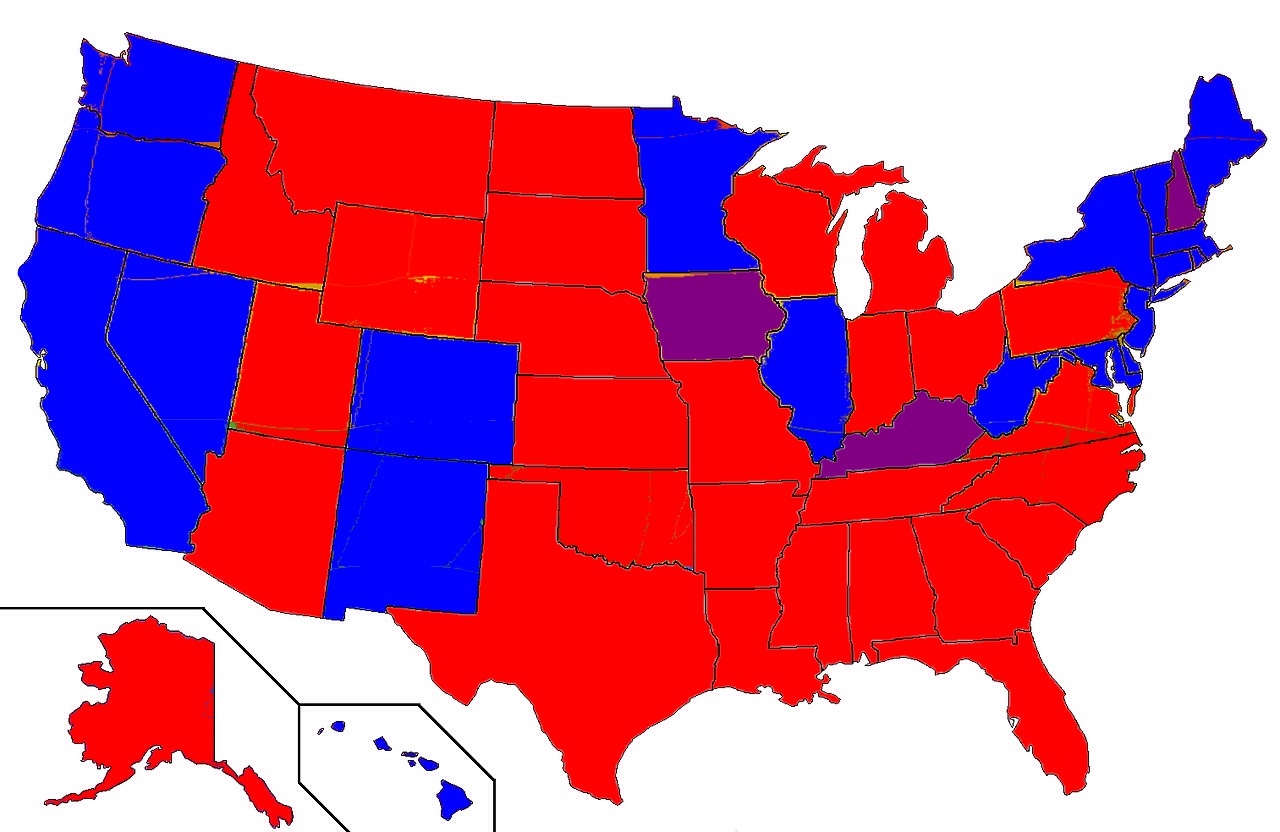
Today’s post is about comparisons. As men, we are often sizing each other up, but in this case, I wanted to compare political control of the states with it’s effects on same-sex marriage recognition.

IMG_9044.JPG

The above map shows party control of the state legislatures. Those in Red represent that both houses of the state legislature are controlled by the Republican Party. Those in Blue represent that both houses of the legislature are controlled by the Democratic Party. The three states in Purple (Iowa, Kentucky, and New Hampshire) represent that one house of the legislature is controlled by Democrats while the other is controlled by Republicans.

IMG_9046.JPG

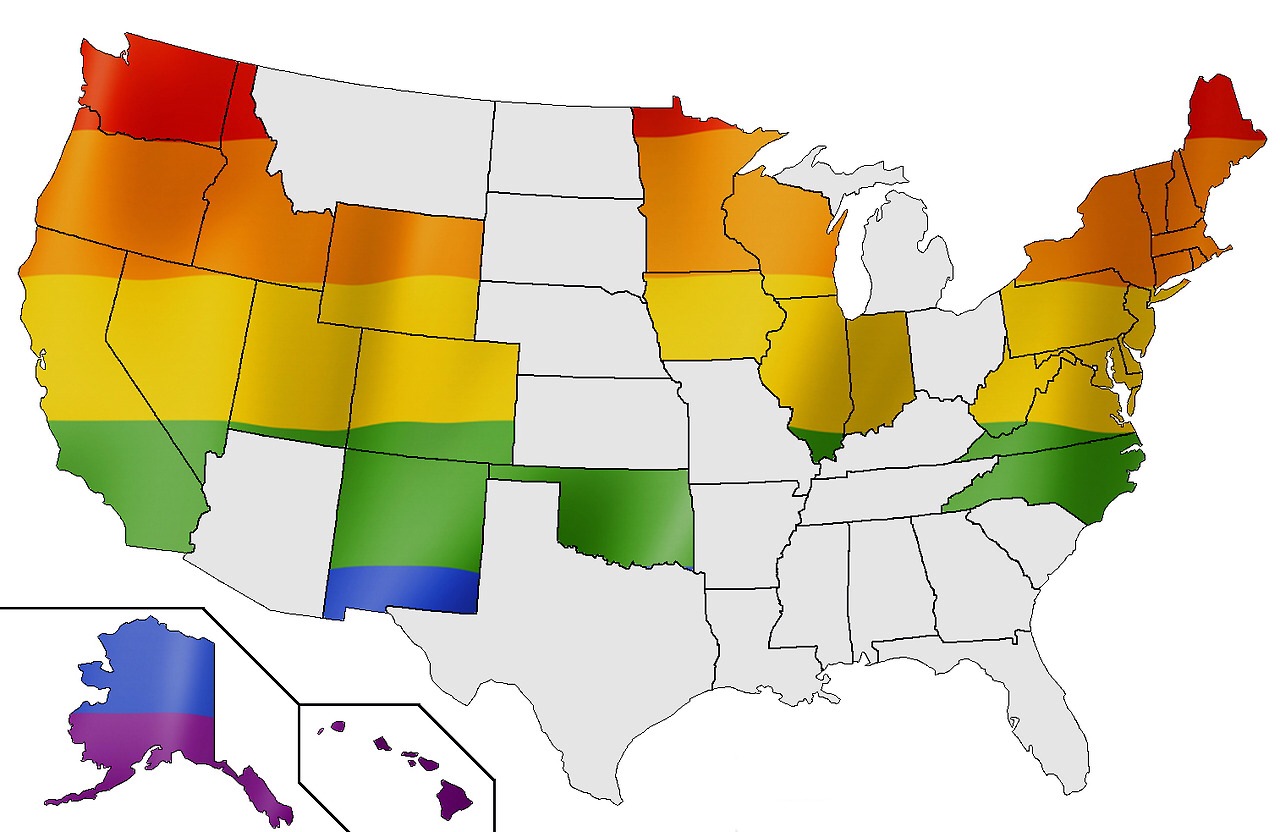
The above map shows party control of the state governorship. Those in Red represent that the governor is a member of the Republican Party. Those in Blue represent that the governor is a member of the Democratic Party.

IMG_9043.JPG

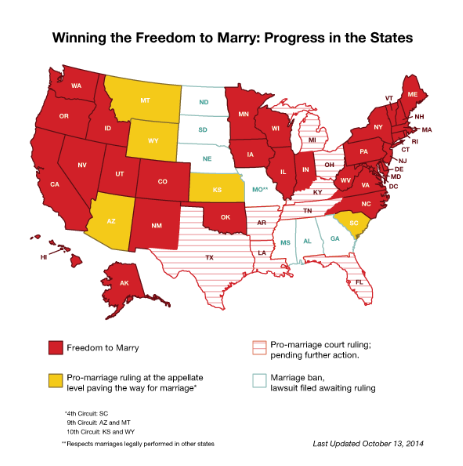
The above map shows which states recognize and perform gay marriage. All states whose legislature is currently controlled by the Denocratic Party have legalized gay marriage. In most of the states that have Republican controlled state legislatures have had gay marriage made legal through the courts. You will also notice that the political party of the governor does not correspond well with the map of states with same-sex marriage.

I decided to use the visual aids to help us visualize the politicalization of America. JiEL commented yesterday that he’d like to see a map of the state-by-state political make-up of the United States. He said, “I’m almost sure that the same states that are against equality of marriage rights and liberty rights are those same ones….” I agreed that it would be interesting to compare the different maps. I hope you’ll find it interesting too.


A Difficult Climb

IMG_8864.PNG

Most people do not fully understand how an amendment can be proposed and ratified. As someone who teaches history and government, it’s part of my job to understand this process. Article V of the Constitution lays out the processes by which constitutional amendments can be proposed and ratified. It begins with the proposing of the amendment which can be done in one of two ways.

In the first method which takes place in the U.S. Congress, both the House of Representatives and the Senate must approve the amendment by a two-thirds supermajority vote, a joint resolution amending the Constitution. Amendments so approved do not require the signature of the President of the United States and are sent directly to the states for ratification. The second method, which has never been used, requires two-thirds (or 34) of the state legislatures to ask Congress to call a national convention to propose amendments.

Of these two processes, it is unlikely that a new Equal Rights Amendment as I outlined on Monday could pass by a supermajority of both houses of the current Congress. The atmosphere is highly politicized with Republicans largely against equality for LGBT Americans and Democrats largely for LGBT equality. With Democrats not holding a supermajority in both house, it is highly unlikely to be able to move through Congress.

However, 34 states legislatures could call for a national convention. The likelihood of this is fairly slim because it’s never been done before, and the majority of state legislatures, roughly 60 percent are controlled by Republicans. However, the majority of Americans, even if you go by state-by-state polls, favor same-sex marriage. At least, two-thirds of the states have 50 percent or more of its citizens who favor same-sex marriage. If the majority of citizens in favor of marriage equality in those 34 states became vocal enough, then state legislatures might be convinced to vote for a national convention for proposing amendments. This is also a tricky prospect because it would depend on who the states sent to a national convention and whether or not they would even even choose to propose a new ERA. The precedent set by the original Constitutional Convention would point to a national convention throwing out their mandate and proposing completely different amendments.

If a new ERA were proposed by a national convention, then it would move to the states for the ratification process. Again, Article V recognizes two ways for this to be accomplished. An amendment could be added to the Constitution if three-fourths of the state legislatures approve it. States may also choose to call ratifying conventions in which three-fourths of the states approve it. This method has been used only once, to ratify the 21st Amendment, repealing Prohibition.

The fact is, I realize this is a dream. Even with the 30 states that currently have same-sex marriage legalized, not all of those states would want to agree to a constitutional amendment for LGBT equality. Some polls show that in 38 states, there is a majority or near majority of people who believe that same-sex marriages should be recognized. The Pew Research poll which looked at regional support of same-sex marriage showed that only 34 states supported same-sex marriage, with basically the old Confederate states of the South, plus Kentucky, Oklahoma, and West Virginia being opposed to same-sex marriage.

Of the thousands of proposals that have been made to amend the Constitution, only 33 obtained the necessary two-thirds vote in Congress. Of those 33, only 27 amendments (including the Bill of Rights) have been ratified. It’s a long shot but with enough momentum and support behind it, it is a possibility.

Sources:

http://en.m.wikipedia.org/wiki/Same-sex_marriage_in_the_United_States
http://en.m.wikipedia.org/wiki/Public_opinion_of_same-sex_marriage_in_the_United_States
http://en.m.wikipedia.org/wiki/List_of_United_States_state_legislatures
http://www.archives.gov/federal-register/constitution/
http://www.freedomtomarry.org/resources/entry/marriage-polling
http://www.pewresearch.org/fact-tank/2014/10/15/gay-marriage-arrives-in-the-south-where-the-public-is-less-enthused/

IMG_9028.PNG


Equal Rights Amendment

IMG_9009.JPG

Just over four years ago, I wrote a post about the Equal Rights Amendment (ERA). In that post I suggested that a new ERA be proposed. The original Equal Rights Amendment was designed to guarantee equal rights for women. The ERA was originally written by Alice Paul and Crystal Eastman, and it was introduced in the Congress for the first time in 1923. Though the ERA was introduced in every Congressional session between 1923 and 1970, it almost never reached the floor of either the Senate or the House for a vote—instead, it was usually “bottled up” in committee. In 1972, it passed both houses of Congress and went to the state legislatures for ratification.

The resolution in Congress that proposed the amendment set a ratification deadline of March 22, 1979. Through 1977, the amendment received 35 of the necessary 38 state ratifications. Five states later rescinded their ratifications before the 1979 deadline, though the validity of these rescissions is disputed. In 1978, a joint resolution of Congress extended the ratification deadline to June 30, 1982, but no further states ratified the amendment before the passing of the second deadline. Several feminist organizations, disputing the validity and/or the permanence of the ratification deadline, and also disputing the validity of the five rescissions, continue to work at the federal and state levels for the adoption of the ERA.

The language of the 1972 ERA was fairly simple and read:

Section 1. Equality of rights under the law shall not be denied or abridged by the United States or by any state on account of sex.

Section 2. The Congress shall have the power to enforce, by appropriate legislation, the provisions of this article.

Section 3. This amendment shall take effect two years after the date of ratification.

In all likelihood, the Equal Rights Amendment (ERA) is dead and will never be ratified to become the 28th Amendment. The fight to ratify the ERA is still ongoing and is not quite over. More than three decades after the deadline set by Congress, advocates are working to advance the amendment’s cause at the grass-roots level as some in Congress work to either repeal the amendment’s deadline or start over.

Advocates say the Supreme Court’s June 30 ruling in Burwell v. Hobby Lobby has energized interest in the ERA. That 5-4 decision said the 2010 Affordable Care Act can’t require certain businesses to provide free insurance coverage for birth control if they object on religious grounds. Pay equity is another factor driving renewed enthusiasm for the Equal Rights Amendment. Women on average are paid 77 cents for every dollar men are paid, according to the ERA Coalition.

Congress is considering amendment resolutions that take two different approaches: the three-state approach and the fresh start approach. The “three-state” approach, sponsored by Sen. Ben Cardin, D-Md., and Rep. Jackie Speier, D-Calif., would repeal the ratification deadline and make the ERA part of the Constitution when three more states ratify it. The “fresh start” approach — by Menendez and Rep. Carolyn Maloney, D-N.Y. — would start over with a new resolution and no ratification deadline. Menendez and Maloney also are co-sponsors of the three-state approach legislation.

I believe that they should not only push through with the fresh start approach, but I think there should be a Federal Amendment that would extend the ERA to include barring discrimination because of sexual orientation or identity. I propose that the new language of the amendment read:

Section 1. Equality of rights under the law shall not be denied or abridged by the United States or by any state on account of sex, gender identity, or sexual orientation.

Section 2. The Congress shall have the power to enforce, by appropriate legislation, the provisions of this article.

Section 3. All laws infringing on the rights of individuals because of sex, sexual identity, or sexual orientation shall become null and void immediately upon passage of this amendment.

I think it should also be proposed that a possible Section 4 might be added that would define sex, gender identity, and sexual orientation.

Section 4. Definitions of sex, gender identity, or sexual orientation.

Section 4.1. Sex shall be defined as the biological and physiological characteristics that define men and women.

Section 4.2. Gender shall refers to the socially constructed roles, behaviors, activities, and attributes that a given society considers appropriate for men and women. Gender identity shall be defined as the gender, male, female, with which a person identifies exclusive of their biological secondary sexual characteristics. The gender identities one may identify as include male, female, both, somewhere in between (“third gender”), or neither and may or may not correspond to the sex assigned to them at birth.

Section 4.3. Sexual orientation describes a pattern of emotional, romantic, or sexual attraction to men, women, both genders, neither gender, or another gender. Sexual orientation is enduring and also refers to a person’s sense of personal and social identity based on those attractions, behaviors expressing them, and membership in a community of others who share them.

Though some might believe this fourth section is too strict or defined. However, whenever the debate over gay marriage is brought up, the ideas of polygamy, bigamy, and bestiality are always raised in the debate by crackpots. I think these definitions would clear up any debate about the meaning of the terms. It would also not allow for a great deal of interpretation of the meaning of the amendment by the Supreme Court or the state ratifying legislatures.

If this amendment were to be proposed and ratified, the debates over GLBT rights would effectively be ended. Gay marriage would be forced to be recognized nationwide and we would no longer be holding our breaths as court cases continue in nineteen states. Furthermore, school bullying would be against federal laws. Teachers could not be fired because of their sexual orientation. We would have definitive protection once and for all. I realize this is a dream, but I think it is a great idea. What do you think? Should we all push to have this amendment proposed, passed by Congress, and ratified by the states?

I am going to be discussing more about this idea this week. I want to look at whether it is possible for a new ERA to pass through Congress and what would happen if it reached the states. Though I believe that the federal courts are moving in the right direction, court decisions can be overturned. The Supreme Court has reversed their decisions before, and let’s face it, the Supreme Court is as political as any branch of government and with that the balance of the Court could move away from LGBT rights. I think a constitutional amendment is the true way that LGBT Americans to be equal once and for all.


The Night They Drove Old Dixie Down

IMG_8730.JPG

The Night They Drove Old Dixie Down
By Robbie Robertson

Virgil Kane is the name
And I served on the Danville train
‘Till Stoneman’s cavalry came
And tore up the tracks again

In the winter of ’65
We were hungry, just barely alive
By May the 10th, Richmond had fell
It’s a time I remember, oh so well

The night they drove old Dixie down
And the bells were ringing
The night they drove old Dixie down
And the people were singing
They went, “Na, na, la, na, na, la”

Back with my wife in Tennessee
When one day she called to me
“Virgil, quick, come see,
There goes Robert E. Lee!”

Now, I don’t mind chopping wood
And I don’t care if the money’s no good
You take what you need
And you leave the rest
But they should never
Have taken the very best

The night they drove old Dixie down
And the bells were ringing
The night they drove old Dixie down
And all the people were singing
They went, “Na, na, la, na, na, la”

Like my father before me
I will work the land
And like my brother above me
Who took a rebel stand

He was just 18, proud and brave
But a Yankee laid him in his grave
I swear by the mud below my feet
You can’t raise a Kane back up
When he’s in defeat

The night they drove old Dixie down
And the bells were ringing
The night they drove old Dixie down
And all the people were singing
They went, “Na, na, la, na, na, la”

The night they drove old Dixie down
And all the bells were ringing
The night they drove old Dixie down
And the people were singing
They went, “Na, na, la, na, na, la”

Robbie Robertson wrote this song, which is about the American Civil War – “Dixie” is a term indicating the old American South, and was defeated by the Union army. Robertson came up with the music for this song, and then got the idea for the lyrics when he thought about the saying “The South will rise again,” which he heard the first time he visited the South. This led him to research the Civil War.

The song’s lyric refers to conditions in the Southern states in the winter of early 1865 (“We were hungry / Just barely alive”); the Confederate states are starving and defeated. Reference is made to the date May 10, 1865, by which time the Confederate capital of Richmond had long since fallen (in April); May 10 marked the capture of Confederate President Jefferson Davis and the definitive end of the Confederacy.

I decided to choose this song because of the Supreme Court turned away appeals Monday from five states seeking to prohibit same-sex marriages, paving the way for an immediate expansion of gay and lesbian unions. By refusing to hear the appeals, the Supreme Court is driving Old Dixie down. Yesterday’s decision only effects the southern state of Virginia, plus four northern states (though Oklahoma can be considered either).

The justices on Monday did not comment in rejecting the appeals from Wisconsin, Indiana (both Seventh Circuit), Oklahoma, Utah (both Tenth Circuit), and Virginia (Fourth Circuit). The First, Second, and Third Circuits are made up of states with marriage equality already in force.

The court’s order immediately ends delays on marriage in those states. Couples in six other states — Colorado, Kansas, North Carolina, South Carolina, West Virginia and Wyoming — should be able to get married in short order. Those states would be bound by the same appellate rulings that were put on hold pending the Supreme Court’s review.

That would make same-sex marriage legal in 30 states and the District of Columbia. No other state cases were currently pending with the high court, but the justices stopped short of resolving for now the question of same-sex marriage nationwide.

Two other appeals courts, in Cincinnati and San Francisco, could issue decisions any time in same-sex marriage cases. Judges in the Cincinnati-based Sixth Circuit who are weighing pro-gay marriage rulings in Kentucky, Michigan, Ohio and Tennessee, appeared more likely to rule in favor of state bans than did the Ninth Circuit judges in San Francisco, who are considering Idaho and Nevada restrictions on marriage. This would leave only the Fifth, Eighth, and Eleventh Circuits without rulings on marriage equality, though cases are making their way through the courts in these Circuits.

Experts and advocates on both sides of the issue believed the justices would step in and decide gay marriage cases this term. However, the justices sidestepped the issue for now. Advocates believe that the justices have an obligation to settle an issue of such national importance, not abdicate that responsibility to lower court judges. Opting out of hearing the cases leaves those lower court rulings in place, but it leaves twenty states in a state of limbo.

It takes just four of the nine justices to vote to hear a case, but it takes a majority of at least five for an eventual ruling. Monday’s opaque order did not indicate how the justices voted on whether to hear the appeals. Of there is a dispute with the Sixth Circuit ruling against marriage equality, then the Supreme Court will likely be forced to hear the case and make a nationwide decision. Only time will tell, but the Fifth, Eighth, and Eleventh Circuits will likely eventually rule along the lines of what is expected of the Sixth Circuit, which will be further reason for the Court to take the case since their will be conflict in the lower courts. The Fifth and Eleventh Circuits are comprised of the Old Confederacy, a section of the country that is staunchly anti-LGBT rights. Virginia may have been brought down but the fight is not over.


It’s Time: SCOTUS and Marriage Equality

20140821-220616-79576908.jpg

The U.S. Supreme Court has stepped in to block a federal appeals court ruling that would have allowed gay marriages to begin in Virginia on Thursday. The decision was widely expected and tells little about how the high court will ultimately rule on the issue. It merely preserves the status quo. Now, it’s up to the Supreme Court. It’s unlikely they will continue a perpetual stay on the issue. The federal courts have been moving quickly on the issue, and the Utah and Virginia cases have passed through the appellate courts and await the Supreme Court. Virginia asked the justices to decide the gay marriage constitutional question “as quickly as possible.”

The first opportunity for the court to take action would be when it meets Sept. 29 for its first conference of the new term. But even if the court decides to go ahead and take the Utah case, which likely will be the first one there, the timetable for filing briefs would put the argument at mid- to late January at the earliest. If this timetable occurs, the Supreme Court could issue a ruling by late spring 2015.

Many court specialists believe the justices will go ahead and take either the Utah or Virginia case early in the term. Other experts think the justices may want to wait for a decision from the 6th Circuit Court of Appeals, based in Cincinnati, where the panel at argument this month sounded as though it would uphold the ban on gay marriage. That would provide a conflict in the lower courts for the Supreme Court to resolve.

To date there have been 37 pro-gay marriage rulings in state and federal courts since the Supreme Court last year struck down the federal Defense of Marriage Act. That law barred federal recognition of marriages performed in states where such unions are legal, and set the stage for a nearly unanimous set of rulings in the lower courts issued by both Republican and Democratic appointees.

While the nations lower courts have consistently overturned gay marriage bans, the Supreme Court will likely be forced to make a final decision on the matter. This is a risky proposition. Equal protection should give the Supreme Court no choice but to say that all states must recognize same sex marriages from states where it is legal. Will they go a step further and make it legal in all states, or issue a partial ruling such as in the case of the Defense of Marriage Act? However, if the 6th Circuit Court of Appeals does uphold the ban, the Supreme Court could do the same, and marriage equality will take a step backwards, or at the very least remain static. Federal recognition could remain, and state recognition could continue to be a state issue.

Nineteen of the 50 states, plus the District of Columbia, currently allow same-sex marriage. How likely do you think it is that the United States will have nationwide marriage equality by the summer of 2015?


I Would Say “Only in Texas,” But…

20140618-230945-83385493.jpg

The first Father’s Day for Jason Hanna and Joe Riggs was bittersweet because days earlier, a judge in Texas denied their request to have their names placed on the birth certificates of their newborn twins.

The twins, Lucas and Ethan, share an egg donor and were born to a surrogate mother a month ago. The twins are half brothers. Each of the men is a biological father to one of the babies. But, because Texas has a ban on gay marriage (it was ruled unconstitutional by a federal judge last February, but the decision was stayed pending appeal), and because a judge can use his or her own discretion in these cases, neither of the men is currently on the birth certificates of either of the boys, nor have they been able to co-adopt each other’s biological child.

Only the surrogate mother — who has no biological relationship to the boys, since embryos were transferred to her — is on the birth certificates. In essence, the men are not legally defined as the parents of their own children. And though they have DNA tests for proof, they’re worried, particularly if something were to happen to one of them while the other still has not been able to co-adopt the other’s biological child.

The couple petitioned a judge in their county to add each of their names to their biological sons’ birth certificates and to cross-adopt, or second-parent adopt, the boys. The judge has denied the family on both requests.

“As of right now in Texas two men cannot be on the birth certificate,” Jason Hanna explained in an interview on SiriusXM Progress. “So our attorney followed the letter of the law. We petitioned the court. We had DNA testing there [in court] and petitioned the judge to ultimately remove the surrogate mother from the birth certificate, who has no biological ties to the boys. We would like each biological dad to be placed on the birth certificate of our own son, and then ultimately proceed to the second-parent adoption. The entire petition was denied.”

“We were sworn in and ultimately the judge was saying that with the information she had in front of her, under Texas law she couldn’t grant it,” Riggs said of their appearance in court last week. “I was shocked. We had a ton of questions as we walked away from that courtroom.”

‘It’s a little scary because right now we don’t have full parental rights over own biological children,’ Hanna told the Fox affiliate in Dallas.

Added Riggs: ‘A family court, I guess I expected them to be looking out for the best interests of our kids. We walked out away that day and it wasn’t in the best interests of our kids.’

According to GLAAD, it is unclear in Texas and 17 other US states whether LGBT parents can jointly adopt. This has resulted in legal rulings varying from judge to judge or county to county. Some judges in Texas have approved such adoptions to same-sex couples. It was particularly jarring to Hanna and Riggs because other gay couples in Texas, including friends of theirs, have successfully completed this process. The couple’s lawyer has offered them several options on bringing the petition back, changing the paperwork and the process. But there’s no question that if their marriage was legally recognized they would not be having this problem at all.

The legal picture could improve for the couples if a ruling by a federal judge overturning the states’s ban on gay marriage is upheld by a higher court.

“In order to grant a second-parent adoption [automatically under current law], it has to be between two married people,” Jason explained. “And so, considering we’re not legally married in the eyes of Texas, they don’t have to grant that second-parent adoption because they don’t recognize our marriage…It’s up to the judge’s discretion on whether or not to grant it.”

Hanna and Riggs worry, as they wait for the next step, because they’re in a scary legal limbo.

“Without [co-adoption], if something happened to either me or Joe we don’t have any legal recourse to keep the other’s biological child,” Hanna said. “The state could come in and separate these two brothers…We want to reiterate how important it is for a state to recognize each family, whether it’s same-sex or opposite-sex, and really to ensure everyone has equal protection from the state.”

Jason Hanna and Joe Riggs met six years ago and knew they wanted to be together and raise children, so they saved their money, knowing it would be a costly process. They married last July in Washington DC, where gay marriage is legal, and then went back to Dallas to celebrate their wedding with family and friends in August. They found a surrogate mom, and this past April the twins were born.

20140618-231021-83421855.jpg

It’s heartbreaking to think that a state has erased the parents of children and put a family in legal jeopardy, simply because of discrimination against gay and lesbian couples. But that’s what happened to this gay couple in Texas after what they described as the “magical” birth of their twin boys.