Category Archives: Uncategorized

Blood and Fire

Over the past four-and-a-half decades, California science fiction writer David Gerrold has produced 42 novels, 11 of them nominated for major industry awards. But among Trekkers — they hate being called “Trekkies” — he is famous for another reason. In 1967, at age 19, Gerrold sold Paramount Pictures a lighthearted “Star Trek” script in which the Enterprise became a breeding farm for tiny, fecund balls of fur. “The Trouble With Tribbles,” as the episode was titled, consistently polls as the most popular episode in “Star Trek” history.

In fall 1986, when Paramount announced it was creating a new “Trek” series, “The Next Generation,” the now middle-aged Gerrold was brought on-board to help create it. Before Gerrold had done much more than move into his Los Angeles office, he traveled to Boston for the 20th anniversary convention of the original show. Following a speech to a large crowd of Trekkers, Gene Roddenberry, the creator of “Star Trek,” took a question about “The Next Generation” from a fan named Franklin Hummel, a Boston Public Library employee and director of a gay science fiction group called the Gaylaxians. Gerrold was in the crowd, taking notes.

“Franklin asked whether there would be a gay character on the new show. He made the point that [the original] ‘Star Trek’ had been a leader in bringing black and Asian characters to television, that this was the next step,” Gerrold told me in May. “Gene agreed. He said, ‘Sooner or later, we’ll have to address the issue. We should probably have a gay character.'”

Back in Los Angeles, Gerrold says, Roddenberry mentioned “the gay issue” in a meeting about the direction of the new series. Apparently some members of the staff were surprised. “Next Generation” producer “Robert Justman made a remark about ‘ensign tutti-frutti,'” says Gerrold. “But Gene very calmly explained that it was time.”

A few months later, in late 1986, Gerrold began work on “Blood and Fire,” his first — and, as things turned out, only — “Next Generation” script. In the story, Captain Jean-Luc Picard and his Enterprise D answer a call from a distressed medical research vessel. When the mission team beams over, it finds that the ship’s crew is infected with “Regulan blood worms,” an apparently incurable pathogen so deadly that Starfleet Command has ordered its officers to destroy any ship they contaminate.

Aside from its obvious reference to AIDS, the script also contained a casual nod to homosexuality. “How long have you been together?” Commander Will Riker asks a pair of male officers who accompany him to the blood-worm-stricken ship.

“Since the academy,” one replies.

“This was during one of the worst parts of the AIDS crisis,” Gerrold says. “Before protease inhibitors, before AZT. AIDS was not a treatable condition; it was a fatal disease. And the fear of it was widespread, so much so that blood donorship had reached critically low levels.

“On a more personal note, Michael Minor [art director for ‘Star Trek II: The Wrath of Khan’] and Merritt Butrick [who played Kirk’s son in the ‘Star Trek’ movies] were also infected.”

In Gerrold’s script, curing the disease required a complete blood transfusion. To treat the infected, the worried Enterprise D crew was asked to donate blood. “I felt this plot point would raise the consciousness of 20 million ‘Star Trek’ fans overnight,” says Gerrold. “In fact, I was hoping that we could put a card at the end of the episode encouraging people to donate blood.”

Gerrold never got a chance to lobby for that card. After a series of arguments with Roddenberry’s underlings, Gerrold quit the show, and the episode was permanently shelved. Gerrold says, half-joking, that the script got caught up in “orifice politics.”

The breakup was bitter. Roddenberry, who had sent Gerrold a telegram congratulating him on “Blood and Fire” (“Everybody loves your script”), now began badmouthing his work at “Star Trek” conventions.

“A large part of the problem was that Gene’s health was failing,” Gerrold says. “He didn’t have the physical strength he needed — and he was experiencing mental lapses as well.”

Gerrold says that some of Roddenberry’s collaborators stepped in and began to make decisions about the show. Other writers, including Herb Wright, were fired. Roddenberry’s lawyer, Leonard Maizlish, even went so far as to write story memos and rewrite scripts. And Maizlish was hardly sensitive to the gay issue. “The last time I saw [Maizlish] I was helping Herb Wright pack up his office,” says Gerrold. “The lawyer came to make sure we weren’t stealing anything. To my face, he called me ‘an AIDS-infected cocksucker. A fucking faggot.'”

Some details of Gerrold’s story are disputed (though not the bit about Maizlish, who is now dead; David Alexander, Roddenberry’s authorized biographer, referred to the lawyer in his discussions with me as “Roddenberry’s dark presence”).

Many “Star Trek” insiders say Gerrold’s “Blood and Fire” was simply a bad script. “David has made a career out of this sort of claim,” says Ernie Over, a Wyoming journalist who worked as Roddenberry’s personal assistant. “He had an agenda, which was to get gay people onto ‘Star Trek.'”

“I knew Gerrold from 1972, and I’d read all his books up to that point. ‘Blood and Fire’ was not his best work,” says Richard Arnold, Roddenberry’s research consultant on “The Next Generation” and a columnist for the official “Star Trek” newsletter. “I was almost offended by the stereotypes. The scene I remember particularly was when the gay couple was having a sort of lover’s dispute. The one we could call the wife was expressing concern to the other about getting into dangerous situations. He was saying stuff like ‘You know how much I worry about you when you’re away.’ I mean, come on. This was absolutely ridiculous — for Starfleet officers or for gay men.”

But whatever the merits of the “Blood and Fire” script, Arnold, Over and other “Star Trek” insiders agree that Roddenberry’s subordinates have deliberately kept the official “Star Trek” canon free of any explicit mention of homosexuality since the creator made his comments to the Gaylaxians 15 years ago.

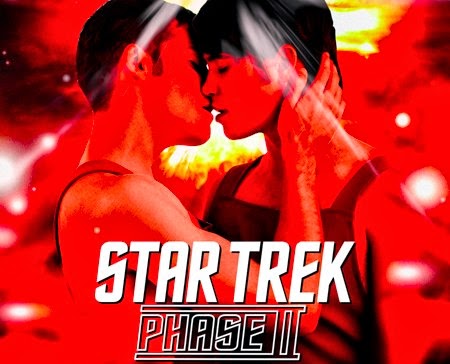
Decades after David Gerrold wrote a Star Trek script dealing with homosexuality that was shelved by the producers, a revamped version of the episode was filmed by the fan series Star Trek: New Voyages.

“I knew about the script and the story, and I approached David with an idea of using it in our series,” said New Voyages executive producer James Cawley. “A few of the original elements were kept intact but changed to make it relevant to 2001 as opposed to 1987.” The gay characters in the revised script will be Captain Kirk’s nephew Peter, seen as a child in “Operation: Annihilate”, and his lover, Lieutenant Alex Freeman.

“Producers did not want to address homosexuality in Star Trek even though the original series talked about race and war and drugs and hippie culture,” noted Cawley. “We have dared to [do] something that the franchise holders would never do. We are including an openly gay couple in the Enterprise, showing the world that…the prejudice and the bias will be gone [in the future].”

The actor playing Peter, Bobby Rice, has already been involved in another fan production, Star Trek: Hidden Frontier, which is set in the Next Generation era and has also included gay characters. Cawley saw his performance and sought him out to appear in New Frontier. “It’s pretty wild. I never thought I’d be a Kirk,” said Rice. “I feel like what we are doing is fantastic and groundbreaking … homosexuality should be generally accepted in the future. Star Trek has always been about tackling these kinds of issues.”

Gerrold said that he was delighted with the longer screen time than a 44-minute television episode and the fact that he can portray events he could not have scripted in 1987. “At one point they are talking about getting married, and at one point they actually kiss on-screen. But we are not going any place that’s thematically out of place in Star Trek,” he said. “I’m enormously proud of how far we have come in such a short time and that I get to live long enough to see this episode be shot.”

"To Boldly Go…"

The Starship Enterprise, arguably the most famous vessel in the history of fiction, has seen some amazing sights. Its crew has gone back in time, averted intergalactic war and defeated monsters that eat whole planets. In the two newest movies, J.J. Abrams has given Star Trek a reboot with an exciting new take on the 47 year old franchise.  I’m a big Star Trek fan, and as such, I went to see the newest movie, Star Trek Into Darkness, last weekend.  I loved it.  When I saw the first Star Trek by J.J. Abrams, some people in the theater were not thrilled with the reboot.  Into Darkness, however, bring back some of the story-lines Star Trek Fans are familiar with.  This was a movie for new Trek fans and old.  The movie is filled with references to the original Star Trek, and at the same time, allows new fans to experience Star Trek in whole new light. 

Star Trek took on many issues of its day.  Most Star Trek stories depict the adventures of humans and aliens who serve in Starfleet, the space-borne humanitarian and peacekeeping armada of the United Federation of Planets. The protagonists have altruistic values, and must apply these ideals to difficult dilemmas. Many of the conflicts and political dimensions of Star Trek represent allegories of contemporary cultural realities. Star Trek: The Original Series addressed issues of the 1960s, just as later spin-offs have reflected issues of their respective decades. Issues depicted in the various series include war and peace, the value of personal loyalty, authoritarianism, imperialism, class warfare, economics, racism, religion, human rights, sexism, feminism, and the role of technology. Roddenberry stated: “[By creating] a new world with new rules, I could make statements about sex, religion, Vietnam, politics, and intercontinental missiles. Indeed, we did make them on Star Trek: we were sending messages and fortunately they all got by the network.”
Yet there’s one frontier that has consistently eluded producers: Through three seasons on television and six movies, the decks of the original Enterprise have never witnessed a single word or gesture of gay affection. The same goes for the Enterprise D from “Star Trek: The Next Generation” and the eponymous craft from “Deep Space Nine” and “Voyager.” No same-sex kisses. No hand-holding. Not even a casual reference to the existence of homosexuality.

It is an odd distinction for the franchise that, 45 years ago, gave America its first televised interracial kiss.  In the 1968 episode “Plato’s Stepchildren”, Uhura (Nichelle Nichols) and Captain Kirk (William Shatner) kiss. The episode is popularly cited as the first example of a scripted inter-racial kiss on United States television. Originally, the scene was meant to be filmed with and without the kiss, so that the network could later decide whether to air the kiss. However, Shatner and Nichols deliberately flubbed every take of the shot without the kiss so that they could not be used.  With many groundbreaking topics and depictions “You would think that occasionally a gay or lesbian character would [appear] somewhere in the 24th century,” wrote a contributor to the Lavender Dragon fan newsletter a few years back. “Has the Federation [of Planets] found a ‘cure’ for homosexuality?”

Star Trek’s creators have beaten around the bush on the issue, but never fully embraced a homosexual character in the Star Trek franchise.  This is what I want to look at this week in my posts, so,stay tuned for more.

P.S. There will not be a poem for this Tuesday, but I will be back to my regularly scheduled program next week.

Moment of Zen: Summertime

School’s out for summer.  It has finally arrived. Finally, a little freedom is at hand.

Last Day of School

No kids today, just paperwork to be done and I have to get my room ready for summer.  This won’t be much of a post because I have had a horrendous headache.  It woke me up I. Te middle of the night Thursday night and it has been off and on in intensity since then. It’s one of those where it is hard for me to even look at the screen because it looks so bright.  I just need to make it through tomorrow and possibly graduation if I’m feeling better.

Will Grayson, Will Grayson

When I was little, my dad used to tel me, “Will, you can pick your friends, you can pick your nose, but you can’t pick your friend’s nose.”  Those seemed like a reasonably astute observation to me when I was eight, but it turns out to be incorrect on a few levels.  To begin with, you cannot possibly pick your friends, or else I never would have ended up with Tiny Cooper.

Will Grayson, Will Grayson
And thus begins Will Grayson, Will Grayson by John Green and David Levithan.  Back in August 2012, I came across a news story on NPR about the 100-Best Ever Teen Novels.  NPR began the discussion by saying:  

It’s almost a cliche at this point to say that teen fiction isn’t just for teens anymore. Just last year, the Association of American Publishers ranked Children’s/Young Adult books as the single fastest-growing publishing category.

It’s true since Harry Potter came out, more and more teens are getting into reading and more and more adults are also reading these same books.  I read the Hunger Games trilogy (#2 on the list) and really enjoyed it, and last night I finished Will Grayson, Will Grayson (#34 on the list and the one I decided to buy immediately but just got the chance to read).  By the way, To Kill a Mockingbird was number three on the list, but it should have been number one because I think it is one of the greatest books ever written, young adult or adult.  Harry Potter was number one, and I can understand it only because so many kids read them and is a major reason for the teen novel boom. 
Enough about other teen novels, I really want to discuss in this post the novel Will Grayson, Will Grayson.  Will Grayson, Will Grayson is collaboration between John Green and David Levithan.  In designing the plot for the book, the two authors decided to split it evenly in half. John Green wrote all the odd-numbered chapters while David Levithan wrote all the even-numbered chapters. This also held true for the main characters’ names, with Levithan choosing the given name and Green the surname. The only plot they decided on together was the fact that the two characters would meet at some point in the novel and that their meeting would have a tremendous effect on their lives. After this decision, they separately wrote the first three chapters for their half and then shared them with each other. After sharing, they then “knew immediately it was going to work”, as stated by Levithan.
Green’s Will is a straight kid with a chip on his shoulder with a flamboyant gay best friend named Tiny Cooper. The other Will is gay and struggles with depression.  One cold night, in a most unlikely corner of Chicago, two teens—both named Will Grayson—are about to cross paths. As their worlds collide and intertwine, the Will Graysons find their lives going in new and unexpected directions, building toward romantic turns-of-heart and the epic production of history’s most fabulous high school musical.  
Hilarious, poignant, and deeply insightful, John Green and David Levithan’s collaborative novel is brimming with a double helping of the heart and humor that have won both them legions of faithful fans. Will Grayson, Will Grayson debuted at #3 on the New York Times bestseller list for children’s chapter books, the first book starring gay characters ever to appear on the list.
It’s hard to explain exactly why this book works so well, but a big part of it is the cynicism of the two Will Graysons. Both characters are so jaded that it balances Tiny’s optimism and enthusiasm. Without that balance the story would have felt like getting punched in the face by sunshine every time Tiny spoke, but it never feels that way. Instead Tiny is the anomaly. He’s the exception to the sarcastic rule and because of that it’s so refreshing for everyone in the story to have someone in their life that’s encouraging and joyful about life, despite whatever hardships he’s going through.
At first I didn’t love the second Will Grayson’s chapters. His whole section is written only in lowercase and that drove me nuts, but I got used to it. Levithan wrote that the reason for the lack of capitalization is because the second Will Grayson sees himself as a lowercase person.  He is so pessimistic and kind of mean, but he grows on you. I don’t think it’s any coincidence that I began to enjoy the 2nd Will’s story so much more after Tiny becomes a part of it. You quickly realize that Tiny brings out the best in almost everyone.
The first Will Grayson’s father adds so much to the story. Parents tend to be absent in young adult books, but his Dad makes a brief appearance here and it reminded me how important good parents are. Sometimes just being there or saying I love you can make all the difference in a child’s life and I loved the quiet scene Will and his Dad shared.  The second Will Grayson’s mother is also an important character that helps you u deer stand her son and helps to point him in the right direction.
I want to close with a quote from “Acknowledgments”  page for Will Grayson, Will Grayson:

We acknowledge that being the person God made you cannot separate you from God’s love.

Two more days left of school!!!


Three Stupid People in The News

A prominent member of the Westboro Baptist Church is drawing a link between the Oklahoma tornado’s devastation and a local team’s support for openly gay NBA star Jason Collins.

Why can’t people get it through their thick heads that God does not punish us on earth, but in the hereafter.  Only Satan tempts us to make us think that God punishes us, because Satan believes that we will then turn from God.  Westboro Baptist Church with its messages of hate and false teachings is more in line with a Satanic cult than a Christian church.

The rights of same-sex parents in Texas are at the center of allegations leveled this month against Judge John R. Roach, who presides over the 296th District Court in McKinney. On May 8, state resident Page Price claimed in a Facebook post that Roach had enforced a “morality clause” in a custody agreement between her lesbian partner, Carolyn Compton, and Compton’s ex-husband. Price said the judge’s ruling will effectively split the same-sex couple apart.

For gays and lesbian living in Texas, the state’s prohibition on same-sex marriage does not simply limit whom they can and cannot marry. The ban also affects everything from medical power of attorney and estate planning, to parental custody.  It’s judges like Roach (perfect name for the man by the way) who give the justice system a bad name.  Conservatives often rail about “activist judges” but to me, someone who would take their antiquated idea of morality and pass judgement on a couple is an activist judge, not someone who follows the tenements of the American legal system: “Equal Justice for ALL.”

Chris Busby is the vice president of the Log Cabin Republicans of Houston and has worked as a volunteer supporting the Republican Party for a number of years. Recently he made the decision to run for a Precinct Committee Person (PCP) vacancy in the Harris County Republican Party…Busby’s application was “lost” in the process. Then, when Busby was finally called up to be interviewed, it was noted that he was affiliated with Log Cabin Republicans, a gay Republican group. Committee member Terry Lowry was apparently so horrified by the thought of a gay Republican that he pulled out a hate pamphlet entitled “The Homosexual Agenda,” which dates back to the 1970s. From it, he quoted excerpts pertaining to the repeal of age of consent laws, asking Busby if he agreed with this rhetoric from the 1970s that claims that gays are pedophiles and child molesters. Some people in the room later explained that the line of questioning was about baiting Chris to admit that he himself is a pedophile. One of the other committee members implied that the only reason that gays want to be part of the party is so that they can relax pedophilia laws. 

Another one from Texas, Terry Lowry, and I personally liked Houston when I was there for a conference one time.  I can’t quite understand Log Cabin Republicans but that is beside the point.  The Republican Party knows that it must change in order to get voters nationwide.  Therefore, it should welcome Log Cabin Republicans, not claim that all gay men are pedophiles and child molesters.

So there you have it.  Three idiots in the news. Click on the titles of the articles to read the full news item.


The Countdown Continues: Three more days of school.


"Four Winds" by Sara Teasdale

Four Winds
  by Sara Teasdale

“Four winds blowing thro’ the sky,
You have seen poor maidens die,
Tell me then what I shall do
That my lover may be true.”
Said the wind from out the south,
“Lay no kiss upon his mouth,”
And the wind from out the west,
“Wound the heart within his breast,”
And the wind from out the east,
“Send him empty from the feast,”
And the wind from out the north,
“In the tempest thrust him forth,
When thou art more cruel than he,
Then will Love be kind to thee.”

In 1884, Sara Trevor Teasdale was born in St. Louis, Missouri, into an old, established, and devout family. She was home-schooled until she was nine and traveled frequently to Chicago, where she became part of the circle surrounding Poetry magazine and Harriet Monroe. Teasdale published Sonnets to Duse, and Other Poems, her first volume of verse, in 1907. Her second collection, Helen of Troy, and Other Poems, followed in 1911, and her third, Rivers to the Sea, in 1915.

In 1914 Teasdale married Ernst Filsinger; she had previously rejected a number of other suitors, including Vachel Lindsay. She moved with her new husband to New York City in 1916. In 1918, she won the Columbia University Poetry Society Prize (which became the Pulitzer Prize for poetry) and the Poetry Society of America Prize for Love Songs, which had appeared in 1917. She published three more volumes of poetry during her lifetime: Flame and Shadow (1920), Dark of the Moon (1926), and Stars To-night (1930). Teasdale’s work had always been characterized by its simplicity and clarity, her use of classical forms, and her passionate and romantic subject matter. These later books trace her growing finesse and poetic subtlety. She divorced in 1929 and lived the rest of her life as a semi-invalid. Weakened after a difficult bout with pneumonia, Teasdale committed suicide in 1933 with an overdose of barbiturates. Her final collection, Strange Victory appeared posthumously that same year.
Countdown Conitnues: Four Days until summer vacation begins.

My thoughts and prayers are with the tornado victims in Oklahoma. There is a link to the Red Cross near the bottom of the right column if anyone would like to make a donation.

The Final Countdown Has Begun

Five Days


There are five more days until school is out for summer.  Today is a review day for the exams.  Tuesday is the first of the exam days, so we will dismiss at 11:30 am, but there will be grading that needs to be kept up with so I don’t fall behind.  Wednesday will be another exam day, dismissal at the same time, but their will be an end of the year luncheon for teachers along with a retirement party for one of our teachers, who, by the way, has been teaching at my school for thirty years.  Thursday will be the last exam day, and all grades will have to be in before we leave, but that afternoon, we will have a teachers party away from school.  Friday is our last day.  It is a teacher workday, so we have to get all of the final checklist of end of school things to get done.  Then I will be out for summer, though there is a possibility of teaching summer school in June.

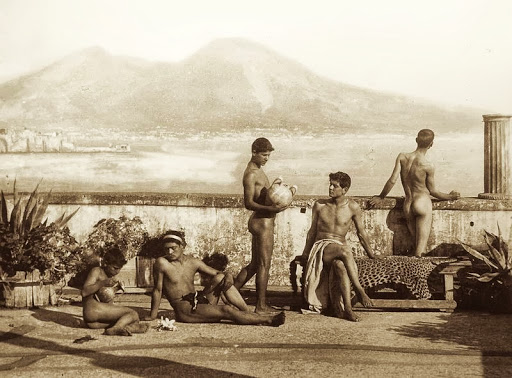
The photograph above of the five young men is by Wilhelm von Gloeden (1856-1931) and is known as Land of Fire. It is one of the most famous and republished images by Gloeden. It shows a view upon the Vesuvius from Naples from the terrace used by both Gloeden and by his cousin Wilhelm von Pluschow. The background Vesuvius was heavily retouched, almost repainted, on the glass negative. 

Baron Wilhelm von Gloeden (September 16, 1856 – February 16, 1931) was a German photographer who worked mainly in Italy. He is mostly known for his pastoral nude studies of Sicilian boys, which usually featured props such as wreaths or amphoras suggesting a setting in the Greece or Italy of antiquity. From a modern standpoint, his work is commendable due to his controlled use of lighting as well as the often elegant poses of his models. Innovative use of photographic filters and special body makeup (a mixture of milk, olive oil, and glycerin) to disguise skin blemishes contribute to the artistic perfection of his works.


Moment of Zen: Just Because


Exam Time

I was working late into the night last night making out exams and study materials for my students.  Semester exams are next week and today and Monday are review days.  These are always busy days trying to help the students prepare for their exams.  Other than that, there is not much to write.  Students never realize the amount of work teachers put into preparing their education.  If they did, maybe they would study harder.  Nah, probably not.