Category Archives: Uncategorized

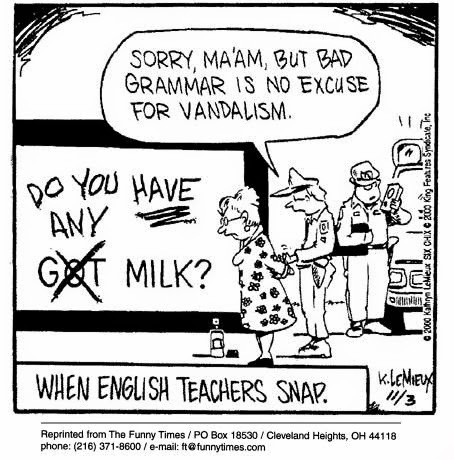
Proper Grammar

On his 77th birthday, a man received a gift certificate from his wife.  The certificate paid for a visit to a medicine man living on a nearby reservation who was rumored to have a wonderful cure for erectile dysfunction. After being persuaded by his wife, he drove to the reservation, handed his ticket to the medicine man and wondered what would happen next. 

The medicine man slowly, methodically produced a potion, handed it to the 77 year-old, and with a grip on his shoulder, warned, “This is powerful medicine and it must be respected. You must take only a teaspoonful and then say ‘1-2-3.’ When you do that, you will become more manly than you have ever been in your life, and you can perform as long as you want.”

The old man was encouraged. As he walked away, he turned and asked, “How do I stop the medicine from working?”  

“Your partner must say ‘1-2-3-4,'” he responded. “But when she does, the medicine will not work again until the next full moon.”

The old man was very eager to see if it worked so he went home, showered, shaved, took a spoonful of the medicine, and then invited his wife to join me in the bedroom. When she came in, he took off all his clothes and said, “1-2-3!”

Immediately, he was the manliest of men. His wife was excited and began throwing off her clothes. And then she asked, “What was the 1-2-3 for?”

And that, boys and girls, is why we should never end our sentences with a preposition! One could end up with a dangling participle!


The Great Gatsby

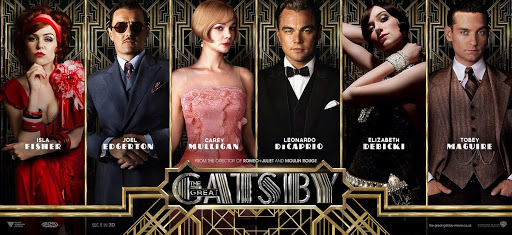
The kids at my school have gone gaga over the movie “The Great Gatsby.”  I have not seen it yet, and I probably won’t until it comes out on DVD.  (The next movie I will go see is the new Star Trek movie “Into Darkness.”). Have any of you seen “Gatsby”?  I’m glad to see the kids excited about The Great Gatsby; many of them are even looking forward to reading the book.  Personally, The Great Gatsby is not my favorite Fitzgerald book.  I prefer This Side of Paradise and Tender Is the Night, but The Great Gatsbyis a classic.
With all of the excitement over the movie, I have had several of the kids in my Drama Club show an interest in doing the play The Great Gatsby.  However, it has a large cast and a large number of male parts.  I have mostly girls in my Drama Club, and they are never keen on playing male parts.  However, I would love to do a 1920s era play that would have a small cast of 8-12 and have mostly women, but I haven’t been able to find or think of anything that fits that description.  So, since I know some of you have experience in theater, I would love to know if any of you have a suggestion or two.  If you know of anything, please let me know.

Not by Sophie Cabot Black

Not
by Sophie Cabot Black

that you are unloved
but that you love
and must decide which
to remember; tracks left 
in the field, a language
of going away or coming back–
and to look up
from the single mind,  
to let untangle 
the far-off snow
from sky
until no longer
held as proof
is also where birds
find agreement
strung along branches
each with their own song
for the other,
every note used
to sing anyway–
how to hold the already
as the not yet 

About This Poem

“This was written for a friend who kept asking me if anyone would ever love her. Always that question, and what is there to say except to endure enough to see what happens. Maybe even to be brave enough to start first, to love without expectation, even hope.”

–Sophie Cabot Black

Sophie Cabot Black is the author of three books of poetry. Her most recent is The Exchange: Poems (Graywolf Press, 2013). She divides her time between New York City and rural Connecticut.


Mother’s Day

flw 604743_slonecznikowe-pole

The Virtues of a Woman/Mother 

An excellent wife who can find? She is far more precious than jewels.  

The heart of her husband trusts in her, and he will have no lack of gain.  

She does him good, and not harm, all the days of her life. 

She seeks wool and flax, and works with willing hands.  

She is like the ships of the merchant; she brings her food from afar.  

She rises while it is yet night and provides food for her household and portions for her maidens.  

She considers a field and buys it; with the fruit of her hands she plants a vineyard.  

She dresses herself with strength and makes her arms strong.  

She perceives that her merchandise is profitable. Her lamp does not go out at night.  

She puts her hands to the distaff, and her hands hold the spindle.  

She opens her hand to the poor and reaches out her hands to the needy.  

She is not afraid of snow for her household, for all her household are clothed in scarlet.  

She makes bed coverings for herself; her clothing is fine linen and purple.  

Her husband is known in the gates when he sits among the elders of the land.  

She makes linen garments and sells them; she delivers sashes to the merchant.  

Strength and dignity are her clothing, and she laughs at the time to come.  

She opens her mouth with wisdom, and the teaching of kindness is on her tongue.  

She looks well to the ways of her household and does not eat the bread of idleness.  

Her children rise up and call her blessed; her husband also, and he praises her:  

“Many women have done excellently, but you surpass them all.”  

Charm is deceitful, and beauty is vain, but a woman who fears the LORD is to be praised.  

Give her of the fruit of her hands, and let her works praise her in the gates.  

Proverbs 31: 10-31

I hope that we all think of our mothers today. I love my mama, but like all mothers, she drives me crazy sometimes. She has been in a long period of depression since she found out I was gay, but that was relieved somewhat by the birth of my niece, so she now has the grand-baby she always wanted. She is still convinced I am going to hell, but she doesn’t say it as much anymore. As long as it is a “don’t ask, don’t tell, don’t discuss” situation, we get along great.

So even if your mother drives you crazy, I hope that you still have a good relationship with her and tell her how much you love her today.

I love you, Mama.

(She would surely die if she ever saw this blog, but I did choose a picture of sunflowers because they are her favorite.)


Moment of Zen: His Smile


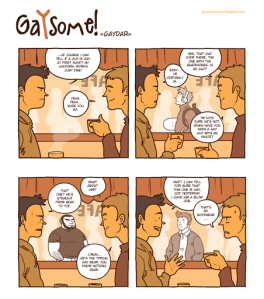
Gaysome: Gaydar

For more, visit GAYSOMECOMIC!

Doctor Dumbass

When I think of my profession, first and foremost, I am an historian.  I’m also a teacher, who wants to share his knowledge of history.  Currently, I teach high school, mainly because college jobs are hard to find.  I honestly don’t think that once I complete my PhD that the job market will be much better for history professors, which is why a news article I read yesterday pisses me off so much.  Harvard history professor Niall Ferguson recently made what I consider some idiotic remarks.  At a May 2013 investment conference in Carlsbad, California, Ferguson was asked about his views on economist John Maynard Keynes‘s quotation that “in the long run we are all dead.” Ferguson implied that Keynes was indifferent to the future because he was gay and did not have children.

Ferguson did post an apology for these statements shortly after reports of his comments were published, saying his comments were “as stupid as they were insensitive”.  In the apology, Ferguson stated: “My disagreements with Keynes’s economic philosophy have never had anything to do with his sexual orientation. It is simply false to suggest, as I did, that his approach to economic policy was inspired by any aspect of his personal life.”  However, how seriously can we take Ferguson’s apology.  If you read his full apology “An Open Letter to the Harvard Community” in the Harvard Crimson, you will see that he does not back down from saying that Keynes’s homosexuality influenced his decision making, he just gives it a different twist this time.  His apology sounds much more like when someone says, “Yeah, I was told to apologize, and though I should not have said it and I am ‘sorry,’ I was still right.”

Bruce Bartlett,  an American historian whose area of expertise is supply-side economics and served as a domestic policy adviser to President Ronald Reagan and as a Treasury official under President George H. W. Bushargued that right wing critics of Keynes have long used his homosexuality to “defame him and discredit his theories” and that Ferguson was simply the latest.  Paul Harris, writing in The Guardian, suggested that Ferguson had borrowed his controversial view of Keynes from similar opinions expressed by historian Gertrude Himmelfarb and economist Joseph Schumpeter. Several commentators pointed out that the views Ferguson expressed on Keynes and his sexuality at the conference can be found in previous lectures and published work by Ferguson himself.  Bartlett, among others has argued that Ferguson misunderstands Keynes’ view that one cannot simply ignore the short term in the interest of the long term.

I probably should backtrack a bit here for those not familiar with John Maynard Keynes.  Keynes was a British economist whose ideas have fundamentally affected the theory and practice of modern macroeconomics, and informed the economic policies of governments. Keynes is most famous for Keynesian economics, which bears his name.  Keynesian economics is aeconomic theory stating that active government intervention in the marketplace and monetary policy is the best method of ensuring economic growth and stability.  Supporters of Keynesian economics believe it is the government’s job to smooth out bumps in business cycles.

As for Keynes’s personal life, his early romantic and sexual relationships were almost exclusively with men. At Eton and at Cambridge, Keynes had been in many homosexual relationships; significant among these early partners were Dilly Knox and Daniel Macmillan. Keynes was open about his homosexual affairs, and between 1901 to 1915, kept separate diaries in which he tabulated his many sexual encounters. Keynes’s relationship and later close friendship with Macmillan was to be fortuitous; through Dan, Macmillan & Co first published his Economic Consequences of the Peace. Attitudes in the Bloomsbury Group, in which Keynes was avidly involved, were relaxed about homosexuality. Keynes, together with writer Lytton Strachey, had reshaped the Victorian attitudes of the influential Cambridge Apostles; “since [their] time, homosexual relations among the members were for a time common”, wrote Bertrand Russell. One of Keynes’s greatest loves was the artist Duncan Grant, whom he met in 1908. Like Grant, Keynes was also involved with Lytton Strachey, though they were for the most part love rivals, and not lovers. Keynes had won the affections of Arthur Hobhouse, as well as Grant, both times falling out with a jealous Strachey for it. Strachey had previously found himself put off by Keynes, not least because of his manner of “treat[ing] his love affairs statistically.”
Ray Costelloe (who would later marry Oliver Strachey) was an early heterosexual interest of Keynes. Of this infatuation, Keynes had written “I seem to have fallen in love with Ray a little bit, but as she isn’t male I haven’t [been] able to think of any suitable steps to take.”
In 1921, Keynes fell “very much in love” with Lydia Lopokova, a well-known Russian ballerina, and one of the stars of Sergei Diaghilev’s Ballets Russes. For the first years of the courtship, Keynes maintained an affair with a younger man, Sebastian Sprott, in tandem with Lopokova, but eventually chose Lopokova exclusively. They married in 1925. The union was happy, with biographer Peter Clarke writing that the marriage gave Keynes “a new focus, a new emotional stability and a sheer delight of which he never wearied.” Lydia became pregnant in 1927 but miscarried.  Ferguson at least had the good graces to acknowledge this fact in his “apology.”
Back to Ferguson, it is abhorrent to me that Harvard University, one of America’s most prestigious centers of learning, would employ someone such as Ferguson.  However, Harvard is know for employing controversial historians, which in my opinion, Harvard should be ashamed of itself.  Niall Ferguson is the worst kind of historian, one who is politically bent and has no sense of objectivity.  It makes him one-sided and therefore not creditable.  So as Leslie Winkle referred to Sheldon Cooper on The Big Bang Theory, so will I refer to Niall Ferguson as “Doctor Dumbass.”

Team Blake


I’m not much for reality TV, or the different contest shows, but every now and then I really get into one of these shows.  This year it is The Voice on NBC.  With Shakira and Usher replacing Christina Aguilera and Cee Lo Green, season four couldn’t be better.  I’m also fully behind Team Blake, who has chosen some tremendous talent this year.  If you aren’t a fan of The Voice, and you love great country music (I’m not a huge country music fan, but I love a great country song.  There is some other music as well besides country.), then you should be watching The Voice.  Coach Blake Shelton has chosen all country singers this year, and in my opinion, he should be blowing all of the rest of the competition out of the water. All of the judges have talented team members, but to me, none compare
 to Blake’s.  So, I will introduce them to you.


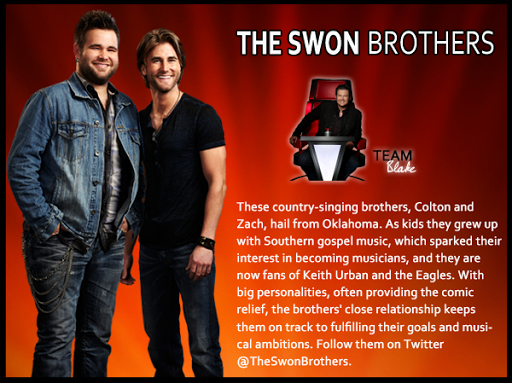
MY FAVORITE:  The Swon Brothers


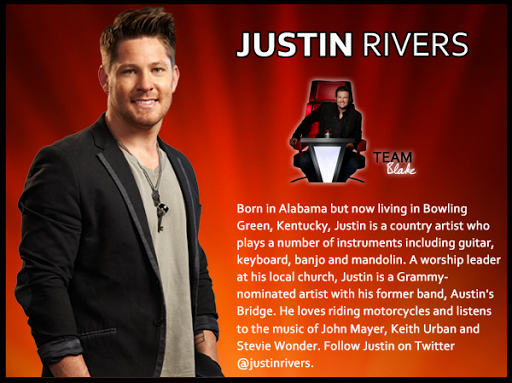
THE ALABAMA BOY:  Justin Rivers


SWEET SIXTEEN:  Danielle Bradbury


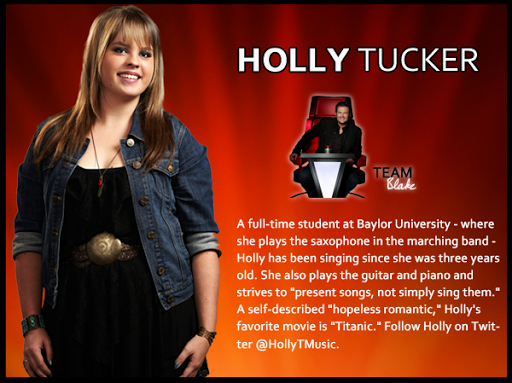
THE KNOCKOUT:  Holly Tucker


I don’t want to see any of Team Blake go, but one will be eliminated on tonight’s show.  If I were to chose the one to go in this knockout round, it would have to be Holly Tucker.  Colton and Zach to me are the strongest as The Swon Brothers.  They have the energy and the talent, and as Shakira said last night, “There music is comforting.”  As a fellow Alabamian, I have to also pull for Justin.  He’s cute and has a star quality about him that can’t be denied.  Danielle is going to be the darling of this competition.  At only sixteen, she has a big voice, one that will take her far.  Holly though just did not stand out that much for me.  Blake chose great songs for his team and I wish them all the best tonight.
UPDATE:  I can’t believe that America voted Holly Tucker as their favorite from Team Blake.  Their second favorite was Danielle, leaving Blake to have to chose between Justin Rivers and The Swon Brothers. Blake chose The Swon Brothers. I hated to see Justin go.

Queer by Frank Bidart

Queer
by Frank Bidart

Lie to yourself about this and you will
forever lie about everything.

Everybody already knows everything

so you can
lie to them. That’s what they want.

But lie to yourself, what you will

lose is yourself. Then you
turn into them.

                 *

For each gay kid whose adolescence

was America in the forties or fifties
the primary, the crucial

scenario

forever is coming out—
or not. Or not. Or not. Or not. Or not.

                 *

Involuted velleities of self-erasure.

                 *

Quickly after my parents
died, I came out. Foundational narrative

designed to confer existence.

If I had managed to come out to my
mother, she would have blamed not

me, but herself.

The door through which you were shoved out
into the light

was self-loathing and terror.

                 *

Thank you, terror!

You learned early that adults’ genteel
fantasies about human life

were not, for you, life.  You think sex

is a knife
driven into you to teach you that.

Frank Bidart

Frank Bidart was born in Bakersfield, California, in 1939 and educated at the University of California at Riverside and at Harvard University, where he was a student and friend of Robert Lowell and Elizabeth Bishop.

His first volume of poetry, Golden State (1973), was selected by poetRichard Howard for the Braziller Poetry series, but it wasn’t until the publication of The Sacrifice (1983) that Bidart’s poetry began to attract a wider readership. Bidart’s early books are collected in In the Western Night: Collected Poems 1965-90 (1990).

His recent volumes include Star Dust (Farrar, Straus and Giroux, 2005),Music Like Dirt (2002), and Desire (1997), which was nominated for a Pulitzer Prize, and was a finalist for both the National Book Award and the National Book Critic’s Circle Award. He is also the co-editor of Robert Lowell’s Collected Poems (2003).

About his work, the former U.S. Poet Laureate Louise Glück has said, “More fiercely, more obsessively, more profoundly than any poet sinceBerryman (whom he in no way resembles) Bidart explores individual guilt, the insoluble dilemma.” And about his career as a poet, she said, “Since the publication, in 1973, of Golden State, Frank Bidart has patiently amassed as profound and original a body of work as any now being written in this country.”

His honors include the Wallace Stevens Award, the Lila Wallace-Reader’s Digest Foundation Writer’s Award, the Morton Dauwen Zabel Award given by the American Academy of Arts and Letters, the Shelley Award of the Poetry Society of America, and The Paris Review‘s first Bernard F. Conners Prize for “The War of Vaslav Nijinsky” in 1981. In 2007, he received the Bollingen Prize in American Poetry.

Bidart was elected a Chancellor of the Academy of American Poets in 2003. He lives in Cambridge, Massachusetts, where he has taught at Wellesley College since 1972.


Gay and Southern

One of my readers, blog buddies, and a dear friend, Jay, sent me a link to an article about the realities of coming out in the South, and I wanted to share it with my readers. (Coming Out in the South” by Damon M. Banks) My experience with coming out were much like those of the author of this piece.  Before the ready access of the Internet, there were no sources of information to find.  Yes, you might could find a book at the local library, but who wanted the librarian, who you either knew or your family did, to know you were checking out that kind of book.  I remember when the book Midnight in the Garden of Good and Evil came out and I wanted to read it, so I checked it out of the library.  When I began to read it and realized the number of gay characters in it, I was afraid of what someone might think of me reading it, so I immediately took it back.  It was a few years before I had the courage to go back and read it.


Nowadays, if a kid wanted to read a book, they can just download it on one of their many electronic devices.  If they have a question about homosexuality, they can Google it on their smartphone or any other Internet connected device.  They can also use the Internet to connect with a wide range of people with similar interests  on the many social networking sites.  The Internet is a wonderful tool to help someone reach out and discover who they are.
As the author of the piece above pondered, what would my life have been like if I had the technology kids have today?  Would I been brave enough to come out earlier?  Or would I have understood my sexuality earlier and been able to come to terms with it sooner?  Being Christian, gay, and a Southerner, is not the easiest qualities to come to terms with, but I and many others have. 
What was your reaction to the article linked above?  For those of you in the South, is it a pretty accurate description of your coming out?