Category Archives: Uncategorized

Victory!

Four years ago…Hell, even a year ago, I would never have been happy for Obama to win a second term. However, he has largely followed through for LGBT Americans. I hope he will continue to fight for us.  Maryland and Maine have approved gay marriage, Minnesota has defeated a gay marriage ban, and Washington state is still too close to call.  Overall, I think it was a good day for LGBT Americans.

However, Alabama voters failed once again.  The right wing Christian nutcase Roy Moore won Chief Justice of the Alabama Supreme Court (he had been removed from that office once before for violating a federal court order), and the always idiotic Twinkle Cavanaugh defeated the last Democrat to hold statewide office in Alabama to become President of the Public Service Commission.  Also, the people of Alabama defeated a measure to desegregate Alabama school (thankfully, the US Supreme Court did that for us forty years ago.)


America Singing

I Hear America Singing
 by Walt Whitman
I hear America singing, the varied carols I hear,
Those of mechanics, each one singing his as it should be blithe and strong,
The carpenter singing his as he measures his plank or beam,
The mason singing his as he makes ready for work, or leaves off work,
The boatman singing what belongs to him in his boat, the deckhand
     singing on the steamboat deck,
The shoemaker singing as he sits on his bench, the hatter singing as he stands,
The wood-cutter’s song, the ploughboy’s on his way in the morning, or
     at noon intermission or at sundown,
The delicious singing of the mother, or of the young wife at work, or of
     the girl sewing or washing,
Each singing what belongs to him or her and to none else,
The day what belongs to the day—at night the party of young fellows,
     robust, friendly,
Singing with open mouths their strong melodious songs.
  
I, Too, Sing America
 by Langston Hughes
I, too, sing America.
I am the darker brother.
They send me to eat in the kitchen
When company comes,
But I laugh,
And eat well,
And grow strong.
Tomorrow,
I’ll be at the table
When company comes.
Nobody’ll dare
Say to me,
“Eat in the kitchen,”
Then.
Besides,
They’ll see how beautiful I am
And be ashamed—
I, too, am America.

VOTE!!!

10 Reasons to Vote


1. So you can complain

If you love to complain in order to see changes, voting is for you. 

2. It’s your right

Others died for this privilege and now it’s your right. 

3. Representation

Who’s representing you? Find out and make sure your concerns are their concerns. 

4. It’s your duty

“Ask not what your country can do for you, ask what you can do for your country.” – John F. Kennedy. 

5. More federal money …

for higher education funding, youth programs, the environment, HIV/AIDS or breast cancer research, whatever your cause.

6. To cancel out someone’s vote

In disagreement with your parents or friends on certain issues? Cancel them out.

7. To bust the stereotype

Young adults between the ages of 18 and 25 are said to not care about the issues. Prove them wrong!

8. If you don’t, someone else will

Why would you want someone else deciding what’s best for you?

9. Every vote counts

Remember the 2000 Election controversy?

10. Make some noise!

Your opinions matter. It’s time to be heard.
If you have not voted early, please go vote tomorrow. It is our civic duty, and we cant afford to lose that right because we are too lazy to go vote.

Moment of Zen: Coffee

There may be some skipped posts in the next few coming days.  I am in the process of moving to a new house, and I have not been able to set up the Internet yet at the new house.

3 Reasons Life Actually Does Get Better

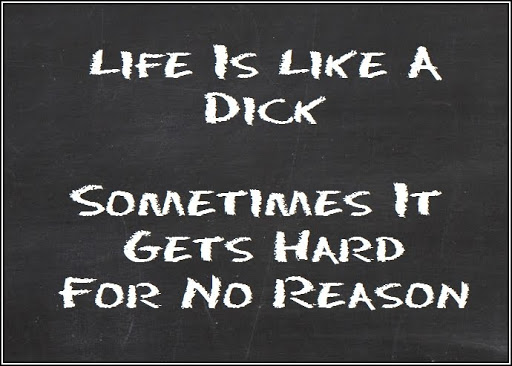
In the last year or so, you’ve no doubt heard “It gets better” used as a motto to encourage gay teens who’ve been the victims of bullying. Well, we all know that life gets hard at times, sometimes for no reason as the graphic above says. So here are five things to always keep on mind.

#3.  The Money Situation Will Improve (Even if it Doesn’t)

I’m not saying you’ll be rich someday. I’m saying it’s really not about money. It’s about freedom.  As a private school teacher who just barely gets by from paycheck to paycheck, it has to be about something more than money.

#2. You Will Find Someone
You have to relax. It turns out some lessons taught by romantic comedies aren’t full of crap. Concentrate on taking care of yourself first, because 90 percent of a relationship’s success is a matter of maturing into the type of person other people want to be around.
If you get more comfortable with yourself, you stop trying so hard, you get more relaxed and don’t feel like you have to work so hard to hide your true self. You don’t stop looking for someone, I don’t mean that; you just stop hating yourself so hard for not finding them. I know it sounds like a Catch-22, but it’s the lack of self-hatred that will make you attractive.

#1. The World isn’t as Bad as You Think

When you’re a kid, your parents shelter you from the worst of what’s really going on in the world. As you get older, your worldview changes and expands. You start to think outside of your own town and social circle. You’ll see a lot of bad news. Violence, government scandals, wars over seemingly petty bullshit. At some point (usually in your college years) you have gotten cynical. And at some later point, hopefully, you lose that cynicism.

Life gets better because you’re going to make it better. Because you’ll have the power and the freedom to make it better.


Día de los Muertos

More than 500 years ago, when the Spanish Conquistadors landed in what is now Mexico, they encountered natives practicing a ritual that seemed to mock death.  It was a ritual the indigenous people had been practicing at least 3,000 years. A ritual the Spaniards would try unsuccessfully to eradicate.  A ritual known today as Día de los Muertos, or Day of the Dead.  The ritual is celebrated in Mexico and certain parts of the United States, including the Valley.
Although the ritual has since been merged with Catholic theology, it still maintains the basic principles of the Aztec ritual, such as the use of skulls.  Today, people don wooden skull masks called calacas and dance in honor of their deceased relatives. The wooden skulls are also placed on altars that are dedicated to the dead. Sugar skulls, made with the names of the dead person on the forehead, are eaten by a relative or friend, according to Mary J. Adrade, who has written three books on the ritual.
The Aztecs and other Meso-American civilizations kept skulls as trophies and displayed them during the ritual. The skulls were used to symbolize death and rebirth.  The skulls were used to honor the dead, whom the Aztecs and other Meso-American civilizations believed came back to visit during the monthlong ritual.
Unlike the Spaniards, who viewed death as the end of life, the natives viewed it as the continuation of life. Instead of fearing death, they embraced it. To them, life was a dream and only in death did they become truly awake.
“The pre-Hispanic people honored duality as being dynamic,” said Christina Gonzalez, senior lecturer on Hispanic issues at Arizona State University. “They didn’t separate death from pain, wealth from poverty like they did in Western cultures.”  However, the Spaniards considered the ritual to be sacrilegious. They perceived the indigenous people to be barbaric and pagan.
In their attempts to convert them to Catholicism, the Spaniards tried to kill the ritual.  But like the old Aztec spirits, the ritual refused to die.  To make the ritual more Christian, the Spaniards moved it so it coincided with All Saints’ Day and All Souls’ Day (Nov. 1 and 2), which is when it is celebrated today.  Previously it fell on the ninth month of the Aztec Solar Calendar, approximately the beginning of August, and was celebrated for the entire month. Festivities were presided over by the goddess Mictecacihuatl. The goddess, known as “Lady of the Dead,” was believed to have died at birth, Andrade said.
Today, Day of the Dead is celebrated in Mexico and in certain parts of the United States and Central America.  “It’s celebrated different depending on where you go,” Gonzalez said.
In rural Mexico, people visit the cemetery where their loved ones are buried. They decorate gravesites with marigold flowers and candles. They bring toys for dead children and bottles of tequila to adults. They sit on picnic blankets next to gravesites and eat the favorite food of their loved ones.
In Guadalupe, the ritual is celebrated much like it is in rural Mexico.  “Here the people spend the day in the cemetery,” said Esther Cota, the parish secretary at the Our Lady of Guadalupe Church. “The graves are decorated real pretty by the people.”
In the United States and in Mexico’s larger cities, families build altars in their homes, dedicating them to the dead. They surround these altars with flowers, food and pictures of the deceased. They light candles and place them next to the altar.

Sent from my iPad


Happy Halloween

The Fantasy and Folklore of All Hallows

By Jack Santino

Halloween had its beginnings in an ancient, pre-Christian Celtic festival of the dead. The Celtic peoples, who were once found all over Europe, divided the year by four major holidays. According to their calendar, the year began on a day corresponding to November 1st on our present calendar. The date marked the beginning of winter. Since they were pastoral people, it was a time when cattle and sheep had to be moved to closer pastures and all livestock had to be secured for the winter months. Crops were harvested and stored. The date marked both an ending and a beginning in an eternal cycle.
The festival observed at this time was called Samhain (pronounced Sah-ween). It was the biggest and most significant holiday of the Celtic year. The Celts believed that at the time of Samhain, more so than any other time of the year, the ghosts of the dead were able to mingle with the living, because at Samhain the souls of those who had died during the year traveled into the otherworld. People gathered to sacrifice animals, fruits, and vegetables. They also lit bonfires in honor of the dead, to aid them on their journey, and to keep them away from the living. On that day all manner of beings were abroad: ghosts, fairies, and demons–all part of the dark and dread.
Samhain became the Halloween we are familiar with when Christian missionaries attempted to change the religious practices of the Celtic people. In the early centuries of the first millennium A.D., before missionaries such as St. Patrick and St. Columcille converted them to Christianity, the Celts practiced an elaborate religion through their priestly caste, the Druids, who were priests, poets, scientists and scholars all at once. As religious leaders, ritual specialists, and bearers of learning, the Druids were not unlike the very missionaries and monks who were to Christianize their people and brand them evil devil worshippers.
As a result of their efforts to wipe out “pagan” holidays, such as Samhain, the Christians succeeded in effecting major transformations in it. In 601 A.D. Pope Gregory the First issued a now famous edict to his missionaries concerning the native beliefs and customs of the peoples he hoped to convert. Rather than try to obliterate native peoples’ customs and beliefs, the pope instructed his missionaries to use them: if a group of people worshipped a tree, rather than cut it down, he advised them to consecrate it to Christ and allow its continued worship.
In terms of spreading Christianity, this was a brilliant concept and it became a basic approach used in Catholic missionary work. Church holy days were purposely set to coincide with native holy days. Christmas, for instance, was assigned the arbitrary date of December 25th because it corresponded with the mid-winter celebration of many peoples. Likewise, St. John’s Day was set on the summer solstice.
Samhain, with its emphasis on the supernatural, was decidedly pagan. While missionaries identified their holy days with those observed by the Celts, they branded the earlier religion’s supernatural deities as evil, and associated them with the devil. As representatives of the rival religion, Druids were considered evil worshippers of devilish or demonic gods and spirits. The Celtic underworld inevitably became identified with the Christian Hell.
The effects of this policy were to diminish but not totally eradicate the beliefs in the traditional gods. Celtic belief in supernatural creatures persisted, while the church made deliberate attempts to define them as being not merely dangerous, but malicious. Followers of the old religion went into hiding and were branded as witches.
The Christian feast of All Saints was assigned to November 1st. The day honored every Christian saint, especially those that did not otherwise have a special day devoted to them. This feast day was meant to substitute for Samhain, to draw the devotion of the Celtic peoples, and, finally, to replace it forever. That did not happen, but the traditional Celtic deities diminished in status, becoming fairies or leprechauns of more recent traditions.
The old beliefs associated with Samhain never died out entirely. The powerful symbolism of the traveling dead was too strong, and perhaps too basic to the human psyche, to be satisfied with the new, more abstract Catholic feast honoring saints. Recognizing that something that would subsume the original energy of Samhain was necessary, the church tried again to supplant it with a Christian feast day in the 9th century. This time it established November 2nd as All Souls Day–a day when the living prayed for the souls of all the dead. But, once again, the practice of retaining traditional customs while attempting to redefine them had a sustaining effect: the traditional beliefs and customs lived on, in new guises.
All Saints Day, otherwise known as All Hallows (hallowed means sanctified or holy), continued the ancient Celtic traditions. The evening prior to the day was the time of the most intense activity, both human and supernatural. People continued to celebrate All Hallows Eve as a time of the wandering dead, but the supernatural beings were now thought to be evil. The folk continued to propitiate those spirits (and their masked impersonators) by setting out gifts of food and drink. Subsequently, All Hallows Eve became Hallow Evening, which became Hallowe’en–an ancient Celtic, pre-Christian New Year’s Day in contemporary dress.
Many supernatural creatures became associated with All Hallows. In Ireland fairies were numbered among the legendary creatures who roamed on Halloween. An old folk ballad called “Allison Gross” tells the story of how the fairy queen saved a man from a witch’s spell on Halloween.
O Allison Gross, that lives in yon tower
the ugliest witch int he North Country…
She’s turned me into an ugly worm
and gard me toddle around a tree…

But as it fell out last Hallow even
When the seely [fairy] court was riding by,
the Queen lighted down on a gowany bank
Not far from the tree where I wont to lie…
She’s change me again to my own proper shape
And I no more toddle about the tree.

In old England cakes were made for the wandering souls, and people went “a’ soulin'” for these “soul cakes.” Halloween, a time of magic, also became a day of divination, with a host of magical beliefs: for instance, if persons hold a mirror on Halloween and walk backwards down the stairs to the basement, the face that appears in the mirror will be their next lover.
Virtually all present Halloween traditions can be traced to the ancient Celtic day of the dead. Halloween is a holiday of many mysterious customs, but each one has a history, or at least a story behind it. The wearing of costumes, for instance, and roaming from door to door demanding treats can be traced to the Celtic period and the first few centuries of the Christian era, when it was thought that the souls of the dead were out and around, along with fairies, witches, and demons. Offerings of food and drink were left out to placate them. As the centuries wore on, people began dressing like these dreadful creatures, performing antics in exchange for food and drink. This practice is called mumming, from which the practice of trick-or-treating evolved. To this day, witches, ghosts, and skeleton figures of the dead are among the favorite disguises. Halloween also retains some features that harken back to the original harvest holiday of Samhain, such as the customs of bobbing for apples and carving vegetables, as well as the fruits, nuts, and spices cider associated with the day.
Today Halloween is becoming once again and adult holiday or masquerade, like mardi Gras. Men and women in every disguise imaginable are taking to the streets of big American cities and parading past grinningly carved, candlelit jack o’lanterns, re- enacting customs with a lengthy pedigree. Their masked antics challenge, mock, tease, and appease the dread forces of the night, of the soul, and of the otherworld that becomes our world on this night of reversible possibilities, inverted roles, and transcendency. In so doing, they are reaffirming death and its place as a part of life in an exhilarating celebration of a holy and magic evening.

Mr. Macklin’s Jack O’Lantern

Mr. Macklin’s Jack O’Lantern
by David McCord

Mr. Macklin takes his knife 
And carves the yellow pumpkin face: 
Three holes bring eyes and nose to life, 
The mouth has thirteen teeth in place. 
Then Mr. Macklin just for fun 
Transfers the corn-cob pipe from his 
Wry mouth to Jack’s, and everyone 
Dies laughing! O what fun it is 
Till Mr. Macklin draws the shade 
And lights the candle in Jack’s skull. 
Then all the inside dark is made 
As spooky and as horrorful 
As Halloween, and creepy crawl 
The shadows on the tool-house floor, 
With Jack’s face dancing on the wall. 
O Mr. Macklin! where’s the door?
Another quick Halloween poem by McCord:

On Halloween, what bothers some

About these witches is, how come

In sailing through the air like bats
They never seem to lose their hats?


How fun are these poems!  David McCord (1897-1997) was a renowned author of children’s poetry and also wrote adult poetry and prose.  McCord, who was born in New York City in 1897, lived for a while in Princeton, N.J. At 12, he moved with his family to Oregon, where he lived on an uncle’s farm on the edge of a wilderness. It was there, he later wrote, that he learned, ”Poetry is rhythm, just as the planet Earth is rhythm; the best writing, poetry or prose — no matter what the message it conveys — depends on a very sure and subtle rhythm.”

McCord graduated from Harvard with a bachelor of arts in 1921 and received a master’s in chemistry in 1922. He became an editor of the Harvard Alumni Bulletin the next year, and from 1925 until his retirement in 1963 was the executive director of the Harvard Fund Council. In 1956, Harvard awarded him its first honorary degree of Doctor of Humane Letters.

He wrote or edited more than 40 books of poetry and prose. Among them were ”One at a Time,” a collection of his children’s verse published in 1978 by Little, Brown; ”On Occasion,” a collection of his occasional verse published in 1943 by Harvard University Press; ”About Boston,” a collection of essays about the city first published in 1948 by Doubleday and reprinted in 1964 by Little, Brown, and ”What Cheer,” an anthology of British and American humorous and witty verse published by Coward-McCann in 1945 and reprinted in 1946 as ”The Pocket Book of Humorous Verse.”

A Guide To How To Survive The Last Week Of The Presidential Election With Conservatives Around


Here is a list of ten ways to survive the last week of the election with conservatives.  Seven of these came from the Huffington Post (an article on how to deal with conservative family members) while three of them are mine.  I’ve also added some further comments on the tips.  Besides dealing with family members I also have conservative friends and co-workers and I work at a very conservative school.  When we did a pre-presidential election last spring, only one student voted for Obama.  It can be quite,difficult since I have to teach government, and all of the students want to know how I will vote.  So far I have told them that I will vote for Dr. Jill Stein, the Green Party candidate, or Gary Johnson, the Libertarian Party candidate.  I tell them that it doesn’t matter how I vote since Romney will win in Alabama, but I refuse to vote for Romney.  I’m pretty sure I will either vote for Johnson or Obama, I will know when I get to the polls.

So here are some tips to survive those conservatives.

Tip 1: Set boundaries. Just refuse to talk politics with them.  They know you disagree with them, so just let each other disagree and refuse to discuss the topic.

Tip 2: Change the subject. “How about this weather?”  I do this one a lot when an uncomfortable subject comes about.  Just move on to something else, and the rest will generally follow.

Tip 3: Just keep eating.  I don’t have a hard time continuing to eat, but sometimes I do have a hard time keeping my mouth shut about politics.  However, my Mama always taught me not to talk with my mouth full, so this is a polite way to just keep out of the topic of politics.

Tip 4: Remind them that they once had to fight for acceptance, too.  This is one of the Huffington Post’s suggestions.  It doesn’t work too well if you are from a white family in the South.  They have always felt accepted.  However, for some this might be an option.

Tip 5: Take it as an opportunity for a good laugh.  Make a joke out of it. It’s according to who you are having a conversation with and what type of sense of humor they have, but you know who you can joke with and who you can’t.  It is easy to joke at the ridiculousness of either party, so you can actually have a little fun with it and not get too serious, but you might also get your point across at the same time.

Tip 6: Pretend it’s the holidays and just drink.  When it’s hard to deal with some folks, especially at a social gathering where it is acceptable, just have a few drinks, pour you a stiff one, have a few beers.  The party will get going and the topic of politics will go out the window.  It is Halloween this week after all.

Tip 7:  Argue with them.  Yes, I said it. You can do it civilly or not, but sometimes it is just to hard to keep your mouth shut.  S let them have and let the chips fall where they may when the dust settles.

Tip 8:  Remind them that Romney is a Mormon. If they are a Christian conservative, remind them of all the things they have always thought of Mormons.  Keep as a back-up too that Obama attends the same church that George W. Bush attended as president.

Tip 9: Embrace this opportunity to cut off those family members you never liked in the first place.  This is another one of the Huffington Post’s suggestions, but not one that I particularly agree with, unless it is a family member or acquaintance that you really don’t like.

And finally, for those you do like…

Tip 10: Just remember that no matter what happens, they are still your family and you love them. If all else fails, just give them some Halloween candy to shut them up.  Women like chocolate and give a man something very chewy, so it will keep him quiet a while.

So do you guys have any suggestions?

Moment of Zen: WORK

CDC Medical Alert


The CDC has issued a medical alert about a highly contagious, potentially dangerous virus that is transmitted orally, by hand, and even electronically.

This virus is called Weekly Overload Recreational Killer (WORK).

If you receive WORK from your boss, any of your colleagues or anyone else via any means whatsoever – DO NOT TOUCH IT!!! This virus will wipe out your private life entirely. If you should come into contact with WORK you should immediately leave the premises.


Take two good friends to the nearest liquor store and purchase one or both of the antidotes – Work Isolating Neutralizer Extract (WINE) and Bothersome Employer Elimination Rebooter (BEER). Take the antidote repeatedly until WORK has been completely eliminated from your system.


You should immediately forward this medical alert to five friends. If you do not have five friends, you have already been infected and WORK is, sadly, controlling your life.