Moment of Zen: Comfy Couch

Who doesn’t love a comfortable couch?









I have a lot of pics of guys on couches, and I couldn’t just choose nine pics like I normally do. I whittled them down to twenty. The other ten can be seen if you click “Continue reading.” I think there are a few some of y’all will really like.
Continue reading
Friday Blues

It’s Friday morning. Isabella started trying to wake me at 4:30 am, but I held her off until 5 am. Instead of bounding out of bed with the usual determination, I found myself wanting to hit snooze, or at least going back to bed after feeding Isabella, but I know I can’t. Isabella is not a patient cat, few cats are, and I have to get ready for work. Fridays have a funny way of testing my work ethic, whether it’s when I’m working from home and know I can work at my own pace, even taking a nap if I want, or having to go to the museum for work like today. I’m very ready for the weekend, but there’s still a to-do list staring back at me. I have next week’s class to prepare for, a class to teach for another professor this afternoon, and a physical therapy appointment this afternoon. So, I’ll hop in the shower, get dressed and head out the door. I just don’t want to do so. At least, the weekend is very near.
I hope everyone has a wonderful weekend! We just need to get through Friday first.

Broadening the Mind

“Travel is fatal to prejudice, bigotry, and narrow-mindedness, and many of our people need it sorely on these accounts. Broad, wholesome, charitable views of men and things cannot be acquired by vegetating in one little corner of the earth all one’s lifetime.”
—Mark Twain
The above quote by Mark Twain emphasizes the transformative power of travel in broadening one’s perspective and combating ignorance, prejudice, and narrow-mindedness. Travel exposes people to different cultures, customs, and ways of thinking, which challenges preconceived notions, stereotypes, and biases. It fosters empathy and understanding by showing the diversity and complexity of human experiences.
Twain acknowledges that many individuals remain confined to their limited worldviews because they have not had the opportunity—or the inclination—to step outside their familiar surroundings. He suggests that travel could help these individuals overcome their prejudices. By encountering different perspectives and lifestyles, travelers develop a more inclusive, kind, and generous attitude toward others. This openness leads to a deeper appreciation of humanity’s shared values and differences.
Remaining in a single place or within a single worldview limits personal growth and understanding. Twain suggests that staying in a “bubble” leads to stagnation, whereas exploration brings enlightenment and growth. In essence, Twain is advocating for travel as a means to expand one’s mind, challenge ignorance, and promote a more compassionate and inclusive outlook on life.
I have not had much of a chance to travel recently because I am not counting going back to Alabama for the holidays or traveling to conferences for work. I would love to get away and spend a few days in Montreal or go on another gay retreat like the one I went to a few years ago at Easton Mountain. When the weather gets warmer, I would love to visit Ogunquit, Maine, or Provincetown, Massachusetts, both towns known for LGBTQ+ tourists, with numerous LGBTQ+-owned and -operated hotels, restaurants, and bars. I haven’t taken a gay themed vacation in a while and would love for the chance to do so. Of course, I wish I could take a trip to Europe, but I definitely can’t afford to cross the Atlantic, but a boy can dream.
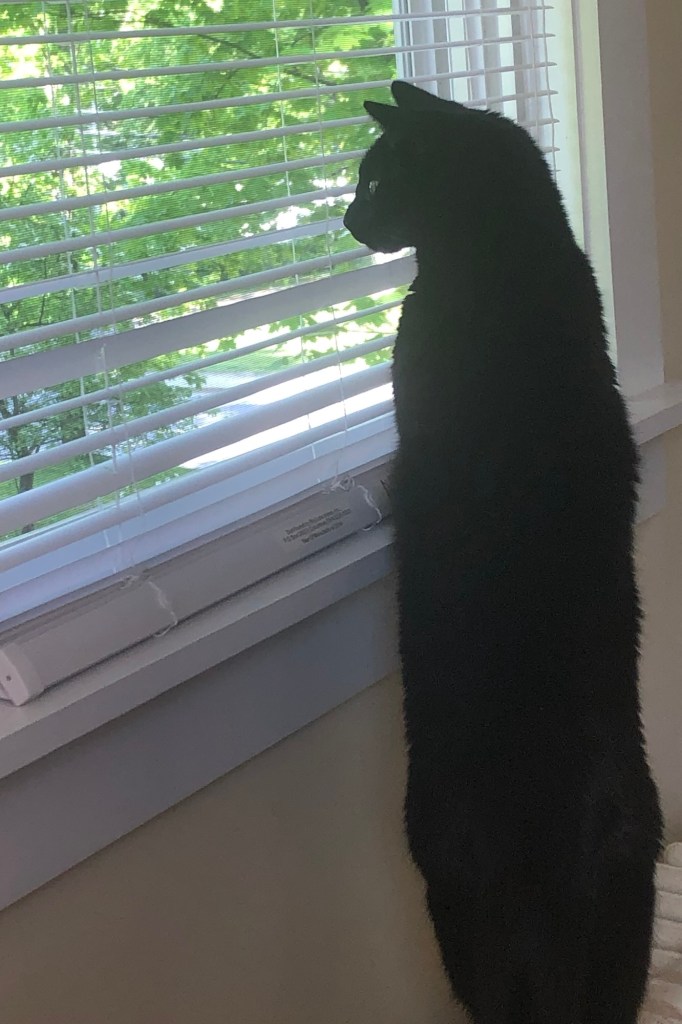
I have not posted an Isabella picture of the week in a couple of weeks, so here you go:

WFH Wednesday

I have an appointment on Friday, so I switched my work from home day to today. I like having the longer weekend at home, but I can focus most of my day on preparing for my class tomorrow. My class is a 75 minute class, and if I had given the full lecture I had planned, it would have been about a 90 minute lecture. I had to hurry through one part of it, but I had purposely put it at the end of the lecture so that I could skip it if necessary. Several of my students have remarked about how they are enjoying the class. They said they knew it would be an art history class, but they found it interesting that it was also a class about travel. I hope they continue to feel that way at the end of the semester. This class is a lot of extra work, but so far, I am enjoying it. I’m glad that I have today working from home so I can work on it without any interruptions. It also means that if I want to take a nap after lunch, I can.

Winter Night

Winter Night
By Amos Wilder
O magical the winter night! Illusory this stretch
Of unimaginable grays; so shadowy a sketch
Only the fading inks of spirit artistry can etch.
Here is nor dawn nor eventide nor any light we know,
This ghostly incandescence and unearthly afterglow,
This far-spread conflagration of the fields of snow
That pales the clouds, snow-laden, and blanches all the night,
As though in place of moon and stars some spectral satellite
Cast glamor on the earth and floods of violet light.
The wraith-like landscape glimmers, valley, lake and hill,
Unutterably patient! Intolerably still!
No inclination of a leaf nor songster’s trill.
. . . So could one stand an hour, a day, a century,
Breathless . . . What frozen silence! What immobility!
As of some gray unfinished world in age-long reverie.
O whither have you vanished, treading the leaves of fall,
Bright spirit of the summer, leaving the scene in thrall
To silence? To what springtime, far, far beyond recall?
What far retreat of being, what ebbing of the flood
Of life to bless far landscapes anew with leaf and bud
Has left prospect passionless and charmed this stricken wood?
. . . And yet from depths how distant, that tide of green shall rise,
And that bright spirit come again with April in her eyes,
And winter’s pale prostrations be but phantom memories.
About the Poem
Amos Niven Wilder’s poem “Winter Night” is a rich, contemplative work that explores themes of stillness, mystery, and spiritual reflection, set against the stark and serene backdrop of a winter evening. The poem is known for its vivid depiction of a winter night, characterized by silence, snow, and a sense of vastness. Wilder uses sensory imagery to immerse the reader in the scene—cold air, dim light, and the soft crunch of snow underfoot. This creates a sense of isolation but also serenity, as winter often brings an otherworldly stillness that encourages introspection. The winter landscape serves as both a physical setting and a metaphor for deeper themes. The snow and quiet symbolize purity, renewal, and a stripping away of distractions, creating a space for contemplation.
The quiet of the winter night invites the speaker—and by extension, the reader—to turn inward. The absence of noise emphasizes a spiritual stillness, offering a chance to pause and reflect on life, mortality, and eternity. The stillness may also suggest a kind of communion with the divine, as nature often serves as a conduit for spiritual experience in poetry. Wilder evokes a sense of mystery in the vastness and quiet of the winter scene. The infinite expanse of snow and sky points to something beyond human comprehension—a divine presence or the eternal unknown. Winter, in its starkness, often reminds us of life’s impermanence and the greater forces at work in the universe.
Winter can represent both hardship and resilience. The cold and darkness remind us of our vulnerability, yet the poem’s tone suggests that there is beauty and meaning to be found even in the harshest conditions. Snow often symbolizes purity and renewal, but also the covering or concealment of things beneath. Snow transforms the familiar into something otherworldly, encouraging a new perspective. Night represents mystery, introspection, and the unknown. The darkness of night contrasts with the brightness of the snow, suggesting the coexistence of clarity and obscurity in human understanding.
Amos Wilder, a theologian and poet, often infused his works with spiritual depth. In “Winter Night,” the interplay of natural imagery and introspection reflects a search for divine meaning in the physical world. The stillness and silence of the scene may symbolize a sacred space where God’s presence can be felt in the quiet of creation. “Winter Night” by Amos Wilder is a profound meditation on nature, spirituality, and the human condition. Through its vivid imagery and reflective tone, the poem invites readers to find beauty and meaning in the quiet moments of life, even in the starkness of winter. It reminds us that silence and stillness can open us to deeper truths about ourselves and the divine.
About the Poet
Amos Niven Wilder (1895–1993) was an American poet, scholar, theologian, and professor known for his contributions to literature, biblical studies, and theology. He is widely regarded for his ability to bridge the worlds of creative writing and academic theology, often exploring the interplay between faith, imagination, and the human experience. Wilder published several volumes of poetry, including Arachne (1928) and Grace Confounding (1972). His poetry reflects themes of nature, spirituality, and the human search for meaning.
Wilder was born on September 18, 1895, in Madison, Wisconsin, into a prominent and intellectual family. His father, Amos Parker Wilder, was a U.S. diplomat, and his younger brother, Thornton Wilder, became a Pulitzer Prize-winning playwright and novelist (Our Town, The Bridge of San Luis Rey). He was educated at Yale University, where he developed an interest in literature and theology, and later pursued advanced studies at the University of Oxford as a Rhodes Scholar. Wilder served as an ambulance driver during World War I, an experience that profoundly shaped his worldview and writing. The horrors and disillusionment of war deeply influenced his poetry and theological reflections.
After completing his education, Wilder became a professor of New Testament studies and theology, teaching at institutions such as Andover Newton Theological School and Harvard Divinity School. He was a pioneer in the field of biblical literary criticism, which involves studying the Bible as a work of literature, focusing on its poetic forms, narrative structures, and symbolic imagery. He wrote critical works such as Theopoetic: Theology and the Religious Imagination (1976), which explores the relationship between theology and the arts, emphasizing the role of imagination in understanding religious truths. Wilder’s theology emphasized the intersection of faith, creativity, and the human imagination. He argued that religious understanding is not only a matter of doctrine but also of aesthetic experience and poetic insight.
Amos Wilder is remembered as a deeply thoughtful and innovative thinker who bridged disciplines and challenged traditional boundaries between theology and literature. His contributions continue to inspire theologians, poets, and scholars. Wilder’s life and work exemplify a commitment to exploring the deeper questions of existence through both intellectual rigor and creative expression.


Recent Comments
noisilycool3bc985058… on Pic of the Day parrnga on Transformed, Not Conformed winnerimpossible1f89… on Moment of Zen: A Room with a… noisilycool3bc985058… on Pic of the Day paul on Pic of the Day Top Posts & Pages