


Black Cat Appreciation Day

Have you ever feared a black cat crossing your path? This is from ancient superstitions where people thought this meant bad luck. For many cultures and historical settings, black cats were actually meant for positive things. So, to try and dispel these myths about black cats, National Black Cat Appreciation Day was created to be celebrated on August 17 every year. Today, pop culture loves black cats. There’s the sarcastic Thackery Binx in Hocus Pocus, Salem, in Sabrina, the Teenage Witch, Pyewacket in the classic Bell, Book, and Candle, and Isis from the Star Trek episode “Assignment: Earth.” Black cats are seen as loyal companions, and this is what they were seen as for a lot of cultures in history too.

So, who’s to blame for this negative black cat spin? Superstition! But mostly because during the Middle Ages, people (mainly the Catholic Church) saw witches as shape-shifting black cats and the damage was done. From then on, black cats were seen as evil entities for years and years to follow. The reputation for bad luck and evil is not warranted.

Since 2011, cat lovers around the world have celebrated Black Cat Appreciation Day on August 17th. It is a day to celebrate and appreciate the black cats in your life. Today, I celebrate my little companion, Isabella, a beautiful, sleek black cat. Black Cat Appreciation Day was created by a man named Wayne H. Morris, in honor of his late sister, June, who passed away at age 33, a few years before the first official Black Cat Appreciation Day. This date was chosen as a memorial of June’s passing. June deeply loved her own black cat, Sinbad, who lived to be 20 years old.

Black cats are often the least adopted and most overlooked cats in animal shelters, resulting in many of these wonderful animals being euthanized when they can’t find a loving home. Thank goodness many animal shelters these days are “no kill” shelters. Because they are less likely to be adopted from shelters, they need a special holiday in their honor to bring awareness to this issue, and to encourage people to adopt these amazing animals. Also, many shelters will not allow adoptions of black cats in October because people adopt them for Halloween and then discard them afterward. The life of a black cat in shelters can be very sad because there are several stupid and silly reasons why people looking to adopt a cat are less likely to adopt black cats.
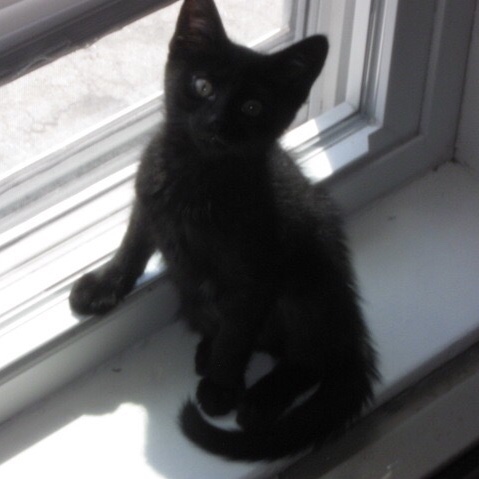
Black cats are beautiful creatures that make a wonderful addition to any home. In some countries, including England, Scotland, and Japan, they are considered good luck. In Japan, it is believed that a single woman who owns a black cat will have many suitors. In England, they are commonly thought to bring good luck to anyone who crosses their path. In Scotland, it is said that a strange black cat arriving at your home will bring good fortune and prosperity.
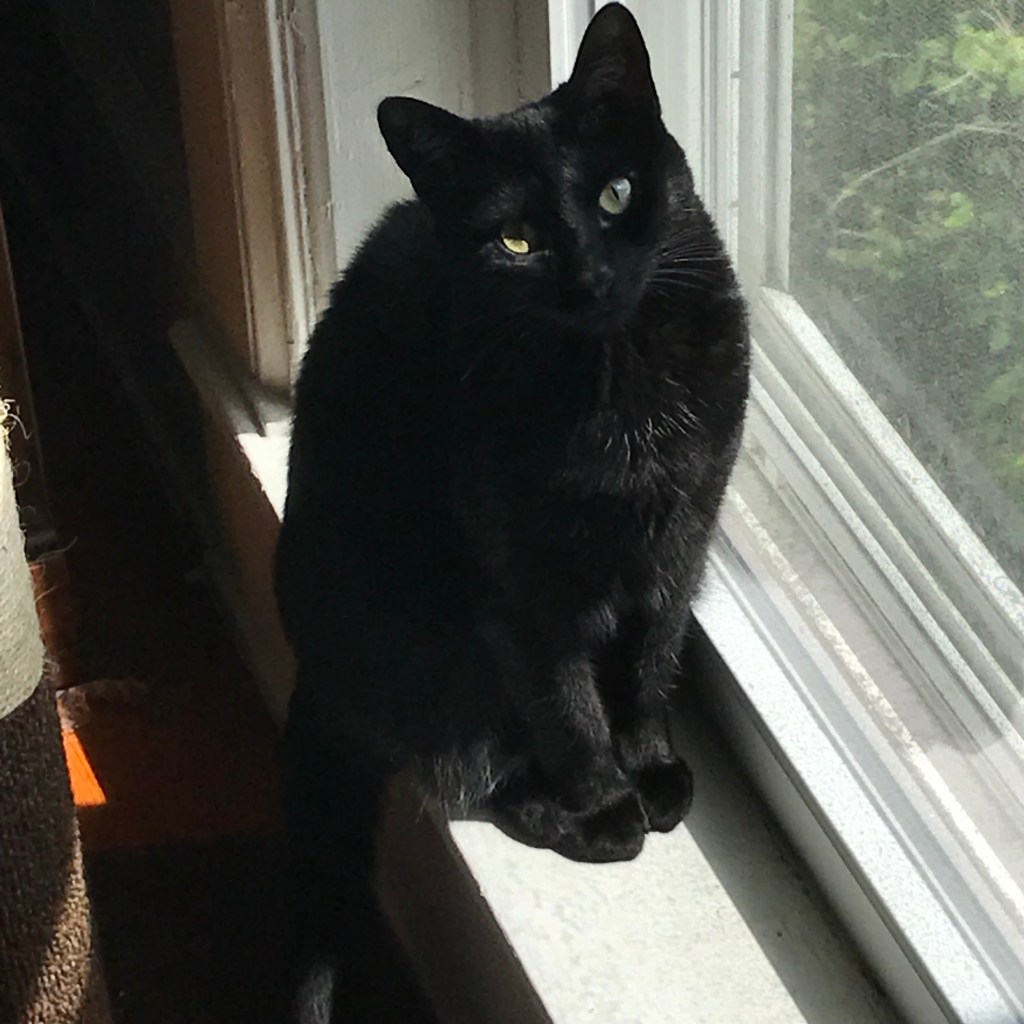
Many cat owners agree that their black cats are often the most affectionate and playful cats they’ve ever had. Isabella is not very affectionate in the traditional sense, but she’s very loving and affectionate in her own way. She wants to be near me most of the time and sometimes wants to lay on me, but she never cuddles and hates to be held. Others claim black cats are known for their unique personalities and cuddly dispositions. Some researchers also claim that black cats are more resistant to disease. There is some research to suggest that at least two genes associated with melanism, i.e. what gives them their black color, may also help them resist certain diseases.
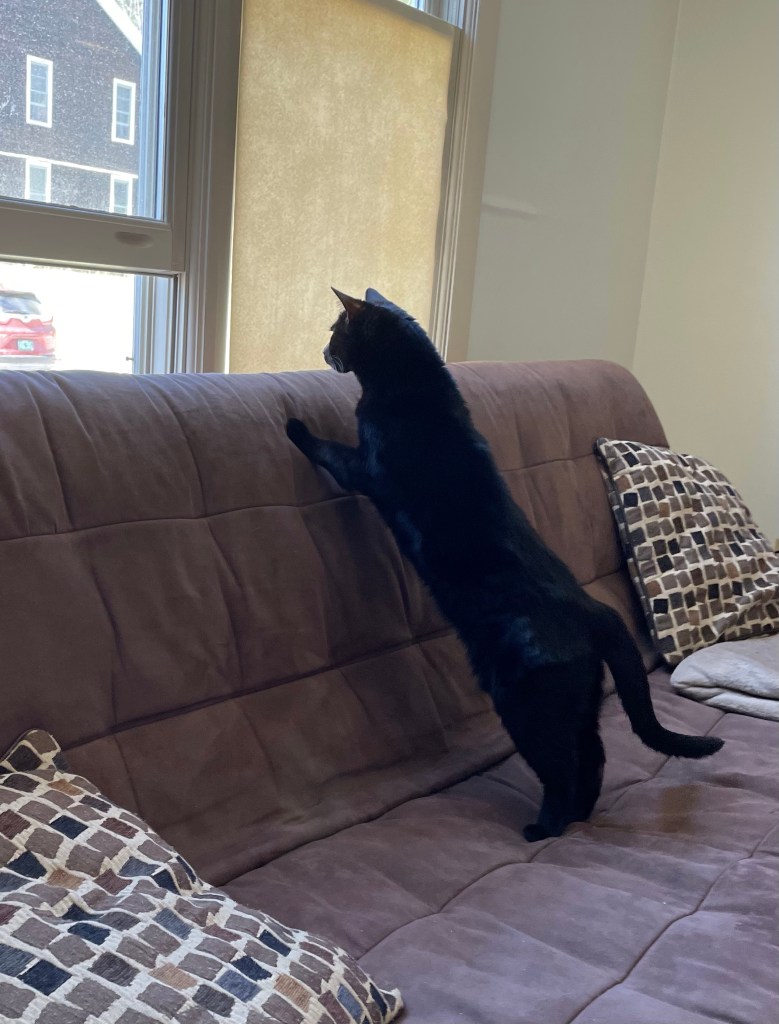
So if you are looking to adopt a cat, consider a black cat. They need the love, and they will love you back. Isabella might not be the most affectionate, but she constantly shows her love and appreciation for me, and isn’t that what we all want from our pets, especially our cats who often seem so indifferent to their human companions. Isabella is rarely far away from me. I’ve had cats in the past who show how mad they are at you for leaving them for any amount of time. Isabella has never been that way. Most of the time, she greets me at the door, and if she hears me in the hallway, and I don’t come into my apartment quick enough, she makes her impatience known. She is a wonderful little companion, and I feel so blessed to have her.

Cape Cod
Cape Cod
By George Santayana – 1863-1952
The low sandy beach and the thin scrub pine,
The wide reach of bay and the long sky line,—
O, I am far from home!
The salt, salt smell of the thick sea air,
And the smooth round stones that the ebbtides wear,—
When will the good ship come?
The wretched stumps all charred and burned,
And the deep soft rut where the cartwheel turned,—
Why is the world so old?
The lapping wave, and the broad gray sky
Where the cawing crows and the slow gulls fly,—
Where are the dead untold?
The thin, slant willows by the flooded bog,
The huge stranded hulk and the floating log,—
Sorrow with life began!
And among the dark pines, and along the flat shore,
O the wind, and the wind, for evermore!
What will become of man?
About This Poem
“Cape Cod” first appeared in Santayana’s Sonnets and Other Verses (Stone & Kimball, 1894). As Santayana recounts in Persons and Places: The Middle Span (Charles Scribner’s Sons, 1945), the poem originated in a fishing trip with friends to Cape Cod, during which he “never held a rod in [his] hand, and never meant to.” He explains, “I wrote some lines on Cape Cod, of which the poet William Vaughn Moody said that there for once I had been inspired. But that inspiration came only by the way, as on returning we skirted a beach in the gathering twilight. Cape Cod in general has the most cheerful associations in my mind.” The scholar Newton Phelps Stallknecht later wrote about the poem in George Santayana (University of Minnesota Press, 1971) that “language, rhythm, and imagery yield fully to the sense of forlorn exile that is throughout. The scene becomes a haunting symbol of loneliness, an end of the world, whose beauty lives in its very desolation.”
About This Poet
George Santayana was a philosopher, critic, essayist, novelist, and poet. born Jorge Agustín Nicolás Ruiz de Santayana y Borrás on December 16, 1863, in Madrid, was a philosopher, critic, poet, and novelist. He was the author of many books, including The Sense of Beauty: Being the Outlines of Aesthetic Theory (Charles Scribner’s Sons, 1896) and Three Philosophical Poets: Lucretius, Dante And Goethe (Harvard University, 1910).
He received his PhD from Harvard, where he taught Conrad Aiken, T. S. Eliot, Robert Frost, and Wallace Stevens. In 1912, Santayana moved to Europe and never returned to the United States. He died on September 26, 1952.
Fun Weekend

I had such a fun weekend. My friends and I went up to Church Street in Burlington Friday night, just as we planned. The only hiccup was that traffic was terrible on I-89, so it took twice as long to get up there, and that did not leave us with much time to check out the sales during Church Street’s annual sidewalk sale. We basically went to two stores. First, we went to Kiss the Cook, which, just as it sounds, is a kitchen store. All three of us enjoy cooking. Well, I enjoy cooking; they enjoy baking. They got a few things, but I didn’t buy anything there. Then we went to Ten Thousand Villages. There, I bought something. They had the cutest coffee mug with a black cat crawling up the sides. They also had some black cat bookends, but I did not buy them. The coffee mug, though, I coudl not resist.

After that, it was time for our dinner reservation. I have eaten at Sweetwaters many times, and it’s always busy. Friday night was no exception. However, it felt like because they know they are closing, they aren’t putting in as much of an effort. The food wasn’t as good as it was in the past. Our waiter was very nice, and I doubt it was his fault that service was extremely slow, which always seems to have more to do with being understaffed and whatever goes on in the kitchen.
Saturday, we went to CiderFest, which was a little bit of a letdown. Right away, we knew there wasn’t going to be much to it. The description had said they would have BBQ and cider slushies. It must have been a typo because they had a BBQ, and in the North, BBQ can mean hamburgers and hot dogs, which is what they had. We decided to go to Prohibition Pig, which is a very good BBQ place nearby, but the restaurant part was closed, and only the Brewery was open. The brewery menu is not BBQ but tacos. It’s really an odd thing. My brisket tacos were good, but there were only two really small tacos, just enough to get you hungry. My friend’s jerk chicken tacos were not as good. After eating, we went back to the CiderFest and got some apple cider donuts and a cider slush, but we did not stick around for the bluegrass music.

Yesterday morning, Isabella had me up as usual, and I got up and fed her and had breakfast myself. Then, I went for a hike. It was the same place that has the little waterfall, but it was a really nice hike. I enjoyed being out all alone and in nature in the early morning. It was about 49 degrees and the crisp temperature was exhilarating. After I got back, I took a shower and then went to the grocery store to get a few things. The rest of the day was spent relaxing. It was a good weekend.

God Will Provide

Therefore, humble yourselves under the mighty hand of God, that He may exalt you in due time, casting all your care upon Him, for He cares for you.
—1 Peter 5:6-7
One of my favorite hymns begins with, “What a friend we have in Jesus/All our sins and griefs to bear/What a privilege to carry/Everything to God in prayer.” I can remember my mother playing this on the piano when I was growing up. It was her favorite to play, and it would reverberate through the house when she was playing it. I love the simple message in the song. The hymn was originally written by preacher Joseph M. Scriven as a poem in 1855 to comfort his mother, who was living in Ireland while he was in Canada. It has also provided me, and many others, with comfort over the years.
We worry too much. We are always afraid of what the future holds. Even the most level-headed of people have worries, whether they outwardly show it or not. The American actress and comedian, Gilda Radner, who died of cancer in 1989, is quoted as saying, “I wanted a perfect ending. Now I’ve learned, the hard way, that some poems don’t rhyme, and some stories don’t have a clear beginning, middle, and end. Life is about not knowing, having to change, taking the moment and making the best of it, without knowing what’s going to happen next. Delicious Ambiguity.”
Trusting in God plan for us is what makes the unknown, as Radner called it, “Delicious Ambiguity.” Numbers 6:24-26 God told Moses to tell the Israelites, “The Lord blesses you and keeps you; the Lord makes His face shines upon you and is gracious to you; the Lord looks upon you with favor and gives you peace.” When we have anxiety and doubt, remember Galatians 5:22-23, “But the fruit of the Spirit is love, joy, peace, longsuffering, kindness, goodness, faithfulness, gentleness, self-control. Against such there is no law.”


Authors
Recent Comments
noisilycool3bc985058… on Pic of the Day Joe on Pic of the Day Benny S on Pic of the Day noisilycool3bc985058… on Pic of the Day iameverywhere1 on Pic of the Day Top Posts & Pages




Amazon Associate

As an Amazon Associate I earn from qualifying purchases. So, if you click on a link that takes you to Amazon.com, I may earn a commission.
Trust me, it isn’t much, but every little bit helps.

 Joe
Joe


 The Closet Professor