
Black and Blue
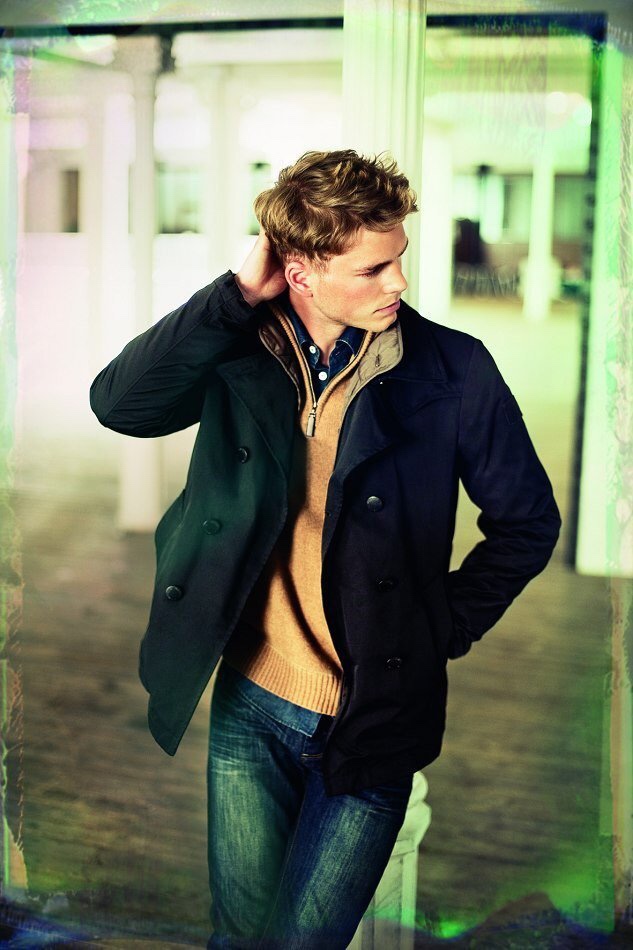
Yesterday when I got dressed, I put on a dark blue shirt, a pair of gray pants, and a navy blue sweater vest. At least I thought it was a navy vest. It was 20 degrees, and it was the first day I’d felt like wearing a sweater. The problem is, I got to work and looked at my sweater in more natural light and realized that it was actually black. So, as soon as I got in my office, I took off the sweater vest. I said something about it to my boss, and he said, “Oh, it’s ok.” I said That it was not ok in my book. He’s straight and has terrible fashion sense. He may be my boss but he rarely dresses like it.
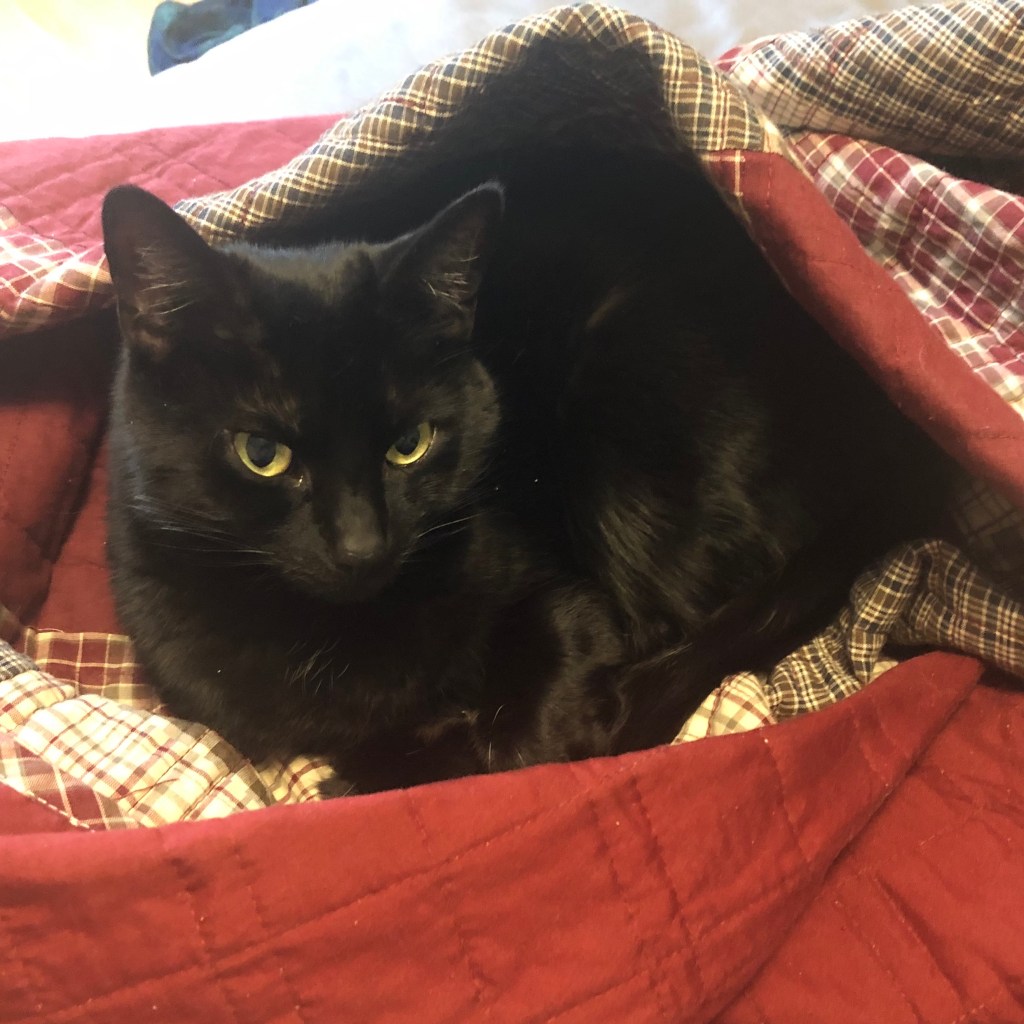
Far too often, I can’t tell the difference between black and blue. Most of the time, I have to compare a piece of clothing that I know for certain if it is either is blue or black. I thought I’d done that yesterday, but apparently, even that didn’t work. Maybe I’ll have to start comparing everything against Isabella. I know for certain that she’s black. Oh well, at least I didn’t wear two different shoes.

First Snow

Last night, we had our first snow of the season. This makes only the second time since I moved to Vermont that our first snow has been after Halloween. I am not complaining. Honestly, I don’t know that I’m ready for snow just yet. Luckily, last night was only a light dusting. Other areas of Vermont, like Burlington, received a mix of precipitation yesterday morning and during the day, but we’d only had light rain intermittently yesterday. The mountains saw a fair amount of snow yesterday, but they had gotten a little bit of snow already.
❄️Winter is coming!❄️
🤬Dammit!🤬
Soon, we’ll be clearing inches of snow off our cars to go anywhere. I’ve been told that the stripes/coloring of the caterpillars are indicative of a mild winter this year, but I was also told that the caterpillars are sometimes wrong. I guess we’ll just have to wait and see.
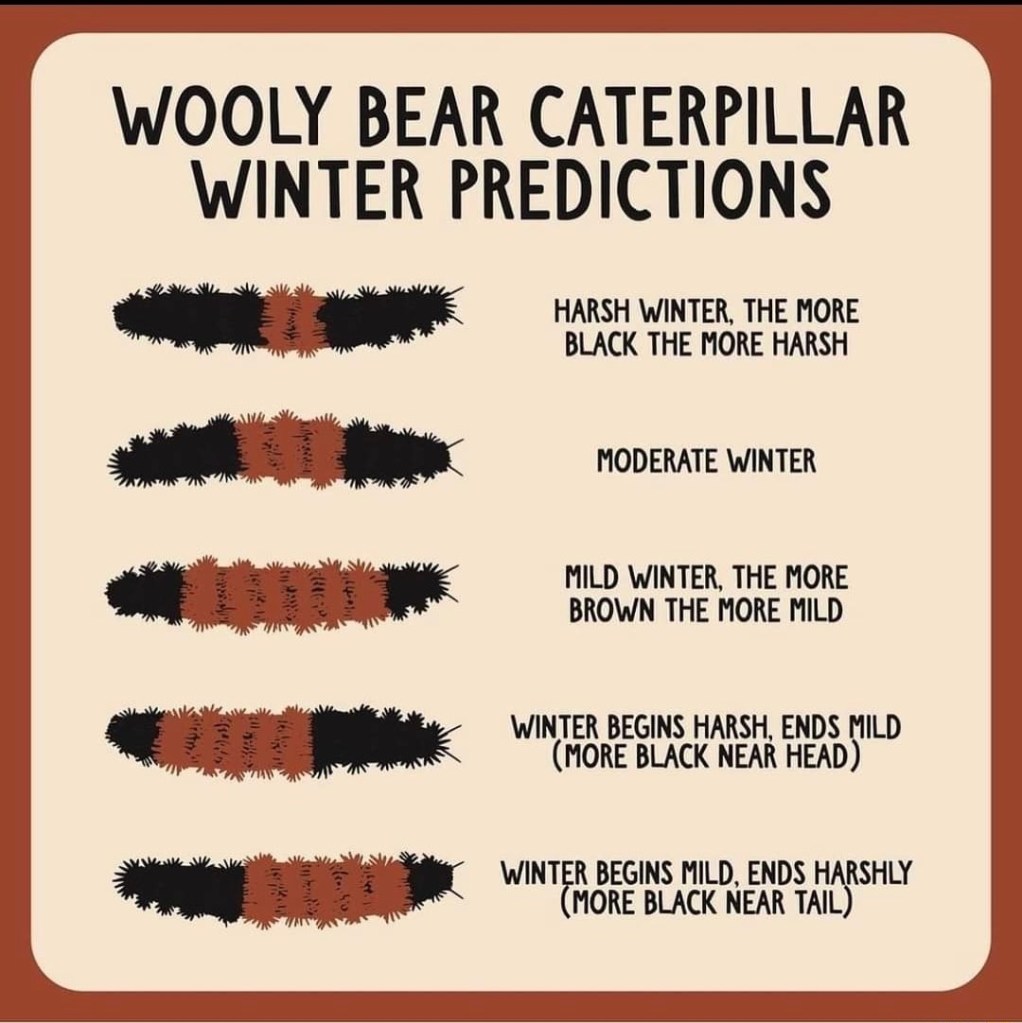
I have been told that our wooly bear caterpillars look like the one in the middle and are mostly brown. However, I’ve never seen a caterpillar in Vermont, so I have no idea what they look like this year.

If I Could Tell You
If I Could Tell You
By W. H. Auden
Time will say nothing but I told you so,
Time only knows the price we have to pay;
If I could tell you I would let you know.
If we should weep when clowns put on their show,
If we should stumble when musicians play,
Time will say nothing but I told you so.
There are no fortunes to be told, although,
Because I love you more than I can say,
If I could tell you I would let you know.
The winds must come from somewhere when they blow,
There must be reasons why the leaves decay;
Time will say nothing but I told you so.
Perhaps the roses really want to grow,
The vision seriously intends to stay;
If I could tell you I would let you know.
Suppose all the lions get up and go,
And all the brooks and soldiers run away;
Will Time say nothing but I told you so?
If I could tell you I would let you know.
About This Poem
“If I Could Tell You” is a poem by the Anglo-American poet W. H. Auden (1907-73), who was born in York and made his name as the foremost English poet of the 1930s, before emigrating to the United States (where he would live on and off for much of the rest of his life) towards the end of the decade. This poem is an example of a curious verse form known as the villanelle (one of my personal favorite poetic forms. A villanelle is a French verse form, although one that took its name from an Italian one (the word derives from villanella, a form of Italian part-song which originated in Naples in the sixteenth century). This intriguing verse form comprises 19 lines made up of five tercets (three-line stanzas) and a concluding quatrain. As the Oxford English Dictionary summarizes it, “The first and third lines of the first stanza are repeated alternately in the succeeding stanzas as a refrain and form a final couplet in the quatrain.” In Auden’s poem, the two refrains are therefore “Time will say nothing, but I told you so” and “If I could tell you I would let you know.”
The villanelle emerged as a popular poetic form in English verse when poets of the 1930s started to use it. It became popular because the poets of the 1930s were following the 1920s modernist poets, like T. S. Eliot and Ezra Pound, but also wished to distance themselves from their styles and modes of writing. Auden, for instance, disliked free verse and the whiff of elitism that is often found in modernist poetry. A villanelle is as far removed from free verse as a poem can get. Like a sonnet, the form is very strict in its structure, but while a Sonnet can have variations, a villanelle cannot have any variations. It must be comprised of nineteen lines and using rhyme throughout. It can only have two different rhymes, an a rhyme and a b rhyme, throughout, and two lines must be repeated no fewer than four times each.
Poems like “If I Could Tell You” shows the 1930s poets’ dislike of elitism. T. S. Eliot’s 1922 poem The Waste Land is the most famous modernist poem in English. In it, the poet quotes ancient Greek and Latin as well as modern German and French, and alludes to William Shakespeare, Edmund Spenser, Andrew Marvell, and Greek myth. The poem presents a challenge, on some level, to just about any reader. Few would know all these languages and all of these frames of reference. By contrast, “If I Could Tell You” does not send the reader scurrying to a bilingual dictionary (or even to an English one, for that matter: everyone knows what a rose, a brook, or a soldier is), nor does it allude to other writers. Auden once claimed that he writes “for his betters.” Of course, this does not mean the poem is therefore “easy” or straightforward. The very title says as much: “If I Could Tell You.” Unlike the modernists, Auden wants to communicate in a direct and clear, accessible way; but he can’t. The repeated line “If I could tell you I would let you know” shows that something eludes even his understanding or comprehension.
Auden wrote “If I Could Tell You” in October 1940, when the mood in Europe was still bleak and the future looked increasingly uncertain during the Second World War. From across the Atlantic, in New York where he was living at the time, Auden felt as though civilization itself was under threat, as a poem from the previous year, “September 1, 1939,” so poignantly shows. The two refrains of the villanelle appear to alternate between certainty (‘Time will…’) and uncertainty (‘If I…’). But what is so masterly about Auden’s use of these two refrains is how both actually pull the reader in opposite directions, poised somewhere between knowability and conjecture: “If I could tell you” is the first half of the line, but the second, “I would let you know,” promises the surety of personal guarantee in an uncertain time.
Similarly, “Time will say,” but what it will say is just a smug, all-knowing, ‘I told you so’, which doesn’t help to explain much—anyone can be wise after the fact, and Old Father Time is in a better position than most. Observe how, in the brilliant final stanza of the poem, Auden turns that declarative statement into a question: “Will time say nothing but I told you so?” The rest of the poem operates on a similar see-saw between clarity and ambiguity, confident declaration and timid uncertainty (“Perhaps the roses…”; “The vision seriously intends…”). This uneasy combination is even there in the unusual word-combinations Auden uses: both brooks and soldiers can be said to ‘run away’, in a linguistic feature that approaches zeugma (much as when Queen Anne takes both counsel and tea in Pope’s The Rape of the Lock, or a Dickensian character leaves in a flood of tears and a sedan chair); combining the masculine, contemporary reference to soldiers (contemporary for 1940 certainly) with the more feminine and traditionally poetic “brooks” offers a microcosm of what is going on in the poem at the macro-level.
“If I Could Tell You” is a deeply paradoxical poem: a poem at once about being certain of nothing (except that the speaker would tell us the truth if he had the answers) in a time of uncertainty (except that we can be certain that there “must be” reasons why things happen, even though we don’t know what they are).
About W. H. Auden
Wystan Hugh Auden (1907-73) was born in York, England, and was educated at the University of Oxford. He described how the poetic outlook when he was born was “Tennysonian” but by the time he went to Oxford as a student in 1925, T. S. Eliot’s The Waste Land had altered the English poetic landscape away from Tennyson and towards what we now call “modernism.”
Surprisingly given his later, better-known work, Auden’s early poetry flirted with the obscurity of modernism: in 1932 his long work The Orators (a mixture of verse and prose poetry with an incomprehensible plot) was published by Faber and Faber, then under the watchful eye of none other than T. S. Eliot. Auden later distanced himself from this experimental false start, describing The Orators as the kind of work produced by someone who would later either become a fascist or go mad.
Auden thankfully did neither, embracing instead a more traditional set of poetic forms (he wrote a whole sequence of sonnets about the Sino-Japanese War of the late 1930s) and a more direct way of writing that rejected modernism’s love of obscure allusion. This does not mean that Auden’s work is always straightforward in its meaning, and arguably his most famous poem, “Funeral Blues,” is often “misread” as a sincere elegy when it was intended to be a parody of public obituaries.
In early 1939, not long before the outbreak of the Second World War, Auden left Britain for the United States, much to the annoyance of his fellow left-wing writers who saw such a move as a desertion of Auden’s political duty as the most prominent English poet of the decade. In America, where he lived for much of the rest of his life with his long-time partner Chester Kallman, Auden collaborated with composers on a range of musicals and continued to write poetry, but 90 percent of his best work belongs to the 1930s, the decade with which is most associated. He died in 1973 in Austria, where he had a holiday home.

Cat People 🐈⬛

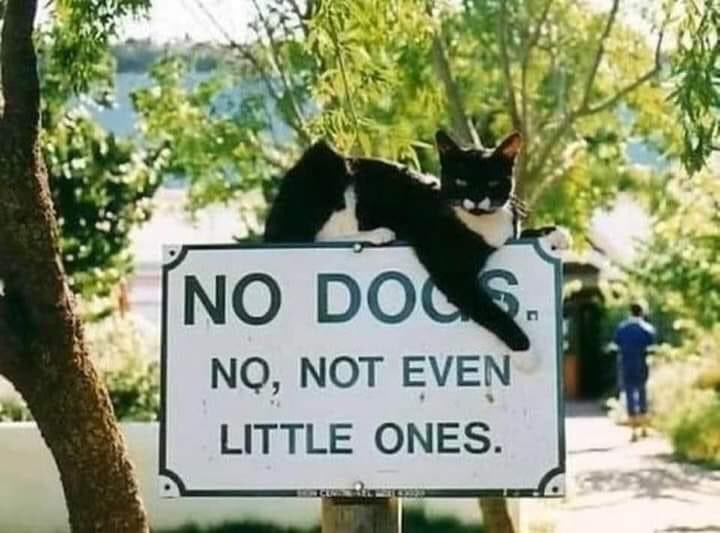
There are basically four types of people in this world: cat people, dog people, those who like cats and dogs, and those who don’t like pets. I fall squarely in the cat people category. I do not like dogs. Sometimes, I can tolerate them, but they still make me nervous. I have been afraid of dogs most of my life. I was traumatized by one as a child, and I’ve never been able to get over it. I don’t like dogs. I don’t like the way they smell. I hate to hear them bark. I can’t stand for one to lick me or slobber all over me. I absolutely despise when I tell someone I don’t like dogs and have been afraid of them since I was a child and they to respond, “Oh, but you’ll like my dog. He’s so sweet and lovable.” No, I am not going to like your dog. I may tolerate him, but I’ll never be comfortable around him. I just wish people could understand that and not get offended. I had a boss once that found it hilarious that her dozen little dogs would jump all over me, and she was convinced that her dogs were the exception to my feelings about dogs. They were not, and it was absolute torture every time I had to go to her house. So, as the sign below says, “NO DOGS, NO NOT EVEN LITTLE ONES.”
Cats are a different story. I love cats.I don’t think they smell at all, and if you take care of their litter box (or have an automatic one like I do) it won’t smell. The noises cats make are nowhere near as annoying, and a cat’s purr has been found to have a calming effect on humans. Most won’t lick you or slobber on you. Sometimes, they cuddle with you, and sometimes, they just do their own thing. For someone who enjoys their solitude, a cat can be a perfect companion because they often like their solitude as well. Isabella is not one to cuddle, but my previous cat Victoria was. Sometimes, I wish Isabella cuddled more, but cats always have their own personalities, occasionally multiple ones in the course of five minutes. One pet or scratch too many and you’ll know it. For me, that’s all part of their charm, and once you know a cat, then you can see when their mood has changed.



Authors
Recent Comments
noisilycool3bc985058… on Pic of the Day Joe on Pic of the Day vandycolt on Pic of the Day furbirdsqueerly on Pic of the Day Joe on Pic of the Day Top Posts & Pages



Amazon Associate

As an Amazon Associate I earn from qualifying purchases. So, if you click on a link that takes you to Amazon.com, I may earn a commission.
Trust me, it isn’t much, but every little bit helps.

 Joe
Joe


 The Closet Professor