Last week, we had some “warm” days here in Vermont. The high temperatures were in the 40s and even got up to the 50s and 60s, a veritable heat wave for us in March. Back in Alabama, these temperatures would cause us to get out our sweaters and heavy coats. In Vermont, it means we put up sweaters and heavy coats. For some, it even means that they break out their t-shirts. I have adapted well to the cold temperatures of Vermont, but not that much. I merely wore a long sleeve shirt.
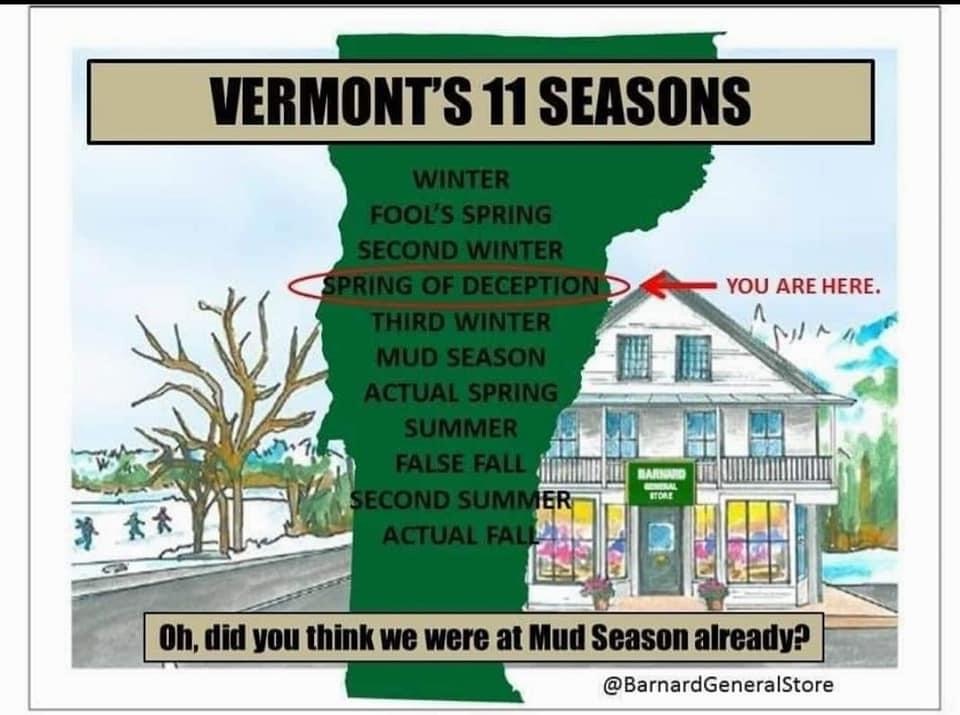
This time of year is known as “Spring of Deception,” see the picture below. The spring of deception rarely lasts long, and it looks like it lasted only a few days this year. Yesterday, it snowed off and on all day long. We will see if “Third Winter” will set in since it was 3° this morning, and the high today is expected to be 16°. It will warm up some after. We have a rollercoaster of temperatures for the next ten days. If the forecast holds, we may even get back into the 50s.
Vermont weather is very unpredictable. If the forecast continues as it looks right now, we are in for some sun, a rarity in Vermont. Before I know it, mud season will be here, although that is likely to happen next month. Being March also means that it is Maple Sugaring Season, which often corresponds with mud season.
Regardless of the “season,” it is in Vermont, it is still better than any season in Alabama. If Alabamians are lucky, they get a week of Autumn and a few weeks of Spring before the heat of summer sets in. Just as Vermont has Winter from basically October/November to April/May, Alabama has Summer from April/May to September/October. I went from long Summers to long Winters. I would much rather have the long Winters. I prefer the colder temperatures. I hate being hot and sweaty. The heat has always aggravated my migraines. I may not enjoy shoveling snow, clearing snow off my car, driving in snow, or the bitterly cold winds, but I don’t have to deal with long periods of heat and humidity, hurricanes, or tornadoes. So, I will take the long Winters.
“Not everyone who says to Me, ‘Lord, Lord,’ shall enter the kingdom of heaven, but he who does the will of My Father in heaven. Many will say to Me in that day, ‘Lord, Lord, have we not prophesied in Your name, cast out demons in Your name, and done many wonders in Your name?’ And then I will declare to them, ‘I never knew you; depart from Me, you who practice lawlessness!’
—Matthew 7:21-23
On Wednesday, I wrote a post about my “Graduate School Trauma.” I wasn’t trying to make excuses for not finishing my Ph.D., but I wanted to tell my story so that others would be encouraged to stand up for themselves and not bend to the pressures often put upon us. Florence Nightingale said, “I attribute my success to this—I never gave or took any excuse.” Within that post was an unwritten lesson: God has a plan for us, and we shouldn’t make excuses for our failures, especially when it was probably not in God’s plan for us in the first place. Getting my Ph.D. was not in the cards for me. I believe that my current career is part of God’s plan for me. It took a long and winding road to get here, but I enjoy my current job. Of course, some things aggravate me about my job, but doesn’t everybody have something that irritates them about their job?
Benjamin Franklin said, “The man who is good for excuses is good for little else.” The New Merriam Webster’s Dictionary says that an excuse is a reason for your conduct, a justification of what you have done. It is different from the reason for your action. As the case may be, a legitimate cause for doing something, or for not doing it, is a reason. But an excuse is something you give when you have no real reason for your action. It is a camouflage, an attempt to save face and salvage your self-esteem.
We make excuses because we do not want to take on responsibilities, be embarrassed, or face the consequences. Similarly, afraid of punishment, Adam blamed Eve, and Eve blamed the serpent after disobeying God’s command. By doing so, their relationship with God changed. The formerly close relationship of walking with God changed into one of hiding and deceiving. Isaiah 59:2 says, “But your iniquities have separated you from your God; and your sins have hidden His face from you so that He will not hear.” Whether dealing with God or with people, the best and only way to live is to admit our failures and not hide behind excuses, no matter how carefully crafted they are.
On one occasion, Jesus told a story about a man who planned a large dinner and invited many guests, but they all begged off before the meal and decided not to come. Luke 14:16-24 tells the story:
He said to him, “A certain man gave a great supper and invited many, and sent his servant at supper time to say to those who were invited, ‘Come, for all things are now ready.’ But they all with one accord began to make excuses. The first said to him, ‘I have bought a piece of ground, and I must go and see it. I ask you to have me excused.’ And another said, ‘I have bought five yoke of oxen, and I am going to test them. I ask you to have me excused.’ Still another said, ‘I have married a wife, and therefore I cannot come.’ So that servant came and reported these things to his master. Then the master of the house, being angry, said to his servant, ‘Go out quickly into the streets and lanes of the city, and bring in here the poorand the maimed and the lame and the blind.’ And the servant said, ‘Master, it is done as you commanded, and still there is room.’ Then the master said to the servant, ‘Go out into the highways and hedges, and compel them to come in, that my house may be filled. For I say to you that none of those men who were invited shall taste my supper.’”
All three excuses given by the men are valid in themselves. You would expect a man to look at a piece of property before he bought it, not afterward, since it might be underwater, and there is nothing wrong with buying property. There is also nothing wrong with buying a team of oxen, or an automobile today, and a prudent individual would test drive something before he bought it. There is certainly nothing wrong with getting married. The problem was that each had a misplaced sense of priorities. An excuse is generally satisfactory to only the person who gives it. The story that Jesus told was a parable of a God who loves us and invites us to receive eternal life through the invitation of Jesus Christ. Jesus says in Matthew 11:28, “Come to Me, all you who labor and are heavy laden, and I will give you rest.” That invitation is personal, and it is for us. Don’t make excuses, but trust in the Lord.
Over the past year, most of the people I know have gained weight during this pandemic. In a poll of more than 1,000 WebMD readers, nearly half of the women and almost one-quarter of the men said they’d gained weight “due to COVID restrictions.” This trend is no surprise, as routines have been disrupted, stress has increased, and it’s mostly been unclear when things will ever return to normal.
The restrictions that quarantine places on everyday life have interrupted many people’s daily routines. The rise in unstructured time, the closure of gyms and recreational centers, movement restrictions, and the enormous stress of the pandemic affected people’s sleeping patterns, eating habits, and levels of physical exercise. All of this contributed to weight gain. People struggled to focus on weight management due to increasing work demands, unforeseen hardships, and safety concerns.
Since I was young, I’ve always struggled with my weight. Until I was 6, I was considered too thin and given milkshakes to gain weight. Sadly, that worked too well, and I learned that I loved food. Stress has almost always caused me to gain weight. I had a workout partner for a while in graduate school, and I lost enough weight to get down to a healthy size. However, my workout partner moved on, and I fell back into old habits. The weight came back. Over the years, my weight has continuously fluctuated. I’ve gained weight, lost a few pounds, gained some back, and so on.
Over the past year, I have been fortunate not to gain weight as many of my friends have. I have lost over 30 pounds, but I need to lose more. While many people have begun wearing pants with elastic in the waist, I’ve had to buy pants with a smaller waist. Wednesday, when I had to go to the museum, I put on my dress belt, which I have not worn much over the past year. It was too big. I tried to cinch it to the next hole but realized there wasn’t another hole to use. I realized I had to buy a new dress belt. I had already purchased a casual belt that fits better, but I thought my dress belt would be okay.
Some people might be like me and have lost weight. Others have gained weight during the pandemic. However, we have to realize that we will get back to normal eventually. If you have gained weight, you can get back into a routine to get you back to a healthier weight. I will have to work not to fall into bad habits and regain the weight I have lost. In a time when more than 530,000 Americans have died from COVID-19, and in the face of the devastation caused by this pandemic, the anxiety, and the sadness, it is important to remember that simply being alive and healthy is a blessing.
Every few days, I get an email from a particular organization. The organization’s name and the emails’ subjects are not important. It’s the name of the sender that causes my heart to sink every time I see it. The woman’s first name is Andrea, and her last name is the same as the last name of my former dissertation advisor, who was partially responsible for me not receiving my Ph.D. If it were just the last names they had in common, it probably would not be an issue, but said dissertation advisor’s first name was Andrew. Each time these emails pop up in my inbox, my heart sinks as I always misread them as my former dissertation advisor’s name. Only one letter differentiates their names. It’s only for a second, and then I realize my mistake. However, it makes me realize just how traumatized I was by that former advisor. His emails always brought some fresh new hell, and eventually, I became paralyzed with fear every time I received one of his emails.
Most of you know that I pursued a Ph.D., but I never finished it. There were many reasons for that: funding and the need for me to get a job. I ended up teaching 7th-12th grade social studies and English at a small private school, and teaching six different preps a day and dealing with challenging students left me with no energy when I got home at night, not to mention the amount of work I took home each night. Once I began working full time, I no longer had the time or the energy to continue researching and writing my dissertation.
Before my teaching job, I had taken a year to devote entirely to finishing my dissertation, moved back in with my parents (trauma in itself), and had developed a set of deadlines to complete the chapters of my dissertation. I got the plan approved by my then dissertation advisor and moved home, and began to write. I met all of my deadlines within a week of their due date, but I felt I needed my advisor’s feedback before I could move onto the next chapter. Before I was assigned this advisor, I had an advisor that I had worked with closely throughout my graduate career. I knew what he expected, and he was excited about the research I was doing. My first dissertation advisor continuously encouraged my efforts. Then, he got a job in North Carolina and left. The department decided that this other professor, with whom I had never worked with and never took a class with, would replace my old advisor. This was a disastrous decision, and in hindsight, it is one that I should have fought and objected to, but back then, I was not assertive enough to do so. I am not a very assertive person today, but I was even less so back then.
My new dissertation advisor not only wasn’t familiar with me nor I with him, but he also hated my dissertation topic. He had been on my committee before as a minor member who was just supposed to offer some advice here and there but was not supposed to have the final say. I should have known there would be a problem with him as my dissertation committee chair when he held up my dissertation prospectus’s approval for over a year. Everyone else signed off on the proposal and was encouraging, but he insisted on certain changes. I will never understand this because he was the only member of my committee who was not tenured, and the other members should have overruled him, but they did not. I submitted one revision after another, taking into account his various criticisms. What was most annoying was that the final proposal was almost identical to the first one I submitted. I have always felt he gave me the runaround because he was insecure in his position and took it out on me.
Therefore, when he became my dissertation advisor, we agreed on deadlines that he and I would meet to keep the writing of the dissertation moving. He was supposed to review the chapters as I submitted them and suggest changes. If I remember correctly, he was given several weeks to do this. He took several months, and when he did return the chapters, I went through revisions similar to what he had put me through with the proposal. I was very frustrated. I seemed never to do anything to his satisfaction, and he repeatedly criticized my work when other professors did not. He held up my dissertation for so long that time was beginning to run out on my ability to finish. Finally, I got an email from him saying that he would no longer be able to be my advisor. He blamed me for the delays and said he could no longer work with me. In reality, I found out the university had denied him tenure, which was a requirement for him to sign off on the final draft of my dissertation. By university regulations, he could not be the chair of my dissertation committee. The department’s thought process had initially been that he’d have tenure by the time I finished my dissertation, and all would be fine.
At this point, I had to move on to my third dissertation chair. My final chair is who I should have begun with in the first place. I remember attending a conference at the University of Alabama that she’d also be attending so that we could sit down face to face and discuss my dissertation. I told her the problems I had with my previous advisor. She sympathized with me and told me two things. First, she apologized on behalf of the department because of all the turnover of faculty they had experienced during my time in the Ph.D. program. I had been lost in the shuffle. Second, she said that she had faced a similar situation where her dissertation advisor had balked at her dissertation topic. She said that she had persevered and wrote it anyway, winning them over with the final product. She told me not to give up, and she’d be behind me the whole way. This all sounded great, but that’s not how it worked out.
I had spent several years dreading emails from my previous advisor, wondering what fresh hell he was going to put me through. I was traumatized, and my psyche could not handle looking at my dissertation anymore. I was mentally and physically exhausted from teaching full-time at a private school that did not support me either, but I had financial troubles that were barely being held at bay with the meager paycheck I was getting from that job. At the time, I had issues, and maybe a good therapist could have worked me through those issues, but I lacked health insurance. During these years, I was also suffering from the worst headaches of my life, but I was not in a job that allowed me to take time off for being sick for any reason. I continued to teach whether I had a common cold, whooping cough, or the flu. As a teacher early in his career, I caught every disease the children brought to school, and for the most part, the school’s administration prevented me from taking sick leave. So, having a “little” headache was not an excuse for not coming to work. They never sympathized with just how much pain I was in.
I do not blame the circumstance surrounding my failure to finish my dissertation solely on a difficult dissertation advisor or with the lack of support from my graduate program. Although those two things were a major contributing factor, the blame also falls on me. In recent years, I have come to realize that while I was a great lecturer and could keep a college class enthralled to the point that they wouldn’t even realize that we had gone past time for class to be dismissed, I was not cut out for to be a middle and high school teacher. If I had received my Ph.D., I would probably be teaching at a community college or maybe even a university somewhere, and I would not likely be happy about it. I hated grading. I hated dealing with difficult students and cheaters. I hated the politics of academia. I would probably be miserable in a job teaching the same subjects semester after semester and if at a university continually trying to get published because of most universities’ publish or perish mentality. And if I had gotten my Ph.D., I would have never moved into the museum field and focused on public history. I still get to lecture and give presentations in my current jobs, but I no longer have to grade. I get to write and do research that I find exciting and rewarding. I get to do all the things I loved about teaching without having to do all the things I hated.















 Joe


