“You, my brothers and sisters, were called to be free. But do not use your freedom to indulge the flesh; rather, serve one another humbly in love.” — Galatians 5:13
On Memorial Day, we pause not just to wave flags or grill burgers, but to remember—solemnly and with reverence—those who laid down their lives in service to this country. They died in deserts, on beaches, in jungles and skies, in places known and forgotten. Each one was a person, not just a name etched into stone.
Among them were LGBTQ+ Americans who, in every generation, answered the call to serve—even when their nation would not serve them in return.
Some lived and died in silence, hiding their full selves to avoid dishonorable discharge, imprisonment, or violence. Under policies like Don’t Ask, Don’t Tell, they were forced into shadows, where honesty could mean disgrace. Yet they still fought. Still bled. Still gave everything.
Others served proudly after the policy ended in 2011—openly gay, lesbian, and bisexual service members who finally could wear their uniforms and their identities without fear. Their courage was not only on the battlefield, but in living truthfully in spaces where truth had long been forbidden.
And still today, many transgender service members fight battles on two fronts—one abroad, and one at home. While their competence and valor are unquestioned, their right to serve remains under political siege. Recent Republican-led efforts to reinstate a transgender military ban have made this painfully clear. These attempts to erase or exclude are not just policy debates—they are messages that say, “You do not belong.”
But in God’s eyes, they do belong. They always have.
“Greater love has no one than this: to lay down one’s life for one’s friends.” — John 15:13
This verse reminds us that the greatest act of love is not found in slogans, but in sacrifice. LGBTQ+ service members—whether in silence or with open pride—have made that sacrifice. And on this Memorial Day, we must speak their names, even if history tried not to record them.
They were called to be free, just as we are called to be free. But let us not use that freedom to forget. Let us use it to serve one another humbly in love—as Paul writes in Galatians—and to advocate for those whose service has been overlooked, whose dignity is still contested.
It’s been far too long since I’ve had a proper evening out—good food, good company, and a reason to dress up a little. One thing you should know about me: I love clothes. I love the search for the perfect outfit, the anticipation of debuting something new, and the quiet confidence that comes from getting dressed up for something special. An old friend used to call me a fashion plate. I’m not sure I’d go that far, but there’s no denying I enjoy the ritual of putting together a look for a night on the town.
Tonight’s outing is long overdue. My friend and I haven’t had a dinner out together in months—perhaps not since my birthday last November. She’s my closest friend here in Vermont. We both moved here around the same time, and we’re both originally from the same part of Alabama, so we share a lot of common ground. But this past semester has been a whirlwind for us both—busy schedules, long days, and not enough energy left for social plans. Until now.
We’ve had this dinner on the calendar all week, and we’re both looking forward to it. It’s not just the company—it’s the destination. The restaurant we’re heading to is a favorite of ours, set along the banks of a cascading river. The sound of rushing water over rocks has always had a calming effect on me. It’s the kind of place where the setting enhances the whole evening.
The ambiance inside is just as appealing: a harmonious blend of industrial and rustic design, softened with modern lighting and eclectic furnishings. It strikes that perfect balance—classy without being stuffy, hip without trying too hard. The crowd is always mixed, which gives it a lively, unpredictable energy that I love.
In the past, I would have picked an outfit well in advance, something I’d been waiting for the right occasion to wear. But lately, with my weight loss, I’m at that in-between stage—too small for many of my old clothes, but not quite ready to invest in a whole new wardrobe. Still, I have a few pieces that fit well and make me feel good. Tonight’s look is simple but springlike: a muted yellow oxford shirt and crisp, light khaki pants. Fresh, clean, and just dressy enough.
Whatever I wear and whatever I eat tonight, the real joy will be sharing the evening with a friend who understands me, in a place that feels both comforting and a little bit special. After all, sometimes the best nights out aren’t about anything extravagant—they’re about reconnecting, relaxing, and remembering how good it feels to just be.
I’ve been on vacation this week, and honestly—it’s been really nice. Except for having to go into work on Thursday this week and next (the museum is short-staffed during the summer), it’s been a true break. I’ll be the only one there, which makes things easier, and while today might bring an art shipment and a backlog of emails, I’ve done my best to stay away from my inbox. Out-of-office reply firmly in place.
What’s been especially lovely is not having to get up and rush anywhere. Isabella, of course, still insists on waking me up between 4 and 4:30 a.m., but without the usual morning scramble—deciding what to wear, prepping for the day—it’s felt like a small luxury. I’ve still gone to Planet Fitness, but my trainer has been under the weather this week, so I’ve kept it simple and just walked on the treadmill. Hopefully, he’s back tomorrow so we can return to our regular sessions.
In other news, some of you may remember that my doctor referred me to a gastroenterologist, but the earliest appointment I could get was in November. I asked to be put on the cancellation waitlist, though I was warned I was near the bottom and not to get my hopes up.
Well, surprise! On Tuesday morning, they called and asked if I could come in that afternoon. I was there by 1 p.m.
I’m really glad I got to see him. This liver issue has been weighing on my mind. He explained all the different potential causes for the scarring shown on my ultrasound and liver elastography. But here’s the good news: he doesn’t believe the test results are accurate. The techs who performed the exam apparently had difficulty getting proper measurements, and he said liver elastography isn’t always reliable—especially since my bloodwork has never shown any major liver issues. Some numbers have been mildly elevated now and then, but nothing alarming.
He said there are two more accurate ways to assess liver damage: a liver MRI or a biopsy. I’ve had an MRI before (of my brain, no less), and he assured me this one would be much easier. As for the biopsy—he said it’s more involved and, frankly, about as unpleasant as it sounds. It’s usually a last resort.
He ran a few blood tests, checking for Hepatitis A and a genetic condition called hemochromatosis (which causes iron overload). The results came back clear—perfect iron levels and an unexpected bonus: I apparently have immunity to Hep A. I’m not sure how, but I missed his call and got that info from a voicemail.
His overall impression was reassuring. With my recent weight loss and commitment to healthier habits—eating better, regular gym visits—he believes the liver scarring may heal on its own. That sounds like good news to me.
Now it’s time to get ready for work. Wishing everyone a good day—and if you’re on vacation too, I hope it’s as restful as mine has been.
🐈⬛
I almost forgot the Isabella Pic of the Week. Even she knows she’s pretty and can’t stop looking at herself.
From the polished marble of ancient statues to the shimmer of modern photography, Greco-Roman gods have been reimagined for centuries as icons of idealized, eroticized male beauty. In myth, their bodies held cosmic power; in art, their nudity has long served as a conduit for expressing desire, divinity, and the human longing for transcendence.
This post explores nude depictions of four major figures—Apollo, Adonis, Dionysus, and Ganymede—through a selection of artworks that span antiquity, the Renaissance, Neoclassicism, and into modern queer photography. These gods persist not merely as symbols of myth but as enduring archetypes of same-sex attraction and aesthetic longing.
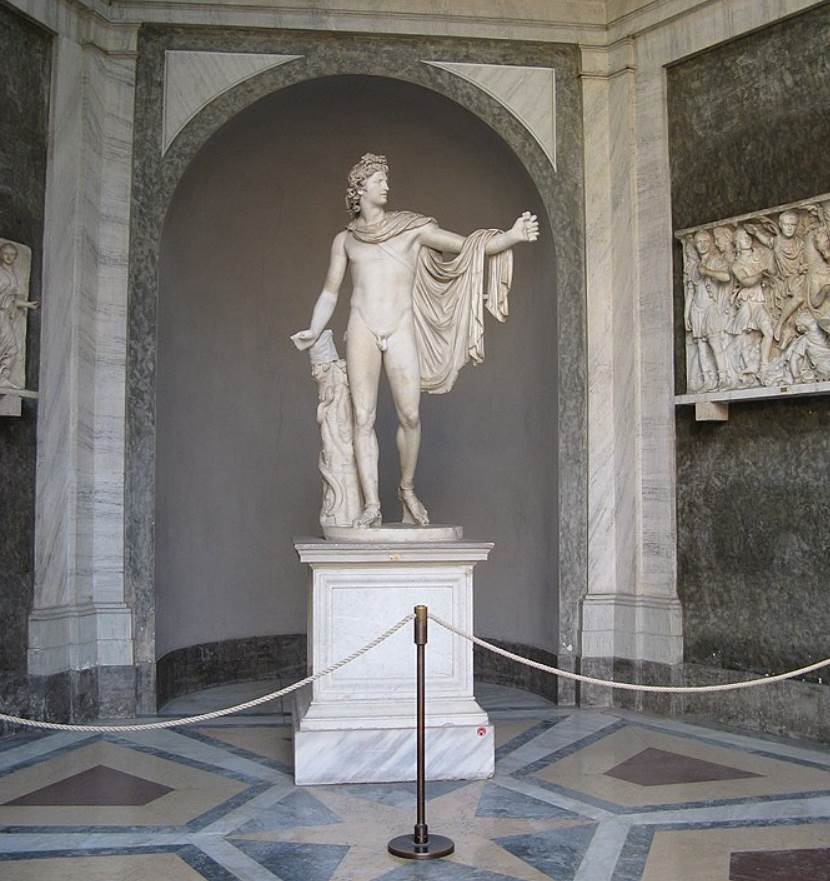
Few deities embody beauty like Apollo, the Greek god of light, music, and reason. His idealized, youthful body became the template for masculine perfection across Western art history.
The Apollo Belvedere [above], a Roman copy of a 4th-century BCE Greek bronze, exemplifies this ideal. Standing nude but for a cloak draped over one arm, Apollo’s form is serene, balanced, and timeless.
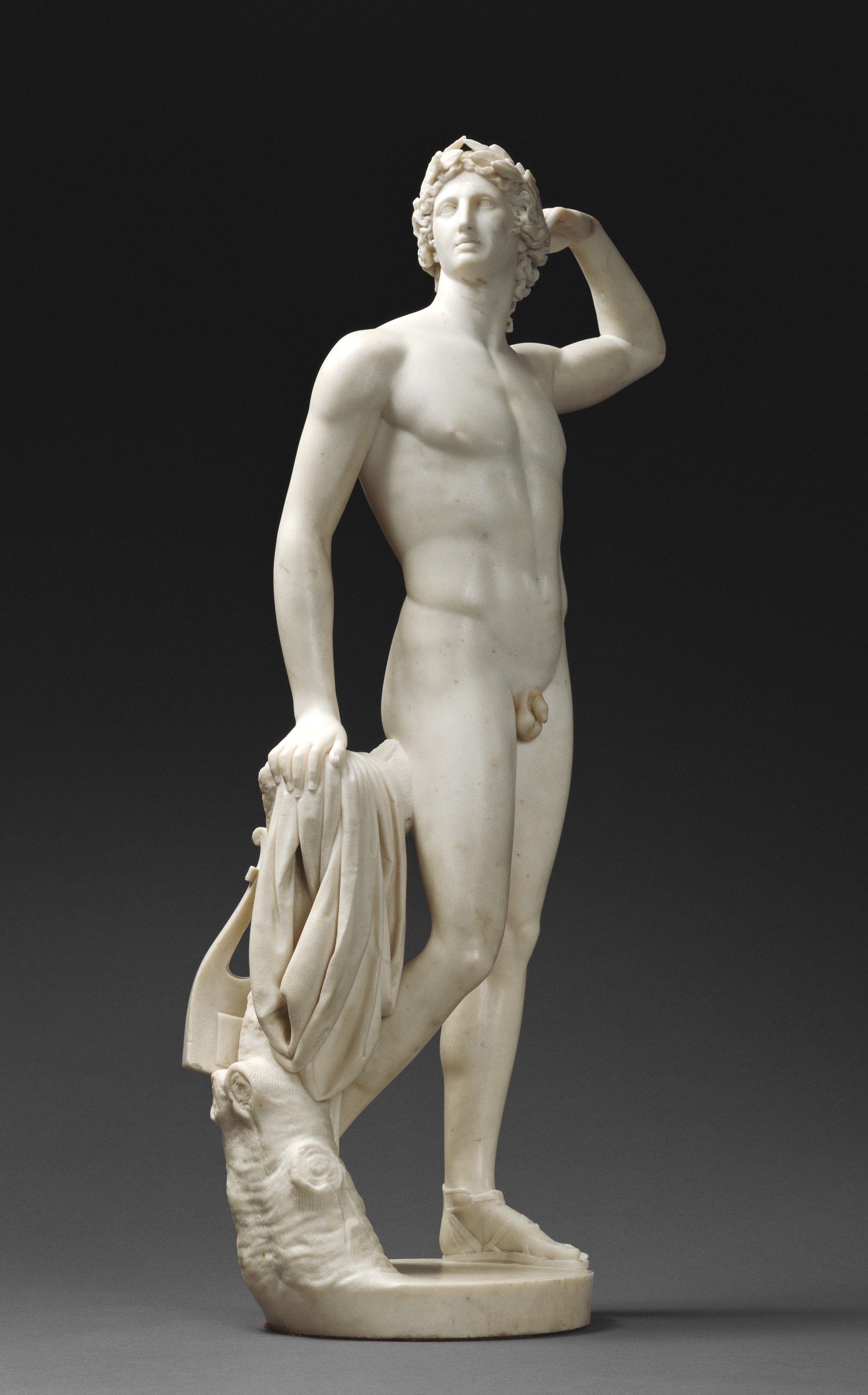
In the late 18th century, Neoclassical sculptor Antonio Canova reinterpreted this ideal in Apollo Crowning Himself [above](1781–1782), depicting the god nude, lifting a laurel wreath with quiet triumph. It is a vision of reason and beauty as divine harmony.
Modern artists have reclaimed Apollo with more intimate and erotic intentions. Photographer Herbert List’s Nap in the Afternoon [above] (1933) portrays a nude young man reclined in soft light, radiating not mythic grandeur but human vulnerability and quiet sensuality. Likewise, Pierre et Gilles’ Apolló [below](2005) transforms the god into a glowing nude queer icon, bathed in gold, sun rays, and self-aware kitsch—modeled by Jean-Christophe Blin with overt erotic charge.
Adonis, loved by both Aphrodite and Persephone, represents ephemeral beauty—the lover who dies young, whose body becomes memory and myth.
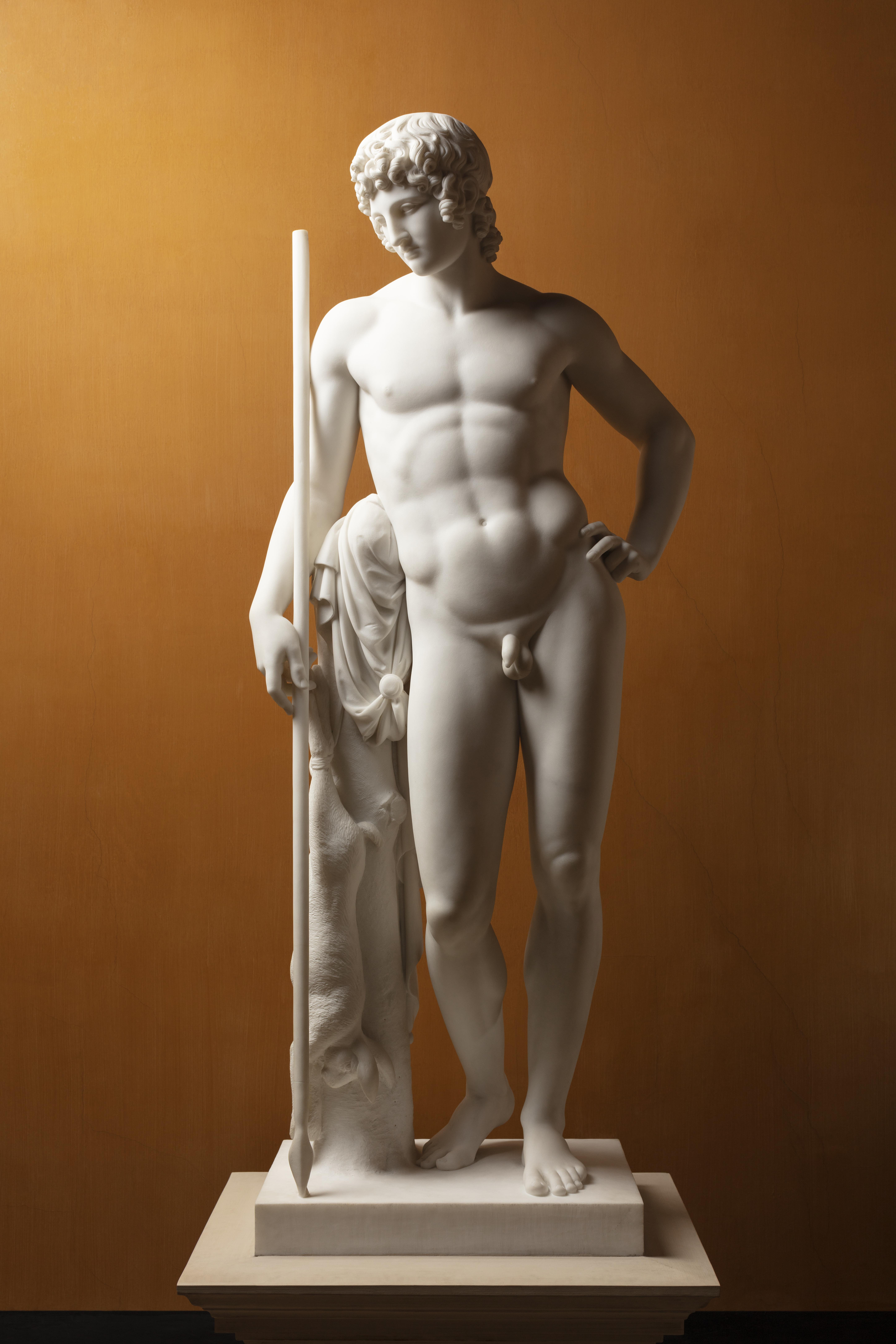
Bertel Thorvaldsen’s Adonis [above] (1808–1832) renders him fully nude and poised with graceful sorrow, a figure both heroic and tender. This tension becomes tragic in Peter Paul Rubens’s Venus Mourning Adonis [below] (1614), where Adonis lies partially nude in Venus’s embrace, his body mourned as much as it was desired.
In modernity, Adonis has been reborn as a name for fitness models, physique photography, and pornographic performers. Whether in glossy “Adonis Physique” [below] portfolios or by adult actors adopting the name, these contemporary “gods” continue the legacy of youthful male beauty displayed and consumed—reflecting society’s ongoing obsession with eroticized perfection.
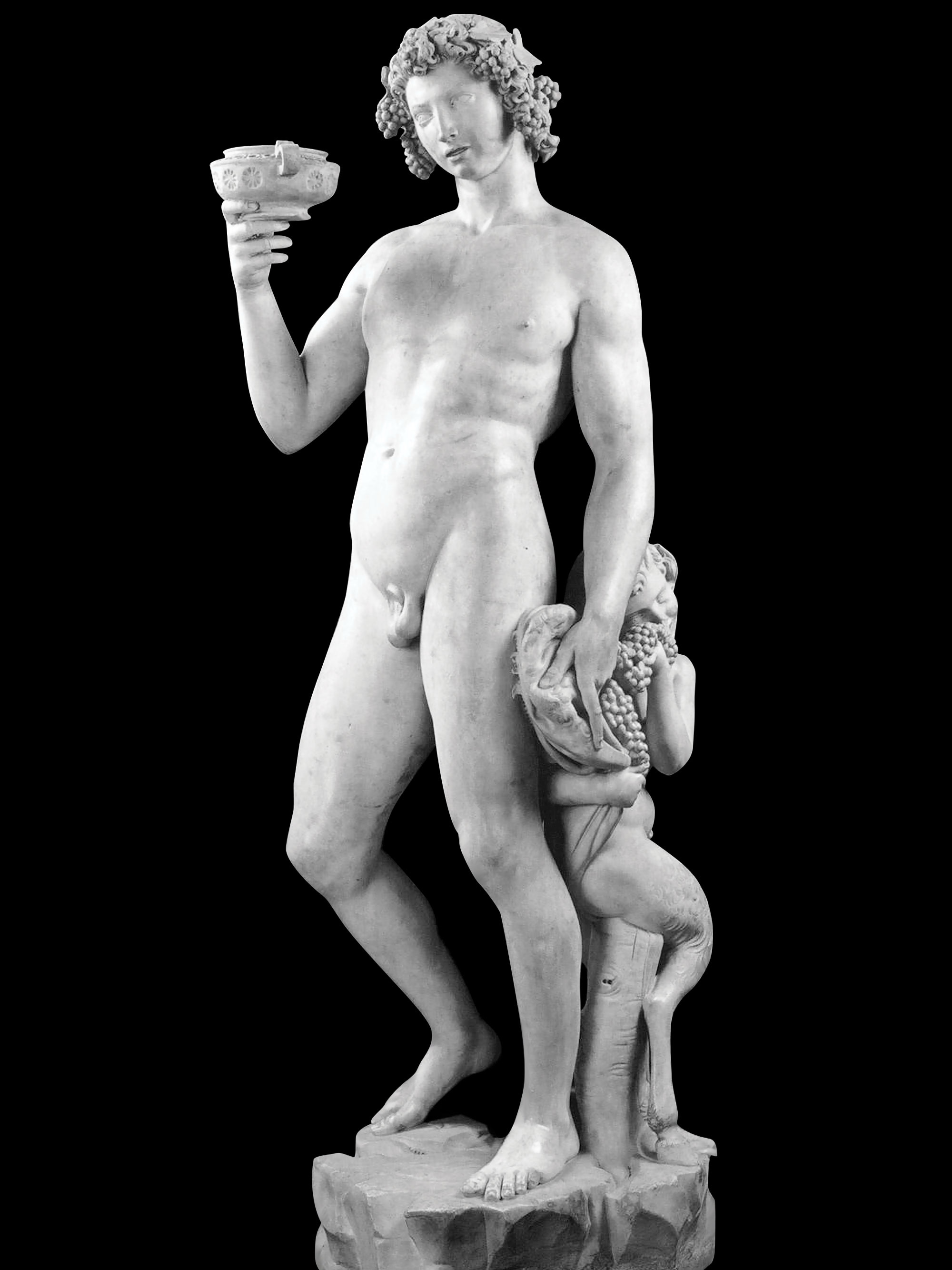
While Apollo embodies clarity and Adonis, fragility, Dionysus represents something wilder—fluid gender, sensual abandon, and ecstatic freedom.
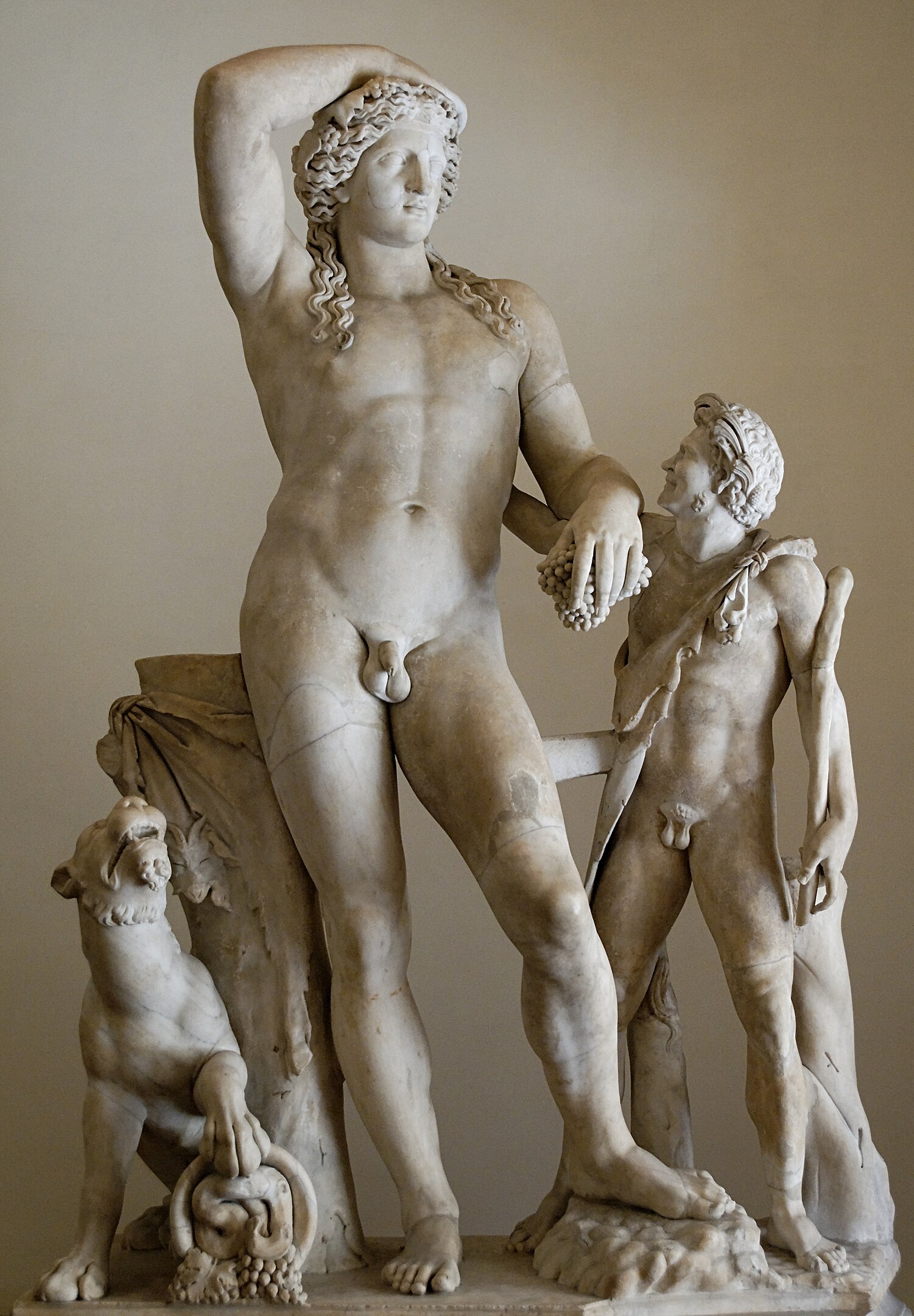
The Ludovisi Dionysus [above] (2nd century CE) captures this duality, showing the god nude and youthful, reclining beside a satyr. His form is less structured than Apollo’s, more languid—inviting the viewer into the pleasures of intoxication and eroticism.
Michelangelo’s Bacchus [above] (1496–1497) expands this image with a staggering, fully nude god offering wine. His body is softly muscled, unsteady, and provocatively unguarded—a subtle challenge to Renaissance masculinity.
In modern queer art and performance, Dionysus is frequently reimagined as a nude figure of androgynous seduction—adorned with ivy, lounging among vessels and male companions. Whether in contemporary photography, drag, or performance art, he embodies liberation from gender, structure, and shame.
Ganymede, the beautiful Trojan prince abducted by Zeus, is mythology’s most overt celebration of male same-sex desire. Ancient Greek art embraced this narrative, often depicting Ganymede nude and pursued by Zeus in eagle form, as on red-figure vases from the 5th century BCE.
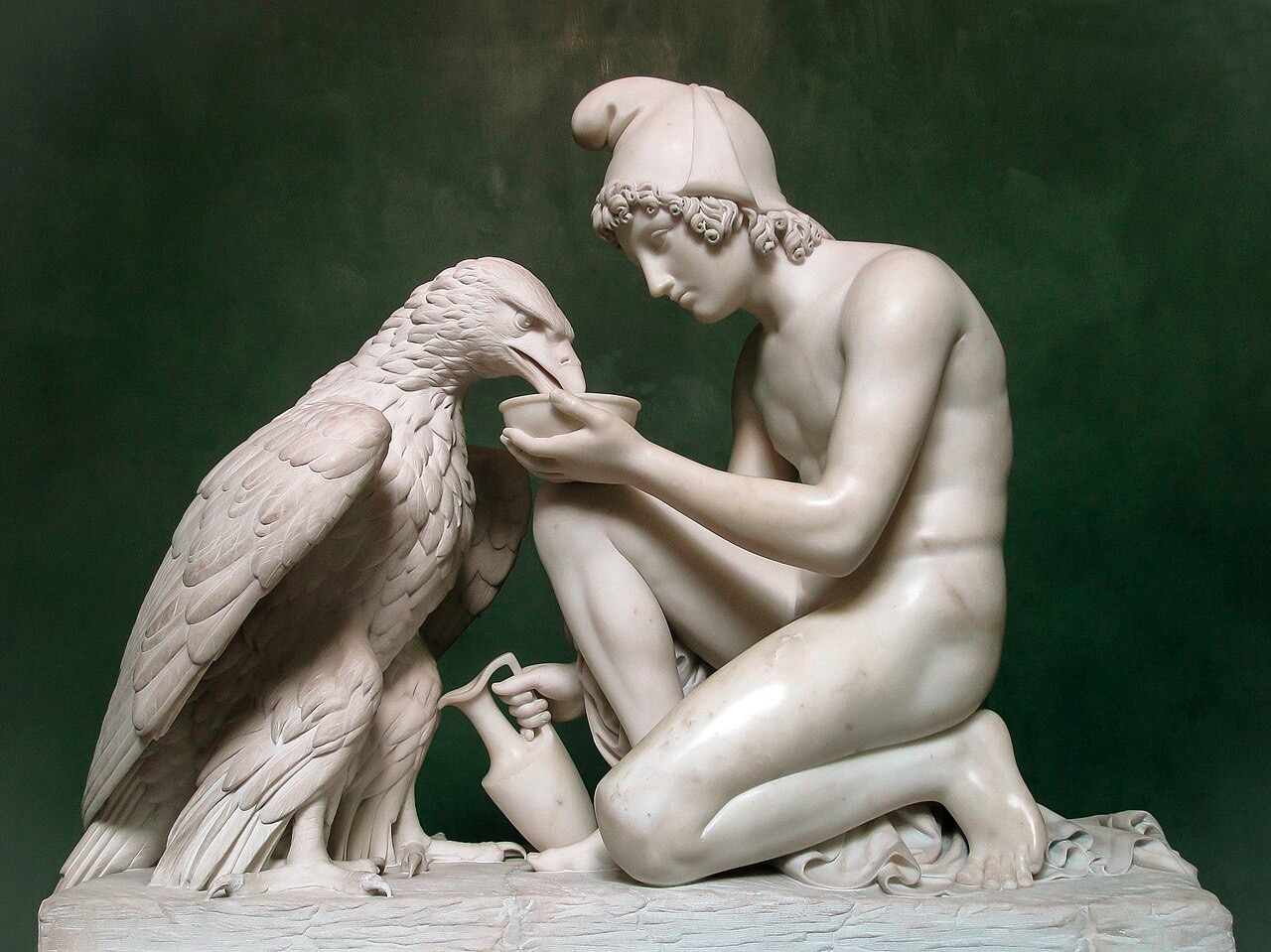
Neoclassicism softened the abduction in Bertel Thorvaldsen’s Ganymede and the Eagle [above] (1817). Here, Ganymede stands fully nude, offering a cup to Zeus with serenity and grace. His nudity is not scandalous but dignified, even sacred.
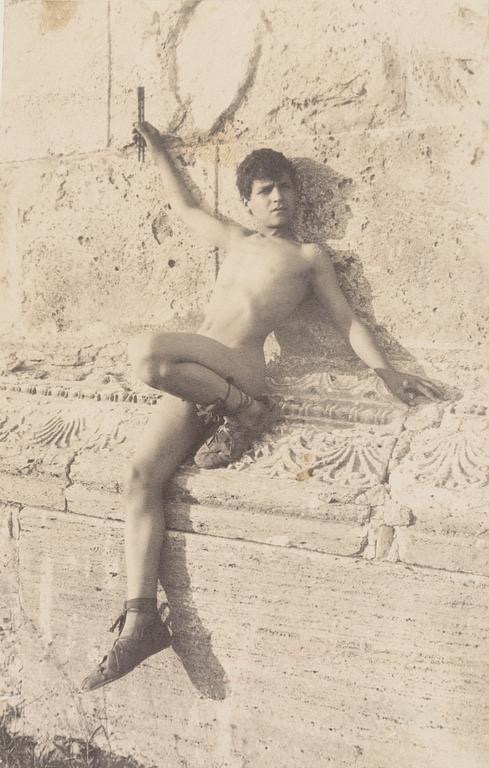
This narrative takes a more intimate turn in Wilhelm von Gloeden’s Ganymede-inspired photographs [above] , taken in Sicily between 1890 and 1910. His nude young models, posed with amphorae or gazing skyward, evoke myth while offering coded homoerotic imagery at a time when queer expression was criminalized. These photographs blend longing, artifice, and resistance—a queer reclamation of myth.
From ancient temples to modern studios, the nude forms of Apollo, Adonis, Dionysus, and Ganymede have served as vessels for beauty, longing, and erotic speculation. Their depictions reveal more than aesthetic ideals; they reflect how cultures across time have understood desire—particularly same-sex desire—not as taboo, but as divine.
These bodies, carved in marble, painted in oils, or captured in silver print, continue to remind us that queer love, and the beauty that awakens it, is older than shame and as enduring as myth.


























 Joe
Joe





 The Closet Professor