

Start Each Day with Hope

“This is the day that the Lord has made; let us rejoice and be glad in it.”
—Psalm 118:24
Mornings can be tough, especially when the world around us feels heavy. As gay men, many of us have faced rejection, loneliness, or struggles with self-acceptance. Some days, it’s easy to wake up feeling discouraged, wondering if things will ever truly get better, especially under the current administrations regime. But here’s the truth: Every day we wake up is a new opportunity—a fresh start filled with God’s love, grace, and purpose. The enemy would love nothing more than for us to wake up and immediately focus on what’s wrong—the hardships, the disappointments, the fears, especially the fears. But God calls us to something greater. Instead of dwelling on the negativity, what if we started each day by thanking God for another chance to experience His goodness?
Paul reminds us in Romans 12:2, “Do not be conformed to this world, but be transformed by the renewal of your mind.” This means that our outlook on life isn’t shaped by what happens to us, but by how we choose to see it. Even when things look bleak, we can renew our minds by focusing on God’s promises rather than our problems. One of the most beautiful reminders in Scripture comes from Lamentations 3:22-23, “The steadfast love of the Lord never ceases; his mercies never come to an end; they are new every morning; great is your faithfulness.” No matter what happened yesterday—no matter the mistakes, the hurt, or the disappointment—God’s mercies are fresh each morning. He doesn’t hold our past against us. He meets us with grace and gives us the strength to keep going.
Before you even get out of bed, declare God’s truth over your life. Say, “I am loved. I am chosen. I have a purpose.” This affirmation reminds me of the movie, The Help. It’s a look at life in Jackson, Mississippi back in the early 60’s when racial division and inequality were most evident in the lives of the citizens of that community. I’ve watched The Help several times, and I am sadly reminded of a time when so many people were marginalized and treated as if they were less-than-human. I guess part of what saddens me is that much of the division and inequality between races remains still. We also see division and inequality today, especially with how politicians and churches treat transgender individual and other members of the LGBTQ+ community. In the movie, an African-American maid and nanny named Aibileen Clark, played by Viola Davis, helps to raise a young white girl named Mae Mobley, played by Eleanor Henry. In her role as a nurturing care-giver, Aibileen attempts to speak encouragement, value and worth into the life of the young girl by having her repeat several phrases along with her. “You is smart, you is kind, you is important.” Similarly, we can tell ourselves “I am loved. I am chosen. I have a purpose.”
Be mindful of what you consume in the morning. Instead of doomscrolling or watching latest disasters on the news, start your day with some good music, read your Bible, say a prayer, or just take a long hot shower to rinse away all the negativity you might have woken up with that morning. Some days will still be hard. There will be moments when the weight of the world feels overwhelming. But even in those moments, remember: You are not alone. God sees you, He loves you, and He has plans for you. There are also people in your life who love you and care about you. There are people who make you happy, remember them. So today, no matter what you’re facing, take a deep breath and say: This is the day the Lord has made—I will rejoice and be glad in it! Thank the Lord for a new day and fresh mercies. When life feels overwhelming, God can help us focus on His goodness instead of our worries. We should fill our hearts with joy, our minds with peace, and our spirits with strength. No matter what comes our way, we can choose to trust in God and embrace this day with hope. Go forward today and everyday knowing you are deeply loved, and let that love be the reason you rise each morning with joy.




Better

Thankfully, I am feeling better today. Yesterday was a doozy of a migraine, and I ended up taking a sick day from work. Today is a work from home day, which means I can take it a little easier and be more comfortable than if I were at the office. I have a bit of work that has to be done, so I can’t take it too easily.
Late this afternoon, I have an appointment with my eye doctor. I haven’t had an eye exam in several years, and I know it’s past time to get one. My eye sight has definitely gotten worse, and I need to know for sure what strength reading glasses I need. Also, I’m out of contacts, and I need a new prescription to buy any more.
Even though it will be a work from home day, it will also be a busy day. At least it’s Friday. I hope everyone has a wonderful weekend!

Bad Sleep

I had a terrible night’s sleep last night. I went to bed about an hour early, but I was awake at 2:30 am. I tried going back to sleep and may have dozed a bit. However, when I woke up again, it was 3:00 am. At 3:30 am, I was wide awake. I never did fall back to sleep again. I was in that half awake, half sleep mode until I finally got up for good a little after 5:00 am. I also woke up with a headache. If my headache doesn’t improve soon (sometimes it does once I am up and moving around), I’m going to call in sick to work.
Here’s your Isabella pic of the week:

She was such a cute little kitten. She seemed to be all fluff.

Framing Desire: Artful Erotic Photography

The history of early photography of naked men is closely tied to artistic traditions, social taboos, and legal restrictions, particularly in the 19th and early 20th centuries. While photography provided a new medium for capturing the human form, it also faced censorship and moral scrutiny. As a result, photographers often had to employ various strategies to create images that were erotic but still permissible under the law.
In the 19th century, nude male photography was often justified through its connection to classical art and academic study. Photographers used the precedent set by Greek and Roman sculpture, Renaissance paintings, and life drawing classes to frame their work as educational and artistic rather than pornographic. By emphasizing the male nude as a study of anatomy or an expression of classical beauty, they were able to produce and circulate such images under the guise of art.

Many early photographers of nude men focused on athleticism and physical perfection, presenting their subjects as bodybuilders, wrestlers, or classical figures. This approach aligned with the growing interest in physical culture and health movements of the late 19th century. The work of photographers like Eadweard Muybridge, who captured male movement in a scientific manner, helped lend legitimacy to nude male imagery as a form of study rather than explicit erotica.
Some photographers created nude male studies specifically for artists to use as reference material. These “academic nudes” often depicted men in classical poses, mimicking sculptures like those of Michelangelo or Praxiteles. By presenting these images as educational tools, photographers could justify the nudity and avoid accusations of obscenity.

To cater to an audience that sought erotic imagery without violating legal restrictions, photographers used subtle posing, lighting, and suggestive themes to create implied sensuality. Some of the most common techniques included partial nudity (e.g., drapery covering genitals), positioning subjects in classical, heroic, or mythological contexts, physical intimacy without overt sexuality (such as men wrestling), and soft focus and artistic blurring to create an impressionistic effect that distanced the images from explicit realism.
Some of the most significant photographers of male nudes include Wilhelm von Gloeden (1856–1931), Fred Holland Day (1864–1933), Baron Wilhelm von Plüschow (1852–1930), and Eadweard Muybridge (1830–1904). Gloeden was famous for his staged photographs of young men in classical and pastoral settings in Sicily. His work was often erotic yet defended as “artistic” due to its connection to classical themes. Day was an American photographer who created religious and mythological images featuring nude men, pushing the boundaries of acceptability. Plüschow, like Gloeden, photographed young men in Mediterranean settings, using classical themes to justify nudity. While not an erotic photographer, Muybridge’s motion studies of the nude male body were widely referenced for their anatomical and artistic value.
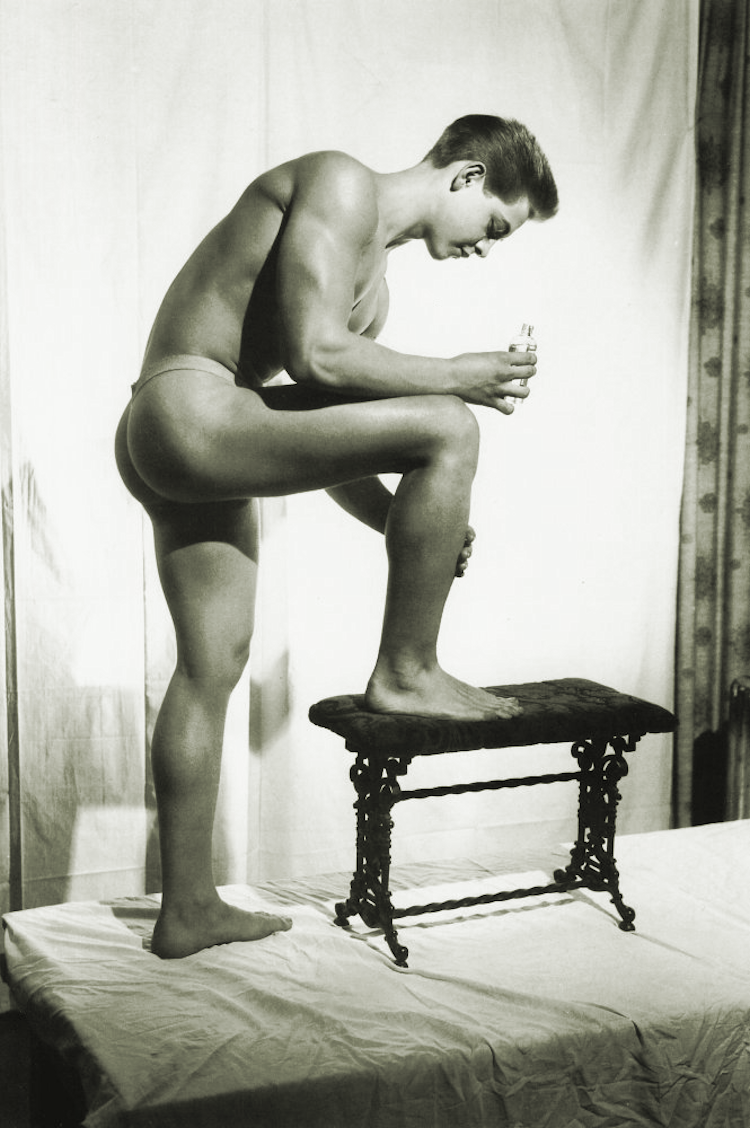
In the 19th and early 20th centuries, obscenity laws restricted explicit nude photography, particularly if it was seen as erotic rather than educational or artistic. The Comstock Laws in the U.S. (1873) made it illegal to distribute “obscene” material, which included certain forms of nude photography. Many photographers operated discreetly, producing private or underground collections for clients who sought male erotic imagery. In the 1930s, George Platt Lynes, an American fashion and commercial photographer, began taking nudes of friends, performers, and models, including a young Yul Brynner, although these remained private, unknown, and unpublished for years. The difference between “art” and “pornography” was often subjective, leaving photographers to defend their work based on artistic merit.
By the 1940s and 1950s, physique photography became a major outlet for male nudity. Photographers such as George Quaintance, Lon Hanagan (Lon of New York), and Bob Mizer (Athletic Model Guild) used images of muscular men in skimpy posing trunks or classical warrior outfits to suggest nudity without breaking obscenity laws. These images were marketed as “health and fitness” material but were clearly aimed at a gay audience.
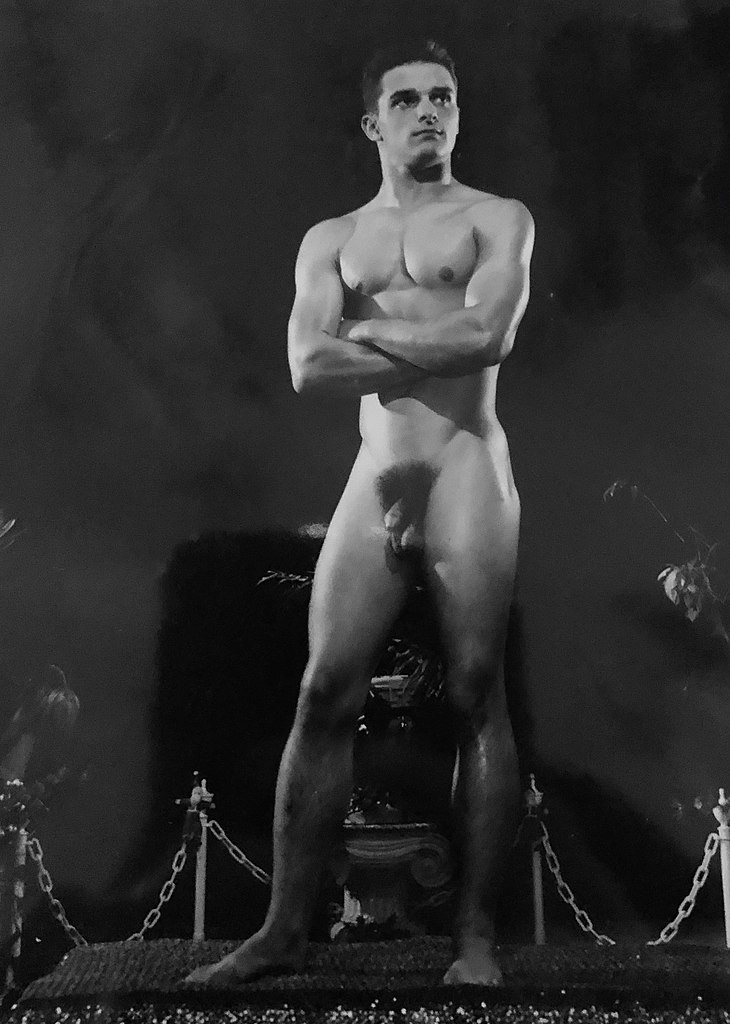
The photographs taken survive in various archives. Lynes’s photographs featuring gay artists and writers from the 1940s that were acquired by the Kinsey Institute. Most of Gloeden’s surviving pictures (negatives and prints) are now in the Fratelli Alinari photographic archive in Florence and further prints are in private collections or held by public institutions such as the Civico Archivo Fotographico in Milan. Examples of Mizer’s work are now held by esteemed educational and cultural institutions the world over, and can be found in various books, galleries, and private art collections.
The early history of male nude photography is a story of balancing art, censorship, and hidden desire. Photographers used classical references, athleticism, and coded eroticism to create images that were both sensual and legally defensible. While these early images were often constrained by societal norms, they laid the groundwork for more openly homoerotic and artistic expressions in later decades.



Authors
Recent Comments
furbirdsqueerly on Pic of the Day Joe on Pic of the Day noisilycool3bc985058… on Pic of the Day vandycolt on Moment of Zen: Reading noisilycool3bc985058… on Pic of the Day Top Posts & Pages




Amazon Associate

As an Amazon Associate I earn from qualifying purchases. So, if you click on a link that takes you to Amazon.com, I may earn a commission.
Trust me, it isn’t much, but every little bit helps.

 Joe
Joe


 The Closet Professor