Monthly Archives: July 2010

Author Spotlight: Jason Goodwin

Jason Goodwin (born 1964) is a British writer and historian. He studied Byzantine history at Cambridge University. Following the success of A Time For Tea: Travels in China and India in Search of Tea, he walked from Poland to Istanbul, Turkey. His account of the journey, On Foot to the Golden Horn, won the John Llewellyn Rhys/Mail on Sunday Prize in 1993.
imageSubsequently he wrote Lords of the Horizons: A History of the Ottoman Empire. Later, he became popular as the author of the mysteries The Janissary Tree and The Snake Stone, two books which pivot on a Turkish eunuch detective, Yashim, who lives and works in 19th century Istanbul. The Janissary Tree won the coveted Edgar Award for Best Novel in 2007 and will be available in 38 languages. The third Yashim novel, The Bellini Card, was released in the summer of 2008. A fourth novel is set to be published in April 2011 called An Evil Eye (Yashim the Eunuch). The books are a fascinating read. Yashim the eunuch was castrated as a boy by an enemy of his father’s, so he did what anyone during this 1800s in Istanbul who had lost their testicles—he became a eunuch. These books are most certainly not gay books, though they are far from homophobic, it just isn’t part of the stories. As a member of the royal household, Yashim is the detective the Sultan turns to when he needs a mystery solved. Yashim uses his many contact, including his friend the Polish ambassador, Stanislaw Palewski (both feel a kindred spirit because Poland was no longer a country, and thus as Palewski says, he is a man without a country—not fully a man at all, and Yashim is a man without balls—not fully a man either.
The Janissary Tree: A Novel
image In 1836, though the corrupt elite troops known as the Janissaries were crushed 10 years earlier, there are ominous signs that their influence still persists in the twisted alleys and secret places of Istanbul. A series of crimes, including the barbaric murders of several soldiers and the theft of some precious jewels, leads eunuch Yashim Togalu to delve into the past in an effort to separate legend from truth. With special access to all areas of the sultan’s royal court, Yashim uses his network of contacts to try to solve the crimes.

The Snake Stone: A Novel
imageWhen French archeologist Maximilien Lefèvre begins asking very pointed, well-informed questions about long-lost Greek artifacts and then is found dead outside the French embassy, series hero Yashim, a Turkish eunuch, finds himself suspected of the murder. His efforts to clear his name take him from markets and wharves to palaces and underground tunnels as he uncovers a secret society, unearths sacred relics and hunts the murderer. Goodwin’s secondary characters, particularly Yashim’s close friend Stanislaw Palewski, the world-weary Polish ambassador, are distinct and memorable, and the mystery presents an entertaining challenge to the reader as well as to charming, determined Yashim.
The Bellini Card: A Novel
image Near the start of Edgar-winner Goodwin’s fine third historical to feature the eunuch Yashim, who serves the Ottoman rulers of early 19th-century Turkey (after 2008’s The Snake Stone), Yashim’s close friend Stanislaw Palewski, the Polish ambassador to the Turkish sultan, accepts an undercover assignment on the sultan’s behalf. Posing as an American, the diplomat travels to Venice in an effort to locate a portrait of Mehmet the Conqueror (who reclaimed Constantinople from the Christians in 1453), painted by the legendary artist Gentile Bellini. Fortunately for Palewski, Yashim, who has a secret plan for the painting’s recovery, intervenes in time to set the mission on the right track after the murder of two art dealers. While Yashim initially plays a backstage role, the eunuch and a shadowy power broker engage in an exciting and complex duel of wits in the book’s final quarter.


Achilles and Patroclus

Surrender of Briseis; Marble bas-relief - Bertel Thorvaldsen

The relationship between Achilles and Patroclus is a key element of the myths associated with the Trojan War. imageIts exact nature has been a subject of dispute in both the classical period and modern times. In the Iliad, it is clear that the two heroes have a deep and extremely meaningful friendship, but the evidence of a romantic or sexual element is equivocal. Achilles is tender towards Patroclus, while he is callous and arrogant towards others. Commentators from the classical period on have tended to interpret the relationship through the lens of their own cultures. Thus, in Athens during the 5th century BC, the relationship was commonly interpreted as pederastic. While some contemporary readers maintain the same pederastic view, others believe the relationship to simply be a strong friendship between two war heroes. Contemporary readers are more likely to interpret the two heroes either as non-sexual “war buddies”, or as an egalitarian homosexual couple.

Due to this strong relationship, the death of Patroclus becomes the prime motivation for Achilles to return to battle. image The friendship of Achilles and Patroclus is mentioned explicitly in the Iliad. Whether in the context of a tender friendship or military excellence, Homer makes their strong connection clear.

The death of Patroclus underpins a great deal of Achilles’ actions and emotions toward the Trojan war for the rest of the poem. Achilles’ strongest interpersonal bond is with Patroclus, whom he loves dearly. As Gregory Nagy points out,

For Achilles … in his own ascending scale of affection as dramatized by the entire composition of the Iliad, the highest place must belong to Patroklos…. In fact Patroklos is for Achilles the πολὺ φίλτατος … ἑταῖρος — the ‘hetaîros who is the most phílos by far’ (XVII 411, 655).

(Hetaîros means companion or comrade; in Homer it is usually used of soldiers under the same commander. Later the word is used of concubines.)

Although most warriors fought for personal fame or their city-state (including, at times, Achilles), at certain junctures in the Iliad, Achilles fights for Patroclus. image He dreams that all Greeks would die so that he and Patroclus might gain the fame of conquering Troy alone. After Patroclus dies, Achilles agonizes touching his dead body, smearing himself with ash, and fasting. He laments Patroclus’ death using language very similar to that later used by Andromache of Hector. For a brief moment Achilles’ character shifts from a strong and unbreakable warrior to an emotional and vulnerable character. However, Thetis motivates Achilles to return to the battlefield. Achilles returns to the battlefield with the sole aim of avenging Patroclus’ death by killing Hector, Patroclus’ killer, even though the gods had warned him that it would cost him his life.

Achilles’ attachment to Patroclus is an archetypal male bond that occurs elsewhere in Greek culture: Damon and Pythias, Orestes and Pylades, Harmodius and Aristogeiton are pairs of comrades who gladly face danger and death for and beside each other.  Their bond was also the inspiration for the bond between Alexander and Hephaestion.


Alexander The Great’s Gay Lovers

THE GAY LOVERS OF ALEXANDER III OF MACEDON,
known as ‘THE GREAT’

Alexander the Great
Alexander the Great
Note on Alexander, the movie by Oliver Stone
When Oliver Stone was thinking of doing a movie on the life of the legendary son of king Phillip II of Macedon and queen Olympias, one unexpected obstacle stood in his way: the Greek government. It didn’t want one of their greatest heroes ‘besmirched’ by public knowledge of his male loves. As a result, the film was shot mainly in Morocco and Thailand.  No scenes were filmed in Greece, as the Athens News Agency explains, because of government opposition to Stone’s portrayal of the Greek hero.
Not surprisingly, these “erotic reality deniers” provided Mr. Stone with free publicity, as well as comic relief. A group of homophobic Greek lawyers even threatened to sue Warner Bros. and the director for implying Alexander the Great was bisexual. The lawyers, trampling their own intellectual heritage underfoot, sent a letter to the studio demanding they state in the title credits that the movie was a fictional tale.
Drama surrounding the “gayness” of Alexander has a precedent. A couple of years previously, a mob of hundreds of Macedonian Greeks stormed an archeological symposium after a speaker presented a paper on the homosexuality of Alexander. Police were then called in to evacuate . . . the scholarly participants!
image Not that Hollywood was any better. The film, which Stone had been trying to get on the screen for 15 years, received only lukewarm applause. It later came out that the studio pressured Stone to cut all the scenes of Alexander’s affair with that dangerous brat Bagoas. No wonder the critics found the leftovers boring!  Stone’s movie could have been done much better; he could have portrayed Alexander as we know him historically, gay lovers and all, but Colin Farrell was not the best choice to play Alexander.  When the DVD was released, Stone attempted to salvage the movie by rearranging the scenes and taking out much of the homosexual content.  The movie became such a boring travesty, that Stone had to re-release the DVD as an original directors cut, even that could not help this movie very much.  At least it featured a little bit of nudity.
The Life of Alexander the Great
image Alexander the Great commanded his first battles while only sixteen years old and went on to conquer the entire known world, leading his troops from the mountains of northern Greece all the way to the mountains of northern India. He subdued every opponent in his path, from the Greek city states to the kingdoms of North Africa, Asia Minor and Persia. His relentlessness in battle, often tempered by his magnanimity to the vanquished, was legendary. But so was his devotion to his friends and companions, and the love which he shared almost exclusively with his male peers starting in tender childhood.
This was no chance event. Born in August of 356 BCE, under the sign of the lion, he was the quintessential product imageof a patriarchal warrior culture, the very paragon of a male dominated world ruled by masculine values and a masculine aesthetic. His tutor from the age of thirteen on was the philosopher Aristotle, who commented on the excesses as well as the values of pederasty, and who had a number of male beloveds of his own. Alexander embodied those ethics for the rest of his brief but volcanic life. However, he stretched the accepted boundaries of ancient male love. Not only did he have love affairs with boys, but above them all, was his love for a man his own age, his childhood friend Hephaestion. This relationship resembled modern gay love and became legendary for it’s passion.
image What may seem normal to some of us today, the gay love of one man for another, in ancient days was frowned upon as a threat to masculinity and the structure of society. Love between grown men and teenage boys was the only proper way for two males to love each other. The men vied to be chosen by the boys as their lovers and the boys, ideally, were educated and led into adulthood by their lovers. Their love was an erotic love, and it often had its sexual aspects, but, as many of the philosophical and oratory texts show, men were expected to refrain from penetrating their beloved boys. Though in Alexander’s world of palaces, power, and passion, the pedagogic ideal was honored more in the breach than the observance, yet boys remained the focus of men’s affection. Philip II himself, Alexander’s own father, pursued young lovers tirelessly all his life. His very death came at the hand of a vengeful former beloved, Pausanias, who had been spurned by the king for a prettier boy. One trifled with Greek boys at one’s peril!
image Unlike Philip’s affairs, the love between Alexander and Hephaestion never waned. Alexander saw their love as emulating that heroic love between Achilles and Patroclus, another ancient couple that modern gay couples can look to as an example of devotion. Crossing into Asia on their way to Persia, the two halted their campaign in Illium by the ruins of Troy. There Alexander sacrificed and offered garlands at the shrine of Achilles, while Hephaestion did the same at the shrine of Patroclus. Following the ancient custom, Alexander ran naked around the hero’s tomb, proclaiming his admiration for Achilles, “fortunate in life to have so faithful a friend, and in death to have so famous a poet.”
Male love did not blind the Greeks, nor Alexander, to the lure of beautiful women: he married Roxane, a Persian princess, daughter of Oxyartes of Bactria, and fathered a child with her. Later, as the Roman/Greek historian Arrian reports, Alexander, while in Persia at Susa “…held wedding ceremonies for his Companions; he also took (another) wife himself – Barsine, Darius’ eldest daughter, and, according to Aristobulus, another as well, namely Parysatis, the youngest daughter of Ochlus…”(VII.5)
His love of women, however, may have been an acquired taste. The Roman historian Curtius reports that “He scorned (feminine) sensual pleasures to such an extent that Olympias, his mother, was anxious lest he be unable to beget offspring.” To whet his appetite for the fair sex, King Philip and Olympias had Kallixeina, a Thessalian hetaira (a professional courtesan) brought in. And one of his contemporary biographers, Eumenes, claimed Alexander “was not at his ease with sex.”
The other great male love of Alexander’s life that we know about was the eunuch Bagoas.image The two met while Alexander was on campaign against the Persian king Darius. The war had raged for some time, with Darius finally on the run, deserted by his vassals and eventually assassinated by one of his own men. His general, Nabarzenes, went to swear fealty to Alexander and to offer rich gifts, a beautiful boy among them. Curtius describes him as “… Bagoas, a eunuch exceptional in beauty and in the very flower of boyhood, with whom Darius was intimate and with whom Alexander would later be intimate,” (VI.5.23) The stormy, outspoken character of the boy matched his stunning looks and the friendship and love which grew between him and the warrior king lasted the rest of their lives.
image Alexander saw to it that his young beloved was well provided for. As Eumenes recounts, the king installed Bagoas in a villa outside of Babylon and required all his officers and courtesans, both Greek and Persian, to render him honors (to present him with rich gifts). They all did but one, the faithful satrap Orsines, who claimed that he had come “to honor the friends of Alexander, not his whores,” and that “it was not the custom of the Persians to take males in marriage who had been turned into women for the sake of being fucked.” Enraged, the young Bagoas wrought Orsines’ destruction by means of endless calumnies, rousing Alexander’s mind to anger until he condemned the man to death. Still not satisfied with his handiwork, Bagoas struck Orsines as he was being led off to execution. Orsines turned and drove home one final insult: “I had heard that women once reigned in Asia; this however is something new, for a eunuch to reign!” (Curtius, X.1.22)
imageAlexander’s favor to Bagoas can also be seen in his later appointment of Bagoas as one of the trierarchs, men of substance who oversaw and funded the construction of the navy for the journey homeward. Their love affair is attested to by many historians of the time, such as Plutarch, who recounts an episode showing that the love between the two was common knowledge among the troops, and much appreciated. At a dancing contest, Bagoas had won the honors then went to sit by the side of the king, “which so pleased the Macedonians that they shouted out for him to kiss Bagoas, and never stopped clapping their hands and shouting till Alexander took him in his arms and kissed him warmly,” (Plutarch, The Lives). The episode is attested by several ancient writers.
image This new love in no way affected the deep devotion which bound him to Hephaestion, which was itself famous throughout Magna Graecia. The cynic philosopher Diogenes wrote to Alexander about it, berating him for his sexual enslavement (and incidentally casting a light on the type of sexual intercourse preferred by Greek men: face to face, between the thighs): “If you want to be kalos kagathos (“beautiful and good”, the Greek expression for noble and ideal) throw away the rag you have on your head and come to us. But you won’t be able to, for you are ruled by Hephaestion’s thighs.” (Diogenes of Sinope, Letters, 24) Their love was undone only by Hephaestion’s death during the summer festivities at Ecbatana (in Persia) on their way home from India.
Alexander, who had borne hardship and wounds that would have felled a lesser man, was completely undone by this loss. It is said that he lay upon Hephaestion’s body for a day and a night and finally had to be dragged off by his friends. For another three days he remained mute, in tears, fasting. When he rose he sheared off all his hair and ordered all the ornaments in the city broken off the walls and the manes and tails of all the horses sheared. He forbade all music in the city and ordered every town in the empire to carry out mourning rituals. Then he sent envoys to Ammon’s oracle at the oasis of Siwah in Egypt to ask that divine honors be granted to his dead friend. The body of Hephaestion was embalmed and carried on to Babylon, where it was cremated on a pyre, in a funeral on which he planned to spend astronomical sums. Little did Alexander know that Babylon was to become his final stop as well. Forced to stay in the town through the hot, mosquito-ridden summer months, he took sick and died after a short illness. By our accounting the year was 323 BCE. Alexander was only 33 years old.
Editorial Board, World History of Male Love, “Famous Homosexuals”, The Gay Lovers of Alexander the Great, 2000 <http://www.gay-art-history.org/gay-history/gay-literature/famous-homosexuals/alexander-great-gay/alexander-great-gay.html>
Just for the record, to any of my Greek readers, always remember this, the greatest man in Greek History was a homosexual (ο μεγαλύτερος άνθρωπος στην ελληνική ιστορία ήταν ομοφυλόφιλος), not a pederast like many ancient Greeks, but a homosexual who had a male lover of equal age, which made a huge difference in the Ancient Greek World.


Bagoas

image Bagoas (in Old Persian Bagoi) was a eunuch in the Persian Empire in the 4th Century BCE, said to have been the catamite (a boy kept for homosexual purposes) of both Darius, and later Alexander the Great.

Another eunuch of the same name, a vizier of the empire, deposed one Persian king and was killed by another when this Bagoas, called son of Pharnuches, would have been a young child.

Fictionalized versions

image Bagoas is the narrator and title character of The Persian Boy, the historical novel by Mary Renault, which portrays him sympathetically. He reappears in a smaller but still significant role in the sequel Funeral Games. He makes an even briefer appearance in Les Conquêtes d’Alexandre by Roger Peyrefitte. Peyrefitte, unlike Renault, has Bagoas riding to battle by the side of Darius. He is also a major character in Jo Graham’s novel Stealing Fire, part of her Numinous World series. Played by Francisco Bosch, he also appears in the Oliver Stone film Alexander, which is based in part on Renault’s writings.


Two-Spirit, The American Third Sex

George Catlin (1796-1872), Dance to the Berdache.

Catlin_-_Dance_to_the_berdacheDrawn while on the Great Plains, among the Sac and Fox Indians, the sketch depicts a ceremonial dance to celebrate the two-spirit person.
pic-25 Gay Native Americans call themselves Two-Spirits and have historically been considered a third sex, though they did not suffer castration, which was not common in the Americas.  Two-Spirit People is an English term that emerged in 1990, out of the third annual inter-tribal Native American/First Nations gay and lesbian conference, in Winnipeg, to describe Native Americans who fulfill one of many mixed gender roles found traditionally among many Native Americans and Canadian First Nations indigenous groups. The mixed gender roles encompassed by the term historically included wearing the clothing and performing the work associated with both men and women.
 pic-17A direct translation of the Ojibwe term, Niizh manidoowag, “two-spirited” or “two-spirit” is usually used to indicate a person whose body simultaneously houses a masculine spirit and a feminine spirit. The term can also be used more abstractly, to indicate presence of two contrasting human spirits (such as Warrior and Clan Mother) or two contrasting animal spirits (which, depending on the culture, might be Eagle and Coyote); however, these uses, while descriptive of some aboriginal cultural practices and beliefs, depart somewhat from the 1990 purposes of promoting the term.
Prior to western contact, many American Native tribes had third-gender roles. These include “Berdaches” (a derogatory French term for genetic males who assumed a feminine role) and “Passing women” (genetic females who took on a masculine role). The term Berdache in not a Native American word; rather it was a European definition covering a range of third-gender people in different tribes. Not all Native American tribes had Transgender people.
pic-07 These individuals are often viewed as having two spirits occupying one body. Their dress is usually a mixture of traditionally male and traditionally female articles. They have distinct gender and social roles in their tribes.
alan-valdez-hispanic-native-americanTwo-spirited individuals perform specific social functions in their communities. In some tribes male-bodied two-spirits held active roles such as: healers or medicine persons, gravediggers, undertakers, handling and burying of the deceased, conduct mourning and sexual rites, conveyers of oral traditions and songs, nurses during war expeditions, foretold the future, conferred lucky names on children or adults, wove, made pottery, made beadwork and quillwork, arranged marriages, made feather regalia for dances, special skills in games of chance, led scalp-dances, and fulfilled special functions in connection with the setting up of the central post for the Sun Dance.
pic-24 In some tribes female-bodied two-spirits typically took on roles such as: chief, council, trader, hunter, trapper, fisher, warrior, raider, guides, peace missions, vision quests, prophets, and medicine persons.
native-american-i-dan-nelson Two-spirit people, specifically male-bodied (biologically male, gender female), could go to war and have access to male activities such as sweat lodges. However, they also took on female roles such as cooking and other domestic responsibilities. It is obvious from the list above that Two-Spirits carried out many of the most important tasks of the tribes.
For more information about Two-Spirits, please visit TWO SPIRIT: GBLT INDIAN NATION.  It is a very interesting article.

sexy_indian1sexy_indian2

Twospirit


The Sex Lives of Eunuchs

6a00e55370249988330133eca3558d970b-400wi
01dfrg
Throughout history, there has existed basically three types of eunuchs:  those where were castrated before puberty, those who were castrated after puberty, and those who had their penis and testicles removed during the castration. Those in the first group, who castrated during puberty, never developed mature sexual organs because they did not go through puberty.  With the lack of mature male hormones, i.e. testosterone, their voices never changed, they had more feminine features, often gained weight very easily and lacked muscle tone, and they were totally impotent.  6a00e55370249988330120a7c50f2c970b-400wi The second group, those who were castrated after puberty, went through puberty and though many took on feminine traits, it was easier for them to gain muscle mass, and they had the ability to get an erection. However, because of the lack of testicles, they could not produce sperm and therefore could not reproduce.  They did however, have the ability to ejaculate, though instead of the creamy white ejaculate most men produce, it would mostly be a clear viscous liquid composed of the parts of their semen not produced by the testicles.  The third group lacked a penis and testicles and therefore were obviously not able to get an erection.  They bodies could remain masculine, if the procedure occurred after puberty, but since it was a highly dangerous procedure during the years before modern surgery, it was often performed on young men. 
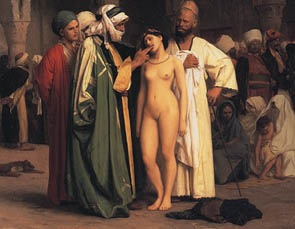
LOVING-040210-02 In the Ottoman Empire (modern day Turkey, the Middle East, Northeast Africa, and the Balkans), African slaves who were bought for the purpose of guarding the harem were often taken into the desert on their journey from sub-Saharan Africa to the Sultan’s palace and the procedure was performed there.  They young Africans’ penis and testicles were sheared off by a sharp blade, then a hot blade would cauterize the wound, and their bodies were buried in the hot sand up to their necks so that the bleeding could be staunched and the healing could begin.  Many did not survive this horrific and barbaric procedure.  If they did, they would be taken back to Istanbul as slaves to guard the women of the harem. Africans were not the only eunuchs of the Ottoman Empire.  300The conquered Christian communities of the Balkans in Eastern Europe were forced to pay a tax to the Ottoman Empire. Devşirme or devshirme (Serbian: Данак у крви and Bulgarian: Кръвен данъкtribute in blood) was the practice by which the Ottoman Empire conscripted boys from Christian families, who were taken from their families by force, converted to Islam, trained and enrolled in one of the four imperial institutions: the Palace, the Scribes, the Religious and the Military.  The devşirme system humiliated non-Muslim societies controlled by the Ottomans and was resisted.  Those who joined the military became part of the Janissary, an elite military corps that protected the Sultan.  The other young men who would serve in the palace, as scribes, were castrated.  These young men, generally, only had their testicles removed and according to how old they were and whether they had been through puberty, determined if they were impotent or not.
3_13_2010_IP Being castrated did not end a eunuchs sex life.  The first and last of eunuchs, those castrated before puberty and those who had their sexual organs completely removed, could not perform an active role in sexual relations; however, they could and often did take on the passive role.  Eunuchs in history have often held high positions in society because they are seen as trustworthy since the lack of testosterone removes a great deal of aggressive tendencies.  They could and did use their sexual abilities to gain favor in royal courts  and the jealousies around their power could be used for or against them.  Those who had fully functioning penises (i.e. they could get erections) could dominate others and gain favor with women, because they could provide a safe sexual partner without the risk of pregnancy.  The downside is that most if not all eunuchs were slaves and just as African-American slaves were subject to the sexual whims of their masters, so were eunuchs in the ancient world.
There will be more posted about the sex lives of eunuchs and the Ottoman Empire later.  I am also working on a few posts about Egyptian eunuchs and those in the Far East.  There were some fascinating figures who were eunuchs, one Chinese eunuch may have even reached America decades before Christopher Columbus.


The Third Sex

307px-1749_eunuch One of the reasons that I went ahead and changed the name of Cocks and Asses Only to Cocks, Asses, and More and then set up my new blog, The Closet Professor, earlier this week is because I knew that I wanted to do a post about eunuchs, and quite honestly, not all eunuchs fit into the purview of Cocks and Asses Only.  When castrated, some eunuchs only had their testicles removed, and they would most certainly fall into the category of cocks and asses only, but many time in the ancient world, eunuchs suffered full castration and their testicles and penis were removed. It is not something that I think any man really relishes the thought of, but that I have always found particularly fascinating. 

The word eunuch [from the Greek meaning keeper of the couch] does not haremderive, as one might think, from the operation that produced a eunuch but rather from one of his functions. Eunuch goes back to the Greek word eunoukhos, “a castrated person employed to take charge of the women of a harem and act as chamberlain.” The Greek word is derived from eunē, “bed,” and ekhein, “to keep.” A eunuch, of course, was ideally suited to guard the bedchamber of women. From remote antiquity on, eunuchs were employed in the Middle East and China as guards and servants in harems or other women’s quarters and as chamberlains to kings. The eunuchs’ confidential position frequently enabled them to exercise an important influence over their royal masters. Many of the patriarchs of Constantinople during Byzantine times were eunuchs. Eunuch advisers disappeared as a class only with the end of the Ottoman Empire.

The title of this post comes from the notion that eunuchs made up a “third sex.”  bagoas-alexander-movie Third gender or third sex refer to a gender category present in almost all indigenous/ non-Western societies, of people who are considered neither completely male, nor completely female. It is a gender identity separate from ‘men’ and ‘women,’ of people considered to be the intermediate sex; in-betweens (like the androgynes) or neutrals (like the agendered).  In some indigenous societies such as the Native North Americans, the third sex, or two-spirits, took on roles of their other non-physical gender. In western culture were many such men and women were shunned, discriminated against, or often persecuted, a third sex never really developed, except within the community of eunuchs.  Eunuchs were seen as no longer being male, but they were also not female, because they did not possess female sex organs.  Therefore eunuchs in western culture became a third sex, one that was no longer considered male, had similar legal status as women, and were often slaves, even when they held important positions within the governments of the ancient world.  The eunuch Bagoas was supposedly a lover of Alexander the Great.  Bagoas (in Old Persian Bagoi) was a eunuch in the Persian Empire in the 4th Century BCE, said to have been the catamite (a boy who has a sexual relationship with a man) of both Darius, and later Alexander the Great.

The Hijra of India (click on the picture below, “Tejal Shah” for information about the photo and it’s meaning) are probably the most well known and populous third sex type in the modern world — Mumbai-based community health organisation The Humsafar Trust estimates there are between 5 and 6 million hijras in India. In different areas they are known as Aravani/Aruvani or Jogappa. Often (somewhat misleadingly) called eunuchs141.346 in English, they may be born intersex or apparently male, dress in feminine clothes and generally see themselves as neither men nor women. Only eight percent of hijras visiting Humsafar clinics are nirwaan (castrated). Indian photographer Dayanita Singh writes about her friendship with a Hijra, Mona Ahmed, and their two different societies’ beliefs about gender: “When I once asked her if she would like to go to Singapore for a sex change operation, she told me, ‘You really do not understand. I am the third sex, not a man trying to be a woman. It is your society’s problem that you only recognize two sexes.'” Hijra social movements have campaigned for recognition as a third sex, and in 2005, Indian passport application forms were updated with three gender options: M, F, and E (for male, female, and eunuch, respectively). Some Indian languages such as Sanskrit have three gender options. In November 2009, India agreed to list eunuchs and transgender people as “others”, distinct from males and females, in voting rolls and voter identity cards.

In addition to the feminine role of hijras, which is widespread across the subcontinent, a few occurrences of institutionalized “female masculinity” have been noted in modern India. Among the Gaddhi in the foothills of the Himalayas, some girls adopt a role as a sadhin, renouncing marriage, and dressing and working as men, but retaining female names and pronouns. A late-nineteenth century anthropologist noted the existence of a similar role in Madras, that of the basivi. However, historian Walter Penrose concludes that in both cases “their status is perhaps more ‘transgendered’ than ‘third-gendered.'”

We will begin our lessons on eunuchs and the third sex this week, and I hope you will find it interesting and informative as we delve into this mysterious topic. My current plan is to continue to introduce historical, cultural, and political topics on Cocks, Asses, and More, then to integrate this new blog, I will be spending several days, but usually no longer than a week on the topic introduced over at the Cocks, Asses, and More.  I hope that you will enjoy this approach.  This way, there are not so many long history posts on one day, and thus since we all have busy schedules we can devote more time to a topic of discussion.  Please feel free to chime in with comments, suggestions, and discussions on both, Cocks, Asses, and More and this blog.


Forever Florence

sl-david This article, “Forever Florence,” is by Felice Picano and is from from the Fall 2004 issue of The Out Traveler. It is one of my favorite writings about Florence. I wanted to share it with you and I hope that you enjoy it.

Florence, Italy 022 My first night in Florence, I was walking home late from dinner to my pensione in the mostly residential Santa Croce (central west) side of town. Fog had begun to creep up from the Arno river. I don’t know what I was thinking, perhaps how quiet the town was at 11 p.m. or how I should take a look the next day into the huge library, the Biblioteca Nazionale, I’d just passed. When I turned I faced a long double row of buildings, identical in the misted-over streetlight, all the shops closed for the night. There was a succession of arched doorways, and in the first doorway I walked by were two young men kissing. Not just kissing, they were necking passionately, hands all over each other, inside each other’s clothing, oblivious of me, of anyone or anything but their mutual passion.

6 I began smiling then, and as far as Florence is concerned I’ve never stopped smiling. One of the most beautiful and best-maintained cities in Europe, from the beginning Firenze, literally “the flowery one,” has been thoroughly sexy, thoroughly gay, and thoroughly welcoming. There, even my high school Italian was tolerated, if at times politely corrected. Unlike in Rome, where I lived almost a year. When I spoke Italian there, they called me Professorino–little professor–interrupting before I was through to tell me the dialect word I should have used.

660 Unlike so many others, I never fell in love while in Florence, alas, but on a later visit I made a friend, a book clerk working at the well-known Feltrinelli bookstore, and it was Flavio who expostulated the much-used “Ah, certo!” (“of course”) to the anecdote of my first night in town. He explained, “The great Michelangelo lived directly across the street. His spirit haunts la citta, you know, and drives men to seduce other men.”

2023_p_gabriel_garko_2 A myth, right? The next day I checked the spot, and indeed it was located on Via Buonarroti, and there was Casa Buonarroti, a museum to the artist that I’d never noticed.

gabriel garko It was at the end of that same visit that I found myself chided one night by my dinner companions for never having seen their famous Duomo. Obediently, the next rainy afternoon I dragged myself to the spectacular cathedral in the center of the city. In truth, I’d had my fill of Italian churches. So I took in the view from atop the dome, which was admittedly pretty cool, and I was back downstairs, exiting, when a young cleric passed by with candle-lighting equipment in his hands–and a considerable tenting effect at crotch level.

argentero-luca_00012 I never found out whether he was a postulant, priest, deacon, dean, or what, but, hypnotized by the sight, I followed him through the main body of the church, past a nave, and into a dim chapel, where he’d found an isolated spot near a large pillar and was just standing there, waiting. Waiting for me, it turned out. No sooner had I joined him than he began kissing me.

LucaArgentero04Fanciulli was a word the young cleric used for boyfriends when we chatted later. And that’s the very word that comes up time and time again in Michael Rocke’s study of homosexuality in Florence, Forbidden Friendships, a book that confirms, if any confirmation was needed, just how gay Florence has been historically–or at least from the time of record-keeping about such matters, the 15th century on.

luca-argentero-foto Naturally, while in Florence I’d heard the stories of famous artists of the Renaissance. How young Leonardo da Vinci, the most bronzedavid beautiful youth in the city, had aristocratic men fighting over him but was eventually spirited away by Francis I, king of France – now, that’s a sugar daddy! – and didn’t return until he’d grown a beard. Or how Donatello, who, like Leonardo, never married and kept a studio full of apprentices, sculpted his statue of David, the first fully free-modeled statue since classical times. Only when it was shown did others get the joke literally behind the masterpiece. Goliath may have been defeated–his head cut off, and young David standing atop it–but from the rear view the slain Philistine’s helmet feather erectly rises along the boy’s legs, poking at his naked butt. It is as though Donatello is saying, “The boy’s so beautiful, even the dead can get it up for him.”

We think of Botticelli in the context of his Venus and other lovely women, but he never married either, and he also kept apprentices in style. The story goes that he was utterly taken with one lad and was so proud of his beauty that he painted him naked, sleeping, taken from life, in a piece titled Venus and Mars, where, let’s

BotticelliVenusMars recall, Venus is fully clothed. The gesture was intended to show his friends and enemies the young man’s ineffable beauty. But the boy, although willing, turned out to be faithless, so Botticelli painted him again, this time as the North Wind in his famous Primavera saying, in effect, that the boy blew hot and cold and also–impugning his masculinity–that he blew, period.

Luca-Argentero-Intimissimi-01 On another trip to the city I began hanging out in a café in the Piazza Santa Trinita, between the bridge of the same name and the chic shopping street Via de Tornabuoni. Seeing me writing all the time, one waiter, Titone, began calling me “the poet.” He told me he’d grown up around the corner and that another poet, Lord Byron, had lived nearby, after he’d fled England. Byron’s vengeful wife, tired of his infidelities with both men and women, accused him of sleeping with his own sister. So Byron was forced into exile. Fancy exile, I found out, since he stayed with the unmarried William Beckford, a British millionaire and author of the justly forgotten Gothic novel Vathek. According to Titone, Byron satisfied Beckford and all of his live-in boys. “Ha un cazzo grande!” the waiter assured me. When I asked how he knew Byron’s size, Titone began limping away, crowing, “The clubfoot! God compensates!”

Luca-Argentero-Intimissimi-02 A stone’s throw from my preferred café is where the Old Market had been located for centuries, and also the ancient Street of the Furriers, which, according to Rocke’s book, were two conspicuous stomping grounds of artisans and working-class 15th-century queers looking for sex. The aristos meanwhile favored the Boboli Gardens, meeting lower-class youths behind the Pitti Palace, and later at night, when the river mists rose from the Arno, outdoor sex was freely available in the corners and doorways of shops along the venerable Ponte Vecchio (Old Bridge), then filled with grocers, butchers, and carpenters, now a tony leather and jewelry mart by day that’s still cruisy at night.

2701419812_071e4ffcc3 Florence was so devastated by plague in 1348–the population ebbed to 40,000–that everyone was encouraged to make babies. The city fathers founded an Office of the Night to police the widespread homosexuality the city had become known for all over Europe–in Renaissance Germany the word for gay was Florenzer. In the 70-year history of the office, over 3,000 men were convicted of same-sex sodomy, and thousands more confessed to gain amnesty; as many as 17,000–one out of every two men in Florence–were accused. Gay and straight, married and single, the accused came from all ages, classes, areas of the city-state, and walks of life (although, like today, the clothing trade was best represented). “The links between homosexual activity and broader male social relations were so dense and so intertwined,” writes Rocke, “that there was no truly autonomous distinctive sodomitical subculture, much less one based on a modern sense” of being gay. In late-medieval and Renaissance Florence, Rocke concludes, “there was only a single sexual culture with a predominantly homoerotic character.”

normal_raoul_3B211B Despite fines, exile, and corporal punishment, the Office of the Night failed in its task and was disbanded after a brief surge of intense gay repression by the followers of the Dominican reformer Savonarola. After he was burned at the stake, his supporters lost credit and the city magistrates decided more or less to sweep the “problem” of widespread homosexuality under the rug.

raoul_bova2 The pervasive, mostly man-boy homoeroticism that defined Florence for centuries persists to this day. Over lattes and glasses of wine, across counters at the flower-filled outdoor produce markets, in any clothing, book, or butcher store, male clerks, bartenders, and waiters will flirt shamelessly with young men, openly calling them bello and uaglio (beautiful lad and sweet boy, respectively). Who knows how much is traditional banter, how much mere bluff? Living in Rome, I was always invited by Florentine flirters to move to their city and repeatedly told that the SPQR found on ancient Roman shields and obelisks stood for Sono Porci, Quelle Romani, which translates as “Those Romans are pigs.” With my looks, in Tuscany, the Florentine men flattered me, I’d be assured of love eternally.

raoul_bova41 Even the stylish young lesbian couple I met in the lobby of the English-language theater showing Kim Novak as Moll Flanders–said within minutes of our meeting that they had the perfect man for me. Molto gentile, they insisted, handsome, and from one of the Four Hundred families. Fool that I was, looking for love and not a meal ticket, I never showed for the appointment.

raoul-bova-in-una-foto-del-calendario-di-max-10711Since 1795 homosexuality has been decriminalized in Florence. The age of consent for sex is 14, with male hustlers legal at 18. Italian homosexuals, almost 5 million of whom are eligible voters, according to Arcigay, Italy’s largest and oldest gay association, have not thrown their considerable weight behind any particular political party or coalition. In a Roman Catholic nation with an openly homophobic pope issuing antigay decrees, the political situation is still not as open or loose as in much of Northern Europe. Enrico Oliari, who heads Gay Lib, a center-right gay association with about 400 members, rejects the clichÈ that the left is pro-gay and the right is homophobic. He claims that Italy’s gay voters have yet to be mobilized by anyone. Although in 2003 the Italian legislature had bills presented on same-sex marriage, the right of gays to adopt children, and banning discrimination on the basis of sexual orientation, none became law. Only the bill annulling a decree that barred gays from giving blood made it through the parliament.

Florence 082 Florence 086

Where can you find romance in Florence? Besides the usual places, museums (don’t miss the Uffizi Gallery–formerly Medici government offices, explaining the name), trattorias, palaces, and theaters are all good bets. Gay locals swear by the annual Maggio Musicale Fiorentino, the distinguished May opera and concert festival that brings performers and audiences from all over Europe. Many think the off-season is better than when tourists flood the well-known piazzas. And lately gay Florentines have come to prefer living in what used to be older, more rustic villages and byways: new suburbs above the city, toward the town of Fiesole–another worthwhile day trip. I say aim for the spring and summer, when every hillside around the everlasting city of Florence is a patchwork of brilliant colors thanks to the name-giving flowers.

The original article can be found by clicking on the following link.

Another interesting look at Florence, Italy, can be found in David Leavitt’s Florence, A Delicates Case. It is a truly fascinating little book.

Just a side note, the pictures of men in this post are of three very hot Italian actors: Gabriel Garko, Luca Argentero, and Raoul Bova. Some of you may recognize Raoul Bova from the movie “Under the Tuscan Sun.”


M

106david Caravaggio was sometimes known as M.  His painting are sometimes darker in style than many of the Renaissance artists.  He doesn’t have the lightness of the Tuscan painters, nor does he have the blues of Titian.  However, of all the Renaissance painters, he seems to me to have the most realism.  His paintings look more like photographs than paintings, giving them a realist quality that many of the great Renaissance artists lacked.

David_Jacques_Louis_Male_Nude_known_as_Patroclus Michelangelo Merisi da Caravaggio, known simply as Caravaggio, was an Italian artist at the turn of the 17th century whose influence rivals that of Michelangelo when it comes to Western  art. But while Michelangelo was known for a devotion to the caravaggio_amor_berlinidealized form of body and Christian spirit, Caravaggio was known for his ability to realistically capture moments of human emotion, often in violent depictions of Christianity’s sacred stories. Caravaggio apprenticed in Milan, and in the early 1590s made his way to Rome. He made a splash in Rome, first with collectors and other artists, then with commissions from the Vatican, including The Calling of Saint Matthew and The Martyrdom of Saint Matthew. By all accounts Caravaggio was a belligerent cuss, and  his brief career as a famous artist is marked by episodes of violent behavior and trouble with the law. After killing a man in Rome in 1606 he was on the lam, finding haven in Naples, Malta and Sicily, where his extraordinary talent and 8039-st-john-the-baptist-youth-with-ra-caravaggiosociety connections bailed him out of one scrape after another. Along the way, he mastered chiaroscuro, the technique of bringing contrasted light images from shadowy backgrounds, and pioneered the modern tradition of Realism — “painting what you see” — using techniques that remain a mystery. Caravaggio also painted his subjects live, directly onto the canvas, without the use of carefully planned drawings, unlike the masters of his era. Caravaggio was popular — and notorious — during his lifetime, but his reputation in the history books suffered until the 20th century, when modern critics agreed that he’d changed the face of Western art and influenced greats such as Rubens, Rembrandt and Vermeer.

Since the 1970s art scholars and gender studies scholars have debated the homoeroticism of Caravaggio’s art, but there is very little evidence from his own time regarding his sexuality. A <img title="SOURCE CREDIT –
‘BFI STILLS POSTERS & DESIGNS’

Reproduction of this image requires the appropriate copyright clearence. In making this image available, the BFI confers no licence to use or copy the image. All copyright clearence is the responsibility of the user.

In consideration for making this image available, the user hereby agrees to indemnify the BFI against any claim or liability arising from the use of this image.

The information service of the BFI National Library may be able to carry out copyright ownership research on your behalf. Fax +44 020 7436 0165 for details of services and costs.” style=”border-top-width: 0px; display: inline; border-left-width: 0px; border-bottom-width: 0px; margin-left: 0px; margin-right: 0px; border-right-width: 0px” height=”244″ alt=”SOURCE CREDIT –
‘BFI STILLS POSTERS & DESIGNS’

Reproduction of this image requires the appropriate copyright clearence. In making this image available, the BFI confers no licence to use or copy the image. All copyright clearence is the responsibility of the user.

In consideration for making this image available, the user hereby agrees to indemnify the BFI against any claim or liability arising from the use of this image.

The information service of the BFI National Library may be able to carry out copyright ownership research on your behalf. Fax +44 020 7436 0165 for details of services and costs.” src=”http://lh3.ggpht.com/_6trla2rXMnY/TDu3kqlRCVI/AAAAAAAALCo/duqXCfvOA5M/caravaggio.photo01_thumb2.jpg?imgmax=800″ width=”165″ align=”left” border=”0″> connection with a certain Lena is mentioned in a 1605 court document (the complainant Pasqualone is speaking): “I didn’t see who wounded me, but I never had disputes with anybody but the said Michelangelo (i.e., Caravaggio). A few nights ago he and I had words on the Corso on account of a girl called Lena who is to be found in Piazza Navona, past the palace of Mr. Sertorio Teofilo. She is Michelangelo’s girl. Please, excuse me quickly, that I may dress my wounds.” The biographer Passeri, however, writing about the incident some seventy years later, implies that although Lena was Caravaggio’s friend and model there was no sexual relationship between them, and that Caravaggio was, on the contrary, taking revenge on Pasqualone for impugning his behavior with her.

The sole other piece of evidence comes from the libel trial  brought against Caravaggio by Baglione in 1603. Baglione 41baptisaccused Caravaggio and his friends of writing and distributing scurrilous doggerel attacking him; the pamphlets, according to Baglione’s friend and witness Mao Salini, had been distributed by a certain Giovanni Battista, a bardassa, or boy prostitute, shared by Caravaggio and his friend Onorio Longhi. Caravaggio denied knowing any young boy of that name, and the allegation was not followed up.

In the absence of conclusive documentary evidence modern art scholars have turned to the evidence of the paintings. Caravaggio never married and had no known children, and Howard Hibbard notes the absence of erotic female figures from the artist’s oeuvre: “In his entire career he did not paint a single female nude.” On the other hand, the cabinet-pieces from the Del Monte period are replete with “full-lipped, languorous boys … who seem to solicit the onlooker with their offers of fruit, wine, flowers – and themselves.”Caravaggio_Baptist_Galleria_Nazionale_d'Arte_Antica,_Rome


Bastille Day

bastille_day_fw

prise_de_la_bastilleOn this date in 1789, citizens of Paris rioted; they took over the Bastille prison, released the seven prisoners inside, and destroyed the fortress. Bastille Day (known in France as La Fête Nationale) has been celebrated on the event’s anniversary ever since, with feasting, parades and fireworks. It was the second of two pivotal events that started the French Revolution. The first one had taken place three weeks earlier, on June 20, 1789, when all but one of the 577 members of France’s Third Estate of the Estates-General — locked out of their meeting hall by Louis XVI’s soldiers — convened on a nearby tennis court. There they signed a declaration renaming their body the National Assembly and vowing to continue to meet until a constitution was written. This declaration became known as the Tennis Court Oath.


bastille-day-extravganza-flyer

Claude Monet, Rue Montorgueil, Paris, Festival of 30 June 1878

Of Course, you know that I can’t celebrate a holiday without some hot men, so here they are:

6a00d83451a23669e201157073a335970b-800wi

39

Viva La France