Monthly Archives: July 2010

Did He Sculpt the Perfect Man?

michelangelo Adam color Several years ago, a friend of mine took a trip to Italy.  This was before I first went to Italy myself.  When she came back she brought me a souvenir.  It was a small statue of Michelangelo’s David.  She said that she wanted to bring me back the perfect man.  She thought there was no better gift for me, and I have to agree.  David is perfection in beauty. AV001628

So for today’s post I wanted to feature two of my favorite Renaissance artists.  Both of whom are believed to have been gay.  The first is Michelangelo (the other is Michelangelo also, but a different one).

michel Michelangelo was born March 6, 1475,  in Caprese, Republic of Florence and died Feb. 18, 1564, in Rome, Papal States. He was an Italian sculptor, painter, architect, and poet. He served a brief apprenticeship with Domenico Ghirlandaio in Florence before beginning the first of several sculptures for Lorenzo de’Medici. After Lorenzo’s death in 1492, he left for Bologna and then for Rome. There his Bacchus (1496 – 97) established his fame and led to a commission for the Pietà (now in St. Peter’s Basilica), the masterpiece of his early years, in which he demonstrated his unique ability to extract two distinct figures from one marble block. His David (1501 – 04), commissioned for the cathedral of Florence, is still considered the prime example of the Renaissance ideal of perfect humanity. On the side, he produced several Madonnas for private patrons and his only universally accepted easel painting, The Holy Family (known as abc_michelangelo37 the Doni Tondo). Attracted to ambitious sculptural projects, which he did not always complete, he reluctantly agreed to paint the ceiling of the Sistine Chapel (1508 – 12). The first scenes, depicting the story of Noah, are relatively stable and on a small scale, but his confidence grew as he proceeded, and the later scenes evince boldness and complexity. His figures for the tombs in Florence’s Medici Chapel (1519 – 33), which he designed, are among his most accomplished creations. He devoted his last 30 years largely to the Last Judgment fresco in the Sistine Chapel, to writing poetry (he left more than 300 sonnets and madrigals), and to architecture. He was commissioned to complete St. Peter’s Basilica, begun in 1506 and little advanced since 1514. Though it was not quite finished at Michelangelo’s death, its exterior owes more to him than to any other architect. He is regarded today as among the most exalted of artists.

14086-creation-of-adam-michelangelo-buonarroti Fundamental to Michelangelo’s art is his love of male beauty, which attracted him both aesthetically and emotionally. In part, this was an expression of the Renaissance idealization of masculinity. But in Michelangelo’s art there is clearly a sensual response to this aesthetic.

The sculptor’s expressions of love have been characterized as 312both Neoplatonic and openly homoerotic; recent scholarship  seeks an interpretation which respects both readings, yet is wary of drawing absolute conclusions. One example of the conundrum is Cecchino dei Bracci, whose death, only a year after their meeting in 1543, inspired the writing of forty eight funeral epigrams, which by some accounts allude to a relationship that was not only romantic but physical as well:

La carne terra, e qui l’ossa mia, prive
de’ lor begli occhi, e del leggiadro aspetto
fan fede a quel ch’i’ fu grazia nel letto,
che abbracciava, e’ n che l’anima vive.

The flesh now earth, and here my bones,
Bereft of handsome eyes, and jaunty air,
Still loyal are to him I joyed in bed,
Whom I embraced, in whom my soul now lives.

240px-Dying_slave_Louvre_MR_1590 The greatest written expression of his love was given to Tommaso dei Cavalieri (c. 1509–1587), who was 23 years old when Michelangelo met him in 1532, at the age of 57. Cavalieri was open to the older man’s affection: I swear to return your love. Never have I loved a man more than I love you, never have I wished for a friendship more than I wish for yours. Cavalieri remained devoted to Michelangelo until his death.

The sonnets are the first large sequence of poems in any modern tongue addressed by one man to another, predating Shakespeare’s sonnets to his young friend by fifty years.

I feel as lit by fire a cold countenance

That burns me from afar and keeps itself ice-chill;

A strength I feel two shapely arms to fill

Which without motion moves every balance.

(Michael Sullivan, translation)

346px-Michelangelo_Bacchus 400px-Moses_San_Pietro_in_Vincoli 293px-Michelangelo-Christ

michelangelo


The Renaissance Man

In my post explaining the picture behind the title of my blog, I mentioned that the bridge is in Amboise, France. The Chapel at Amboise Chateau is the final resting place of the quintessential Renaissance man.

What’s a Renaissance man? The term Da vinciRenaissance man refers to someone who is knowledgeable and accomplished in a wide variety of subjects, in both the arts and sciences. One of history’s greatest examples of a Renaissance man is Leonardo da Vinci, who was born on this date in 1452. Best known as the painter of the Mona Lisa, Leonardo was also a sculptor, a draftsman, an engineer, a scientist, an inventor and an architect. He was equally at home in the studies of human anatomy and military engineering, and was as fascinated by firearms and cannon as he was by the flow of water, the way plants grow and how birds fly. Testament to his skills was the title he received from the French king Francis I: first painter, architect and mechanic to the king.

  • Born: 15 April 1452
  • Birthplace: Vinci, Italy
  • Died: 2 May 1519 (natural causes)
  • Best Known As: Painter of the Mona Lisa

Leonardo da Vinci is best remembered as the painter of the Mona Lisa (1503-media_httpuploadwikim_yyqod.jpg.scaled500 1506) and The Last Supper (1495). But he’s almost equally famous for his astonishing multiplicity of talents: he dabbled in architecture, sculpture, engineering, geology, hydraulics and the military arts, all with success, and in his spare time doodled parachutes and flying machines that resembled inventions of the 19th and 20th centuries. He made detailed drawings of human anatomy which are still highly regarded today. Leonardo also was quirky enough to write notebook entries in mirror (backwards) script, a trick which kept many of his observations from being widely known until decades after his death.

leonardo-da-vinci-renaissance Was Leonardo da Vinci Gay? The late Renaissance painter, poet, designer, architect and inventor, Leonardo da Vinci (1452-1519) is famous for his paintings of the Vitruvius Man, The Last Supper and Mona Lisa, to name just a few masterpieces. Through his art, Leonardo da Vinci depicted the complexities and perfection of the human form and was often thought to represent a melding of both humanity and divinity through mathematics, science, music, paint and poetry.

leonardo-da-vinci-study-manSpeculation over Leonardo da Vinci’s sexuality began when he was 24 years old after his arrest on charges of sodomy, a serious crime in 15th century Florence. No witnesses appeared to support allegations da Vinci had sexual relations with a seventeen-year-old male model, thus the charges were dropped.

Although allegations of Leonardo da Vinci’s homosexuality were never substantiated, rumors continued to circulate among those who analyzed his depiction of young boys in his paintings, his portrayal of an effeminate John in The Last Supper, and the fact that he had several young male protégés and no wife and kids.

leonardo_da_vinci05a15

After the hearings, Leonardo kept his personal Michelangelo-nude-man-sketchlife extremely private. At the time, unfavorable rumors or negative public attention was detrimental to the career of an artist, such as da Vinci, who was dependant upon the support of patrons and the Church.

Today, we are left with mere speculation as to the same-gender-loving feelings Leonardo da Vinci may have expressed in his personal life and his art. Regardless of his sexuality, Leonardo da Vinci should be (and is) remembered as the most influential Renaissance artists in our history.

We all know that the most talented men and artists in the world have generally been gay. So why shouldn’t we believe that the greatest Renaissance man in history was gay. He was one of the greatest architects, artists, engineers in history, and well ahead of his time. Sounds like a gay genius to me.

Since I have already written some blogs about the Renaissance on (Cocks, Asses, & More), I will continue to post those over the next several days. After we have revived Europe from the Dark Ages of the Medieval Period, (Renaissance means Rebirth) we will return and study what the Renaissance Europeans studied—the Classics of the Ancient World.


My Title Picture

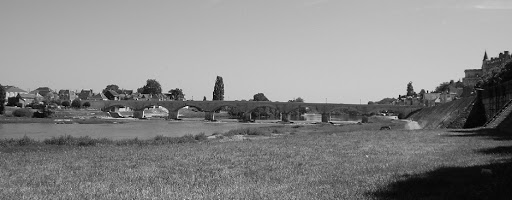
This picture was taken by me several years ago when I was in France. As we sat to have a picnic lunch, with all the food bought fresh from the local farmer’s market, we had this beautiful view of the medieval bridge in the picture. The bridge is located in town of Amboise.

Amboise is a town in north central France, in Touraine, on the Loire River (the river in the picture). It is a wine and wool market, and its manufactures include sporting goods, pharmaceuticals, and film and radio equipment. The town is chiefly famous, however, for its Gothic château, a royal residence from the reign of Charles VIII (who was born and died there) to that of Francis II. Leonardo da Vinci, who probably worked on it, is said to be buried in its chapel. Amboise was the scene (1560) of a Huguenot plot against the Guise family. Other old structures in the town include St. Denis Church (12th, 15th, 16th, and 17th cent.), St. Florentine Church (15th cent.), the town hall (16th cent.; restored), and the Clos-Lucé (15th cent.), where Francis I spent part of his youth and where da Vinci lived while in France and where he died.

Below is a picture of Château Amboise.


The Ancient Olympics: A History Lesson

ancient-olympics When I took my first history class in college, I did a research project on the Ancient Olympics. I had always been fascinated with the thought of athletes competing in the nude, but I also was in by the Summer Olympics that year, which were being held in Atlanta. My family and I actually went to the Olympics that year since it was close by and had a great time. I was thinking today about doing another history post and I was thinking about all the conversation we have been having about circumcision, and the idea of the Ancient Olympics came to me.

b_39k2701retocuhedbb_39k2038retouchedb

One of the things I learned during that research project on the Ancient Olympics is that men were not allowed to compete if they were kynodesmecircumcised, which meant that during that time Greek Jews were not allowed to compete in the Ancient Olympics. I also learned that in order to protect their penis during wrestling matches and other contact sports, the men would tie a string around the tip of their foreskin enclosing their glans, thus keeping them safe. The kynodesme was tied tightly around the part of the foreskin that extended beyond the glans. The kynodesme could then either be attached to a waist band to expose the scrotum, or tied to the base of the penis so that the penis appeared to curl upwards.

hugh-plummer-02-13 article-0-0909EC69000005DC-218_468x637

The ancient Olympics were rather different from the modern Games. There were fewer events, and only free men who spoke Greek could compete, instead of athletes from any country. Also, the games were always held at Olympia instead of moving around to different sites every time.

3-sport-nude-lubo-spirko 30s_french_soldiers_wrestling_nude
Like our Olympics, though, winning athletes were heroes who put their home towns on the map. One young Athenian nobleman defended his political reputation by mentioning how he entered seven chariots in the Olympic chariot-race. This high number of entries made both the aristocrat and Athens look very wealthy and powerful.
6a00d83451b90769e20133eca5dbe4970b-400wi

There are numerous myths about how the Olympics began. One myth says that the guardians of the infant god Zeus held the first footrace, or that Zeus himself started the Games to celebrate his victory over his father Cronus for control of the world. Another tradition states that after the Greek hero Pelops won a chariot race against King Oenomaus to marry Oenomaus’s daughter Hippodamia, he established the Games.

Patrick sindre skoglund[2]

Athletic games also were an important part of many religious festivals from early on in ancient Greek culture. In the Iliad, the famous warrior Achilles holds games as part of the funeral services for his best friend Patroclus. The events in them include a chariot race, a footrace, a discus match, boxing and wrestling.

yik Braeden Baade (6)

The footrace was the sole event for the first 13 Olympiads. Over time, the Greeks added longer footraces, and separate events. The pentathlon and wrestling events were the first new sports to be added, in the 18th Olympiad.
milo-of-kroton
Click on any of the event names to see a description of a particular sport:

olive-wreath-ancient-olympicsThe victorious olive branch. The Ancient Olympic Games didn’t have any medals or prizes. Winners of the competitions won olive wreaths, branches, as well as woolen ribbons. The victors returned home as heroes – and got showered with gifts by their fellow citizens.
Here are two videos the History Channel did about the Ancient Olympics. Too bad, they have them wearing modesty pouches.

By the way, for those interested, here is an explanation of women’s role in the Ancient Olympics:
Married women were banned at the Ancient Olympics on the penalty of death. The laws dictated that any adult married woman caught entering the Olympic grounds would be hurled to her death from a cliff! Maidens, however, could watch (probably to encourage gettin’ it on later). But this didn’t mean that the women were left out: they had their own games, which took place during Heraea, a festival worshipping the goddess Hera. The sport? Running – on a track that is 1/6th shorter than the length of a man’s track on the account that a woman’s stride is 1/6th shorter than that of a man’s! The female victors at the Heraea Games actually got better prizes: in addition to olive wreaths, they also got meat from an ox slaughtered for the patron deity on behalf of all participants! Overall, young girls in Ancient Greece weren’t encouraged to be athletes – with a notable exception of Spartan girls. The Spartans believed that athletic women would breed strong warriors, so they trained girls alongside boys in sports. In Sparta, girls also competed in the nude or wearing skimpy outfits, and boys were allowed to watch.
Another side note, Spartan marriage rituals are quite fascinating, if any one is interested I will do a straight post about Spartan sexuality and the marriage rituals. It will have some about gay sex, these were the Spartans after all.


Ancient Mentorships (With a Little Sex Occasionally Thrown In)

love_gift_-_calyx_krater_aegisthos_painter_ca_460_bce
It has been suggested that I do another one of my history posts this time on the ancient practice of pederasty. Before you NAMBLA folks get too excited, this is not a post about Man/Boy love, and it is not a post about pedophilia. It is about pederasty and what I think is the modern equivalent.
Pederasty (or Greek Paederasteia) is the relationship between an adult male and a boy, generally one between the ages of twelve and seventeen, in which the older partner is the mentor to the younger man. Pederasty is a relationship between an older man and an adolescent boy outside his immediate family. The word pederasty derives from Greek (paiderastia) “love of children” or “love of boys”, a compound derived from παῖς (pais) “child, boy” and ἐραστής (erastēs) “lover”.
Historically, pederasty has existed as a variety of customs and practices within different cultures. The status of pederasty has changed over the course of history, at times considered an ideal and at other times a crime.
In the history of Europe, its most structured cultural manifestation was Athenian pederasty, and became most prominent in the 6th century BC. Greek pederasty’s various forms were the subject of philosophic debates in which the carnal type was unfavorably compared with erotic yet spiritual and moderate forms.
Anthropologist Geoffrey Gorer distinguishes pederasty from pedophilia, which he defined as a separate fourth type that he described as “grossly pathological in all societies of which we have record.” According to Gorer, the main characteristic of homosexual pederasty is the age difference (either of generation or age-group) between the partners. In his study of native cultures, pederasty appears typically as a passing stage in which the adolescent is the beloved of an older male, who may act as a mentor. He remains as such until he reaches a certain developmental threshold, after which he in turn takes on an adolescent beloved of his own.
Ancient history
Among historical figures, some were recorded as having relations with others of their own sex — exclusively or together with opposite-sex relations — while others were recorded as only having relations with the opposite sex. However, there are instances of same-sex love and sexuality within almost all ancient civilizations. Additionally, Transgender and third sex peoples have been recorded in almost all cultures across human history.

Ancient Greece and Rome
The earliest documents concerning same-sex pederastic relationships come from Ancient Greece. Such relationships did not replace marriage between man and woman, but occurred before and beside it. A mature man would usually not have a mature male mate (exceptions aside, such as Alexander the Great) but he would be the erastes (lover) to a young eromenos (loved one). The ideal held that both partners would be inspired by love symbolized by Eros, the erastes unselfishly providing education, guidance, and appropriate gifts to his eromenos, who became his devoted pupil and assistant, while the sexuality remained short of penetrative acts. The hoped for result was the mutual improvement of both erastes and eromenos, each doing his best to excel in order to be worthy of the other.
Many historians believe that early pederast relationships were not sexual. In fact, these relationships are much like an internship. The older man, who was generally a better classed or more powerful citizen than the young man’s family, taught the young man how to be a man and how to join in politics or trade. There is little doubt that the relationship was sometimes sexual, but most historians now think that is rare.
I will give two famous examples of both a sexual relationship and that of a non-sexual relationship.

250px-Emperor_Hadrianus_Crete_2th_cent_Istanbul_Museum300px-Antinous_Pio-Clementino_Inv256_n3

The first relationship is that of Emperor Hadrian, a grecophile and the third of the so-called Five Good Emperors. Hadrian believed in the concept of pederasty and had a relationship with a young man named Antinous. Antinous was born to a Greek family in Bithynion-Claudiopolis, in the Roman province of Bithynia in what is now north-west Turkey. One version is that Antinous joined the entourage of the Emperor when Hadrian passed through Bithynia in about 124, and soon became his beloved companion who accompanied him on his many journeys through the empire. Another version has it that Hadrian had the empire searched for the most beautiful youth, and chose Antinous. Although some have suggested the two might have had a romantic relationship, it is uncertain if this was true. In October 130, according to Hadrian, Antinous was drowned in the Nile. It is not known whether his death was the result of accident, suicide, murder, or religious sacrifice. At Antinous’s death the emperor decreed his deification, and the 2nd century Christian writer Tatian mentions a belief that his likeness was placed over the face of the Moon, though this may be exaggerated due to his anti-pagan polemical style.

stpaulSaint_Timothy

The second great example, and one that was probably not a sexual relationship, is that of St. Paul (Saul of Tarsus) and St. Timothy. The New Testament describes the relationship between the older Paul and the younger Timothy as a mentor/mentored relationship. Since Paul was a Roman citizen and a Greek Jew, he would have been very familiar with the idea of pederasty. It is my belief that the relationship between Paul and Timothy was a pederastic relationship, however, since Paul became so pious and self-denying (or you might even say ascetic) he probably did not engage in any sexual conduct once his conversion occurred.
What is the modern day equivalent to pederasty?
So above was the history lesson, now here is how I think pederasty translates to today. In recent weeks, I have been trading emails between some older bloggers. Now you younger bloggers out there may consider me one of the older bloggers, I am 32, but I think of myself as what is probably middle-aged in blog years. There seems to be three age groups: they young twenty-something bloggers, us middle-agers (LOL) in our thirties and forties, and the older guys in their fifties and sixties. I think all three groups can learn a lot from the others. Sometime, it’s just nostalgia for me with the younger guys, and it’s a learning experience with the older guys.
Anyway, with some of the older guys I have been talking with, I have definitely learned a lot. I have always found I learn a lot from older people. Don’t count them out, you younger guys! For younger guys they often don’t understand the difficulties older guys had. Especially, when coming out could been either losing your job or being put in jail for sodomy. They often got married and tried to live a so-called hetero-normal life. It often didn’t work out. When I was growing up, it was still not acceptable to be gay. It often was perceived as a death sentence, because I was a kid during the height of the AIDS crisis in the eighties and early nineties. I had a cousin and his partner who died of AIDS and his family never acknowledge that he was gay nor that he died of AIDS. However, it was not a huge secret, at least behind closed doors. This cousin went to one of the only doctors in the state who specialized in AIDS patients and then a year or two after he died his partner died the same way. Yet, still it wasn’t talked about.
I think the three generational gaps are because of this. The older guys lived in a time when you had to be in the closet. The middle guys lived and remembered the horror of the AIDS crisis, the great unknown that it was back then. The younger guys grew up in the age of Will & Grace, when being gay was much more accepted and continues to be more accepted each day. There are still parts of this country where incidents like Matthew Shepard’s death can and does still occur.
Older men have a lot they can teach us younger men. They can teach us about history. They can teach us about being responsible sexually. They can teach us about the mistakes they made. They can teach us how to be better lovers (they often do tend to have more experience). They can teach us about being better gay men. They can teach us about the struggles gay men have gone through. And they can teach us that, though we may be in different stages in our lives, we are not alone. There aren’t a lot of pics to this post, mainly because I don’t think it needs to distract away from the message, and there just aren’t that many Daddy/Boy (adult bois) pictures out there that aren’t bondage pics.
Thanks for reading, and if you go to the end of the post, congrats, LOL.
I will have a post in a little while about my first sexual experience with another man, who was an older man.


Welcome

Welcome to The Closet Professor. The Closet Professor is a blog dedicated to GLBT Studies: History, Art, Literature, Politics, and Culture. There will be a wide range of topics that will begin with my GLBT Studies posts from my other blog, Cocks, Asses, & More.

I hope you enjoy this blog. I set it up for those who are more interested in these topics than the purely erotic posts of Cocks, Asses, & More. Most of the posts The Closet Professor will be published in conjunction with Cocks, Asses, & More, but this blog will also contain posts that are unique to The Closet Professor. If you enjoy the cultural aspects of Cocks, Asses, & More, I hope you will love this blog.

Join me in a fun and intellectual journey through GLBT culture throughout the ages. I hope you enjoy our lessons together. Feel free to make comments and suggestions for current and future posts. In the next few day I will be posting most of my history posts from Cocks, Asses, and More.

JoeBlow