
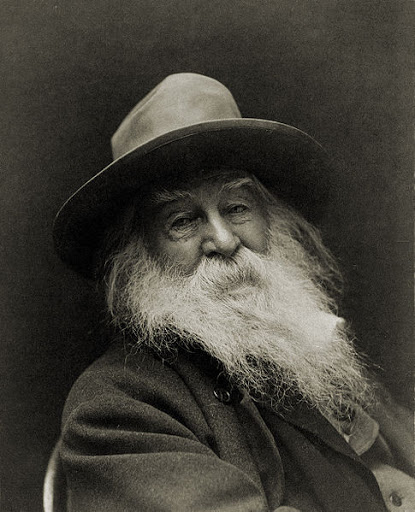
In honor of the official repeal of DADT today, I wanted to post a poem about homosexual love in the military. Long before DADT was an official policy, Walt Whitman was serving as a nurse for the US Army during the Civil War. Drum Taps (1865), Walt Whitman’s sequence of poems on the Civil War that reflects his experience as a hospital volunteer, includes several poems that appreciate soldiers in more or less homoerotic terms (for example, “First O Songs for a Prelude” and “O Tan-Faced Prairie-Boy”).
But it is elegies such as “Vigil Strange I Kept on the Field One Night,” “Reconciliation,” and “As I Lay with My Head in Your Lap Camerado” that allow Whitman to express himself unrestrainedly.
In “Reconciliation,” the speaker’s tenderness for the fallen soldier overpowers the enmity between armies, in terms that anticipate Wilfred Owen’s “Strange Meeting”: “my enemy is dead, a man divine as myself is dead, / I look where he lies white-faced and still in the coffin–I draw near, / Bend down and touch lightly with my lips the white face in the coffin.”
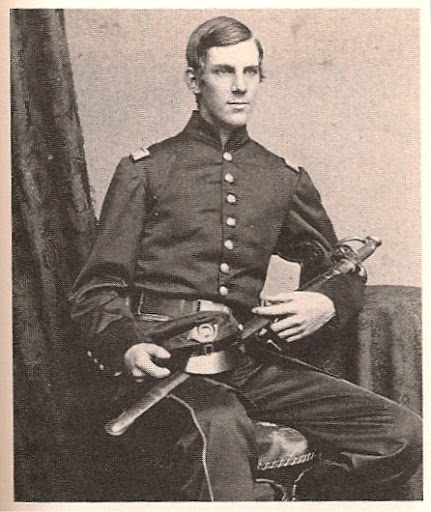
As I Lay with My Head in Your Lap Camerado
As I lay with my head in your lap camerado,
The confession I made I resume, what I said to you and the open air
I resume,
I know I am restless and make others so,
I know my words are weapons full of danger, full of death,
For I confront peace, security, and all the settled laws, to
unsettle them,
I am more resolute because all have denied me than I could ever have
been had all accepted me,
I heed not and have never heeded either experience, cautions,
majorities, nor ridicule,
And the threat of what is call’d hell is little or nothing to me,
And the lure of what is call’d heaven is little or nothing to me;
Dear camerado! I confess I have urged you onward with me, and still
urge you, without the least idea what is our destination,
Or whether we shall be victorious, or utterly quell’d and defeated.
Walt Whitman
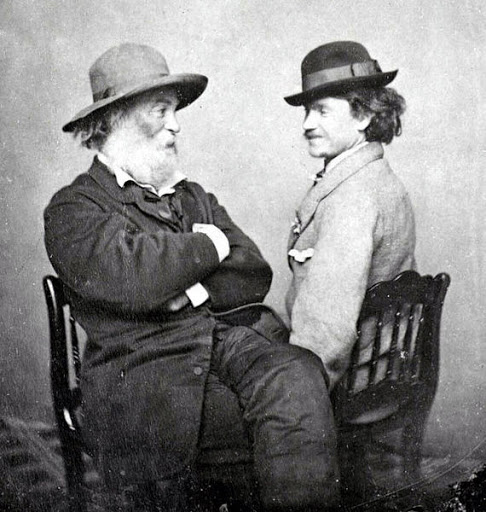
In this particular poem, Whitman writes a brief, but beautiful confession and declaration of his own sexuality. It is a brief, but significant love poem, and the manner of Whitman’s “confession” can be explored in a number of ways, but it ultimately points to a homosexual relationship. The first obvious hint that this poem is linked to Whitman’s homosexuality is his adjustment of the word “camerado.” The original Spanish word is actually “camarada” with a feminine ending, and it means “friend” or comrade.” By changing this specific word to have a male ending, we know that Whitman is aiming and professing this poem to a male friend. The significance of this male friend becomes more apparent as Whitman continues with his poem. His use of the actually word “confession” within the second line – “The confession I made I resume, what I said to you and the open air I resume” is another example of Whitman confessing openly his sexuality. As Whitman continues to describe this poem, he draws attention to the fact that it will make others “restless” and his words are “weapons full of danger, full of death.”

The intensity of the poem, although subtle but existent, is what ultimately points that nature of the poem has to do with love or at least intimacy. Whitman seems very determined in this poem, especially as he says “Dear camerado! I have urged you onward with me, and still urge you, without the least idea what is our destination or whether we shall be victorious, or utterly quell’d and defeated.” Whitman seems to be dismissing everything else, and urging this other person to do the same. He is rejecting any significance of heaven or hell, and embracing the fact that whatever road he is going down may bring hard times. Indeed, to announce homosexuality during Whitman’s era would have brought on a lot of criticism and grief.
Sources:



 Joe
Joe





 The Closet Professor
September 20th, 2011 at 8:08 am
The poem is wonderful!! One that I have not seen or read before. Thanks for posting!!But, the commentary is even more inspiring.Keep up the good work, joeblow!
September 20th, 2011 at 11:27 am
love Walt Whitman this is one of his poems I haven't read before so thank you
September 20th, 2011 at 2:45 pm
Joe: Interesting post, I like the sideline commentary because sometimes I just can't figure out what the poem means.I ran across this article and found it amusing, have a look:http://twodaymag.com/love/view/15-signs-your-man-might-be-gay-according-to-christwire.org/Same place has an article on classifying bisexuals, do fit in any?http://twodaymag.com/love/view/the-13-forms-of-bisexuality
September 20th, 2011 at 6:29 pm
Interesting that we never read this kind of poem in literature class. Nor discussed this particular topic about Walt Whitman. Thanks for expanding my knowledge of a great writer!Peace <3Jay
September 25th, 2011 at 4:47 pm
Thanks, silvereagle.I love the poetry of Whitman too, becca.Great links, FOC. I am glad that you enjoyed the commentary as well as the poem.When I teach literature, I tend to gear it more toward what is interesting more so than the so-called "classics."
August 21st, 2012 at 6:33 pm
Where did you get the image of Henry Heath? Could you email me?Ana Bretonbretonfilms@gmail.com
May 15th, 2016 at 4:06 pm
I was introduced to Walt Whitman’s poetry when I was nine-years-old by my father. My father was a devoutly spiritual man after he served in the Korean War and came to the conclusion that human life was much more valuable than human death and that love and kindness and cooperation was much more sacred than petty politics and other ideologies and sectarian violence which contributed to senseless pain and suffering of more than 600 million souls in the 20th century, alone, thus titling it “The Century of Blood”.
Whitman was literally a prophet in his own right. He reached a level of both human and spiritual understanding a hundred years before his time. Yet, instead of being embraced by his contemporaries the majority of the Western literary world snubbed him like radioactive waste; demonized him and marginalized him because his poetry spoke of love, the human body, sexuality, the heavens, nature and love in its rawest, untainted and most trusting way, which was so intense artistically, socially and politically America obscured him so harshly and unrelentingly he died a penniless man. One of the few friends Whitman had was Ralph Waldo Emerson and Mr. Emerson understood that the man Whitman was had nothing to do with being homosexual, even though he wrote what we interpret as homoerotic scenes. Whitman dedicated himself to celebrate life the way it was supposed to be celebrated and not contained in the stuffy Victorian age of black and static where the beauty of life was suffocatingly caked on funeral parlor make-up and forlornly pronounced taboo and egregiously shameless and then chained eternally in secrecy in some closet where virgins and spinsters were forced to repent to a ghastly mutilated and bleeding Christ hovering over them by a single candlelight. Instead, Whitman left us his legacy of naked fruit and human love gardens and lilacs in dooryards and unpaved wild roads and plowed fields and moonlit skinny dipping nights and laughing lovers kissing and frolicking and two naked boys loafing on sweet grass beneath lilac trees. His legacy which in all understanding is our legacy and it will resonate and nourish our conscience for time immortal.
Whitman changed poetry for all people: homosexual, heterosexual, bisexual, Jew, Catholic, Protestant, Muslim, the farmer, the professor, the senator refusing to pay homage to the orgasm, the pulpit pounder with his fire and brimstone speaking faster than hell can burn a feather; he changed the tune, the status quo–what was known as the politically correct of the 19th-century. He was a man of the earth and the earth is the site for infinite orgasm, not just sexually and bodily but spiritually too with a joy that is so exuberant and healthy and lively it is indescribable. Nature is an orgasm too. Each climax is an extension of the human sexual organs and the soul and has no limitation. It is essential to our happiness and longevity.
Whitman’s poetry spoke of all these things but he made sure that it did not fall into the entrapment of romanticism because what he wrote was reality–a reality purposely ignored by close-minded societies and for this ignorance Whitman’s poetry waged war against the pathological and harshly protected archaic and stiff traditions of his time. He refused to negotiate and follow the rules of sexual and social oppression. He was the fresh herbs of poetic thyme and sage denouncing the stench of a society bathed in sexual repression and hypocrisy. Yet, he saw America for its vast potential and spoke out against robbing her resources and raping her people. He spoke out against cruelty against the mentally insane, the prisoner, the widow, the orphan and the criminal; he spoke out against the rich exploiting the working-class and made it crystal clear that the female (companion to man) was of her own right and the equal of man and was not simply his companion. He spoke about love in both heart-wrenching and heart-soothing ways that no one else not even the ancients nor Neruda or Cavafy could express because our Walt understood what no other could understand and then have the immense mind and soul and heart to put it unapologetically down on paper.
Whitman transformed poetry in a whole new evaluation that was never known nor fully accepted and he should be held and given the title of America’s father of poetry. It must also be safe to say Whitman was not gay. He had both female and male companions and friends and he was married and had children. He was not homosexual; instead, the correct expression of his sexuality would be more “bisexual” than anything. Yet, his sexuality should NEVER be an item of contentious disputation or conjecture or assumption. Instead, we must celebrate the man for what he contributed to the world of literature and literally gave his life to helping others as he did working as a nurse during the Civil War. He gave and continues to give to humanity what no other poet has ever given or achieved. May his memory, spirit and poetry live for ten thousand years? May it be transferred to other worlds throughout the cosmos and used as a master plan for universal peace.
I love you Walt Whitman, I love you, I love you I do. May the Revelation Subud live on forever!
J.D. Rollins