Monthly Archives: July 2012

What does it mean to be a true Christian?

Are you ever ashamed to identify as a Christian?  Do your friends and acquaintances have negative associations with what “Christians” are and how they go about spreading their message to the world?  If so, maybe it’s time for a reminder of what it means to live as a true Christian in this world.

Think for a moment about times you find yourself coming into conflict with others – perhaps others who identify as Christians, or perhaps others who want nothing to do with the church.  If they mistreat you (maybe because you’re a Christian; maybe because you’re gay; maybe for an entirely different reason), how do you respond?

When you read this passage, keep two things in mind: 1) In what ways can you change your own behaviors and attitudes to follow Peter’s advice here?  2) If all Christians behaved as Peter suggests, how might the world’s opinion of Christianity change?

1 Peter 3:8-16

New American Standard Bible (NASB)

To sum up, all of you be harmonious, sympathetic, brotherly, kindhearted, and humble in spirit; not returning evil for evil or insult for insult, but giving a blessing instead; for you were called for the very purpose that you might inherit a blessing. For,

” The one who desires life, to love and see good days,

Must keep his tongue from evil and his lips from speaking deceit.

” He must turn away from evil and do good;

He must seek peace and pursue it.

” For the eyes of the Lord are toward the righteous,

And His ears attend to their prayer,

But the face of the Lord is against those who do evil.”

Who is there to harm you if you prove zealous for what is good? But even if you should suffer for the sake of righteousness, you are blessed. And do not fear their intimidation, and do not be troubled, but sanctify Christ as Lord in your hearts, always being ready to make a defense to everyone who asks you to give an account for the hope that is in you, yet with gentleness and reverence; and keep a good conscience so that in the thing in which you are slandered, those who revile your good behavior in Christ will be put to shame.

Often, as gay Christians, we are misunderstood by fellow Christians who cannot understand how we can be gay and Christian, by the LGBT community who do not look at the infinite and awesome love of God but at the hatred by those so-called Christians who also do not look at God’s infinite and awesome love, or by the various other people who see gay and Christian as oxymorons.  However, we know God’s truth. We read it in his word.  We feel it in our hearts.  We are truly blessed by God’s love and should be eternally grateful for that love and thank God in our prayers for his love and blessings.

Moment of Zen: Ten Joys of Summer


Military members to march in uniform at San Diego Gay Pride Parade

CAMP PENDLETON, Calif. — The Department of Defense is allowing service members to march in uniform in a gay pride parade for the first time in U.S. history.

The Pentagon on Thursday issued a military-wide directive saying it was making an exception to its policy that generally bars troops from marching in uniform in parades.

The exception is being made for San Diego’s Gay Pride Parade that will take place Saturday.

The Defense Department says it is making the exception because parade organizers had invited service members to march in uniform and the matter was getting national attention.

The Pentagon says the exception is only for this year’s parade in San Diego and does not extend beyond that.


Today Went By Too Fast

Yesterday, I posted that I would try to do a post later in the day, but the dates conspired against me. First, as I was trying to sleep in, I received a call to run an errand, which should have lasted 30 minutes, and instead ended up taking over two and a half hours. Then I had to go take care of something for my parents at their other house, that took much longer than anticipated and I ended up having to stay the night down there, sans Internet access, and finish up this morning. On my way home, I called back one of my fellow teachers who had called to see how I was doing, and since I was about to pass by her house, she wanted me to stop in and visit. I told her that I had a meeting tonight and couldn't stay long. She insisted that I could just come by for ten minutes. An hour and a half later I was racing home to change and get to my meeting on time. Now, I am trying to get a little rest from the last 36 hour whirlwind.


Sleeping In…

I will try to do another post later today, but right now I am going back to sleep.  TTYL.


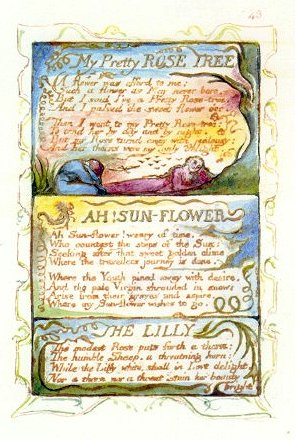
Ah! Sun-flower

Afternoon” by Philip Gladstone

Ah! Sun-flower

BY WILLIAM BLAKE

Ah Sun-flower! weary of time,
Who countest the steps of the Sun:
Seeking after that sweet golden clime
Where the traveller’s journey is done;

Where the Youth pined away with desire,
And the pale Virgin shrouded in snow
Arise from their graves and aspire
Where my Sun-flower wishes to go.

Ah Sunflower” is a poem written by the English poet William Blake. It was published as part of his collection Songs of Experience in 1794Ed Sanders of The Fugs set the poem to music and recorded it on The Fugs First Album in 1965. For the passing of the 2nd millennium British composer Jonathan Doveset the text of “Ah, Sunflower” and two other poems by Blake (“Invocation” and “The Narrow Bud Opens Her Beauties To The Sun”) in his piece “The Passing of the Year” (2000), a song cycle for double chorus and piano. In 2002 the Canadian sisters Kate and Anna McGarrigle wanted to record Ed Sanders’ setting in French; they asked Philippe Tatartcheff to translate the poem, only to find the words no longer scanned with the tune. So they composed a new tune which accommodated both languages. That appeared the following year on their album La vache qui pleure in both English and French recordings. (From Wikipedia)


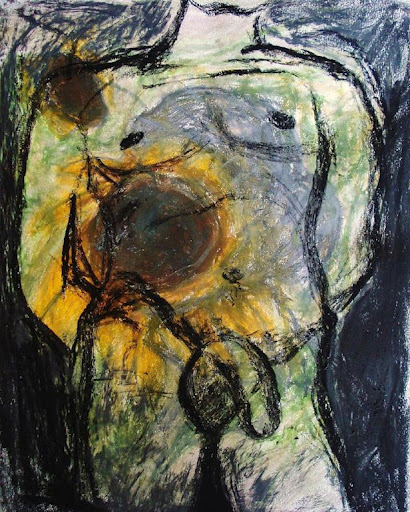
Male Nudes with Sunflowers” by Sheri Larsen

While reading Where the Heart Beats by Kay Larson (see my post Where the Heart Beats), I came across an interesting passage about Allen Ginsberg, who was a longtime fan of William Blake.  In his Harlem apartment in 1948, Ginsberg was masturbating while reciting the above poem, but “the poem’s elusive heart was not revealing itself.”  Then he heard a voice, which he believed was either Blake or God from the “Ancient of Days” intoning their words and revealing the meaning of these words.  According to Larson, Ginsberg saw the solidity of the world seem to flicker and go transparent. In an interview in 1995, Ginsberg stated, “And I was living (in 1948) in Harlem, East Harlem, New York, on the sixth floor of a tenement. There was a lot of theology books around, in an apartment that I had rented from a theology student-friend, so I was reading a lot of Plato’s Phaedrus, St John of the Cross…and (William) Blake. And I had the sudden… reading “The Sick Rose” and “The Sunflower”, I had the odd sensation of hearing Blake’s voice outside of my own body, a voice really not too much unlike my own when my voice is centered in my sternum, maybe a latent projection of my own physiology, but, in any case, a surprise, maybe a hallucination, you can call it, hearing it in the room, Blake reciting it, or some very ancient voice of the Ancient of Days reciting, “Ah Sunflower…” So there was some earthen-deep quality that moved me, and then I looked out the window and it seemed like the heavens were endless, or the sky was endless, I should say.”   The vision continued to unfold over the next few days.  The poem awakened a deeper “real universe,” a cosmic consciousness for Ginsberg, which he saw everywhere he looked.  Though he tried to invoke the experience again, he was never able to do so. (Probably because he did not have the correct sequence of drugs or alcohol again, but who knows.)  The point is that the poem revealed something to Ginsberg.  Something that we may never fully understand.


The experience my have inspired a later poem by Ginsberg published in 1955. The Ginsberg poem, “Sunflower Sutra” brings to light a very important and universal issue. Although it was written in the 1950’s it is still comparable to the here and now. When Ginsberg wrote this poem, it was the time of conservatives, consumerism, and strong morals. Ginsberg did not relate to such a culture and instead expressed himself through his poems, which blatantly rejected such outlooks on life. “Sunflower Sutra” is about the death of the inner beauty and spirit in one’s soul in relation to the destruction of nature and the realization that it is never too late to bring such creativity and beauty back to life. Ginsberg describes the fall of a mighty the sunflower. Once a bright yellow beacon of life, it now is “broken like a battered crown.” Having been covered by the dirt and grime of industry, by human “ingenuity,” this sunflower is really representing a demise in humanity. Rather than choosing nature as a prime example for life, choosing the “perfect beauty of a sunflower,” we have chosen industry and technology, and have forgotten that we are flowers. Ginsberg berates the dust and grime which have rained down from the locomotives onto “my sunflower O my soul” and wonders “when did you forget you were a flower?” This poem really is not about a flower, but the tragedy of losing one’s inner beauty, the vivacity and brightness which makes one shine.


Sunflower Sutra

I walked on the banks of the tincan banana dock and
sat down under the huge shade of a Southern
Pacific locomotive to look at the sunset over the
box house hills and cry.
Jack Kerouac sat beside me on a busted rusty iron
pole, companion, we thought the same thoughts
of the soul, bleak and blue and sad-eyed,
surrounded by the gnarled steel roots of trees of
machinery.
The oily water on the river mirrored the red sky, sun
sank on top of final Frisco peaks, no fish in that
stream, no hermit in those mounts, just ourselves
rheumy-eyed and hungover like old bums
on the riverbank, tired and wily.
Look at the Sunflower, he said, there was a dead gray
shadow against the sky, big as a man, sitting
dry on top of a pile of ancient sawdust–
–I rushed up enchanted–it was my first sunflower,
memories of Blake–my visions–Harlem
and Hells of the Eastern rivers, bridges clanking Joes
Greasy Sandwiches, dead baby carriages, black
treadless tires forgotten and unretreaded, the
poem of the riverbank, condoms & pots, steel
knives, nothing stainless, only the dank muck
and the razor-sharp artifacts passing into the
past–
and the gray Sunflower poised against the sunset,
crackly bleak and dusty with the smut and smog
and smoke of olden locomotives in its eye–
corolla of bleary spikes pushed down and broken like
a battered crown, seeds fallen out of its face,
soon-to-be-toothless mouth of sunny air, sunrays
obliterated on its hairy head like a dried
wire spiderweb,
leaves stuck out like arms out of the stem, gestures
from the sawdust root, broke pieces of plaster
fallen out of the black twigs, a dead fly in its ear,
Unholy battered old thing you were, my sunflower O
my soul, I loved you then!
The grime was no man’s grime but death and human
locomotives,
all that dress of dust, that veil of darkened railroad
skin, that smog of cheek, that eyelid of black
mis’ry, that sooty hand or phallus or protuberance
of artificial worse-than-dirt–industrial–
modern–all that civilization spotting your
crazy golden crown–
and those blear thoughts of death and dusty loveless
eyes and ends and withered roots below, in the
home-pile of sand and sawdust, rubber dollar
bills, skin of machinery, the guts and innards
of the weeping coughing car, the empty lonely
tincans with their rusty tongues alack, what
more could I name, the smoked ashes of some
cock cigar, the cunts of wheelbarrows and the
milky breasts of cars, wornout asses out of chairs
& sphincters of dynamos–all these
entangled in your mummied roots–and you there
standing before me in the sunset, all your glory
in your form!
A perfect beauty of a sunflower! a perfect excellent
lovely sunflower existence! a sweet natural eye
to the new hip moon, woke up alive and excited
grasping in the sunset shadow sunrise golden
monthly breeze!
How many flies buzzed round you innocent of your
grime, while you cursed the heavens of the
railroad and your flower soul?
Poor dead flower? when did you forget you were a
flower? when did you look at your skin and
decide you were an impotent dirty old locomotive?
the ghost of a locomotive? the specter and
shade of a once powerful mad American locomotive?
You were never no locomotive, Sunflower, you were a
sunflower!
And you Locomotive, you are a locomotive, forget me
not!
So I grabbed up the skeleton thick sunflower and stuck
it at my side like a scepter,
and deliver my sermon to my soul, and Jack’s soul
too, and anyone who’ll listen,
–We’re not our skin of grime, we’re not our dread
bleak dusty imageless locomotive, we’re all
beautiful golden sunflowers inside, we’re blessed
by our own seed & golden hairy naked
accomplishment-bodies growing into mad black
formal sunflowers in the sunset, spied on by our
eyes under the shadow of the mad locomotive
riverbank sunset Frisco hilly tincan evening
sitdown vision.
          Allen Ginsberg

          Berkeley, 1955


The Cruelty of Politics in an Election Year

With a few months remaining in the 112th Congress — and a few weeks until lawmakers adjourn for August recess — advocates say the chances for advancing any pro-LGBT legislation even in the Democratic-controlled Senate are slim — at least before Election Day.

Michael Cole-Schwartz, spokesperson for the Human Rights Campaign, expressed the sentiment that progress on pro-LGBT bills is unlikely in Congress anytime soon.

“Obviously the calendar is tight with only seven legislative weeks between now and the election,” Cole-Schwartz said. “Further, as summer rolls on, it begins to get harder and harder to get much done on Capitol Hill.”

Still, Cole-Schwartz said HRC will look to see what could be accomplished in the lame duck session and push to include LGBT provisions in any major tax bill or other omnibus spending package that comes to the floor.

Few had expected pro-LGBT legislation to move through the House while Republicans remain in control of the chamber, although some progress was made on bills in the Senate — including the Employment Non-Discrimination Act, the Domestic Partnership Benefits & Obligations Act, and the Respect for Marriage Act — leading to hopes that more progress could be made in at least one chamber of Congress.

On ENDA, which would bar job discrimination against LGBT people in the workplace, the Senate Health, Education, Labor & Pensions Committee held a historic hearing last month featuring the first-ever testimony from an openly transgender person before the Senate. Earlier in the Congress, the DPBO bill, which would extend health and pension benefits to partners of federal workers, and the RMA, which would repeal the Defense of Marriage Act, were reported out of their respective committees of jurisdiction.

But even these bills may not advance. A Senate Democratic aide, speaking on condition of anonymity, said it was unlikely that Senate Majority Leader Harry Reid (D-Nev.) would schedule time for votes on these bills before Election Day, but left the door open for the possibility of them being tacked on to larger legislation coming to the floor.

“There is very little chance that any of these bills will be voted on in the Senate — as freestanding legislation – before the end of 2012,” the aide said. “However, it’s possible that one of the first three listed could be pushed by their sponsors as an amendment to another bill.”

A spokesperson for Reid’s office didn’t respond to a request for comment on whether floor time would be scheduled for any pending pro-LGBT legislation for the remainder of this Congress.

Progress on one measure, the reauthorization of the Elementary & Secondary Education Act, which was intended as a vehicle for pro-LGBT legislation, has apparently reached an impasse. Sen. Al Franken (D-Minn.), the sponsor of the Student Non-Discrimination Act, and Sen. Bob Casey (D-Pa.), had pledged to offer their anti-bullying bills as amendments to ESEA reauthorization when it came to the floor.

Cole-Schwartz said ESEA reauthorization “has stalled and is not expected to move further this year,” but advocates are looking for other options on the anti-bullying bills.

“While we had hoped it to be a vehicle for LGBT-inclusive schools legislation, we are working with allies to identify other options,” Cole-Schwartz said.

Shawn Gaylord, director of public policy for the Gay, Lesbian & Straight Education Network, or GLSEN, echoed the sentiment that negotiations on ESEA reauthorization have stalled and “the general consensus in the education community is that any movement within this Congress is unlikely.”

“ESEA is the vehicle that will most likely move both the Safe Schools Improvement Act and Student Non Discrimination Act,” Gaylord said. “However, without any momentum for reauthorization, it’s unlikely that either of those bills will reach the floor of the House or Senate. GLSEN is continuing to build support for the bills among members so that we’re in a stronger position if ESEA moves in the next Congress.”

It’s on ENDA where advocates are still optimistic about the prospects of at least a markup for the legislation — although the proper strategy for advancing the bill is in dispute among some groups.

LGBT advocates have been calling for a markup of ENDA for months at the same time they previously called for a Senate hearing on the legislation. Cole-Schwartz said HRC is “pushing hard to have an ENDA markup in the HELP committee” as a follow-up to the hearing.

A spokesperson for the HELP committee, which is chaired by Sen. Tom Harkin (D-Iowa), didn’t respond to a request for comment on any updates to plans to hold a markup on ENDA.

Tico Almeida, president of Freedom to Work, has been pushing for a Senate floor vote on ENDA this summer regardless of whether or not the committee first holds a markup of the legislation. While acknowledging the chances of a vote before August recess remain slim, Almeida said a floor vote on ENDA before the end of this year could still happen.

“I think there is a real possibility that ENDA will get a full Senate vote in September or in a lame duck [session], if LGBT groups make a strong effort to push for that,” Almeida said. “We are fortunate that Sen. [Mark] Kirk and Sen. [Jeff] Merkley are strongly pushing for it, and I think Sen. Harkin’s committee staff is very engaged in determining how to most strategically move the bill forward and that might mean skipping markup and going straight to the floor.”

Almeida said the timing of this vote demonstrates there should no problem holding a vote on the legislation before Election Day and Reid can live up to his promise in 2009 that a Senate vote on ENDA can happen soon.

“ENDA’s first and only full Senate vote was in September 1996 — just weeks before a presidential election — so nobody should use this year’s election as an excuse to further delay a vote that Senator Reid promised three years ago would be coming ‘soon,'” Almeida said. “Voters deserve to know whether our representatives support LGBT Americans’ freedom to work without discrimination. By bringing ENDA to the floor before the election, voters in key Senate races in places like Massachusetts and Nevada will finally learn where Senators [Scott] Brown and [Dean] Heller stand.”

But other groups are saying the markup needs to happen before the floor vote. HRC’s Cole-Schwartz said “a successful markup is an important step” on ENDA as part of the strategy for the bill, which includes securing 60 votes beforehand to avoid a filibuster and achieving a successful vote.

“Building a strong legislative history for any piece of legislation is important,” Cole-Schwartz said. “Given that neither the House nor the Senate has ever marked up the inclusive bill, we believe a markup has two major benefits: one, it removes a procedural objection that some senators would likely use to object to floor consideration and two, it creates a more complete and solid legislative record should the law ever be challenged in court.”

Almeida insisted that any technical changes that are necessary for ENDA can be done on the Senate floor and the legislation — such as “Don’t Ask, Don’t Tell” repeal — has gone to the Senate floor prior to markup.

“Senate rules allow a bill to skip markup, and it may be the most strategic thing to go directly to the floor,” Almeida said. “Freedom to Work would support that strategic option, if that’s what Harkin, Merkley and Kirk think is best.”

Source: Washington Blade


Comfort in a Time of Grief

St. Augustine of Hippo (354-430) in his writings gave us the following prayer for consolation:

God of our life, there are days when the burdens we carry chafe our shoulders and weigh us down; when the road seems dreary and endless, the skies grey and threatening; when our lives have no music in them, and our hearts are lonely, and our souls have lost their courage. Flood the path with light, run our eyes to where the skies are full of promise; tune our hearts to brave music; give us the sense of comradeship with heroes and saints of every age; and so quicken our spirits that we may be able to encourage the souls of all who journey with us on the road of life, to Your honor and glory. 

The loss of my Grandmama has been very difficult for me to deal with, as you can tell from my posts these last two weeks. For most of my life, she was the one person I could be guaranteed would love me completely and unconditionally. She was the one person that I could be guaranteed to see my side of things and understand me when others did not.  Though we never discussed that I was gay, I have no doubt that it would not have bothered her. 
As a way to deal with Grandmama’s passing, I have been searching the Bible for inspiration and comfort in this time of grief. These are some of the verses that have brought me some comfort.
Revelation 14:13 
And I heard a voice from heaven saying, “Write this: Blessed are the dead who die in the Lord from now on.” “Blessed indeed,” says the Spirit, “that they may rest from their labors, for their deeds follow them!”
Revelation 21:4 
He will wipe away every tear from their eyes, and death shall be no more, neither shall there be mourning, nor crying, nor pain anymore, for the former things have passed away.”
Romans 12:15 
Be happy with those who are happy, and weep with those who weep.
Ecclesiastes 3:1-8 
To every thing there is a season, and a time to every purpose under the heaven: 
A time to be born, and a time to die; 
A time to plant, and a time to pluck up that which is planted; 
A time to kill, and a time to heal; 
A time to break down, and a time to build up; 
A time to weep, and a time to laugh; 
A time to mourn, and a time to dance; 
A time to cast away stones, and a time to gather stones together; 
A time to embrace, and a time to refrain from embracing; 
A time to get, and a time to lose; 
A time to keep, and a time to cast away; 
A time to rend, and a time to sew; 
A time to keep silence, and a time to speak; 
A time to love, and a time to hate; 
A time of war, and a time of peace. 
Isaiah 57:1-2
Good people pass away; the godly often die before their time. But no one seems to care or wonder why. No one seems to understand that God is protecting them from the evil to come. For those who follow godly paths will rest in peace when they die.
Romans 15:13 
May the God of hope fill you with all joy and peace as you trust in him, so that you may overflow with hope by the power of the Holy Spirit.
2 Corinthians 1:3-4 
Praise be to the God and Father of our Lord Jesus Christ, the Father of compassion and the God of all comfort, who comforts us in all our troubles, so that we can comfort those in any trouble with the comfort we ourselves receive from God.
I have found particular comfort in these last three passages.  I hope if there are any others out there grieving, that these passages will bring them comfort as well.

I know that I have been a bit moribund these last two weeks, but Grandmama’s death has been, obviously, on the forefront of my mind. This blog is not a memorial blog, and I will be back to my usual posts starting tomorrow. I actually have some exciting things coming up that were already in the works before Grandmama’s illness and death. These are things that I hope you will be excited over as well.


Moment of Zen: Wishing I Were Somewhere Else

The past two weeks have been some of the most heart-wrenching of my life. Though it’s over now, the loss of Grandmama is not something that I will actually ever get over. It may get easier with time, and I will always have fond memories of Grandmama, but none of that is a lot of consolation at the present time.

However, today is Bastille Day in France, and I can without hesitation say that I would much rather be in Paris today, or anywhere in Europe for that matter, just to be somewhere else.


Where the Heart Beats

When I was first contacted about reviewing Kay Larson’s book Where the Heart Beats: John Cage, Zen Buddhism and the Inner Life of Artists I knew very little about who John Cage was. So I did a little cursory research.  I found out that he was a musician, composer, artists, and a Buddhist homosexual. He sounded like an interesting and quirky individual, especially considering that his most famous composition is a piece titled 4’33”.  It was composed in 1952 for any instrument (or combination of instruments), and the score instructs the performer not to play the instrument during the entire duration of the piece throughout the three movements (which, for the first performance, were divided into thirty seconds for the first, two minutes and twenty-three seconds for the second, and one minute and forty seconds for the third). The piece purports to consist of the sounds of the environment that the listeners hear while it is performed, although it is commonly perceived as “four minutes thirty-three seconds of silence”. Needless to say, I was intrigued and was interested in reading the book.
At first you might think that Where the Heart Beats is another biography of John Cage. Though there is a strong biographical element in the book, it is more the biography of an idea, a study of the way Zen Buddhism came to be at the center of the working life of a group of artists, centered on John Cage. There is a lot of name dropping in the book of those of the Beat generation who Larson believes influenced Cage’s music and Zen philosophy.  Central to this is Cage’s attendance at the lectures of Daisetz Teitaro Suzuki in New York in the 1950’s. Suzuki, a Zen Buddhist teacher, was an influential figure in the spreading of of Zen Buddhism to the West.  The description of Suzuki is intriguing, telling that he was not a Zen master, though still considered an expert on Zen.  He was not formally educated, but clearly a master of languages, having taught himself Sanskrit, Tibetan Sanskrit, and Pali, and fluent in Japanese, English, classical Chinese, and “several European languages.”
Larson’s book is divided into three parts, which attempt to follow the arc of revelation as Cage comes to discover Zen Buddhism and through it effect changes to his work.  The first part, Mountains are Mountains, is largely narrative and biographical though it is more of a collage than a single biography, with portraits of Cage and his colleagues, teachers and influences brought together into a single narrative.  The middle section, Mountains are no longer Mountains, covers just the years 1950-52.  The final section Mountains are again Mountains deals with the years afterwards, the after shock. But Larson is not really interested in Cage the man at this stage, more in the way his ideas are transmitted. She gives us a series of vignettes and snapshots as knowledge and influence move out in increasing circles from Cage himself.
From the very outset, Larson sees Zen in everything.  She became a convert of Zen Buddhism in 1994. Larson extensively quotes from Cage’s own writings, putting these passages separately so that it seems as if Cage is himself contributing. But Cage is an unreliable observer of his own life, tending to re-shape events to suit the legend. Larson’s writing style is often hard to understand. She waxes philosophically about the influences of Zen Buddhism, and her flowery writing style is one of my pet peeves.
This was a book that I wanted to like more than I was able to. I have to confess that I found it a little heavy going. There are so many people mentioned that it sometimes becomes rather difficult to keep up with who’s who unless you are already familiar with all the names mentioned. Larson’s goal was an interesting goal, but the outcome was not nearly as interesting as I hoped it would be. It demonstrates the centrality of Zen Buddhism to Cage’s thinking. If you have a serious interest in the subject of John Cage and of Zen Buddhism, then I believe that you would enjoy the book.  Though I teach about Buddhism in my classes, Zen Buddhism is not a concept I am greatly familiar with, therefore I found myself lost at times reading this book.  Also, I have to admit that I might have found this book more interesting and an easier read had I not read it while sitting in a hospital’s noisy ICU waiting room.