Monthly Archives: May 2013

"Four Winds" by Sara Teasdale

Four Winds
  by Sara Teasdale

“Four winds blowing thro’ the sky,
You have seen poor maidens die,
Tell me then what I shall do
That my lover may be true.”
Said the wind from out the south,
“Lay no kiss upon his mouth,”
And the wind from out the west,
“Wound the heart within his breast,”
And the wind from out the east,
“Send him empty from the feast,”
And the wind from out the north,
“In the tempest thrust him forth,
When thou art more cruel than he,
Then will Love be kind to thee.”

In 1884, Sara Trevor Teasdale was born in St. Louis, Missouri, into an old, established, and devout family. She was home-schooled until she was nine and traveled frequently to Chicago, where she became part of the circle surrounding Poetry magazine and Harriet Monroe. Teasdale published Sonnets to Duse, and Other Poems, her first volume of verse, in 1907. Her second collection, Helen of Troy, and Other Poems, followed in 1911, and her third, Rivers to the Sea, in 1915.

In 1914 Teasdale married Ernst Filsinger; she had previously rejected a number of other suitors, including Vachel Lindsay. She moved with her new husband to New York City in 1916. In 1918, she won the Columbia University Poetry Society Prize (which became the Pulitzer Prize for poetry) and the Poetry Society of America Prize for Love Songs, which had appeared in 1917. She published three more volumes of poetry during her lifetime: Flame and Shadow (1920), Dark of the Moon (1926), and Stars To-night (1930). Teasdale’s work had always been characterized by its simplicity and clarity, her use of classical forms, and her passionate and romantic subject matter. These later books trace her growing finesse and poetic subtlety. She divorced in 1929 and lived the rest of her life as a semi-invalid. Weakened after a difficult bout with pneumonia, Teasdale committed suicide in 1933 with an overdose of barbiturates. Her final collection, Strange Victory appeared posthumously that same year.
Countdown Conitnues: Four Days until summer vacation begins.

My thoughts and prayers are with the tornado victims in Oklahoma. There is a link to the Red Cross near the bottom of the right column if anyone would like to make a donation.

The Final Countdown Has Begun

Five Days


There are five more days until school is out for summer.  Today is a review day for the exams.  Tuesday is the first of the exam days, so we will dismiss at 11:30 am, but there will be grading that needs to be kept up with so I don’t fall behind.  Wednesday will be another exam day, dismissal at the same time, but their will be an end of the year luncheon for teachers along with a retirement party for one of our teachers, who, by the way, has been teaching at my school for thirty years.  Thursday will be the last exam day, and all grades will have to be in before we leave, but that afternoon, we will have a teachers party away from school.  Friday is our last day.  It is a teacher workday, so we have to get all of the final checklist of end of school things to get done.  Then I will be out for summer, though there is a possibility of teaching summer school in June.

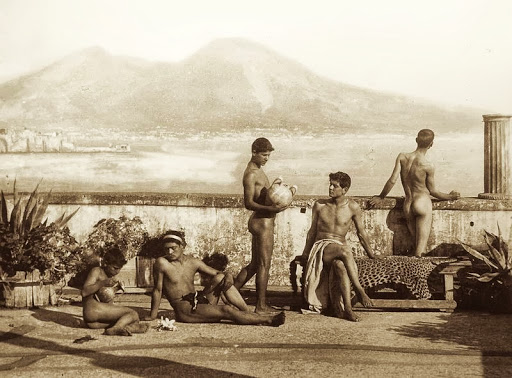
The photograph above of the five young men is by Wilhelm von Gloeden (1856-1931) and is known as Land of Fire. It is one of the most famous and republished images by Gloeden. It shows a view upon the Vesuvius from Naples from the terrace used by both Gloeden and by his cousin Wilhelm von Pluschow. The background Vesuvius was heavily retouched, almost repainted, on the glass negative. 

Baron Wilhelm von Gloeden (September 16, 1856 – February 16, 1931) was a German photographer who worked mainly in Italy. He is mostly known for his pastoral nude studies of Sicilian boys, which usually featured props such as wreaths or amphoras suggesting a setting in the Greece or Italy of antiquity. From a modern standpoint, his work is commendable due to his controlled use of lighting as well as the often elegant poses of his models. Innovative use of photographic filters and special body makeup (a mixture of milk, olive oil, and glycerin) to disguise skin blemishes contribute to the artistic perfection of his works.


Testing Your Faith

My preacher often tells the story that each time he asks his wife what he should preach on this week, she always answers, “The Book of James.”  I’ve yet to hear him preach on the book of James, but there are some wonderful passages in James that I would like to share with you over the next few weeks.  The first passage is known as “Testing Your Faith.”
Count it all joy, my brothers, when you meet trials of various kinds, for you know that the testing of your faith produces steadfastness.  And let steadfastness have its full effect, that you may be perfect and complete, lacking in nothing.

If any of you lacks wisdom, let him ask God, who gives generously to all without reproach, and it will be given him.  But let him ask in faith, with no doubting, for the one who doubts is like a wave of the sea that is driven and tossed by the wind.  For that person must not suppose that he will receive anything from the Lord; he is a double-minded man, unstable in all his ways.

Let the lowly brother boast in his exaltation, and the rich in his humiliation, because like a flower of the grass he will pass away.  For the sun rises with its scorching heat and withers the grass; its flower falls, and its beauty perishes. So also will the rich man fade away in the midst of his pursuits.

Blessed is the man who remains steadfast under trial, for when he has stood the test he will receive the crown of life, which God has promised to those who love him.  Let no one say when he is tempted, “I am being tempted by God,” for God cannot be tempted with evil, and he himself tempts no one.  But each person is tempted when he is lured and enticed by his own desire.  Then desire when it has conceived gives birth to sin, and sin when it is fully grown brings forth death.

Do not be deceived, my beloved brothers.  Every good gift and every perfect gift is from above, coming down from the Father of lights with whom there is no variation or shadow due to change.  Of his own will he brought us forth by the word of truth, that we should be a kind of firstfruits of his creatures.
James 1: 5-18
James regards trials of life as inevitable. He says when, not if you fall into various trials. At the same time, trials are occasions for joy, not discouraged resignation.  I know that sounds like a difficult task, but if we believe that God has a plan for each of us, then we know that the trials will lead to something greater.  We can have joy in the midst of trials, because trials are used to produce patience.
Patience is the ancient Greek word hupomone. This word does not describe a passive waiting, but an active endurance. It isn’t so much the quality that helps you sit quietly in the doctor’s waiting room as it is the quality that helps you finish a marathon.  The ancient Greek word hupomone comes from hupo (under) and meno (to stay, abide, remain). At its root, it means to remain under. It has the picture of someone under a heavy load and resolutely staying there instead of trying to escape. The philosopher Philo called hupomone “the queen of virtues.”
Faith is tested through trials, not produced by trials. Trials reveal what faith we do have, not because God doesn’t know how much faith we have, but to make our faith evident to ourselves and those around us.  If trials do not produce faith, what does? Romans 10:17 tells us: “So then faith comes by hearing, and hearing by the word of God.” Faith is built in us as we hear and understand and trust in God’s word.
Trials don’t produce faith, but when trials are received with faith, it produces patience. But patience is not inevitably produced in times of trial. If difficulties are received in unbelief and grumbling, trials can produce bitterness and discouragement.  The work of patient endurance comes slowly, and must be allowed to have full bloom. Patient endurance is a mark of the person who is perfect and complete, lacking nothing.
The act of faith and patience is given to us through God’s infinite wisdom.  If we have faith in God, then we can ask his for his guidance.  In my nightly prayers, I always begin with “Lord, please forgive me of my sins.  Help me to be a better person and to follow the path that you have chosen for me.”  God knows that path, and he calls us to follow it. Matthew 7:13-14 says:  “Enter by the narrow gate. For the gate is wide and the way is easy that leads to destruction, and those who enter by it are many.  For the gate is narrow and the way is hard that leads to life, and those who find it are few.”
Life is filled with trials and temptations but our faith can guide us through that narrow gate.  We must remain steadfast and patient, for God says we must stand the test to receive the crown of eternal life.  We will be tempted and lured and enticed to follow our own desires, but if that desire is given birth through sins, or if desire gives birth to sin, then we must have the patience to resist.  If we resist, the rewards will be great.
We must remember that, “Every good gift and every perfect gift is from above” which comes down to us from our God in Heaven.  So the next time that you are feeling like there is no hope, that the world is against you, or the trials seem too burdensome, rejoice in God and he will lead you through the troubled times.  Have faith and patience and you will receive joys and eternal rewards.


Moment of Zen: Just Because


Exam Time

I was working late into the night last night making out exams and study materials for my students.  Semester exams are next week and today and Monday are review days.  These are always busy days trying to help the students prepare for their exams.  Other than that, there is not much to write.  Students never realize the amount of work teachers put into preparing their education.  If they did, maybe they would study harder.  Nah, probably not.

Proper Grammar

On his 77th birthday, a man received a gift certificate from his wife.  The certificate paid for a visit to a medicine man living on a nearby reservation who was rumored to have a wonderful cure for erectile dysfunction. After being persuaded by his wife, he drove to the reservation, handed his ticket to the medicine man and wondered what would happen next. 

The medicine man slowly, methodically produced a potion, handed it to the 77 year-old, and with a grip on his shoulder, warned, “This is powerful medicine and it must be respected. You must take only a teaspoonful and then say ‘1-2-3.’ When you do that, you will become more manly than you have ever been in your life, and you can perform as long as you want.”

The old man was encouraged. As he walked away, he turned and asked, “How do I stop the medicine from working?”  

“Your partner must say ‘1-2-3-4,'” he responded. “But when she does, the medicine will not work again until the next full moon.”

The old man was very eager to see if it worked so he went home, showered, shaved, took a spoonful of the medicine, and then invited his wife to join me in the bedroom. When she came in, he took off all his clothes and said, “1-2-3!”

Immediately, he was the manliest of men. His wife was excited and began throwing off her clothes. And then she asked, “What was the 1-2-3 for?”

And that, boys and girls, is why we should never end our sentences with a preposition! One could end up with a dangling participle!


The Great Gatsby

The kids at my school have gone gaga over the movie “The Great Gatsby.”  I have not seen it yet, and I probably won’t until it comes out on DVD.  (The next movie I will go see is the new Star Trek movie “Into Darkness.”). Have any of you seen “Gatsby”?  I’m glad to see the kids excited about The Great Gatsby; many of them are even looking forward to reading the book.  Personally, The Great Gatsby is not my favorite Fitzgerald book.  I prefer This Side of Paradise and Tender Is the Night, but The Great Gatsbyis a classic.
With all of the excitement over the movie, I have had several of the kids in my Drama Club show an interest in doing the play The Great Gatsby.  However, it has a large cast and a large number of male parts.  I have mostly girls in my Drama Club, and they are never keen on playing male parts.  However, I would love to do a 1920s era play that would have a small cast of 8-12 and have mostly women, but I haven’t been able to find or think of anything that fits that description.  So, since I know some of you have experience in theater, I would love to know if any of you have a suggestion or two.  If you know of anything, please let me know.

Not by Sophie Cabot Black

Not
by Sophie Cabot Black

that you are unloved
but that you love
and must decide which
to remember; tracks left 
in the field, a language
of going away or coming back–
and to look up
from the single mind,  
to let untangle 
the far-off snow
from sky
until no longer
held as proof
is also where birds
find agreement
strung along branches
each with their own song
for the other,
every note used
to sing anyway–
how to hold the already
as the not yet 

About This Poem

“This was written for a friend who kept asking me if anyone would ever love her. Always that question, and what is there to say except to endure enough to see what happens. Maybe even to be brave enough to start first, to love without expectation, even hope.”

–Sophie Cabot Black

Sophie Cabot Black is the author of three books of poetry. Her most recent is The Exchange: Poems (Graywolf Press, 2013). She divides her time between New York City and rural Connecticut.


Precious Memories

Precious memories, unseen angels
Sent from somewhere to my soul

How they linger, ever near me

And the sacred past unfold.


Precious memories, how they linger
How they ever flood my soul

In the stillness of the midnight

Precious, sacred scenes unfold.

In the stillness of the midnight
Echoes from the past I hear

Old-time singing, gladness bringing

From that lovely land somewhere.


Precious memories, how they linger
How they ever flood my soul

In the stillness of the midnight

Precious, sacred scenes unfold.

I remember mother praying
Father, too, on bended knee

Sun is sinking, shadows falling

But their prayers still follow me.


Precious memories, how they linger
How they ever flood my soul

In the stillness of the midnight

Precious, sacred scenes unfold.

As I travel on life’s pathway
Know not what the years may hold

As I ponder, hope grows fonder

Precious memories flood my soul.


Precious memories, how they linger
How they ever flood my soul

In the stillness of the midnight

Precious, sacred scenes unfold.


Yesterday at church, we sang the hymn “Precious Memories” in honor of mothers.  This is my first Mother’s Day without Grandmama, who passed away in July.  As I stood singing this hymn, all I could do was cry.  I thank God though for those “precious memories” that I have of my Grandmama.


Mother’s Day

flw 604743_slonecznikowe-pole

The Virtues of a Woman/Mother 

An excellent wife who can find? She is far more precious than jewels.  

The heart of her husband trusts in her, and he will have no lack of gain.  

She does him good, and not harm, all the days of her life. 

She seeks wool and flax, and works with willing hands.  

She is like the ships of the merchant; she brings her food from afar.  

She rises while it is yet night and provides food for her household and portions for her maidens.  

She considers a field and buys it; with the fruit of her hands she plants a vineyard.  

She dresses herself with strength and makes her arms strong.  

She perceives that her merchandise is profitable. Her lamp does not go out at night.  

She puts her hands to the distaff, and her hands hold the spindle.  

She opens her hand to the poor and reaches out her hands to the needy.  

She is not afraid of snow for her household, for all her household are clothed in scarlet.  

She makes bed coverings for herself; her clothing is fine linen and purple.  

Her husband is known in the gates when he sits among the elders of the land.  

She makes linen garments and sells them; she delivers sashes to the merchant.  

Strength and dignity are her clothing, and she laughs at the time to come.  

She opens her mouth with wisdom, and the teaching of kindness is on her tongue.  

She looks well to the ways of her household and does not eat the bread of idleness.  

Her children rise up and call her blessed; her husband also, and he praises her:  

“Many women have done excellently, but you surpass them all.”  

Charm is deceitful, and beauty is vain, but a woman who fears the LORD is to be praised.  

Give her of the fruit of her hands, and let her works praise her in the gates.  

Proverbs 31: 10-31

I hope that we all think of our mothers today. I love my mama, but like all mothers, she drives me crazy sometimes. She has been in a long period of depression since she found out I was gay, but that was relieved somewhat by the birth of my niece, so she now has the grand-baby she always wanted. She is still convinced I am going to hell, but she doesn’t say it as much anymore. As long as it is a “don’t ask, don’t tell, don’t discuss” situation, we get along great.

So even if your mother drives you crazy, I hope that you still have a good relationship with her and tell her how much you love her today.

I love you, Mama.

(She would surely die if she ever saw this blog, but I did choose a picture of sunflowers because they are her favorite.)