Monthly Archives: January 2016

A Brother Blog 

  
Our blog friend John has started a new blog. Some of you may have known him through “Behind the Mask,” but he said that he didn’t like the name nor could he ever get going with that blog. The new blog is what I’m calling a “brother blog.” Cities have sister cities and ships have sister ships, but since both my blog and his are both run by men, I decided that brother blog was a more appropriate term.

John asked me for suggestions for the name of his new blog. I’ve never been very inventive or much of a wordsmith, though I love plays on words and puns, I’m not good at it. A blog name should speak something about you. The title “The Closet Professor” fit me because I was a teacher and in many rural areas, even high school teachers used to be known as professor. Plus, when I was teaching college, “The Professor” was a nickname some of my friend gave me. While it doesn’t necessarily fit me now, I’m not going to change it. It’s who I am in the blog world and what I will remain for the foreseeable future.

Back to blog names…Some are inventive play on words, such as Michael’s “In Dodd We Trust” or mystery writer Greg Herren’s “Queer and Loathing in America.” Others are pretty straight forward such as “BosGuy” or “daninokc.” Both are simple but effective. Some of them can even use archaic words to give a subtlety to their title, such as one NSFWish pictorial blog about butts I know called “Callipygian Male” (Callipygian meaning “having well-shaped buttocks”) or  another NSFWish blog, “Salmagundi” (Salmagundi means “a general mixture; a miscellaneous collection). As much as I might try, I am just not that clever with words, so my titles have always been boring. However, I have always liked the title “The Closet Professor” and when asked about a blog title, my response was, “Well, you could always be my brother blog and name it ‘The Closet Preacher?'” To my astonishment, John liked the idea.

So my first in what maybe one day will become a family of blogs, “The Closet Preacher” was born. So what is “The Closet Preacher” about? Duh, John is a closeted preacher, lol. But to be more serious, “The Closet Preacher” is a blog where John shares his life and research with the world. He write anonymously, of course, because he is gay and closeted.

Here is what he says in his “About Me” page:

My name is John. I am an ordained minister in the Church of God. I serve a growing congregation in the Southeastern United States, where I was raised. I have preached since I was eighteen years old and I have worked as a youth pastor, associate pastor, and, now, pastor, totaling eight years of experience.

I enjoy cooking, reading, traveling, and visiting historical sites, graveyards, and museums. I am fanatical about Ole Miss Football and Duke Basketball. I frequent small barbecue joints and guzzle very sweet tea. I like midnight driving with the windows down. And, Dave Matthews is my favorite band.

I have known I was gay since middle school and I am proud to be gay. But, I am forced to live deep in the closet, for the moment, because of my vocation.

His first blog post is a beautiful devotional. I hope that you will go check out his blog.


WWJD?


Once again this week, I turn to the generosity of Michael Dodd to provide the weekly devotional. I have been talking to and counseled by a very dear friend of mine, who is a preacher in Alabama, and he has helped me in getting my faith back. I’m still not ready to write a devotional yet, but soon I think I will be.

Some years ago when I was visiting my parents, my young niece was there wearing a woven anklet with the initials WWJD on it. I asked her if she knew what they stood for.

“What would Jesus do?” she replied promptly, smiling up into my face. Then she looked down at the anklet for a moment and turned a puzzled look on me. “What does that mean?” she asked.

Obviously the anklet was more a fashion statement than a religious statement for her at that age. The question she asked, however, was a profound one: What does it mean to ask what Jesus would do?

I suspect some of the people behind the marketing of WWJD jewelry and accessories may have only been asking how much they could make financially, but behind it no doubt lay a sincere wish to find a simple way of calling people – young people, in particular – to reflect on their behavior in the light of the behavior of Jesus.

In this, they were continuing the tradition found all the way back in Paul’s first letter to the Corinthians: “Imitate me, as I imitate Christ.” (I Corinthians 11:1) In other places, the context makes clear that imitation of Christ is also meant: “Become imitators of us and of the Lord.” (I Thessalonians 1:6); “Therefore be imitators of God.” (Ephesians 5:1) And, of course, one of history’s most popular books of Christian devotion bears the very title The Imitation of Christ.

John of the Cross in his Ascent of Mount Carmel, offers this advice to the person seeking union with God:

First, have habitual desire to imitate Christ in all your deeds by bringing your life into conformity with his. You must then study his life in order to know how to imitate him and behave in all events as he would.

Ascent of Mount Carmel I,13, 3

 I would like to point out something that may be easy for believers to overlook in this advice. John says we “must study his life in order to know how to imitate him and behave in all events as he would.” That seems straightforward and points us toward the Gospels, the word of God. And clearly we must turn to the Gospels as our primary source for understanding the life of Jesus.

 Yet there is a danger that we need to beware. Sometimes we unconsciously fall into the error of thinking that the Word did not become flesh so much as that the Word became text. We do not turn our gaze upon the living person of Jesus but upon the text of scripture. And we easily think that the particular translation that we have before us or that we prefer is the fullness of the word of God.

It is not so simple. There is an Eastern story about the spiritual master warning his disciples not to mistake the finger pointing at the moon for the moon itself. Even the inspired text points beyond itself.

John of the Cross talks about focusing on the life of Jesus. To me, this means that we gaze upon the living Jesus, not the words about Jesus. God’s Word became flesh, not text. When we focus only on the words about Jesus we can let ourselves be led astray. If you think I exaggerate, reflect on the tragic divisions within the Christian community that are due to different interpretations of biblical texts. We need to contemplate what Jesus did and learn the lessons contained in his example.

So What Would Jesus DO?

Michael Dodd

Michael Dodd has written and lectured about Carmelite spirituality and history for over twenty years. His work has appeared in publications in the United States, Europe and Africa. He is the author of The Dark Night Murders: A Fray John of the Cross Mystery and Jerome Gratian: Treatise on Melancholy. The above devotional is from his book Elijah and the Ravens of Carith: A Twenty-First Century Reflection in a Medieval Carmelite Mode, which can be purchased on Amazon.com in paperback for $9.95. 


Moment of Zen: A Nice Chest


 Smooth, hairy, or in between,
tattooed or pierced,
I love a man with a beautiful chest.
They are the pillows God gave us
to lay our heads and
hear our lover’s heartbeat.


Off Day

   
I’m not taking off a day from work, just from blogging. This cold is still kicking my butt, but hopefully it is getting better. So I’m leaving you with some pictures of the beautiful Mr. Colton Haynes.


Nudity in Vermont


I don’t think anyone would disagree that Vermont is an interesting state. There are many interesting facts about Vermont. On is that, in Vermont, it’s legal to be naked in public, but it’s illegal to get naked there. Vermonters can let it all hang out outdoors — provided “it” was already hanging out when they left their home, car or place of employment. The actual shedding of garments al fresco exposes the perpetrator not only to the elements but also to the risk of prosecution for lewd and lascivious conduct. 

Legally, the distinction between garden-variety nude sunbathing and raincoat-clad flashing has much to do with what offends the public’s “sense of decency, propriety and morality.” That standard was established in 1846, when the Vermont Supreme Court was asked to decide, in State v. Millard, whether one J. Millard of Orleans County was guilty of lewd and lascivious conduct after he repeatedly “exposed his private parts” to several people “with intent to incite in their minds lewd and unchaste desires and inclinations.” Prudently, the court determined that Millard wasn’t a nudist but a pervert.

The legal threshold for bringing an L&L charge for public nudity, or even the lesser one of disorderly conduct, has evolved over time. In the early 1970s, just as hippies and back-to-the-landers were arriving in the Green Mountain State, the state police asked then-Chittenden County state’s attorney Patrick Leahy to weigh in on what Leahy called the “time-honored practice of unclothed swimming, known colloquially as ‘skinny-dipping.'” After one overzealous prosecutor sparked public outrage by jailing a man for swimming au naturel in a river, the cops expressed confusion as to the appropriate response to birthday-suit bathers. In response, Leahy penned a somewhat tongue-in-cheek missive to “any law-enforcement officer so lacking in other criminal matters to investigate, so as to have time to investigate this currently popular subject.”

“I was originally disinclined to slow the crime-fighting operation of the Chittenden County State’s Attorney’s Office long enough to issue a memorandum of such minuscule moment,” Leahy wrote in his July 7, 1971, memo. But after “researching the issue” — mostly by consulting colleagues and reviewing “old Norman Rockwell paintings thoughtfully resurrected by the ACLU, showing such activities taking place allegedly in Vermont” — Leahy determined that “most Vermonters I’ve talked to have engaged in such scandalous activity at some time in their life (with the exception of a couple I didn’t believe, who claimed to have done so in May in Vermont).”

Ultimately, Leahy advised that while nude bathing was unacceptable in certain public areas — such as Burlington’s North Beach, where local ordinance specifically bans it — it was fine on private land out of public view. As for semi-secluded areas, Leahy determined that nudity is acceptable “if no member of the public present is offended, no disorderly conduct has taken place.” But if said nakedness doth offend, Leahy advised the cops to ask the skinny-dippers to get dressed or face a ticket.

In later years, that standard for police involvement eroded to the point where the mere public airing of one’s privates no longer qualified as a potential violation. Throughout the 1980s and ’90s, several parks and beaches around Vermont became hangouts for those who enjoy in-the-buff recreation. One such spot is the Ledges, a clothing-optional swimming hole on Wilmington’s Harriman Reservoir. In the late 1990s, as the Ledges grew in popularity, it began attracting unwanted scrutiny, drawing complaints about discarded condoms, sex in the woods and the occasional “bush-whacker,” aka public masturbator.

Though such incidents were rare, in June 2001 the Wilmington Selectboard decided to just say no. In a four-to-one vote, the board enacted the Wilmington Public Indecency Ordinance. It was spearheaded by the aptly named Margaret Frost, a grandmother who owned a cabin on the reservoir and described herself as affronted by the full-frontal nudity on view. According to an October 2002 New Yorker story about the dustup, Frost’s cabin was about 200 yards from the nearest full Monty, leading one to suppose she had a fine pair of binoculars for viewing the, um, wildlife. The following year, a citizens’ group called Friends of the Ledges drew on support from several nationwide “naturist” groups and rallied enough public support to overturn the ban. Today, the Ledges remains one of the best-known clothing-optional parks in New England.

A more successful effort to strip away the right to bare asses was mounted in Brattleboro in August 2006, after some local residents complained about teens publicly airing their privates downtown. A year later, the town selectboard passed a no-nudity ordinance, which drew international media coverage.

Nevertheless, by the mid-2000s, mass displays of public nakedness were, if not commonplace in Vermont, at least tolerated. Beginning in 1996, the University of Vermont supported its students’ annual Naked Bike Ride, held each semester at midnight on the last day of classes. UVM officially sanctioned the rides until November 2011, when then-interim president John Bramley sent out a campus-wide email saying the school would no longer pony up the $17,000 needed to cover barricades, lights, private security guards, campus police and other event costs.

In his message, Bramley cited safety concerns resulting from past rides, including incidences of sexual assault, overconsumption of alcohol and bicycle-related injuries, which presumably included excessive chafing. Despite Bramley’s bum steer, the nude ride still happens, with participation contingent on the temperature.
Source: WTF: Why Is Public Nudity Legal in Vermont But Public Disrobing Isn’t?


Cold

  
I seem to have come down with a cold. It’s not a bad one. One minute I am able to almost forget about it then I will start coughing or swallow or feel the aching in my body or all of the above. Anyway, it seems to hit in waves and I was so tired when I went home, I basically went to bed. There was no need for that nighttime, sniffling, sneezing, coughing, aching, fever, best sleep you ever got with a cold… medicine. I was in the middle of texting a friend while simultaneously writing this post when I fell asleep.


My Doubt

image
My Doubt
By Jane Hirshfield

I wake, doubt, beside you,
like a curtain half-open.

I dress doubting,
like a cup
undecided if it has been dropped.

I eat doubting,
work doubting,
go out to a dubious cafe with skeptical friends.

I go to sleep doubting myself,
as a herd of goats
sleep in a suddenly gone-quiet truck.

I dream you, doubt,
nightly—
for what is the meaning of dreaming
if not that all we are while inside it
is transient, amorphous, in question?

Left hand and right hand,
doubt, you are in me,
throwing a basketball, guiding my knife and my fork.
Left knee and right knee,
we run for a bus,
for a meeting that surely will end before we arrive.

I would like
to grow content in you, doubt,
as a double-hung window
settles obedient into its hidden pulleys and ropes.

I doubt I can do so:
your own counterweight governs my nights and my days.

As the knob of hung lead holds steady
the open mouth of a window,
you hold me,
my kneeling before you resistant, stubborn,
offering these furious praises
I can’t help but doubt you will ever be able to hear.
About This Poem

Jane Hirshfield is the author of The Beauty (Knopf, 2015), which was longlisted for the 2015 National Book Award. She is a Chancellor of the Academy of American Poets and the 2016 Mohr Visiting Poet at Stanford University. When I read this poem, it immediately struck me as describing the way I have been feeling for the last month. When I read what Jane Hirshfield said about the poem, it hit even closer to home. Hirshfield described the poem by saying, “There are times almost impossible to navigate and silencing, when everything has come into question. The doubt behind this poem was, in the living of it, something close to despair—at my own life; at the life of the world held in any day’s news. Yet to find within the times of ash anything that might be made word-malleable, anything susceptible to imaginative leap and some sense, even, of the comic—that in itself is antidote and through-passage. By the time the poem was half-written, the window had been cracked open an inch; once that happens, some breathable air can’t help but rush in.” I’m hoping for some of that breathable air to reach me.


Cool News

  
While I was in Alabama for the holidays, winter finally hit Vermont. I’m going to admit something dumb. I can be a real flake at times. When I was landing in Manchester Saturday night, I looked out the window and thought, I didn’t know Manchester was near the beach, but that’s the prettiest white sand I’ve seen besides the gulf coasts if Alabama and Florida. Then it downed on me, that’s not sand that’s snow. Everything was blanketed in, not really snow but ice. As I drove home yesterday, the ice turned more to snow as I drove northwest back toward home. When I left Vermont, the temperature had been in the upper 30s, low 40s. Today, the high is expected to be 9 and the low is expected to be -5. (All temps are in Fahrenheit, of course. I never could convert to Celsius.) I will finally get to use my real winter gear today and tomorrow. Then the temperature will rise back into the 30s.

In other cool news (pun intended), “Teen Wolf”/”Arrow” star and one of my favorite crushes Colton Haynes appeared to open up about his sexuality in a coy social media post some media outlets have deemed his public coming out.

On Tumblr, a user wrote of the 27-year-old actor, “When I found out Colton Haynes had a secret gay past, I got so excited even though i know it makes absolutely no difference in my life.”

On his personal Tumblr, Haynes quickly responded to the remark:

Was it a secret? Let’s all just enjoy life & have no regrets 🙂

Although the “Arrow” actor has thus far remained tight-lipped about the meaning behind his remark, a number of publications have interpreted the post as him publicly acknowledging that he’s gay. For anyone who has followed Haynes career, this is no big surprise.

The actor’s sexuality has been the subject of heavy media speculation for some time. The “secret gay past” that the Tumblr user was referencing could refer to a March 2006 photo series that ran in the now-defunct publication XY which purportedly showed Haynes kissing another man. I first noticed Haynes when he appeared in that magazine, though I dint know who he was at the time. Once I found out who he was, I have followed his career.

In an interview discussing the turning point in his career as an actor, Haynes describes it as “The day I decided to trust my own instincts and not mask my sometimes big personality. I’ve had a bunch of agents and managers over the years who controlled my every move and didn’t necessarily care about me as a person.” When I read this, the actions of his agents and managers in the past make more sense. They’d sued or threatened lawsuits to have the pictures from XY Magazine removed from websites. Of course it didn’t work and they didn’t get all of them removed. For years one of the major search terms that brought people to my blog was “Colton Haynes gay,” that is because of a post I did several years ago about gay college,life, in which I’d used some of those XY pictures.

Haynes, however, has been much less secretive than he was in his time with “Teen Wolf.” For the past two halloweens, he has dressed in Disney drag: Princess Fiona and Ursula. He’s also made no secret in the last few years that he has a gay brother, Joshua, or that he has a close friendship with out actor John Barrowman. In 2013, Haynes was spotted in an airport holding hands with his “Arrow” co-star, Barrowman. Barrowman, who married husband Scott Gill that same year, laughed off the incident in a Greg In Hollywood interview. “He’s a great kid and we have a great time and he’s becoming a really good friend, which I think is really nice,” Barrowman said of Haynes. 

I’ve been hoping for years that Haynes would come out. His sexuality has been one of the worst kept secrets in Hollywood. Congrats, Colton! Now, if you’d just marry me.


God’s Eye View


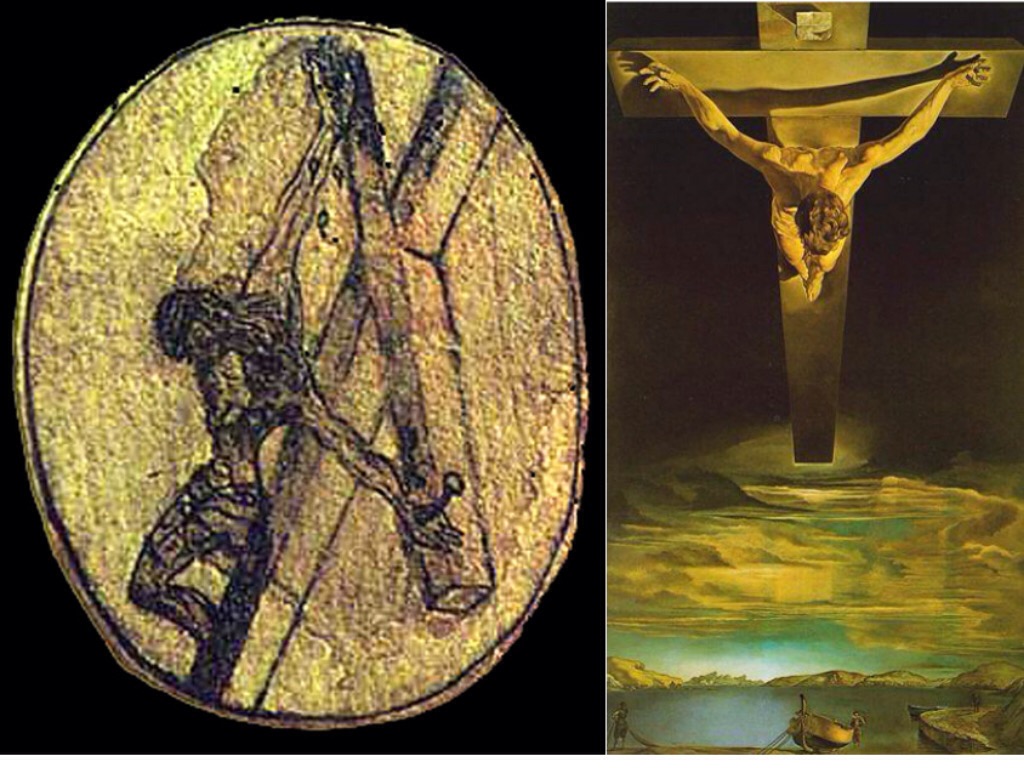
 Michael Dodd was kind enough to provide the following devotional today. I was so glad that Michael agreed to send a devotional which comes from a book of devotionals that he wrote. Michael always provides the perfect words for encouragement, and I always value his advice tremendously. When Michael sent this devotional, he wrote “Attached is an excerpt from my book for your consideration. This passage refers to a drawing of Christ crucified done by St. John of the Cross [left], later made much more famous by the Salvador Dali painting it inspired [right].” When he sent this, he also said that he “realize[d] that this passage may hit very close to the bone for you at the moment and might not be one you want to use.” Here is what Michael sent me:

In his profound teaching on the experience that has come to be called the dark night of the soul, John of the Cross helps the person experiencing spiritual dryness see the experience from a different perspective. He helps me see that God has not abandoned me, despite my feelings or my confusion, but that God is perhaps being present to me in a new way. This may be unfamiliar to me and seem to be regression, whereas, properly understood, it is in fact a sign of spiritual progress. It is a matter of changing my perspective so that I begin to see things from God’s point of view.

A wonderful example of this can be seen in a famous painting of Salvador Dali, based on a drawing of the crucified Christ by John of the Cross. The original drawing, preserved in the museum at the Monastery of the Incarnation in Avila, intrigues the viewer because of the angle from which it is drawn. Most familiar views of the crucifixion are head-on or perhaps looking up at the figure of Jesus on the cross. John’s drawing looks at the body from the side and a bit from above. It is such an unusual angle that the viewer’s first impulse is to shift position or even to reach out and turn the drawing, trying to make it fit into the expected perspective. Dali’s beautiful painting emphasizes this view from above, so that one is looking down, as it were, from heaven on the scene of Christ’s death. At first, it may look like a bird’s-eye view, but then the thought come: It is perhaps a God’s-eye view.

If you read the accounts of the Passion in the four gospels, you cannot help being struck by the way the perspective in John differs from the perspective in the first three gospels. The story is the same, and we tend to merge details from each version into one continuous storyline in our imagination. Yet the Jesus in John seems to be moving in a different atmosphere than the same Jesus in Matthew, Mark and Luke. I would contend that it is not the story that is different, but the perspective. Matthew, Mark and Luke tell the story very much from the human point of view; John gives us a mystical glimpse into the same events with the eyes of God.

In the Dali painting, the bloody brutality that marks our ordinary perception of Calvary is missing, and instead there is an air of timelessness and even serenity. Instead of the walls of Jerusalem in the background, we see a boat beside a body of water, and nearby stands a figure in the uniform of the papal Swiss Guard. The mind is directed not to the past but to the future, to the action of God that will flow from this supreme act of love on the part of Jesus: the establishment of the church as the sacrament of his body and the instrument of the invitation to universal salvation.

When you and I stand on different sides of an image and look at it, we see the same object, but what we see is not the same. My view – and yours – is always partial. That is why we move around from side to side, walk around behind a statue or peer at a painting from different angles. Our view remains partial, but we seek to see more so that we may see more fully. We sometimes mistakenly think we have seen all there is to see. Dali’s painting, like the original drawing of John of the Cross, is a reminder that there is more.

Dryness, therefore, can call us to change our way of seeing things, our way of seeing the world and ourselves so as to open out hearts and minds up to what Jesus calls “God’s work.” Dryness, tragedy and sorrow can be seen as an opportunity for grace more than as a sign of divine anger.

I’m not sure Michael expected my response. I had been talking earlier with my friend John, who will most likely also be providing some devotionals until I can get back on a firmer spiritual footing. After reading the above devotional, a few things kind of clicked and I wrote Michael back saying: “It did hit close to home, but not in a bad way. John and I had a long discussion this afternoon about our relationship with God. He said that God is always with us, but sometimes he is silent and allows us to work through things on our own, especially when it is a time of great pain. We also discussed heaven. I was always taught that you did not enter heaven until the Day of Judgement, but he said that he’s always believed we go straight to heaven. He allowed me to realize…that for God, time is meaningless. So even if we do go to heaven on the Day of Judgement, time is meaningless once we are there, so those who have gone on before are able to enjoy the greatness of heaven and look down upon us even now before the Judgement because for them it has already happened. Maybe I’m making a stretch here, but when we look at things from God’s perspective as it is done in the two paintings and in the Gospel of John, then we can take greater comfort in the passing of loved ones. They are already in a better place.”

Michael Dodd

Michael Dodd has written and lectured about Carmelite spirituality and history for over twenty years. His work has appeared in publications in the United States, Europe and Africa. He is the author of The Dark Night Murders: A Fray John of the Cross Mystery and Jerome Gratian: Treatise on Melancholy. The above devotional is from his book Elijah and the Ravens of Carith: A Twenty-First Century Reflection in a Medieval Carmelite Mode, which can be purchased on Amazon.com in paperback for $9.95. 

By the way, Michael did not ask that I mention his books, but I think anyone who reads this blog and also reads the comments know that Michael is a very special person, wise beyond words, and we all love him.


Moment of Zen: Being Held

image
When I was in college and coming to terms with my sexuality, one of the things that made me realize I was gay was that I wanted to be held by a man. Of course I’d had fantasies about sex with a guy and kissing a man and all the other things that gay men do, but the number one thing I always wanted was to be held in the strong arms of a man and to feel his hard chest up against me. I wanted a man to put their arms around me and make me feel safe. Honestly, if I had to choose just one type of contact with a man, I’d be happy the rest of my life, if I could just get held and comforted on occasion. Maybe that sounds silly or even pathetic, but I’d held my girlfriends and comforted them and all I wanted was to be held in the same way. Knowing that I wanted to be held, helped me to realize that I was attracted to men and not women. Also the fact that when I had erotic dreams they were always of men and not women was the other major clue.

Usually my moments of zen are things that made me smile during the week, but this one is something that I long for. I want someone to hold me when I cry. I want someone to hold me because they love me. I want someone to hold me so their smell can make all things right with the world. I want someone to hold me so we can feel our heartbeats in unison. I want someone to hold me and make me safe. Ther are many things in life that I want that I know I will never have, but to have someone to hold me could and I hope will happen.

Thought of being held always bring to mind the song “The Best Is Yet To Come” because of the lyrics in the second half of the song:

Wait till your charms are right for these arms to surround
You think you’ve flown before, but baby, you ain’t left the ground
Wait till you’re locked in my embrace
Wait till I draw you near
Wait till you see that sunshine place
Ain’t nothin’ like it here
The best is yet to come and babe, won’t it be fine?
The best is yet to come, come the day you’re mine
Come the day you’re mine