Monthly Archives: February 2016

The Porn Phenomenon

Josh McDowell, a well-known evangelist and apologist, commissioned a new study to expose what he calls the “pervasiveness of pornography in the church and among Christians” and to his disbelief, the statistics proved what he had already feared – “pornography has infiltrated the church, especially among young adults.”
“Of young adults 18-24 years old, 76 percent actively – and these are Christians – actively seek out porn,” McDowell lamented to OneNewsNow.
Here are some additional key findings from the church commissioned study titled: “THE PORN PHENOMENON: A COMPREHENSIVE, GROUNDBREAKING NEW SURVEY ON AMERICANS, THE CHURCH, AND PORNOGRAPHY: Impact of Internet Pornography on American Population and the Church.”
  • 21% of youth pastors and 14% of pastors admit they currently struggle with using porn.
  • About 12% of Youth Pastors and 5% of Pastors say there are addicted to porn
  • 87% of pastors who use porn feel a great sense of shame about it
  • 55% of pastors who use porn say they live in constant fear of being discovered
OneNewsNow reports on McDowell’s one man crusade to turn the tide on all those young Christian’s addicted to playing with themselves.
McDowell tells OneNewsNow young people have a cavalier attitude towards porn.
 
“Of 13- to 24-year-olds, 96 percent would say that when they talk to someone about porn – their friends, which most of them are Christians now – they do it in either a neutral, positive or encouraging way,” he says.
 
McDowell is putting together what he calls the most comprehensive conference for Christian leaders about Internet pornography. Called “Set Free Summit,” it will take place in April in Greensboro, North Carolina.
Source: The Daily Grind, February 5, 2016


Read more: http://2anothercountry.blogspot.com/2016/02/church-funded-study-finds-76-of-young.html#ixzz3zOufwhQs


How Do I Love Thee? (Sonnet 43)


How Do I Love Thee? (Sonnet 43)
Elizabeth Barrett Browning
How do I love thee? Let me count the ways.
I love thee to the depth and breadth and height
My soul can reach, when feeling out of sight
For the ends of being and ideal grace.
I love thee to the level of every day’s
Most quiet need, by sun and candle-light.
I love thee freely, as men strive for right.
I love thee purely, as they turn from praise.
I love thee with the passion put to use
In my old griefs, and with my childhood’s faith.
I love thee with a love I seemed to lose
With my lost saints. I love thee with the breath,
Smiles, tears, of all my life; and, if God choose,
I shall but love thee better after death.

What is more appropriate for the week before Valentine’s Day than this beautiful love sonnet.  It’s one of my favorite poems and was first published by Elizabeth Barrett Browning in her book Sonnets from the Portuguese (1850).  Most critics agree that Barrett Browning wrote the sonnets, not as an abstract literary exercise, but as a personal declaration of love to her husband, Robert Browning (who was also an important Victorian poet). Perhaps the intimate origin of the sonnets is what led Barrett Browning to create an imaginary foreign origin for them. But whatever the original motives behind their composition and presentation, many of the sonnets immediately became famous, establishing Barrett Browning as an important poet through the 19th and 20th centuries. Phrases from Barrett Browning’s sonnets, especially “How do I love thee?,” have entered everyday conversation, becoming standard figures of speech even for people who have never read her poetry.

I wanted to post this poem for all those that I love, including my wonderful readers.  I think that my favorite part of this poem is “if God choose, I shall but love thee better after death.”  How wonderful is that line.  We know that all things will be greater in heaven than on earth, so to be able to love better after death, implies to me that the love in life is as great a love as can be imagined.  Only in heaven could it be greater.  That’s a powerful statement of love.  I have family and friends that I love with all of my heart, and I hope that one day I will find that love in a romantic way.  If you have found that love, I admire you and am jealous.  If you haven’t, then I hope that you too will find it someday.

For those like me who are single on Valentine’s Day, it can seem so lonely, but there is one thing I have learned over the years: you must love yourself.  Before you can truly love someone else, you have to first love yourself.  If there are things about yourself that you don’t love, you will never allow yourself to be loved in the way we all deserve to be loved.  So love yourself, and allow yourself to be loved, too. So to ultimately answer Browning’s question, “How do I love thee?” I must love myself first so that I can love you more.

T.G.I.M.

  
Yes, that does stand for Thank God It’s Monday. When I was teaching, I dreaded Mondays. I dreaded Tuesdays, Wednesdays, Thursdays, and Fridays as well. I’m probably one of the very few who ever say this, but I’m glad for Monday to be here. While I used to look forward to my weekends to be away from the students and school bullshit, I now dread the weekends. They are so lonely. After I moved to Vermont, I rarely see anyone on the weekends. I’d much rather be at work and surrounded by people than be here alone.

Besides the loneliness, Sundays seem to be the hardest because it’s the day of the week that my friend died on and I often can’t stop thinking about it. I used to be happy on Sundays but now I’m just sad all day, but emails and blog comments are what I look for most because they make my day and make it a little better. I miss my friend, and some days, and especially Sundays, are almost unbearable at times. I wish I could just skip the weekend all together. I worked at the museum Saturday, and being away from my apartment really helped but then I dreaded Sunday.

I think that thinking about my friend who passed away more on the weekends when I’m so lonely is why my Sunday posts always mention my friend these days. I can’t help it because it’s all that’s on my mind when I think of Sunday. I know there is nothing I can do about it, but I wish with all my might that I could go back to that day and change what happened.

It doesn’t help that I don’t have a church to go to. I’d planned to go to one of the three churches on the same block that I live on, but I overslept for the Methodist and Episcopal services and I thought the United Church had 11 am services, but it turned out to be at 10 am when the other services were. This may sound strange but while I love church, I don’t like to go when it means going alone.

How fucked up is it that I hate the weekends now. At least it goes to show just how much I love my job and the people I work with on a daily basis.


Testing of Your Faith


We know that all things work together for good[1] for those who love God, who are called according to his purpose. Romans 8:28 (NRSV)

In the above verse, other translations read God causes all things to work together for good. I mention this because John, Susan, Alan and others have all stressed to me this belief. As you read the scriptures carefully, it says that God causes all things to work for our good, not that He causes all things. It’s a very good distinction to make, and one that can be a hard concept to understand. We look around the world and we thank God for all the good things that happen to us, but then we blame God for all the bad things that happen as well, but the above verse shows that God is working for the good of mankind and the bad things are beyond what he controls. Sometimes, He lets nature take its course. 

In my grief, I have forgotten a passage from my favorite book of the bible, James. In James 1:2-4, James writes “My brothers and sisters, whenever you face trials of any kind, consider it nothing but joy, because you know that the testing of your faith produces endurance; and let endurance have its full effect, so that you may be mature and complete, lacking in nothing.” This is a scripture that is hard for many to swallow. We should rejoice in our sorrows? We should find joy in our trials? Death is a part of life, and at some point we will all face the sorrow that goes with the death of someone we love. All of you know that I am still struggling with my friend’s death, but it is getting better each day. I believe that by having a crisis of faith over my friend’s death, I have grown stronger in my faith. I find great comfort in speaking to my friends who are ministers. Great ministers have a presence of calm about them. God has called them to the profession of ministry and is able to work through them to help people find peace and love in His Word.

God created us because He loves us. God never intended for tragedy and prejudice, wars and hatred, lust and greed, jealousy and pride. God meant for Earth to be a paradise, a place where there would be no death, but mankind did not always follow God’s Word, and the world suffers pain because of sin. Physical death is just the death of the body, but the spirit lives on. If your spirit is separated from God for eternity, it will be lost forever.

God has provided a rescue in the person of His Son, Jesus Christ. In 2 Corinthians 1:3-4, Paul states, “Blessed be the God and Father of our Lord Jesus Christ, the Father of mercies and the God of all consolation, who consoles us in all our affliction, so that we may be able to console those who are in any affliction with the consolation with which we ourselves are consoled by God.”

God is not angry with you. In John 3:16, the Bible says that He loves everyone. However, because we live in an imperfect world, we all deal with good and bad. God is aware of everything that happens and has the ability to take what was intended for evil and use for good. The evil in this world does not render God powerless. It is quite the opposite. He promises to be with us – and, if we live life in relationship with Him – to guide us into a life of peace and freedom from fear. Jesus states in John 10:10, “The thief comes only to steal and kill and destroy. I came that they may have life, and have it abundantly.”

It often feels like difficult circumstances are directed at us or someone we love. We live in an imperfect world, and the Bible says that it rains on the just and the unjust. We all live through painful and uncomfortable things. Who are we trusting when those things happen to us or someone we love? Are we self-reliant or do we rely on God? If we reach out to God in time of need, then we are accessing the One who created the universe. The Bible says that He is waiting for our response. He has already made the invitation through His Son Jesus. Why you? Because He loves you. He wants you to look to Him so He can rescue you and bring you peace. Romans 5:8 says, “But God proves his love for us in that while we still were sinners Christ died for us.” John 11:1-44 talks about the death of Jesus’s friend Lazarus. John 11:35 states that “Jesus wept.” Two words that are so incredibly powerful: Jesus wept. Jesus though had an advantage over us, he could bring back to life his friend, but we must take consolation that our loved ones have also come back to life and are waiting for us in heaven.

We still ask ourselves, what good can come out of this? There are no easy answers, just simple ones: growth and glory. We grow because when life hurts, we pay attention and we find out what is real and whom we can trust. In the Bible, in James 1:1- 4 tells us when we face trials, we can see it as a positive thing in our life because ultimately we are going to grow from it. That’s hard to realize when our pain is all we can see and feel. But, after you’ve experienced life as a follower of Jesus, and you’ve experienced His faithfulness, then you know it’s true.

When life is difficult, we look to God and find out that He has grace. In 2 Corinthians 12:9, the Bible tells us that His grace is sufficient for you, for his power is made perfect in our weakness. First, we must give our situation and life to God; this is the hardest part, because we feel more secure of we think we are in control of things. Once we give these things over to Him, He is going to give us the ability to stand up and endure. This is what I did when I lost my job and God guided me in the right direction. I must trust God in this tragedy as well. It is hard to admit weakness. That is what it takes to act in humility and allow God to take control of your situation. Acknowledge to God that He needs to bear your burdens because you can’t anymore. Jesus longs for you to come to Him and know Him personally. In 1 Peter 5:7 Paul tells us to “cast all your anxiety on him, because he cares for you.” In Matthew 11:28-29, Jesus tells us to come to Him “all you that are weary and are carrying heavy burdens, and I will give you rest. Take my yoke upon you, and learn from me; for I am gentle and humble in heart, and you will find rest for your souls.

I want to end today with a beautiful hymn that speaks to what I am talking about today:

Softly and Tenderly

By Will L. Thompson, pub.1880
Softly and tenderly Jesus is calling,

Calling for you and for me;

See, on the portals He’s waiting and watching,

Watching for you and for me.
Refrain:

Come home, come home,

You who are weary, come home;

Earnestly, tenderly, Jesus is calling,

Calling, O sinner, come home!
Why should we tarry when Jesus is pleading,

Pleading for you and for me?

Why should we linger and heed not His mercies,

Mercies for you and for me?
Time is now fleeting, the moments are passing,

Passing from you and from me;

Shadows are gathering, deathbeds are coming,

Coming for you and for me.
Oh, for the wonderful love He has promised,

Promised for you and for me!

Though we have sinned, He has mercy and pardon,

Pardon for you and for me.


Moment of Zen: Superheroes 

  
Ok, so these guys are really just nearly naked guys with the symbols for Superman, the Flash, and Robin on their chests, but I do love my superheroes. A superhero doesn’t have to have superpowers because the two greatest superpowers are love and kindness. I’ve been fortunate to know quite a few superheroes in my lifetime.


Don’t Look Back

image

The song playing at the restaurant I was at for lunch had the following lyrics:

Oh Lord, why have you forsaken me?
Got me down in Mississippi where I don’t want to be.

Switch Mississippi for Alabama and that was me 6 months ago. It was ironic because I went yesterday and got my new Vermont license plates and driver’s license. I am now an official citizen of Vermont. I was even able to register to vote as part of my driver’s license application. The bad thing is Becoming a Vermont citizen is quite expensive and I still have to pay for my car to be inspected and to get holes drilled on my front bumper to be able to mount the front license plate.

I’d planned to get them back on my birthday but had forgotten some of my documents and had to go home. By the time I got home, it had been almost 24 hours since I’d heard from my best friend and I tried desperately to get in touch with him only to find out that night that he’d died in a car accident. It has taken me this long to be able to go and try again. Plus, I had the afternoon off today.

Back to the song above, I had no idea who the artist was or the name of the song. I did some searching and found out that it is by The SteelDrivers and is called “Ghosts of Mississippi.” Here are the full lyrics:

Late one night behind corn whiskey
I fell asleep with a guitar in my hand
I dreamed about the ghosts of Mississippi
And the blues came walkin’ in like a man

Without a word I passed that guitar over
He tuned it up like I’d never seen
A crooked smile was his expression
Then he closed his eyes and began to sing

(chorus)
Oh Lord why have you forsaken me
Got me down in Mississippi where I don’t want to be
Oh Lord why have you forsaken me
Got me down in Mississippi where I don’t want to be

(repeat chorus)

When I woke up I looked into the mirror
I saw no reflection for a while
But as my eyes came into focus
I recognized that crooked smile

(repeat chorus)

Late one night behind corn whiskey
I fell asleep with a guitar in my hand
I dreamed about the ghosts of Mississippi
And the blues came walkin’ like a man

(repeat chorus)


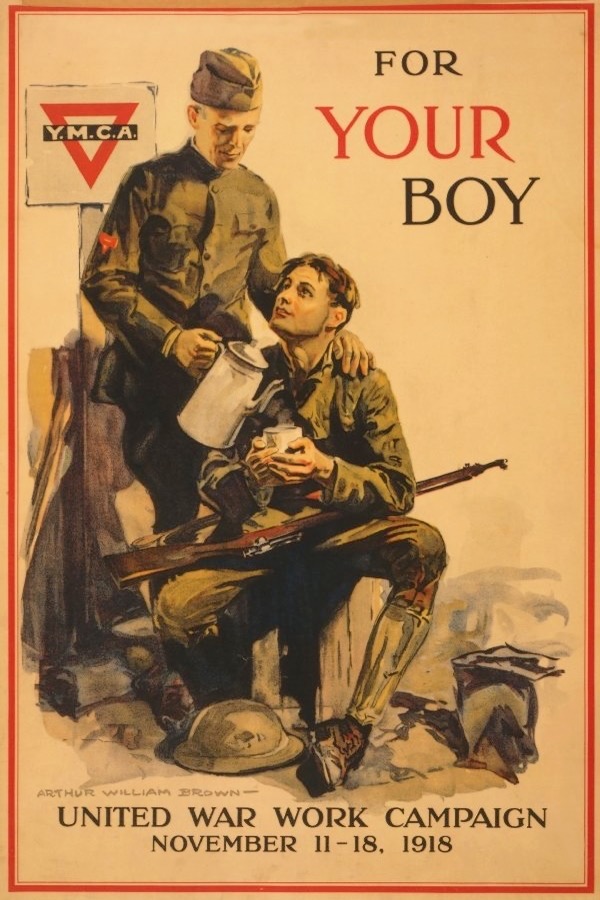
For Your Boy

  
This is a World War I poster that I came across that I absolutely love. This poster for the United War Work Campaign shows a man in military uniform pouring a cup of tea for a young soldier seated with a rifle across his lap and helmet at his feet. The “boy” is quite handsome, and he is looking admiringly at the other man. I’m sure that cup of coffee/tea from the YMCA tasted very good after being in combat.

On September 9, 1918, President Woodrow Wilson wrote to Raymond Fosdick, coordinator of the War Department’s Commission on Training Camp Activities. The end of the war was in sight, and it was estimated that the demobilization of nearly four million U.S. troops would require at least two years and a staggering sum for programs to maintain morale. Interestingly, the poster above is dated November 11-18, 1918. The war ended on November 11th, though I cannot find any reference to this poster being made to mark the end of the war. It seems to be a coincidence. The end was more than in sight when these dates occurred.

Wilson requested that aid organizations pool their resources on a massive single campaign to raise funds for soldier-morale programs “in order that the spirit of the country in this matter may be expressed without distinction of race or religious opinion in support of what is in reality a common service.” Seven organizations—the YMCA, YWCA, American Library Association, War Camp Community Service, National Catholic War Council (Knights of Columbus), Jewish Welfare Board, and Salvation Army—set out to raise $170 million during a one-week fundraising drive in November 1918. With a nearly $1 million operating budget, a National Publicity Committee was formed and chaired by Bruce Barton, a magazine editor who was an official with the YMCA. All media would be employed: print, outdoor advertising, leaflets, stickers, lapel pins, radio spots, motion-picture shorts.

The resulting United War Work Campaign was a resounding success, raising more than $203 million for soldier-aid programs. It was hailed in the press at the time as the largest fundraising event in history.

Here is another poster from the same campaign but this one features General Pershing:

  
The caption reads: Cabled from France August 21st, 1918, “A sense of obligation for the varied and useful service rendered to the army in France by the Y.M.C.A. prompts me to join in the appeal for its further financial support. I have opportunity to observe its operations, measure the quality of its personnel and mark its beneficial influence upon our troops, and I wish unreservedly to commend its work for the Army.” Pershing.


See Monday’s Post

  
Thank you all for the advice you have given me about my headaches. I plan to try the essential oils. Many of the conventional cures for cluster headaches, I went with my doctor. I have a type called chronic cluster headaches because while they hurt in the same place as traditional cluster headaches and go in cycles, there is no relief during one of the cycles like in regular episodic cluster headaches. Also, I do take Verapamil every day, which has for the most part, lessened the intensity and frequency of the cluster headaches. I have been under a lot of emotional stress since my friend died and it caused the frequency to be more often.  

I’ve tried Imitrex as an abortive measure, and found that it intensifies the headaches. I think it is because it is a traditional triptan and it raises my blood pressure, thus nullifying the effects of the Verapamil. For the really bad cluster headaches I take a combination of Flexeril and Bupap or Flexeril and Norco (the Norco is much less effective than its predecessor Lortab). Either combination seems to work. The problem is that Flexeril, I need asleep for at least 10 hours or I am groggy and can barely stay awake, so I need time to go to bed and sleep off the cluster headache, which I did last night.

I completely understand why cluster headaches are called suicide headaches. The pain can be so intense that you really think death could be an alternative. While I have felt that way, I know the medications work and when I take my medication, the feeling of about 30 minutes later of the easing of pain is (almost) better than an orgasm.

I know for at least one person this post might seem familiar, but since I had a headache last night, I largely cut and pasted from our email the day before.


Election Day, November, 1884

image


Election Day, November, 1884
By Walt Whitman, 1819 – 1892

If I should need to name, O Western World, your powerfulest scene and show,
‘Twould not be you, Niagara—nor you, ye limitless prairies—nor your huge rifts of canyons, Colorado,
Nor you, Yosemite—nor Yellowstone, with all its spasmic geyser-loops ascending to the skies, appearing
and disappearing,
Nor Oregon’s white cones—nor Huron’s belt of mighty lakes—nor Mississippi’s stream:
—This seething hemisphere’s humanity, as now, I’d name—the still small voice vibrating—America’s
choosing day,
(The heart of it not in the chosen—the act itself the main, the quadriennial choosing,)
The stretch of North and South arous’d—sea-board and inland—Texas to Maine—the Prairie States—Vermont,
Virginia, California,
The final ballot-shower from East to West—the paradox and conflict,
The countless snow-flakes falling—(a swordless conflict,
Yet more than all Rome’s wars of old, or modern Napoleon’s:) the peaceful choice of all,
Or good or ill humanity—welcoming the darker odds, the dross:
—Foams and ferments the wine? it serves to purify—while the heart pants, life glows:
These stormy gusts and winds waft precious ships,
Swell’d Washington’s, Jefferson’s, Lincoln’s sails.

The United States presidential election of 1884 was the 25th quadrennial presidential election, held on Tuesday, November 4, 1884. It saw the first election of a Democrat as President of the United States since the election of 1856. The campaign was marred by exceptional political acrimony and personal invective.

New York Governor Grover Cleveland narrowly defeated Republican former United States Senator James G. Blaine of Maine to break the longest losing streak for any major party in American political history: six consecutive presidential elections.

The issue of personal character marked was paramount in the 1884 campaign. Blaine had been prevented from getting the Republican presidential nomination during the previous two elections because of the stigma of the “Mulligan letters”: in 1876, a Boston bookkeeper named James Mulligan had located some letters showing that Blaine had sold his influence in Congress to various businesses. One such letter ended with the phrase “burn this letter”, from which a popular chant of the Democrats arose – “Burn, burn, burn this letter!” In just one deal, he had received $110,150 (over $1.5 million in 2010 dollars) from the Little Rock and Fort Smith Railroad for securing a federal land grant, among other things. Democrats and anti-Blaine Republicans made unrestrained attacks on his integrity as a result. Their slogan was “Blaine, Blaine, James G. Blaine, the continental liar from the State of Maine.” Cleveland, on the other hand, was known as “Grover the Good” for his personal integrity; in the space of the three previous years he had become successively the mayor of Buffalo, New York, and then the governor of the state of New York, cleaning up large amounts of Tammany Hall’s graft.

Commentator Jeff Jacoby notes that, “Not since George Washington had a candidate for president been so renowned for his rectitude.” In July the Republicans found a refutation buried in Cleveland’s past. Aided by sermons from an opportunistic preacher named George H. Ball, they charged that Cleveland had fathered an illegitimate child while he was a lawyer in Buffalo. When confronted with the scandal, Cleveland’s immediately instructed his supporters to “Above all, tell the truth.” Cleveland admitted to paying child support in 1874 to Maria Crofts Halpin, the woman who claimed he fathered her child, named Oscar Folsom Cleveland. Halpin was involved with several men at the time, including Cleveland’s friend and law partner, Oscar Folsom, for whom the child was named. Cleveland did not know which man was the father; he assumed responsibility because he was the only bachelor among them. Shortly before election day, The Republican media published an affidavit from Halpin in which she stated that until she met Cleveland her “life was pure and spotless”, and “there is not, and never was, a doubt as to the paternity of our child, and the attempt of Grover Cleveland, or his friends, to couple the name of Oscar Folsom, or any one else, with that boy, for that purpose is simply infamous and false.” Republican cartoonists across the land had a field day.

Cleveland’s campaign decided that candor was the best approach to this scandal: it admitted that Cleveland had formed an “illicit connection” with the mother and that a child had been born and given the Cleveland surname. They also noted that there was no proof that Cleveland was the father, and claimed that, by assuming responsibility and finding a home for the child, he was merely doing his duty. Finally, they showed that the mother had not been forced into an asylum; her whereabouts were unknown. Blaine’s supporters condemned Cleveland in the strongest of terms, singing “Ma, Ma, Where’s my Pa?” (After Cleveland’s victory, Cleveland supporters would respond to the taunt with: “Gone to the White House, Ha, Ha, Ha.”) However, the Cleveland campaign’s damage control worked well enough and the race remained a tossup through Election Day. The greatest threat to the Republicans came from reformers called “Mugwumps” who were angrier at Blaine’s public corruption than at Cleveland’s private affairs.

In the final week of the campaign, the Blaine campaign suffered a catastrophe. At a Republican meeting attended by Blaine, a group of New York preachers castigated the Mugwumps. Their spokesman, Reverend Dr. Samuel Burchard, made this fatal statement: “We are Republicans, and don’t propose to leave our party and identify ourselves with the party whose antecedents have been rum, Romanism, and rebellion.” Blaine did not notice Burchard’s anti-Catholic slur, nor did the assembled newspaper reporters, but a Democratic operative did, and Cleveland’s campaign managers made sure that it was widely publicized. The statement energized the Irish and Catholic vote in New York City heavily against Blaine, costing him New York state and the election by the narrowest of margins. New York decided the election, awarding Governor Cleveland the state’s 36 electors by a margin of just 1,047 votes out of 1,171,312 cast.

The Election of 1884 is one of the most fascinating to me. The other is the election of 1912 when a Democrat won again for the first time since Cleveland’s second term, which by the way was nonconsecutive the only such candidate to do so in history. The 1912 election was a rare four-way contest. Incumbent President William Howard Taft was renominated by the Republican Party with the support of its conservative wing. After former President Theodore Roosevelt failed to receive the Republican nomination, he called his own convention and created the Progressive Party (nicknamed the “Bull Moose Party”). It nominated Roosevelt and ran candidates for other offices in major states. Democrat Woodrow Wilson was finally nominated on the 46th ballot of a contentious convention, thanks to the support of William Jennings Bryan, the three-time Democratic presidential candidate who still had a large and loyal following in 1912. Eugene V. Debs, running for a fourth time, was the nominee of the Socialist Party of America.

Wilson won the election, gaining a large majority in the Electoral College and winning 42% of the popular vote, while Roosevelt won 27%, Taft 23% and Debs 6%. Wilson became the only elected president from the Democratic Party between 1892 and 1932, and the second of only two Democrats to be elected president between 1860 and 1932. This was the last election in which a candidate who was not a Republican or Democrat came second in either the popular vote or the Electoral College, and the first election in which all 48 states of the contiguous United States participated.


Head Exploding

  
Last night, just before I started to write my blog for today, I had an intense headache. Without a doubt it is a cluster headache because it has the usual symptoms. The guy in the picture kind of describes it. He’s sitting up because it’s too painful to lay down. He’s covering his eyes with his arm and pressing the back of his head where the other pain is located. I fucking hate these headaches.