Archives: 2019

Gay Rights Movement: Post Stonewall

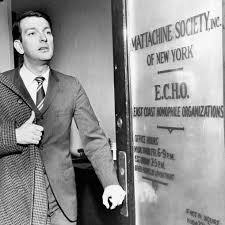
Not all gays believed that the riots and “revolution” were a good thing. The older and more wealthy gay men who frequented Fire Island in the summer either ignored the riots or were embarrassed by then. They belonged to the beliefs of the Mattachine Society who believed in assimilation and accommodationist tactics. The Mattachines wanted gays to act like heterosexuals and thus blend into the greater society.[1] The differences between the accommodationists and the liberationist will be a trend in gay politics to this day.

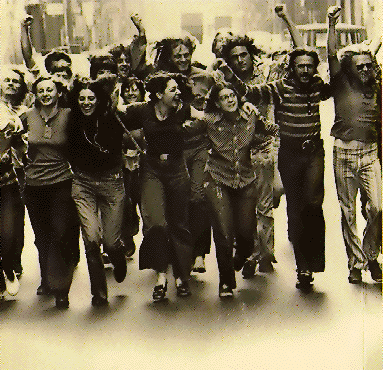
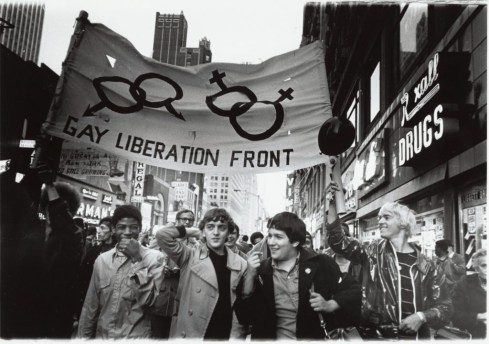
On the evening of July 4, 1969, the New York Mattachine Society called a meeting. The purpose of the gathering was to stop anymore riots and to get gays and lesbians to follow more closely their view of how the revolution should proceed, mainly for them to act like straight people and gain respect among normal society. Most of the gays in the room that night were tired of the Mattachine’s tactics. They wanted a new movement, one that challenged what normal was, one that was more militant, and one in which they did not have to change who they were. That night, the gays and lesbians at the Mattachine Society meeting formed the beginnings of the Gay Liberation Front.[2]

The Gay Liberation Front (GLF) never had the same organizational hierarchy that the Mattachine Society had. The GLF allowed for each chapter to move in its own direction and determine how best to achieve their overall goals in their local area. The GLF was also more visible than many people actually preferred to be, but for the GLF to succeed they had no choice but to use the “We’re here, we’re queer, get used to it” tactics.[3] The GLF had their share of splinter groups and unlikely alliances, such as with the Black Panthers.

The gay liberation movement also moved into more proper politics in the early 1990s. The AIDS epidemic took a great deal of the steam out of the movement that had continued to build during the seventies. In the early nineties, groups like the Human Rights Council, the largest gay and lesbian political action committee, the Gay and Lesbian Task Force, and the Lambda Legal Defense Fund tackled legislative and legal issues pertaining to gay and lesbian rights. Gays and lesbians even entered the political arena with a branch of the Democratic Party, the Stonewall Democrats, and with a branch of the Republican Party, the Log Cabin Republicans. The same old issues of whether gays should assimilate into society or make society accept them for who they are and at the same time have equal rights are still apparent in the splits that exist within the gay community.[4]

[1]Ibid., 206-207.

[2]Ibid., 211-212.

[3]James T. Sears, Rebels, Rubyfruit, and Rhinestones: Queering Space in the Stonewall South, (New Brunswick: Rutgers University Press, 2001), 60, 64.

[4]Benjamin H. Shepard, “The Queer/Gay Assimilationist: The Suits vs. the Sluts,” Monthly Review: An Independent Socialist Magazine 53:1 (May 2001): 49-63.

Further Reading:

“ 4 Policemen Hurt in ‘Village’ Raid,” The New York Times, 29 June 1969.

Duberman, Martin. 1994. Stonewall. New York: Plume.

“Hostile Crowd Dispersed Near Sheridan Square,” New York Times, 3 July 1969.

Meeker, Martin. 2001. “Behind the Mask of Respectability: Reconsidering the Mattachine Society and Male Homophile Practice, 1950s and 1960s.” Journal of the History of Sexuality. 1:78-116.

“Police Again Rout ‘Village’ Youths,” New York Times, 30 June 1969.

Sears,James T. 2001. Rebels, Rubyfruit, and Rhinestones: Queering Space in the Stonewall South. New Brunswick: Rutgers University Press.

Shepard, Benjamin H. 2001. “The Queer/Gay Assimilationist: The Suits vs. the Sluts.” Monthly Review: An Independent Socialist Magazine 53:1, 49-63.

Smith, Howard. “Full Moon Over the Stonewall,” The Village Voice, 3 July 1969.

Suran, Justin David. 2001. “Coming Out Against the War: Antimilitarism and the Politicization of Homosexuality in the Era of Vietnam.” American Quarterly 3: 452-488.

Truscott,Lucian, IV. “Gay Power Comes To Sheridan Square.” The Village Voice. 3 July 1969.

“Village Raid Stirs Melee.” New York Post. 28 June 1969.

Pic of the Day


Gay Rights Movement: Stonewall Riots

While the two movements described by Meeker and Suran are precursors of the gay liberation movement sparked by the Stonewall Riots, the most often cited catalyst of the gay liberation movement is the series of riots that began on the night of Friday, June 27, 1969, after a raid on the Stonewall Inn, which continued for the next three nights. Raids of gay bars in New York City, particularly Greenwich Village, were not uncommon in the summer of 1969, what made the raid on the Stonewall on June 27 so different was that the patrons of the bar resisted instead of going peacefully. 
The New York Post was the first of the New York newspapers to report the raid and the first “melee” that followed the raid. The Post described the scene following the raid on the Stonewall Inn, “a tavern frequented by homosexuals at 53 Christopher St.” The raid was staged because of the unlicensed sale of liquor. On that first night twelve people were arrested with charges ranging from assault to disorderly conduct because of the impromptu riot that soon ensued. As the police drove away with those in custody from the raid, the newspaper describes how “hundreds of passerby” shouted “Gay Power” and “We Want Freedom” while laying siege to the bar with “an improvised battering ram, garbage cans, bottles and beer cans in a protest demonstration.” More police were sent to 53 Christopher Street where the disturbance raged for more than two hours.[1] 
For the next two days and again on July 3, the New York Times ran small pieces about the “Village Raid.” On June 29, the Times reported that shortly after 3 a.m. on the previous day, that the bar had been raided. About two hundred patrons were thrown out of the bar and soon were joined by about two hundred more in protest of the raid. Police seized several cases of liquor from the establishment, which the police stated was operating without a liquor license. The Times reported that the “melee” lasted for only about forty-five minutes after the raid before the crowd dispersed and thirteen people in all were arrested with four policemen suffering injuries, one a broken wrist. The June 29 article also stated that the raid was one of three conducted in the last two weeks, and on the night of June 28, “throngs of young men congregated outside the inn. . .reading aloud condemnations of the police.” [2] image The June 30 edition of the newspaper stated that on the early morning of June 29, a crowd of about four hundred gathered again on Christopher street and a Tactical Patrol Unit was called in to control the disturbance at about 2:15 a.m. The crowd was throwing bottles and lighting small fires. With their arms linked, the police made sweeps down Christopher Street from the Avenue of the Americas to Seventh Avenue, but the crowds merely moved into side streets and reformed behind the police. Those who did not move out of the way of the police line were pushed along and two men were clubbed to the ground. Stones and bottles were thrown at the police and twice the police broke ranks to charge the crowd. Three people were arrested on charges of harassment and disorderly conduct. The June 30 article also states that the crowd gathered again on the evening of June 29 to denounce the police for “allegedly harassing homosexuals.” Graffiti painted on the boarded up windows of the inn stated “Support gay power” and “Legalize gay bars.”[3] A July 3, article in the New York Times stated that a chanting crowd of about five hundred gathered again outside the Stonewall Inn and had to be dispersed by the police, while four protestors were arrested.[4] 
On July 3, 1969, The Village Voice published two, more substantial articles on the incidents surrounding the Stonewall Inn. Of the two articles, Lucian Trusctott IV’s article is written in a tongue-in-cheek style focusing on the several days of riots that ensued after the first raid. Truscott reports that the crowd, which returned on Saturday night, were being led by “gay power” cheers: “We are the Stonewall girls/ We wear our hair in curls/ We have no underwear/ We show our pubic hair!” The article is mostly sympathetic to the gay cause and quotes Allen Ginsberg, a gay activist, stated “Gay Power! Isn’t that great! We’re one of the largest minorities in the country–10 percent, you know. It’s about time we did something to assert ourselves.” Truscott is prophetic when he end his article by stating: 
We reached Cooper Square, and as Ginsberg turned to head toward home, he waved and yelled, “Defend the fairies!” and bounce on across the square. He enjoyed the prospect of “gay power” and is probably working on a manifesto for the movement right now. Watch out. The liberation is under way![5]
The other article, by Howard Smith, is much more subdued. Smith, a reporter for the Voice, only relates the night of the raid, when he stayed with the police for protection. Although his article is not exactly pro-gay, Smith does offer some interesting observations that the other reports of the Stonewall Riots leave out. First of all, Smith reports on the number of men in drag that actually fight back. All other reports in The New York Times and The New York Post only state that the young men who resisted the police were young men, but Smith states that their were men in drag and a number of lesbians who resisted the police. Smith also describes in detail the “melee” especially concerning the attack on the police wagon while he was inside with the police for protection against the mob. Lastly, Smith points out the connection with the bar being owned by the mafia, although he only states that the men who own and run the establishment are Italians. Smith does relate that statements to the police were basically: “we are just honest businessmen, who are being harassed by the police because we cater to homosexuals, and because our names are Italian so they think we are part of something bigger.”[6] 
While the newspapers provide a glimpse at the reaction of the New York press as the riots were happening, several further accounts were later retold in memoirs of the Riot. The most thorough account is given by Martin Duberman in his book Stonewall. Mostly through oral history interviews, Duberman is able to relate the events of the Stonewall Riots with more accuracy than the accounts in the New York City newspapers. 
No one really knows what set off the “flash of anger” that began the riots. Most of the people who were there just say that all of a sudden the crowd grew angry and either began throwing bottles or trying to free one of the men in drag who were being arrested.[7] Even if it cannot be determined what set off the anger that went through the crowd, it must be asked, why that night. Many factors could have contributed to why the people in the Stonewall Inn fought back. It could have been because most of them had reached their breaking point, with the criminalization of their behavior to the Vietnam War that had raged for the last four years in the living rooms of every American with a television. One interesting theory could be that with Judy Garland’s funeral earlier that day, the men in the Stonewall Inn were distraught over losing their greatest icon. Probably what compounded most of the anger that rushed through the crowd was that most of the patrons were high on some type of drugs.[8] Another factor was that the raid occurred early in the morning. Usually raids happened earlier in the evening so that the bar could open back up. Police were being bribed, so raids were rarely major incidents.[9] 
Once the crowd did begin to fight back, the fervor of rebellion and the feeling that a revolution was happening among the gay community swept through the crowd.[10] No longer were gays going to work with the system to make themselves feel more normal. They wanted to be accepted for who they were, not for who the establishment wanted them to be. African-Americans had made great strides in their civil rights struggle, and women were just beginning to make strides for women’s liberation and equality. As pointed out by Alan Ginsberg earlier, gays and lesbians were a large minority in the United States. If they could make themselves heard, this could change everything for them. No longer would they be forced to only socialize with each other in dank and dingy, mafia owned bars, that could be raided at anytime and served watered down drinks so the owners could make more money. The law in New York City stated that a person must wear at least three articles of clothing appropriate to one’s own gender.[11] Gay bars were not allowed to have a liquor license and most were not allowed to have dancing. 
“[1]Village Raid Stirs Melee,” New York Post, 28 June 1969. 
“[2]4 Policemen Hurt in ‘Village’ Raid,” The New York Times, 29 June 1969, 33. 
“[3]Police Again Rout ‘Village’ Youths,” New York Times, 30 June 1969, 22. 
“[4]Hostile Crowd Dispersed Near Sheridan Square,” New York Times, 3 July 1969. 
[5]Lucian Truscott IV, “Gay Power Comes To Sheridan Square,” The Village Voice, 3 July 1969, 18. 
[6]Howard Smith, “Full Moon Over the Stonewall,” The Village Voice, 3 July 1969, 25. 
[7]Martin Duberman, Stonewall, (New York: Plume, 1994), 196-197. 
[8]Ibid., 181-196. 
[9]Ibid., 194-195. 
[10]Ibid., 198. 
[11]Ibid., 196.
Next: Gay Rights Movement: Post-Stonewall


Pic of the Day


Gay Rights Movement: The Anti-War Movement

In more modern times, the United States and most countries of the world criminalized homosexuality (sodomy) and therefore banned gay men and women from serving in the military. The Mattachine Society, founded in 1950, was one of the earliest homophile (gay rights) organizations in the United States, probably second only to Chicago’s short-lived Society for Human Rights (1924). Harry Hay and a group of Los Angeles male friends formed the group to protect and improve the rights of homosexuals. Because of concerns for secrecy and the founders’ leftist ideology, they adopted the cell organization of the Communist Party. In the anti-Communist atmosphere of the 1950s, the Society’s growing membership substituted a more traditional ameliorative civil rights leadership style and agenda for the group’s early Communist model. Then as branches formed in other cities, the Society splintered in regional groups by 1961.

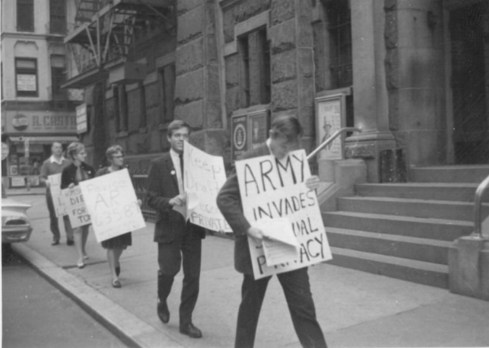
Youths rebelled against older homophile organization, which often refused to take a stance on the Vietnam War. Young gay men had to chose whether or not to reveal or conceal their homosexuality when they came before the draft board, because with the draft board being composed of local citizens, this could mean being outed to friends, neighbors or parents. The dilemma faced by gay youths polarized the gay liberation movement and gay youths joined in on the antiwar protests.[1] While older homophile organizations saw non-participation of homosexuals in the American military as detrimental to gay rights, youths of the antiwar stance saw it as a positive good. Suran contends that there are four major assertions by gay men in the antiwar movement. First, young homophiles saw military service as politically and morally counterproductive. Second, they declared war as a masculine affront to gay men. They cited the “effiminist” nature of homosexual men and refused to participate in macho role playing. Third, the young activists viewed imperialism as an extension of heterosexist ideology. Finally, they perceived homosexuality itself as antiwar antiestablishment, and anti-imperialist. With these four beliefs, young homophiles refused to embrace the older homophile tradition of assimilation in to “normal” society through military service.[2]

Though the Mattachine Society fell apart by the 1970s, one of their focuses was on protesting the US policy against gays serving in the military. They believed they could serve their country in any capacity, whether it be in government (gay men and women were not allowed to serve in government positions because their sexuality could be used as a basis for blackmail by communist spies) or in the military.

When more public gay rights groups formed after the 1969 Stonewall Riots, image gay men had moved away from support for military service. With the Vietnam War and the draft still very much a reality, gay rights groups turned their backs on the issue of military service because they did not want to be drafted. However, the government also turned their backs on the ban and forced many gay men who were drafted to serve, deciding that they needed the manpower more than they needed to uphold the ban on military service. In the United States today, sodomy is no longer illegal thanks to the Supreme Court decision, Lawrence v. Texas, and in 1973 the American Psychiatric Association removed homosexuality from its Diagnostic and Statistical Manual of Mental Disorders. Therefore there is no legal or medical reason that can be used to deny gay men and women the right to serve openly in the military.

image

[1]Justin David Suran, “Coming Out Against the War: Antimilitarism and the Politicization of Homosexuality in the Era of Vietnam,” American Quarterly 53, no. 3 (2001): 453.

[2]Ibid., 471-472.

Next: The Stonewall Riots


Pic of the Day


And Now Upon My Head the Crown
Phillip B. Williams

1.
In the first place—I wanted him and said so
when I had only meant to say. His eyes
opened beyond open as if such force would unlock me
to the other side where daylight gave reason
for him to redress.

When he put on his shirt,
after I asked him to keep it off, to keep putting off
the night’s usual end, his face changed beneath
the shirt: surprise to grin, to how even the body
of another’s desire can be a cloak behind which
to change one’s power, to find it.

2.
In the first place
he slept, he opened the tight heat of me that had been
the only haven he thought to give a name:
Is-it-mine? Why-you-running? Don’t-run-from-it—as though
through questions doubt would find its way away from me,
as though telling me what to do told me who I was.

Copyright © 2018 by Phillip B. Williams. Originally published in Poem-a-Day on January 2, 2018, by the Academy of American Poets.

About This Poem

“This poem is part of a few ‘failed sonnets’ I’d written and revised out of their intended form. In this revision, I wanted the phrase ‘in the first place’ to move through two possibilities: the first instance and the first location. That there may be other readings is great. As for the title, I guess I was thinking less about success and more about regretting when one gets exactly what one has asked for.”
—Phillip B. Williams


Gay Rights Movement: Mattachine Society

Most historians agree that the movement towards gay rights, at least, nominally began with the founding of the Mattachine Society in Los Angeles in 1950 as the first gay rights organization in history. Harry Hay founded the organization and gave it its name after the medieval group of court jesters who satirized the government and royalty by wearing masks to keep themselves anonymous. Mattachine went through two different phases in its development. Early leadership based the leadership of the organization on the cell structure of the Communist Party with a secret hierarchical structure and a very centralized leadership. The seven founding members of the Mattachine Society remained anonymous as the mysterious “fifth order” who ran the organization through their leadership. The organization had three primary goals: to unify homosexuals as a group and with the dominant heterosexual culture, to educate both homosexuals and heterosexuals on the subject of homosexuality, and to enter the realm of political action.[1]

Due to the insistence of the first Mattachine Society that homosexuals adapt to the homophobic society of the Cold War by adopting the social and cultural mores of heterosexuals, the organization began to lose influence and membership. By 1957, the organizations national headquarters moved from its base in Los Angeles to San Francisco where it remained until the national organization disbanded in 1961. With the end of the national organization and its insistence on conservative politics, the local chapters began to become more radical in their quest for gay liberation.[2] The Communist Party structure and tactics of the Mattachine Society ultimately hurt the organization more that it would help it. With the Red Scare during the Cold War, the politics of the movement had a difficult time getting any recognition. Besides its communist association, this early homophile organization was never that large of a political organization. The fear of being publicly discovered as a homosexual was worse than having freedoms during the 1950s, when coming out meant that you were considered mentally ill, a social deviant, often classified as a criminal, and were barred from holding civil service jobs.

In his examination of the radicalization of the gay liberation movement, historian Justin David Suran shifts the focus from the radicalization of local homophile organizations to the gay participation in the antiwar movement. Local homophile organizations were still working for homosexuals to be “normalized” by assimilating into imagethe heterosexual cultures, most by allowing gay men and women to serve discretely in the U.S. Armed Forces. With the ability to be deferred from the draft by being labeled homosexual, many young gay men saw the opportunity to stay out of the Vietnam War. As the war continued into the early seventies, the deferment for homosexuality would have to be proved by a doctor or an arrest report in order to receive the deferment because of the prevalence of heterosexual men posing as homosexuals to stay out of the military.[3]

[1]Martin Meeker, “Behind the Mask of Respectability: Reconsidering the Mattachine Society and Male Homophile Practice, 1950s and 1960s,” Journal of the History of Sexuality 10, no. 1 (2001): 83.

[2]Ibid., 79.

[3]Justin David Suran, “Coming Out Against the War: Antimilitarism and the Politicization of Homosexuality in the Era of Vietnam,” American Quarterly 53, no. 3 (2001): 458-463.

Next: The Anti-War Movement


Pic of the Day


Tinderbox

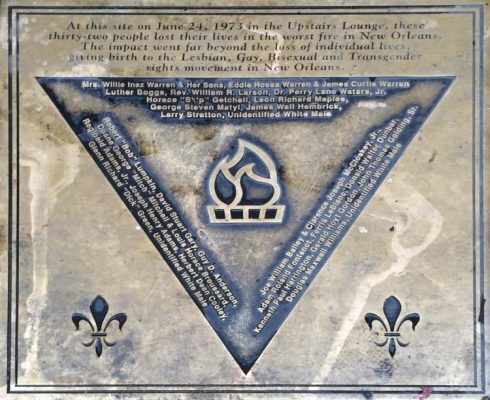
UpStairs_Lounge_Marker-e1529467315579.jpg

I’ve passed by this plaque in the sidewalk at 141 Chartres Street. A wave of grief always washes over men when I see it.

Author Robert Fieseler‘s book “Tinderbox” looks at the 1973 fire at the UpStairs Lounge, a gay bar in New Orleans, which killed 32 people and put prejudicial beliefs against gay men in sharp relief.

Here & Now‘s Jeremy Hobson talks with Fieseler (@wordbobby) about the book.

Book Excerpt: ‘Tinderbox’

by Robert Fieseler

June 25, 1995

There was a fire, the minister of the Metropolitan Community Church – a gay man named Dexter Brecht – preached to his small flock of gays and lesbians. It was a fire so horrific that Courtney Craighead, the church’s deacon (who was standing nearby), couldn’t even speak about his memories of the event. It was a fire set intentionally on June 24, 1973, resulting in the death of one-third of their Metropolitan Community Church (MCC) congregation at the time. This fire, which had happened twenty-two years and one day before, at a hangout called the Up Stairs Lounge, remained so disturbing a memory that it never existed in the pages of American history. This tragedy, congregants knew, was in fact the only reason that the New Orleans Times-Picayune had opted to send a reporter to hear their minister that Sunday. “We gather here this morning to remember,” Brecht continued. “Remembering, whether we like it or not, is part of the human condition. It is good as a way of acknowledging our grief.”

It was a horrific scene to relate: a fire in a busy bar on the fringe of New Orleans’s French Quarter that was set with lighter fluid. On that evening, flames had invaded a sanctuary for blue-collar gay men. The fast-moving blaze overtook the second-floor bar with deep ties to the MCC faithful, but the destruction would extend well beyond church membership, claiming the lives of thirty-one men and one woman.

Although it raged out of control for less than twenty minutes, the blaze left a fallout that shocked Carl Rabin, the coroner who would struggle to identify the bodies using jewelry and hotel room keys. Fingers and faces and bones were scorched beyond recognition. “They were just piled up,” he said. “People in a mass. One falls, then another falls. It’s just a mass of death. It’s sickening.”

Then the story went silent. After a mere blip of coverage, it fell off the front pages of newspapers, and then from interior pages entirely. Local and national television channels would dedicate just a few minutes of on-the-scene coverage to the Up Stairs Lounge, in which survivors were interviewed with cameras to their backs, due to reporters’ fear of legitimizing the gay lifestyle and victims’ fear of outing themselves. Yet, in fact, the tragedy had affected nearly every segment of New Orleans’s closeted gay community, estimated a month later by the local Gay People’s Coalition to be from 40,000 to 100,000 of the city’s then 600,000 residents. Most of the dead—educated and illiterate, young and old, white and black, including a hustler, a minister, and a dentist—perished within the fire’s first 360 seconds.

The Up Stairs Lounge, Brecht related to his flock, represented a moment that exposed a majority of citizens as at best apathetic toward homosexuals while also revealing that civil rights movements of the era were tone-deaf to homosexual plight. Indeed, civil rights and feminist constituencies in the 1970s did not leap to the defense of the Up Stairs Lounge victims. The tragedy was not noted in Distaff, New Orleans’s feminist magazine—it was a time when lesbians themselves were marginalized from “mainstream feminists”—nor was there any mention in iconic black newspapers like The Chicago Daily Defender, despite there being a black victim.

“This fire was a holocaust,” Brecht intoned. “Perhaps not in the millions like in the forties, but surely just as devastating to the lesbian, gay, bisexual, and trans-gendered community.” The immediate aftermath of this blaze—occurring on the last day of celebrations marking the fourth anniversary of the 1969 Stonewall Riots—became a chilling moment of loss for those gay Americans who actually heard the story, who were long conditioned to the reality that their sorrows were quarantined from the heterosexual American dream. In a cartoon in the August 1973 issue of The Advocate, which was then a somewhat ragtag alternative newspaper in Los Angeles, a man in a hospital bed was bandaged up like a mummy; in the background, his chart read “Up Stairs Bar Fire Victim.”

With its physical and emotional toll, the Up Stairs Lounge fire sat in stark contrast to the legendary riot that had taken place outside of the Stonewall Inn in New York City on June 28, 1969. On that day, homosexuals, transsexuals, and street kids had joined forces to resist New York Police Department officers who were raiding a gay bar and arresting the patrons. This act of defiance had become a wellspring for gay political recruitment.

In the wake of the Stonewall Riots, a new movement called Gay Liberation arose. It was a “radical thinking” and “militant” crusade—according to a newsletter distributed by the more conservative Homophile Action League—whose stated goal was “complete sexual liberation for all people” through the abolishment of institutions that forced homosexuals to “live two separate existences.” Gay Liberation was a departure from the so-called homophile movement (the term derived from the Greek words homo and phile, meaning “same love”), which had led the fight for homosexual rights up until then. Standing in an oblique shadow of the Stonewall Riots, the Up Stairs Lounge fire would be a major test of Gay Liberation: Could the movement steward its people through a crisis? Would gay people recognize its right to lead?

Yet, as Dexter Brecht addressed his congregation twenty-two years later, the Up Stairs Lounge remained forgotten.

Excerpted from the book Tinderbox: The Untold Story of the Up Stairs Lounge Fire and the Rise of Gay Liberation by Robert W. Fieseler. Copyright © 2018 by Robert W. Fieseler. Used with permission of the publisher, Liveright Publishing Corporation, a division of W. W. Norton & Company, Inc. All rights reserved.